Jim Smith is best known for his weekly "Real Estate Today" column published on the Real Estate page of The Denver every Saturday and in 24 metro area weekly newspapers the following Wednesday or Thursday. Individual articles are also published at http://RealEstateToday.substack.com. Over a decade of the columns are archived at www.JimSmithColumns.com.
It’s that time of year when I like to remind readers about the advantages of electric vehicles (EVs) in cold weather. Here’s what you need to know.
1) No warming up is needed. Put the car in Drive and go! Also, the cabin will be warm within 1/2 mile because it doesn’t require an engine to warm up first. In my Tesla I can turn on the heat with my phone app a few minutes earlier so the cabin, steering wheel and seat are all warm when I get in the car. Also, I can leave the heater on when I park the car so it’s warm when I return, if I am just going into a store for a short time. (I do the same thing on hot summer days, so it stays cool!)
2) Your car will never break down, stranding you in a freezing car on the side of the road. The only time you see an EV on the side of the road is if there’s a flat tire or an accident. Stuck in a snow drift? The EV’s heater will keep you warm as long as you need, consuming only 3 to 5 miles of range per hour — and producing no carbon monoxide!
3) Because of its low center of gravity, an EV handles snow-covered (and dry) roads great — better than any car I’ve owned.
4) Used EVs are your best buy. The older (pre-2018) Tesla Models S & X are a great buy because most come with transferrable lifetime free supercharging coast-to-coast when purchased privately, not as Certified Pre-Owned from Tesla. Ask before buying.
2021 has been a difficult year for everyone, but it has also been a year of growth for Golden Real Estate and for me personally. Fortunately, Rita and I have escaped infection by Covid-19. We are all fully vaccinated, and Rita and I plus a couple broker associates have received our booster shots.
We’ll be closing out 2021 with over $50 million in closed sales volume, compared to less than $32 million in 2020.
So we have a lot to be thankful for at Golden Real Estate, most especially the patronage of buyers and sellers who chose us to serve their real estate needs. I know for a fact that many of this year’s clients chose us not only because of the real estate reputation we have built through this weekly column but also because of the political stands I have taken regarding our former president and his followers. We gained far more clients than we lost because of my political writing.
And we are not alone politically. While fellow agents and brokerages have not spoken out as we have for fear of losing clients, the National Association of Realtors (NAR) has taken some courageous stands demonstrating alignment with our own values. For example, last fall the incoming president of NAR apologized for the past policies of the association which reinforced systemic racism, such as redlining and steering buyers to minority areas instead of showing them all listings they were financially qualified to buy. I’m grateful for the attention paid by NAR to social justice issues, but also for its effort, albeit unsuccessful so far, to eliminate the practice of off-MLS (“pocket”) listings.
I’m also grateful for the progress being made by REcolorado, Denver’s MLS. I have seen this progress from the inside as a member of the Rules & Regulations Committee as well as from being a user of REcolorado’s services. I appreciate REcolorado for adopting some of my suggestions, such as creating a field for closing notes.
At the top of my gratitude list is the fact that we were able to rent a storefront in downtown Golden. In early December, Golden Real Estate will be moving to 1214 Washington Avenue, the former location of Laurel Property Services. We look forward to benefiting from the pedestrian traffic of that prime location. We have ordered a WindoVision unit from TouchPoint Systems to capitalize on that traffic. Below is an artist’s rendering of it installed in our storefront. It allows passersby to search the MLS live using a through-the-window touch screen.
What’s really exciting about our move to downtown Golden is what it allows us to do with our current building on South Golden Road. As you know by now, we are a showplace of “net zero energy,” so I am partnering with broker associate Ty Scrable, who is super-committed and knowledgeable about sustainability, to create a new business we are calling The Net Zero Store. Our goal is to bring under one roof and into one showroom the various products and services that allow homeowners and businesses to “go net zero.”
Ty and I will be presenting our plans for this new venture at the Nov. 30th, 7pm, meeting of the Colorado Renewable Energy Society at the Jefferson Unitarian Church, 14350 W. 32nd Ave. Here’s a link if you’d like to attend.
Each year at this time, I like to remind readers that the real estate business is not as seasonal as it once was. It used to be that spring and summer were considered the time to put a home on the market, based primarily on the school calendar. But that is old-school thinking.
Nowadays, with buyers and their agents setting up automated MLS searches based on the buyers’ needs and wants, homes are selling year round. What makes winter a particularly good time to list a home is that most sellers continue to think the old way and keep their homes off the market until spring.
As a result, those sellers who do put their home on the market enjoy two advantages. The first is less competition from other listings, and the second is the large number of buyers who will get the automated alert when a new listing matches their search criteria. (Over 850 buyers got alerts for this week’s featured listing.)
As I write this on Tuesday morning, Nov. 23rd, there is only one active listing in the entire City of Golden. How would you like your home to be the only home for sale in a city of 20,000 people and 7,500 homes?
I myself have nearly 100 buyers with MLS alerts matching their search criteria. When a new listing is entered on the MLS which matches a buyer’s search criteria, that buyer gets an email alert with all the photos and details about that particular listing.
Perhaps you recall the DTC condo I featured last week. In the first day that it became active on the MLS, over 500 buyers received email alerts about it, four of whom tagged it a “favorite” and six tagged it a “possibility.” When a client tags a listing, their agent gets an email letting him or her know, likely triggering an in-person showing. That listing is already under contract for 10% over listing.
My $725,000 Littleton listing featured two weeks ago triggered email alerts to over 650 buyers, 18 of whom tagged it a favorite and 8 of whom tagged it as a possibility. It went under contract in five days for 20% over listing price.
Don’t wait for spring to list your home if you’d just as well sell it now. This is a great time to list!
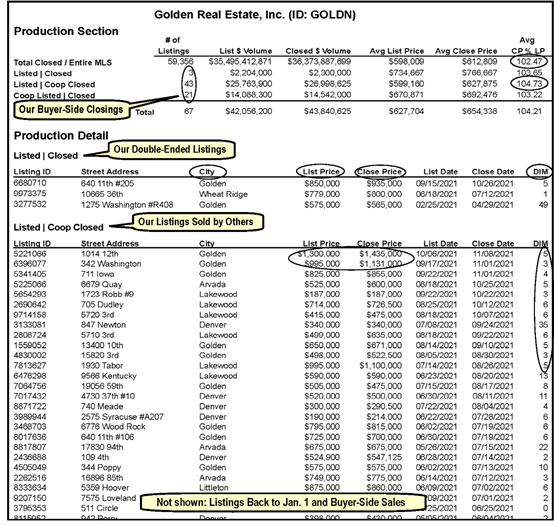
The MLS printout for Golden Real Estate below shows the information that can be gleaned about individual agents and their brokerages. I’m showing our company report, but I could have shown my personal report. This print-out shows our production since Jan. 1st of this year.
The Production Section at top summarizes the report, showing that we had 46 listings since Jan. 1st, three of which we sold ourselves. We had 21 buyer-side closings. The right-hand column shows the average of closed price (CP) to listing price (LP) — 102.47% for all MLS sold listings but much better for Golden Real Estate’s sold listings — 104.73%.
In the Production Detail section, the right-hand column shows how many days each sold listing was on the MLS before going under contract. Notice there are no zero days in MLS (“DIM”) because every listing was exposed to the full market so it would attract the most buyers, and yet there are few listings that took over a week to sell.
The “City” column lets you know where the agent (or company) does most of its business. The “List Price” and “Close Price” columns are also instructive. I’ve circled the two most recent sales as examples of how much above the listing price we sold those listings, thanks to our “auction style” of handling multiple offers, as opposed to the “highest and best” approach of most listing agents. It takes more work, but yields better results (a higher price) for our sellers.
This is not to suggest that an agent’s production is the sole criterion you should consider in choosing your listing agent. However, we learn from experience, which comes from actual transactions, not from years in the business. An agent with only five years’ of licensure but who does a dozen-plus transactions a year can be more “experienced” than an agent who has done a couple transactions a year over a 20-year career.
And let’s not forget about testimonials. Ask for them, and look for online reviews, too. We like www.RatedAgent.com, because it only displays reviews solicited from actual clients following a closing, so the reviews can’t be phonied up or altered in any way.
The government’s supervision of lenders has changed the way that home loans are made. Once you select your lender, you will be interacting with multiple people. Understanding who the “players” are is important.
I asked Jaxzann Riggs, owner of The Mortgage Network to describe those players..
The Loan Originator/Loan Officer
Sometimes called a “loan originator” or “loan officer” (LO) this is your team manager. Your LO will typically be your first contact with the lender. The LO decides if your income, assets, and credit will allow you to obtain the financing you need. The LO will be an educator and your advocate. He/she will manage the overall progress of the application, making sure that deadlines agreed upon by you and the seller are honored.
The Processor
The processor is the player tending to your loan application as it winds its way from application to closing. Your processor will request documentation from you that supports the information that you and the LO have put into the application for the loan. Their job is to organize your documents so that they paint a clear picture of your ability to repay the loan. The loan processor is the go-between between the borrower and underwriter.
The Appraiser
The appraiser will create a report that assesses the home’s market value to ensure that the amount of money requested for the loan will be acceptable to FNMA or FHLMC. The appraiser confirms the home’s dimensions, examines amenities, and evaluates the overall condition. He/she examines the records of comparable properties, ideally ones in the same neighborhood that have sold recently. Based on this information, the appraiser arrives at an opinion of how much your property would sell for if you put it on the market. This opinion assists the underwriter, along with your income, assets, and credit history in deciding how much it will lend you and on what terms.
The Underwriter
Think of the underwriter as the final word. FNMA and FHLMC are quasi-governmental agencies that set underwriting standards which lenders must follow. After reviewing your credit history, assets, the size of the loan, and the appraisal of the home, it is the underwriter who will decide whether your application meets government standards and either approve or decline the application. If they decide that your credit profile or application does not meet FNMA/FHLMC standards, they may deny your mortgage or require a larger down payment. Underwriters have discretion in the approval decision and, while they are the “gatekeeper” for the lender, they typically will look for ways to approve the loan.
The Closer
While not obvious, there are two “closers” working on your loan team. The title company’s closer must coordinate with the lender’s closer to reconcile the numbers associated with the loan and real estate transaction. The title closer will be presenting the lender’s final documents for your signature on the day of closing. The closing package includes the final loan application, loan estimate and closing disclosure, title insurance documents, deed of trust, bill of sale, affidavit of title, tax documents, etc. While they start their work at the beginning of the transaction, their work is not finished until all the documents that you sign at closing have been recorded with the county.
The Most Valuable Player (MVP)
The most important player is YOU. Your LO and Loan Processor will not ask you for documentation unless they know that it will be required by the underwriter. The more responsive you are to their requests, the faster the loan will be approved and the lower your stress level will be during the process.
Do you have other questions about the mortgage process? I recommend calling Jaxzann at 303-990-2992.
Recent experience with my listings has caused me to rethink recommendations I’ve made in the past about fixing up a home before putting it on the market.
Despite a moderating seller’s market, two recent listings went under contract for way above their listing prices, and I think it was because of the effort and money that was expended on dressing them up for sale.
In previous columns I have said you don’t need to do much to sell a home. Only fix “eyesores,” I wrote. If the carpet is old but not damaged or rippled, just have it professionally cleaned, don’t replace it.
My most recent seller, however, spent significant time and money dressing up their home before putting it on the market, and I think it paid off. The home was listed at what the comparable sales suggested it should sell for, but it attracted 12 offers and ended up going under contract in five days for 20 percent over the listing price.
The new carpeting was well chosen and beautifully installed. The seller followed our stager’s advice to the letter. The deck was re-stained. The concrete flatwork which had settled was mud-jacked. Windows were washed and screens labeled and put away. I asked the seller to describe all they had done over several months, and it’s super-instructive. Here’s a link to what they wrote.
Another effort — by me — really paid off, too. The narrated video tour with drone video which we put on YouTube and linked to the MLS and our website was so effective in showing off the home that a buyer from the East Coast submitted the winning offer without seeing it in person. That’s because our videos simulate an actual showing, starting out front (just like a real showing) and going through the home and into the backyard, narrating all the time.
As I wrote in a previous column, we are amazed that more agents don’t shoot live action narrated videos. They’re easy to do once you get the knack of it, and they cost nothing to create and edit if the listing agent does it himself. And who better than the listing agent to “show” a listing?
Come on, dear colleagues, get with the program. It can pay off for you as it pays of for Golden Real Estate agents week after week!
In November 2019 the National Association of Realtors (NAR) created its Clear Cooperation Policy (CCP) designed to end the practice of “pocket listings.” A pocket listing is one which an agent keeps in his or her “pocket,” hoping to sell it himself instead of giving other agents the opportunity to sell it. The incentive is financial. Roughly half the listing commission goes to the agent who sells a listing. If an agent sells the listing himself, he/she gets to keep the entire commission.
The term “clear cooperation” is a reference to the purpose of the MLS, which is “cooperation and compensation.” Every MLS member agrees to cooperate with other MLS members, allowing them to sell their listing. And every listing specifies the compensation which the buyer’s agent will receive — typically 2.5 to 2.8 percent in our market.
You can read the three previous articles I’ve written about this policy at www.JimSmithColumns.com. Those articles (in Nov. 2019, Feb. 2021, and Aug. 2021) document the creation of the CCP and its subsequent implementation by REcolorado, our MLS. The deadline set by NAR to do so was May 1, 2020.
My August 12, 2021, column described how our MLS is fining agents $1,500 for a first offense when they fail to put a listing on the MLS within one business day of promoting it outside their own office in any way — online, in print or via a sign in the ground.
One would think that with such a big penalty the number of homes selling with zero days on the MLS would have declined, but in fact they have increased. I didn’t realize that until I read a Nov. 3rd article from Inman.com which quoted a study by Broker Resource Network (BRN). The study pulled data from 24 multiple listing services comparing the number of homes sold with zero days on MLS during the 12 months before and after the May 1, 2020, implementation date.
“In every market reviewed across the United States, brokerages recognized double and triple digit increases in Zero Days On Market listings across firms of all sizes and business models,” the report said. These were figures for big brokerages, not the full MLS.
So I checked REcolorado statistics to see what our full-MLS statistics are for homes sold with zero days on the MLS. I found that there were 2,225 such closings reported in the 12 months before May 1, 2020, and 2,769 reported in the 12 months after May 1, 2020 — a 24.4% increase.
To discover the longer trendline, I looked at several half-year periods going back to 2018. In the last 180 days (as of this past Sunday), there were 1,677 closings of resale residential listings recorded on REcolorado with zero days on MLS before going under contract.
During the same 180 days of 2020, there were 1,295 such closings, making this year a 29.5% increase over last year. The number in 2019 was even lower — 1,077. In 2018 it was not much different — 1,104.
What could account for this counter-intuitive increase?
One explanation might be the explosion of the seller’s market during the pandemic, which really took off simultaneously with the implementation of the Clear Cooperation Policy (and the pandemic surge).
One way to assess the seller’s market is to measure how many homes went under contract after 4 days on the MLS during those 12 months before and after May 1, 2020, and the median ratio of sold price to listing price for those listings.
During the 12 months before the implementation of the CCP, there were 4,563 closings of listings which went under contract in 4 days, and the median ratio of sold price to listing price was 1.0019. During the 8 months after May 1, 2020, there were 4,896 such closings, and the median ratio was 1.01299. Another 2,840 such closings took place during the remaining 4 months of the 12-month period after May 1, 2020, and the median ratio for them was 1.05157. Clearly, the seller’s market was accelerating. It makes sense that more sellers might receive offers they “can’t refuse,” and that listing agents might encourage them to accept those offers.
There was an important loophole created when the CCP was implemented by REcolorado and perhaps by those 24 other MLSs. That loophole is called the “office exclusive,” which allows any brokerage to promote an off-MLS listing within the brokerage, so long as there is no advertising of any kind on social media or in print and no sign in the yard — the definition of a pocket listing.
This policy greatly favored large brokerages which could have hundreds of agents in a dozen or more offices, to promote new listings internally with the additional incentive of keeping the full commission of each transaction within the brokerage.
If this loophole were to be closed, there would probably be far fewer closings with zero days in the MLS — and sellers might get more money for their homes by having them exposed to more competing buyers.
As I mentioned above, a listing agent profits from keeping a listing off the MLS, because it increases the chances of selling the listing himself and thereby greatly increasing his/her commission. Of the 100 homes on REcolorado which sold for $1.25 million or more in the last 180 days with zero days on the MLS, 25% of them were double ended (see list below), and only 9 of those 25 listings reduced the commission paid by the seller because of their listing agent’s windfall. (The agents at Golden Real Estate always discount our commission when we double-end a transaction.)
D0uble-Ended Sales On REcolorado Over $1.25 Million – Last 180 Days, Showing Whether Seller Got a Discounted Commission
By contrast, of the 100 highest priced homes ($1,575,000 and over) which sold after 4 days on the market, only 2% were double-ended. Whether or not you call it “greed,” the agents who kept their homes off the MLS greatly profited from it — and the sellers paid the price by not exposing their homes to all potential buyers.
Another recent article from Inman reminds us that Fair Housing was one of the reasons the Clear Cooperation Policy was introduced. A blog post on REcolorado also makes this point. The reasoning is that if a home is sold privately without being exposed to all buyers on an MLS, then it is more likely to be sold within the same demographic. Thus, pocket listings are inherently discriminatory against minority groups, whether they be racial or, for example, LGBTQ.
I’m sure that these articles and the studies behind them, including my own analysis of REcolorado statistics herein, will lead to some discussion locally and nationally about how to tweak the Clear Cooperation Policy so it is more effective and less counter-productive, which it clearly has proven to be. I do not believe, however, that the Clear Cooperation Policy will be scrapped, because its stated intention is clearly good public policy.
Sellers: Insist that your home is put on the MLS so that all interested buyers have the opportunity to see it and participate in a bidding war that nets you more money.
I don’t know anyone who doesn’t like the idea of saving money, which will happen when you convert your home to “net zero energy.” So, what are the steps you can take to get there?
“Net zero energy” means that your home generates more energy than it consumes. With “net metering,” your electric meter runs backwards when your solar panels generate more electricity than you’re using (on a sunny day), then runs forward at night, resulting in zero (or less) net consumption of electric power.
Solar power gets more affordable every year. When I purchased my first 10-kW solar photovoltaic system 15 years ago, the cost was over $60,000, but Xcel Energy gave a rebate of $4.50 per watt, so I got a check for $45,000 from the utility, reducing my net cost to $15,000. Nowadays that same system would cost as little as $15,000 with no Xcel rebate but a 26% federal tax credit.
While you can generate your own electricity, you cannot generate your own natural gas, so terminating natural gas service is key to achieving net zero energy. This involves some major system changes if you are currently heating your home and your water using natural gas, cooking with gas (including with a gas grill) and have a gas fireplace.
There are electric alternatives to all of these uses of natural gas, and you’ll appreciate that eliminating natural gas also eliminates the possibility of a gas explosion and of carbon monoxide poisoning (unless you have a gas powered car).
Heating your home with electricity used to mean installing baseboard resistance heating units in each room, but that is so 20th century. Nowadays electric space heating is done far more efficiently (and evenly) using heat pumps.
Gas forced air furnaces and water heaters are considered to have a 15-year life expectancy, so when yours fail, think of that as an opportunity to adopt heat pump technology for both functions. And a heat pump eliminates the need for a separate A/C unit, since it heats and cools.
Gas furnaces and water heaters generate heat by burning gas. A heat pump moves heat, similar to what A/C does. (How heat pumps work) It cools your home by moving the heat out of your house. If you put your hand over the external compressor unit while it’s cooling your home, you will feel the heat that was moved from inside your home. In heating mode, the process is reversed, and the heat pump moves heat from outdoors into your house. It may surprise you to know that when it’s freezing outside there is actually heat that can be moved from outside to the interior of your house, but it’s true. (Heat pumps work in extremely cold climates) Our office has been heated solely by heat pump since November 2017, and ever since there has never been a day when the system failed to keep our office at 70°F or warmer.
A heat pump water heater (which I installed at our home) has the compressor built into the unit, above the tank. You can feel cool air emitting from it when it is heating water. I suggest putting it in a wine cellar where it’ll keep the room cool without buying a separate A/C unit.
For cooking, you’ll be amazed and delighted by the induction cooktops that are now widely available. I saw them used on a cruise ship for both cooking and warming surfaces, and the chefs loved them. (Modern cruise ships have eliminated natural gas because of the fire hazard.)
An all-electric home will, of course, demand more electricity, but Xcel Energy now allows you to install enough solar panels to generate double your electrical usage over the prior 12 months. That is more than enough to cover your new electric space heating, water heating and cooking needs, with capacity left over to charge an EV, too.
An important first step in pursuing net zero energy for your home is to reduce your need for energy, and the easiest and cheapest way to do that is to improve your home’s insulation. I had Dennis Brachfield of About Saving Heatblow cellulose insulation into the exterior walls (not just the attic) of a 1940s bungalow I owned, and I was astonished at how much more comfortable the house became. Even if your exterior walls have batt insulation in them, there is still space in the walls to blow in cellulose. (How to insulate an old house)
I learned something interesting from that experience. We all know that walls can radiate heat, such as a brick wall in bright sunlight. Well, walls can also radiate coldness, or suck heat. The air temperature in my bungalow before and after blowing in insulation was the same, but I felt warmer and burned less gas.
You can go beyond improving the insulation of your exterior walls and attic. There are numerous places that allow cold into your home, especially around your windows. Whether or not you install triple-pane Alpen windows, as we did at our office, caulking around the window frames and elsewhere can reduce the energy needed to heat your home.
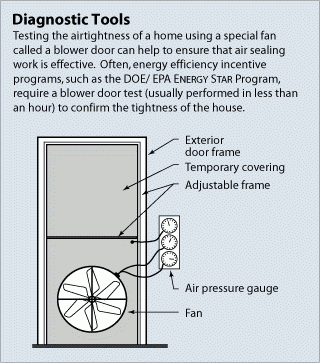
A blower door test done by a contractor will identify the air leaks in your home. Insulating your attic with blown-in cellulose and your crawlspace with plastic sheeting will also reduce your home’s energy needs whether from gas heating or your new heat pump. (Insulating crawl spaces)
Of course, many homes, especially in older neighborhoods, can’t benefit from solar power because of shading from trees or insufficient south-facing roof area, but you can purchase community solar. (This is also a good solution for condos which have no roof at all.)
The way community solar works is that you invest in solar panels that are part of a solar farm in some distant pasture. The electricity generated by your panels in that remote location is credited to the electric meter for your home or condo. One advantage of community solar is that when you move, you only need to change which meter gets credited with your solar production.
Other ways of reducing energy use include replacing CFL or incandescent light bulbs with affordable LED bulbs and “daylighting” your home or office. (Batteries + Bulbs sell 8-packs of 60W LED replacement bulbs for $6.49, tax included, after $15 instant rebate.) We have “sun tunnels” in our home and office to bring daylight into interior spaces. In fact, on a sunny day we don’t need to turn on any lights in our office. It’s great— and saves energy. We had Design Skylights of Evergreen install Velux sun tunnels at both home and office.
Would you like one of us to visit your home for a private consultation about the sustainability possibilities in your home? Email me at Jim@GoldenRealEstate.com.
Disruption is happening in every industry, spurred on primarily by internet-based technology. Amazon is disrupting brick and mortar retail. Uber and Lyft have disrupted the taxi industry. Tesla disrupted the auto industry’s dealer model. Travel agents have suffered from online ticket sales by airlines, cruise lines and related businesses.
Now companies like Zillow, Open Door, and OfferPad are disrupting the real estate industry with their “iBuyer” model.
But those and other disruptors have not killed off the older business models. They are grabbing market share, but of an increasing market. You can expect to see brick and mortar retail stores, taxi companies, travel agents and, yes, traditional real estate brokerages such as Golden Real Estate thriving for years to come.
We ourselves have not suffered from these disruptors. Indeed, while 2020 and 2021 have seen huge growth by these new real estate enterprises, they have also brought record growth for our brokerage and other traditional brokerages, and it is easy to see why.
Buying and selling a primary residence is typically the biggest financial transaction we all deal with. Yes, buyers increasingly utilize the internet to search for homes, but they end up calling us to see them. Sellers also use the internet to monitor the market — many taking advantage of the MLS alerts that we set up for them — but they want someone they know and trust to bring their real estate savvy to bear in listing and marketing their home when it’s time to sell.
The “full-service” real estate agent is being redefined, and I like to think that my broker associates and I epitomize that evolution. Some of the services we provide can not be obtained from those other companies.
Full service goes beyond providing our free moving truck, moving boxes and packing material, which we’ve been doing since 2004. Here are some other services you can expect from us.
We have an in-house handyman who can help with preparing a home for market, such as repairing drywall damage, washing windows, and doing light plumbing and light electrical tasks such as installing a new toilet, faucet or light fixture. He’s also there to address many of the issues which arise from the buyer’s inspection. And he’s also there if needed to drive our truck for moving, or even for a dump run or for taking a load of possessions to Goodwill or Arc.
We also have a certified home stager who provides our sellers with a free consultation to help their home show its best.
You’re familiar by now with how we create narrated video tours of each listing, including drone videos, but we also serve out-of-state buyers by shooting videos of other agents’ listings that interest them. Last June I did that for a Minnesota couple who felt they had “seen” an Arvada home well enough through my narrated video tour of it to go under contract, not visiting the home in person until they came for the inspection.
Speaking of inspection, experienced agents like us from a traditional brokerage can be counted on to recommend a good inspector who has a track record with them. Other specialists we know and trust — giving our clients the comfort to employ them — include estate sales companies, structural engineers, electricians, plumbers, HVAC companies, and more. The real benefit from these trusted vendors is that they will make sure you’re satisfied with their work, because they want to be referred to future clients.
“Full service” also implies availability and responsiveness. My broker associates and I are available 7 days a week, and we answer our cell phones on evenings and weekends. Although I have associates who can be my “boots on the ground” when I go on vacation, I take my cell phone (and laptop) with me, and I answer it when it rings.
Often we provide service for which we don’t expect or receive any compensation. For example, this past Sunday I got an inquiry from a man who had inherited his mother’s house and wanted an appraisal for tax purposes. I explained that only licensed appraisers can do appraisals but offered to do a free market analysis, which he happily accepted. He may call me about listing it later on, but that’s not the point. I’m happy to be of service.
I follow a policy that I came to embody many years ago: Concentrate on giving and the getting will take care of itself.
If the General Assembly follows the recommendation of DORA’s “sunrise” report, we may see the return of regulation of HOA management companies and of the community association managers (CAMs) they employ.
DORA’s recommendation, released earlier this month, stated that regulation of CAMs “is necessary to protect consumers” and recommended the creation of a new regulatory program.
CAMs were regulated starting in 2015, but the bill to retain that regulation (which DORA recommended) was killed by the General Assembly in 2017 resulting in the phase out of CAM regulation in June 2019. With the General Assembly now controlled by Democrats, this new recommendation may result in legislation restoring regulation of CAMs that will be signed into law by Gov. Polis.
You can find the full text of DORA’s sunrise report here.







 Jim Smith's Blog