Housing Trends Reflect Pandemic’s Influence  

The effect of pandemic lockdowns has triggered more interest in working at home, a trend that will be long-lasting and possibly permanent.

Early in the pandemic we saw a surge in real estate activity as buyers sought more space for working from home. Compounding that was a desire for more at-home entertainment and exercise. People want not only a home office, but a home theater and a home workout facility. These are features that will, in my opinion, dominate home design and buyer demands for at least the coming decade.

People feel safer at home, but they don’t want to feel cloistered. They want elbow-room.

Lockdowns also triggered more separations and divorces as couples who weren’t really in love found that being cloistered together at home didn’t work for their relationship. This also contributed to the real estate boom of 2020 and into 2021.

Real estate was considered an “essential service” in the early days of Covid-19 lockdowns, and we Realtors certainly relished the lack of traffic and traffic jams on local highways.  Those days of free-flowing traffic may be gone, but there is still a widespread appreciation of working from home and doing less commuting. This means continued buyer activity focused on finding additional home office space.

Some homeowners are finding that additional space at home instead of trading up to a bigger home. There’s increased interest, for example, in building ADUs over detached garages, not to create rental income (a great idea) but for the homeowner’s own use as a studio or office away from family distractions.

An attached garage can offer great potential for additional living space, not just as a workshop, but as a home office, art studio, workout room or even a bedroom if necessary. Heating and cooling, on top of improved insulation, will be job #1 before improving the flooring, walls and ceiling. Rather than extending your home forced-air furnace ductwork, consider installing a single-unit heat pump mini-split system.  I saw this on a garage in north Golden—a perfect application of this technology.

Click here for the Realtor Magazine article which inspired this article.

BONUS FEATURE:

Here’s an article submitted by Tina Martin about transforming your garage into a great work space:

Work-from-home jobs have become much more prevalent in recent years, with many people looking for remote opportunities or even starting their own businesses from the comfort of their houses. If you’ve just started working from home or are planning to in the near future, you’ll need a quiet, dedicated space for an office, and one place you may not have thought of to create a setup is your garage. With a few simple changes, you can transform this area into another room that comes with plenty of benefits–including more privacy and fewer distractions. You can also look for ways to make the transition to working from home a little easier at the same time.

Come prepared

If you’re going to be working from home at your own business, it’s a good idea to be as prepared and organized as possible to make the process a smooth one. This means taking steps to ensure that your company has all its bases covered legally, including creating an LLC so you can keep track of your tax responsibilities and remain in good standing with the IRS. A limited liability company comes with less paperwork and more flexibility than a corporation, so you can stay on top of things and run your business the way you want. Every state has its own rules for formation, so look up the steps for creating a Colorado LLC before jumping in.

Set up your workspace

Once you have the details figured out, it’s time to think about how to turn your garage into a room you can work in throughout the seasons. Of course, you’ll need access to wi-fi and electricity, but never try to handle electrical work on your own–hire a pro if you have to add wiring to your garage. If you already have wi-fi in your home, a simple and affordable signal extender could help you bring service to your new workspace. You’ll also want to make sure you have access to cool and warm air for the different seasons and that the garage is well-ventilated. Add shelving and a desk so you can keep things neat, and don’t forget to bring in a comfortable, supportive chair.

Let some light in

Once you know where your desk will be, think about how to make sure you have the right light for your needs. Many garages have overhead fluorescent lighting, which can be tiresome to your eyes for long periods of time. Look for a small lamp or two that will provide task lighting to the right areas and diffuse the overheads for your comfort. If your garage has a window, even better! Natural light is beneficial for working in an office because it can help to prevent disruptions in the circadian rhythm and boost your mood. If you don’t have a window, take breaks throughout the day and step outside for some fresh air.

Keep distractions out

Once you have your office space set up, it’s time to keep the distractions to a minimum. There are several ways you can achieve this, but you might start by replacing the garage door with a regular one that locks. Keep your new office space dedicated to business-only; the more it looks and feels like home, the easier it will be for you to put off work. It’s also a good idea to keep devices out of the space unless they’re necessary for your job.

Creating a home office out of a garage doesn’t have to be time-consuming or costly. With a few simple moves, you can turn this space into an entirely new room and give yourself the workspace you’ve always wanted in the process.


Must Read: ‘From Homes to Cars, It’s Now Time to Electrify Everything’  

Every now and then I read an article that I am compelled to share, because it simply “nails it.”

Such was the article by Saul Griffith, published Oct. 19, 2021, on the Yale School of the Environment website, http://www.e360.yale.edu, and re-posted Nov 30, 2021, on GreenBuildingAdvisor.com.

Here’s a link to the full article: https://e360.yale.edu/features/from-homes-to-cars-its-now-time-to-electrify-everything.

The thesis of that article is summarized as follows: “The key to shifting away from fossil fuels is for consumers to begin replacing their home appliances, heating systems, and cars with electric versions powered by clean electricity. The challenges are daunting, but the politics will change when the economic benefits are widely felt.”

The diagram above right shows what can be electrified in a home. Rita and I are most of the way there. This fall I purchased an electric snow blower to complement our electric lawn mower, weed eater, leaf blower and automobiles. Earlier this year I purchased a heat pump water heater to complement our heat pump hybrid furnace. (Hybrid, because it still burns natural gas when the outdoor temperature dips below 30° F.)

All these electric devices are powered by the sun, thanks to our 10-kW solar PV system installed when we bought our home in 2012.  Because we still cook with gas and occasionally burn gas in our furnace and fireplace, our Xcel bill is still around $35-40 per month, but we’re doing our part to “electrify everything.”

You can do that, too.

The central thesis of Saul Griffith’s article is that we have little control over the supply side of energy, although there are encouraging signs of it becoming less dependent on fossil fuels.  But we have total control over the demand side of energy:

“We don’t have a lot of choice on the supply side, but we have all of the choice on the demand side. For the most part, we decide what we drive, how we heat our water, what heats our homes, what cooks our food, what dries our laundry, and even what cuts our grass. This constitutes our ‘personal infrastructure,’ and it is swapping out that infrastructure that will be a key driver of the global transition from fossil fuels to green energy.”

According to Griffith, who co-founded the non-profit Rewiring America, there are 280 million cars and trucks in America, 70 million fossil-fueled furnaces, 60 million fossil-fueled water heaters, 20 million gas dryers, and 50 million gas stoves, ovens and cooktops. Until now, the conversation has been about making each of those fossil-fueled appliances more efficient, earning “Energy Star” ratings.

But the real goal should be to replace them with electric appliances burning the increasingly green electricity which is being generated by our electric utilities.

A common refrain from people regarding electric cars is that they are not really zero emissions because of how the electricity is generated. I myself was originally reluctant to buy an EV because I didn’t want to “switch from burning gas to burning coal.”

However, that argument overlooks the relative efficiency of electric motors.  In a fossil-fueled car, only 20% of the energy in the fuel is propelling the car. The rest is waste energy, primarily creating heat which then requires more fuel to cool it. In an EV, 90% of the energy from the battery propels the car. There’s almost no waste energy.

An suitable analogy to the gas-powered car is an incandescent light bulb, in which light is a byproduct of heating the filament. It’s no surprise that the LED light bulb uses about 20% of the electricity of an incandescent light bulb for the same amount of light, because light is the primary product of the LED, not a by-product of waste energy.

Because of its relative efficiency, even if an EV is charged from electricity created entirely by coal, its carbon footprint is far below that of a fossil-fuelel vehicle. The same applies to today’s highly efficient heat pumps for both space heating (and cooling) and for water heating.

Griffith’s point is that more efficient fossil-fueled appliances won’t get us where we need to be to save the planet from catastrophic climate change. We need to get to zero emissions, which is only possible by going all-electric in our homes and vehicles as our electric utilities make their inevitable transition — whether incentivized by government or simply by the economies of renewable energy — to clean energy.

You, like me, will love the effects of this transition to all-electric living. Imagine a future where carbon dioxide is not a household poison; where motorcycles don’t disturb the peace and quiet of our streets and canyons; where semis slow down quietly because they are putting energy back into their batteries instead of using loud and polluting engine braking; where our neighbors aren’t disturbed by loud lawn mowers, snow blowers and leaf blowers; and where children no longer suffer health problems from their own school buses or playgrounds next to highways.

You, like me, will appreciate the ease of use and near-zero maintenance of electric devices. My snow blower, lawn mower, and leaf blower start by pushing a button or pulling a lever and never need a tune-up, refueling or oil change.

Griffith is not arguing that everyone should immediately swap out their fossil-fueled cars or appliances but rather avoid replacing them with newer ones. Cars, for example, can last for 20 years, and gas furnaces for 15 years. When they need replacing, make the smart choice and replace them with their electric counterparts. You’ll be glad you did five or ten years later when their resale value has evaporated due to public recognition that they became obsolete before you purchased them.

Recommended Video: Are We in a Housing Bubble?  

This is a question that seems to be on everyone’s mind, especially after a year which has seen double digit appreciation in home prices.

Finally, I found a focused discussion on this topic by highly knowledgeable persons that I can recommend. Here’s a YouTube link for that discussion. The panelists are Nick Bailey, president of Re/Max, LLC, Lawrence Yun, chief economist for the National Association of Realtors, and Ward Morrison, president of a mortgage franchising frim. The consensus of these experts is that 2022 will see most appreciation (3 to 5%, says Yun) but no crash. The main reason is the imbalance of supply and demand and mortgage rates projected to be no higher than 4%, which is still quite low.

The record job growth is also a critical factor. Foreclosures will remain low because only 2% of homeowners have negative equity. Watch the 28-minute video on our blog. You’ll learn a lot, as I did.

My Favorite Home Improvements When Purchasing a New-to-Me Home  

This column is adapted from my July 18, 2019, column on this topic.

Energy efficiency is very important to Rita and me, so the first thing we did when we purchased our current home was to pay for an energy audit to identify opportunities for making the home more air-tight. One result of that test was to blow additional cellulose insulation into walls and ceilings and to caulk around windows. We considered installing an energy recovery ventilator (ERV) to bring fresh air into the home using a heat exchanger that warms outside air in the winter and cools outside air in the summer. Instead we installed a fan in our powder room that runs 24/7 at a very low volume, but higher when occupied.

I love bringing sunlight into a home, with sun tunnels. Rita and I had Mark Lundquist of Design Skylights install a Velux sun tunnel in our garage and another one in our laundry room. (He installed four more at Golden Real Estate.)

Speaking of sunlight, we replaced every light bulb in our home with LEDs which are “daylight” color.

Installing solar photovoltaic panels is a no-brainer now that the cost has dropped so much. Your roof doesn’t have to face due south. Southeast and southwest are good enough. Since everyone will be driving an electric car eventually, install as much solar PV as Xcel Energy allows to cover that future load.

Don’t you hate climbing a curb to enter your driveway? Developers install mountable curbs the entire length of residential streets, because they can’t know where each driveway will be. One of the first things we did at our home was to remove the mountable curb in front of our driveway.  It cost about $2,000 for our 3-car-wide driveway, but we love it every time we enter from the street!

When your gas forced air furnace needs replacing, consider replacing it with a heat-pump or hybrid furnace. And when your gas water heater needs replacing, I recommend buying a heat-pump water heater. We bought a 50-gallon Rheem unit for $1,200, but it came with a $400 rebate. Once you’ve replaced both, you will have eliminated the most common sources of carbon monoxide poisoning in your home. 

Other improvements I’d recommend: Replacing any bathroom carpeting with ceramic or porcelain tile; replacing regular double-pane windows with Low-E windows on south-facing windows; replacing fluorescent fixtures (as we did in our garage) with flush-mount LED panels sold at Lowes for about $100.  Love ’em!

Electric Cars Are Your Best Cold Weather Choice  

It’s that time of year when I like to remind readers about the advantages of electric vehicles (EVs) in cold weather. Here’s what you need to know.

1)  No warming up is needed. Put the car in Drive and go! Also, the cabin will be warm within 1/2 mile because it doesn’t require an engine to warm up first. In my Tesla I can turn on the heat with my phone app a few minutes earlier so the cabin, steering wheel and seat are all warm when I get in the car. Also, I can leave the heater on when I park the car so it’s warm when I return, if I am just going into a store for a short time. (I do the same thing on hot summer days, so it stays cool!)

2)  Your car will never break down, stranding you in a freezing car on the side of the road. The only time you see an EV on the side of the road is if there’s a flat tire or an accident. Stuck in a snow drift? The EV’s heater will keep you warm as long as you need, consuming only 3 to 5 miles of range per hour — and producing no carbon monoxide!

3)  Because of its low center of gravity, an EV handles snow-covered (and dry) roads great — better than any car I’ve owned.

4)  Used EVs are your best buy. The older (pre-2018) Tesla Models S & X are a great buy because most come with transferrable lifetime free supercharging coast-to-coast when purchased privately, not as Certified Pre-Owned from Tesla. Ask before buying.

5)  There are federal and state tax credits and various rebates to be had. See the following website for a full list: www.electricforall.org/rebates-incentives

Happy Thanksgiving! Here Are Some Things That We’re Grateful for This Year  

2021 has been a difficult year for everyone, but it has also been a year of growth for Golden Real Estate and for me personally. Fortunately, Rita and I have escaped infection by Covid-19. We are all fully vaccinated, and Rita and I plus a couple broker associates have received our booster shots.

We’ll be closing out 2021 with over $50 million in closed sales volume, compared to less than $32 million in 2020.

So we have a lot to be thankful for at Golden Real Estate, most especially the patronage of buyers and sellers who chose us to serve their real estate needs.    I know for a fact that many of this year’s clients chose us not only because of the real estate reputation we have built through this weekly column but also because of the political stands I have taken regarding our former president and his followers. We gained far more clients than we lost because of my political writing.

And we are not alone politically. While fellow agents and brokerages have not spoken out as we have for fear of losing clients, the National Association of Realtors (NAR) has taken some courageous stands demonstrating alignment with our own values. For example, last fall the incoming president of NAR apologized for the past policies of the association which reinforced systemic racism, such as redlining and steering buyers to minority areas instead of showing them all listings they were financially qualified to buy. I’m grateful for the attention paid by NAR to social justice issues, but also for its effort, albeit unsuccessful so far, to eliminate the practice of off-MLS (“pocket”) listings.

I’m also grateful for the progress being made by REcolorado, Denver’s MLS. I have seen this progress from the inside as a member of the Rules & Regulations Committee as well as from being a user of REcolorado’s services. I appreciate REcolorado for adopting some of my suggestions, such as creating a field for closing notes.

At the top of my gratitude list is the fact that we were able to rent a storefront in downtown Golden. In early December, Golden Real Estate will be moving to 1214 Washington Avenue, the former location of Laurel Property Services. We look forward to benefiting from the pedestrian traffic of that prime location. We have ordered a WindoVision unit from TouchPoint Systems to capitalize on that traffic. Below is an artist’s rendering of it installed in our storefront. It allows passersby to search the MLS live using a through-the-window touch screen.

What’s really exciting about our move to downtown Golden is what it allows us to do with our current building on South Golden Road. As you know by now, we are a showplace of “net zero energy,” so I am partnering with broker associate Ty Scrable, who is super-committed and knowledgeable about sustainability, to create a new business we are calling The Net Zero Store. Our goal is to bring under one roof and into one showroom the various products and services that allow homeowners and businesses to “go net zero.”

Ty and I will be presenting our plans for this new venture at the Nov. 30th, 7pm, meeting of the Colorado Renewable Energy Society at the Jefferson Unitarian Church, 14350 W. 32nd AveHere’s a link if you’d like to attend.

Don’t Wait Until Spring to Sell Your Home; There Are Many Advantages to Putting It on the MLS in Winter  

Each year at this time, I like to remind readers that the real estate business is not as seasonal as it once was. It used to be that spring and summer were considered the time to put a home on the market, based primarily on the school calendar. But that is old-school thinking.

Nowadays, with buyers and their agents setting up automated MLS searches based on the buyers’ needs and wants, homes are selling year round. What makes winter a particularly good time to list a home is that most sellers continue to think the old way and keep their homes off the market until spring.

As a result, those sellers who do put their home on the market enjoy two advantages. The first is less competition from other listings, and the second is the large number of buyers who will get the automated alert when a new listing matches their search criteria. (Over 850 buyers got alerts for this week’s featured listing.)

As I write this on Tuesday morning, Nov. 23rd, there is only one active listing in the entire City of Golden. How would you like your home to be   the only home for sale in a city of 20,000 people and 7,500 homes?

I myself have nearly 100 buyers with MLS alerts matching their search criteria. When a new listing is entered on the MLS which matches a buyer’s search criteria, that buyer gets an email alert with all the photos and details about that particular listing.

Perhaps you recall the DTC condo I featured last week. In the first day that it became active on the MLS, over 500 buyers received email alerts about it, four of whom tagged it a “favorite” and six tagged it a “possibility.” When a client tags a listing, their agent gets an email letting him or her know, likely triggering an in-person showing. That listing is already under contract for 10% over listing.

My $725,000 Littleton listing featured two weeks ago triggered email alerts to over 650 buyers, 18 of whom tagged it a favorite and 8 of whom tagged it as a possibility. It went under contract in five days for 20% over listing price.

Don’t wait for spring to list your home if you’d just as well sell it now. This is a great time to list!

NAR’s chief economist predicts a hotter-than-normal real estate market this winter. Click here. And realtor.com published an article on this same topic on November 15th:  “Should You Wait Until Spring to Sell Your Home? No Way! Why Winter Listings Rule Today.” 

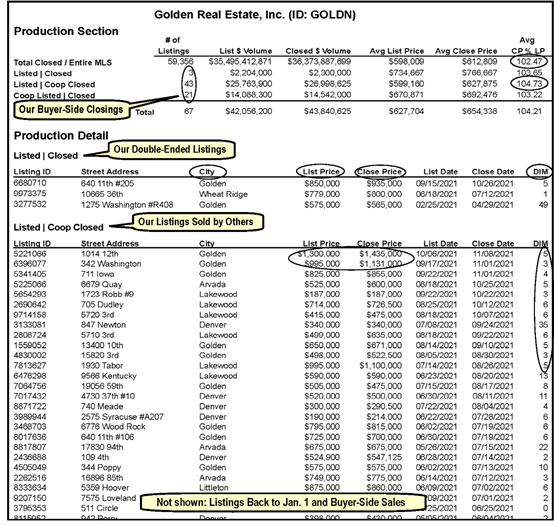
Interviewing a Listing Agent? Ask Him or Her to Bring Their MLS Production Print-out  

The MLS printout for Golden Real Estate below shows the information that can be gleaned about individual agents and their brokerages. I’m showing our company report, but I could have shown my personal report. This print-out shows our production since Jan. 1st of this year.

The Production Section at top summarizes the report, showing that we had 46 listings since Jan. 1st, three of which we sold ourselves.  We had 21 buyer-side closings. The right-hand column shows the average of closed price (CP) to listing price (LP) — 102.47% for all MLS sold listings but much better for Golden Real Estate’s sold listings — 104.73%.

In the Production Detail section, the right-hand column shows how many days each sold listing was on the MLS before going under contract. Notice there are no zero days in MLS (“DIM”) because every listing was exposed to the full market so it would attract the most buyers, and yet there are few listings that took over a week to sell.

The “City” column lets you know where the agent (or company) does most of its business. The “List Price” and “Close Price” columns are also instructive. I’ve circled the two most recent sales as examples of how much above the listing price we sold those listings, thanks to our “auction style” of handling multiple offers, as opposed to the “highest and best” approach of most listing agents. It takes more work, but yields better results (a higher price) for our sellers.

This is not to suggest that an agent’s production is the sole criterion you should consider in choosing your listing agent.  However, we learn from experience, which comes from actual transactions, not from years in the business. An agent with only five years’ of licensure but who does a dozen-plus transactions a year can be more “experienced” than an agent who has done a couple transactions a year over a 20-year career.

And let’s not forget about testimonials. Ask for them, and look for online reviews, too. We like www.RatedAgent.com, because it only displays reviews solicited from actual clients following a closing, so the reviews can’t be phonied up or altered in any way.

It Takes Many ‘Players’ on a Mortgage Lending Team to Get You to the Closing Table  

By JIM SMITH, Realtor®

The government’s supervision of lenders has changed the way that home loans are made. Once you select your lender, you will be interacting with multiple people. Understanding who the “players” are is important.

I asked Jaxzann Riggs, owner of The Mortgage Network to describe those players..

The Loan Originator/Loan Officer

Sometimes called a “loan originator” or “loan officer” (LO) this is your team manager. Your LO will typically be your first contact with the lender. The LO decides if your income, assets, and credit will allow you to obtain the financing you need. The LO will be an educator and your advocate. He/she will manage the overall progress of the application, making sure that deadlines agreed upon by you and the seller are honored.

The Processor

The processor is the player tending to your loan application as it winds its way from application to closing. Your processor will request documentation from you that supports the information that you and the LO have put into the application for the loan. Their job is to organize your documents so that they paint a clear picture of your ability to repay the loan. The loan processor is the go-between between the borrower and underwriter.

The Appraiser 

The appraiser will create a report that assesses the home’s market value to ensure that the amount of money requested for the loan will be acceptable to FNMA or FHLMC. The appraiser confirms the home’s dimensions, examines amenities, and evaluates the overall condition. He/she examines the records of comparable properties, ideally ones in the same neighborhood that have sold recently. Based on this information, the appraiser arrives at an opinion of how much your property would sell for if you put it on the market. This opinion assists the underwriter, along with your income, assets, and credit history in deciding how much it will lend you and on what terms.

The Underwriter

Think of the underwriter as the final word. FNMA and FHLMC are quasi-governmental agencies that set underwriting standards which lenders must follow. After reviewing your credit history, assets, the size of the loan, and the appraisal of the home, it is the underwriter who will decide whether your application meets government standards and either approve or decline the application. If they decide that your credit profile or application does not meet FNMA/FHLMC standards, they may deny your mortgage or require a larger down payment. Underwriters have discretion in the approval decision and, while they are the “gatekeeper” for the lender, they typically will look for ways to approve the loan.

The Closer

While not obvious, there are two “closers” working on your loan team. The title company’s closer must coordinate with the lender’s closer to reconcile the numbers associated with the loan and real estate transaction. The title closer will be presenting the lender’s final documents for your signature on the day of closing. The closing package includes the final loan application, loan estimate and closing disclosure, title insurance documents, deed of trust, bill of sale, affidavit of title, tax documents, etc. While they start their work at the beginning of the transaction, their work is not finished until all the documents that you sign at closing have been recorded with the county.

The Most Valuable Player (MVP)

The most important player is YOU. Your LO and Loan Processor will not ask you for documentation unless they know that it will be required by the underwriter. The more responsive you are to their requests, the faster the loan will be approved and the lower your stress level will be during the process.

Do you have other questions about the mortgage process? I recommend calling Jaxzann at 303-990-2992.

I’m Reconsidering the Advice I’ve Given About What to Fix or Improve Before Listing Your Home  

Recent experience with my listings has caused me to rethink recommendations I’ve made in the past about fixing up a home before putting it on the market.

Despite a moderating seller’s market, two recent listings went under contract for way above their listing prices, and I think it was because of the effort and money that was expended on dressing them up for sale.

In previous columns I have said you don’t need to do much to sell a home. Only fix “eyesores,” I wrote.  If the carpet is old but not damaged or rippled, just have it professionally cleaned, don’t replace it.

My most recent seller, however, spent significant time and money dressing up their home before putting it on the market, and I think it paid off. The home was listed at what the comparable sales suggested it should sell for, but it attracted 12 offers and ended up going under contract in five days for 20 percent over the listing price. 

The new carpeting was well chosen and beautifully installed. The seller followed our stager’s advice to the letter. The deck was re-stained. The concrete flatwork which had settled was mud-jacked. Windows were washed and screens labeled and put away. I asked the seller to describe all they had done over several months, and it’s super-instructive. Here’s a link to what they wrote.

Another effort — by me — really paid off, too.  The narrated video tour with drone video which we put on YouTube and linked to the MLS and our website was so effective in showing off the home that a buyer from the East Coast submitted the winning offer without seeing it in person. That’s because our videos simulate an actual showing, starting out front (just like a real showing) and going through the home and into the backyard, narrating all the time.

As I wrote in a previous column, we are amazed that more agents don’t shoot live action narrated videos. They’re easy to do once you get the knack of it, and they cost nothing to create and edit if the listing agent does it himself.  And who better than the listing agent to “show” a listing?

Come on, dear colleagues, get with the program. It can pay off for you as it pays of for Golden Real Estate agents week after week!