Zillow Says Late April Is the Best Time to Sell a Home  

Here are the key takeaways from a report released this week by Zillow:

> Homes listed for sale in the second half of April can expect to sell for 2.8% more, or about $9,300 on the typical U.S. home. 

> The first two weeks of November are the worst time to list a home, associated with a 3.5% discount. 

> The potential price difference between the best and worst times to list is 68% higher than it was pre-pandemic. 

Here’s a link to the full Zillow report.

The Current Surge in Sold Prices of Homes Will Cause a Jump in 2023-2024 Property Taxes  

In Colorado, property taxes are based on a calculation of what each property might have sold for on June 30th of the prior even-numbered year.

That means the property taxes for 2023 and 2024 will be based on what your home could have sold for on June 30, 2022. Given the crazy surge in home prices, you could see a 30% or higher jump in your property’s assessed valuation and therefore a 30% or higher jump in your property taxes for the next two years. 

The chart below shows the likely impact of the current run-up in median prices compared to the median prices in prior Junes of even-numbered years, based on data from REcolorado. Although your home’s valuation will be based on the sales of comparable homes near yours leading up to June 30, 2022, the fact that the median sold price of residential properties metro-wide will have increased by over 30% from June 30, 2020, suggests that your home’s valuation and therefore your taxes could rise by 30 percent or more.

I’ve estimated (conservatively) that the median sold price in June will be $570,000 because the median sold price was already $540,000 in February. That is already a 27.7% increase over June 2020.

That, however, is an average for the entire Denver metro area, defined for these purposes as within 25 miles of the state capitol.  There are locales within the metro area where the increase in values over the last two years have approached 35% or more. Here is how that metro-wide 27.7% average increase of Feb. 2022 over June 2020 breaks down by county:

Denver County—19.5%

Jefferson County—30.1%

Douglas County—31.9%

Adams County—28.6%

Arapahoe County—27.1%

Boulder County—40.7%

Gilpin County—42.4%

The appreciation also varies greatly by city addresses:

Golden addresses—15.9%

Littleton addresses—26.0%

Arvada addresses—33.0%

Broomfield—27.2%

Centennial—36.9%

Aurora—30.5%

Highlands Ranch—31.8%

Castle Rock—36.5%

So, keep an eye on what homes like yours are selling for this April, May and June of this year to get a sense of what the county assessor’s valuation of your home will look like when you get that notification in May 2023.

About 50 readers are receiving “neighborhood alerts” from me.  These are email alerts regarding all MLS listings within your particular neighborhood. Usually, the alerts cover a certain subdivision or ZIP code, but they could be structured to include only listings which are comparable to your own home. For example, if you have a 1970s ranch home, I could set up an alert that only includes ranch-style homes built between 1960 and 1990 within a half mile or mile of your home. This will give you the best indication of how the value of your own home may be calculated by your county assessor. Feel free to email me at my address below to request such an alert or to modify the alert I am already sending you.

MLS Statistics Document the Return of Last Year’s Out-of-Control Seller’s Market  

One of the most dependable indicators of a strong “seller’s market” is the number of listings which sell above their listing price, and by how much. Another is the number of days that a listing is on the MLS (“DOM”) before going under contract.

As shown in the chart below, drawn from REcolorado’s data for the period of January 2021 through last month, the seller’s market peaked in May and June of last year but has now surged again. All indications are that the surge will continue through the spring.

Average DOM is always higher than median DOM because there are many homes that languish on the market unsold because they are overpriced, or for another reason. What’s remarkable about this sellers market was how low the average DOM went as even those hard-to-sell homes attracted buyers.     

As with the previous surge, the average DOM has sunk below 20 while the median DOM has revisited its all-time low of 4 days on the MLS.

(Note: These statistics are for residential listings in the metro Denver area, which I’ve defined here as within a 25-mile radius of the State Capitol.)

The rising cost of money — that is, the increase in mortgage rates projected for this year — will lure many buyers “off the fence” hoping a buy a home before interest rates rise further.

I foresee a stronger than usual seasonal jump in the number of new listings as spring arrives.

Many people believe, erroneously, that the best time to list a home is in the spring, so those people will be putting their homes up for sale in the coming weeks. In addition, as I wrote last week, many homeowners who weren’t thinking of selling before are likely to decide it’s a good time to “cash out.” But I don’t foresee that increase in supply going far to meet the needs of today’s home buyers, and I don’t see prices leveling off, much less declining.

It surprises many of us that homes are appraising at the high prices they are selling for, but when a winning bidder waives appraisal objection to win a bidding war — which is almost common nowadays — that sale becomes a comp that supports future appraisals at the same price or higher. (On the appraisal form, there’s a place to indicate a rising, falling or stable market, and when an appraiser checks the box that it’s a rising market, that gives him or her more leeway to appraise a home higher than recent comparable sales might otherwise justify, further fueling the frenzy.)

The real estate market is becoming less and less predictable, along with other elements of our economy and society. War could be imminent or a new Covid variant might come. God only knows!

The 2.8% Co-op Commission Is Becoming Less & Less Common  

There’s a term in journalism called “the buried lead,” meaning that the key point of an article doesn’t appear until several paragraphs into it.

Well, last week’s column had a buried lead. You may recall that the headline spoke about the myth of the 6% listing commission. The point of the column was that it’s common for prospective sellers to think there’s a “standard” 6% commission that’s charged by most listing agents. In fact, as I explained, the listing commission is negotiable and has declined over the last 40 years from a 7% commission dictated by the Denver Board of Realtors to listing commissions averaging, according to surveys by the National Association of Realtors (NAR), in the mid-5% range.

What has slowed the decline of the listing commission is the more resilient “co-op” commission paid to buyer’s agents from the listing commission.

Until recently, 2.8% was almost universally offered to buyers’ agents. If listing agents offered less, they ran the risk of limiting the number of showings and contracts they would receive, since the amount of the co-op commission was prominently displayed on the MLS.

What’s now allowing listing commissions to drop to (or even below) 5% has been the freedom that listing agents now feel to offer a smaller co-op commission.

It has been my own practice to list homes for 5.6% because I felt it necessary to offer half of it — 2.8% — to the agent who represents the buyer. With a 2.5% co-op becoming more common (as I showed in last week’s column and as evidenced in the chart below), I’m more comfortable now listing homes, especially higher priced homes, for 5% instead of 5.6%. I believe next year’s survey by NAR will show a big drop in listing commissions, and it will be because of the lowering of co-op commissions.

In addition to being good news for sellers, this is not bad news for listing agents because of the increase in selling prices of listings. Getting 2.5% on a $700,000 transaction pays $3,500 more than getting 2.8% on that same listing when it sold for $500,000 a few years ago.

Why Aren’t More Homes Going on the MLS Amid This Record Shortage of Listings?  

This January, only 3,237 non-builder homes were entered for sale on the Denver MLS within 25 miles of downtown Denver, the lowest number of new resale listings in that area for any January in at least 10 years. That’s a big drop from January of 2020 (pre-pandemic), which saw 4,171 new listings of non-builder homes for sale.

I find these statistics surprising, given what an ideal time it is to sell one’s home. We’ve had a seller’s market throughout the pandemic, but this month it became a sellers market on steroids, partly because of the Marshall Fire, which destroyed over 1,000 homes, putting even more pressure on the limited supply of homes for rent and for sale.

Of January’s 3,237 new listings, 2,611 went under contract before month’s end, and the median time on market before they went under contract was a mere 4 days. Only 214 (8.2%) of them were active more than a week before going under contract.

Of those listings which went under contract before the month’s end, 284 of them closed in January, 227 selling for more than the listing price, with the median listing selling for 5.2% over listing.  More than 1 in 9 sold for at least 15% over the listing price. Obviously, most of the homes that went under contract were the subject of bidding wars, and the thing to remember about a bidding war is that there are losers — many losers who are still in the market, possibly interested in your home. Except for the small number who get totally discouraged and quit looking, they are still on the lookout for a home to buy.

Any new listing, if priced appropriately, should sell quickly and, frankly, for more than it will appraise for — but appraising is not generally a problem because, as we all know, a home is worth what a willing buyer will pay. We’re not seeing problems with homes appraising, especially when the listing agent can show the appraiser multiple arm’s length offers for close to the same price.

Even so, it is common practice now for winning bidders to waive appraisal objection, meaning they agree to bring additional cash to the closing if their lender won’t lend them the contracted amount because of a low appraisal.

Buyers are incentivized to purchase now more than they were last year (or even last month), because it’s quite clear that mortgage interest rates, which have hovered around 3% for a year or longer, have started rising. By the end of 2022, we may see interest rates for mortgages in the 4% range. On a $500,000 loan, a 1% higher interest rate equates to an additional $417 per month on your mortgage payment. That’s a strong incentive to buy now.

With the ranks of buyers swelling because of these and other factors, why aren’t homeowners putting their homes on the market?

The number one reason I encounter is that would-be sellers dread being a buyer in this market. Being a buyer is very frustrating, and although sellers know they will be able to sell quickly, they worry about being able to buy a replacement home. They understandably don’t want to end up homeless.

This problem is mitigated when a seller can make an offer that is not contingent on the sale of their current home, something that might be more possible than you think.

For example, if you have a lot of equity in your current home — say, for example, you owe $50,000 on your existing home, but it’s worth $700,000 — you can probably get a credit union to give you a Home Equity Line of Credit (HELOC) for 80% of your equity minus what you owe. In the above example, that would be about $500,000. 

The nice thing about a HELOC vs. a regular mortgage is that you don’t pay any interest until you draw on that line of credit, such as at the closing on the home you’re buying. Then you put your current home on the market, sell it quickly, and pay off the HELOC at closing, having paid as little as one month’s interest on that $500,000 loan.

I like credit unions because they are non-profit member organizations, and the closing costs are typically less than with other lenders. If the line of credit is small enough — say, 50% of your equity — credit unions have been known to waive a full appraisal, saving you several hundred dollars.

If you have a lot of money tied up in stocks that you don’t want to sell, you can borrow against them, then pay off the borrowed amount when you sell your current home.

If you have a large balance in an IRA, you can withdraw money from it and not pay any penalty for early withdrawal if you re-deposit the withdrawn amount within 60 days, which is possible since you’ll be selling your current home within that time period.

Another highly effective approach is to sell your home requiring a 60-day closing and a 60-day free rent-back, which gives you 120 days after going under contract to find and close on a replacement home as a cash buyer (if you’ll be netting enough from the sale).  You could also make the penalty for overstaying the free rent-back period be a reasonable rental amount such as $100 to $150 per day.  The seller still has the ability to evict you but may be open to this arrangement as long as you’re making a good faith effort to buy and move.

Sometimes a would-be seller tells me that they don’t want to buy while prices are so high. I point out that if you are selling and buying in the same market, it doesn’t matter what prices are, because you benefit in the same way on the sale of your current home.  The same applies in a depressed market.  Don’t want to sell because you won’t get what you’d like for your current home? If you’re buying in the same market, you won’t pay as much for your replacement home.

My broker associates and I are happy to arrange an in-person or phone conversation with you about selling your current home and/or buying a replacement home. Our phone numbers are below.

Jim Smith, Broker/Owner, 303-525-1851

Broker Associates:

Jim Swanson, 303-929-2727

Chuck Brown, 303-885-7855

David Dlugasch, 303-908-4835

Ty Scrable, 720-281-6783

Anapaula Schock, 303-917-1749

The Buying of Homes Has Become More & More Frantic Since the Marshall Fire  

I had a busy weekend this last Saturday and Sunday. With two new listings, I held each open for two hours. I couldn’t even count the number of visitors at the single family home listing that I held open on Saturday. Listed at $495,000, over 120 agent showings had been scheduled during the five days that it was active, and I received 25 contracts for it by the Sunday afternoon deadline. It went under contract for $630,000 on Sunday evening.

Surprised by this level of interest, I did some research Monday to quantify the increased buyer activity. Here’s what I found.

During the first 23 days of January, 403 Jefferson County listings went under contract.  Of those, 295, or 73.2%, had been active a week or less at the time they went under contract..

But not only were new listings selling this month. Twenty-four, or 6%, of the listings that went under contract in the first 23 days of January had been languishing on the market for 3 months or longer. Three listings had been on the MLS for over half a year.

My very busy open house on Saturday, Jan. 22nd in Arvada

Of the 403 contracts written so far in January, 36 (8.9%) were for homes listed for $1 million or more. The most expensive home on that list, a 1930 ranch-style home in Genesee Ridge that had been on the MLS for 275 days, went under contract last Monday. This didn’t happen because of a recent price reduction. It had been listed at $5.9 million since last July 15th. It was originally listed at $6.6 million on April 1, 2021.

So, how does January’s activity compare with December’s?  In December, a total of 554 Jeffco homes went under contract, most of which have now closed. Of those, 336, or 60.6%, had been active a week or less, versus 73.2% of the January contracts Twenty-five of them, or 4.5%, had been active for three months or longer, versus 6% in January..

Forty-four Jeffco homes (7.9%) sold for $1 million or more in December, compared to 8.9% in January.

So, yes, statistics do reflect a more frantic sales pace in January.

Taking a longer perspective, let’s look at the 4th quarter of 2021 vs. the 4th quarter of 2020.

In the latest quarter, 56% of the homes went under contract in 7 days or less, versus 60.2% in Q4 of 2020. A smaller percentage of homes that had been on the MLS three months or longer sold in the 4th quarter of each year — 3.9% in 2020, down to 3.0% in 2021.

Having established the statistical basis for my observation that home buying has become more frantic this month, let’s look at possible reasons.

At least one of the 25 contracts I received last weekend for my Arvada listing was from a family which lost their home in the Marshall fire.  They are currently living in an Airbnb.  Others may have been from victims of that fire, but they didn’t say so in their offer.

Another buyer was an investor who told me that they were rushing to buy a home because they felt prices were rising at an increasing rate. This buyer thought that despite the bidding wars, they could get a better deal now than if they waited another year to add to their portfolio.

Rising interest rates and the expectation of further increases later on probably are playing a role. People want to buy before rates increase further. You may have read that a high percentage of buyers are cash buyers, but this has not been my experience, and only three or four of the 25 contracts I received for my listing.

The Year in Review: 2021 Saw Unprecedented Real Estate Changes  

I don’t think anyone in real estate foresaw the amazing year which is now coming to an end, any more than they foresaw the pandemic’s arrival in March 2020 and its effect on that year’s real estate market.

Even though the pandemic spanned both years, the two years display notably different patterns when it comes to home sales.

Below are four charts derived from REcolorado statistics, the first three of which span the time from Jan 1, 2020 through Dec. 27, 2021, when I researched this article. Final figures for December 2021 are not yet in but shouldn’t greatly affect that month’s stats. Because REcolorado is a statewide MLS, I limited the analysis to listings within 20 miles of downtown Denver, which includes the metro area except for the city of Boulder.

The most spectacular effect of the pandemic is shown in the top left chart, as homes started going under contract in a week or less (median), down from 26 median days in MLS in January 2020. Despite that, you can see that the active inventory of listings shot up from about 5,000 before the pandemic to a high of nearly 8,000 in May 2020. Inventory only started dropping at the end of that first summer, but  it’s apparent that the decline in active listings was not for lack of new listings but rather because most listings which came on the MLS went under contract within a week, causing the number of unsold listings to decrease.

The third chart has what looks to be an uninteresting top line, but that’s only because of the compressed scale. It actually reveals a dramatic change which only occurred in the second year of the pandemic. The ratio of closed price to listing price was only 99.3% in January 2020, but it rose to 100% in February and stayed there through January 2021. It surged to almost 105% in June 2021 and was still at 100.6% in November.

What has happened in the luxury market is even more pronounced. The fourth chart, going back six years, shows how the number of closings over $1 million has surged from well below 100 in early 2016 to a high of 547 in June 2021, with the two pandemic years showing the most outstanding growth. On the same chart you can see that the change in price per finished square foot was up and down showing a gradual increase month-to-month from 2016 to 2019, but then took on a sharper and steadier increase during the pandemic.

There does seem to be a cause-and-effect relationship between the pandemic and the real estate market. In the beginning, we could conclude that the lockdown was causing people to seek bigger homes to accommodate working from home (and schooling at home). Also, it seems that some couples broke up under the strain of being together 24/7, further increasing the demand side of the real estate market.

Although the government is reluctant to reimpose a lockdown for pretty obvious reasons, the pandemic is still a factor and can be expected to drive further real estate activity for months to come, even as interest rates rise gradually.

(Actually, rising interest rates can stimulate buying activity, because once buyers see rates rising and realize they’ll continue to rise, they want to buy before rates rise much further.)

Don’t Wait Until Spring to Sell Your Home; There Are Many Advantages to Putting It on the MLS in Winter  

Each year at this time, I like to remind readers that the real estate business is not as seasonal as it once was. It used to be that spring and summer were considered the time to put a home on the market, based primarily on the school calendar. But that is old-school thinking.

Nowadays, with buyers and their agents setting up automated MLS searches based on the buyers’ needs and wants, homes are selling year round. What makes winter a particularly good time to list a home is that most sellers continue to think the old way and keep their homes off the market until spring.

As a result, those sellers who do put their home on the market enjoy two advantages. The first is less competition from other listings, and the second is the large number of buyers who will get the automated alert when a new listing matches their search criteria. (Over 850 buyers got alerts for this week’s featured listing.)

As I write this on Tuesday morning, Nov. 23rd, there is only one active listing in the entire City of Golden. How would you like your home to be   the only home for sale in a city of 20,000 people and 7,500 homes?

I myself have nearly 100 buyers with MLS alerts matching their search criteria. When a new listing is entered on the MLS which matches a buyer’s search criteria, that buyer gets an email alert with all the photos and details about that particular listing.

Perhaps you recall the DTC condo I featured last week. In the first day that it became active on the MLS, over 500 buyers received email alerts about it, four of whom tagged it a “favorite” and six tagged it a “possibility.” When a client tags a listing, their agent gets an email letting him or her know, likely triggering an in-person showing. That listing is already under contract for 10% over listing.

My $725,000 Littleton listing featured two weeks ago triggered email alerts to over 650 buyers, 18 of whom tagged it a favorite and 8 of whom tagged it as a possibility. It went under contract in five days for 20% over listing price.

Don’t wait for spring to list your home if you’d just as well sell it now. This is a great time to list!

NAR’s chief economist predicts a hotter-than-normal real estate market this winter. Click here. And realtor.com published an article on this same topic on November 15th:  “Should You Wait Until Spring to Sell Your Home? No Way! Why Winter Listings Rule Today.” 

Interviewing a Listing Agent? Ask Him or Her to Bring Their MLS Production Print-out  

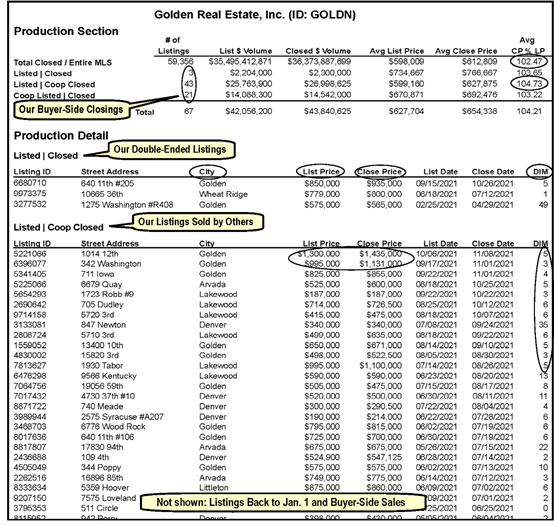
The MLS printout for Golden Real Estate below shows the information that can be gleaned about individual agents and their brokerages. I’m showing our company report, but I could have shown my personal report. This print-out shows our production since Jan. 1st of this year.

The Production Section at top summarizes the report, showing that we had 46 listings since Jan. 1st, three of which we sold ourselves.  We had 21 buyer-side closings. The right-hand column shows the average of closed price (CP) to listing price (LP) — 102.47% for all MLS sold listings but much better for Golden Real Estate’s sold listings — 104.73%.

In the Production Detail section, the right-hand column shows how many days each sold listing was on the MLS before going under contract. Notice there are no zero days in MLS (“DIM”) because every listing was exposed to the full market so it would attract the most buyers, and yet there are few listings that took over a week to sell.

The “City” column lets you know where the agent (or company) does most of its business. The “List Price” and “Close Price” columns are also instructive. I’ve circled the two most recent sales as examples of how much above the listing price we sold those listings, thanks to our “auction style” of handling multiple offers, as opposed to the “highest and best” approach of most listing agents. It takes more work, but yields better results (a higher price) for our sellers.

This is not to suggest that an agent’s production is the sole criterion you should consider in choosing your listing agent.  However, we learn from experience, which comes from actual transactions, not from years in the business. An agent with only five years’ of licensure but who does a dozen-plus transactions a year can be more “experienced” than an agent who has done a couple transactions a year over a 20-year career.

And let’s not forget about testimonials. Ask for them, and look for online reviews, too. We like www.RatedAgent.com, because it only displays reviews solicited from actual clients following a closing, so the reviews can’t be phonied up or altered in any way.

NAR’s ‘Clear Cooperation’ Policy Has Failed to Reduce the Number of Pocket Listings  

In November 2019 the National Association of Realtors (NAR) created its Clear Cooperation Policy (CCP) designed to end the practice of “pocket listings.” A pocket listing is one which an agent keeps in his or her “pocket,” hoping to sell it himself instead of giving other agents the opportunity to sell it. The incentive is financial. Roughly half the listing commission goes to the agent who sells a listing. If an agent sells the listing himself, he/she gets to keep the entire commission.

The term “clear cooperation” is a reference to the purpose of the MLS, which is “cooperation and compensation.” Every MLS member agrees to cooperate with other MLS members, allowing them to sell their listing. And every listing specifies the compensation which the buyer’s agent will receive — typically 2.5 to 2.8 percent in our market.

You can read the three previous articles I’ve written about this policy at www.JimSmithColumns.com. Those articles (in Nov. 2019, Feb. 2021, and Aug. 2021) document the creation of the CCP and its subsequent implementation by REcolorado, our MLS. The deadline set by NAR to do so was May 1, 2020.

My August 12, 2021, column described how our MLS is fining agents $1,500 for a first offense when they fail to put a listing on the MLS within one business day of promoting it outside their own office in any way — online, in print or via a sign in the ground.

One would think that with such a big penalty the number of homes selling with zero days on the MLS would have declined, but in fact they have increased. I didn’t realize that until I read a Nov. 3rd article from Inman.com which quoted a study by Broker Resource Network (BRN). The study pulled data from 24 multiple listing services comparing the number of homes sold with zero days on MLS during the 12 months before and after the May 1, 2020, implementation date.

“In every market reviewed across the United States, brokerages recognized double and triple digit increases in Zero Days On Market listings across firms of all sizes and business models,” the report said.  These were figures for big brokerages, not the full MLS.

So I checked REcolorado statistics to see what our full-MLS statistics are for homes sold with zero days on the MLS. I found that there were 2,225 such closings reported in the 12 months before May 1, 2020, and 2,769 reported in the 12 months after May 1, 2020 — a 24.4% increase.

To discover the longer trendline, I looked at several half-year periods going back to 2018. In the last 180 days (as of this past Sunday), there were 1,677 closings of resale residential listings recorded on REcolorado with zero days on MLS before going under contract.

During the same 180 days of 2020, there were 1,295 such closings, making this year a 29.5% increase over last year. The number in 2019 was even lower — 1,077.  In 2018 it was not much different — 1,104.

What could account for this counter-intuitive increase?

One explanation might be the explosion of the seller’s market during the pandemic, which really took off simultaneously with the implementation of the Clear Cooperation Policy (and the pandemic surge).

One way to assess the seller’s market is to measure how many homes went under contract after 4 days on the MLS during those 12 months before and after May 1, 2020, and the median ratio of sold price to listing price for those listings.

During the 12 months before the implementation of the CCP, there were 4,563 closings of listings which went under contract in 4 days, and the median ratio of sold price to listing price was 1.0019. During the 8 months after May 1, 2020, there were 4,896 such closings, and the median ratio was 1.01299.  Another 2,840 such closings took place during the remaining 4 months of the  12-month period after May 1, 2020, and the median ratio for them was 1.05157. Clearly, the seller’s market was accelerating. It makes sense that more sellers might receive offers they “can’t refuse,” and that listing agents might encourage them to accept those offers.

There was an important loophole created when the CCP was implemented by REcolorado and perhaps by those 24 other MLSs. That loophole is called the “office exclusive,” which allows any brokerage to promote an off-MLS listing within the brokerage, so long as there is no advertising of any kind on social media or in print and no sign in the yard — the definition of a pocket listing.

This policy greatly favored large brokerages which could have hundreds of agents in a dozen or more offices, to promote new listings internally with the additional incentive of keeping the full commission of each transaction within the brokerage.

If this loophole were to be closed, there would probably be far fewer closings with zero days in the MLS — and sellers might get more money for their homes by having them exposed to more competing buyers.

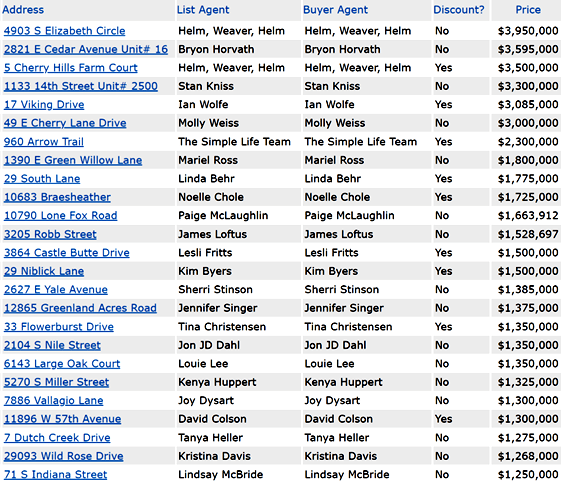
As I mentioned above, a listing agent profits from keeping a listing off the MLS, because it increases the chances of selling the listing himself and thereby greatly increasing his/her commission. Of the 100 homes on REcolorado which sold for $1.25 million or more in the last 180 days with zero days on the MLS, 25% of them were double ended (see list below), and only 9 of those 25 listings reduced the commission paid by the seller because of their listing agent’s windfall. (The agents at Golden Real Estate always discount our commission when we double-end a transaction.)

D0uble-Ended Sales On REcolorado Over $1.25 Million – Last 180 Days, Showing Whether Seller Got a Discounted Commission

By contrast, of the 100 highest priced homes ($1,575,000 and over) which sold after 4 days on the market, only 2% were double-ended. Whether or not you call it “greed,” the agents who kept their homes off the MLS greatly profited from it — and the sellers paid the price by not exposing their homes to all potential buyers.

Another recent article from Inman reminds us that Fair Housing was one of the reasons the Clear Cooperation Policy was introduced. A blog post on REcolorado also makes this point. The reasoning is that if a home is sold privately without being exposed to all buyers on an MLS, then it is more likely to be sold within the same demographic. Thus, pocket listings are inherently discriminatory against minority groups, whether they be racial or, for example, LGBTQ.

I’m sure that these articles and the studies behind them, including my own analysis of REcolorado statistics herein, will lead to some discussion locally and nationally about how to tweak the Clear Cooperation Policy so it is more effective and less counter-productive, which it clearly has proven to be. I do not believe, however, that the Clear Cooperation Policy will be scrapped, because its stated intention is clearly good public policy.

Sellers: Insist that your home is put on the MLS so that all interested buyers have the opportunity to see it and participate in a bidding war that nets you more money.