Here Are Some Strategies for Assembling Your Down Payment Funds

Last week I wrote about how  first-time home buyers can buy a home with as little as $1,000 out of pocket, but the rest of us may be challenged to come up with down payment money when we buy a home.

Many buyers assume that lenders require a 20% down payment, but that’s not necessarily true. There are loans available from many lenders with as little as 3% down payment. FHA requires 3.5%down, and qualified veterans can get a 0% down VA loan. On conventional loans the interest rate charged will probably be higher, but with rates for conventional loans so low, what’s an additional quarter percentage point or so anyway?

And don’t assume that every loan with less than 20% down payment requires mortgage insurance, which can be expensive. Often mortgage insurance is waived in exchange for a slightly higher interest rate.

So, first determine how much money you will need for your down payment, and shop around with different lenders, since this requirement can vary greatly. Generally, I recommend mortgage brokers instead of banks, because banks only sell their own loan products, but mortgage brokers can sell multiple products from multiple lenders, including special products for first responders, teachers, medical personnel, and others.

Once you know the amount you need to raise, how can you raise it when you don’t have that much cash in the bank?

Start your quest by asking advice from your loan officer. A good loan officer, like Jaxzann Riggs of The Mortgage Network, will be able to make suggestions once she (or he) has a full picture of your financial situation and assets.

Strategies I’ve seen employed include the following.

1) If you own a home currently and have substantial equity in it, you can borrow against that equity with a Home Equity Line of Credit or HELOC. Credit unions are good at issuing these loans to its members, but if you’re planning on selling, you need to apply for a HELOC before you put your home on the market. Since these loans have little or no closing costs and you don’t pay interest until you actually draw on that line of credit, there’s no reason not to have a HELOC in place right now and certainly ahead of needing the money. It’s like having money in the bank — literally.

2) If you have a high-balance IRA or other retirement fund, you may be able to withdraw money from it without penalty if you return that money within a couple months, so this is a good strategy if you need the money from selling your current home but don’t want to make an offer on your replacement home that is contingent on selling your current home. A loan against your 401K carries no penalty, I’m told.

3) If you own stocks and bonds but don’t want to sell them, consider using them as collateral for a loan.

4) Relatives or friends can gift you with money, but speak to your loan officer about documentation requirements. As you may know, anyone can give up to $15,000 per year to anyone else without paying gift tax.

5) Another option is a bridge loan. This option carries a higher interest rate, but it could be your answer.  Ask your loan officer.

6) Get creative! If you’re engaged, how about a bridal registry for down payment funds? A GoFundMe campaign might work for you, too. If you have no loan on your car and it’s worth a lot, credit unions will lend you money against it. (I did that once.) You may own jewelry or other valuables to which you are not so terribly attached that you might be willing to sell them. (Rita and I have done that, too.)

Don’t Fall for This Gift Card Scam

This Monday, people on my contact list received an email that looked as if it was from me, asking for “help.” If they responded to the email, it went to a scammer pretending to be me who said I was in a meeting but could they help me purchase some Google gift cards for me and I’d reimburse them.

This kind of scam doesn’t hurt the person who’s being impersonated, but it hurts his/her friends and contacts who fall for it. Tell your family and friends about this scam and don’t let them fall for it.

1,200+ Metro Area Homes Are Sitting on MLS – No Bidding Wars for Them

No buyer wants to be in a bidding war, but there are many listings on the MLS that aren’t selling, and submitting an offer won’t put you into a bidding war. You might even buy them for less than their listing prices.

As I write this on Sunday, there are 1,241 active (that is, unsold) listings on the MLS within 25 miles of downtown Denver that have been active 10 or more days. There are 764 that have been active a month or longer, and 483 that have been active 60 days or longer. And it’s not as if those 483 listings are in the boondocks. The map shown here (from REcolorado) shows where they are.

483 Homes on the MLS for 60 Days or Longer

As I’ve written before, any agent can set you up to receive only listings which have been on the MLS a certain number of days. It is a good way to avoid bidding wars.

    Let me or one of my broker associates below know if you’d like us to set up an email alert like that for you.

Jim Smith, 303-525-1851

Jim Swanson, 303-929-2727

Chuck Brown, 303-885-7855

David Dlugasch, 303-908-4835

Ty Scrable, 720-281-6783

Andrea Cox, 720-446-8674

Home Buyers Have Widely Differing Needs and Motivations

During my two decades as a licensed real estate agent and Realtor, I’ve met and worked with a wide variety of buyers and gotten to know their varying needs and motivations. Allow me to share some of that with you. I’ve identified at least five categories of buyers.

First-time home buyers: This group has always enjoyed a wide variety of programs to meet their special needs. By the way, you are deemed a “first-time” homebuyer if you have not owned a home for at least 3 years.

The primary need for this group is obtainable financing. We can connect first-time buyers with lenders who require as little as $1,000 out-of-pocket to get into a home, and who offer classes for first-time homebuyers to help them succeed as homeowners.

The motivation to change from renter to owner is well understood. Homeownership is the number one method of wealth creation. Not only are the taxes and interest on your home tax deductible (with some limitations now), but your home may well appreciate in value as much as or more than what you pay for it each month. Then, when you sell, your capital gain on it will be mostly or entirely tax free. With such incentives, first-time home buyers are highly motivated and rewarded for buying a home.

Move-up buyers: Homeowners frequently need to buy a bigger home or simply want to buy a more luxurious one. Typically, this is when children are born or adopted, but with Covid-19 we’ve seen homeowners who need more space to work at home, not just temporarily but long-term. Employers have learned that workers can be highly productive working at home, and employees like the lack of commuting time and expense — but they need space for a home office.

Downsizing buyers: Empty nesters rattling around in 5-bedroom homes with lawns to mow and bushes to trim are wanting, if not needing, to have a simpler life in a smaller home — perhaps a “lock-and-leave” home where they can travel and not worry about their home while they’re gone. Many of these homeowners have long ago paid off their mortgages, or their mortgage is small enough that they can buy a newer, smaller home and live mortgage-free. Taking out a home equity line of credit on their paid-off home could provide the cash to buy the replacement home without a contingency on the sale of their current home, which also allows them time to transition from one home to the next. That’s just one strategy that I can share if you are in this group.

Investors: I don’t work much with investors, preferring to work with people who buy a primary residence, but I have broker associates with extensive experience serving this group of buyers. With the bidding wars going on currently, investors, especially fix-and-flippers, are having trouble buying homes with enough margin to make a profit on reselling them, but it can be done.

Relocation buyers: In this column last week I wrote about “climate refugees” relocating to Colorado from areas with high climate risks. Others move here for jobs or family. Such buyers need to find the right city, community and home to buy despite being new to Colorado. That’s where they need us the most. Yes, we can give them tours and answer their questions after carefully listening to their needs and wants. Before they even come to town, I like to send them listings and FaceTime them as I preview homes of particular interest. In just the past month I sold an Arvada listing to a couple from Minnesota and a Denver listing to a couple from Los Angeles. Both went under contract based solely on my video tours and only saw the home in person when they came for the inspection a week or so later. They could have terminated at that time, but they both loved the homes.  I love my job!

How High Are Bidding Wars Pushing Up Home Prices?

We’ve all heard some crazy examples of bidding wars in which homes have sold for way over their listing prices, so I took a snapshot of just one day’s closings, limited to a 15-mile radius of downtown Denver. That takes in an area from Broomfield to Highlands Ranch and from Golden to Aurora. It does not include the City of Boulder.

The day I chose was last Friday. The source was REcolorado.com.

I limited my search to homes, condos and townhouses that were on the MLS at least one day and no more than 6 days before going under contract. Those are the listings that experienced bidding wars. I divided the results into homes which sold up to $500,000 and those that sold for more than that.

On April 16th there were 48 closings up to $500,000. The median home sold for 4.7% over its asking price. It was a tri-level home in Aurora listed at $420,000 which sold in 3 days for $440,000. Only 3 homes sold for the listing price and 2 sold for less. The highest ratio was 25.8% for a home in Aurora that sold in 1 day.

There were 68 homes that closed on April 16th for more than $500,000. The median home in that group sold for 8.3% over its listing price.  It was a 1950 ranch in Denver’s North Hilltop neighborhood listed for $600,000 that sold in 3 days for $650,000. The highest overbid in this group was 18.8% for a 2-story home in Westminster listed for $425,000 that sold in 5 days for $505,000. Only 5 sold for the listing price and 4 sold for less.

To get a statistically meaningful number of closings over $1 million, I looked at 68 such closings from April 1-16. The median ratio was 4.3% over listing price. The highest was for a 1954 bungalow in Denver which was listed at $965,000 and sold for $1,205,000, 24.9% over listing.

Note: These statistics reflect the bidding wars that were taking place during late March, when most of these listings went under contract. Today’s bidding wars appear to be even more intense. Stay tuned!

Golden Real Estate Wins Sustainability Award

Broker/owner Jim Smith and broker associate David Dlugasch pose with the Golden Sustainability Award in front of their two Teslas.

Back in 2010, Golden Real Estate was awarded the “Sustainability Award for Business” from the City of Golden for the brokerage’s solar-powered office. Eleven years later, we have been awarded this recognition a second time because of how much further we have taken our passion for sustainability.

Back in 2010 we had a 5kW solar array on our roof — enough to power our office, but little else. We had a couple other features — sun tunnels to daylight our office reducing the need for artificial lighting, extra insulation to reduce the amount of natural gas needed to heat the office, and we accepted polystyrene (aka Styrofoam) for recycling.

Now, we have 2 ground-mounted solar arrays adding another 15kW of solar power, providing enough electricity to heat and cool our office with heat pumps and to power our five agent-owned Teslas as well as offering free EV charging to the general public. We had our gas meter removed in 2017 and now our Xcel Energy bill is $10 to $11 per month, which is the cost of being connected to the electric grid. We are now a “net zero energy” facility — and we’re taking two truckloads of Styrofoam to a reprocessing center in Denver every month.

Thanks to “net metering,” the electric grid functions like a battery, receiving our excess energy during sunny days and giving it back to us when we need it. We like to consider our office an example that other businesses can aspire to, and we are grateful for this week’s recognition by Golden. Click on the following 2-minute YouTube video tour of our net zero office:

Lakewood Earth Day 2021 features this video tour of Golden Real Estate’s Net Zero Energy office.

Redfin Survey Suggests Colorado Will See Influx of Buyers Due to Climate Fears

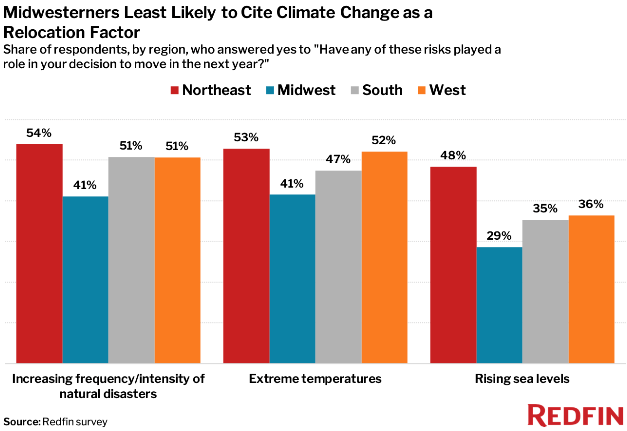
A recent survey of 2,000 U.S. residents by Redfin found that three-quarters of Americans are hesitant to buy homes in areas with a high climate risk. Those risks include more severe hurricanes & tornadoes, flooding, higher temperatures, wildfires, and rising sea levels.

It’s not hard to see why Colorado would be a favored destination for “climate refugees.” I have sold several homes to Californians recently, including just this month to my stepson, who currently lives in Sherman Oaks. 

We Realtors are seeing more and more of our listings going to out-of-state buyers, subjecting local buyers to increased competition in bidding wars.

If you’ve been paying attention to national weather reports, you can understand this trend. In California, the last two fire seasons have been terrifying. Last week’s earthquake in Los Angeles could have added to the situation.

In the Midwest, we have seen tornado after tornado destroying entire neighborhoods. And rising water temperatures in the Atlantic Ocean and the Gulf of Mexico are promising increasingly severe hurricanes and flooding.

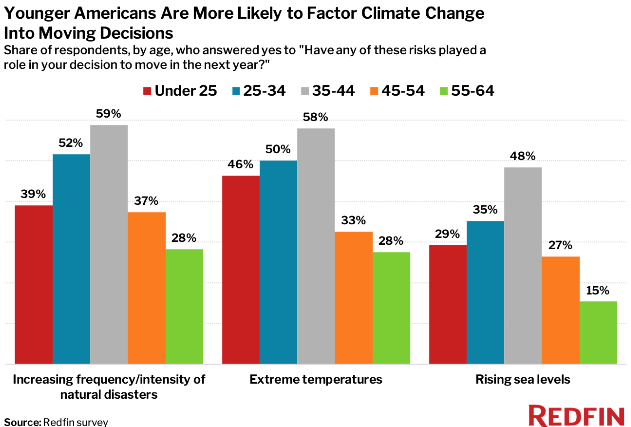
The Redfin survey broke down by age the reluctance of home buyers to purchase a home in such areas. What it found was that buyers between 35 and 44 years old have the highest reluctance, with buyers between 25 and 34 years old having the second highest reluctance to buy in such areas.

Fifty-nine percent of persons between 35 and 44 years old said that the increasing intensity and frequency of natural disasters played a role in their decision about where to move.  Fifty-eight percent said that extreme temperatures played a role, and 48% said that rising sea levels played a role in their decision.

For people 25 to 34 years old, the percentages were 52%, 50% and 35% respectively.

The lowest percentage of reluctance was among the oldest buyers surveyed, those between 55 and 64 years old. (For some unexplained reason, Redfin didn’t survey people 65 and older.) Only 28% of that age group said that natural disasters and rising temperatures were a factor in their decision to buy, and only 15% cited rising sea levels as a factor.

Among my own clients, I have been surprised at how many sellers — all of them seniors — have relocated to Texas and Florida. For some it was to be close to family. For others it was because of lower home prices. They benefited from our runaway seller’s market, buying equivalent homes for much less money in those states.

“Climate change is making certain parts of the country less desirable to live in,” says Redfin’s chief economist. “As Americans leave places that are frequently on fire or at risk of going underwater, the destinations that don’t face those risks will become increasingly competitive and expensive.”

Perhaps the Denver Post should bring back the phrase, “Climate Capital of the World,” below its front-page logo.

Golden Real Estate Wins Service Quality Award

For the second time, Golden Real Estate has been recognized by Quality Service Certification, Inc. for being among the top 20 small real estate brokerages for excellence in quality service.

The “Quality Excellence” Award is “awarded in recognition of the highest level of service quality and customer satisfaction in the real estate industry.”

The award is known as the QE Award. This year’s award recognizes the top 5 large companies, the top 10 midsize companies and the top 20 small companies, with the winning brokerages spanning 22 states and including some of the most respected independent and well-known national and regional brand names. We were recognized as one of those top 20 small companies.

The award is based upon the results of a post-closing survey of buyers and sellers who were in a real estate transaction with participating real estate companies. All Golden Real Estate clients have been surveyed since 2013.

Quality Service Certification, Inc. (QSC) and Leading Research Corporation of Laguna Niguel, CA, administer the survey process to ensure that every past buyer and seller is surveyed, preventing agents or companies from influence, interference or  manipulation in any way.

Larry Romito of QSC said that the QE Award is based on aggregated overall Customer Satisfaction as a percentage of all returned surveys of real customers, where every past customer has been surveyed without selectivity, editing, deletion, cleansing or manipulation. “No other system exists, anywhere in the real estate industry that can legitimately make that claim,” he said.

Find the reviews of all Golden Real Estate agents (including me) at www.RatedAgent.com .  

Higher Home Values Mean Higher Property Taxes

This amazing seller’s market is raising everyone’s real estate values, which is bound to be reflected in higher property taxes.

Early next month all property owners in the state will receive a notice from their county assessor assigning a new “full valuation” on which 2021 and 2022 property taxes will be based.

The good news is that the valuation will be as of June 30, 2020, avoiding the worst of the increases which we have see since then.

Look for another blog post in early May in which I will instruct you on how to tell whether your home’s valuation is too high and how to appeal it.

Manufactured and Modular vs. ‘Stick-Built’ Homes: Here Are My Thoughts

There has been some confusion in the real estate world over the term “manufactured” homes. Most recently the term has been applied to mobile homes — also referred to as single-wide or double-wide homes, which are transported fully finished to mobile home parks.

But “manufactured,” as I understand it, can be applied to a home whose walls, trusses and other components are put together in a warehouse, then shipped on flatbed trailers to a construction site where they are assembled and installed on a standard concrete foundation.

A “modular” home goes a step further, in that entire rooms might be assembled in a warehouse, transported to a work site and then assembled with other modules to make a complete house.

The first home I bought in Colorado was a ranch with walk-out basement in Golden’s Mesa Meadows subdivision. Only after I had moved in did a neighbor share with me how my home was put together in a day or two. Its components were manufactured in Fort Morgan and delivered to Golden only after the concrete foundation was ready to receive them. Anyone looking at the home would think it was a  “stick-built” home like the other homes in the neighborhood. When I bought it and when I later sold it, it wasn’t listed on the MLS as “manufactured,” because that would have felt like a misrepresentation, given the type of home it was.

The neighbor who explained that my home was actually built in Fort Morgan and assembled on site, explained how that process made for a better home. The exterior walls were 2×6 construction (to withstand the rigors of shipment) and they were fully insulated on the factory floor rather than on-site, resulting in better quality control. It made sense to me. It also made me wonder why more homes aren’t built that way.

I remember learning that an affiliate of Habitat for Humanity in Minnesota or Wisconsin constructs homes that way during the cold winter months — having volunteers assemble entire wall units in heated warehouses during cold spells, then delivering them to the site later on.

Every conventionally built home uses roof trusses that are made to order on factory floors and shipped to work sites on flatbed trailers, so why not have wall units made to order as well?

From 1933 to 1940 Sears Roebuck sold mail-order “Kit Homes” that were “pre-cut and fitted.” A 2-story colonial-style home called the “Martha Washington” was sold by Sears for $3,727. Other kit homes had names like the Cape Cod, the Ridgeland, the Franklin, the Dayton, and the Collingwood. See below for that model’s description from the Sears catalog. Many homes in Denver were built from Sears kits, but you’d never know it. Original owners of those homes are long gone, and the current owners of them probably have no idea.

There are definite economies to building homes that are “pre-cut” and partially pre-assembled off-site. For one thing, the factory workers can work every day regardless of the weather and even in multiple shifts. They can be more productive in a heated warehouse. There will be more efficient use of materials and more recycling and reuse as well.

Right now, the growing “tiny home” market is doing such construction and delivering modules or even entire homes to work sites, enjoying great economies in doing so. There is no reason that more elements of larger homes couldn’t be built off-site and delivered to construction sites for final assembly.

One example of off-site modular construction utilized in the building of sustainable homes is Structural Insulated Panels or “SIPs,” shown here.  Two sheets of sheathing have 4 to 5 inches of foam insulation between them. SIPs can replace walls built with wood framing and provide superior insulation.

Impresa Modular is a West Virginia company with a great website (www.ImpresaModular.com) describing the many kinds of off-site home construction methodologies they employ and sell.

There is so much innovation happening in home construction, much of which can not only reduce construction costs but can result in better insulated homes.

Here’s a picture of the manufactured home belonging to Butch Roberts of Salida, who sent the comment below: