It’s Suddenly Much Easier to Qualify for a Refinance of Your Home Mortgage

Refinancing has been all the buzz this year. Many homeowners have taken advantage of record-low rates to refinance their homes. Unfortunately, lower-income borrowers, especially those who lost income streams due to Covid-19, were unable to refinance because of income requirements. According to the Federal Housing Finance Agency (FHFA), over two million families could not refinance in 2020 when they might have benefited from it. As of June 5, 2021, this is no longer the case. Lower-income homeowners may now potentially save hundreds of dollars per month on their mortgage under a government initiative called “RefiNow.”

I spoke with Jaxzann Riggs of The Mortgage Network to learn about this program.

We have all heard the term “refinancing,” but you may not know why someone might consider refinancing. Homeowners choose to refinance their mortgage for different reasons. Refinancing your home could allow you to secure a lower interest rate, which lowers monthly payments, to shorten the duration of your mortgage, to switch to a fixed-rate mortgage, or to access equity.

While refinancing may sound ideal for your situation, the process and guidelines post-COVID have been quite strict and restrictive. One important factor in qualifying for refinancing is your debt-to-income (DTI) ratio. Your DTI is the percentage of your gross monthly income that you pay each month towards your debt and other obligations, including mortgage, minimum credit card payments, car loans, and student loans. Traditional loans require DTI to be under a certain threshold to refinance — typically under a maximum of 44%. Many people, especially service industry workers and small business owners, lost their jobs and sources of income during the pandemic, and the regulation regarding DTI was an obstacle to refinancing. RefiNow may be able to change that.

RefiNow, Fannie Mae’s new refinance option, makes it easier for homeowners earning at or below 80% of their area median income (AMI) to refinance at a lower interest rate to reduce their monthly payment. This new program is designed to lower the barriers that keep low-income borrowers from refinancing, which have historically resulted in those borrowers refinancing at a slower pace than higher-income borrowers. With RefiNow, you are allowed to have a DTI of up to 65% (instead of 44%) and you will be given an appraisal credit of up to $500. The new program does not just benefit homeowners, it helps lenders because it improves the probability that homeowners who may have been struggling to make their current payments will be able to make future payments, resulting in fewer pandemic related foreclosures. Don’t despair if your loan is owned by Freddie Mac (FHLMC). Freddie is slated to offer a similar loan program in the next few weeks.

To qualify for RefiNow, you must have:

> A Fannie Mae-backed mortgage secured by a one-unit, principal residence. Unsure? Go to https://www.KnowYourOptions.com/loanlookup

> A current income at or below 80% of the Area Median Income (AMI) This varies by census tract, but your lender can look this up for you.

> Not have missed a mortgage payment in the past six months, and no more than one missed mortgage payment in the past 12 months.

> A debt-to-income ratio of 65% or less, and a minimum 620 FICO score (minimum 660 FICO score for manufactured homes).

> A reduction of at least $50 per month on the new loan and you may not access any of your equity.

If you are not sure if a RefiNow loan is right for you, reach out to Jaxzann Riggs at (303) 990-2992 with any questions and to discuss your best options.

Legislation Bans HOA Limits on Political Flags & Signage

Before the current session of the Colorado General Assembly ends this Saturday, it will send to the Governor a bill which bars HOAs from limiting the display of partisan flags and signs.

The bill’s prime sponsors are Rep. Lisa Cutter of Jefferson County and Sen. Robert Rodriguez of Denver, both Democrats.

The title of the bill is “Homeowners’ Association Regulation of Flags and Signs” with the subtitle “Concerning additional protections for homeowners’ freedom of expression in common interest communities.”

Sounds like a good idea, right? Who is (or dares to be) against freedom of expression? It has attracted 11 other representatives and 5 other senators as sponsors.

However, let’s consider the unintended (or perhaps intended) consequences of this law. Basically the bill only allows content-neutral regulation of signs and flags, prohibiting only commercial messages.

Considering the political divide in our country and the extremism on each side of it, do we really want to allow unfettered display in our communities of right-wing and left-wing signs and flags?

I can live with the fact that a neighbor might be a QAnon follower, but I don’t want his lawn festooned with conspiracy messages or even Trump 2024 flags and signs without any limitation on their number or duration of display.

Currently it is common for an HOA to bar flags or signs of a political nature unless they are for a particular candidate or ballot measure and to limit their display to 45 days prior to an election and a short period afterwards. The effect of HB21-1310 would be to bar HOAs from enforcing any such limitation on the display of any political message at all, even if the membership voted for such a limitation.

If this bill becomes law, look for signs cropping up in your neighborhood for “Stop the Steal” or “Black Lives Matter” or “White Power” or even hate speech that’s reduced to a slogan. Do we need that much freedom of expression right under our noses every, day year round?

This can only serve to rile up divisions among neighbors who were heretofore happily ignorant of each other’s political beliefs. I can picture neighbors removing or destroying signs and flags they disagree with. These actions will be caught on cameras leading to criminal complaints and sometimes violence.  Do we really want to go in this direction?

Homeowners and renters are entitled to the quiet enjoyment of their premises. Unleashing this “freedom of expression” through flags and signs will only work against that principle.

I hope Governor Polis vetoes this bill when it gets to his desk.

Let’s Make Our Summer a Little Bit Quieter

Walking our dog, Chloe, is a favorite daily routine for me. Recently, I passed a neighbor mowing his lawn with a battery electric lawn mower, and I thanked him for doing so. “I love it,” he replied, and it got me thinking how nice it would be if more neighbors ditched their noisy gasoline lawn mowers, edgers, trimmers and blowers now that electric versions of each (both battery & corded) are widely available and affordable.

The next time your gas-powered device needs a tune-up, use that money to purchase of an electric version and you’ll enjoy not only a quieter neighborhood but no future tune-ups, no struggles to start the device, and lower cost overall.

I have read that a lawn mower emits more pollution than an automobile. A quick Google search on the topic produced the following:

“The EPA estimates that hour- for-hour, gasoline powered lawn mowers produce 11 times as much pollution as a new car. According to the EPA, each gas-powered lawn mower produces as much air pollution as 43 new automobiles driven 12,000 miles per year – lawn care produces 13 billion pounds of toxic pollutants per year.”

My stepson has a small lawn and is happy to use an old-style rotary push mower. I have a 10-year-old corded electric mower that has never needed repair and a battery powered weed eater which only needs me to replace the string now and then — my biggest annoyance!

Just Listed: Littleton Home Backs to Greenbelt

DCIM\100MEDIA\DJI_0297.JPG

Vintage Reserve is a special community in unincorporated Jeffco. This 4-BR home at 5359 W. Hoover Dr. (just listed for $875,000) has one of the best locations, backing to a greenbelt, with two trailheads just 4 doors away! Other trails lead to the neighborhood’s fabulous clubhouse, playground and picnic area. With a main-floor bedroom and 3/4 bath, this is a fine home for aging in place or for having senior guests. There’s a lot to like about this home, which requires little or no updating, unless you want to finish the walk-out basement, which has rough plumbing for a bath. Find more pictures and details at www.LittletonHome.info, then call your agent or Jim Smith at 303-525-1851 for a private showing. It will be open this Saturday, June 12th, from 11 a.m. to 2 p.m. Showings begin on Thursday, June 10th, and it will not be sold prior to June 14th.

DCIM\100MEDIA\DJI_0293.JPG

Just Listed: 2-Bedroom Arvada Patio Home

DCIM\100MEDIA\DJI_0305.JPG

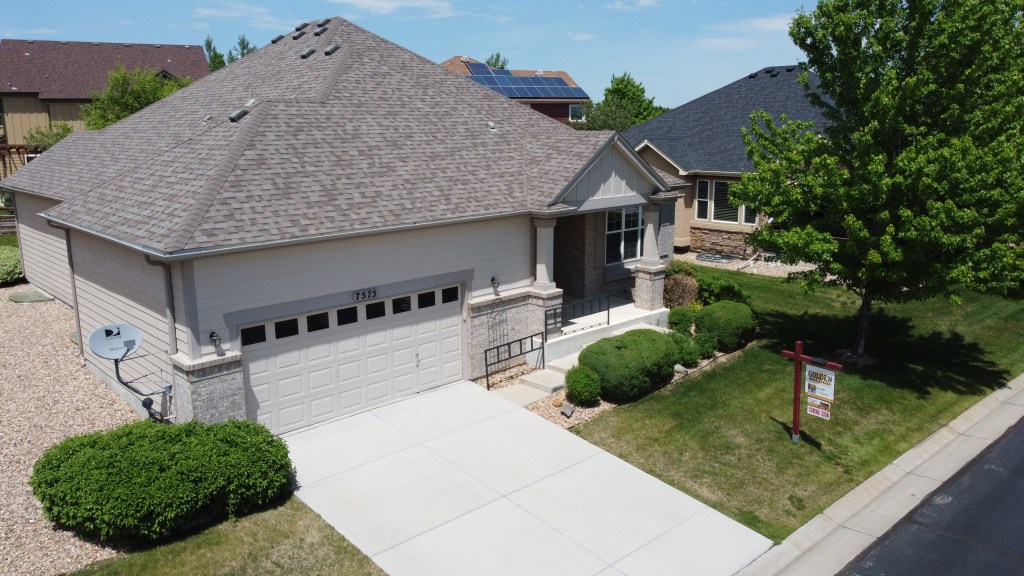
Good patio homes are hard to find, and this one at 7575 Loveland St. in Arvada’s Saddle Brook subdivision is going to make some buyer very happy. It was just listed for $650,000. Like a true patio home, there is no mowing or yard maintenance to handle — it’s done by the HOA, along with snow removal from your driveway, walkway and front porch! It’s not a senior community, but seniors find the maintenance-free living to their liking, allowing them to “lock and leave” without anyone knowing they’re gone. Everything is on the main floor, including the laundry, and all appliances are included — even the high efficiency washer and dryer. The basement is unfinished, but does have rough plumbing for another bathroom and a second set of laundry hook-ups. You can take a video tour with drone footage at www.ArvadaPatioHome.info, then call your agent or Jim Smith for a private showing. This home will be open both Saturday and Sunday, June 12th & 13th, from 11 a.m. to 2 p.m.

DCIM\100MEDIA\DJI_0299.JPG
c

NAR’s Member Profile Reveals Drop In Realtors’ Median Income

Despite the pandemic and the shortage of active listings, the membership of the National Association of Realtors (NAR) grew by 5.7% in 2020 over 2019. Perhaps it was because people lost their hourly or salaried jobs and moved toward self-employed occupations such as real estate.

Some of those new Realtors just might want to reconsider their career choice when they read NAR’s 2021 Member Profile based on 18,209 respondents. Here are some of the results, bearing in mind that roughly half of licensed real estate agents are not Realtors, a term only members of NAR can use. I consider NAR members (“Realtors”) the agents who are serious about real estate, since Realtor dues are about $500 per year. Licensees don’t join a Realtor brokerage unless they hope and expect to justify that expenditure.

Real estate has always attracted people who perceive it as a high income profession. They don’t realize that the “80/20 rule” applies as much to real estate as it does to any profession. While that rule would suggest that 20% of Realtors earn 80% of the income, it’s actually worse. I would estimate that 10% of us earn 90% of the income.

I’ve been a Realtor for nearly 20 years, so I know a lot of fellow agents, yet it continues to surprise me that most listings in my own city are by agents — usually Realtors — I’ve never heard of.  Looking at the six active listings in Golden as I am writing this column, I’ve only heard of one of the listing agents, and he had only 10 sold listings in the past 12 months. Another of the six had one sold listing, a third agent had two sold listings, and a fourth agent had zero sold listings in the last 12 months. (I had 25 sold listings.)

According to NAR, the sales volume per Realtor dropped to $2.1 million. With our median sales price in Denver’s MLS at $438,239 in 2020, that’s less than five closings per Realtor.

The median gross income of Realtors has never been over $50,000 per year, and it fell 13% from $49,700 in 2019 to $43,330 in 2020, according to the Member Profile. And that is gross income. Realtors are typically self-employed and have lots of expenses, with the median for 2020 being $5,330. That brings the median net income down to $38,000. For Realtors who specialize in residential real estate, the median net income for real estate activities in 2020 was even lower —$23,500. Depending on family size, that is at or below the poverty level!

73% of residential specialists said that real estate activities provided 75% or more of their personal income. 56% of residential Realtors say that it is their only occupation. 29% say it has never been their primary occupation.

Realtors with 16 or more years in the business had a median gross income of $75,000 in 2020, down from $86,500 in 2019. Realtors with 2 years or less in the business had a median gross income of $8,500, compared to $8,900 in 2019.  Welcome to your new profession!

Missing from the NAR report is how many members (who probably thought real estate was their path to wealth) dropped out in their first or second year of membership.

The largest expense for most Realtors is vehicle expenses —$1,200. (My largest expense is, no surprise, advertising!)

Of the respondents to NAR’s survey who specialize in residential real estate, 23% reported no transactions in 2020. Another 32% reported between 1 and 5 transactions in 2020. The median was 4 transactions for males and 5 transactions for females. Notably, the median for White/Caucasian residential Realtors was 7 transactions, compared to between 2 and 3 transactions for other racial groups.

Here are some other findings from the 2021 Member Profile that I found interesting.

The median age of a Realtor is 54, unchanged from when I entered the business (as a 54-year-old) 19 years ago.

The typical Realtor has 8 years’ experience. 17% of residential Realtors said it was their 1st career. 49% said it was their 2nd career, and 34% said it was their 3rd or more.

79% of respondents were “very certain” they would remain in the business another two years.

Most Realtors worked 35 hours per week in 2020, down from 36 hours in 2019. (I work at least 60 hours/week and am still married…)

Text messaging is the top method of communication that members use with their clients, at 93%, followed by phone (90%) and email (89%).

88% of Realtors work as “independent contractors,” meaning they live on commission income alone, have no tax withholding and pay all their own expenses.

Realtors change firms a lot. The median tenure of Realtors with their current firm is five years.

65% of Realtors are females, up from 64% last year. (As I understand it, RE/MAX broke the gender barrier back about 1970. Before that, our industry was virtually all men — and they wore suits and ties to work.)

82% of Realtors own their own home, and 37% own a secondary property.

86% of brokerages are independent, non-franchised, mostly with a single office and typically have only two full-time licensees.

The typical residential brokerage has operated for 14 years. (That’s us! Rita and I founded Golden Real Estate in July 2007.)

Brokerages typically got 30% of their customer inquiries in 2020 from referrals by past clients, 25% from repeat business with prior clients, 10% from their website, and 10% from social media. (Golden Real Estate gets well over 75% of its business from readers of this column, which has appeared every week without fail for over 15 years.)

Firms with only one office typically had 18 transactions in 2018. (Golden Real Estate does much better, closing 45 seller sides and 22 buyer sides in the last 12 months.)

Of respondents to NAR’s survey, 57% were White/Caucasian, 20% were Hispanic/Latino, 16% were Black/African American, and 8% were Asian/Pacific Islander. 60% were female and 38% were male. 89% were heterosexual, 3% were gay/lesbian, and 6% preferred not to say.

Do You Own a Green Home?

The Metro Denver Green Homes Tour is looking for homes to feature on its next tour, October 2nd, 2021. If your home has features that would make it a good addition to this fall’s green home tour — super insulation, solar, HVAC, etc. — contact Sheila Townsend at sheilactownsend@gmail.com or Jim Smith at Jim@GoldenRealEstate.com.

Take a video tour of a different home from 2020’s Metro Denver Green Homes Tour every month at www.GreenHomeoftheMonth.com.

Here’s Some Practical Advice on Avoiding Scams When Hiring a Moving Company

I have never been scammed by a moving company, because I have never used one. The last time I remember seeing a moving company truck at my home was when Mayflower moved my family from Maine to Denver in 1953. As an adult, I always used U-Haul trucks until I bought my first box truck as a Realtor in 2004.  

So, I have no personal experience to call upon when it comes to being scammed by movers, but, according to a federal agency, 1 in 10 consumers falls victim to a moving scam. That agency, which is part of the Dept. of Transportation, is the Federal Motor Carrier Safety Administration.

“Stop Moving Scams in their Tracks” is just one useful section at fmcsa.dot.gov/protect-your-move.

I was reminded of this topic last week as Rita’s son and daughter-in-law hired a moving company to move from L.A. to Denver. They described the experience of hiring and working with their movers as nightmarish. Coincidentally, this week I also received and read a blog post on this subject by Anita Clark, a Coldwell Banker agent in Florida.  Much of the following is inspired by (or from) her useful blog post.

The most important thing you can do to protect yourself is to have a written contract that clearly states what the mover will do as part of the terms of the contract. If the contract is vague or does not specifically identify what they are responsible for, you will need to resolve those issues before signing any contract. You do not want to get caught with questionable fees at the end of your move.

As with anything in life, if a mover’s quote looks too good to be true, it probably is. Quotes from legitimate companies should be within 10% of each other. If one quote is much lower, you’d be wise to not go with that company because they’ll probably get you later with hidden fees, as described below.

Typically, movers ask for a deposit up front and full payment before they open the truck at your new home. That’s when they could hit you with those unexpected charges, with urgency and lack of management present working against you.

In her blog post, Anita listed the following common hidden fees consumers might encounter:

Gas fees: Gas costs to pick up and deliver items.

Assembly/disassembly: To take apart or put items back together.

Bulk items: Piano, large appliances, outdoor equipment, etc.

Environmental: Typically seen as a disposal fee, such as for moving materials.

Insurance: Moving companies are required to assume liability for the items they are moving.

Packing labor & supplies: This can be costly, so consumers should understand what is included in their contract.

Tolls: You shouldn’t pay these.

Weight: A company might give a low quote based on a weight estimate but a new and higher price once they drive to the scale and weigh the truck. Another way these movers overcharge customers is by adding weight (e.g., fuel or passengers) to the truck before weighing it.

 Some of the key things you can do to avoid moving scams are:

Online company check: Review their history, reviews, website and BBB rating and interview past clients if possible.

In-person quote:  Always ensure that a moving company representative comes to your house so he/she can prepare an accurate estimate.

Written contracts: If you aren’t offered a written contract or the contract does not itemize the services and fees, avoid that moving company.

This is just some of the information and advice which you can find at that FMCSA website mentioned in the second paragraph above. If you are contemplating a move in which you can’t use Golden Real Estate’s moving truck, moving boxes, packing material and personnel, definitely learn all you can from that website.

A recurring issue that my own clients have described when moving to or from another state is a “delivery window” of 10 or more days written into the contract. The mover may insist (verbally) that the truck they loaded is going directly to your new home, but unless your stuff filled an entire semi trailer, it’s quite likely that they will wait to combine your stuff with that of another party moving to the same city or state. This might, of course, entail moving you furniture from one truck to another or into a warehouse, then into another truck.

To avoid this double or triple moving of your stuff, I suggest using a “pod” moving company. You load the pod (container), lock it, and it is delivered to your new home.

Arvada’s Net Zero Energy Geos Community Faces a Challenge From New Developer

The Geos Community located southwest of Indiana Street and 72nd Avenue in Arvada is a shining example of what’s possible in net zero energy home construction.

Geos Solar PV

All Geos homes are solar powered and have no natural gas service. Heating and cooling is provided by ground source or air source heat pumps. Water heaters utilize heat pumps, not gas, and all the homes and townhouses are built according to passive solar design standards.

 Two Geos homes were on last fall’s Metro Denver Green Homes Tour, and you can view narrated video tours of them by clicking on that link.

Now a developer has bought the remaining land within the Geos Community but is intending to install natural gas service in all the homes they will build. Naturally, the current residents are quite upset about this turn of events and are hoping to convince the City of Arvada not to allow this diminution of the original intent of Geos to be a strictly net zero energy community.

Visit www.DiscoverGeos.com to appreciate this community’s net zero energy mission.

Rainer W Gerbatsch, a Geos resident, in an email to Linda Hoover, Senior Planner for the City of Arvada, expressed concern about the new developer’s plan to deviate from the community’s principles by installing natural gas in future homes. Here is Ms. Hoover’s emailed response:

Thank you for your strong interest in your community.  I was forwarded your concerns regarding the new upcoming development in the GEOS Neighborhood and I will do my best to address your comments.  The GEOS Development was approved 12 years ago.  I took over as the staff planner for this project in 2014 when the previous planner left the City.  When GEOS was approved, it was intended to be a sustainable community and Norbert Klebl tried for many many years to obtain the funding to make that happen.  To date,  the only homes constructed out there are on Block 10 which has a mix of the staggered “checkerboard” single family detached homes and townhome units.  This totals approximately 38 units out of the 282 planned.  While the existing homes have a number of sustainable features, SunStudios (Architect) and Laudick Engineering are telling us that marketing of this concept has been very difficult in part due to the economics of having a development without gas service and other unique features of this development, such as having custom designed mechanical heating systems, etcetera.  Most of the larger home builders want developments that have gas service.  As you may know, this development went through a bankruptcy last summer.  The new owners are currently in the process of working with a new builder – Dream Finders Homes.  As Dream Finders comes on board, they are planning on keeping many of Norbert’s original concepts, but wanting to make some adaptations to make it economically feasible.  The lot layout which has the staggered checkerboard placement of single family detached homes in the middle of the block and townhome units on the ends of the block will remain as originally intended.  As a result these homes will continue to have the same architecture and passive solar design.  In addition, solar panels will be placed on the rooftops and appliances will be energy efficient.  These new homes will follow the Building Code to construct energy efficient homes.  The building codes adopted by the City already allow various paths/choices to construct very efficient (minimum energy code) all the way to net-zero buildings – the traditional codes were followed to build the first 38 units. It is my understanding that DreamFinders would prefer to have the project served by gas, but are still looking into the economics of this issue.   

This development was and still is zoned PUD (Planned Unit Development) which has its own unique design requirements rather than following the standards in the City’s Land Development Code (LDC).  The GEOS Design Book states that “architecture should strive for Energy Self-Sufficiency and the avoidance of Fossil Fuels.”  It also identifies net zero homes as one of the intended goals (not requirements) and further clarifies that that “goal can be achieved by combining good solar orientation and good insulation with geothermal or solar thermal heat, and photovoltaics.” However, it is silent on the issue of gas service.  

As a result, we would allow the development to be built without gas service (just as was done for the first phase of GEOS) provided alternatives were ensured.  However, no restrictions were included in the Design Book or on the project approvals that prohibited gas service. Passive systems, energy efficient buildings, heat recovery ventilation are guidelines not requirements.  

Sent 5/13/2021

Here is Rainer’s response to Ms. Hoover’s email:

I am familiar with the background of GEOS and the more recent events. Contrary to your statement that net-zero homes are difficult to sell, recent sales activity of homes in GEOS show just the opposite – there is high interest in these homes resulting in higher than expected returns for the seller and very short listing periods. It would appear that cited developer/builder statements are either uninformed or demonstrate an unwillingness to engage in construction practices that are a win-win situation for the builder, the buyer, and perhaps most importantly, the environment we all rely on. Also, I contacted and asked the architect whether he supported the cited developer/builder statements, and he responded that he did not.

Studies of completed net-zero buildings in Colorado (including GEOS) conducted by SWEEP also show that the initial cost of net-zero, all-electric homes at this time is on par with so-called traditional (polluting) construction. Net-zero construction represents a clear choice once future buyers understand that (1) these homes represent (already at this time) substantial yearly savings in energy use/expenditures (fossil fuel based energy costs will only increase as the cost of natural gas escalates based on the need to curtail and ultimately eliminate gas as a potent driver of climate change), and (2) eliminate health risks related to exposure to gas appliances and fossil-fuel burning heating devices that generate a variety of air pollutants which have been linked to cancer, decreased lung function, heart disease and a host more diseases. While these risks have been recognized for some time, they are finally receiving mainstream media attention. However, resolution is not possible without the engagement of all levels of government with developers/builders on more responsible construction practices. In summary, net-zero construction is currently superior to traditional construction because of reduction in emissions, elimination of health issues traced to fossil fuel based energy use in homes, and escalating future costs of fossil fuels, particularly natural gas.

GEOS’ prominence as a leader in de-carbonized and sustainable community living is recognized locally (we have been visited by members of sustainability committees of several Colorado towns), and nationwide (CNN’s chief environmental correspondent Bill Weir visited GEOS; CNN will be airing a nationwide broadcast on GEOS, highlighting its features as the model for home construction to achieve decarbonization and healthier interior air quality for residents). In that vein, responsible governments on all levels are preparing and committing to road maps with the goal to rapidly reduce emissions in home construction through elimination of fossil fuels, increased efficiency in appliance/lighting and heating/cooling, as well as the production of on-site renewable energy. In order to have an effective road map, commitments are required which mean nothing less than elimination of fossil fuel use in all new buildings. Consider that the IEA has just issued a special report; this statement stands out: Fatih Birol, the IEA’s executive director and one of the world’s foremost energy economists, told the Guardian: “If governments are serious about the climate crisis, there can be no new investments in oil, gas and coal, from now – from this year.”

It is 2021, and permitting a developer/builder team the inclusion of natural gas infrastructure for about 250 new homes, based on questionable developer/builder concerns of perceived marketability or economics, thereby locking in emissions for the life of the buildings, subjecting owners to health risks related to gas pollutants and escalating energy costs (not considering future mandated retrofits based on the trajectory of climate induced changes), is not responsible, sets the wrong signal and constitutes a serious setback in rising to the challenges of the climate crisis.

The City of Arvada has the opportunity and responsibility to address the climate crisis, facilitate the transition from fossil fuels to renewable energy, and protect the health of residents from natural gas pollutants. Both can be realized, simply and effectively, through rapid adoption of policies and building codes that support state and nationwide goals in emission reductions. We urge you to demonstrate your commitment to a sustainable future not only through elimination of the fossil fuel infrastructure for the next phase(s) of GEOS, but through a city-wide commitment to net-zero construction, fossil-fuel free construction.

Sent 5/20/2021

I Have Reserved a Ford F-150 Lightning Electric PIckup

By JIM SMITH

There’s a lot to like about Ford’s electric version of their popular F-150 pickup truck, and I joined more than 50,000 others who reserved one of them on the first two days it was available for reservations.

I’m a big fan of Teslas — Rita has a Model S and I have a Model X — but I’m no fan of its long anticipated Cybertruck. I like that Ford’s EV has the same styling and functionality of the standard F-150, plus over-the-air software updates (like Tesla), and its battery can power my home in the event of a power failure. You can reserve your own at www.Ford.com. The starting price is under $40,000, so the cost after federal and state tax credits will be under $30,000. 

For a detailed article about the F-150 Lightning Pro by Green Car Reports, click here.