
Many Renters Are Unaware of Programs That Make Homeownership a Possibility

Last week I wrote about the challenges facing buyers who must sell their current home in order to buy a new home and are not sure how to accomplish that.

This week, I’m going to address the different challenges facing renters, including first-time home buyers.

There are many programs for first-time home buyers, but did you know that anyone can qualify as a first-time home buyer if he or she hasn’t owned a home for at least three years? You could have owned many homes in your lifetime, but if you haven’t owned one in the past three years, you can take advantage of these special programs.

A common misconception among people who want to buy a home is that a 20% down payment is required, but that is simply not true. Another misconception is that if you put down less than 20%, you’d be required to pay for mortgage insurance. There are conventional loans available with as little as 3% down that don’t require mortgage insurance. That differs from the 3.5% minimum down payment required for FHA loans which do require mortgage insurance which continues for the life of the loan.

One of our preferred lenders, Scott Lagge of Movement Mortgage, compares the low costs of available programs to what renters pay when they lease a condo or home. Typically, renters need to come up with the first and last month’s rent plus a damage deposit.  Some first-time home buyer programs have out-of-pocket costs as low as $500.  Moreover, your partially tax-deductible mortgage payments could be as low or lower than what you’d pay in totally non-deductible rent.  

When I bought my first home in Golden in 1997, I was single but I had a good friend (also renting) who agreed to rent a room from me if I bought a suitable home. I found a ranch-style home with a walk-out basement that worked perfectly. He lived in the basement, I had a main-floor master suite, and he had access to the kitchen. We both saved money over renting, and I was building equity in my home. This is a formula that can work for anyone – if they have someone they’d like to have living in their basement!

There are programs from CHFA (the Colorado Housing & Finance Authority) that offer a grant of up to a 3% of the first mortgage loan amount, or up to 4% through a “silent” second mortgage that accrues no interest and requires no payment until the first mortgage is paid off, either at maturity, refinance or resale.

Scott claims that the best first-time homebuyer program of all is his company’s Dream to Own Loan.  This loan includes a silent second of 4% of the purchase price to be used for down payment and closing costs. This is the closest thing to a no-money-down loan that Scott’s aware of for first-time buyers.  There’s no mortgage insurance and the rates are competitive.  Call Scott at 303-944-8552 for more details.

Another great option for renters is a rent-with-option-to-buy program which you can read about at www.HomePartners.com.  The way it works is that you only have to qualify to rent a home which that company then purchases so you can rent it.  They’ll pay up to $500,000 for almost any home (except a condo) that’s on the MLS once you agree to rent it at a pre-determined rental amount based on the purchase price.  You can rent the home for up to five years, knowing in advance what your rent will be for all five years, but at any time you can buy that home at a price that is also agreed to in advance. Call Golden Real Estate to apply for this program.

That program is also a good option when your credit isn’t strong enough to buy right away but you know it will be better within five years. You can also use the program for the peace of mind that comes from knowing what you’ll pay in rent for five years and that you won’t have to move.

It’s also a good program for people relocating to our area who see a home they may want to buy but feel better renting it with an option to buy it later on if they like it — but they don’t have to.
Timing the Sale of Your Current Home and Purchase of New Home Can Be Challenging

Have you faced this dilemma? You want to buy a home that better fits your family’s needs, but you are stymied by the need to sell your current home to pay for the next one.  So you stay put in a home that doesn’t quite meet your needs.

There are several ways to tackle the challenge of buying a home when it depends on selling your current home. Let’s look at different scenarios based, first of all, on the amount of equity you have in your current home.

If you own your home “free and clear” and are downsizing to a lesser priced home, the easiest path is to take out a home equity line of credit (or HELOC) on your current home. This kind of loan is easier to obtain than a standard mortgage, especially when done through a credit union. Note: You must do this before going on the market.

When I obtained a HELOC from a credit union, they didn’t even charge for title insurance and did only a “drive-by” appraisal, and the closing took place at the loan officer’s desk with no closing fee. It couldn’t have been easier.

If you have a mortgage on your home but still have substantial equity, a HELOC can provide the cash you need for a 20% down payment, which is what’s required to get the most favorable interest rate on the mortgage for the home you’re buying. You would no longer be a cash buyer for your new home, and the mortgage lender for your home purchase may make the sale of your current home a condition for approving the loan on your new home, depending on the size of your income and the ratio of your debts to your income. But that doesn’t mean you can’t succeed in buying the new home.

Under the right circumstances, a seller and his/her listing agent will consider an offer that is contingent on the sale of the buyer’s current home. I have succeeded in this process as a buyer’s agent by showing that the buyer’s home is ready to be listed immediately and will be priced to sell quickly based on a market analysis.

Don’t expect, however, to win a bidding war against non-contingent buyers. You can avoid bidding wars and succeed with a contingent offer by looking only at homes that have been on the market over two weeks. Your agent can set up an email alert with that being one of the search criteria. Then be sure to include in the contract the price that you are going to list your home and submit with it a market analysis demonstrating that it is priced to sell quickly. That market analysis should include a spreadsheet of comparable homes sold in the last six months, showing days on market, and a price per square foot that is higher than the price per square foot of your home at the listing price specified in your offer. Your agent could even enter the home on the MLS as an “incoming” (not yet active) listing, complete with high quality photos, showing that you’re ready to “pull the trigger” immediately after your contract is accepted on the new home.

The contract to purchase your new home could have a closing date of 45 to 60 days, and if you have priced your current home correctly, you should get multiple offers and be under contract within, say, four days with a buyer who has agreed to match the closing date on your new home.

One of the deadlines in a contract to buy a home is the contingency deadline, after which you would lose your earnest money if you fail to close on your purchase.  That date should not be the day of closing but maybe a week earlier. If the contract to purchase your current home has the same date for that last opportunity for your buyer to terminate and get their earnest money back, you can have some peace of mind about everything working out well.

When I write a contingent contract, I like to add a provision that the seller can terminate if my buyer’s home is not under contract within, say, a week or 10 days after going under contract. That increases the likelihood of acceptance.

(I’ll write about the challenges facing renters who want to become home owners in next week’s column.)

Readers Responded in Great Numbers to Our Offer of Free Neighborhood Alerts

In last week’s column, I offered to set up Free Neighborhood Alerts for any reader who wanted to keep track of real estate activity in his or her subdivision or larger area. The response was overwhelming. I myself have received over 40 requests, keeping me so busy that I’ve had to make time to write this week’s column!

I’m not complaining. My broker associates and I are pleased to make this service available to everyone who wants it, and we’ve become pretty efficient at creating these free alerts.

We’re able to fulfill more requests, so feel free to ask for your own neighborhood alert. All our broker associates are able to create these highly personalized reports.  Just give us your address and the boundaries of the area you wish to monitor. The initial alert will tell you all the active, under contract, sold, withdrawn and expired listings in that area, going back 90 or 180 days or longer. Future alerts will come to you within 15 minutes of a new or changed listing being entered on the MLS. You will literally be up-to-the-minute in your knowledge of real estate activity in your neighborhood!

I’m happy to handle every request I get from readers, but if you know one of our broker associates, feel free to direct your request to him or her. They are more than happy to provide this free service.

Send your requests by email only, please. Here are the names and email addresses of our broker associates:

Chuck Brown — Chuck@GoldenRealEstate.com

Kristi Brunel — Kristi@GoldenRealEstate.com

David Dlugasch — David@GoldenRealEstate.com

Debbi Hysmith — Debbi@GoldenRealEstate.com

Norm Kowitz — Norm@GoldenRealEstate.com

Andrew Lesko — Andrew@GoldenRealEstate.com

Carrie Lovingier — Carrie@GoldenRealEstate.com

Carol Milan — Carol@GoldenRealEstate.com

Jim Swanson — Swanson@GoldenRealEstate.com

In addition to setting up the neighborhood alert for you, we will also send you valuation reports on your home using two different software packages that you will find are much more accurate than, say, the Zillow “Zestimates” which home owners are used to seeing. We can also provide a spreadsheet of active, under contract and sold listings that are comparable to your own home as a double-check on those valuations.

Why Be in the Dark About Real Estate Activity in Your Neighborhood? We Can Help.

If you’re like most people, you probably consult Zillow to find out what your home is worth, and you track the activity in your area by watching for yard signs and looking online to learn their listing and selling prices.

At Golden Real Estate we offer a Free Neighborhood Alert, which notifies you by email within 15 minutes every time a home is listed, goes under contract and is sold.  Wouldn’t it be nice to have that information automatically and instantly?

Such alerts cost us nothing to set up, and the emails are sent by computer without any additional work on our part, so please take advantage of this free service. Send your request (by email) to me or any of the other agents at Golden Real Estate, who are listed on our website, GoldenRealEstate.com. All our agents’ email addresses are [firstname]@GoldenRealEstate.com.

What we’ll do is identify your subdivision or neighborhood and send you alerts only for real estate activity in that area. Feel free in your request to identify the boundaries of the area you want to include in your email alert.

By giving us your own address when you request the Neighborhood Alert, you’ll automatically receive two free valuation reports for your own home using different software packages that are considered to be more accurate than Zillow’s “Zestimates.” 

One of them is by Realtor Property Resource (RPR), which is available only to members of the National Association of Realtors. (All of us are NAR members.) The other is the Realist Report, which is part of REcolorado, the Denver MLS on which virtually all local homes are listed for sale.

These two software packages use propriety algorithms which combine public records information about your own house with MLS transactions of comparable homes.  These valuations can be, but are not always, close in their estimation of your home’s value, but, of course, neither knows the condition of your home or of those “comparable” homes. But, then again, Zillow doesn’t know that either!  If you are more than just curious and want to know the true market value of your home, we need to visit your home in person, which we are happy to do.  Just ask us!

Meanwhile, if you ask, we can send you the full MLS listings (including pictures and virtual tours) of the homes that appear to be comparable to yours, so that you (and we) can get a better sense of how your home actually compares to those sold and competing listings.

We also like to provide a single-page spreadsheet of those comparable sales, as well as any active or under contract comparables, so you (and we) can readily compare such variables as price per above-grade square foot and per finished square foot.  We’re happy, of course, to help you interpret that raw information, as we do in actual listing presentations.

If you are contemplating the sale of your home and if we are not the right brokerage for one reason or another, we’re happy to provide a spreadsheet similar to the one shown below for the brokers or brokerages you are considering so you can properly compare and contrast them. 

If we’re not the right brokerage for you, we want to assist you in finding the best broker and brokerage. We can also evaluate and refer you to excellent agents in other markets.

The Federal Reserve Raised Interest Rates, Yet Mortgage Rates Plummeted. Why?

If you follow mortgage interest rate fluctuations, you may wonder how mortgage rates can drop despite several increases in the Federal Reserve’s much talked about discount rate over the past year.

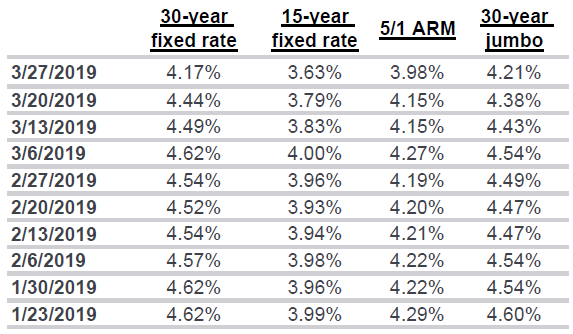
The benchmark 30-year mortgage rate plummeted 27 basis points (over 1/4 percent) last week, the biggest weekly drop in a decade, creating a huge affordability window for home buyers and for homeowners considering a mortgage refinance. The last time the benchmark 30-year rate was below this level was Jan. 3, 2018, when it hit 4.10 percent, according to Bankrate’s historical data.

This can be a teachable moment, so I asked one of my preferred lenders, Scott Lagge of Movement Mortgage to explain.

According to Scott, financial markets are complex, and many factors impact interest rates.  What we are experiencing currently is based to a large degree on consumer sentiment.  As consumers, we can have a huge impact on the market based on what we “feel” about where the economy is headed.  If we “feel” the market is getting worse, we hold onto our money, spend less, buy less, and shift our investments from short term to long term investments. Therefore, worries about slowing economic growth can change our behaviors as consumers and as investors.  Investors worried about the economy slowing in the short-term start to shift their money to long-term investments such as bonds, specifically mortgage backed securities (also known as mortgage bonds). This flood of money into mortgage bonds reduces mortgage bond values and rates fall due to an over abundance or supply of bonds.  In essence, it’s supply and demand.

For a more technical explanation, Scott cited this statement from Greg McBride, CFA, Bankrate’s chief financial analyst: “Worries about slowing economic growth — both domestically and abroad — and the inversion of the Treasury yield curve put investors into semi-panic, bringing bond yields still lower after the Fed indicated no more rate hikes in 2019.”

Above is a chart from www.Bankrate.com showing last week’s sudden drop in mortgage interest rates. 

Changes in mortgage rates can affect home prices. To the extent that buyers use mortgage financing, what they can afford to purchase goes up or down. As mortgage rates flirted with 5%, we saw a definite softening of the long-running seller’s market. If these low rates last into the coming weeks, we may see more buyers wanting to resume house hunting and lock in a low mortgage rate.

Scott Lagge invites you to call him at 303-944-8552 if you’d like to see what interest rate you qualify for. Call me at 303-525-1851 if you’d like to go house hunting!

The Way Real Estate Agents Are Compensated Confuses Many Buyers & Sellers

The real estate industry is unlike any other industry in the way its sales personnel are compensated. Since it is a persistent source of confusion for the general public, allow me to explain.

Imagine you went to a Ford dealership and described what you need in a car or truck. The salesman goes to his computer and pulls up his own inventory and the inventory of all the other dealers in the metro area.

It turns out that Chevrolet or Toyota might have a vehicle that better fits your needs, and the salesman knows that he’ll earn just as much by taking you to their lots and selling you one of their vehicles, so you get in his Tesla and go car-hunting. He even takes you for test drives without a salesman from the other dealership being involved at all. You go back to the Ford dealership, where a purchase offer is signed and emailed to the dealership which has that vehicle. The salesman helps you arrange financing with a trusted lender and sends proof of cash or financing with the offer.

Although there are some “auto brokers” who function as I’ve described above (in fact, I bought my Chevy Volt using an auto broker), that’s not how most car sales transactions work. It is, however, exactly how real estate works.

You’ve probably heard of the Multi-List Service (MLS) on which real estate listings are posted. The central premise of the MLS is “cooperation and compensation.”  To be a member of the MLS — essential if you’re in the real estate business — you must agree to cooperate with every other member of the MLS and to offer compensation if another member sells your listing. The percentage commission offered to other members is called the  “co-op” commission. In the Denver market, that commission is typically 2.8%. There’s an interesting history of MLS-type “exchanges” dating back as far as the 1880’s, which you can read at www.NAR.realtor.

The listing contract which every agent prepares for a seller specifies the total commission (typically between 5 and 6 percent) and the co-op which the listing agent is offering to other MLS members. In the “old days,” before Taft-Hartley anti-trust laws were enforced in our industry, the Denver Board of Realtors prescribed a 7% listing commission, and prescribed that 40% of that commission (or 2.8%) be offered to other agents as a co-op.  Under that formula, sellers would pay 4.2% commission to the listing agent and 2.8% to the selling agent at closing.

Once the Department of Justice said that anti-trust laws apply to the real estate industry, the Board of Realtors and the MLS could no longer dictate commission rates, and listing rates began their inevitable decline as agents competed with each other for listings. This is a good thing for sellers, but it has no real meaning for buyers. Indeed, when listing agents have tried to pay less than 2.8% co-op commission, they have found that buyers’ agents are less likely to show and sell their listings. As a result, listing agents now earn less than buyers’ agents in a given transaction, even though they are the ones laying out money for photographs, brochures, staging consultations, advertising and other expenses associated with maximizing their listings’ exposure to potential buyers.

Now and then, this commission model — wherein the entire commission is paid by the seller — is challenged, but it endures almost universally, if for no other reason than “it works.”

Where this business model causes confusion is when a broker or brokerage advertises a 1% or 2% “listing fee” in order to get a listing appointment, at which time the seller learns that this does not include the requisite (or at least recommended) 2.8% commission to the buyer’s agent.. These brokers and brokerages know that honestly advertising a 3.8% or 4.8% listing fee would garner them far fewer listing appointments.

Another source of confusion is what’s known as the variable commission. This term applies to a commission that is reduced if the listing agent doesn’t have to pay a co-op commission because the buyer has no agent of his own. However, most listing agents — 85% by my calculation — don’t mention reducing their commission in their listing presentations and hope that the seller won’t ask them about reducing their commission if they don’t have to pay a co-op commission. At Golden Real Estate, it is office policy to offer a variable commission.

As real estate values continue to increase, it’s reasonable to ask whether the commission rates — which I’ve said are typically between 5 and 6 percent) should be reduced on the theory that it takes little more money and effort to market a million-dollar home than it does to market a $400,000 or $500,000 home.

The extent to which listing agents can reduce their commission, however, is limited by that 2.8% co-op commission that we feel obligated to offer. After all, if we reduced our commission to, say, 4%, we’d only earn 1.2% after giving away 2.8% to the buyer’s agent.

Where we can be more accommodating on those higher priced homes is in agreeing to a lower variable commission. My practice is to reduce my 5.6% commission to 4.6% when I don’t have to pay 2.8% to a buyer’s agent, but I’m willing to adjust both those numbers on a higher-priced listing.  By the way, that appears to be the practice of most broker associates at Golden Real Estate.  Because of Taft-Hartley, I can’t dictate what they offer.

About 5% of transactions are double-ended, although that percentage is much higher at Golden Real Estate because of our more extensive marketing of listings and the fact that we offer Totally Free Moving to Colorado buyers when they are unrepresented.

When Is Your Real Estate Agent a ‘Transaction Broker’ and Not an ‘Agent’?

Although it’s common (including by me) to talk about real estate professionals as “agents,” the proper term is “brokers,” because the term “agent,” at least here in Colorado, has a specific legal meaning which is important to understand.

One reason most of us call each other “agents” instead of “brokers” is that here in Colorado the term “broker” is commonly used when referring to the employing broker or managing broker in a real estate company.  For example, I’m the “broker” at Golden Real Estate, and my agents are “broker associates.” It’s just simpler (and more common) to call them “agents.”

So what is an “agent” in the legal sense? An agent is an advocate for his or her client, serving with “the utmost good faith, loyalty and fidelity.” An agent will share with his client anything that helps in negotiating the best deal in a transaction. For example, if a broker were to reveal that his buyer is desperate to buy a home or that his seller is desperate to sell his home, an “agent” on the other side of the transaction could (and should) use that information to his client’s advantage. A good “agent” would never let that kind of information slip!

A “transaction broker,” on the other hand, has no such responsibility to his or her client and functions only to facilitate a transaction. Indeed, he is barred from disclosing to one party anything about the other party that would favor that party in negotiating a transaction.

At Golden Real Estate, as at most brokerages, it is our office policy to always function as “agents” for our buyers and sellers. The only exception is when we find ourselves on both sides of a transaction because one of our pre-existing buyer clients (for whom we’re an agent) wants to buy a property from one of our sellers (for whom we’re also an agent). Then we’re obligated to serve as a transaction broker and advise each party that we’re now a neutral facilitator of the transaction and can no longer coach either party regarding price or any other transaction issue.

So what happens when an unrepresented buyer approaches a listing agent about buying his or her listing for which he is functioning as an “agent”? The agent could choose to have the buyer sign an agency agreement, but that would require him to sacrifice his “agent” relationship with the seller and become a transaction broker.  It is Golden Real Estate’s policy always to treat an unrepresented buyer of our listings as a “customer,” thereby retaining our “agent” relationship with the seller.

Did I confuse you more? I hope not! Hopefully the broker you employ knows the rules of agency relationship, as we certainly do.

Off-Market Transactions Hurt Sellers By Shutting Out Buyers Who Might Pay More

The sale of homes without listing them on the MLS frustrates would-be buyers who are waiting for just such a home. Those frustrated buyers might have paid more than the actual buyer, in which case it’s fair to say that both buyers and sellers have been harmed.

This is an update of a column with the same headline published exactly a year ago. On March 22, 2018, I wrote that in January and February of that year 4.4% of the sold listings were only entered on the MLS after closing. It’s even worse this January and February, when the percentage of Denver sales showing zero days on market rose to 6.3%. Another 2% sold in one day, which is still not enough time to expose a listing to all potential buyers.

I have determined that with proper exposure, 4 days is the “sweet spot” for listing a home and getting the highest possible price for it. That is office policy at Golden Real Estate, violated only when the seller insists on selling sooner for one reason or another, such as to a friend.

Analyzing the 101 Denver sales in January and February, the median sale was for full price, which makes sense. However, half the 86 Denver homes which sold after 4 days on the market garnered from 1% to as much as 10% above their listing price. That can amount to a lot of money “left on the table” by sellers who chose (or were convinced by their agent) to sell without exposing the home to more buyers via the MLS..  

It’s reasonable to ask how listing agents may have profited (at their seller’s expense) from keeping listings off the MLS. An analysis of the Denver listings that were entered as sold with zero days on market this January and February reveals that 20.8% of them were double-ended, meaning that the listing agent kept the entire commission instead of sharing it with a buyer’s agent. Not one of the homes that sold after 4 days on the MLS was double-ended. It seems obvious to me that many listing agents are convincing their clients to sell without putting their home on the MLS so they can increase the chance of doubling their commission. Putting their self-interest ahead of their clients’ is a serious violation of both ethics and law.

This is not to say that zero days on the market is never in the best interests of the seller. For example, the seller and buyer might know one another, or otherwise found each other, and simply asked an agent to handle the transaction without seeking other buyers.  Or perhaps it was a for-sale-by-owner property where an agent brought the buyer and entered the sale on the MLS after closing as a courtesy to other agents and to appraisers. Or a seller might ask to keep the home off the MLS because he/she does not like the idea of opening their home to lots of strangers.

One would hope, however (and sellers should expect), that when a broker double-ends a transaction, he or she would at least give the seller a break on the commission, rather than keeping the portion (typically 2.8%) that would have been paid to a buyer’s agent. This practice is referred to as a “variable commission” and is office policy at Golden Real Estate. Unfortunately, however, only two of the 21 listings that was double-ended and sold without being put on the MLS offered their sellers this discount. The other 19 enjoyed the windfall of keeping the full commission to themselves, without sharing that windfall with their sellers.

Some agents put listings on Zillow as “coming soon” while holding them off the MLS as a technique for attracting a buyer before other agents know about the listing. The Real Estate Commission addressed this practice in a 2014 position statement, stating that “if the property is being marketed as ‘coming soon’ in an effort for the listing broker to acquire a buyer and ‘double end’ the transaction, this would be a violation of the license law because the broker is not exercising reasonable skill and care.”  Further, the commission stated, “a broker who places the importance of his commission above his duties, responsibilities or obligations to the consumer who has engaged him is practicing business in a manner that endangers the interest of the public.” 

Sadly, that is still happening.

Electric Vehicle Event on April 20th at Golden Real Estate

Golden Real Estate is celebrating Earth Day by holding an electric vehicle round-up on Saturday, April 20th, from 10 am to 3 pm in our South Golden Road parking lot.

It’s a national event, called “Drive Electric Earth Day,” organized by Drive Electric Week, which is held every September. As with that event, we’re inviting owners of electric cars, trucks and motorcycles to show their vehicles and maybe offer rides. You can register online at www.DriveElectricWeek.info as either an EV owner or attendee

As an extra added attraction, I have invited Best Electric Bikes USA (who sold me my electric bicycle a few years ago) to set up shop and bring some electric bikes for test rides. Research has shown that owners of electric bikes ride more often and therefore get more exercise than owners of non-electric bikes. It’s true for me!