The Pros and Cons of Buying in a Community With a Homeowners Association

Like every real estate agent, I have encountered buyers who don’t want to buy in a neighborhood with an HOA. I have set up more than one MLS alert for buyers with “No HOA” as one of their search criteria.

There are many good reasons to avoid an HOA, just as there are reasons to want an HOA. Among the negatives, an HOA costs money, al-though those dues do cover some expenses you would otherwise have to pay for on your own, such as trash collection. In a patio home community, dues could cover snow removal up to your front door and garage, grounds maintenance, a community pool, fitness center, and even water and sewer.  Unless the community is self-managed, your dues also pay for a management company.

The more common negatives we hear concern personal liberty. You can’t change your home’s exterior, including paint color or adding a new deck, without approval by the HOA. You probably can’t store your RV on the street or on your lot. And there’s always that one neighbor who is a self-appointed enforcer of the covenants and rules. I was turned in once by one who saw my lawn person passing through the adjoining common space to reach my backyard.

According to the Community Associations Institute (CAI), the number of HOAs in the United States has increased from just 10,000 in 1970 to more than 320,000 today. If you buy a home in a subdivision developed in the last 30 years, you most likely will be buying in a neighborhood with an HOA. So, what are the arguments in favor of an HOA?

A common refrain in support of HOAs is that they protect property values for their members. Without an HOA to enforce its rules, a neighbor could paint his home dayglo yellow or litter his yard, visible to you, with old furniture and cars on blocks. He could allow the paint to peel and not replace his obviously hail damaged roof and let the exterior of his home go into disrepair. These are just a few examples of how one homeowner can affect a neighborhood’s property values. Imagine putting your beautifully updated home on the market if the above description applied to your neighbor’s house.

People in non-HOA communities can tell “bad neighbor” stories to rival any HOA horror story.

Back in the 1970s it was common for subdivisions to be built with covenants that applied to every home in that subdivision, but no HOA was created to enforce those covenants. If a neighbor violated a covenant, one’s only recourse was to sue that neighbor in civil court — an unlikely scenario. Some non-HOA neighborhoods have created neighborhood associations with voluntary dues (for example, $30 per year), which cover the cost of community picnics, newsletters, etc. I listed a home in one such non-HOA subdivision, Columbine Knolls South in south Jeffco, which is quite aggressive in enforcing a covenant that restricts the type of roof a homeowner can install.

Starting around the 1990s, subdivision developers created HOAs which they controlled until a certain percentage of homes were sold, at which point they would turn over control to a board elected by the residents. Unless it was a really small subdivision, this board would then hire a management company to handle the hiring of vendors (such as trash haulers or grounds keepers) and enforcing covenants, as well as rules and regulations promulgated by the board of directors at their monthly meetings or by the homeowners at their annual meeting.

Done right, HOAs can be an efficient means of providing services, assigning payment responsibility and being responsive to members’ concerns. Such factors have driven the continued growth of association-governed communities, including HOAs, condominium associations, and other “common interest communities.”

HOAs can fund a diverse variety of services and amenities, from golf courses to equestrian facilities and fitness centers. Few Americans could afford such benefits without the shared responsibility made possible with an HOA. According to CAI, “People who don’t want to contend with gutters and yard work can purchase homes in communities where these responsibilities are taken on by the associations. There are age-restricted communities, pet-free and pet-friendly communities, even communities with air strips. Community associations give people options, alternatives, facilities and resources they could not otherwise enjoy.”

CAI states that more than 62 million Americans live in neighborhoods with an HOA and “take advantage of association-sponsored activities like holiday events, social clubs, athletic and fitness activities, pool parties and more. These activities help residents get to know their neighbors and forge new, supportive friendships.”

Because it’s not a popular assignment (and is unpaid), you can probably get elected to your HOA board and have a say in its governance.  I did that myself but resigned after a couple years. You may be more suited to that experience.

I totally respect those who want to avoid HOAs for one reason or another. Rita and I have experienced both ways of life and, while we don’t value one over the other, we appreciate why others may have a strong feeling for or against living in an HOA-governed neighborhood.

If you are not outright opposed to an HOA but do have concerns, just know that when you go under contract with a home in an HOA, the seller must provide financial and other documents as well as bylaws and minutes of recent HOA meetings, and you can terminate if you don’t like what you read.

Consider Installing a Heat Pump Water Heater

If you’re attuned to the issue of sustainability, you may already know that heat pump water heaters are a smart replacement for gas water heaters and a great way to reduce your “carbon footprint.”

Combine it with replacing your gas furnace with a heat pump mini-split system and your gas range with an electric induction cooktop, and you could disconnect your gas meter and go all-electric. Then trade in your gas-powered car for an electric car and put enough solar panels on your home to power it all, and you’re on your way to eliminating the use of fossil fuels altogether — provided you’re willing to live without your gas fireplace!

Heat pumps don’t create heat, they move heat, which is why they are more efficient than gas or resistance heating. Toasters and electric space heaters are examples of resistance heating. Rather than heating water directly, a heat pump water heater moves heat out of the room into the water tank. For synergy, put it in the same room as a freezer, which is doing the opposite — moving heat into the room. Or build a wine cellar around your water heater for free cooling of your wine!

I purchased my Rheem  unit for under $1,300 (on sale at Home Depot) and earned a $400 rebate from Xcel Energy plus a $300 federal tax credit.  

Could Accessory Dwelling Units Be a Solution, Albeit Small, to Housing Shortage?

An increasing number of jurisdictions, including Denver, Englewood, Boulder, Golden and Arvada, are allowing the construction of a second dwelling unit for homes zoned for single-family. The common term for them is “Accessory Dwelling Unit” or ADU. Golden, unlike the other cities, allows an ADU on properties zoned for either one or two dwelling units.

The ordinances that allow such units include rules that distinguish a home with an ADU from, say, a duplex. For example, they cannot have their owned legal description and can’t have separate water and sewer connections.

Sixty-two ADUs have been approved under Golden’s 2009 ADU ordinance. Denver has permitted 263 ADUs just since Jan. 1, 2016.

Arvada had Jefferson County’s first ADU ordinance, enacted in 2007. Its key points were:

> The property owner must live on site, in either the main house or in the ADU.

> The ADU is limited to 800 SF, or 40% of main home’s size. Minimum size is 200 SF.

> No more than 1 bedroom is allowed.

> No more than two persons may live in a unit up to 600 SF, or three persons in a unit between 600 and 800 SF.

> One on-site parking space is required.

> The ADU’s design must be consistent with that of the principal unit, and the entrance, if visible from the street, must be clearly subordinate to the primary home’s entrance.

These are only some of the requirements with which a homeowner must comply when adding an ADU to his or her property.

The cities differ in some of their requirements. For example, Arvada forbids a home business in an accessory dwelling unit, but Golden’s code does not reference that usage.

ADUs can be within the primary structure (such as a walk-out basement) or in a separate structure, either above a detached garage or as a standalone structure. 

There are many uses for ADUs. One use is to create a rental unit, helping homeowners with their ownership costs. Another is to provide a “mother-in-law” unit that provides an elderly family member with independent living but in close proximity to family. Conversely, an elderly homeowner might use an ADU to provide living quarters for a caregiver who needs to be close by. Ditto for a family which has hired a nanny for their young children.

In Golden, each ADU requires an allocation under Golden’s 1% growth limitation. Only Boulder, among the other cities that allow ADUs, has such an ordinance.

California, with its high housing costs, appears to be the national leader in the adoption of ADUs. Here’s some useful information from an article I found online from the New York and Michigan Solutions Journalism Collaborative:

Parts of California have welcomed ADUs for decades while others operated under much stricter rules. This created a complex patchwork of local regulations that was difficult for residents and builders to navigate. The new laws relaxed regulations around setback requirements, minimum lot sizes and other elements that previously made building ADUs difficult in some areas.

Legislative changes at the state and local levels appear to have opened the floodgates for ADU permits in parts of California, including San Jose, where ADU permits issued per year went from 192 in 2018 to 416 in 2019, according to www.BuildinganADU.com.

In Redwood City, a smaller city in the Bay Area, ADU permit issuance doubled during the same period.

The idea appears to be popular among older homeowners: 84 percent of people 50 and older would construct an ADU in order to provide a home for a loved one in need of care, and according to a 2018 study on ADUs by AARP.

The federal government backed the idea of accessory dwellings in the 1990s, with a Task Force on Regulatory Barriers to Affordable Housing recommending removing restrictions on accessory apartments to enable elders to age in place, according to 2008 research in the Journal of Aging and Policy.

Data on the effectiveness of ADUs for caregiving families is scarce, beyond anecdotal evidence and numbers illuminating their popularity in cities where they’re legal and encouraged.

California’s openness to ADUs is part of the state’s strategy to tackle its crushing housing market, which with runaway prices and low housing stock threatens to shut out residents who’ve been living in Bay Area cities like San Francisco or San Jose for decades.

I have become familiar with a local company, Verdant Living, that specializes in the construction of ADUs, or “backyard bungalows.”  Their website is www.VerdantLiving.us. Owner John Phillips pointed me toward another useful website, www.AccessoryDwellings.org.

Denver Real Estate Market Ends 2020 with a Record-Breaking December

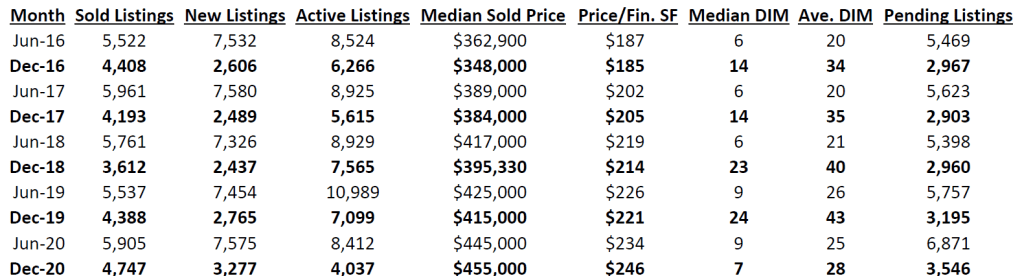
The chart below is a compilation of various market indicators for the Denver metro area, which I am defining as a 25-mile radius of the State Capitol. There are some surprising differences this December from previous Decembers to be discerned from looking at that chart. I have included June figures but put the December stats in bold type to make it easier to compare summer vs. winter statistics over the last five years.

Source: REcolorado

Historically, one would expect to see more sold listings, new listings and active listings in June than in December, and that trend held true in 2020, but the numbers for this December broke some new ground.

The number of sold listings and new listings were at record highs for a December, leaving the number of active listings at a record low. There has been lots of talk about how low our active inventory is, but, as I’ve written before, that’s not for lack of new listings but rather how quickly buyers are snapping up new listings.

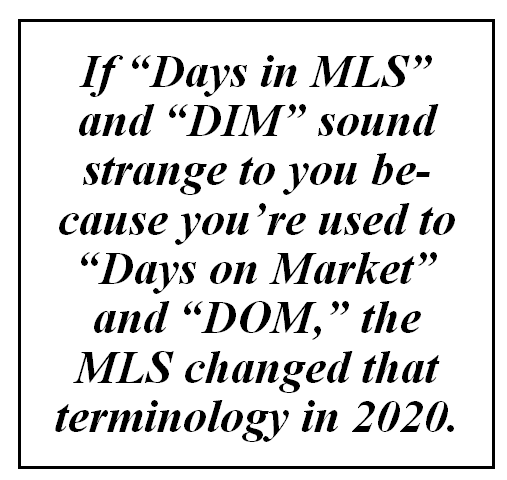
The strength of this sellers’ market becomes more evident when you look at the other columns. In past years, the median sold price in December was substantially lower than it was in June, but the opposite was true this year, rising to a record $455,000. Correspondingly, the average price per finished square foot surged above June’s number to a record $246, and the median days in the MLS (“DIM”) plunged from last December’s 24 to just 7 days this December — even lower than the DIM for June 2020. The average DIM of 28 is more typical of summer months than winter, reflecting the fact that even homes that had been languishing on the market (because they were overpriced) were selling at a faster clip last month. Indeed 22% of the listings sold were on the MLS for over 30 days. Of those, 5.8% were active over 90 days, and 3.4% were active for more than 120 days. Those older listings are responsible for raising the average DIM.

Because of the well-publicized migration away from densely populated areas because of Covid-19, I was curious to learn whether single-family detached homes represented a higher percentage of the closings this December, compared to December 2019, but in fact the percentage dropped a little this year — 66.7% this year vs. 69.5% last year. The same was true in June, when the pandemic was already raging and we believed that people were fleeing condos for detached single-family homes. This is counterintuitive, and I can offer no theory to explain it, but I have more to say about this topic below.

Another measure of the strength of the current sellers’ market is how many homes sold above their asking prices. With December 2019’s days in MLS number so high (24), one hardly needs to ask, but here are the numbers. This December, 16.6% of the listings sold for their full listing price, and 42.2% sold above their listing price. Last year, those numbers were dramatically lower. While 15.8% sold for their full listing price, only 15.9% of listings sold above their listing price in December 2019.

So, what’s the prognosis for 2021?  January is positioned to have a record number of closings, considering that there are a record number of pending transactions left over from December, as shown in the chart. With mortgage interest rates projected to remain at record lows — currently at or below 3% — there is a strong incentive for buyers to keep buying. Another factor favoring buyers is the movement of service sector jobs towards working from home.

To measure that trend, I compared the December-over-December sales in Downtown Denver, part of Capitol Hill and the Golden Triangle (specifically, a 1.2-mile radius from 20th & Arapahoe Streets in downtown Denver) and found there were 63 sales in December 2019 compared to 77 sales in December 2020. Meanwhile, there were 272 active listings in December 2019, but that surged to 444 active listings in December 2020.  It’s a buyer’s market there.

In that same area, the days in MLS dropped from 43 days last December to 32 days this December (way higher than the 24 days vs. 7 days for the 25-mile radius in the above chart), but the median sold price plunged from $535,000 in December 2019 to $480,000 in December 2020. Compare that to the $40,000 increase in median sold price with the larger metro area, as shown in the above chart.

So, yes, it is still harder to sell a home in the densely populated central Denver area, and there is definitely an out-migration taking shape, but it’s still too early to call it an exodus.

Note: All these statistics were compiled from REcolorado, Denver’s MLS, excluding listings from other MLSs which are displayed on REcolorado.com. Often those listings from other MLSs are merely duplicates of REcolorado’s own listings, so I excluded them.

National Association of Realtors Promotes “Pathways to Professionalism”

As you are probably aware, members of the National Association of Realtors (NAR) are sworn to abide by the Realtor Code of Ethics. It’s what separates them from the men and women who are licensed to practice real estate but choose not to pay roughly $500 in annual dues to be a member of the local, state and national Realtor associations.

Golden Real Estate requires all its broker associates to join the local Realtor association, which automatically enrolls them in the Colorado Association of Realtors and NAR. Most of us are members of the Denver Metro Association of Realtors, although agents have the choice of which local Realtor association to join.

In addition to the Code of Ethics is the voluntary and lesser known Pathways to Professionalism. It is a collection of recommended courtesies which all Realtors should embrace, as we certainly do at Golden Real Estate. Here are those courtesies, broken down into three categories. It should be noted that failure to practice these courtesies cannot form the basis of a complaint by fellow Realtors or members of the public. Here they are, highlighting ones I particularly like:

Respect for the Public

1) Follow the “Golden Rule”: Do unto other as you would have them do unto you.

2) Respond promptly to inquiries and requests for information.

3) Schedule appointments and showings as far in advance as possible.

4) Call if you are delayed or must cancel an appointment or showing.

5) If a prospective buyer decides not to view an occupied home, promptly explain the situation to the listing broker or the occupant.

6) Communicate with all parties in a timely fashion.

7) When entering a property ensure that unexpected situations, such as pets, are handled appropriately.

8) Leave your business card if not prohibited by local rules.

9) Never criticize property in the presence of the occupant.

10) Inform occupants that you are leaving after showings.

11) When showing an occupied home, always ring the doorbell or knock—and announce yourself loudly before entering. Knock and announce yourself loudly before entering any closed room.

12) Present a professional appearance at all times; dress appropriately and drive a clean car.

13) If occupants are home during showings, ask their permission before using the telephone or bathroom.

14) Encourage the clients of other brokers to direct questions to their agent or representative.

15) Communicate clearly; don’t use jargon or slang that may not be readily understood.

16) Be aware of and respect cultural differences.

17) Show courtesy and respect to everyone.

18) Be aware of—and meet—all deadlines.

19) Promise only what you can deliver — and keep your promises.

20) Identify your REALTOR® and your professional status in contacts with the public.

21) Do not tell people what you think — tell them what you know.

Respect for Property

1) Be responsible for everyone you allow to enter a listed property.

2) Never allow buyers to enter a listed property unaccompanied.

3) When showing a property, keep all members of the group together.

4) Never allow unaccompanied access to a property without permission.

5) Enter a property only with permission even if you have a lockbox key or combination.

6) When the occupant is absent, leave the property as you found it (lights, heating, cooling, drapes, etc.) If you think something is amiss (e.g., vandalism), contact the listing broker immediately.

7) Be considerate of the seller’s property. Do not allow anyone to eat, drink, smoke, dispose of trash, use bathing or sleeping facilities, or bring pets. Leave the house as you found it unless instructed otherwise.

8) Use sidewalks; if weather is bad, take off shoes and boots inside property.

9) Respect sellers’ instructions about photographing or videographing their properties’ interiors or exteriors.

Respect for Peers

1) Identify your REALTOR® and professional status in all contacts with other REALTORS®.

2) Respond to other agents’ calls, faxes, and emails promptly and courteously.

3) Be aware that large electronic files with attachments or lengthy faxes may be a burden on recipients.

4) Notify the listing broker if there appears to be inaccurate information on the listing.

5) Share important information about a property, including the presence of pets, security systems, and whether sellers will be present during the showing.

6) Show courtesy, trust, and respect to other real estate professionals.

7) Avoid the inappropriate use of endearments or other denigrating language.

8) Do not prospect at other REALTORS®’ open houses or similar events.

9) Return keys promptly.

10) Carefully replace keys in the lockbox after showings.

11) To be successful in the business, mutual respect is essential.

12) Real estate is a reputation business. What you do today may affect your reputation — and business — for years to come.

Narrated Video Tours Still Surprisingly Rare in Real Estate

The term “virtual tour” was introduced to the real estate industry a couple decades ago, and early vendors wowed us with 360-degree still photos of each room The latest “shiny object” is a product by Matterport. I remember getting a demo of it at a trade show several years ago. They call their product an interactive virtual reality tour — still photos in which you can use your mouse or finger to rotate each photo manually left to right or up and down. Gray circles indicate new photo points. You click on them and are taken to that place where you can, again, rotate horizontally or vertically. Thus, you can, at your own pace, navigate around the entire property choosing which room you want to enter and leave. Here’s an example of a Matterport tour:

https://my.matterport.com/show/?m=zWvgi4YHRhU&mls=1

Still, it’s only a collection of still photos with no narration. Personally I find it kind of dizzying and nowhere near as useful as being walked through the home by the listing agent pointing out the features of the home.

I have been selling real estate now for 19 years and seen a dozen or more variations of the “virtual tour” concept, but none of them include narration like the video tours we have been creating since 2007.

For this article I studied 50 currently active listings by other brokerages and only half have any “virtual tour.” More surprisingly, only one of them had a narrated video tour. The rest were merely slide shows, most of them with music, but 10 were completely silent, which merely duplicates the MLS’s own slide show. (Example) Two had actual videos but they were drone videos. Eleven had the interactive Matterport slideshows described above.

The one narrated tour was quite good in the detail which the agent shared, but the agent chose to be in half the scenes, which struck me as a little weird. I prefer to feature the home, not myself, in my video tours.

Visit www.GRElistings.com to view our currently active and pending listings, each of which you’ll see has a narrated video tour.

Readers Appreciate Our Free MLS Neighborhood Alerts

Back in April 2019, I offered to set up Free Neighborhood Alerts for any reader who wanted to keep track of real estate activity in their subdivision or larger area. The response was overwhelming. I myself have 42 readers who currently receive such alerts for their neighborhood.

I’m not complaining. My broker associates and I are pleased to make this service available to everyone who wants it, and we’ve become pretty efficient at creating these free alerts.

The MLS allows members to set up an unlimited number of email alerts, designed to assist buyers in searching for homes. We have adapted it to provide neighborhood alerts. Once set up, the alerts are generated automatically by the MLS. Just give us your address and the boundaries of the area you wish to monitor. The initial alert will tell you all the coming soon, active, under contract, sold, withdrawn and expired listings in that area, going back 90 days or longer.

Future alerts will come to you within 15 minutes of a new or changed listing being entered on the MLS. You will literally be up-to-the-minute in your knowledge of real estate activity in your neighborhood!

I’m happy to handle every request I get from readers, but feel free to ask any of our broker associates to create a neighborhood alert for you. They are listed below with their email addresses and are more than happy to provide this free service. Send your requests by email only, please.

In addition to setting up the neighborhood alert for you, we can also send you valuation reports on your home using two different software packages — Realtor Property Resource (RPR), which is only available from members of the Realtor association like us, and Realist — that you will find are much more accurate than Zillow’s “Zestimates,” which home owners are used to seeing.

I also like to provide a spreadsheet of active, under contract and sold listings that are comparable to your own home, which serves as a double-check on those two software valuations.

Jim Smith, Jim@GoldenRealEstate.com

Broker Associates:

Jim Swanson, BrokerSwanson@aol.com

Chuck Brown, Chuck@GoldenRealEstate.com

David Dlugasch, David@GoldenRealEstate.com

  Carol Milan, Carol@GoldenRealEstate.com

  Ty Scrable, Tyler.Scrable@gmail.com

Downsizing Safely and Effectively in Your Senior Years

Are you thinking that now’s the time to leave your big-house life behind? If so, you’re in luck. Despite the pandemic, the real estate market is strong, interest rates are low, and it’s still a great time to sell and buy. But you can’t go into the process blindly. Here are some tips to get you started on the right track.

First on your to-do list: Work with an experienced agent like those of us at Golden Real Estate. After all, an agent who knows the area can price your home correctly and help you find the right replacement home for you. We know the local market and whether a neighborhood is senior-friendly. You can ask us questions and get knowledgeable answers about local amenities, such as public transportation, fitness centers, and local senior facilities that will enrich your life.

If you prefer to downsize into a rental unit within a senior community, we can advise you on those communities and that process too, so feel free to ask us.

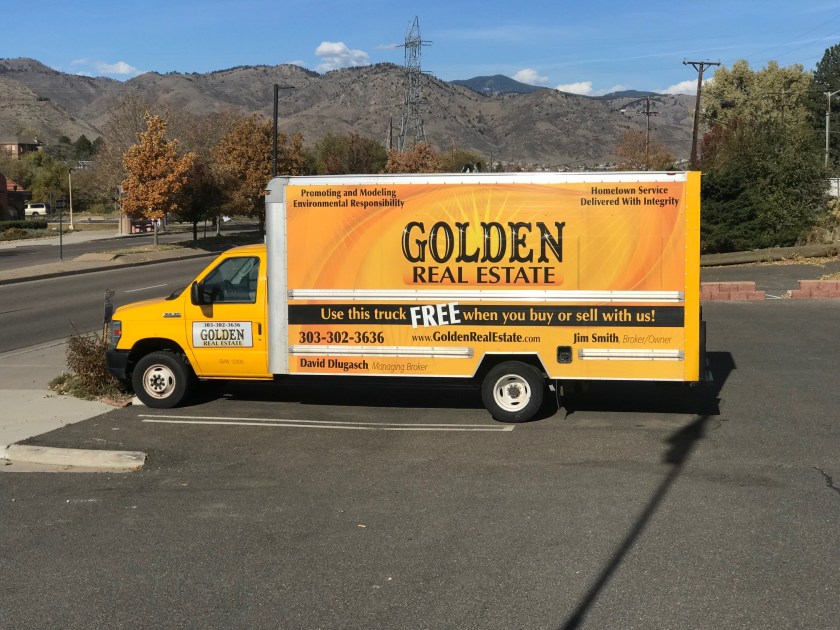
We can also help you determine a budget. As a buyer, keep in mind that it’s a seller’s market, and having us on your side can help get your foot in the door. If you’re moving locally, we can also save you a bundle with our free moving truck and our in-house movers.

You want to take a look at your budget to determine what you can afford. Our preferred lenders offer free affordability calculators. They allow you to input data, such as your home price, down payment, and monthly expenses. This can help you determine your potential future living expenses.

Once you have an agent and a price range, it’s time to compare what you can afford with what you need, and then make adjustments to your list as necessary. Many seniors, according to Home Tips For Women, look for features including those which lower utility costs. These, along with things like single-level living and wide doorways, allow for greater mobility, an important consideration if you’ve already begun to experience mobility issues.

Something to keep in mind during the downsizing process is that moving into a smaller home will require downsizing your belongings as well. Once you have chosen your future home, you can evaluate the belongings in your current one. This is an emotional process which takes patience, and, ideally, you’ll have cooperation from your friends and family. It’s often best to give certain things to your children and grandchildren now so you’re not tight on space in your new home. You can use our truck for that, too (and for trips to Goodwill).

If you’re moving outside the metro area, choosing the right moving company is something else that deserves special attention. Movers charge different prices, even for what appear to be the same services. Your moving company will factor everything from whether you need an entire truck to how far you’re moving, to the overall weight of your household goods into the price. Previous clients have given us feedback on their experiences which we can share with you.

Finally, make your move while you’re in good health and don’t wait until you have to move. And let yourself enjoy the process. Your retirement is a time of change and to feel all the excitement associated with it. Moving is not always easy, but the end result of downsizing can be more financial freedom and a better quality of life during your senior years.

Downsizing as a senior presents a significant lifestyle change, but it’s one to embrace. If you still have questions, don’t be afraid to reach out to us. My broker associates and I (see below) are here to make the process as seamless as possible and can be a valuable resource not to be overlooked.

Jim Smith— 303-525-1851

Jim Swanson — 303-929-2727

Chuck Brown — 303-885-7855

David Dlugasch — 303-908-4835

Carol Milan — 720-982-4941

View Posts

Tyler Scrable — 720-281-6783

Here’s a Good Resource for Seniors

Colorado doesn’t rank high in the percentage of our population that’s 65 and over. In fact, seniors represent only 14.2% of our population, ranking Colorado 46th among the 50 states.

Recently I was made aware of a website with tons of Colorado-specific information for seniors. Here’s that website’s address: https://www.seniorhousingnet.com/seniors/senior-living-us/colorado

Look to Us, Not Zillow, for an Accurate Valuation of Your Home

It’s common for people to put stock in Zillow’s “Zestimates” of their home’s value, but any Realtor can provide a much more accurate estimate of your home’s value. Realtors have access to my favorite valuation tool, the Realtor Property Resource or RPR, as well as to the MLS’s Realist tool, which non-Realtors can access. (Not all agents are Realtors.) Also, we can use the MLS to create a spreadsheet of all the comparable homes which have been on the market in your subdivision or area. Here’s an example:

Up for Growth Promotes Affordable Housing and ‘Accessible Growth’

Up for Growth Action describes itself as the only federal advocacy campaign focused solely on breaking down the barriers to affordable and market-rate housing.

“Housing was on the ballot on November 3,” said Mike Kingsella, executive director of the organization. “The next Congress and new administration cannot afford to ignore the immediate and long-term challenges of housing in the United States, because we have a housing shortage that affects nearly every aspect of Americans’ lives. We will be on the front lines of advancing a bipartisan, pro-housing agenda that increases access to high-quality housing in vibrant neighborhoods at prices all Americans can afford,” he said. Their work “supports the creation of affordable homes, jobs, and transit-oriented development — all critical to our country’s economic recovery and growth.”

Up for Growth Action believes that America’s housing crisis is driven by two separate, but interrelated challenges: the nation’s increasing income inequality that prevents widespread access to quality and affordable housing, and a shortage of homes, requiring proactive legislation. The organization focuses on policies that enable communities to build housing needed to meet the country’s 7.3-million-home shortage, as shown by Up for Growth’s research . 

“Improving housing accessibility and affordability across the full spectrum of American society is critical in transforming the communities in which we live, work, play and invest,” said UP for Growth’s Chuck Leitner. “Driving the real estate investment and operating industry’s deeper engagement in addressing these and other housing issues is fundamental in the process and is why our mission is so important.”

Up for Growth Action supports policies focused on tearing down systemic barriers to housing development such as exclusionary zoning, and increasing access to capital for affordable housing development. The organization promotes what it calls “accessible growth” – prioritizing housing production in areas of high economic opportunity, areas that leverage investments in transportation and infrastructure, and in areas where jobs already exist.

Though a relatively new organization, Up for Growth Action already boasts progress in enacting its legislative agenda. In my Oct. 15th column I wrote about its YIMBY (Yes in my Backyard) proposal that was passed by the US House of Representatives but stalled in the Republican-controlled Senate.

The incoming Biden-Harris administration has already outlined a comprehensive housing plan that is aligned with Up for Growth Action, including a focus on reducing exclusionary zoning to increase housing stock, direct investment in housing, and recognizing the relationship between where people live and their wellbeing.