Realtor.com Weighs in on the Real Estate Market’s Surprising Rebound

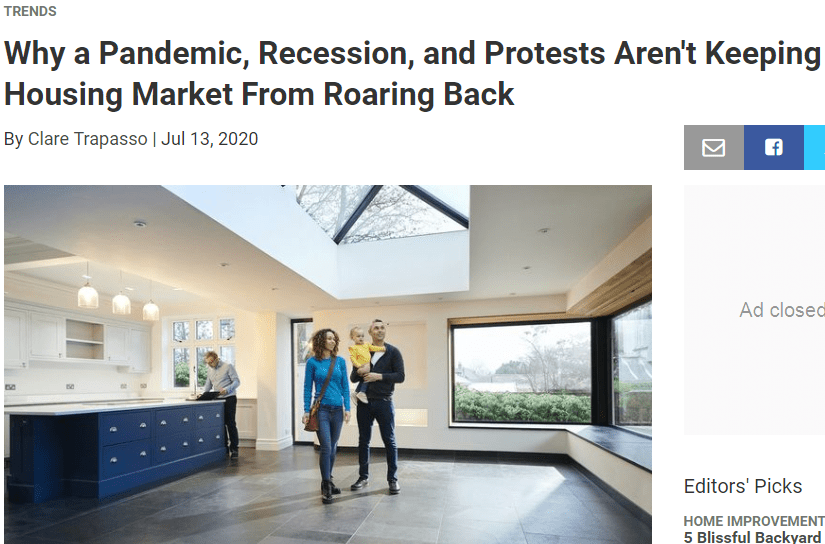
The fact that we’re still in a seller’s market puzzles many real estate professionals, but there are reasonable explanations, which Realtor.com did a good job of describing in a July 13th article by Clare Trapasso.

The headwinds in this market are strong and numerous. We have a lingering and maybe worsening pandemic, staggering unemployment numbers, and a contentious presidential campaign, made even more contentious because of our national reckoning about systemic racism. How does one account for such a strong real estate market, and when will that market soften?

First let’s look at our local numbers. In my July 9th column, I showed statistically how the market had surged in June.  As I write this on Monday evening, there are 4,903 active listings within 20 miles of the State Capitol, but there are 7,720 listings under contract, 3,905 of which (or 50.6%) went under contract in 7 days or less.  A total of 5,219 listings closed in the last 30 days, 2,679 of which (or 51.3%) went under contract in 7 days or less and 1,895 of which (or 36.3%) sold for above full price, likely with competing offers.

So, yes, we are still in a seller’s market — but how can that be, given all that’s going on?

To quote the realtor.com article, “The housing market is back — and then some.”

Nationally, according to realtor.com, median home prices rose 6.2% year-over-year for the week ending June 27th.  According to REcolorado, the median sold price for listings within 20 miles of the State Capitol that same week was $440,000, with 49.9% of them selling in 7 days or less, compared to $418,000 for the same 7-day period a year ago, when 44.5% sold in 7 days or less. That’s a 5% increase in median price year-over-year.

To quote the realtor.com article, “Homes are selling faster than they did in 2019, when no one had heard of Covid-19. And bidding wars are back as first-time and trade-up buyers who have lost out on other homes slug it out.”

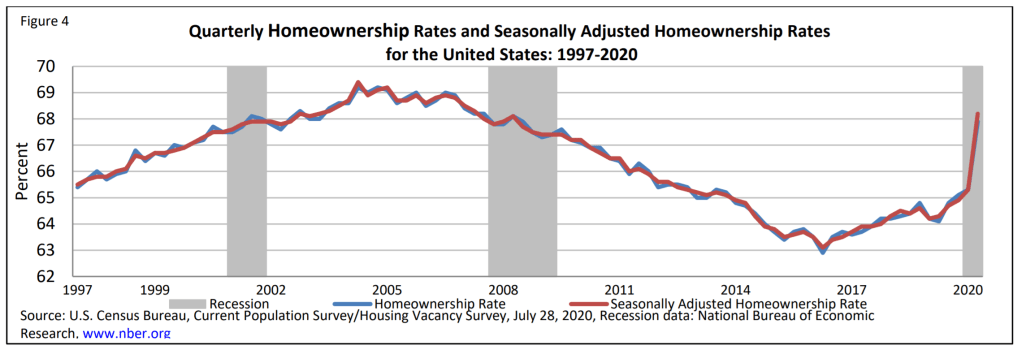
The contrast between this market and the market during the “Great Recession” of 2008 couldn’t be sharper. Back then, there was a glut of housing and few buyers. Today, the situation is reversed, with fewer listings and a glut of buyers. Because the 2008 crisis was caused by the subprime mortgage scandal, the glut of housing was made worse by a flood of foreclosures.

Quoting further from the realtor.com article, “To be sure, there are plenty of danger signs ahead in this economy, including continuing historic levels of unemployment and rising coronavirus infection rates in many parts of the country. But, for now, real estate is bouncing back much quicker than other bellwether industries. The reason: After months on hold, Americans are beginning to feel more confident about the idea of buying or selling a home.”

The article quoted a Fannie Mae survey of 1,000 participants, showing that 61% said it was a good time to buy and 41% said it was a good time to sell. And that survey was taken before mortgage rates dropped to under 3%, which happened just last week.  As a result, we can expect the real estate market to be even more supercharged in the coming weeks. Already, mortgage applications for home purchases had risen 33.2% year over year in the week ending July 3rd, according to the Mortgage Bankers Association.

Lower interest rates mean lower mortgage payments by hundreds of dollars, which instantly increases the affordability of homes, and buyers understandably believe they are smart to buy now before the rates rise again, as they surely will.

The low interest rates also make the decision to buy more compelling for renters burdened by the still high cost of renting in the Denver market.  This is particularly compelling for white-collar workers who were not furloughed or laid off during the pandemic and may have money in the bank for a down payment.

Another factor which I mentioned in my earlier column is the number of workers who started telecommuting because of the pandemic and whose employers said they could keep telecommuting even after it’s safe to return to the office. These people are in a buying mood as they look to move further from the congestion of downtown apartments or condos where going outside involves a greater risk of Covid-19 infection.  They also saved a lot of money (as Rita and I did) by eating more home cooked meals because restaurants were closed. And Netflix costs a lot less than going out to the movies or the theatre, to say nothing about the savings on popcorn made at home or purchased at the supermarket!

Yet another factor is the increase in divorces and separations resulting from forced home confinement. I was amused to note the increase in TV commercials by divorce attorneys during April and May.

Buyers Benefit From Having an Agent Who Knows Home Systems and Sustainability

One of the reasons I enjoy showing homes to buyers is that I get to educate them about home systems and how they work, as well as identify the sustainable and not-so-sustainable features of each home.

The agents at Golden Real Estate have a thorough understanding of home systems as a result of our combined decades of experience and hundreds of transactions. In addition, we have taken classes on energy efficiency, insulation, solar power and home construction which allow us to serve buyers better when we show them homes.

Together, for example, we toured the model homes at Richards Farms when they were under construction, where we learned, among other things, about that builder’s foam insulation process.

There are so many aspects of energy efficiency and sustainability. Everyone by now knows about solar photovoltaics — creating electricity from the sun. Our office has 20 kW of solar panels, but having solar power is only the beginning. It’s how efficiently you use that power that makes the difference.

Heating and cooling is the biggest user of energy in any home, and the number and variety of HVAC systems have become more extensive and more complicated, and we understand and can explain them. They include: gas forced air heating and compressor-based air conditioning (most common in Colorado and much of the country), hot water baseboard heat, hot water radiant floor heating, wall-mounted heating panels or strips, heat pump mini-splits for both heating and cooling, hybrid heat-pump with gas forced air (which Rita and I have in our home), ground-source heat pump for both heating and cooling (the “gold standard” of efficient heating and cooling) — and let’s not forget heating with wood or wood pellets!

Windows can vary greatly. Double-pane windows may be standard now, but a Colorado company, Alpen, has made a name for itself with triple-pane windows and now quadruple-pane windows.  Recently I wrote about John Avenson’s Westminster home, in which some of his south-facing Alpen windows have micro-etching to divert sunlight toward the ceiling of his kitchen, a high-tech alternative to reflective window shelving, which we saw when we toured a newer building at the National Renewable Energy Laboratory.

Skylights are so 20th Century. Today’s modern replacement are sun tunnels (Solatube is a leading brand), which are great for illuminating interior rooms. Just last week I showed a home with five Solatubes in it, lighting up the living room and an interior bathroom amazingly well from the mid-day sun. My buyer didn’t realize they weren’t ceiling light fixtures until I pointed them out. (We have two sun tunnels in our home illuminating our windowless garage and laundry room, and we have four sun tunnels in the Golden Real Estate office. We don’t have to turn on any lights on sunny days!)

A knowledgeable agent can also point out passive solar features of a home, which others might not recognize. These include proper window configuration, wide overhangs above south-facing windows, thermal masses in south-facing sunrooms, and deciduous trees providing strategically positioned shade in the summer but allowing more sunlight in the winter. I like to see (and point out) cellular shades, especially vertical ones covering patio doors for cold-weather insulation.

Often I notice that the listing agent didn’t mention the features (such as the Solatubes) that my buyers and I recognize as selling points. Of course, when doing the narrated video tours of our own listings, my broker associates and I don’t miss the opportunity to point out those features. And, of course, we are sure to mention those features in the MLS listing.

Many agents miss the opportunity to write a separate description on the MLS for each individual room. It’s not a mandatory field, but it’s the best place to mention a room’s Solatube, heated floor, porcelain tile, hardwood or other feature.

Here Are Some Things You Should Expect to Learn From a Professional Home Inspection

A home inspection is the best investment that any home buyer can make, providing you base your decision on the qualifications of the inspector and not by cost alone. In Colorado, home inspectors are not licensed, so look for one like Jim Camp of Metropolitan Home Inspections, who is ASHI-certified. Not only might you find a problem that you could get the seller to fix, but you’ll also learn things you need to know about as the future owner of that home.

The inspector will also show you where the utility shut-offs are located and how to operate them, which can be important during an emergency.

The cost of an inspection varies from one inspector to the next and depends on the size of the home or possibly the purchase price.  Expect to spend between $300 and $500 for the basic or standard inspection. Add-on services which I recommend include a test for radon gas ($100 to $150) and a sewer scope (also $100 to $150).

If a high level of radon gas (over 4.0 picocuries per liter) is detected, the buyer should demand that it be mitigated, which costs a minimum of $900 and as much as $2,000 if there is both a basement and a crawl space.

A sewer scope involves sending a camera through the piping from the house to where it enters the sewer line under your street.  Sewer lines in older homes were built with clay pipes which are prone to root intrusion and collapse.  If root intrusion is discovered, the seller will usually agree to have the sewer line cleaned and rescoped, and if there is a collapse or other break, the repair could cost several thousand dollars, so both tests are money well spent.

The general inspection should be scheduled as soon as possible to allow time for additional inspections as indicated. For example, the inspector may discover evidence of mold or mildew, termite infestation or structural issues, and you’ll need time to arrange those inspections. 

In older (pre-1985) homes, it’s common to encounter a Federal Pacific Electric or Zinsco panel, which can cost $1,500 or more to replace. The inspector should recommend further evaluation and certification by a licensed electrician and recommend its replacement since FPE and Zinsco lost their UL endorsement due to breaker failures resulting in electrical fires. An inspector will test electrical outlets for correct polarity and will also check for ground-fault protection on outlets located within six feet of any water source, such as kitchens, bathrooms, unfinished basements, outdoors or in the garage, etc.

He (or she) will walk the roof if possible (even though it’s not required) to look for hail damage as well as proper sealing around chimneys, etc.

In this article, I have touched on only some of the many tests and inspections which make the money a buyer spends on professional inspection the best money he or she will spend.

Bidding Wars Are Back, According to Redfin

You’ve got maybe 5 seconds to read the small print…

Nothing has surprised us real estate professionals quite as much as how hot the market has been during the Covid-19 pandemic. Redfin, the brokerage with what I consider misleading TV ads, did an analysis of offers written by their own agents on MLS listings and found that over half of those offers faced competing offers from other agents.

Nationwide, the percentage of Redfin offers facing competition was 53.7% in June, up from 51.8% in May and 44% in April. Boston led the pack with 72.4% of offers facing competition during June, up from 67.2% in May.

The Denver market came in 12th nationally in terms of bidding wars, with 53% of offers facing competition, down from 55.6% in May.  Of the top 12 metro areas, only Denver and Portland had lower percentages in June than in May.

If You Oppose Taxation Without Representation, Support D.C. Statehood

Perhaps you heard that the House of Representatives passed and sent to the Senate a bill making the District of Columbia the 51st State.  It will die in the Republican-controlled Senate.

The United States is likely the only country in the developed world where residents of its capital city have no voting representation in their government. It was only 60 years ago that D.C. was given 3 votes in the Electoral College, and it still has no voting representation in Congress. Republicans will never accept that because the District is overwhelming Democratic. (Trump got 4% of the vote in 2016.)  In 2000, the District added the phrase “Taxation Without Representation” to its license plates, and newly elected President George W. Bush responded by ordering that US Government plates replace the D.C. plates on all White House vehicles. Since then, the verb “End” was added to the controversial phrase.

As a compromise, I suggest that the residential areas of D.C. be annexed into Maryland, giving that state another seat or two (based on population) in the House of Representatives. Perhaps Republicans could accept this approach since it wouldn’t produce two Democratic U.S. Senators, just one or two Democratic representatives.

Houston’s Realtor Association Bars Use of ‘Master’

With the new reckoning about systemic racism in America, the Houston Association of Realtors (HAR) decided that “master bedroom” should be replaced with “primary bedroom,” according to a CNN report.

So long as guest bedrooms aren’t called “slave bedrooms,” I see nothing wrong with the term “master bedroom.”  (And what slaveowner ever had his enslaved workers sleeping in adjoining bedrooms under the same roof?)

I checked with REcolorado, our local MLS (which is separate from but owned by our local Realtor associations), and I was assured that there is no plan here to follow HAR’s initiative, and I suspect frankly that HAR will have second thoughts about that change. I agree with John Legend, whose response was to ridicule the change and tell them to concentrate instead on the very real issue of discrimination in real estate.

Discover Arvada’s Geos Community, Where the Homes’ Energy Costs Are Essentially Zero

That’s what it’s like for Jim & Patty Horan, who bought their 3-bedroom, 3-bath, 2,135-sq.-ft. home at 15062 W. 69th Place in Arvada’s Geos Community. They paid $525,000 for it three years ago (July 2017). 

Like all Geos homes, this one has no gas service. With only 6kW of solar panels on the roof, the home is heated by a ground source heat pump. It draws heat from the earth via a 300-foot-deep loop under the home. The heat pump uses very little electricity during the summer to further cool the 55° fluid in that loop, and not much more energy during heating season to heat that fluid to 100 degrees.

On Saturday, June 27th, Jim Horan gave me a tour of his home which I recorded for this fall’s Metro Denver Green Homes Tour. You can view the video at YouTube.com/jimsmith145.

Geos Community’s website describes it as “Colorado’s first geosolar development” and is the only subdivision I know that’s built entirely “net zero energy.” There are developers building solar-powered communities like KB Home’s subdivision on the northeast corner of Hwy 93 and 58th Ave., but they don’t come close to being net zero.

There’s a term for such homes — “greenwashing,” which Wikipedia defines at “a form of marketing spin in which green PR and green marketing are deceptively used to persuade the public that an organization’s products, aims and policies are environmentally friendly.” I’ve always marveled that those KB Homes were built with many of the solar panels installed on north-facing roof surfaces.

Getting back to the Horans’ home, there’s more to going net zero than having solar panels and a ground-source heat pump. Those features must be coupled with energy saving features so that the limited number of solar panels are enough to meet the home’s energy needs — with energy left over to charge an electric car.

Here are some of those features which I covered in my video tour with Jim Horan.

First and foremost is the passive solar orientation of the building with lots of south-facing windows and a south-facing roof for solar panels. Also, there are overhangs above each south-facing window designed to shade it from the sun during the summer while allow full sun in the winter when the sun is lower in the southern sky.

Next, the building’s “envelope” has to be very tight. That starts with foam insulation blown onto the interior surfaces of the roof and exterior walls, replacing the blown-in cellulose and fiberglass batting typical of tract homes built by other developers. The windows are Alpen triple-pane windows which also have foam-insulated fiberglass framing. (Fiberglass is better for window framing than vinyl – not as prone to aging and warping.)

Those elements make a house too air-tight for healthy living, so an energy recovery ventilator is installed which constantly brings in fresh air, using a heat exchanger designed so that the heat (or coolness) of the air being exhausted is used to heat or cool the fresh air being brought into the house. A heat pump within this device, called a CERV, provides further heating or cooling of that fresh air as needed.

In the townhomes at the Geos Community, the CERV works with an air-source heat pump mini-split instead of a ground-source heat  pump to heat and cool the home year-round.

Have you heard the term “indoor air quality” or “sick building syndrome”?  It refers to high levels of CO2 or volatile organic compounds (VOCs) which can build up in a home, especially in a home as air-tight as the Geos homes.

The CERV monitors both CO2 and VOC levels in the house and will bring in additional fresh air when those gases exceed the level set by the homeowner. (The Horans have the level for each gas set at 950 parts per million, or ppm.)

What are VOCs?  If you can smell it, it’s probably a volatile organic compound. Examples include new carpet smell and, worst of all, cat litter smells.

Two appliances in Geos homes also contribute to their low energy load. One is the Bosch condensation clothes dryer, which pulls in cool, dry air from the room. The air is heated and passed through the clothes; but instead of being vented outdoors, the air travels through a stainless steel cooling device or heat exchanger. It does heat the room it is in, so the Horans choose to dry their clothes on an outdoor line during the summer, even though their heat pump could handle the additional cooling load if they didn’t do that. Home Depot sells the Bosch 300 “ventless” dryer for $989.

The other appliance is the heat-pump water heater. It has a heat pump above the tank which transfers the heat from the room into the water. I’ve written about this product before. Home Depot sells a 50-gallon Rheem model for $1,299 which earns a $400 rebate from Xcel Energy and another $300 in federal tax credit if purchased by December 31, 2020. Because this appliance emits cold air, it’s in a pantry which the Horans keep closed in the winter and open in the summer. (I would put it in a wine cellar or in a room with a freezer, which emits hot air — a symbiotic arrangement within one room.)

As you are beginning to gather, building a net zero energy home is best done from scratch, when the additional cost is less than retrofitting a home. (My home is net zero in terms of electricity, but we still burn $30 to $50 of natural gas each month, and it takes twice as many solar panels for my home, which has about the same square footage as the Horans’.)

You may be wondering how much more it cost to build the Horans’ house, which they bought new in July 2017. To answer that, I searched all the comparable homes (2– or 3-story, between 1,500 and 2,500 square feet within 1 mile radius) sold during the summer months of 2017, and I found that the $246 per finished square foot paid by the Horans was actually below the median price ($253 per finished square foot) for the seven comparable sales. And those homes probably pay thousands of dollars per year more for electricity (and gas) than the Horans.

If you want to learn more about Geos community, give me a call at 303-525-1851 or visit the Geos website, www.DiscoverGeos.com.

Homeowners Complain About Over-Solicitation by Agents, Buyers and Investors

In this era of “Big Data,” there are companies which specialize in providing hungry real estate agents with the names and addresses of homeowners with high “sell scores.”

You can tell if you have a high sell score by how many solicitations you have received by letter, postcard, phone call, text message or email about selling your home.

If you bought your house in the last year or two, you have a low sell score and probably aren’t getting such solicitations, but if you’ve lived in your house a long time and are of a “certain age” that suggests you are an empty nester, you probably get a lot of solicitations, especially from investors, but also from real estate agents who purchase lists with your name, address and phone number.

And these parties don’t pay much attention to Do Not Call lists.

Licensed real estate agents can subscribe to an app called Forewarn which allows us to get your phone numbers, including cell numbers, just by entering your name and ZIP code. I have this app myself. It’s marketed to us as a safety tool to forewarn us about buyers with criminal records, judgments or liens, etc. Armed with that information, we can decline requests to show listings either because they’re not qualified financially or we suspect they might rob or assault us. To get such details on the app, we enter the phone number which appeared on Caller ID, or we search by name and city or ZIP code, if we know it.

In prospecting, it’s a “numbers game.” It only takes a small percentage of persons to “bite” to make the practice of over-soliciting everyone else worth the time and expense, so there’s little you can do to stop it. However, here’s some practical advice on reducing those solicitations by just a little.

Regarding text messages, replying with “Stop” should at least reduce follow-up texts, and if it’s a robo-text, the computer will probably reply instantly with “You’ve been unsubscribed.” That is my favorite text message to receive!

If it’s a phone solicitation, you can block the number on most cell phones.  On my iPhone,  after I hang up, I find the number under “Recents” and click on the circled “i” at the right, scroll down and click on “Block this Caller.”

Many email programs also allow you to label an email as “junk” and to block that email address. In Outlook (which I use), the “Junk” designation is at the very left of the “ribbon” at the top of my screen, to the left of the “Delete” icon.

Of course, you can’t do much about letters and cards that you receive by mail other than to ignore and recycle them.

Many real estate agents subscribe to a service which alerts them every time a listing expires on the MLS, and owners of expired listings can expect to be inundated with calls, texts, letters and even door knocks from agents asking if you still want to sell your home and promising to do a better job than your previous listing agent.  There’s no way to avoid this onslaught of solicitations. Just know that it’s coming and prepare yourself to say “no” as politely as possible to the live solicitations and to respond that way to text messages and emails.  It will only last a few days.

If, however, your listing is “withdrawn” instead of “expired” on the MLS, it’s illegal and unethical for any agent to solicit you. That’s because the definition of “withdrawn” is that your home is subject to a valid listing agreement but merely withdrawn from the MLS. Note, however, that when the expiration date of your listing agreement arrives, the MLS will automatically change your listing status from “withdrawn” to “expired,” and the onslaught of solicitations will begin the next morning.

I don’t want to end this article without assuring you that none of the agents at Golden Real Estate engage in the kinds of solicitation described above. Thanks to our form of advertising (this newspaper column), we depend on prospects contacting us rather than us soliciting you. I myself have been licensed since 2002 and don’t recall ever making a “cold call” or sending a single card or letter soliciting a listing from a homeowner.

Unfortunately, that is unusual in our industry, and I apologize for the behavior of those other real estate practitioners.

John Avenson of Westminster Is a Committed Teacher of Energy Efficiency

The sponsors of the annual Metro Denver Green Homes Tour, held on the first Saturday each October, are preparing to “go virtual” in case an  in-person tour is not allowed.

John Avenson’s house at 9988 Hoyt Place, Westminster

That will be accomplished by creating online video tours of the most notable “green” homes featured over the past 20 years. Since I’m on the steering committee for the tour and have the equipment and experience from creating video tours of homes for sale, I volunteered to create those video tours, starting with John Avenson’s home at 9988 Hoyt Place in Westminster.

By clicking here, you can view the 41-minute video tour, led by John, which I created last Friday. It is highly educational.

John Avenson

Many people, myself included, have created homes which can be considered a “model” of sustainability, solar power, and energy efficiency, but John is surely the only homeowner who has turned his home into a classroom for teaching it. He even posted pictures and diagrams throughout the house with instructional content about this or that feature, as you will see on that video.

He also hosts monthly Passive House meetings in his home theater which are also streamed online. They can be found at www.meetup.com/Passive-House-Meetup-S-W-Region/

John’s house was originally built by the Solar Energy Research Institute (SERI, now the National Renewable Energy Laboratory or NREL) in 1981 using then-state of the art technology, but John has diligently, and at great personal expense, kept retrofitting his home with newer technology, which he is happy to explain to visitors and which he explains on the 41-minute video.

CERV monitor screenshot

For example, because of increased insulation and Alpen quadruple-paned windows, he was able to get rid of SERI’s supplemental natural gas furnace, installing a conditioning energy recovery ventilator (CERV) which is powered electrically. His grid-tied solar PV system provides all his home’s energy needs and has reduced his Xcel Energy bill to under $10 per month — the cost of being connected to the electrical grid.

Some of the technological innovations featured in my video with John were new to me. For example, the Alpen windows across from his kitchen have horizontal micro-etching which redirects the sun’s rays 90° upward to his ceiling instead of straight through the glass, reducing the need for lighting.

John provided his email address in the video, saying that his “learning center” is open 24/7 and that he welcomes all inquiries and visitors.

It Seems That We All Have Racism on Our Minds. Here Are My Thoughts.

It has certainly been an interesting and emotional two weeks since the murder of George Floyd by a Minneapolis police officer. Rita and I have been happy to add our voices, and are impressed at the longevity and the worldwide spread of the demonstrations.

On Sunday afternoon, there was an event in downtown Golden, which the two of us attended.  (See the picture  by Chris Davell of Goldentoday.com below.) It was followed by a march through downtown Golden, although Rita and I didn’t stay for that.

The event was organized by a group called Golden United. I have attended several prior events by this wonderful organization, headed by Golden resident Ron Benioff. You will probably read about it elsewhere in this newspaper since I met the reporter covering it. Several hundred people attended the event in Parfet Park, most of them wearing masks and all socially distanced.

It was, of course, very peaceful. After all, this is Golden, a college town that is majority liberal, majority white, and my home for the past 23 years. A city councilor, JJ Trout, emceed the event, giving a very thoughtful speech of her own. Mayor Laura Weinberg also spoke.  Both displayed great introspection and deep thought on the topic of racism. Ron Benioff spoke, stressing that being non-racist is no longer enough. We all have to be anti-racist.

The police chief, Bill Kilpatrick, was there with one other officer and received generous applause at the mention of his sensitive letter to the community which he wrote shortly after the death of George Floyd. (That was followed this week by a lengthy posting on the city’s website outlining police practices and training related to implicit bias, the use of force and other topics raised following George Floyd death.)

I have a couple thoughts to share beyond my sincere appreciation for Golden United and our city’s political leaders.

First of all, I feel that we are overlooking anti-Hispanic racism, which is just as pervasive as anti-black racism. It was the first and remains the greatest expression of racism by our current president, who opposes even legal immigration from people of any color other than white. (Remember his comment about Norwegians being more desirable than Hispanics?)

It’s my perception, and perhaps yours, that whites and the police are not as fearful of Hispanics as they are of African-Americans, but they still don’t view Hispanics as equally valuable human beings.

I certainly value and appreciate our Hispanic population and especially the Mexican-Amercans and their undocumented cousins who work tirelessly and with seeming contentment at so many jobs which other Americans are unwilling to perform — picking our vegetables and fruits, repairing or replacing our roofs, and collecting our trash alongside African-Americans.  (It was heart-warming last week to read a post on NextDoor urging neighbors to tape dollar bills to the lids of our trash carts as a way of thanking our trash collectors.)

Not only do we as a white society insufficiently appreciate our black and Hispanic population, our regressive laws work to keep that population impoverished. We need to address our anti-poor policies — which are really pro-wealthy policies, such as the Trump tax bill of 2017 — which have widened the gap between rich and poor in America.

Real estate, at least in the Denver market, is a majority white industry, not representative of the racial diversity of the metro area. I can say with confidence that it’s not reflective of any anti-black discrimination in hiring.  My first partner in real estate with whom I co-listed properties was an African-American woman who I miss working with. She remained with Coldwell Banker when I moved to RE/MAX Alliance before starting Golden Real Estate.

My seven broker associates are all white, but they and I would welcome with open arms one or more African-American and Hispanic agents to join our ranks.  It is hard to say why our industry has not attracted more African-Ameri-can brokers, but I’ve noticed a large contingent of Hispanic agents, who even have a highly active association.  I’ve attended their events.

For this column, I interviewed two of the three blacks who serve on the 18-member board of directors of the Denver Metro Association of Realtors. That ratio, it should be noted, is better than the ratio of blacks who are members of DMAR.

Milford Adams, managing broker of Lyons Realty Group LLC in southeast Denver, told me that economics are the primary reason there aren’t more blacks in the industry, since it’s hard for a new agent to get established in the business without significant cash reserves. (I know this personally, since it was two years of expenses exceeding income before I myself started making a living in real estate.)  And, yes, he said he has experienced discrimination, much of it subtle, at every turn as he himself rose through the profession.

Lori Pace, of Kentwood Real Estate in the City Properties office in downtown Denver, has been an activist within the profession and operates a strategic consulting business, offering training to real estate brokerages (see her website, www.LoriPace.com) in the area of recruitment and diversity training.  On that website you can also watch her TEDx talk “Philanthroperty,” which was about inspiring women, not just minority women, to invest in “real estate, not purses,” to grow in wealth and power.

The following was submitted by Lori Pace regarding the program she teaches on diversity:

Everyone’s experience matters and how we live, make a living, and lose lives. There is no such thing as a stupid white question, but there is certainly are intellectual black answers. The Diversity Difference is an essential wellness program illustrating how real estate and health equity impact everyone’s ability to breathe or exhale. 

The Diversity Tool Kit is THE ventilator allowing everyone the opportunity and right to exist and not resist.  It is designed to develop a multicultural, multi-generational mindset. The live and virtual keynote address combines a training series with first-hand accounts and stories on doing business while being Black in America.  It is more than a call to action. It is a collaborative, result-driven process tackling multi-layers of problems and resolutions examining metrics, business strategies, and tools for real-life situations.  Passive conversations become proactive actions.

This is a resource to ensure strategic, proactive, and sustainable ACTIONS that can be implemented immediately.  The agenda is based on an inspirational and REAL approach providing new perspectives for all industries, organizations, and institutions ready to implement a blueprint from a black perspective.

Participants gain a new outlook and opportunity to breakdown and understand how systematic racism in businesses and communities continues to be influenced by the power of segregation and money. Transparency and trusting safe cultures are non-negotiable in order to move forward. The experiential learning deals with Fair Housing and intentional and unintentional Unfair Business Practices. It is time to invest in business, social and emotional “Black and Blue Print” to change your PACE unapologetically with a high return on your investment.

The Real Estate industry and brokerages are major players influencing ALL communities, neighborhoods, business, and institutions.  There is a new demand for answers to awkward questions and circumstances requiring a no-judgment solution. Now more than ever, the world is aware of the negative impacts of silence and ignoring the blinders that have been abruptly removed.