Report Details How the Inflation Reduction Act Will Transform the Building Sector

One of the best analyses of the impact of the IRA on sustainability and the mitigation of climate change was released on Aug. 31st by the Rocky Mountain Institute. Below is a graphic from that report summarizing the IRA’s biggest direct impacts. Click here to view the full report.

As reported by Fast Company, the report “finds that the IRA’s main rebates and tax credits could bring electrification and energy-efficiency upgrades to millions of homes. In total, the bill’s new rebates and expansions of existing tax credits will create more than $23 billion in funding to electrify homes, upgrade heating, cooling, and ventilation equipment, and develop entirely new buildings that meet the highest federal standards for efficient energy use.” The IRA provides funds or rebates for:

Electric heat pumps that can both heat and cool your home, which the Department of Energy estimates will save families $500 to $1,000 every year. There’s a rebate of up to $14,000 for installing them.

Induction cooktops, which replace dangerous and health-harming gas stoves that contribute to asthma and other respiratory diseases.

Insulation, windows, doors, and sealing ductwork, which will ensure a home’s heating and cooling systems don’t have to work as hard to keep families comfortable.

Upgraded electrical panels and wiring for homes that have older electrical service.

The tax credits provided for in the IRA are available immediately, but the rebate program will take some time to be implemented, since it requires the creation of rules and forms.

Big Brokerages’ Stocks Plummet Due to Slowing Market

The publicly traded brokerages are taking a beating, trading near their 2022 lows, as the following stock prices quoted last Wednesday by Inman News Service show:

Compass (COMP)     $3.28 +.07   (year range: $3.20-17.70) 

eXp World Holdings (EXPI)     $14.23  -.06   (year range: $11.06-55.43) 

Redfin (RDFN)    $9.40  -.08   (year range: $7.13-55.87) 

Zillow (Z)    $34.39   +.96  (year range: $28.61-104.05)

Offerpad (OPAD)  $1.61 -.02 (year range $1.60-20.97)

Opendoor (OPEN)   $4.62 -.03 (year range $4.30-25.32)

Anywhere Real Estate (HOUS)     $11.18 +.14 (year range: $9.06-21.03) 

(Anywhere Real Estate is the new name for Realogy, which owns and franchises Century 21, Coldwell Banker. Corcoran, Better Homes & Gardens Real Estate, and ERA Real Estate.)

Golden Real Estate was founded in July 2007, just before the market crash of 2008, but we prospered through that downturn, and we will prosper through this one.

MLS Statistics Confirm a Rapidly Slowing Real Estate Market in Metro Area

As I write this on Sunday evening, I can’t know what the statistics will be at the end of August, so I ran some numbers for the first 28 days of the month to see how they compare to the previous 12 months. The result of that number crunching is in the chart below, and it confirms what we have all been feeling — that the real estate market in the metro area is indeed slowly abruptly.

The chart, limited to REcolorado listings within an  18-mile radius of the state Capitol, shows four metrics which I consult regularly to read the temperature of the market: the average and median days that a listing is active before going under contract, the ratio of sold price to listing price, and the average sold price. As you can see on the bottom four lines of the chart, the market started coming off its peak in May, slipping seriously by July.

During the seller’s market triggered by low mortgage interest rates and the pandemic, we saw the median days on the MLS in the mid single digits, as shown in column two. The average days on the MLS was higher, but not as high as in pre-pandemic times when it was in the 30s and 40s. Amazingly, that metric slipped into the single digits this April and May.

The last time the ratio of sold price to listing price was below 100% was in January 2020. In April of this year, before the impact of rising mortgage interest rates, it peaked at 106.1%, but it fell to 100% in July for the first time in 18 months, and during the first 28 days of August, it slipped to 99.57%.

The average sold price, which fell almost $30,000 in July, fell an unprecedented $58,136 during Aug. 1-28, a 9.2% drop in just one month.  When the full month is tabulated, it could well be worse.

For buyers who have cash or are not scared away by 5% interest rates, this represents an opportunity, and I have had my busiest open houses in a long time over the past three weekends, so I think buyers are ready to capitalize on that opportunity.

This is not to say there will be a market rebound anytime soon. There is a lot of uncertainty in the air in terms of politics, economics, and other matters, which will continue to keep many buyers on the sidelines.

Crested Butte Bans Natural Gas in New Construction — A New Statewide Trend?

Given our commitment to addressing climate change, one of my favorite email newsletters is “Big Pivots,” written by Allen Best of Arvada, The mission of his non-profit is to document, understand and educate about the changes made necessary by climate change.

Among those changes is the transition from fossil-fuel heating of homes and water using natural gas and propane now that electric heat pump units are practical and affordable.

The latest Big Pivots email newsletter (which you can subscribe to at bigpivots.com) was about Crested Butte’s recent decision to outlaw natural gas in new construction. Rather than rewrite what Allen wrote, here is his article with some minor edits:

By ALLEN BEST

Crested Butte, a one-time coal mining town, has now turned its back on natural gas. Town councilors unanimously agreed that any new building erected on the 60 vacant lots cannot be served by gas. Major remodels must be electric-ready. It’s Colorado’s first natural gas ban, although 80 other jurisdictions around the country have taken similar measures.

“There was a lot of talk at council about it being a bold decision, but I don’t see it that way,” said Crested Butte Mayor Ian Billick. “Not only is it what we need to do, but we have all the tools to do it cost effectively.”

Billick arrived at Crested Butte several decades ago as a biologist at the nearby Rocky Mountain Biological Laboratory. Many experiments there have focused on the effects of warming temperatures on existing plants. One experiment involving year-round heat lamps specifically foretells a shift from the showy wildflowers for which Crested Butte is famous to an ecosystem dominated by sagebrush.

Temperatures continue to creep higher, but at more than 8,900 feet in elevation, Crested Butte still has chilly winters. The overnight temperature during January averages 6 below.

The takeaway here is that if Crested Butte is comfortable with the replacement technologies for natural gas, most other places in Colorado should be, too. Instead, builders are still tethering tens of thousands of homes and other new buildings each year to natural gas pipelines.

Denver and Boulder have taken steps to push alternatives. Here and there individual action has occurred. In Westminster, John Avenson in 2017 ordered his natural gas meter removed after maximizing the passive solar potential of his house. (YouTube video tour of John’s home.) In Arvada, Norbert Klebl developed 30 homes without natural gas in a project called GEOS. In Basalt, two affordable housing complexes have been built without natural gas. An all-electric hotel is under construction in Snowmass. North Vista Highlands is slowly taking shape in Pueblo. In Fort Collins, plans have been drawn up for Montava, a  500-unit project.

We have been pivoting slowly, but the transition is accelerating.

Granted, the generation of electricity still causes atmospheric pollution. Emissions will dramatically drop by 2030, however, as Colorado’s utilities close nine of today’s 10 coal-burning units.

Colorado legislators in 2021 passed several laws that collectively seek to squeeze emissions from our buildings. The laws reflect the state’s political makeup. Colorado may be dominated by Democrats, but it’s still a purplish state. In other words, don’t expect a wave of Crested Butte-type mandates such as occurred in California beginning in 2019. We walk on a different balancing beam.

Most important among Colorado’s legislative squeezes is Senate Bill 21-264, which requires Colorado’s four regulated natural gas utilities to incrementally reduce emissions.

The law identifies several pathways. They can, for example, help customers improve efficiency of buildings, so buildings need less gas to provide comfort. They can augment the methane obtained by drilling with methane diverted from sewage plants, feedlots and other sources. The first of their plans will be filed with state regulators in 2023. The bottom line is that the gas companies will have to adjust their business models.

The Colorado Public Utilities Commission has now set about creating rules for evaluating clean-heat plans. In filings beginning last December, real estate agents, home builders and even some municipalities have argued that converting from natural gas will add costs. That was the same message at recent meetings in Montrose and Grand Junction. Their message was simple: Don’t change.

In metro Denver’s more affluent northwest suburbs, Christine Brinker of the Southwest Energy Efficiency Project reports a draft policy would give builders a choice between either all-electric or natural gas with extra energy efficiency.

Unless a way can be found to cost-effectively sequester carbon emissions, natural gas will slowly be phased out in coming decades. Ironically, the arrival of natural gas was one reason that coal mining ended in Crested Butte in 1952 after a seven-decade run.

More Than Just a ‘School of Mines,’ CSM Is a Major Player in Climate Research

The Colorado School of Mines, with its historic connection to fossil fuel and mineral extraction, would seem an unlikely place for a high-level pursuit of the transition from a world powered by fossil fuels to a world of clean energy, but that’s exactly what I have observed.

Even the Petroleum Engineering Department downplays petroleum extraction in its web page with the following opening lines: “As human standards of living rise, so does energy and resource consumption. Hydrocarbon energy will continue to dominate energy usage, and other non-hydrocarbon resource development, such as geothermal and subsurface resource acquisition and development, will continue to grow in importance.”

The spring 2022 edition of Mines Magazine had a major article with the headline, “Oil and gas engineers are the key to the energy transition.”

Back in February 2017, the Faculty Senate adopted a Climate Change Statement. Central to CSM’s commitment to addressing climate change is its Global Energy Future Initiative (GEFI) related to the university’s tagline, “Earth, Energy, Environment,” with a focus on Low Carbon and Renewable Energy, Carbon Capture Utilization and Storage, and Clean Water Innovations, in addition to Minerals & Metals, Supply Chain Transparency, and Oil & Gas.  Under “Oil & Gas,” the GEFI web page talks about “Designing interdisciplinary research focused on the science, engineering and policy of oil and gas in the net-zero energy future” (emphasis added)

While there is a commitment to continued extraction of oil and gas, including hydraulic fracturing, I’m impressed by the recognition that saving our planet depends on transitioning from oil and gas to other forms of energy that reduce or eliminate greenhouse gas emissions.

I have received the email newsletter of CSM’s Payne Institute for Public Policy for several years and have been impressed at the variety and depth of the research which it is working on with regards to climate change.

To give a sense of the depth and breadth of its research, the August 2022 email newsletter from the Payne Institute has the following headlines about different research projects, each with a detailed paragraph and a link to further information on the CSM website:

> New Winners, New Losers – Toward a New Energy Security

> Declaring a Climate Emergency Won’t Save the Planet — Energy Security Could

> Carbon Capture Utilization and Storage in the New Inflation Reduction Act

> Scrap, Sell, Auction or Repurpose? What’s the Best Business Model for Coal Plant Closure?

> How Energy Subsidy Reform Can Drive the Iranian Power Sector Towards a Low-Carbon Future

> Making Carbon Offset Disclosure Align with Climate Value

> Clearing the Non-Technical Hurdles for Carbon Capture & Sequestration

> Interest Group Power and the Passage of Nigeria’s Petroleum Industry Act (PIA) – A Multiple Streams Approach

> Tackling Ripple Effects of Renewable Energy on Mineral Supply Chain

> The Net-Zero Industry Tracker

I suggest that you Google “Colorado Schools of Mines Climate Change,” as I did, to see the many elements of CSM’s commitment to net zero energy research, climate change, and even on-campus sustainability. You’ll be impressed.

My fellow MIT alumni would never forgive me if I concluded this article without pointing out that our alma mater is equally committed to these issues and topics of research. For example, under its Climate Grand Challenges initiative, the Institute selected 27 teams as finalists from a field of nearly 100 initial proposals, representing 90 percent of MIT departments and involving almost 400 MIT faculty, senior researchers, and external collaborators. On April 11five teams with the most promising concepts were announced as multi-year flagship projects that will receive additional funding and support to develop, implement, and scale their solutions rapidly.

We Reduce the Cost of Moving for Homebuyers

We have offered buyers and sellers free use of our box truck since 2004, saving each of them thousands of dollars in moving costs. We also provide moving boxes and packing materials. The truck comes with blankets and dollies, too. For new clients who sign with us in the month of September, we are offering Totally Free Moving. That means we not only give you free use of the truck, we also pay for the labor and gas for any move within the Denver metro area. Call any of us (see list below) for the full details of this special one-time offer!

Jim Smith, Broker/Owner,       303-525-1851

Broker Associates:

Jim Swanson, 303-929-2727

Chuck Brown, 303-885-7855

David Dlugasch, 303-908-4835

Ty Scrable, 720-281-6783

Greg Kraft, 720-353-1922

Pricing Your Home Right Is More Important Than Ever

The “seller’s market” is slowing. You can still sell your home quickly and even attract a bidding war, but that requires pricing your home correctly. Overprice it, and it could sit on the market for a long time, go through multiple price reductions, and end up selling for less than if you had priced it correctly in the beginning. The agents of Golden Real Estate and I can help you thread that needle.  Call any of us for a free consultation.

The softer real estate market also makes marketing your home well more important than ever, and no brokerage provides the kind of marketing — including promotion of your home in this column and our trademark narrated video tours — that Golden Real Estate provides. Our phone numbers are below.

Jim Smith, Broker/Owner      303-525-1851

Broker Associates:

Jim Swanson, 303-929-2727

Chuck Brown, 303-885-7855

David Dlugasch, 303-908-4835

Ty Scrable, 720-281-6783

Greg Kraft, 720-353-1922

Statistics Help to Quantify the Slowing Real Estate Market in Metro Denver

Here are some ways I’ve been able to quantify what we are all seeing, namely the slowing of our local real estate market.

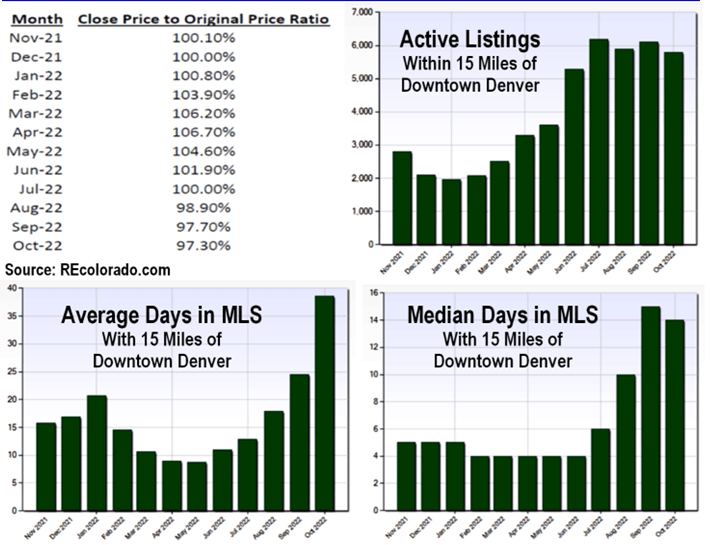
Looking within 14 miles of downtown Denver, the currently active (i.e., unsold) listings have a median days on MLS (DOM) of 27 days. However, the currently pending listings have a median DOM of 13, and the listings that closed in the last 30 days have a median days on the MLS of 7.

The listings that closed in the prior 30 days had a median DOM of just 5, which is what it has been, more or less, through the past couple years. So the market is definitely slowing, and slowing rather abruptly.

The number of active listings —  what we refer to as “inventory” — has surged as homes sit on the market longer.

As I write this on Tuesday morning, there are 4,133 active listings on REcolorado, the Denver MLS, in that same 14-mile radius. That’s down from the peak of 5,521 at the end of July, but you have to go back to September 2020 to find a higher number of active listings than this July, as shown in the chart below.

In prior years, you’d see the number of active listings increase by 50%, more or less, from January to July, but look at this year’s more than triple surge from January to July in that chart.

The chart of pending listings (below) is also instructive. Notice that in most months during 2021 and 2022, the number pending listings was almost always higher than the number of active listings (above chart), but that changed in June and July, when the numbers dropped dramatically.

You’d expect, in a normal market, with a lot more listings to choose from, that more listings would go under contract, but the reverse was true. As the number of listings surged in June and July, the number of listings going under contract went down substantially. That, too, reflects an abrupt slowing of Denver’s real estate market.

(As an aside, notice the effect of the pandemic on the April 2020 number of pending listings. April was the first full month of the pandemic, and the number of listings going under contract plummeted at a time of year when they would normally surge. Notice, however, the quick recovery in the following months. It has been surmised that Covid soon caused a surge in sales as people began to work at home and saw the need for more home office space and the opportunity to move further from their place of work since they were no longer commuting.)

Another statistic demonstrating the slowing of Denver’s real estate market is the extent to which the median sold price of homes has fallen as the market has turned.

The median sold price for that   14-mile radius peaked at $582,950 in June, but it fell to $550,000 in July and has fallen to $520,000 for closings during the first half of August — going down, but still higher than in any prior year.

NOTE: The above article was adapted for a Jefferson County audience using only Jeffco statistics. You can read a PDF of that version at www.JimSmithColumns.com.

Some Reasons We’ll Never Have Self-Driving Cars

When will Elon Musk and others stop talking about “full self-driving,” meaning no driver attention required? I write from the perspective of having used Tesla’s Autopilot features myself for several years. Full self-driving will never happen because the public won’t accept the following:

Speed bumps, potholes, critters you don’t want to hit, or simply rough pavement will never be recognized and avoided. (The car stays centered between the painted lines.)

Full self-driving, like Autopilot, utilizes GPS data about speed limits, which is often out-of-date and doesn’t reflect temporary reductions such as construction and school zones. (On I-70’s central project and on McIntyre Street there are still places where my Tesla wants to slow down to 35 mph in places based on old data.)

On city streets where no painted lines separate the moving lane from parked cars, Autopilot often brakes for a parked car, mistaking it for a stopped car in the moving lane.

Among other issues, a self-driving car will never cross the yellow line on a narrow lane to safely pass a bicycle.

How Concerned Should Homebuyers Be About Fed Interest Hikes?

It is no surprise that headlines like “Fed Hikes Rates” may discourage prospective home buyers, but they should not be discouraged. Jaxzann Riggs, owner of The Mortgage Network, explains why.

The “Federal Reserve” is the central bank of the United States. Founded by an act of Congress in 1913 with the primary purpose of enhancing the stability of the American banking system, the “Fed” is charged with helping to set “monetary policy” for the United States. It sets the “federal funds rate” which is the interest rate that banks charge each other to borrow or lend excess reserves overnight.

“Monetary policy” refers to the actions undertaken by the Federal Reserve to influence the availability and cost of money and credit offered to consumers and businesses to help promote national economic goals. 

You may have also heard the term “quantitative easing.” Quantitative easing (QE for short) is a policy or strategy which has recently been used by the Federal Reserve. During the COVID pandemic, the Federal Reserve not only cut the “Fed funds” rate to zero but it also purchased mortgage-backed and other financial securities to increase the supply of money for homeowners. This encouraged more lending to consumers and businesses. While the result of the policy remains to be seen, most economists suggest that it caused mortgage rates to be held artificially low. The combination of low rates and low housing inventory (construction of new homes fell dramatically following the 2007-2008 fiscal crisis) created the “inflation” of home values with which we are all familiar.

Some assume that the Federal Reserve sets mortgage rates… they do not, but they do influence mortgage rates. The Fed controls short-term interest rates (mortgage rates are long-term rates) by increasing them or decreasing them based upon the state of the economy. When the economy is struggling, the Fed lowers the rates, allowing banks to borrow money at a lower rate to lend to consumers. When the Fed decides the economy may be overheating (read inflation) they tighten the money supply by raising the Fed funds rate. While this does not directly increase mortgage rates, lenders must eventually do the same to keep up with their costs to borrow money from the Federal Reserve.

On July 27th, the Federal Reserve announced a three-quarter percent interest rate hike, and during that week the average 30-year fixed mortgage rate fell one quarter of a percentage point. When there is talk of the Fed raising their rate, mortgage rates can spike, but they typically correct by the time that the increase is actually announced.

Recent positive unemployment figures may cause the Fed to raise rates once again, but the Fed’s chairman, Jerome Powell, has also indicated that there may be a pause on future increases in order to assess their impact on the economy.

We all know that higher rates reduce purchasing power for buyers, but there have been some positives to higher rates. Fewer buyers in the market mean that inventories are rising, and sellers are willing to help buyers with “interest rate buydowns.” Buying at the right price is important, but asking the seller to help with the cost of an “interest rate buydown” instead of offering a lower purchase price will have much more impact on a buyer’s monthly mortgage payment. (Click here to read my July blog post on the topic of interest rate buydowns.) Buyers are qualified for monthly mortgage payments versus loan amounts, so reducing the rate on your new home loan increases your buying power.

If you have lending questions about your personal circumstance, Jaxzann Riggs is standing by. You can reach her on her cell phone at (303) 990-2992.