Broker/owner Jim Smith and broker associate David Dlugasch pose with the Golden Sustainability Award in front of their two Teslas.
Back in 2010, Golden Real Estate was awarded the “Sustainability Award for Business” from the City of Golden for the brokerage’s solar-powered office. Eleven years later, we have been awarded this recognition a second time because of how much further we have taken our passion for sustainability.
Back in 2010 we had a 5kW solar array on our roof — enough to power our office, but little else. We had a couple other features — sun tunnels to daylight our office reducing the need for artificial lighting, extra insulation to reduce the amount of natural gas needed to heat the office, and we accepted polystyrene (aka Styrofoam) for recycling.
Now, we have 2 ground-mounted solar arrays adding another 15kW of solar power, providing enough electricity to heat and cool our office with heat pumps and to power our five agent-owned Teslas as well as offering free EV charging to the general public. We had our gas meter removed in 2017 and now our Xcel Energy bill is $10 to $11 per month, which is the cost of being connected to the electric grid. We are now a “net zero energy” facility — and we’re taking two truckloads of Styrofoam to a reprocessing center in Denver every month.
Thanks to “net metering,” the electric grid functions like a battery, receiving our excess energy during sunny days and giving it back to us when we need it. We like to consider our office an example that other businesses can aspire to, and we are grateful for this week’s recognition by Golden. Click on the following 2-minute YouTube video tour of our net zero office:
Lakewood Earth Day 2021 features this video tour of Golden Real Estate’s Net Zero Energy office.
As much as we Americans love our gas fireplaces, gas ranges and gas grills, we need to recognize that the move to an all-electric home, with the electricity being generated using minimal fossil fuels, is central to the goal of mitigating the effects of climate change.
And it can be a good future, especially if you’re able to generate all the electricity that your home and cars use.
That’s the future Rita and I have created for ourselves. We have 10 kW of solar panels on our Golden home, enough to heat and cool our home and charge our two electric cars. Our forced air furnace only burns gas when the outside temp dips below freezing. Otherwise, a heat pump provides all the heat we need. And recently we replaced our gas water heater with a hybrid water heater that heats all the water we need using its built-in heat pump. It has a standard electric heater coil in case we need faster recovery. (We never have needed faster recovery.)
Yes, we still have a gas cooktop and gas fireplace, and our BBQ grill is plumbed with gas. I can picture us moving to an induction electric cooktop, electric fireplace and electric grill, but for now we comfort ourselves with the knowledge that we have drastically reduced our carbon footprint and our monthly energy bills with the use of heat pumps for heating, cooling and water heating, as well as by driving EVs.
A December article on axios.com reported that some progressive jurisdictions are now banning gas hookups in new residential and commercial construction. According the article, 40 California municipalities, starting with Berkeley in 2019, have banned the installation of natural gas service in new construction.
The most common argument against this anti-natural gas trend relates to the cost of electric heating vs. gas heating, but the people who make that argument are probably thinking of conventional resistance heating, such as baseboard electric heating.
Resistance heating is similar to your kitchen toaster, sending electricity to a coil causing it to generate heat. There is a more efficient way to heat, however, which is to use a heat pump. A heat pump moves heat instead of generating heat, and the cost is as little at one quarter that of resistance heating for the same BTU (heat) output. Here’s a article comparing the two kinds of electric heating.
Moreover, a heat pump can provide both heating and cooling, merely by reversing the direction in which it moves heat, replacing both the gas furnace and electric air conditioning unit which most of us have in our homes.
Another argument against increased electrification is that electricity is itself created by the burning of coal and natural gas. The current fuel mix of Xcel Energy in Colorado is 36% natural gas, 32.5% coal, and the rest renewable energy (mostly wind). The company’s goal is 55% renewable by 2026 and 100% “carbon-free” by 2050, so it makes sense to start now replacing gas appliances with high efficiency electric ones such as heat pumps.
Keep in mind, too, that we can generate our own electricity at home and on our office buildings, taking advantage of “net metering,” paying only to be connected to the electric grid. With net metering, Xcel’s grid functions like a battery, taking excess electricity from our solar installations during the day and delivering it back to us when the sun goes away — or when our solar panels are covered with snow!
We watched this program when it aired on PBS a few weeks ago, but I’ve registered for an online screening this Thursday, Dec. 10th, 7 to 10 pm, because it will include a post-screening panel discussion about the topic of roof-top and community solar programs, which are under attack by utilities in different states. Here in Colorado, we’re blessed with a government which is supportive of clean energy, but that’s not the case everywhere, and there is always the risk that a less friendly government on the state or federal level could frustrate the goal of moving away from an economy based on fossil fuels and to an economy based on clean, renewable energy. Click here to register for it on Eventbrite.com.
The first Saturday of October is when the Metro Denver Green Homes Tour happens, and this year the tour is better than ever because it’s virtual. What that means is that instead of having to visit some or all of the homes between 9 am and 4 pm on a single day, you can watch short videos of each home. It’s possible you could “visit” all 16 homes and the one business in just one or two sittings at your computer and likely learn more about their sustainable features than if you had visited them in person. That’s what I call a green tour of green homes!
Since I shot all those videos myself and thereby learned all those homes’ sustainable features, you can consider me an expert on what’s new and exciting as well as what’s old and proven when it comes to making a home sustainable.
The theme this year is the Best Homes From the Last 25 Annual Tours. The home owned by Rita and me is on the tour, and since I just turned 73 I’d like to share with you how making our home sustainable also secured for us an affordable retirement — if and when I retire!
It all starts with solar power. Nowadays you can install enough solar panels on your home for under $20,000 so that you never pay Xcel or your other electrical provider more than the cost of being connected to their electrical grid. With Xcel Energy, that’s under $10 per month. The electricity you use is free, created from the sun.
You need to be connected to the grid, because the grid functions as your “battery.” Your electric meter runs backward during the day when you’re creating more electricity than you use, and it runs forward at night. Your goal is to have it run backward more than it runs forward.
Plan ahead and buy enough electrical panels so that over time you can replace your gas-fired appliances with electrical ones — a heat-pump water heater, a heat-pump system for heating and cooling, and an electric range — and replace your gas-powered car with an electric one. Now everything in your life is sun-powered!
You can buy a used electric car for under $30,000 or even under $10,000 (Google “used electric cars” and see for yourself) and never buy gasoline or pay for an oil change or tune-up again and probably never have an expensive car repair either. Buying a used electric car is smarter than buying a new one because there’s hardly anything to go wrong with an EV — no transmission, timing belt, motor or hundreds of other expensive parts that could fail. See the article at right about our electric vehicle event. It’s the only in-person part of the tour.
So there you have it. Once you’ve paid off your mortgage (or transitioned to a reverse mortgage), the only costs of living in your home will be your property taxes and water bill, plus $10 per month for being on the electrical grid.
Be sure to “attend” this year’s tour of green homes. Register at www.NewEnergyColorado.com/home-tour. It’s free, although you will be asked for a donation. Another feature of the tour this year is three video presentations.
Hear Bill Lucas-Brown from GB3 Energy on “Reducing your Carbon Footprint with an Electric Mini Split”; John Avenson, from PHIUS.org and Steve Nixon from the National Renewable Energy Laboratory discussing “New Home vs Renovation: 2 alter-native Paths to Zero Energy”; and Peter Ewers from Ewers Architecture Golden presenting “All Electric Buildings, the Key to our Energy Future.”
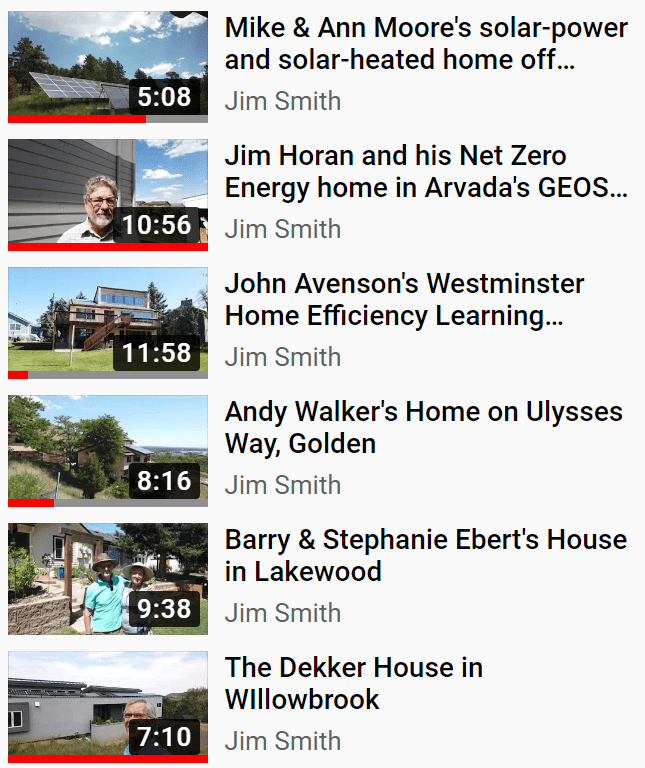
Below are twelve of the videos in the YouTube playlist which you’ll get to view when you register for this year’s tour.
That’s what it’s like for Jim & Patty Horan, who bought their 3-bedroom, 3-bath, 2,135-sq.-ft. home at 15062 W. 69th Place in Arvada’s Geos Community. They paid $525,000 for it three years ago (July 2017).
Like all Geos homes, this one has no gas service. With only 6kW of solar panels on the roof, the home is heated by a ground source heat pump. It draws heat from the earth via a 300-foot-deep loop under the home. The heat pump uses very little electricity during the summer to further cool the 55° fluid in that loop, and not much more energy during heating season to heat that fluid to 100 degrees.
On Saturday, June 27th, Jim Horan gave me a tour of his home which I recorded for this fall’s Metro Denver Green Homes Tour. You can view the video at YouTube.com/jimsmith145.
Geos Community’s website describes it as “Colorado’s first geosolar development” and is the only subdivision I know that’s built entirely “net zero energy.” There are developers building solar-powered communities like KB Home’s subdivision on the northeast corner of Hwy 93 and 58th Ave., but they don’t come close to being net zero.
There’s a term for such homes — “greenwashing,” which Wikipedia defines at “a form of marketing spin in which green PR and green marketing are deceptively used to persuade the public that an organization’s products, aims and policies are environmentally friendly.” I’ve always marveled that those KB Homes were built with many of the solar panels installed on north-facing roof surfaces.
Getting back to the Horans’ home, there’s more to going net zero than having solar panels and a ground-source heat pump. Those features must be coupled with energy saving features so that the limited number of solar panels are enough to meet the home’s energy needs — with energy left over to charge an electric car.
Here are some of those features which I covered in my video tour with Jim Horan.
First and foremost is the passive solar orientation of the building with lots of south-facing windows and a south-facing roof for solar panels. Also, there are overhangs above each south-facing window designed to shade it from the sun during the summer while allow full sun in the winter when the sun is lower in the southern sky.
Next, the building’s “envelope” has to be very tight. That starts with foam insulation blown onto the interior surfaces of the roof and exterior walls, replacing the blown-in cellulose and fiberglass batting typical of tract homes built by other developers. The windows are Alpen triple-pane windows which also have foam-insulated fiberglass framing. (Fiberglass is better for window framing than vinyl – not as prone to aging and warping.)
Those elements make a house too air-tight for healthy living, so an energy recovery ventilator is installed which constantly brings in fresh air, using a heat exchanger designed so that the heat (or coolness) of the air being exhausted is used to heat or cool the fresh air being brought into the house. A heat pump within this device, called a CERV, provides further heating or cooling of that fresh air as needed.
In the townhomes at the Geos Community, the CERV works with an air-source heat pump mini-split instead of a ground-source heat pump to heat and cool the home year-round.
Have you heard the term “indoor air quality” or “sick building syndrome”? It refers to high levels of CO2 or volatile organic compounds (VOCs) which can build up in a home, especially in a home as air-tight as the Geos homes.
The CERV monitors both CO2 and VOC levels in the house and will bring in additional fresh air when those gases exceed the level set by the homeowner. (The Horans have the level for each gas set at 950 parts per million, or ppm.)
What are VOCs? If you can smell it, it’s probably a volatile organic compound. Examples include new carpet smell and, worst of all, cat litter smells.
Two appliances in Geos homes also contribute to their low energy load. One is the Bosch condensation clothes dryer, which pulls in cool, dry air from the room. The air is heated and passed through the clothes; but instead of being vented outdoors, the air travels through a stainless steel cooling device or heat exchanger. It does heat the room it is in, so the Horans choose to dry their clothes on an outdoor line during the summer, even though their heat pump could handle the additional cooling load if they didn’t do that. Home Depot sells the Bosch 300 “ventless” dryer for $989.
The other appliance is the heat-pump water heater. It has a heat pump above the tank which transfers the heat from the room into the water. I’ve written about this product before. Home Depot sells a 50-gallon Rheem model for $1,299which earns a $400 rebate from Xcel Energy and another $300 in federal tax credit if purchased by December 31, 2020. Because this appliance emits cold air, it’s in a pantry which the Horans keep closed in the winter and open in the summer. (I would put it in a wine cellar or in a room with a freezer, which emits hot air — a symbiotic arrangement within one room.)
As you are beginning to gather, building a net zero energy home is best done from scratch, when the additional cost is less than retrofitting a home. (My home is net zero in terms of electricity, but we still burn $30 to $50 of natural gas each month, and it takes twice as many solar panels for my home, which has about the same square footage as the Horans’.)
You may be wondering how much more it cost to build the Horans’ house, which they bought new in July 2017. To answer that, I searched all the comparable homes (2– or 3-story, between 1,500 and 2,500 square feet within 1 mile radius) sold during the summer months of 2017, and I found that the $246 per finished square foot paid by the Horans was actually below the median price ($253 per finished square foot) for the seven comparable sales. And those homes probably pay thousands of dollars per year more for electricity (and gas) than the Horans.
If you want to learn more about Geos community, give me a call at 303-525-1851 or visit the Geos website, www.DiscoverGeos.com.
Here in Colorado, as in much of the country, the typical home heating system is gas forced air. A gas flame heats up a plenum across which a fan blows air through ductwork into the various rooms of a house. For cooling, the same ductwork and fan are used, but instead of the flame heating that plenum, the air passes over a set of coils beyond the plenum with super-chilled fluid created by an outdoor compressor.
Gas forced air, however, is relatively inefficient and is only common in the United States because of our exceptionally low cost of natural gas and other fossil fuels.
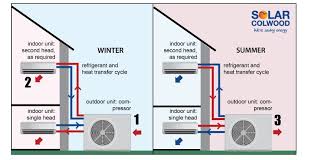
Elsewhere in the world, heating is done using heat pumps. What is a heat pump? Your central air unit is a heat pump, but it operates in only one direction—extracting heat from indoor air and dissipating it outdoors. A heat pump heating system simply reverses that process, creating heat by extracting heat from outdoor air and dissipating it in your home, either through your existing ductwork or through wall-mounted “mini-split” units. Unlike gas, a heat pump moves heat instead of creating it.
How a heat pump works to heat and cool a home using wall-mounted mini-split units heated and cooled by an exterior compressor.
Rita and I replaced our gas furnace in 2012 with a hybrid system by Carrier. It heats our home using the heat pump unless the outdoor temperature falls below freezing, at which point a gas burner kicks in. With our solar panels providing the electricity for the heat pump, our highest mid-winter Xcel bill is under $50. Meanwhile, at Golden Real Estate’s office, as described in my Jan. 4, 2018, newspaper column, we got rid of our furnace and ductwork and installed a ductless mini-split system (like in the above diagram), also powered by solar panels. As a result, our Xcel bill is under $11/month year-round.
In the wake of last Saturday’s green homes tour and electric vehicle showcase, I’d like to share the advice I give to people who ask me about investing in solar power and buying an electric car.
As much as I wish it weren’t so, you will not recoup what you spend on solar panels, insulation and other green home improvements for your home when you sell it. As with any improvement, you will receive a percentage of what you spend, but it will not be anywhere near 100%. Only make those investments because you’ll enjoy the comfort and savings for at least a few years — and because it’s the right thing to do.
Regarding electric cars, I recommend buying a used EV. The used car industry has yet to properly value used EVs. Currently electric cars are devalued the same way gas cars are devalued, which doesn’t make sense. Consider a 4-year-old gas-powered car with 100,000 miles on it. You can probably get it for half its original price, because so many components, such as transmission, timing belt or fuel pump, are worn and might fail. But none of those components exist in EVs. There are under 50 moving parts in a Tesla. The same age EV is simply as good as new.
A used Tesla built before mid-2017 is an especially good deal, because lifetime free supercharging transfers to the buyer (unless purchased from Tesla). I’ve seen many Tesla Model S cars for sale online under $40,000, less than half their original price. Here’s one I found just now on autotrader.com….
KNOWLEDGE IS POWERis the name of the free eBook, which you can download below.
The simple, undeniable fact is this: The sun can provide more energy in an hour than all of humanity uses in a year. We’re talking about an inexhaustible supply of clean, safe, reliable power that people and countries across the planet can access to power their lives and economies.
Even still, fossil fuel utilities continue to make billions of dollars from dirty energy monopolies – while the rest of us pay the consequences.
But we can flip the script by taking bold action.
That’s why Climate Reality has teamed up with HGTV’s Property Brothers co-host and solar energy advocate Jonathan Scott for Knowledge is Power, a new e-book about the incredible benefits of solar energy and the deceptive tactics fossil fuel utilities are using to protect their bottom lines at the expense of every person on the planet.
The benefits of solar don’t end with lower power bills. Cutting carbon pollution? Check. Empowering communities? Check. Providing energy independence? Check. Creating good jobs? Check and check.
Learn more about this incredible resource – and how together we can take control of our energy future – by getting your free download of Knowledge is Power today
Who doesn’t want to make some improvements on a home they have just purchased? Here are some of my personal favorites.
Energy efficiency is very important to Rita and me, so the first thing we do is pay for an energy audit by someone like Andrew Sams of Alpine Building Performance to identify opportunities for making the home more air-tight. This would likely include blowing more insulation into walls or ceilings and caulking around windows. It might also include installing an energy recovery ventilator (ERV) to bring fresh air into the home. This device warms cold outside air in the winter and cools hot outside air in the summer by means of a heat exchanger.
I love bringing sunlight into a home, not with traditional skylights but with sun tunnels. Most people are familiar with the Solatube brand, but I prefer the Velux brand. I had Mark Lundquist of Design Skylights install a 22-inch Velux sun tunnel in my windowless garage and a 14-inch sun tunnel in my windowless laundry room — and four large Velux sun tunnels in the Golden Real Estate office. Ah, sunlight!
Speaking of sunlight, we replaced every light bulb is our house with LEDs which are “daylight” color (like sunlight), not cool white or warm white. CFLs and incandescent bulbs are so 2010!
Installing solar photovoltaic panels is a no-brainer for us, especially now that the cost has dropped so much. Your roof doesn’t have to face due south. Southeast and southwest are good enough. (That’s our situation.) Since you might be driving an electric car someday, install as much PV as Xcel Energy allows to cover that future load. If you have just purchased an EV, Xcel will allow you to install more panels based on anticipated future use.
Don’t you hate climbing a curb to enter your driveway? Developers install those mountable curbs the entire length of the streets in new subdivisions, not knowing exactly where each driveway will be. One of the first things I would do (and have done) is to hire a concrete company to replace the mountable curb with a smooth entrance. It cost over $2,000 for our 3-car-wide driveway, but I love it every time I enter from the street! Caution: the sidewalk will now be sloped slightly and pedestrians could more easily slip on ice, so be prepared to salt your sidewalk to eliminate icing!
When your gas forced air furnace needs replacing, consider replacing it with a heat-pump furnace or mini-splits. And when your gas water heater needs replacing, I suggest buying a heat-pump water heater. The cost is about the same, and, by converting to electricity for both, you will have eliminated the most common sources of carbon monoxide poisoning in your home.
Other improvements I’d consider include: Replacing carpeting with tile in bathrooms; and replacing regular glass with Low-E glass on south-facing windows to reduce the harmful effects of sunlight on furniture, hardwood floors and artwork.
Sellers often ask whether they should renovate prior to putting their home on the market. The short answer is “no.” Unless you’re fixing an eyesore, you will be wasting your money.
So, what’s an “eyesore”? I use the term to define something that draws a buyer’s immediate attention in a negative way — a torn carpet, a damaged countertop, a broken window, a weathered and peeling front door, etc.
The closer an eyesore is to the home’s entrance, the more important it will be to fix. If the eyesore is in a far-flung bedroom or the basement, I’m less concerned, so long as the main part of the house is really attractive. By the time a buyer gets to that eyesore, they will either have fallen in love with the house or not. If they have fallen in love by then, the buyer’s response will be more forgiving — “Oh, that’s easy to fix.”
Eliminating eyesores is worth every penny. Other improvements, such as updating a bathroom or kitchen that’s not an eyesore, may return some or much of what you spend, but probably not all. On such improvements, consider the condition of the real estate market. If there’s a shortage of homes like yours — say, a ranch-style home in a desirable neighborhood — then you could probably minimize even the eyesore fixes. If your home will have lots of competition, fixing those eyesores becomes far more important. This is a topic on which you benefit from speaking with a Realtor, given our ready access to such data.
Committed as we at Golden Real Estate are to sustainability, I hate to say it, but installing solar panels produces about the lowest return on investment when it comes to selling your home. You should only invest in solar if you intend to stay in your home for at least five years. You will get your return on investment from the reduced energy bills, not in a higher sale price for your home. In our case, we installed 10 kilowatts of solar at our home, but that was seven years ago, and we don’t plan to sell anytime soon. If you make the same decision, please buy solar instead of leasing. Selling a home with a leasedsolar system is not as attractive to buyers.
As stated in the headline, make improvements that you want to live with and enjoy, and make them now, not when you’re about to sell. It matters little to Rita and me whether our wonderful new kitchen will return the $40,000 we spent on renovating it, since we will have enjoyed it ourselves for many years. And if you know you’re going to sell eventually, but not soon, spend the money now and enjoy the improvement!
Some of the other improvements Rita and I made soon after buying our home and continue to appreciate over 7 years later include installing Solatubes (to bring sunlight into our windowless garage and laundry room) and an energy audit followed by weatherization improvements. We had acacia hardwood flooring installed, and retrofitted the south-facing windows with Low-E glass. A hybrid gas furnace/heat pump system heats and cools our home. We also installed a hot water recirculation line to provide instant hot water at all faucets.








 Jim Smith's Blog