Homeownership Surged During the Pandemic, According to a Realtor.com Report

On July 28th, Realtor.com published an article by Clare Trapasso (link) with surprising statistics about a surge in homeownership during the 2nd quarter of this year.

According to her article, which was based on a U.S. Census Bureau report (link), the homeownership rate surged to 67.9%, the highest it has been since the Great Recession of 2008. (See chart below.) That rate was 3.8 percentage points higher than the same quarter of 2019 and  2.6 percentage points over the first quarter of this year. Covid-19 arose during the last month of the first quarter, but it dominated the entire second quarter.
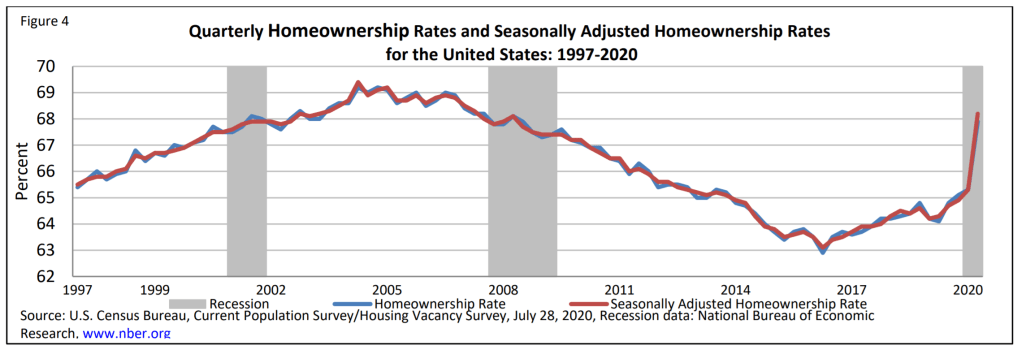
Gray areas = Recessions / Blue line = Homeownership rate / Red line = Seasonally Adjusted Rate

The homeownership rate in this century peaked at 69.2% during the second and fourth quarters of 2004.

As you’d expect, the homeownership rate varies among different age groups, currently 40.6% for adults under 35 and 80.4% of persons 65 and older. The rate has been rising in each age group. In 2015 (2nd quarter) it was 38.4% for the under-35 age group, and it was 78.5% for the 65-and-over group. The greatest increase was in the 35-44 age group, which increased from 58.0% to 64.3% during the same 5-year period.

Homeownership surged in every race and ethnic group in the second quarter from last year to this year. For Non-Hispanic Whites, the rate increased from 73.1% to 76.0%. For Blacks it surged from 40.6% to 47.0%, and for Hispanics of any race, it surged from 46.6% to 51.4%.

The Census report came with a caveat that its data collection methodology was impacted by the   Covid-19 pandemic, shifting from a mix of in-person and phone interviews to entirely phone interviews, which resulted in a reduced response rate, declining from 70% in April to only 65% in June, compared to an average response rate of 82.7% during the second quarter of 2019.

Realtor.com’s chief economist, Danielle Hale, believes the increase in homeownership was distorted by the change in methodology. “It’s likely the homeownership rate rose, but I don’t think it’s likely that it rose that much,” she said.

According to the article on realtor.com, “After a pause during stay-at-home orders, the housing market has rebounded — and then some. The lack of homes on the market hasn’t discouraged the hordes of buyers from descending en masse, seeking to escape small, city apartments and cramped starter homes while taking advantage of record-low mortgage interest rates. (Rates dipped just below 3% for the first time ever earlier this month.)”

As an example, Rita and I just locked in an interest rate of 2.5% for refinancing our home’s mortgage with Jaxzann Riggs of The Mortgage Network. A buyer I’m working with was quoted a 2.25% rate.

“People still want to own homes, and with mortgage rates low, a lot of people are taking advantage of that even though there are lots of scary things going on in the economy,” says realtor.com’s Hale.

The article continues, “This has led median home prices to shoot up 9.1% year over year in the week ending July 18. That’s despite a recession and the most widespread unemployment since the Great Depression. Meanwhile, the number of homes for sale is down 33% compared with the previous year, when the nation was already experiencing a housing shortage.”


How Should a Listing Agent Manage a Bidding War?

In today’s seller’s market, it is common for a new listing to attract multiple offers. There are three ways for a listing agent to deal with competing offers. Above all, it is important that the method chosen is in the seller’s interest, since that’s the listing agent’s legal obligation.

The first approach, of course, is to do nothing — not advise buyers that you have multiple offers and simply accept the best one. This approach, however, assures that the seller won’t get the most money he or she could get for their home.

The more common approach is to inform buyer agents that there are multiple offers and instruct them to submit their “highest and best” offer by a particular deadline. Sometimes the listing agent will add that the seller “reserves the right to sell the home prior to that deadline.”

When I’m functioning as the buyer’s agent, I dislike that approach. Why? Because it could inspire my client, shooting in the dark, to offer more than he needs to in order to win the bidding war, but, worse, we could learn later that my buyer could have won the bidding war if he or she had only offered a little bit more.

HighGate Investment Properties

The third approach is our approach at Golden Real Estate — to function like an auctioneer. If you’ve been to an auction, you know how it works. Everyone knows what the highest bid is, and no one is blindsided. As I explain to buyers and agents, “The only way you will lose out is if you drop out.”  They universally appreciate this approach.

Using this approach, I got my 6th Avenue West listing featured in last week’s column under contract for $41,000 over the listing price. It’s unlikely that asking for “highest and best” would have produced an offer for that amount. The winning bidder’s agent had submitted a full-price offer initially, but, being updated on competing offers, she won the bidding war with her third submission. The other agents had the opportunity to win the bidding war, but they chose when to drop out. The result was that the winner was happy, the seller was very happy, and no one was angry or blindsided in the process. Disappointed, yet, but not angry.

In a bidding war on my other new listing, the price was bid up by about $16,000. In that case, the seller chose not to take the highest bidder (but not by much) because that buyer was an investor, and she preferred an owner occupant. That reflects an important point when handling multiple offers: The seller is always in charge.

A High-Performance Car Can Kill You. A High Performance Home Can Save Your Life.

I have the best assignment on the steering committee of the Metro Denver Green Homes Tour — shooting video tours of the homes we choose to feature. Because of Covid, I’m taking that assignment more seriously than ever, because we may not have an in-person tour this year. (The tour is on October 3rd.)

I post these tours (along with the video tours of our listings) on my YouTube channel. Go there to check out some of the more recent tours.

Those videos, however, are limited in what they can convey in 7 to 10 minutes, so I must leave out a lot of what I learn during the lengthy orientation I get from each homeowner prior to shooting the video.

A good example was my tour last Saturday of Jen Grauer and Josh Renkin’s house in Denver. They scraped a house and built from scratch the best example of a “high performance home” I have come across yet — and I’ve seen a lot of high performance homes.

My 7½-minute tour of the house that Jen completed three years ago could not include a lot of what makes it such a good example of sustainability, so I’ll add to it here.

To be “net zero energy,” a solar-powered home like Jen’s has to be super insulated and super efficient in its use of energy. When a home is that tight, indoor air quality has to be addressed to make the home safe. That job is performed by an Energy Recovery Ventilator (ERV).

The ERV’s job is to bring in fresh air from the outside and to expel bad air while maintaining a healthy indoor humidity level. In the typical home, exhaust fans in bathrooms, kitchens and laundry rooms exhaust air to the outside, thereby drawing fresh air into the house only through whatever leaks exist around doors, windows and other penetrations of the home’s “envelope.” An ERV has one dedicated duct to exhaust air and another to bring in fresh, filtered air. This air is circulated through the house via multiple exhaust and fresh air vents around the home. In addition to maintaining indoor air quality, the ERV transfers some of the temperature (and humidity) of the outgoing air to the incoming air when there is a differential between the two.

Let’s say your home is 70 degrees inside, but it’s 100 degrees outside. The temperature of that incoming air can be reduced to, say, 75 degrees by passing it through a heat exchanger where it doesn’t mix with the outgoing air but acquires some of its temperature. Similarly if the outdoor air is below freezing, the ERV might raise that incoming air to, say, 50 degrees. (I could be way off on these numbers. I’m just trying to convey the concept.)

A conditioning ERV (or CERV) monitors the level of carbon dioxide and volatile organic compounds (VOCs) in the outgoing air. You can set a level that is acceptable (say, 900 ppm maximum) and the CERV will increase the flow of air when those levels are exceeded to bring them back to the acceptable range. Whereas an ERV runs 24/7, the CERV only needs to turn on to bring the levels of CO2, VOCs and humidity down to set acceptable levels. A CERV also has an internal heat pump to add heat or cooling. (See my videos of John Avenson’s and Jim Horan’s homes.)

In Jen’s case, in addition to an ERV, she made sure that the home was built with low-VOC products. For example, instead of using high-VOC particle board, her cabinets are made with zero-formaldehyde birch plywood and her island is solid maple and waterproofed with a zero-VOC oil. Her home has no wall-to-wall carpeting, which typically has VOCs in it. (These items are mentioned in the video of Jen’s house.)

Radon is another pollutant which seeps into every home through their concrete foundation walls and slab-on-dirt. To further improve air quality, Jen installed a radon mitigation system.

In summary, a high performance home can not only save you money in the long run (it costs more to build but nearly eliminates monthly utility bills), it can also create a home than extends your life through improved indoor air quality.

Many Home Sellers Aren’t Familiar With the Capital Gains Tax Exemption

I’m not an accountant or tax advisor, but periodically I need to explain to clients the exemption on capital gains tax enjoyed by homeowners. (You’ll want to verify what I write with your accountant or tax advisor.)

Prior to 1997, the seller of one’s primary residence was required to buy another home that was at least as costly as their previous home in order to avoid paying capital gains tax on the sale.  Since passage of the Taxpayer Relief Act of 1997, however, that is no longer the case, although there are several important rules.

First of all, the home you sell must have been your primary residence for two of the five years preceding the date of sale, and you can only do this once every two years. 

Rita and I once sold a home after owning and living in it for just 18 months, but there was no gain on the sale, so it didn’t matter that we didn’t qualify for the exemption.

Occupancy does not have to be continuous. You only have to have lived in the house for a total of 24 months prior to the date of sale. If you want to enjoy the exemption on a home that you previously lived in, then rented for less than five years, you may need to move into it until the total occupancy meets the 2-year requirement, if you want to enjoy the exemption.

If you’re single, you are exempt from tax on the first $250,000 of gain. For a married couple, the exemption is doubled. (For LGBT couples who own a home together, being able to marry legally brought with it this significant financial advantage.) The gain is calculated by deducting from the sale price your “basis” in the home.  That basis is the sum of the price you paid for the home, the cost of improvements or additions made to it, and the costs and fees associated with purchasing and selling it. Those fees include real estate commissions, title insurance, recording fees, legal expenses, etc.

For example, let’s say you bought a home 30 years ago for $100,000 and you sell it for $700,000 this year. You are married, so you qualify for the $500,000 exemption. If you can document $50,000 in improvements (not repairs), and your cost of selling was, say, 6%, including commissions, title insurance and fees, your basis is increased by $92,000, raising it to $192,000. Thus, your gain was $508,000, but only $8,000 of it is taxable. You will owe 15% federal plus 4.5% Colorado capital gains tax on that $8,000. That amounts to $1,560 tax that would be due the following April 15. That still leaves a lot of tax-free profit from the sale!

Now and then, I meet a couple, like I did last week, who are selling a home they purchased over 30 years ago, and are pushing up against a capital gains tax liability, especially if the homeowner is not married. (If the homeowner is widowed, he or she has two years to sell before the exemption drops to $250,000.) If you are in that situation or approaching it, you could benefit from selling your home and buying another one.

It’s a mistake to put your heirs on the title of your home so they inherit it. That’s because in addition to inheriting your home, they also inherit your basis, which could cost them dearly when they end up selling it.  It’s better to put them on a “beneficiary deed” or let them inherit it through your will. In either scenario, the basis of the home is stepped up to its market value at the time of your death.  The beneficiary deed is a particularly attractive option because the cost of creating and recording it is minimal, and it can be revoked at any time.

One of my clients is a home builder. He builds homes one at a time over a 2-year period, moving into and living in each of them for two years while building the next house. That way he is able to apply the full $500,000 marital exemption to the sale of each house, whereas he’d owe regular income tax on his profit for each home if he sold it upon completion.

You can claim the exemption on the sale of a second home, but you need to have lived in it as your primary residence for two of five years preceding the date of sale, and, as mentioned above, you have to wait two years before taking that exemption on your other home.

If you have additional questions about qualifying for this tax exemption, don’t ask me. As I said, I’m not an accountant or tax advisor.  However, I can refer you to our accountant (who does our taxes) if you don’t have one. I can also refer you to a real estate lawyer for a beneficiary deed.

New Brokerage Offers to Help You Buy Before You Sell

Perhaps you’ve wondered about those TV commercials by a new brokerage called Orchard offering to help you buy your replacement home without selling your current home first. Golden Real Estate has been successful at that, too, although not using the same business model. (See my previous columns on April 25, 2019 and May 11, 2017 and Sept. 17, 2015 and Mar. 12, 2015.)

The company, which came to Denver in January and has closed 14 purchases and 17 sales so far, was formerly called Perch. If you scroll to the bottom at Orchard.com, there’s a link to their reviews, which I suggest clicking on. The 7 negative reviews give an insight that the positive reviews don’t provide.

Basically, the company, based in New York, is “vertically integrated,” meaning that they have their own mortgage company, title company, etc. They are backed by a venture capital firm which provides the working capital to purchase your home if they don’t sell it first.

They operate like the iBuyers I wrote about in two previous columns (Jan. 2, 2020 and August 22, 2019 ). They make a market-based offer to purchase your home, then reduce that offer based on inspection, and they charge a 6% fee (in lieu of a commission).

Also, you pay rent for your new home, which you don’t actually buy until after your home closes. If it doesn’t close in 90 days, Orchard will buy it at their low-ball price. Note: Their agents work on salary, not commission, which is unattractive to the really successful agents.

Realtor.com Weighs in on the Real Estate Market’s Surprising Rebound

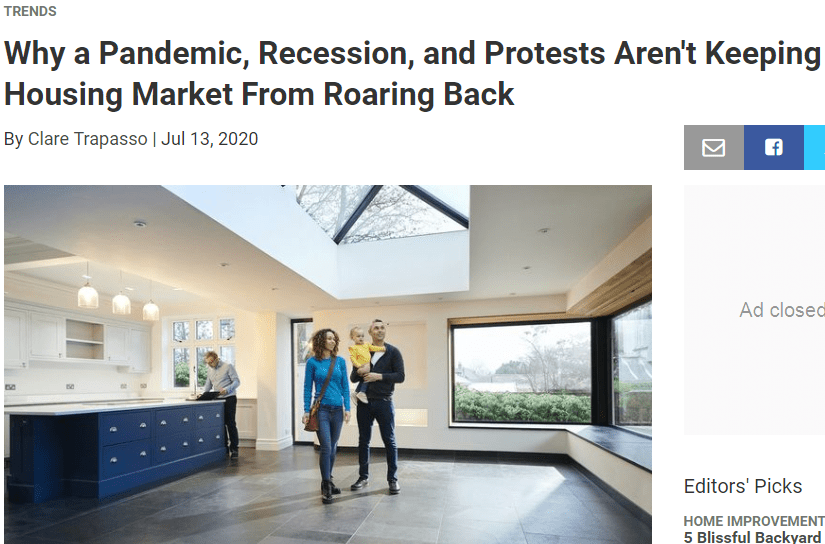
The fact that we’re still in a seller’s market puzzles many real estate professionals, but there are reasonable explanations, which Realtor.com did a good job of describing in a July 13th article by Clare Trapasso.

The headwinds in this market are strong and numerous. We have a lingering and maybe worsening pandemic, staggering unemployment numbers, and a contentious presidential campaign, made even more contentious because of our national reckoning about systemic racism. How does one account for such a strong real estate market, and when will that market soften?

First let’s look at our local numbers. In my July 9th column, I showed statistically how the market had surged in June.  As I write this on Monday evening, there are 4,903 active listings within 20 miles of the State Capitol, but there are 7,720 listings under contract, 3,905 of which (or 50.6%) went under contract in 7 days or less.  A total of 5,219 listings closed in the last 30 days, 2,679 of which (or 51.3%) went under contract in 7 days or less and 1,895 of which (or 36.3%) sold for above full price, likely with competing offers.

So, yes, we are still in a seller’s market — but how can that be, given all that’s going on?

To quote the realtor.com article, “The housing market is back — and then some.”

Nationally, according to realtor.com, median home prices rose 6.2% year-over-year for the week ending June 27th.  According to REcolorado, the median sold price for listings within 20 miles of the State Capitol that same week was $440,000, with 49.9% of them selling in 7 days or less, compared to $418,000 for the same 7-day period a year ago, when 44.5% sold in 7 days or less. That’s a 5% increase in median price year-over-year.

To quote the realtor.com article, “Homes are selling faster than they did in 2019, when no one had heard of Covid-19. And bidding wars are back as first-time and trade-up buyers who have lost out on other homes slug it out.”

The contrast between this market and the market during the “Great Recession” of 2008 couldn’t be sharper. Back then, there was a glut of housing and few buyers. Today, the situation is reversed, with fewer listings and a glut of buyers. Because the 2008 crisis was caused by the subprime mortgage scandal, the glut of housing was made worse by a flood of foreclosures.

Quoting further from the realtor.com article, “To be sure, there are plenty of danger signs ahead in this economy, including continuing historic levels of unemployment and rising coronavirus infection rates in many parts of the country. But, for now, real estate is bouncing back much quicker than other bellwether industries. The reason: After months on hold, Americans are beginning to feel more confident about the idea of buying or selling a home.”

The article quoted a Fannie Mae survey of 1,000 participants, showing that 61% said it was a good time to buy and 41% said it was a good time to sell. And that survey was taken before mortgage rates dropped to under 3%, which happened just last week.  As a result, we can expect the real estate market to be even more supercharged in the coming weeks. Already, mortgage applications for home purchases had risen 33.2% year over year in the week ending July 3rd, according to the Mortgage Bankers Association.

Lower interest rates mean lower mortgage payments by hundreds of dollars, which instantly increases the affordability of homes, and buyers understandably believe they are smart to buy now before the rates rise again, as they surely will.

The low interest rates also make the decision to buy more compelling for renters burdened by the still high cost of renting in the Denver market.  This is particularly compelling for white-collar workers who were not furloughed or laid off during the pandemic and may have money in the bank for a down payment.

Another factor which I mentioned in my earlier column is the number of workers who started telecommuting because of the pandemic and whose employers said they could keep telecommuting even after it’s safe to return to the office. These people are in a buying mood as they look to move further from the congestion of downtown apartments or condos where going outside involves a greater risk of Covid-19 infection.  They also saved a lot of money (as Rita and I did) by eating more home cooked meals because restaurants were closed. And Netflix costs a lot less than going out to the movies or the theatre, to say nothing about the savings on popcorn made at home or purchased at the supermarket!

Yet another factor is the increase in divorces and separations resulting from forced home confinement. I was amused to note the increase in TV commercials by divorce attorneys during April and May.

Buyers Benefit From Having an Agent Who Knows Home Systems and Sustainability

One of the reasons I enjoy showing homes to buyers is that I get to educate them about home systems and how they work, as well as identify the sustainable and not-so-sustainable features of each home.

The agents at Golden Real Estate have a thorough understanding of home systems as a result of our combined decades of experience and hundreds of transactions. In addition, we have taken classes on energy efficiency, insulation, solar power and home construction which allow us to serve buyers better when we show them homes.

Together, for example, we toured the model homes at Richards Farms when they were under construction, where we learned, among other things, about that builder’s foam insulation process.

There are so many aspects of energy efficiency and sustainability. Everyone by now knows about solar photovoltaics — creating electricity from the sun. Our office has 20 kW of solar panels, but having solar power is only the beginning. It’s how efficiently you use that power that makes the difference.

Heating and cooling is the biggest user of energy in any home, and the number and variety of HVAC systems have become more extensive and more complicated, and we understand and can explain them. They include: gas forced air heating and compressor-based air conditioning (most common in Colorado and much of the country), hot water baseboard heat, hot water radiant floor heating, wall-mounted heating panels or strips, heat pump mini-splits for both heating and cooling, hybrid heat-pump with gas forced air (which Rita and I have in our home), ground-source heat pump for both heating and cooling (the “gold standard” of efficient heating and cooling) — and let’s not forget heating with wood or wood pellets!

Windows can vary greatly. Double-pane windows may be standard now, but a Colorado company, Alpen, has made a name for itself with triple-pane windows and now quadruple-pane windows.  Recently I wrote about John Avenson’s Westminster home, in which some of his south-facing Alpen windows have micro-etching to divert sunlight toward the ceiling of his kitchen, a high-tech alternative to reflective window shelving, which we saw when we toured a newer building at the National Renewable Energy Laboratory.

Skylights are so 20th Century. Today’s modern replacement are sun tunnels (Solatube is a leading brand), which are great for illuminating interior rooms. Just last week I showed a home with five Solatubes in it, lighting up the living room and an interior bathroom amazingly well from the mid-day sun. My buyer didn’t realize they weren’t ceiling light fixtures until I pointed them out. (We have two sun tunnels in our home illuminating our windowless garage and laundry room, and we have four sun tunnels in the Golden Real Estate office. We don’t have to turn on any lights on sunny days!)

A knowledgeable agent can also point out passive solar features of a home, which others might not recognize. These include proper window configuration, wide overhangs above south-facing windows, thermal masses in south-facing sunrooms, and deciduous trees providing strategically positioned shade in the summer but allowing more sunlight in the winter. I like to see (and point out) cellular shades, especially vertical ones covering patio doors for cold-weather insulation.

Often I notice that the listing agent didn’t mention the features (such as the Solatubes) that my buyers and I recognize as selling points. Of course, when doing the narrated video tours of our own listings, my broker associates and I don’t miss the opportunity to point out those features. And, of course, we are sure to mention those features in the MLS listing.

Many agents miss the opportunity to write a separate description on the MLS for each individual room. It’s not a mandatory field, but it’s the best place to mention a room’s Solatube, heated floor, porcelain tile, hardwood or other feature.

Here Are Some Things You Should Expect to Learn From a Professional Home Inspection

A home inspection is the best investment that any home buyer can make, providing you base your decision on the qualifications of the inspector and not by cost alone. In Colorado, home inspectors are not licensed, so look for one like Jim Camp of Metropolitan Home Inspections, who is ASHI-certified. Not only might you find a problem that you could get the seller to fix, but you’ll also learn things you need to know about as the future owner of that home.

The inspector will also show you where the utility shut-offs are located and how to operate them, which can be important during an emergency.

The cost of an inspection varies from one inspector to the next and depends on the size of the home or possibly the purchase price.  Expect to spend between $300 and $500 for the basic or standard inspection. Add-on services which I recommend include a test for radon gas ($100 to $150) and a sewer scope (also $100 to $150).

If a high level of radon gas (over 4.0 picocuries per liter) is detected, the buyer should demand that it be mitigated, which costs a minimum of $900 and as much as $2,000 if there is both a basement and a crawl space.

A sewer scope involves sending a camera through the piping from the house to where it enters the sewer line under your street.  Sewer lines in older homes were built with clay pipes which are prone to root intrusion and collapse.  If root intrusion is discovered, the seller will usually agree to have the sewer line cleaned and rescoped, and if there is a collapse or other break, the repair could cost several thousand dollars, so both tests are money well spent.

The general inspection should be scheduled as soon as possible to allow time for additional inspections as indicated. For example, the inspector may discover evidence of mold or mildew, termite infestation or structural issues, and you’ll need time to arrange those inspections. 

In older (pre-1985) homes, it’s common to encounter a Federal Pacific Electric or Zinsco panel, which can cost $1,500 or more to replace. The inspector should recommend further evaluation and certification by a licensed electrician and recommend its replacement since FPE and Zinsco lost their UL endorsement due to breaker failures resulting in electrical fires. An inspector will test electrical outlets for correct polarity and will also check for ground-fault protection on outlets located within six feet of any water source, such as kitchens, bathrooms, unfinished basements, outdoors or in the garage, etc.

He (or she) will walk the roof if possible (even though it’s not required) to look for hail damage as well as proper sealing around chimneys, etc.

In this article, I have touched on only some of the many tests and inspections which make the money a buyer spends on professional inspection the best money he or she will spend.

Bidding Wars Are Back, According to Redfin

You’ve got maybe 5 seconds to read the small print…

Nothing has surprised us real estate professionals quite as much as how hot the market has been during the Covid-19 pandemic. Redfin, the brokerage with what I consider misleading TV ads, did an analysis of offers written by their own agents on MLS listings and found that over half of those offers faced competing offers from other agents.

Nationwide, the percentage of Redfin offers facing competition was 53.7% in June, up from 51.8% in May and 44% in April. Boston led the pack with 72.4% of offers facing competition during June, up from 67.2% in May.

The Denver market came in 12th nationally in terms of bidding wars, with 53% of offers facing competition, down from 55.6% in May.  Of the top 12 metro areas, only Denver and Portland had lower percentages in June than in May.

Houston’s Realtor Association Bars Use of ‘Master’

With the new reckoning about systemic racism in America, the Houston Association of Realtors (HAR) decided that “master bedroom” should be replaced with “primary bedroom,” according to a CNN report.

So long as guest bedrooms aren’t called “slave bedrooms,” I see nothing wrong with the term “master bedroom.”  (And what slaveowner ever had his enslaved workers sleeping in adjoining bedrooms under the same roof?)

I checked with REcolorado, our local MLS (which is separate from but owned by our local Realtor associations), and I was assured that there is no plan here to follow HAR’s initiative, and I suspect frankly that HAR will have second thoughts about that change. I agree with John Legend, whose response was to ridicule the change and tell them to concentrate instead on the very real issue of discrimination in real estate.