We Help Buyers and Sellers With the High Cost of Moving

If you’ve ever paid a moving company to move your furniture and other belongings to a new home, you know it can be very expensive. We’re talking thousands of dollars, even for a local move.

I have always felt that our clients deserve something more than a fruit basket or bottle of champagne at closing, so I continue to look for ways we can add value to each buyer or seller relationship. 

I bought our first moving truck in 2003 and our second truck (a former Penske rental shown here) in 2017. Together those trucks have logged 200,000+ free miles for our clients, who would have spent $200,000 or more on mileage fees alone if they had rented a similar truck from U-Haul.

   When a client uses us for two transactions — to sell their current home and buy their replacement home within a 50-mile radius — I not only reduce the commission charged to sell their current home, but I hire the laborers to drive the truck and to load and unload it — using boxes we provide free!

For-Sale-By-Owner Can Hurt Sellers in a Hot Market

When homes sell this easily (if priced right), you might think you don’t need to use a listing agent, but think again.

Take this example. I listed a home last week for what it was worth based on comparable sales, but it attracted 50 showings and 11 offers and I played the offers against each other to get $30,500 over the listing price, waiving appraisal.

If the owner had tried to sell it herself, fewer buyers would know about the home because it wouldn’t be on the MLS and countless other websites. And how could she have handled those 50 showings without our showing service, which is only available to licensed agents? And what about handling those 11 offers which come in using a software package used by virtually all agents, not available to sellers? It would be rather awkward, don’t you think, to conduct the bidding war and end up with as good a result?

Do you have questions?  Give us a call.

Is Your Home Ready for Winter?

I got the following information/advice from one of my favorite inspectors, Bud Monk. His contact info is at the bottom.

It’s that time of year again, and fall & winter are just around the corner. Are you ready?

Some things to think about in getting ready for Winter.

  • Check your AC condensing unit or your evaporative cooler (swamp cooler)
    • Clean the leaves and debris from the fins with a high pressure water hose or leaf blower, etc.
    • Cover the unit to protect it from snow and ice.
    • Drain swamp cooler and cover to prevent cold air from blowing back into the house.
  • Check your furnace (or have it serviced by a qualified HVAC technician). Turn the thermostat up to 80 and check to make sure the furnace fires and is running properly.
    • Change the filter if necessary.
    • Lubricate the blower fan.
    • Check your smoke and CO detectors to confirm they are working!!!!
  • Check your chimney and fireplace.
    • If you use your fireplace, be sure there are no bird or squirrel nests in the chimney.
    • Verify that the chimney cap is in place and didn’t blow off during a summer storm.
  • Remove and drain your hoses.
    • Disconnect the hoses from the hose bibs and drain the hoses.
    • Turn off the water to the hose bibs and open the valve. Or install the protective foam covers.
  • Drain the sprinkler system.
    • Turn off the water supply to the system.
    • Open all the zone valves and blow out the lines
    • Open the valves and drain the water from the vacuum breaker.
  • Remove the debris from the roof and the gutters.
    • Debris laying in the valley(s) can trap moisture and accelerate the deterioration of the shingles.
    • Debris in the gutters can prevent them from draining properly.
  • Storm windows.
    • If you have storm windows, now is the time to install them.
  • Check the weather stripping on doors and windows.
    • Repair or replace damaged weather stripping.
    • Check and repair / replace caulking around windows and doors.

AND, if you are leaving your home for an extended period of time, have a professional “winterize” your home so that nothing will freeze during your absence. For anyone wanting to do their own winterizing, I have a checklist that is available which will lead you step by step through the process of “winterizing” and “de-winterizing”. The checklist will probably contain several items the average person would not be aware of.

Bud Monk – A-1 Quality Home Inspections – 303.981.6699 – email: vcm_456@yahoo.com

Website: https://www.a-1qualityhomeinspections.com/

MyMove.com Reports Surge in Moves During Covid-19, 28% Citing Virus as the Reason

MyMove.com is the online replacement of the change-of-address form you probably filled out at the post office the last time you moved. While the post office benefits from having the move process computerized, the website makes money by accepting advertising and earning a royalty on moving services which are purchased on the site.

Through their exclusive partnership with the USPS, My-Move also aggregates data from those online change of address forms. Pew Research Center then surveys a sample of those movers to find out why they moved.

In prior columns I speculated about the out-migration from downtown Denver to Jefferson County and other suburbs by “urban cliff dwellers” (as my mother called them) fleeing their congested high rises to reduce their exposure to the virus. An October 14th article on MyMove. com confirmed that trend nationally, as reflected in the chart below. Note: The numbers are for net migration between Feb. 1, and July 31, 2020, subtracting the number of moves into each city from the number moving out of that city. Therefore, the number of moves out of each city is actually higher than the number shown in the chart.

The following is excerpted from that Oct. 14 MyMove article.

Pew Research Center study conducted in June looked at almost 10,000 U.S. adults to understand COVID moving trends better….

About a quarter (28%) told us they chose to move because they feared getting Covid-19 if they stayed where they were living… About a fifth (20%) said they wanted to be with their family, or their college campus closed (23%). A total of 18% gave financial reasons, including job loss.

In reading the chart, it should be noted that “New York, NY” is the postal address for Manhattan, not all five boroughs of New York City, which is why Brooklyn has its own number. Also, not shown is that the biggest destination of New York out-migration is Brooklyn, and vice versa. Since only 28% of movers cited the virus as their reason for moving, that fact does not diminish the impact Covid-19 played in this year’s moves.

The change-of-address form asks whether the move is permanent or temporary, and although the number of permanent moves increased by about 2% year-over-year, the number of temporary moves increased by nearly 27%. Some of those moves were to second homes. Others were students who left campuses which had switched from in-person classes to online learning.

Since an estimated 70% of workers were able to continue working from home, those people who had a place to which they could relocate made the move quickly — likely to a place that was not subject to the lockdowns of their home city. The highest spike was in March, falling slightly in April. As reflected in the above chart, small cities were the primary recipients of this in-migration, which supports what I have already observed, that downtown Denver has a buyer’s market while the suburbs have a seller’s market. 

Reflective of that, my most recent closing was of a tri-level home in Lakewood, which I listed at $520,000 and which sold immediately for $579,000. In Jeffco, 46% of the closings in the past 30 days sold for more than their listing price with median days on market of 5. Meanwhile 87% of the homes (mostly condos) that sold in downtown Denver, Lodo and River North during the same 30-day period sold for less than their listing price, with median days on market of 24.

Denver Has Among Nation’s Lowest Foreclosure Rates

ATTOM Data Solutions, the nation’s most comprehensive aggregator of foreclosure data, reported last week that the number of foreclosure filings in the 3rd Quarter (July-September) of 2020 was down 12% from the 2nd Quarter and down 81% nationally from the same quarter a year ago. Denver was down 89% and Colorado was down 90%. Only three cities and four states recorded bigger year-over-year declines.

The combination of foreclosure moratoria and forbearance programs was a primary contributor to these drops, so the question on many people’s minds is whether we’ll see a flood of foreclosure filings when these programs end sometime in the coming months.

In a press release, Rick Sharga of RealtyTrac, a related company, is quoted as follows:

“We’ll certainly see more repossessions by lenders once the foreclosure moratoria have ended, but maybe not as many as people might expect. Given the record amount of homeowner equity – over $6.5 trillion – it seems likely that many homeowners in financial distress will opt to take advantage of strong demand among homebuyers and sell their property rather than risk losing it to a foreclosure auction.”

Good Business Colorado Grows

Golden Real Estate is proud to be a charter member of Good Business Colorado, a 3-year-old organization of now 300 companies and non-profits which share a commitment to creating a prosperous, equitable and sustainable Colorado. You can learn more about this great organization at www.GoodBusinessColorado.org.

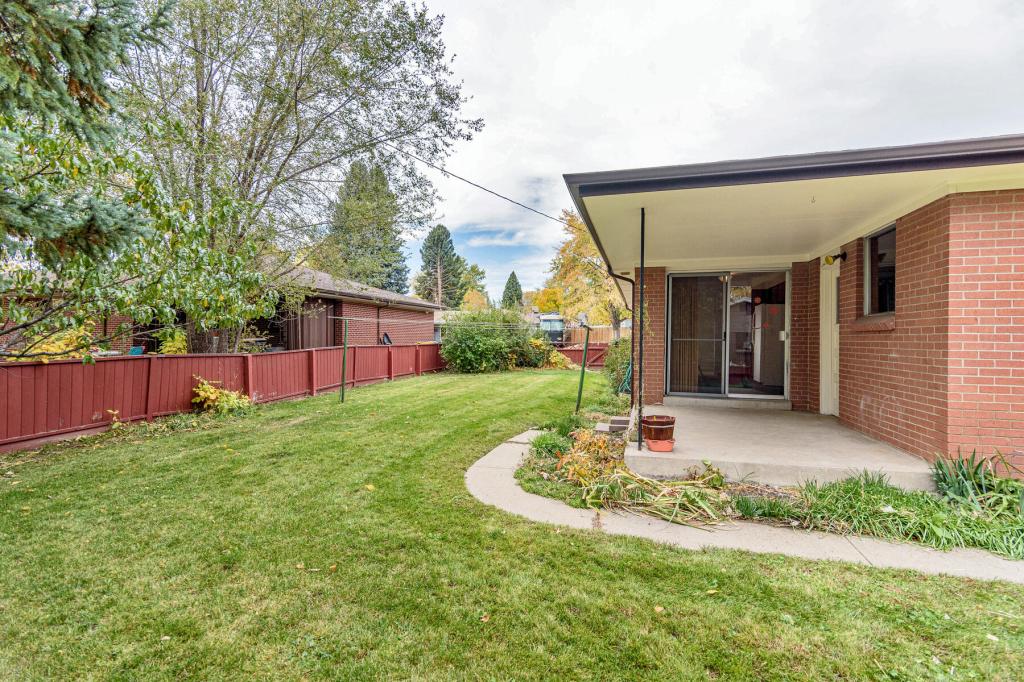
Just Listed: 4-Bedroom, 2-Bath Brick Ranch in Arvada

12082 W. 60th Place — Just listed for $400,000

This 1963 brick ranch has been lovingly maintained, although not particularly updated, since it was purchased by the seller in 1973. Most of the hardwood flooring throughout the main floor has been covered over the years by wall-to-wall carpeting, but the carpet has been removed from the main-floor bedrooms so buyers can see it. The full basement has a non-conforming 4th bedroom, 3/4 bathroom and laundry, plus a full-width family room. The name of the subdivision is Allendale, which is located east of Ward Road and south of 64th Avenue, making it super convenient to shopping as well as Interstate 70, while being an extra quiet neighborhood. You’ll hear no highway noise from your front or back yard! You can take a narrated video tour of this home, inside and out, and see all the interior photos at www.ArvadaRanch.info, then come to our open house this Saturday, October 24th, 11am to 2pm.

You’ve Heard of NIMBY (‘Not in My Backyard’). You’ll Be Hearing About YIMBY in 2021.

One of the many bills passed by the Democratic House which Senate Majority Leader Mitch McConnell has not allowed to be acted on in the Senate is the YIMBY Act. If, as may well happen, the Democrats take control of the U.S. Senate in this year’s election, that act could become law next year.

The YIMBY Act (HR 4351) was bi-partisan, co-sponsored by Democrat Denny Heck of Washington and Republican Trey Hollingsworth of Indiana. It was passed on a voice vote by the House of Representatives on Mar. 2, 2020. Here’s a link to the full text of HR 4351.

Here’s how the act is described and promoted at www.UpForGrowth.org:

The Yes in My Backyard (YIMBY) Act encourages localities to eliminate discriminatory land use policies and remove barriers that prevent needed housing from being built around the country.

The YIMBY Act achieves these goals by requiring Community Development Block Grant (CDBG) recipients to report periodically on the extent to which they are removing discriminatory land use policies and implementing inclusive and affordable housing policies detailed by the bill.

The YIMBY Act increases transparency in land use, zoning, and housing decisions; sheds light on exclusionary polices; and ultimately encourages localities to eliminate barriers to much-needed housing.

Background:

According to Up for Growth’s “Housing Underproduction in the U.S.” report, the United States has underproduced housing by 7.3 million homes from 2000 to 2015.

Exclusionary land use policies — including zoning and density restrictions, onerous parking requirements, and other burdensome development regulations — drive a severe housing shortage and affordability crisis.

The “Missing Millions of Homes” report from the New Democratic Coalition shows that the cost of shelter has been the single largest increase in household budgets in the last 15 years and that the median U.S. family now spends 42% of its income on housing.

Housing underproduction also increases cost of living for families, inhibits geographic mobility, burdens both renters and buyers, and stifles economic productivity. By one estimate, from 1964 to 2009, our national housing shortage lowered aggregate economic growth by 36 percent.

Many of these land use policies are rooted in racism and classism. Their continued existence perpetuates housing discrimination and contributes to the housing affordability crisis affecting large parts of the United States.

Legislative Solution:

The YIMBY Act increases transparency and encourages more thoughtful & inclusive development practices by requiring localities to fully examine and disclose their housing policy decisions.

The bill provides localities a framework for smart policymaking and regulatory practices, thus promoting more inclusive development principles.

The YIMBY Act is an important first step in decreasing the barriers to smart, inclusive growth and reducing the negative and cumulative impact of exclusionary housing policies. It is also a way to clearly demonstrate that the federal government takes seriously the challenges created by exclusionary zoning.

This proposal has not escaped the attention of conservatives, who consider it an attack on suburbia, primarily by eliminating single-family zoning. Allowing greater density and making housing more affordable means to them the introduction of lower-income and therefore racially diverse populations into communities which are historically white and upper-middle or upper income neighborhoods. It’s worth noting that it’s an argument that does indeed divide conservatives from liberals and, because of how it is being promoted, will be a factor in this year’s election.

However, we should remember that zoning laws are matters of local debate and enactment and cannot be forced upon localities by the federal government. That’s why the YIMBY Act only asks localities to consider the implications of their zoning decisions. Single-family zoning will only be modified or eliminated gradually if at all over time and only by a vote of locally elected representatives on city councils and county boards of commissioners. Voters would be wise to recognize fear mongering on the subject for what it is and to consider the underlying motives.

Moreover, it is inconceivable that an established and fully built out subdivision, especially one with a healthy housing stock under 30 or 40 years old, would see any effects from zoning changes. Instead you might see the legalizing of ADUs (Accessory Dwelling Units), which are already popular in many jurisdictions. These units can be in walk-out basements or above detached garages, and provide a great solution for modestly increasing a neighborhood’s and city’s density.

What we are already seeing in the older communities with pre-1970 bungalows is the scraping of isolated homes, making way for attached townhomes. Again, this is only done by the enactment of zoning changes by your elected officials who are not going to act in opposition to their constituents’ loudly expressed viewpoints.

No matter who is elected on the national level or what legislation is passed, housing will always be an expression and result of very localized democratic control — that’s democratic with a small “D.”

Moreover, the YIMBY Act would only apply to localities which accept Community Development Block Grants, for which no community needs to apply.

Realtor Association Takes Fair Housing Seriously

While it might be popular to think of Realtors as privileged conservatives (mostly Republicans) who put up with but are not fans of federal civil rights laws, quite the opposite appears to be true now. Liberal thinking Realtors are in ascendance.

An August 22 article from Realtor Magazine, the official magazine of the National Association of Realtors, makes this abundantly clear.

In 2018, NAR leadership laid bare at its legislative meetings in Washington, D.C., the organization’s “immutable past support of discriminatory and racist practices [link],” vowing to deepen its commitment to industry inclusivity and equal opportunity in housing.

The Chicago Association of Realtors, headed by an African-American woman, apologized last year for its “historically racist policies that persisted for decades.”

Click on that link above. Unless you miss the “good old days,” you’ll be heartened by what you read. It makes me proud to be a Realtor. The commitment to equality and justice is rock solid.

Report Names 7 Cities Most at Risk of a Housing Crash. Denver Isn’t One of Them

With the crazy seller’s market we’re experiencing now, it’s common for people to ask whether we’re in a “bubble” which could burst at any time.

Well, last Wednesday UBS Group released its annual Real Estate Bubble Index, and while it listed three U.S. cities (San Francisco, Los Angeles and New York) as “overvalued,” none of the seven cities listed as “bubble risks” were in the U.S.

Those seven cities with the highest “bubble risk” included Toronto (#3) and Hong Kong (#4), but the rest were all in Europe — Munich (#1), Frankfurt (#2), Paris (#5), Amsterdam (#6), and Zurich (#7).

Boston squeaked into the “Fair Valued” category, and Chicago narrowly made it into the “Undervalued” category.

I was surprised at this analysis until I read the UBS report myself instead of just the coverage of it on a real estate news service to which I subscribe.

The answer as to why more American cities weren’t on the list turns out to be very simple — UBS Group only studies “25 major cities around the world,” and the U.S. cities I mentioned above are the only U.S. cities analyzed each year in the report!  Twelve of the 25 cities studied for this report are in Europe, with the rest divided between North America, the Middle East and Asia/Australia.  It should be noted that the UBS Group office which creates the report is based in Switzerland, so it’s rather Euro-centric.

Click here to view the full UBS Group Global Real Estate Bubble Index.

Despite the limited number of U.S. cities included in the UBS report, there are some useful observations about our market, such as this one:

“Overall, the drop of mortgage rates to historically low levels supports house prices in the U.S. But price changes in the analyzed cities trail the nationwide average. Inner-city demand growth has slowed down as citizens move out to the suburbs as a result of affordability issues and the impacts of COVID-19. Continued migration to lower-cost and more tax-, business-, and regulatory-friendly states has accelerated this trend.”

Claudio Saputelli, Head of Real Estate at UBS Global Wealth Management’s Chief Investment Office, added the following: “The rise of the home office calls into question the need to live close to city centers. Pressure on household incomes cause many people to move to more affordable suburban areas. Moreover, already debt-ridden or economically weaker cities will have to respond to this economic crisis with tax increases or public spending cuts, neither of which bode well for property prices. Taken together, these factors amplify some longer-term uncertainties surrounding urban housing demand.”

Doing my own statistical analysis on REcolorado, Denver’s MLS, I see the trend described above.  While the number of active (i.e., not yet sold) listings and days on market are at nearly   all-time lows in Jefferson County, they are near all-time highs in the Lodo/Downtown Denver market. This is not a good time to sell a condo in any city center (except small cities like Golden), but it is certainly a good time to sell a single-family home (or a condo) in Jefferson County, as I have reported in previous columns.

The last time Realtor Magazine even dealt with the question of a real estate bubble was in November 2018.  The consensus of real estate economists is that our country is not in a real estate bubble, but it’s hard not to worry about it as one looks at the recently increased rate of appreciation in home prices.

With no end in sight to the low mortgage interest rates and with the rich getting richer under the Trump tax cuts, it’s understandable that the real estate market is performing as it is, but such appreciation cannot be sustained long-term.

Only time will tell, and our crystal balls will at least clear up a little after the current election season ends. A Biden victory is sure to bring rollbacks of the Trump tax cuts which benefited the rich (defined as those having taxable incomes over $400,000 per year) and the super rich, which will reduce some of the upward pressure on home prices, but those rollbacks are critical to address the widening wealth gap in America and the exploding national deficit — something that used to be an important issue among Republicans!