How Concerned Should Homebuyers Be About Fed Interest Hikes?

It is no surprise that headlines like “Fed Hikes Rates” may discourage prospective home buyers, but they should not be discouraged. Jaxzann Riggs, owner of The Mortgage Network, explains why.

The “Federal Reserve” is the central bank of the United States. Founded by an act of Congress in 1913 with the primary purpose of enhancing the stability of the American banking system, the “Fed” is charged with helping to set “monetary policy” for the United States. It sets the “federal funds rate” which is the interest rate that banks charge each other to borrow or lend excess reserves overnight.

“Monetary policy” refers to the actions undertaken by the Federal Reserve to influence the availability and cost of money and credit offered to consumers and businesses to help promote national economic goals. 

You may have also heard the term “quantitative easing.” Quantitative easing (QE for short) is a policy or strategy which has recently been used by the Federal Reserve. During the COVID pandemic, the Federal Reserve not only cut the “Fed funds” rate to zero but it also purchased mortgage-backed and other financial securities to increase the supply of money for homeowners. This encouraged more lending to consumers and businesses. While the result of the policy remains to be seen, most economists suggest that it caused mortgage rates to be held artificially low. The combination of low rates and low housing inventory (construction of new homes fell dramatically following the 2007-2008 fiscal crisis) created the “inflation” of home values with which we are all familiar.

Some assume that the Federal Reserve sets mortgage rates… they do not, but they do influence mortgage rates. The Fed controls short-term interest rates (mortgage rates are long-term rates) by increasing them or decreasing them based upon the state of the economy. When the economy is struggling, the Fed lowers the rates, allowing banks to borrow money at a lower rate to lend to consumers. When the Fed decides the economy may be overheating (read inflation) they tighten the money supply by raising the Fed funds rate. While this does not directly increase mortgage rates, lenders must eventually do the same to keep up with their costs to borrow money from the Federal Reserve.

On July 27th, the Federal Reserve announced a three-quarter percent interest rate hike, and during that week the average 30-year fixed mortgage rate fell one quarter of a percentage point. When there is talk of the Fed raising their rate, mortgage rates can spike, but they typically correct by the time that the increase is actually announced.

Recent positive unemployment figures may cause the Fed to raise rates once again, but the Fed’s chairman, Jerome Powell, has also indicated that there may be a pause on future increases in order to assess their impact on the economy.

We all know that higher rates reduce purchasing power for buyers, but there have been some positives to higher rates. Fewer buyers in the market mean that inventories are rising, and sellers are willing to help buyers with “interest rate buydowns.” Buying at the right price is important, but asking the seller to help with the cost of an “interest rate buydown” instead of offering a lower purchase price will have much more impact on a buyer’s monthly mortgage payment. (Click here to read my July blog post on the topic of interest rate buydowns.) Buyers are qualified for monthly mortgage payments versus loan amounts, so reducing the rate on your new home loan increases your buying power.

If you have lending questions about your personal circumstance, Jaxzann Riggs is standing by. You can reach her on her cell phone at (303) 990-2992.

Looking for a Good Deal? Opendoor Is Slashing Prices to Clear Its Inventory

I wrote about Opendoor last week. They’re one of the “iBuyer” companies that buys off-MLS listings and flips them for a profit. Or at least that’s how it’s supposed to work, but too many homes haven’t sold, and they drop their listing prices twice each month until they sell. For too many of their listings, that means they will be getting far less than what they paid for them.

As I write this on Sunday evening, there are 446 unsold Opendoor listings on Denver’s MLS, and the median days on the MLS is 58!  It’s apparent that they bought many of these listings during those heady days before the market softened and now they can’t sell them for a profit or even at the price they paid for them.

To keep it manageable, I studied only the 45 Opendoor listings currently active in Jefferson County. The median days on the MLS for those listings is 75!  That’s three times the median days on the MLS for all active listings in Jefferson County. All but two of those listings have been active for at least 12 days, and all 43 of those have had their prices cut to try to clear the company’s inventory. They’re going to lose money on most if not all of them.  Here are some examples:

They purchased 11022 Trailrider Pass, Littleton, for $631,400 on Dec. 2nd and listed it on Feb. 17th for $820,000.  Nine price reductions later, it’s now listed at $643,000 and has yet to go under contract. At the current price, they will pay their usual 2.5% buyer agent commission, netting them about $5,000 less than they paid for it. Presumably they also had some repairs, repainting and other expenses during the two months between buying and listing.

Opendoor’s oldest listing, 2090 Braun Drive, Golden, was purchased last September for $638,300, and is currently listed for $621,000 after one failed contract and three subsequent price reductions.

4740 S. Tabor St., Morrison, was purchased for $500,500 in December, listed for $612,000 two months later, and after nine price reductions and no contracts, it’s listed at $527,000. Depending on how much money they spent dressing up that listing during those two months, they might break even.

Here are some of the Jeffco listings on which Opendoor will lose a lot of money:

Unsold Jeffco listings priced as much as $50,000 below what Opendoor paid for them:

6384 Newland St., Arvada ($579,000)

7076 Parfet Street, Arvada ($626,000)

6975 W. 63rd Ave., Arvada ($577,000)

12463 W. 68th Ave., Arvada ($693,000)

7155 Fenton Circle, Arvada ($568,000)

9010 W. 5th Pl., Lakewood ($594,000)

289 Marshall St., Lakewood ($657,000)

10112 W. Dartmouth Ave., Lakewood ($379,000)

10946 W. Texas Avenue, Lakewood ($558,000)

11266 W. Kentucky Dr., Lakewood ($575,000)

5645 S. Zang Street, Littleton ($481,000)

6309 W. Fair Dr., Littleton ($649,000)

10679 W. Cooper Place, Littleton ($776,000)

7782 W. Alder Dr., Littleton ($786,000)

6230 W. Maplewood Place, Littleton ($666,000)

5683 W. 118th Place, Westminster ($556,000)

11526 Marshall Street, Westminster ($495,000)

10012 Holland Court, Westminster $464,000)

10063 Flower Street, Westminster ($723,000)

9679 Teller Court, Westminster ($576,000)

6280 W. 45th Avenue, Wheat Ridge ($573,000)

Of the 177 Opendoor listings (in all counties) which closed in the last 90 days, only 18 sold at or above their original listing price. More than half sold for at least 5% below their original price.  In the same 90-day period a year ago, 55% of Opendoor’s listings sold at or above their original listing price.

One could argue that the iBuyer model is still valid and that the company just suffered from the abruptness of the change in the real estate market. Meanwhile, it is also reported that although the market has slowed, prices are still increasing, so perhaps there are some bargains to be had among Opendoor’s “stale” listings.

Although Opendoor Brokerage is difficult for brokers and buyers to work with (they are managing 446 Colorado listings from their office in Tempe, Arizona), my broker associates and I would be happy to show you any of their listings and see if we can get you a good deal!

Let’s Hear It for the Multiple Listing Service: The Best Tool for Buyers & Sellers  

We hear a lot about “off-MLS” sales of homes, particularly by investors. Investors love to buy homes off the MLS, but they turn to the MLS to sell the homes they bought. Prospective sellers should read that sentence again, because it says everything you need to know about the value of the MLS: Buyers can pay less if the seller doesn’t put their home on the MLS; and sellers net more money by putting their home on the MLS.

Investors know they would pay “market value” for MLS listings, because that’s what the MLS is — it’s the market! Investors know they’ll be competing with other buyers if the home is on the MLS. That’s why they find the homes they buy by soliciting homeowners who do not have their home on the market.

They make an appealing pitch — no showings, no open houses, and a quick cash closing. Remember, investors are in business to make a profit, and the only way to make a profit is by paying you less than your home is worth by buying it off the MLS, and then selling it on the MLS.

Now, if money doesn’t matter that much to you — for example, you’re the personal representative of an estate, but you’re not a beneficiary — that’s probably an attractive pitch. After all, it’s not your money! But, if it’s your house and your money, just know that you’ll make more money from the sale of your house if you let a professional like one of the agents at Golden Real Estate expose your home to the full market — which is only accomplished by putting the home on the MLS.

I have written in the past about “iBuyers,” such as Open Door, which buy homes off the MLS, then flip them with minimal improvement by listing them on the MLS. You can find columns on that topic dated Jan. 2, 2020, and Aug. 22, 2019, at JimSmithColumns.com, where all these columns are archived. In those columns I point out that the iBuyer companies typically convince homeowners to meet with them by offering a high sight-unseen price, which is thousands above what they finally offer the seller. It’s a bait and switch approach, so beware!

The essence of the MLS is “cooperation and compensation.” Sellers hire a listing agent for a negotiable commission — currently averaging under 6 percent — which is large enough for the listing agent to compensate another MLS member for producing the buyer of that listing.

There’s an understandable misconception that the seller pays both the listing agent and the buyer’s agent and that somehow that’s unfair — that the buyer should pay his or her own agent.

But, although it may look as if the seller is paying both agents — because it is taken from the seller’s proceeds at closing — in fact, as I said above, the listing agent is paying the buyer’s agent out of his or her listing commission.

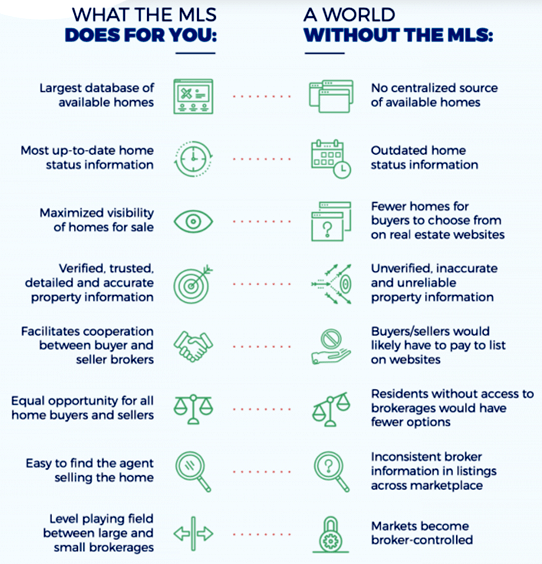
As shown in the graphic below, the MLS is at the heart of making the real estate market work efficiently to expose listings to the full universe of buyers. No other industry that I can think of works as well as the real estate industry, because no other industry has an MLS.

Last year, the National Association of Realtors introduced the Clear Cooperation Policy to make the MLS system work even better, telling participating Realtors, in effect, that if they want to be a member of the MLS, they must commit to giving fellow members a reasonable opportunity to find and sell their listings.

That policy has yet to achieve its goal because some MLS members find a way around it so they can sell their listings without sharing their commission with other MLS members. Golden Real Estate’s agents, however, are in full compliance.

Realtor Magazine Promotes Electric Vehicles in a 4-Page Article  

The summer 2022 edition of Realtor Magazine focuses on sustainability, and one of its articles is titled “Learning to Love EVs.” Click here to read the article online.

The article encourages NAR’s one million members to make their next car electric, but omits one selling point I take advantage of every April — I deduct over $10,000 for business mileage even though the cost of charging is near zero thanks to an abundance of free charging stations. Even if pay for the electricity — whether at home or at Tesla Supercharger or a DC Fast Charging station — the cost of the electricity is so much lower per mile than the cost of a gas-powered car, that the standard IRS deduction per business mile traveled becomes a nice source of tax-free income for Realtors or any other person who uses their personal car for business.

Aging in Place vs. Moving to a 55+ Community: Here Are Some Considerations  

It has been almost four months since Rita and I moved into our 2-bedroom rental in an “active adult” 55+ community. As such,  not all our fellow residents are retired, much less in need of assistance in their day-to-day living. Meals are not provided other than a daily continental breakfast, the primary purpose of which is to facilitate socializing.

Why would seniors want to sell their beloved single-family home with a vegetable garden and fenced yard for their dog? Good question! We loved our home backing to Lookout Mountain, where we lived for 10 years before selling it in March. Our motivation was purely financial at the time, believing that we were at the top of the sellers market. We thought that “cashing out” and renting for a year or two might make sense financially, and we liked what we saw at Avenida Lakewood.

In our minds, it turned out to be a good decision, but would it be a good decision for you? Rita and I have had some time now to weigh the pros and cons (mostly pros) of that decision, and I thought it would make a good topic for this column.

The most compelling positive about our move is that we gained a community which we lacked in the isolation of our single-family home. Yes, we knew and liked many of our neighbors, but Avenida takes community to a whole new level.

As I mentioned in a prior column, we had made more friends in our first month than we made in 10 years as owners of our single-family home. That’s precisely because it’s a 55+ community, and not because it’s an apartment building. In a regular apartment building, one might occasionally see a neighbor in the hallway, elevator or lobby, but the level of activity in a 55+ community is such that it’s rare for us not to see neighbors every time we leave our apartment, not to mention when we engage in one of the group activities.

When we would leave our Golden home, we usually left by car from our garage, and the most “connection” we’d have with our neighbors might be waving to them from the moving car. I might see my next-door neighbor when I walked to the mailbox, and I did meet fellow dog walkers when I took our dog out once a day. But that was about it.

In any given month there are over 300 group activities for our 275+ fellow residents. (See below for the various groups and activities for the month of July.) I myself will attend three fitness classes this week — one on strength building, another on balance and flexibility, and a third on cardio conditioning. Rita likes her Mahjong group and a couple card game groups, and she is joining me on one of those workouts. I also joined the group that writes the monthly newsletter.

That’s just 2% of the available activities, however, and over half our fellow residents engage in 10 or more activities each month. That’s what creates the community. Rita and I are new, so we don’t know everyone’s name, but it seems that many fellow residents do, and social director Sadie definitely knows everyone by name.

Being in our 70s, it’s inevitable that one day in the next 20 or so years, one of us will pre-decease the other, and I can already see that many arms will embrace the one of us who lives on. One well-loved resident died in March (none since, by the way), and he was mourned in the newsletter — which also features a paragraph about each resident who moves in or leaves.

So, community is the number one “pro” of our new lifestyle. In our prior homes, Rita and I never experienced such a sense of community.

While one might miss the lawns and gardens of his/her single-family home, it’s hard to miss the weeding, lawn mowing and snow shoveling — although I did enjoy using my new electric snow blower! (I have it in storage, if you’d like to buy it.)

Rita wasn’t keen about our move initially but has come to love our new home. The few “cons” that we came up with, such as having to dispose of so many possessions or having to walk the dog instead of letting it out the back door, have proved in the end to be positives.

Getting rid of decades of accumulated possessions was a challenge, but a good one. Our heirs will have far less to deal with, and several charities benefited from our donations. And having to walk the dog helps me complete the exercise rings on my Apple Watch each day!

We no longer have a garage, just a carport in the parking lot. With less need of two cars, we have downsized to just one. There are four ChargePoint charging stations in the parking lot, and there’s a bike room for my electric bike.

We have no pantry and a smaller refrigerator, and there’s no place to put a second refrigerator or freezer, so we are spending less money at Costco these days. We were able to rent storage cages on the same floor as our apartment, which helps.

We had to drive to everything before, but now we are within walking distance of a King Soopers, a liquor store, and three favorite restaurants (Mexican, Chinese and Japanese) plus a light rail station.

Several food trucks come to our building each month, and a mini farmer’s market sets up in one of the many common spaces each month. A carpool to a weekly farmer’s market is one of the summer activities.

We don’t have a guest bedroom as we did in our home, but the building has two nicely furnished guest apartments that residents can reserve for a reasonable fee.

Our kitchen is much smaller than the fabulous kitchen in our home, especially regarding counterspace, but Rita bought a rolling island and recently volunteered to me that she loves our kitchen now.

Our stacked washer and dryer aren’t as nice or as big as our high-efficiency units were, but there are jumbo units in the basement that we can use for free if the need arises (for comforters, etc.). There’s also a dog wash room, but our mobile groomer comes to Avenida just as she did to our prior home. Rita and I like to patronize the salon, too!

Security is another advantage of our particular community, with a private security company patrolling our parking lot and sidewalks from dusk until dawn every day. Residents are issued a credit card-sized RFID card which opens all the doors and gates to the building.

I welcome readers’ feedback on this perspective on the 55+ rental option. It should be pointed out that there are many different types of 55+ communities including ones with owned single-family homes.

I Found a Good Website About Downsizing for Retirement

A reader sent me the following message and I checked out his website. I checked it out, and it’s quite thorough and helpful. A couple things to keep in mind when reading it: 1) There is no “standard” real estate commission, but this website quotes a 6% standard commission. I charge 5.6% at most — less if I don’t have to share it with a buyer’s agent and less if I earn a commission on purchasing a replacement home. Also, my top commission for homes over $1 million is 5% with those addition reductions mentioned above. 2) If you use Golden Real Estate, you don’t need to rent a U-Haul for local moving. We provide a free moving truck similar to a large U-Haul, and in some cases we provide free driver and movers, plus free moving boxes, etc. Call for details!

Here’s the message received from a reader of this blog with that recommended website:

My name is Joseph and I work with RetireGuide.com; a free site dedicated to providing accurate, useful information to help today’s seniors fulfill their retirement goals.

We recently published a step-by-step guide to downsizing for seniors or those working towards retirement. Here we cover everything from finances and moving logistics to coping with the emotions that come from parting with a family home. Please feel free to take a look:


https://www.retireguide.com/guides/downsizing-for-retirement/

Thanks, Joseph!

Buyers and Sellers Are Confused by Today’s Chaotic Real Estate Market  

Frankly, we real estate agents are confused, too! Homes that would have attracted bidding wars a few months ago are sitting on the market — attracting few showings and no offers.

But it’s really a tale of two real estate markets, because there are “special” homes which still attract bidding wars. It’s the “ordinary” homes which are not getting any love — tract homes, mostly.

The trigger for this change, as we all assumed, was the abrupt increase in mortgage interest rates which occurred around April 1st, combined, no doubt, with a sinking stock market. There are investors who have already sold those stocks and are cash rich, but there are also investors who prefer to hold their depreciated portfolio and wait for the stock market to recover.

Buyers who can pay cash are unaffected by the rise in interest rates and continue to bid against fellow cash buyers for the “special” homes, especially million-dollar homes. They no doubt appreciate the reduced competition for those homes with the reduction in the number of buyers who depend on mortgage financing.

According to data obtained from REcolorado, the Denver MLS, there has been a negligible increase in the percentage of cash versus non-cash closings, but the rise in interest rates will likely be a factor ongoingly.  

The one statistically significant change I spotted was an 80% increase in closings for homes over $1 million  in the 2nd Quarter compared to the 1st Quarter of 2022. This compares to less than a 50% increase in the sales of homes priced between $500,000 and $800,000. I would normally expect the sales of those lower-priced homes to increase during the “selling season” at least as much as the homes over $1 million.

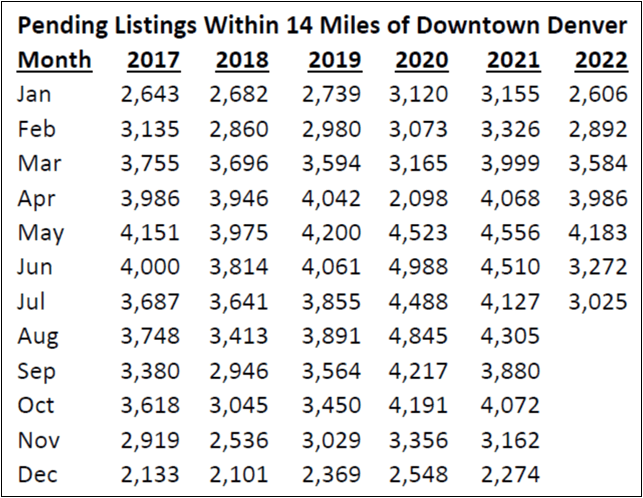
The chart above shows a sharp drop in total MLS sales this June versus the June of 2021, but there’s a longer trend at work than I didn’t suspect before creating this chart using REcolorado data. Notice that 2021 was the peak year and that 2022 showed a month-to-month decline in year-over-year sales for the first six months of the year. The drop in total sales only became significant in June, probably reflecting that change in the mortgage market.

You can also see that 2020 — the year in which Covid-19 appeared — was showing significant growth until the lockdowns occurred in March, resulting in a dramatic drop in total MLS sales, but only for the two months I highlighted in yellow. Then we saw a huge upswing in June, probably due to pent-up demand from April and May.

The question on everyone’s mind is where do we go from here?

My crystal ball is foggy right now, but I think mortgage rates have risen as much as they’re going to this year, and may even moderate in coming months, during which time buyers will come to accept rates in the 5% range as historically “okay,” which they are. We were spoiled by the 3% rates that we enjoyed in 2021, but the memory of those rates is fading. Unless the economy enters a recession, I feel that buyers will return to the market and we’ll see another surge from those buyers who have stayed on the sidelines these past couple months. Then homes which would have sold in less than a week a few months ago, will start moving again.

Indoor Air Quality Is a Subject of Growing Concern  

As America moves away from the use of natural gas and propane for home heating and cooking, the danger of carbon monoxide will disappear, but there are many other pollutants that are getting homeowners’ and builders’ attention.

It’s rare that a home buyer doesn’t order a radon measurement and demand that the level of radon gas be reduced through mitigation to below the EPA action level.

Also of concern are “volatile organic compounds,” which come from carpeting, particle board and other construction materials and furnishings.

Exhausting these gases and bringing fresh air into a home is just as important as filtering the air that is in your home. A new appliance that you’ll hear more and more about and begin seeing alongside furnaces and water heaters in your utility room is the Energy Recovery Ventilator (ERV) or the Conditioning Energy Recovery Ventilator (CERV), which monitors air quality and responds accordingly. Google it to learn more about it.

New Law Prohibits HOAs From Foreclosing Over Unpaid Fees  

You may recall that Green Valley Ranch’s master homeowners association filed over 50 foreclosure actions against homeowners who were delinquent in the payment or dues or even fines for failure to stow trash containers, and the like.

Well, the General Assembly responded and passed HB22-1137 (signed by Gov. Polis) prohibiting the use of foreclosure actions to enforce unpaid fees. Now an HOA can only use Small Claims Court to collect delinquent fees.

Mortgage Interest Buydowns Can Benefit Both Buyers and Sellers  

Interest rates have doubled in the last year. Buyers have reduced buying power at higher rates, and sellers are seeing their listings take longer to go under contract. Lowering the list price is one strategy to entice buyers, but that makes a nominal difference in terms of the monthly payment for a prospective purchaser. 

I talked with Jaxzann Riggs at The Mortgage Network to learn how buying down the interest rate can take the sting out of rising rates and more importantly, how sellers might employ the offer of a buydown to increase the number of offers received.

There are two types of buydowns — temporary and permanent, and each has its own benefits, but the MOST important thing to know about buydowns is that they can be paid for by either the buyer or the seller.

Let’s look at both options for a fictitious buyer.  Rebecca is interested in a house that is listed for $695,000. She is planning on putting 20% down, and her mortgage broker quoted her a rate of 5.454%, with a monthly P&I payment of $3,141. This payment is a little above what Rebecca was hoping for, so she is thinking about asking the seller to assist with the cost of an interest rate buydown.

Temporary buydowns allow the seller or the buyer to contribute money to an escrow account for the benefit of the buyer at the time of closing. A portion of the escrow is used each month to reduce the borrower’s payments for a set amount of time.  A  “2-1 Buydown” is a common option that decreases the interest rate for the first two years of the mortgage. The rate is 2% lower the first year, and 1% lower the second. While the buyer’s mortgage contract is always going to reflect the note rate, the buydown escrow is used to pay the remaining interest balance each month. To ensure that she can afford the full monthly payment, she must qualify for the loan based on the note rate.

In Rebecca’s scenario, a 2-1 buydown will cost $11,968, and would lower her first year’s monthly payments to $2,482, equivalent to an interest rate of 3.454%. This is a monthly savings of $659, which will be paid out of the buydown account. The second year she will pay $2,802 monthly, comparable to a 4.454% rate, with a savings of $339 a month. The third year she will have exhausted the subsidized funds and she will pay the full payment of $3,141 for the remainder of the loan. While the effects of this option only last a couple of years, the monthly savings are significant and for borrowers who anticipate increases in income, this can make home ownership more of possibility.

Permanent Buydowns allow the rate to be “bought down” for the life of the loan. “Points” are paid to the lender at the time of closing in exchange for a lower rate for the life of the loan. While the monthly savings aren’t quite as dramatic as with the temporary buydowns, the benefit will continue throughout the life of the mortgage. 

For Rebecca, the dollars that she would spend for a temporary buydown, $11,968 would buy her rate down to 4.796% for 30 years, lowering her monthly payments to $2,968, saving her $157 a month versus a payment based upon a current rate of 5.45%.  Again, this buydown could be paid for by the seller instead of lowering their sale price, to make their listing more attractive to more buyers.

The bottom line is that buydowns make sense for some.  And sellers who are willing to participate in the cost of buydowns will dramatically increase their buying pool.

If you would like more information about buydowns, call Jaxzann at (303) 990-2992.