How Does This October’s Real Estate Market Compare to Last October’s Market?

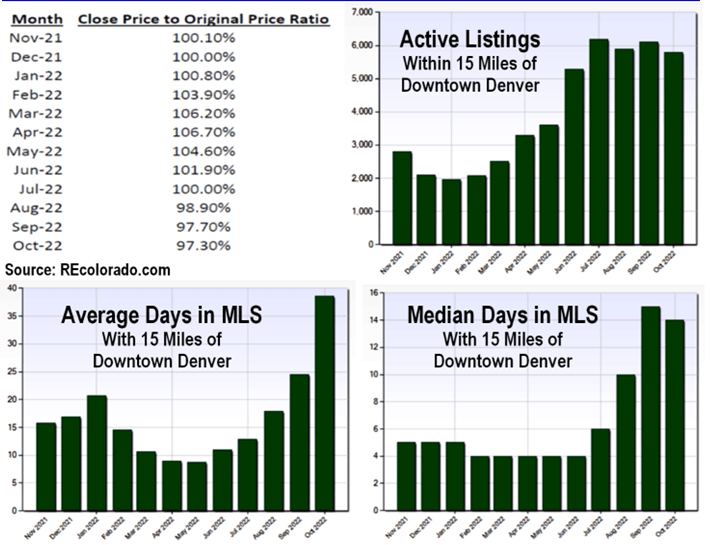
We all know that the Denver metro real estate market has changed dramatically this year, so I thought it would be interesting to compare the first 16 days of October with the same 16 days of October 2021. Here’s what I found.

I pulled the real estate sold listings on REcolorado, Denver’s MLS, for both years, limited to the area within 18 miles of downtown Denver, which roughly includes the area within the C-470/E-470 beltway, but does not include the city of Boulder.

Yes, the market has slowed, but the median sold price jumped from $450,000 for the first 16 days of October 2021 to $550,000 for the same period this year — a 22.2% increase. However, the number of closings plummeted from 2,411 during that period in 2021 to 1,650 this year, a 31.6% decline.

The ratio of sold price to original listing price dropped from 100.82% last year to 99.94% this year, and the median days before going under contract increased from 5 days last October to 16 days this year.

What effect did this year’s increase in interest rates have? During October 1-16, 2021, 18.1% of the closings were cash. During the same period this year, cash closings rose only to 18.25% — hardly any impact, it seems.

Anecdotally, I have observed that higher priced homes are selling more readily in this slower market, so I checked to see what percent of closings were $1 million or higher. During October 1-16, 2021, 6.51% of closings were over $1 million, but that rose significantly this October to 9.94% — and those million-dollar-plus homes sold quicker, with a median days before going under contract of 12, compared to 17 days for homes under $1 million.

There are many more unsold (that is, active) listings now than there were last October — 5,996 compared to 4,386 last year — and fewer pending listings — 3,310 compared to 4,913 last October. A consistent characteristic of the seller’s market was that there were more homes under contract at any given time than there were for sale, which was frustrating for buyers who would see “for sale” signs in front of homes, more than half of which were not, in fact, available to purchase because they were under contract.

Price reductions continue to be quite common in today’s real estate market. Of those nearly 6,000 listings currently active within that 18-mile radius of downtown Denver, over 1,000 per week are reducing their listing prices. As a result, we’re seeing a surge of low-ball offers for listings in all price ranges, as buyers know that homes are not selling for their asking prices and might go for far less.

Just this week, I know of one listing that was on the market for 100 days, starting at $685,000 (a price that was justified by prior sales of comparable homes), reducing its listing price over time to $589,000. The seller finally threw in the towel and sold it to a quick-closing cash investor for under $500,000. That’s an extreme example, but it’s says a lot about the market we are in now.

That example also provides another lesson about the market, because it was an unrenovated home. It had an unimproved kitchen and unimproved bathrooms and nothing flashy or exciting to catch buyers’ attention. My observation has been that homes which are unimproved or otherwise “plain” are sitting on the market and selling only after serious price reductions, whereas homes that are newer or beautifully updated are selling quickly and even attracting a bidding war.

The reason is simple, as I see it: Buyers are simply not inspired to “pull the trigger” at this time, especially if they need to borrow money. It takes a lot to get an offer from them.

This Might Be a Good Time to Do Some Renovation on Your Home

Normally, I would advise a prospective seller not to renovate their home to make it more appealing to buyers, because statistics have shown that you don’t recover 100% of what you spend on improvements. The only exception to that is cosmetic improvements which eliminate eyesores, such as peeling paint, floor damage, or anything that draws immediate negative attention on the part of visitors. Those repairs are worth it.

My other frequent advice is to make improvements which make you happy, albeit with an eye to what would look good to prospective buyers. Would you like a new kitchen or bathroom? Renovate it now, don’t wait to do it when you are ready to sell and want the home to have greater market appeal.

Since you don’t recover 100% of what you spend, do it now so that you can enjoy it, satisfying yourself that it will also help the home sell when the time comes.

Because the market is cooling and interest rates are so high, it might be a good time for sellers to hold back and make those little or bigger improvements that would make life better. Maybe you will want to sell next year or maybe you won’t, but meanwhile, you’ll enjoy your home more.

My broker associates and I would be happy to visit with you in your home and discuss those little and bigger improvements that suit your needs but would also make your home more attractive when the time comes to sell. We won’t be trying to convince you to sell, so feel free to request such a visit. We can also recommend vendors/contractors to make those improvements you decide on.

The Slumping Stock Market Is Making a ‘Reverse Mortgage’ More Appealing to Baby Boomers

Many people who are considered “baby boomers” (born between 1946 and 1964) are now either in retirement or fast approaching it. In fact, About 10,000 baby boomers turn 65 every day. 

Park Hill residents Sandra and Daryl are excited and eager to join their retired peers, however with recent declines in the value of their retirement portfolio, they are concerned that those accounts may not cover their expenses (including their current mortgage payment) for the rest of their lives. While they still have some money owing on their current home they have built a large amount of equity over the past 20 years that can be used to ease the way into retirement. Jaxzann Riggs, owner of The Mortgage Network, explains how that might work. 

Home Equity Conversion Mortgages, more commonly known as “reverse mortgages” or “HECM’s” have become increasingly popular over recent years, and for good reason — a reverse mortgage allows homeowners to access the equity in their home. Borrowers with adequate equity can refinance their existing loan into a reverse mortgage OR they can use a reverse mortgage to purchase a new home.

Borrowers keep ownership of their home as they continue to age, and “non-borrowing” spouses (younger than 62 years of age), may continue to live in the home until his or her death. Borrowers also have flexibility about how they choose to access their equity, allowing people to choose what is best for their circumstance.

Ending current mortgage payments, receiving monthly payments, receiving a lump sum of cash, or creating a growing line of credit are four different options that a borrower may choose to utilize, or they can opt for a combination of all four. This money can be used however a borrower chooses and, because it is considered “borrowed” money and not income, it is not taxable and does not reduce Social Security or Medicare benefits in any way.

Here are some of the common myths and misconceptions about reverse mortgages:

Myth #1: The lender will take ownership of the home.

FALSE: Borrowers will retain ownership of the property. The lender does not take control of the title. The lender’s interest is limited to the outstanding loan balance.

Myth #2: I will be forced to forfeit ownership of my house, the bank will take the title to my home..

FALSE: The heirs will never owe more than the value of the property; however, they will have the option to repay the loan and keep the house for themselves.

Myth #3: To qualify for a reverse mortgage, a home must first be paid off — “free and clear”

FALSE: Even if you still have a loan on your home, you may be eligible for a reverse mortgage.

While relatively easy to obtain, HECMs are not for everyone. You must be at least 62 years of age, have substantial equity in your property, and occupy the home as your primary residence. To be eligible, a reverse mortgage normally requires a minimum of 50% equity in the property. Given the very real possibility of a correction to real estate values, now may be the perfect time to consider your reverse options. Eligible property types include single family homes, two- to four-unit properties (borrower must occupy one unit), townhomes and modular homes, and FHA approved condos.

Some things to remember:

1)    You are still responsible for paying property taxes, homeowners’ insurance, and monthly HOA fees for the home, even though you won’t have a monthly mortgage payment.

2)   If you aren’t living in the home for the majority of the year, or are planning on moving soon, then a reverse mortgage may not be the best fit for you. 

Electric Vehicle Expo at the Taj Mahal

For those who missed it, there was a “Drive Clean Summit & Expo” at the Jeffco Government Center on October 12th. The display of electric vehicles in the parking lot included the following:

An electric street sweeper:

A Bluebird electric school bus:

An electric shuttle bus:

An electric work truck:

A Ford eTransit van:

A Nikola electric semi:

A Lightning Motor electric van (made in Colorado):

A Motiv electric step-van:

A Moser propane-powered self-contained mobile Level 3 charging station prototype:

Study Reveals Why Certain Homes Survived the Marshall Fire While Ones Around Them Did Not

One of the free lectures associated with the Oct. 1st tour of “green” homes was a fascinating presentation by Paul Kriescher of Bowman Consulting based on a study of the few homes which survived the Dec. 31st Marshall Fire while the houses around them burned to the ground. Click here for a PDF of Paul’s PowerPoint slides.

You’ll recall that it was the hurricane-force winds that were responsible for the fast spread of the Marshall Fire. Flying embers were what caused homes to catch fire in rapid succession. According to Paul, there’s a simple reason why those embers didn’t torch certain houses. It was because they didn’t get inside the homes or their attics.

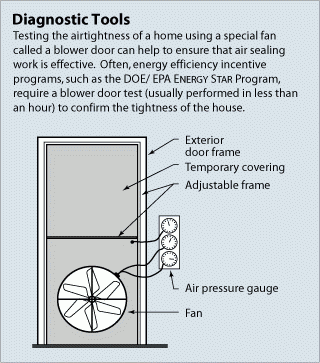
The standard developer-built homes are “leaky” and built with ventilated attics. As I have explained previously, the standard procedure for finding and sealing the places where air can enter your home is to conduct a “blower-door test.”  (See graphic.) This involves installing a computerized fan in a doorway and sucking the air out of a house. The computer on that fan will tell you how leaky your house is — how many air changes per hour your home can expect during a certain wind speed. While that fan is operating, the technician can go through your house and determine all the places where air is coming into your home so that they can be caulked or otherwise sealed.

Many of those places are going to be around windows or on the rim joist — where your floor joists rest on the concrete foundation.

The goal is to get your home to a degree of air tightness at which you achieve two air changes per hour or less. Once you achieve that degree of air tightness, you then install an energy recovery ventilator (ERV) to bring filtered outside air into your home while expelling air from your home.

Making your living quarters more air tight can keep burning embers from entering your home. Combine that with having non-combustible exterior siding, decks and landscaping, and you go a long way toward preventing burning embers from being sucked into your home — and to keeping ash and smoke from making your home unlivable if it doesn’t burn down.

But the most critical area to seal is your attic. Your home probably has an attic which is vented. Blown-in insulation sits on your attic floor to keep your living quarters warm in the winter, while soffit vents combine with roof vents to draw outside air through your attic. This controls moisture buildup but is also ideal for drawing burning embers into your attic which can then light your entire house on fire.

Some builders have switched to building homes with “conditioned” attics, meaning that the underside of the roof is insulated and all vents eliminated. Thus, the attic itself is heated and cooled like the rest of the house. With no vents in your attic, those flying embers blow past your house instead of entering it.

There’s a subdivision in Arvada built by Meritage Homes called Richards Farm. It’s on the north side of 72nd Avenue, across from the Apex Center. Our agents were invited to tour it while it was under construction, and the builder showed us their conditioned attics. The reason the attics were conditioned had nothing to do with fire prevention. They were running heat ducts through the attic, and by insulating the attic, it made the ducts more efficient. But now we know the most important reason for conditioning an attic, and I suspect we’ll see building codes changed to require conditioned attics.

I learned another disadvantage of vented attics from participating in the 1994 Jimmy Carter Work Project, which built 30 Habitat for Humanity homes on the Cheyenne River Sioux Indian Reservation in Eagle Butte, South Dakota. Those one-story homes all had vented attics. Within months of completing those homes there was a blizzard which filled the attics of those homes with snow, which entered through the soffit vents. The snow then melted, causing the drywall ceilings to fall, causing immense damage. The homes had to be vacated and rebuilt on the inside the very next summer. The reservation had no building codes to follow, but if it did it would probably not have allowed vented attics for that reason.

How to Make Sure the Home You Buy Isn’t a ‘Money Pit’

When you go under contract to buy a home, the contract will have a deadline for inspection objection, inspection termination and inspection resolution. Every home buyer is well advised to hire a home inspector and make use of the opportunity to ensure that the home you end up buying is in good condition.

During the recent sellers’ market it was common for buyers to waive or limit their rights to object or terminate based on the condition of the home as a way of making their offers more attractive. Even then, however, the smart buyer hired a professional home inspector so they would know what they’re getting into.

Home inspectors are not licensed in Colorado, but they are typically certified by one of two professional associations. Your real estate agent can recommend inspectors that he or she knows are good based on the experience of previous clients.

The home inspector knows enough about every aspect of a home to provide a good overview, including identifying specific defects. In some areas, however, he will encourage the buyer to order a secondary inspection by someone with more in-depth expertise in the area of concern. Although a certified inspector can diagnose most electrical or plumbing problems, in some cases he might recommend a more detailed inspection by a licensed electrician or plumber. That also helps to produce an estimate for inclusion in the inspection objection submitted to the seller.

Most inspectors can recognize a structural issue but will typically urge you to have the matter evaluated by a structural engineer. This can cost a few hundred dollars but, like the general inspection itself, could allow you to demand (and hopefully get) the seller to pay for a repair instead of paying for it yourself later on.

Two routine inspections that you should consider and which your general inspector can often perform himself for an additional fee, are the sewer scope and radon test.

A sewer scope consists of running a camera from a cleanout within the house to the main sewer line in the street or alley. Until the late 1900s, most home sewer lines were made of clay pipes that are susceptible to root intrusion and collapse. A sewer scope will cost you between $100 and $150, but is well worth it. If it uncovers a collapse, the repair, if excavation is required, could cost $10,000 or more. You will want the seller to pay for that repair, not yourself.

A radon test also costs $100 or so and consists of installing a computerized device in the lowest habitable area of the house — a basement, if there is one, but only if it’s habitable, whether finished or not. This device samples the air every hour for 48 hours, and the resulting measurement is an average of those 48 readings. If the result is in excess of the EPA action level of 4 picocuries per liter of air (4 pCi/L), you should demand that the seller pay for radon mitigation. Mitigation starts at about $1,000 for a single family home, but can be considerably higher if it has a partial basement with an earthen crawl space.  Again, the $100 or so that you spend on the radon test can save you much more if you’re able to get mitigation paid for by the seller.

A final thought: The report produced by your inspector will include every little thing he or she found wrong with the house, because the inspector doesn’t want you to come back later and say he missed something, however insignificant. Typically, your inspector will highlight the serious issues which you should consider for your inspection objection. Even then, it may be wise strategically to omit the minor items that you can take care of (or ignore) yourself.

HOW THE INSPECTION OBJECTION PROCESS WORKS:

As mentioned above, there are three deadlines in the Contract to Buy & Sell:

> Inspection Objection

> Inspection Termination

> Inspection Resolution

Typically, the objection and termination deadlines are within a week or 10 days of the date on which you go under contract. Since inspection is the most common reason that a contract falls, both seller and buyer want this date to be as early as possible. The buyer can submit an objection or can terminate. If he submits an objection, he can’t then submit a termination. However, if an Inspection Resolution is not signed by both parties before the resolution deadline (typically 2-3 days later), then the contract terminates automatically.

The Inspection Objection and Inspection Termination documents are merely notices to the seller, so they are signed only by the buyer. The Inspection Resolution document is what truly matters, and it is signed by both parties, making it an amendment to the contract which, by the way, must be provided to the lender.

Help Turn Pumpkins into Habitat for Humanity Houses!

Golden Real Estate is happy once again to support the Habitat for Humanity pumpkin patches in Lakewood and Arvada. The Lakewood patch is at Garrison Street & Alameda Avenue, on the grounds of Mile Hi Church. The Arvada patch is on the grounds of Trinity Presbyterian Church at 78th Avenue & Wadsworth Blvd. Our thanks go to these two churches for providing great locations for this fundraiser.

Both pumpkin patches are operated each year by Jeffco Interfaith Partners, a coalition of a dozen local faith groups. The profits from these two volunteer-manned patches have funded over 20 Habitat for Humanity homes in the metro area over the past 2+ decades.

The pumpkins are grown on a Navajo reservation in the Four Corners area, so the sales also benefit that community, which gets 60% of the proceeds. Habitat gets the other 40%.

Yes, the pumpkins sold at our two patches may be more expensive than at your local supermarket, but you have the satisfaction of making a difference with every purchase, and the 40% of your purchase which goes to Habitat is tax deductible.  Ask for the tax receipt.

What Can You Do to Make Your Home More Energy Efficient?

In a previous column, I pointed out that making your home more energy efficient can save you money immediately if you finance the improvements, because the monthly payments could be less than your monthly savings. The recently enacted Inflation Reduction Act has some very generous tax credits and rebates that make such improvements even more practical and affordable. My intention this week is to give you a “roadmap” for doing so.

The logical starting point is to hire a professional to do an energy audit of your home — to identify the “low-hanging fruit,” meaning the quickest and easiest changes you can make or improvements you can install that will give you the most “bang for your buck.”

That low-hanging fruit is typically better insulation, and the energy auditor normally begins by performing a blower door test of your home. That involves installing a computer-calibrated fan in a doorway which sucks air out of your house. By depressurizing your home in this manner while all your other windows and doors are closed, the auditor can identify all the leaks which allow cold air into your home in the winter. That way you know where to caulk to make your home less “leaky.”

When it’s cold outside, the auditor can use an infrared camera pointed at your walls and ceilings to assess where you could improve your in-wall and in-ceiling insulation.

You’ll get a written report from you energy auditor with suggestions of things to do and how much benefit you will get from making those changes, whether it’s blowing insulation into your attic and walls, replacing your old gas furnaces and gas water heaters with heat pump versions, or installing better windows. Most recommended improvements will earn you a 30% tax credit under the Inflation Reduction Act.

There are more “roadmap” items, but you will learn about most of them by attending the Oct. 1 tour of green homes. See the blog post.

If you or someone your know is an energy auditor, let me know. We expect big demand for your services!