Pricing Your Home Right Is More Important Than Ever

The “seller’s market” is slowing. You can still sell your home quickly and even attract a bidding war, but that requires pricing your home correctly. Overprice it, and it could sit on the market for a long time, go through multiple price reductions, and end up selling for less than if you had priced it correctly in the beginning. The agents of Golden Real Estate and I can help you thread that needle.  Call any of us for a free consultation.

The softer real estate market also makes marketing your home well more important than ever, and no brokerage provides the kind of marketing — including promotion of your home in this column and our trademark narrated video tours — that Golden Real Estate provides. Our phone numbers are below.

Jim Smith, Broker/Owner      303-525-1851

Broker Associates:

Jim Swanson, 303-929-2727

Chuck Brown, 303-885-7855

David Dlugasch, 303-908-4835

Ty Scrable, 720-281-6783

Greg Kraft, 720-353-1922

Statistics Help to Quantify the Slowing Real Estate Market in Metro Denver

Here are some ways I’ve been able to quantify what we are all seeing, namely the slowing of our local real estate market.

Looking within 14 miles of downtown Denver, the currently active (i.e., unsold) listings have a median days on MLS (DOM) of 27 days. However, the currently pending listings have a median DOM of 13, and the listings that closed in the last 30 days have a median days on the MLS of 7.

The listings that closed in the prior 30 days had a median DOM of just 5, which is what it has been, more or less, through the past couple years. So the market is definitely slowing, and slowing rather abruptly.

The number of active listings —  what we refer to as “inventory” — has surged as homes sit on the market longer.

As I write this on Tuesday morning, there are 4,133 active listings on REcolorado, the Denver MLS, in that same 14-mile radius. That’s down from the peak of 5,521 at the end of July, but you have to go back to September 2020 to find a higher number of active listings than this July, as shown in the chart below.

In prior years, you’d see the number of active listings increase by 50%, more or less, from January to July, but look at this year’s more than triple surge from January to July in that chart.

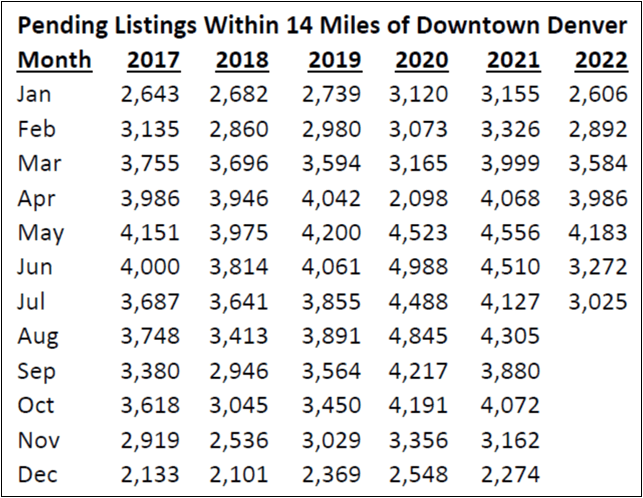
The chart of pending listings (below) is also instructive. Notice that in most months during 2021 and 2022, the number pending listings was almost always higher than the number of active listings (above chart), but that changed in June and July, when the numbers dropped dramatically.

You’d expect, in a normal market, with a lot more listings to choose from, that more listings would go under contract, but the reverse was true. As the number of listings surged in June and July, the number of listings going under contract went down substantially. That, too, reflects an abrupt slowing of Denver’s real estate market.

(As an aside, notice the effect of the pandemic on the April 2020 number of pending listings. April was the first full month of the pandemic, and the number of listings going under contract plummeted at a time of year when they would normally surge. Notice, however, the quick recovery in the following months. It has been surmised that Covid soon caused a surge in sales as people began to work at home and saw the need for more home office space and the opportunity to move further from their place of work since they were no longer commuting.)

Another statistic demonstrating the slowing of Denver’s real estate market is the extent to which the median sold price of homes has fallen as the market has turned.

The median sold price for that   14-mile radius peaked at $582,950 in June, but it fell to $550,000 in July and has fallen to $520,000 for closings during the first half of August — going down, but still higher than in any prior year.

NOTE: The above article was adapted for a Jefferson County audience using only Jeffco statistics. You can read a PDF of that version at www.JimSmithColumns.com.

Looking for a Good Deal? Opendoor Is Slashing Prices to Clear Its Inventory

I wrote about Opendoor last week. They’re one of the “iBuyer” companies that buys off-MLS listings and flips them for a profit. Or at least that’s how it’s supposed to work, but too many homes haven’t sold, and they drop their listing prices twice each month until they sell. For too many of their listings, that means they will be getting far less than what they paid for them.

As I write this on Sunday evening, there are 446 unsold Opendoor listings on Denver’s MLS, and the median days on the MLS is 58!  It’s apparent that they bought many of these listings during those heady days before the market softened and now they can’t sell them for a profit or even at the price they paid for them.

To keep it manageable, I studied only the 45 Opendoor listings currently active in Jefferson County. The median days on the MLS for those listings is 75!  That’s three times the median days on the MLS for all active listings in Jefferson County. All but two of those listings have been active for at least 12 days, and all 43 of those have had their prices cut to try to clear the company’s inventory. They’re going to lose money on most if not all of them.  Here are some examples:

They purchased 11022 Trailrider Pass, Littleton, for $631,400 on Dec. 2nd and listed it on Feb. 17th for $820,000.  Nine price reductions later, it’s now listed at $643,000 and has yet to go under contract. At the current price, they will pay their usual 2.5% buyer agent commission, netting them about $5,000 less than they paid for it. Presumably they also had some repairs, repainting and other expenses during the two months between buying and listing.

Opendoor’s oldest listing, 2090 Braun Drive, Golden, was purchased last September for $638,300, and is currently listed for $621,000 after one failed contract and three subsequent price reductions.

4740 S. Tabor St., Morrison, was purchased for $500,500 in December, listed for $612,000 two months later, and after nine price reductions and no contracts, it’s listed at $527,000. Depending on how much money they spent dressing up that listing during those two months, they might break even.

Here are some of the Jeffco listings on which Opendoor will lose a lot of money:

Unsold Jeffco listings priced as much as $50,000 below what Opendoor paid for them:

6384 Newland St., Arvada ($579,000)

7076 Parfet Street, Arvada ($626,000)

6975 W. 63rd Ave., Arvada ($577,000)

12463 W. 68th Ave., Arvada ($693,000)

7155 Fenton Circle, Arvada ($568,000)

9010 W. 5th Pl., Lakewood ($594,000)

289 Marshall St., Lakewood ($657,000)

10112 W. Dartmouth Ave., Lakewood ($379,000)

10946 W. Texas Avenue, Lakewood ($558,000)

11266 W. Kentucky Dr., Lakewood ($575,000)

5645 S. Zang Street, Littleton ($481,000)

6309 W. Fair Dr., Littleton ($649,000)

10679 W. Cooper Place, Littleton ($776,000)

7782 W. Alder Dr., Littleton ($786,000)

6230 W. Maplewood Place, Littleton ($666,000)

5683 W. 118th Place, Westminster ($556,000)

11526 Marshall Street, Westminster ($495,000)

10012 Holland Court, Westminster $464,000)

10063 Flower Street, Westminster ($723,000)

9679 Teller Court, Westminster ($576,000)

6280 W. 45th Avenue, Wheat Ridge ($573,000)

Of the 177 Opendoor listings (in all counties) which closed in the last 90 days, only 18 sold at or above their original listing price. More than half sold for at least 5% below their original price.  In the same 90-day period a year ago, 55% of Opendoor’s listings sold at or above their original listing price.

One could argue that the iBuyer model is still valid and that the company just suffered from the abruptness of the change in the real estate market. Meanwhile, it is also reported that although the market has slowed, prices are still increasing, so perhaps there are some bargains to be had among Opendoor’s “stale” listings.

Although Opendoor Brokerage is difficult for brokers and buyers to work with (they are managing 446 Colorado listings from their office in Tempe, Arizona), my broker associates and I would be happy to show you any of their listings and see if we can get you a good deal!

Let’s Hear It for the Multiple Listing Service: The Best Tool for Buyers & Sellers  

We hear a lot about “off-MLS” sales of homes, particularly by investors. Investors love to buy homes off the MLS, but they turn to the MLS to sell the homes they bought. Prospective sellers should read that sentence again, because it says everything you need to know about the value of the MLS: Buyers can pay less if the seller doesn’t put their home on the MLS; and sellers net more money by putting their home on the MLS.

Investors know they would pay “market value” for MLS listings, because that’s what the MLS is — it’s the market! Investors know they’ll be competing with other buyers if the home is on the MLS. That’s why they find the homes they buy by soliciting homeowners who do not have their home on the market.

They make an appealing pitch — no showings, no open houses, and a quick cash closing. Remember, investors are in business to make a profit, and the only way to make a profit is by paying you less than your home is worth by buying it off the MLS, and then selling it on the MLS.

Now, if money doesn’t matter that much to you — for example, you’re the personal representative of an estate, but you’re not a beneficiary — that’s probably an attractive pitch. After all, it’s not your money! But, if it’s your house and your money, just know that you’ll make more money from the sale of your house if you let a professional like one of the agents at Golden Real Estate expose your home to the full market — which is only accomplished by putting the home on the MLS.

I have written in the past about “iBuyers,” such as Open Door, which buy homes off the MLS, then flip them with minimal improvement by listing them on the MLS. You can find columns on that topic dated Jan. 2, 2020, and Aug. 22, 2019, at JimSmithColumns.com, where all these columns are archived. In those columns I point out that the iBuyer companies typically convince homeowners to meet with them by offering a high sight-unseen price, which is thousands above what they finally offer the seller. It’s a bait and switch approach, so beware!

The essence of the MLS is “cooperation and compensation.” Sellers hire a listing agent for a negotiable commission — currently averaging under 6 percent — which is large enough for the listing agent to compensate another MLS member for producing the buyer of that listing.

There’s an understandable misconception that the seller pays both the listing agent and the buyer’s agent and that somehow that’s unfair — that the buyer should pay his or her own agent.

But, although it may look as if the seller is paying both agents — because it is taken from the seller’s proceeds at closing — in fact, as I said above, the listing agent is paying the buyer’s agent out of his or her listing commission.

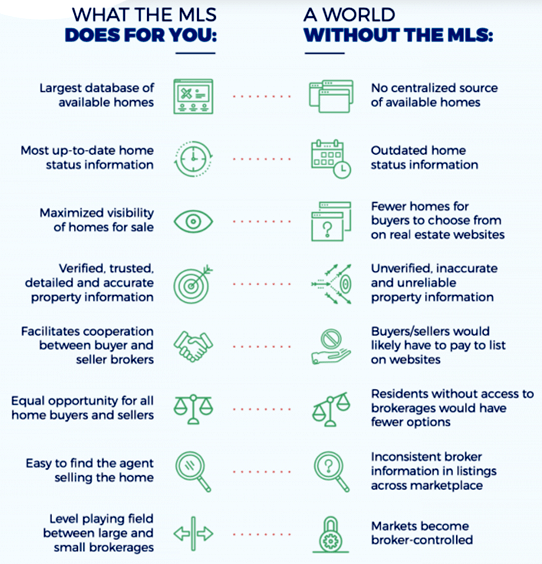
As shown in the graphic below, the MLS is at the heart of making the real estate market work efficiently to expose listings to the full universe of buyers. No other industry that I can think of works as well as the real estate industry, because no other industry has an MLS.

Last year, the National Association of Realtors introduced the Clear Cooperation Policy to make the MLS system work even better, telling participating Realtors, in effect, that if they want to be a member of the MLS, they must commit to giving fellow members a reasonable opportunity to find and sell their listings.

That policy has yet to achieve its goal because some MLS members find a way around it so they can sell their listings without sharing their commission with other MLS members. Golden Real Estate’s agents, however, are in full compliance.

Buyers and Sellers Are Confused by Today’s Chaotic Real Estate Market  

Frankly, we real estate agents are confused, too! Homes that would have attracted bidding wars a few months ago are sitting on the market — attracting few showings and no offers.

But it’s really a tale of two real estate markets, because there are “special” homes which still attract bidding wars. It’s the “ordinary” homes which are not getting any love — tract homes, mostly.

The trigger for this change, as we all assumed, was the abrupt increase in mortgage interest rates which occurred around April 1st, combined, no doubt, with a sinking stock market. There are investors who have already sold those stocks and are cash rich, but there are also investors who prefer to hold their depreciated portfolio and wait for the stock market to recover.

Buyers who can pay cash are unaffected by the rise in interest rates and continue to bid against fellow cash buyers for the “special” homes, especially million-dollar homes. They no doubt appreciate the reduced competition for those homes with the reduction in the number of buyers who depend on mortgage financing.

According to data obtained from REcolorado, the Denver MLS, there has been a negligible increase in the percentage of cash versus non-cash closings, but the rise in interest rates will likely be a factor ongoingly.  

The one statistically significant change I spotted was an 80% increase in closings for homes over $1 million  in the 2nd Quarter compared to the 1st Quarter of 2022. This compares to less than a 50% increase in the sales of homes priced between $500,000 and $800,000. I would normally expect the sales of those lower-priced homes to increase during the “selling season” at least as much as the homes over $1 million.

The chart above shows a sharp drop in total MLS sales this June versus the June of 2021, but there’s a longer trend at work than I didn’t suspect before creating this chart using REcolorado data. Notice that 2021 was the peak year and that 2022 showed a month-to-month decline in year-over-year sales for the first six months of the year. The drop in total sales only became significant in June, probably reflecting that change in the mortgage market.

You can also see that 2020 — the year in which Covid-19 appeared — was showing significant growth until the lockdowns occurred in March, resulting in a dramatic drop in total MLS sales, but only for the two months I highlighted in yellow. Then we saw a huge upswing in June, probably due to pent-up demand from April and May.

The question on everyone’s mind is where do we go from here?

My crystal ball is foggy right now, but I think mortgage rates have risen as much as they’re going to this year, and may even moderate in coming months, during which time buyers will come to accept rates in the 5% range as historically “okay,” which they are. We were spoiled by the 3% rates that we enjoyed in 2021, but the memory of those rates is fading. Unless the economy enters a recession, I feel that buyers will return to the market and we’ll see another surge from those buyers who have stayed on the sidelines these past couple months. Then homes which would have sold in less than a week a few months ago, will start moving again.

Statistics, Oddly, Seem Not to Support the Idea That the Real Estate Market Is Slowing Down  

We all know that the real estate market has slowed down since the dramatic April increase in mortgage rates — right?

Seeking to document and measure that slowdown, I checked the statistics available to me as a member of REcolorado, Denver’s MLS. Below is a chart of the statistics I gathered for the period Jan. 2021 to present. Analyzing that chart, you can see that while there are fewer active listings this May than a year ago, there are roughly the same number of sold listings — and they went under contract just as quickly, with a median days on the MLS (DOM) of just 4. And, more significantly, the median sold price this May was nearly $100,000 higher than May 2021, with a slightly higher ratio of sold price to listing price. April’s statistics year-over-year were even more impressive.

The smaller chart is a 7-day residential “Market Watch” widget that I copied and pasted from the MLS on Tuesday morning. Although I don’t know how to replicate what that chart would have looked like a year ago, it’s safe to say that it’s much different — and does not paint the same picture as the larger chart above. It definitely shows a vibrant market with lots of new, pending and closed listings, but the number of price reductions must be significantly higher than they were a year ago — and 10 times the number of price increases.

So, what does all this data mean for the average homeowner thinking of listing his or her home for sale?

The number of price decreases suggests to me that too many sellers are starting out with a listing price that might have worked in the past, but that is too aggressive for the current market. While the median days-on-MLS is still only 4, you can be sure that those listings lowered their prices a week or more into their time on the MLS.  At the same time, that low days-on-MLS number tells you that the sellers who price their home correctly outnumber those who do not. Good for them. That’s the group you want to be in!

Another obvious conclusion is that while the dramatic increase in mortgage interest rates has impacted many buyers, there are enough buyers who are paying cash or are not deterred by the higher rates, which are still historically low. (When I bought my first home in 1983, I benefited from a subsidized interest rate of “only” 13%!)

Bottom line: Sellers should price their homes less aggressively. Buyers should focus on homes with a DOM over 10 days. That’s where the best deals can be found.

Are Investors Snapping Up Homes, Squeezing Out Other Buyers?  Yes and No.  

Media reports have created the impression that “Wall Street” interests are dominating the purchase of homes for sale, squeezing out individual buyers and causing the low inventory of homes for sale. That’s not exactly true.

What’s happening is that those purchases are happening through an off-MLS process, with very few on-MLS listings, based on my own observation and experience, being purchased by those large investors.

In fact, I can’t think of even one transaction that involved a large entity purchasing one of Golden Real Estate’s listings. And they certainly did not hire us to buy another brokerage’s listing. All our listings have been purchased either by owner-occupants or by small investors — homeowners themselves, who may have a portfolio of rentable homes or condos.

If you’re a homeowner, you’ve likely received, as Rita and I have, many solicitations to sell your home without putting it on the MLS — a bad idea if you want to get the highest price for your home. Also, brokers like me regularly receive emails and texts asking whether I have a “pre-MLS” listing that they or their client could buy “as is” before it’s put on the MLS. My standard reply to such solicitations is that I would never encourage a seller to sell their home without putting it on the MLS, because that’s a sure way to get less than their home is worth. I consider it my responsibility as their agent to get the highest possible price by exposing their home to the maximum number of buyers. That is not achieved by selling one’s home to an investor without putting it on the MLS.

Media experts and others continue to treat the low active inventory on the MLS as the result of reduced number of homes being entered on the MLS, including by off-MLS sales. In fact, the number of new listings this April was higher than both prior Aprils, but the number of active listings keeps declining because those new listings sell so quickly.

Yes, some of those off-MLS sales might have ended up on the MLS if they had not been solicited, but I think mostly they are homes which the owners had not intended to sell before they got “an offer they couldn’t refuse.”

In researching this topic I found a March 31, 2022, article from The Washington Post which highlighted this very problem of big investors buying up homes and converting them to rentals. Using data from Redfin, it reported on major spikes in such purchases from 2020 to 2021. The Denver market had less such activity than most other major markets, but still the percentage rose from 8.4% in 2020 to 12.4% for 2021.

Above is a chart from The Post’s article, based on the Redfin data. Each of those thin lines represents a different metro area. I inserted a carrot symbol at each end of the line for transactions in the Denver metro area. What’s remarkable is that all but two of the metro areas show a spike in investor purchases in 2021. Those metro areas that didn’t show a spike are New York City and adjoining Nassau & Suffolk Counties.

It’s hard to ignore that the pandemic must have played a role in that abrupt rise in purchases by big investors, defined in that article as entities with 100 or more purchases.

The article confirmed that these transactions typically originated from letters or postcards sent to homeowners offering an off-MLS purchase of their homes “as is.” It also showed that majority non-White suburbs experienced most of this activity, giving the process a racial tinge I didn’t expect to see.

Here’s an excerpt from that March article: “In Charlotte and elsewhere, according to The Post’s analysis, investors have purchased a disproportionate number of homes in neighborhoods where a majority of residents are Black. Last year, 30 percent of home sales in majority Black neighborhoods across the nation were to investors, compared with 12 percent in other ZIP codes.” The article didn’t claim that the letters and postcards targeted such communities, only that most sales occurred there.

If a Slowdown in the Real Estate Market Is Coming, April Statistics Don’t Show It  

Last week I predicted a slowdown in the real estate market because of the abrupt and severe increase in mortgage rates, and I stand by that prediction, but it will not be apparent, I believe, until we see the market statistics for May 2022.

April statistics won’t be available until mid-May, but below is a table showing March statistics over the past 6 years. As you can see, especially in the last two columns, the seller’s market was only accelerating. Despite a surge in new listings and a high number of pending and closing listings resulting in a record low number of active listing, the median days in the MLS was at its lowest — 4 days — and the ratio of closed price to listing price was at its highest.

Although the numbers for April aren’t yet available, I checked the pending and closing listings from April 1 through April 24th on REcolorado, the Denver MLS, and found that DOM was still only four, and the ratio of sold price to listing price had swollen to 105.5%.

Keep in mind, however, that those listings which are pending now or have closed in April probably had interest rates that were locked in back in March before the abrupt increase in mortgage interest rates which I still believe will soften the market in May and beyond.

Here are a couple other statistics as of April 24th that suggest an increased seller’s market: There are only 4,995 active listings in the entire MLS, but there are 10,649 pending listings. Compare that to the above chart.

The Surge in Mortgage Interest Rates Could Trigger a Market Slowdown  

Earlier this year, the conventional wisdom was that mortgage interest rates would rise to the 4% range by the end of the year, so when the rates rose to 5% abruptly in early April, it took us all by surprise.

The agents at Golden Real Estate are noticing a reduction in bidding wars, which might be due to the increased cost of financing a home purchase. It may be too early to draw any conclusions, but the interest rate increase is not looking temporary at this point, so we’ll have to see how the statistics for April and May come out.

Principal and interest (P&I) on a 30-year $500,000 loan at 4% has a monthly payment of $2,387. At 5%, that rises to $2,684.  Earlier this year, you could get that loan for 3%, which would cost $2,108 per month for P&I.

How does this affect affordability?

With a 3% interest rate, a person could get a $637,000 loan for the same P&I as a $500,000 loan at 5%. That is enough of a shock to disrupt many buyers’ purchasing plans.

I’ll be watching and let you know.

The Current Surge in Sold Prices of Homes Will Cause a Jump in 2023-2024 Property Taxes  

In Colorado, property taxes are based on a calculation of what each property might have sold for on June 30th of the prior even-numbered year.

That means the property taxes for 2023 and 2024 will be based on what your home could have sold for on June 30, 2022. Given the crazy surge in home prices, you could see a 30% or higher jump in your property’s assessed valuation and therefore a 30% or higher jump in your property taxes for the next two years. 

The chart below shows the likely impact of the current run-up in median prices compared to the median prices in prior Junes of even-numbered years, based on data from REcolorado. Although your home’s valuation will be based on the sales of comparable homes near yours leading up to June 30, 2022, the fact that the median sold price of residential properties metro-wide will have increased by over 30% from June 30, 2020, suggests that your home’s valuation and therefore your taxes could rise by 30 percent or more.

I’ve estimated (conservatively) that the median sold price in June will be $570,000 because the median sold price was already $540,000 in February. That is already a 27.7% increase over June 2020.

That, however, is an average for the entire Denver metro area, defined for these purposes as within 25 miles of the state capitol.  There are locales within the metro area where the increase in values over the last two years have approached 35% or more. Here is how that metro-wide 27.7% average increase of Feb. 2022 over June 2020 breaks down by county:

Denver County—19.5%

Jefferson County—30.1%

Douglas County—31.9%

Adams County—28.6%

Arapahoe County—27.1%

Boulder County—40.7%

Gilpin County—42.4%

The appreciation also varies greatly by city addresses:

Golden addresses—15.9%

Littleton addresses—26.0%

Arvada addresses—33.0%

Broomfield—27.2%

Centennial—36.9%

Aurora—30.5%

Highlands Ranch—31.8%

Castle Rock—36.5%

So, keep an eye on what homes like yours are selling for this April, May and June of this year to get a sense of what the county assessor’s valuation of your home will look like when you get that notification in May 2023.

About 50 readers are receiving “neighborhood alerts” from me.  These are email alerts regarding all MLS listings within your particular neighborhood. Usually, the alerts cover a certain subdivision or ZIP code, but they could be structured to include only listings which are comparable to your own home. For example, if you have a 1970s ranch home, I could set up an alert that only includes ranch-style homes built between 1960 and 1990 within a half mile or mile of your home. This will give you the best indication of how the value of your own home may be calculated by your county assessor. Feel free to email me at my address below to request such an alert or to modify the alert I am already sending you.