Cars Have Titles Which Are Transferred Upon Sale. Homes Do Not. So, What’s a ‘Deed’?

One of my sellers whose closing is fast approaching called me in a panic last week because she couldn’t find the deed to her house, which she thought she’d need to bring to closing.

I explained to her that a deed is not the same thing as a title, and that all she needs to bring to closing is her driver’s license or similar ID to prove who she is.

In fact, there is no “title” to her house. A deed is a legal document which transfers property. It is not proof of ownership. When a deed is recorded by the county clerk, it results in the county changing its records to reflect the new owner’s name, and the deed, once recorded in the clerk & recorder’s database, is then mailed back to the new owner. At that point, it doesn’t matter if you lose or misplace your deed, because the county has the proof of your ownership.

This is different from how motor vehicles are transferred, where you have a title to your car and must sign it over to the new owner when you sell your car. If you lose your title, there’s a procedure for replacing it, but you need that physical title to sell your car.  Not so with real estate.

Many people share my seller’s misunderstanding about deeds And there are different kinds of deeds. The deed used most often is a “warranty deed,” meaning that the seller warrants that they are the owner of the property and, with that deed, transfer it to the buyer.

There are “general” and “special” warranty deeds. I won’t go into the difference here, since the purpose of title insurance is to provide the buyer with a guarantee (regardless of the type of deed) that they are receiving the property free and clear of any claims of ownership or indebtedness by anyone other than the seller.

When a property being sold is in the estate of a deceased seller, it is sold by the “personal representative” of the estate (called an “executor” in other states), and the property is transferred via a “personal representative’s deed.” If the property is purchased at a foreclosure auction conducted by the Public Trustee (who enforces the “deed of trust” securing the mortgage for the lender), then the transfer is via a “trustee’s deed.” 

Whichever kind of deed is used, the fact remains that the deed only exists as evidence of the sale, and it does not need to be presented ever again.

I am not a lawyer, and I am providing this information as I understand it from real estate classes and from my experience as a real estate professional. You’ll want to engage a lawyer if you require further explanation, and I, like any real estate licensee, can refer you to one or more real estate lawyers.

My Advice on Buying Solar Panels and Electric Cars

By JIM SMITH

In the wake of last Saturday’s green homes tour and electric vehicle showcase, I’d like to share the advice I give to people who ask me about investing in solar power and buying an electric car.

As much as I wish it weren’t so, you will not recoup what you spend on solar panels, insulation and other green home improvements for your home when you sell it. As with any improvement, you will receive a percentage of what you spend, but it will not be anywhere near 100%. Only make those investments because you’ll enjoy the comfort and savings for at least a few years — and because it’s the right thing to do.

Regarding electric cars, I recommend buying a used EV. The used car industry has yet to properly value used EVs. Currently electric cars are devalued the same way gas cars are devalued, which doesn’t make sense. Consider a 4-year-old gas-powered car with 100,000 miles on it. You can probably get it for half its original price, because so many components, such as transmission, timing belt or fuel pump, are worn and might fail. But none of those components exist in EVs. There are under 50 moving parts in a Tesla. The same age EV is simply as good as new.

A used Tesla built before mid-2017 is an especially good deal, because lifetime free supercharging transfers to the buyer (unless purchased from Tesla). I’ve seen many Tesla Model S cars for sale online under $40,000, less than half their original price. Here’s one I found just now on autotrader.com….

Were Last Week’s “Climate Strikes” Enough of a Wake-up Call on Climate Change?

We can thank Al Gore for educating us about global warming, but I wish a non-politician such as Carl Sagan had performed that service. I can’t think to any other scientific research which became partisan in a similar way.

Remember CFCs and the ozone hole? It wasn’t a partisan issue. The issue was addressed quickly in a bi-partisan manner.

It was meteorologists, not politicians, that taught us about El Nino and La Nina—the cyclical events in which changes in ocean temperature create weather patterns affecting our entire continent. No one has said El Nino is not real.  It is accepted science — like climate change.

It’s only because Al Gore introduced us to the “inconvenient truth” about climate change that his teachings were disputed and rejected as left-wing propaganda by those on the right. How sad, how unfortunate, and how deadly the consequences.

Last Friday I attended the “Climate Strike” event on the Colorado School of Mines campus and watched news coverage of bigger events around the world.  I’m 72 now, and, yes, the climate will worsen before I die. But those under 40 and certainly those under 20 are seeing the early effects of global warming and worry that their world will be unlivable by the time they’re my age.  For them, it’s a huge crisis.

Back in June, I attended my 50th reunion at M.I.T, during which there was a Technology Day symposium on climate change. One of the speakers, Prof. Noelle Selin, told us that the global concentration of carbon dioxide was 325 parts per million when we graduated in 1969, but now it was 410 ppm. She made us think about those who graduated in 2019 (who she dubbed “the Class of 410 ppm”) and speculated on the class that would be graduating at their 50th reunion. “Will it be the Class of 600 ppm or the Class of 700 ppm?” she asked. And what will life be like for them at their 50th reunion?

It was a sobering presentation. And you can be sure that it was even more sobering for the Class of 2019 and for M.I.T. students who have yet to graduate.  To view her 19-minute presentation, click here.

The impact on real estate — and national security — is apparent when you consider all the “climate refugees” who are likely to migrate from heavily impacted areas such as the Bahamas, Florida, Houston — and Syria, where drought, as much as civil war, contributed to the exodus of Syrians to Europe. Indeed, over a decade ago the U.S. Defense Department labeled climate change a threat to national security. You can understand why.  I do.

The headline of my column on Jan. 14, 2014 was, “We May Have Already Passed the Tipping Point on Climate Change.” That statement was based on the already dramatic reduction in summer sea ice in the Arctic Ocean, as documented by the Earth Policy Institute at Rutgers. I published their chart showing a correlation between the increase in atmospheric CO2 from 300 to 400 ppm since the Industrial Revolution, and the 50% loss of summer sea ice in the Arctic between the late 20th Century and 2013. 

The reason loss of sea ice creates a tipping point for our climate is that sea ice, being white, reflects sunlight, whereas open ocean, being dark, absorbs sunlight, causing more ice to melt and to melt faster. A warmer Arctic region in turn upsets weather patterns worldwide.

Almost six years have passed since I wrote that column, and now the Arctic Ocean is open and navigable for part of the summer. We have learned the term “polar vortex” and experienced the effects of wilder than normal fluctuations of the jet stream. Warmer oceans in the tropics have caused stronger, slower hurricanes, causing 100-year floods to become frequent, as we have already seen in Houston. These effects were already happening back in 2012 with superstorm Sandy in New York and New Jersey and even here in Colorado with the heavy rains and flooding of Sept. 2013.

Unfortunately, we have a president who will never admit he was wrong, so he will never admit that climate change is real, that it is exacerbated by CO2 emissions, and that the only hope, if there is any this late in the game, of reducing the impacts of climate change is to drastically reduce the output of greenhouse gases like CO2 and methane. Instead, inaction on climate change, and worse, may be this president’s #1 legacy.  How sad.

Nothing Would Spur the Real Estate Market More Than Relief of Student Debt

A recurring idea among many of the Democratic presidential candidates is the payoff of student debt combined with making public universities and colleges tuition-free.

If that were to be done, I think we’d see an amazing increase in home purchases by those who are currently saddled with tens of thousands of dollars in debt. Freeing them from monthly payments of that debt could unleash a lot of buying power, and not just for real estate. Dollar-for-dollar, there is probably no investment the government could make of equal scope that would have as great a stimulating effect on the economy.

According to the Center for Responsible Lending, “Student loan debt has topped $1.5 trillion in recent years, making it the largest type of consumer debt outstanding other than mortgages. The average student loan borrower graduates with nearly $30,000 in debt.”

Moreover, according to the Center, The CFPB estimates that over a quarter of borrowers are delinquent or have defaulted on their student loan debt. Such defaults wreak havoc on the borrower’s credit rating, making home financing impossible rather than just difficult.

It’s hard to imagine the impact of having literally millions of home buyers entering the market if this were to happen. It may, in fact, prove to be too much stimulation of an already tight housing market. Meanwhile, the rental market could have the depressing impact of so many renters vacating rental units to buy their own condos and homes.

Speaking of the economy, I read an article last week that the RV industry is experiencing a 20% decline in sales, and that it’s considered a leading indicator of recessions. In my Sept. 5th column I wrote about fears of recession stoking a reduction in home buying activity, although market statistics don’t yet show that happening .

However, the article on declining RV sales got me to thinking. What makes it a leading indicator of a coming recession is that RVs are an extreme example of discretionary spending, the kind that is reduced when consumers fear for their financial future.

Well, real estate purchases are often discretionary, too. People don’t always have to sell their current home or leave their rental to purchase a home. If they are in fear of economic pain, it’s understandable that they would postpone such a purchase.

So, although the statistics don’t yet reflect such a slowdown in real estate activity, I think the prospect of that slowdown is quite real, and I’ll be watching for statistical evidence of it.

If indeed a recession is looming, relief of student debt could have a strong countervailing effect on the economy as a whole, and not just the real estate market.

Note: Some readers of this column got the impression that I supported the forgiveness of student debt. I still need to be convinced that it would be a good thing to do. The point of this column was merely to speculate on the market effect if that idea were to be implemented.

What Is a ‘Variable Commission’ and Why Should Home Sellers Demand It?

This week’s column is intended to help those who might benefit from a better understanding of how real estate brokers are paid.  If you’re already well versed in this, please bear with me while I share some information with those who aren’t as well informed.

Before I explain what a variable commission is, let me explain who pays — and who receives — the commissions in the typical real estate transaction.

Normally, sellers pay the full commission to the listing agent, who then compensates the agent representing the buyer. How commissions are paid and shared is the primary purpose of the Multi-List Service, or “MLS” — to provide a system of  “cooperation and compensation.” If you’re a member of an MLS (a must if you want to do more than just word-of-mouth real estate), you commit to putting all your listings on it so that other MLS members can show and sell them. MLS listings disclose how much the “cooperating” broker will be compensated by the listing agent for procuring the buyer. 

Real estate firms may not dictate, share or discuss the commission rates that their agents charge sellers. To do so would constitute price fixing, a federal offense under the Sherman Anti-Trust Act of 1890. Brokerages may, however, dictate the amount each agent offers to other agents who sell their listings. At Golden Real Estate, we, like most brokerages, require that our broker associates offer a minimum 2.8%  “co-op” commission.  Offering less could result, I’ve found, in fewer showings by other MLS members.

There’s some history behind that 2.8% co-op commission.  Before the Justice Department forbade  the real estate industry from engaging in the fixing of real estate commissions, the Denver Board of Realtors fixed the rate at 7% and pegged the co-op commission at 40% of that, which is 2.8%. Listing commissions began falling due to competition once Realtors could no longer tell sellers there was a “standard” commission, but the  co-op commission remained at 2.8% to assure their listings got shown by agents.  As a result, it’s not uncommon now for listing agents to receive less at closing than buyers’ agents, even though they absorb all the costs of listing a home — signs, advertising, photos, video tours, showing service, staging consultations, etc.

Perhaps you’ve seen ads offering a “1% listing commission.” Such ads conceal (except in their fine print) the fact that an additional 2.8% is added to compensate the buyer’s agent.  As noted above, the listing commission includes what the listing agent will pay the buyer’s agent, so promoting a “1% listing commission” is, quite simply, misleading or deceptive advertising.

That said, let me now explain what a “variable commission” is and why sellers should demand it.

A variable commission is one which is reduced when the listing agent does not have to compensate a buyer’s agent — in other words when the listing agent sells a listing to his own buyer or to an unrepresented buyer, such as an open house visitor. Listing agents like to “double-end” a listing, because doing so can double what they earn on a given transaction.

Sellers certainly want their listing agent to be motivated to sell their own listings, but when that happens,  should the agent share his good fortune with the seller?  That’s the purpose of the variable commission.

Typically, I list a home for 5.6%, committing half of that (2.8%) to paying a co-op commission, but I reduce my commission to 4.6% when I sell the home myself. That way, I still earn more, but my seller pays less.  I want it to be a win/win.

MLS rules requires that each listing disclose the existence of a variable commission, so that brokers representing buyers know what they are up against in the event their buyer must compete with another buyer who doesn’t have his own agent.

Before submitting an offer, buyers’ agents typically ask the listing agent if there are other offers in hand. If the MLS indicates that there is a variable commission, the buyer’s agent will want to know whether any of the offers are from unrepresented buyers and, if so, the amount of the variable commission differential.  If the differential (as with my listings) is 1%, then the buyer’s agent knows that his client’s offer has to be 1% higher than an unrepresented buyer’s offer in order to be of equal monetary value to the seller.

Likewise, when meeting with unrepresented buyers, the listing agent can advise them that the variable commission makes their offer worth 1% more if they don’t engage an agent to represent them.

At Golden Real Estate, we have other rewards we can offer the unrepresented buyer, including “totally free moving” — free use of our moving trucks, free moving labor, gas and packing materials — if they choose to work with us instead of hiring a buyer’s agent.

As a matter of principle, I believe that a variable commission should be part of every listing agreement. However, my own research of sold listing on the MLS found that less than 20% of them indicated a variable commission.  In other words, more than 80% of sellers signed a listing agreement that allows their agent to keep 100% of their commission if they double-end the sale.

My research has also shown that roughly 7% of all real estate sales are double-ended. Thus about 7% of that 80% missed out on a multi-thousand-dollar discount in their real estate commission that they might have enjoyed by listing with, say, a Golden Real Estate agent.

Many homes are sold before they are made active on the MLS. Some, but not all, are put on the MLS after closing, showing zero days on market. I mentioned above that 7% of MLS sales overall are double-ended, but that percentage jumps to roughly 31% for MLS sales with zero days on market. Of those, 70% did not indicate a variable commission.  Many of those sellers, one can surmise, not only did not get as high a price for their home as they might have if it had been put on the MLS as an active listing, but also lost out on a discounted commission.

It should be noted that while the MLS considers a variable commission worthy of having its own data field, the standard listing contract lacks any place to specify a variable commission. If the contract had a section to enter that information, more sellers might ask about it before signing. Instead, unless your agent offers it proactively, as we do, you may not think to ask about including it as an additional provision.


Is a Recession Coming? And, If So, How Would It Impact Real Estate Market?

We Realtors have noticed a general slowing of the real estate market over these summer months, so I’m a little surprised that the statistics don’t reflect any significant slowing. The chart below is an example.

Even while the economy as a whole has shown signs of an impending recession through traditional leading indicators, and while showings are down and we’ve seen more price reductions recently, homes continue to sell, and sold prices are not yet going down significantly.

Median sold prices progressed through the $300,000s starting in May 2015, passing $400,000 in April 2018, fell back into the 300s from September 2018 through February 2019, then peaked at $421,000 this past May. They have stayed around that range since June, falling only to $418,000 in August.

Meanwhile, real estate trade publications and websites have featured numerous articles warning of an impending recession, which is causing buyers to hold off on making offers. Last Thursday, NAR’s chief economist, Lawrence Yun, was quoted as saying, “Super-low mortgage rates have not yet consistently pulled buyers back into the market. Economic uncertainty is no doubt holding back some potential demand, but what is desperately needed is more supply of moderately priced homes.” Yun predicted the low rates to continue through the end of the year, but also predicted that the sale of existing homes will not increase. He predicts home prices will rise by 3% in 2020.

Also last week, realtor.com released a survey of 755 home buyers, 51% of whom said they expect a recession this year or next year, and 56% of whom said that if a recession does occur they would delay their home search until the economy improves.

Three days earlier, realtor.com quoted its senior economist, George Ratiu, as saying, “This is going to be a much shorter recession than the last one. I don’t think the next recession will be a repeat of 2008…. The housing market is in a better position.” The biggest wildcard is probably the President’s back-and-forth on a trade war with China and the rest of the world, and no economist (or presidential advisor) can predict that.

Realtor.com went on to say, “Aspiring buyers hoping that home prices will crash, like they did during the Great Recession, are likely in for a rude awakening. There simply aren’t enough homes being built to satisfy the hordes of buyers. There isn’t likely to be a drop-off in demand anytime soon.”

We agree. Call us!

All-Electric Homes Are Practical Now, and Can Help Mitigate Climate Change

The typical American home is powered electrically but heated by natural gas, propane or other fossil fuels. You and I can generate our own electricity with solar panels, but there’s no way for us to generate natural gas or other fossil fuel energy, so the transition to a “net zero energy” lifestyle necessitates turning away from fossil fuels and going all-electric.

Fortunately, technology has advanced — just in the last decade — to the point where going all-electric is totally practical, affordable, and a way you and I can mitigate climate change

At Golden Real Estate, our office was heated with natural gas until November 2017, when we installed a heat pump “mini-split” system and had our natural gas meter removed. With 20 kilowatts of solar photovoltaic panels, we were able to eliminate our natural gas bill but not increase our electric bill. We continue to pay just $11 per month to be connected to the electric grid (which functions as our “battery” thanks to net metering), but we are generating all the electricity needed to power, heat and cool our office building. We even have enough electricity from the solar panels to power our four electric cars without buying any net electricity from Xcel Energy. We hope other businesses will follow our lead.

Making the switch to all-electric at home is still in our future, because — like you, I suspect — we prefer gas cooking, gas grilling, and having a gas fireplace.

If, however, we can get beyond those preferences, it is possible now to heat our home and domestic hot water using heat pump appliances, and to cook our food with electric or induction cooktops and ovens.  Electric grilling is also available, although not as attractive from a taste standpoint to most of us.

All-electric homes was the subject of a talk by architect Peter Ewers at last week’s meeting of the Colorado Renewable Energy Society’s Jeffco chapter.  You can view an archived video of Peter’s talk at www.cres-energy.org/video.

Once we have removed gas service from our homes (and gas cars from our garages), we will have also eliminated the risks of explosion and carbon monoxide poisoning, too.  Wouldn’t that be great?

I Think I May Have Purchased My Last Car

We all know that a vehicle is “totaled” when the cost of repair is higher than its value after making the repair.

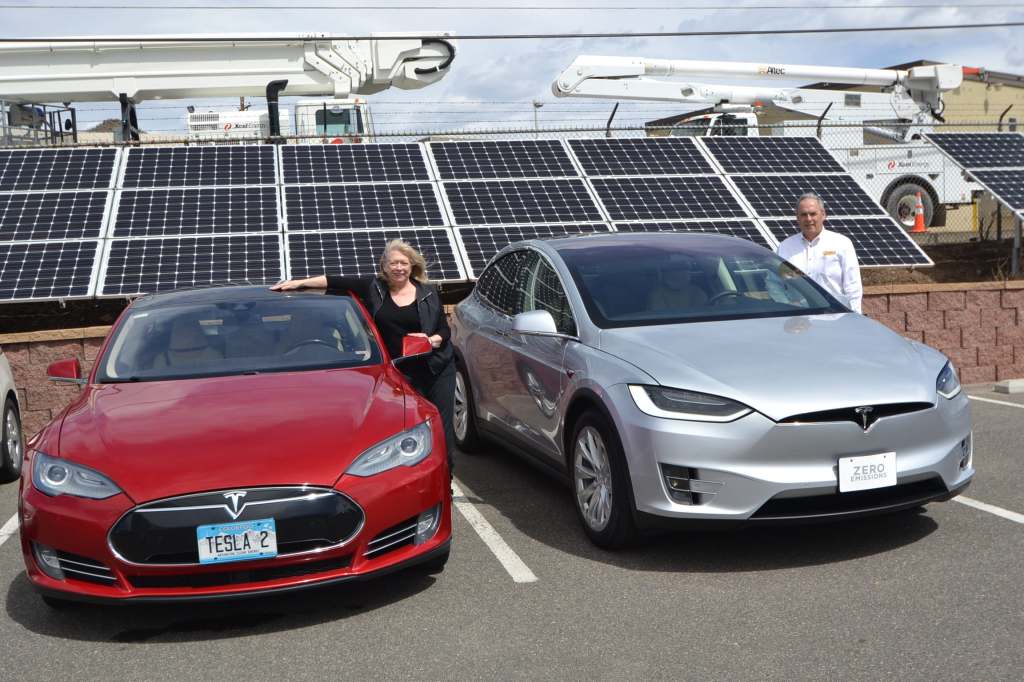
With electric cars such as Rita’s and my Teslas, the math changes rather dramatically. Except for collision damage (which is less likely because of the cars’ advanced driver assistance features), it’s hard to imagine a repair that would not be worth making.

The typical car with an internal combustion engine is often totaled because a new engine or transmission, like many other drive-train related repairs, can easily cost more than the resale value of the car. Not so with an all-electric car such as our Teslas.

Only 3% of the metal in a Tesla is steel — the body and frame are aluminum — so rust is not an issue.  The two electric motors, which are not prone to failure anyway, could be replaced in 15 minutes. There is no transmission, timing belt, fuel pump, exhaust system, etc. In fact there are reportedly fewer than 50 moving parts in the entire car. 

The battery, which barely degrades at all, can also be replaced in minutes, not hours, and, like the two motors, is warranted for eight years, unlimited miles. For me that equates to a 250,000-mile drive-train warranty. If, say, the battery needs replacing 10 years from now, the cost will probably be $5,000 or less by then — well worth the expense.

As you probably know, the operating system of the car is regularly updated by Tesla “over the air” for free. Our two cars have many features and functions that they didn’t have when they were built years ago and will have even more features in 2047, when I turn 100.

So, whereas one can speculate on the useful life of a traditional gas-powered car with a steel body, you really can’t speculate on the life expectancy of an all-electric car.

If you buy a Tesla, you may want to put it in your will, because it may outlive you.

Would you like to learn more about electric cars? On Sat., Sept. 14, from 10 am to 3pm, we’re hosting an EV round-up in our 17695 South Golden Road parking lot. Get more info at www.DriveElectricWeek.info

New Report Reveals the True Cost of Selling Your Home to an ‘iBuyer’

Perhaps you’ve heard about the new concept in home selling called iBuyers. Open Door, Zillow Offers and OfferPad are offering this way of selling your home. Basically, these firms use their own cash to buy your home and then re-sell it for a profit.

If you’re a seller who needs to sell quickly and you’re not worried about getting top dollar (or paying less in fees), the iBuyer model is an option that may not otherwise be available to you. You avoid the uncertainty of not knowing how long your home will sit on the market — or whether it will sell at all.

A company called Collateral Analytics has published a study of 4,000 iBuyer transactions in Phoenix which outlines the costs to sellers and the earnings vs. risks for these iBuyer companies. The report’s title is “iBuyers: A new choice for home sellers, but at what cost?”  It was released two weeks ago. To read the full report, click on this link.

   The last paragraph in the report is a good summary of their findings: “These preliminary empirical results suggest that sellers are paying not just the difference in fees of 2% to 5% more than with traditional agencies, and a generous repair allowance, but another 3% to 5% or more to compensate the iBuyer for liquidity risks and carrying costs. In all, the typical cost to a seller appears to be in the range of 13% to 15% depending on the iBuyer vendor. For some sellers, needing to move or requiring quick extraction of equity, this is certainly worthwhile, but what percentage of the market will want this service remains to be seen.”

In May I got a call from a couple which was under contract with OpenDoor for $548,500, but with a 7% “service charge” and $38,563 for “repairs found in assessment.” This way of doing business annoyed them enough that they terminated with OpenDoor and listed with me at $498,000, selling for $507,000, which netted them more.

Above is one of 3 charts in  the report. The analysis is from Phoenix, where OpenDoor began buying homes in 2016, because they didn’t come to Denver until 2018.

I’ve written in the past about companies which will buy your home “as is” for cash without putting it on the MLS. Then they flip the property to a new buyer for a profit — profit that you gave up  by doing business with them. The same is also true with iBuyers.

Bottom line: Unless money is no object for you, you’ll do better listing your home with a full-service traditional brokerage like Golden Real Estate. Call any of us at the phone numbers below!

Just Listed: Rare Patio Home Near the Arvada Center

This 2-bedroom patio home at 8242 W. 67th Drive is in the Meadow Ridge patio home community just a few blocks west and one block south of the Arvada Center for the Arts & Humanities. It was just listed for $595,000. There are only 41 patio homes in the community, which was built by Designer Homes LLC, which has a 99 score from BuildZoom. And this is a fabulous home with high-end finishes. Every light fixture, for example, is a work of art, not the typical tract home builder light fixture. Be sure to look for them! Even the garage is beautifully painted and super clean! If you’re like me, you’ll also appreciate the full unfinished basement. Overall, I was super impressed, and I know you will be, too! True patio homes like this with zero outside maintenance are hard to find these days. View my narrated video tour at www.ArvadaHome.info, then come to the open house on Saturday, August 24th, 11am to 2pm or call Jim Smith at 303-525-1851 for a private showing.