DMAR Reports Average Home Price Rose by $100K in Last 12 Months

The Denver Metro Real Estate Market Trends Report, released on February 3rd by the Denver Metro Association of Realtors, reveals that detached single-family homes in the metro area set yet another record for average price, exceeding $629,000 in January. Attached single family homes (condos & townhomes) rose by less than half that amount, as shown in the above chart. Download the full report here.

What Defines a Bedroom? Neither the Real Estate Commission nor MLS Will Say

As a broker, I get to decide what constitutes a bedroom. We get no guidance or rules about that from either our MLS (REcolorado) or from the Colorado Real Estate Commission.

This week’s featured listing is a good example. When my seller purchased the condo in April 2017, it was advertised as a 2-bedroom unit, which is what the county assessor calls it. But that “second bedroom” has no window and no closet, measures only 9’ by 10’, and has double glass French doors between it and the kitchen area.

I could not in good conscience market that condo as anything other than a one-bedroom unit with a study.

I could “get away with” marketing the study as a “non-conforming” bedroom, but there are no definitions for that term, either. The term “non-conforming” is most often used for basement bedrooms which don’t have egress windows, although I’ve only used it when, for example, there was no bathroom on the same level or no door giving the room privacy.

On the other hand, I have seen basements listed as having a bedroom when the only door to that bedroom was the door at the top of the stairs. The most outlandish example I can recall was when an open loft overlooking the living room was listed as a bedroom, perhaps because there was a closet — but the nearest bathroom was downstairs. 

I don’t sense any interest on the part of the MLS (on whose Rules & Regulations Committee I have sat for over a decade) or the Colorado Real Estate Commission (to which I’ve applied for appointment) to come up with a definition of “bedroom.” As with other terms such as “raised ranch” or “garden level,” it’s left to the managing brokers (like me) or the listing agents themselves to decide how to describe the homes they market, and it’s up to buyers to make their own decisions to buy a home, irrespective of how it has been described on the MLS.

So, for what it’s worth, here’s my definition of a bedroom: It must have walls (no open lofts!), a window to the outdoors, its own door to common space, a 3/4 or full bathroom on the same level, and, optionally, a closet. The window does not have to qualify as an egress window. The closet is optional only if the room is big enough to allow for a piece of furniture (a wardrobe or armoire) that can serve as a closet. It has to be big enough to support a bed and dresser without being crowded (at least 9’ by 12’ or about 100 square feet).

It’s a judgment call as to whether a room without all those criteria should be called a “non-conforming” bedroom. I do take stock of whether the county assessor calls it a bedroom, but, as I said, the assessor called the study in my condo listing a bedroom, probably because the builder called it that on their plans. (Builders, like brokers, have their own ways of seeing things, and no one is there to contradict them.)

Buyers ask to see a listing based on its description in the MLS, and I’ve had a buyer get really annoyed when we went to see a 3-bedroom home (which was their minimum requirement) only to discover it was a 2-bedroom home. I shared that buyer’s annoyance in the feedback I provided, but that listing continued to claim three bedrooms.

Some brokerages contribute to the problem of inaccurate property descriptions by not allowing broker associates to enter and manage the MLS data for their own listings. That’s not how Golden Real Estate operates. As managing broker, I want my broker associates to enter their own listings on the MLS, and I usually will look at those listings and give my feedback or make changes directly on the MLS, which I’m able to do as their managing broker.

We have an office policy of providing maximum (not just accurate) information on each listing. That means entering data in all applicable MLS fields and not just  the mandatory ones. Many optional fields are quite important, not just useful, to buyers. These include each room’s dimensions and a general description of each room. A quick check of 71 current listings in Lakewood showed that only 13 of them included room dimensions and descriptions. A couple of them only listed bedrooms and bathrooms, not living rooms, kitchens, and other rooms. That’s because you can no longer just indicate the number of bedrooms and bathrooms, you must list each of them and the floor they are on, but you don’t need to enter dimensions or descriptions.

To me, describing the rooms is just as important as the “public remarks,” which is that one paragraph which you read on all the consumer websites to which each listing is populated (Zillow, Redfin, etc.). In describing each room, we like to list the floor covering (hardwood, tile, etc.) plus things like the view out the window, coved ceiling, ceiling fan, walk-in closet(s), access to deck or patio, fireplace (gas or wood), en suite bathroom, wainscoting, and more.  Sellers deserve no less.

Room dimensions and descriptions help to sell a home, so we owe it to our sellers to take advantage of that opportunity. It’s a shame that the majority of listing agents leave these non-mandatory fields blank.

Reader Comment on Last Week’s Article About Racism & Zoning

    Your article was very interesting and timely as we must be reminded of our country’s systemic racist policies that contribute to the discord we experience today. I have a couple of other examples. 

    First, the FHA was the driver for much of the single family homes constructed in suburbia during the ’50s and ’60s.  Its underwriting policies in the early days, mandated that “the neighborhood be homogeneous (seg-regated), with that homogeneity preferably assured through racist restrictive covenants, for which the FHA helpfully supplied forms,” according to Michael Carliner, Development of Federal Homeownership Policy, as quoted on page 96 of Concrete Economics by Cohen and DeLong in 2016 . 

    In addition, I’ve read, but cannot remember the source, that the VA lending policies were similar. As a consequence, black GIs returning home, could only get loans for properties located in black communities (inner city residences) and thus were not able to build up the equity in their homes like the white GIs who were able to buy new homes on the large lots in suburbia.

     This “homogenous neighborhood” requirement in federal lending practices prevented the mixing of the races in modern America, contributing to the racial divide we experience to this day.                          —Michael Nosler

Real Estate Magazine Names Jim Smith a Real Estate “Influencer”

RISMedia, the national real estate news service which publishes Real Estate magazine, has named Golden Real Estate broker/owner Jim Smith as a 2021 “Real Estate Newsmaker” in the category of “Influencer.” It’s in recognition of him publishing this real estate column in multiple newspapers for nearly two decades. Click here to view the RISMedia web page.

“I’m honored to receive this recognition for my work seeking to educate both the general public and my colleagues about important news and developments in this industry which has been so good to me over the past 19 years,” Smith said.

We Can All Learn From Studying Racism’s Role in the Evolution of Local Zoning

No one can deny that racism has played a role in housing, as it has in virtually every aspect of society since the founding of our country. Like me, however, I bet you’ll learn some things you didn’t know from this study of racism in zoning written by my friend, Don Cameron. While this study is of the City of Golden, it would be fair to say that it reflects the evolution of zoning throughout the country. Click here for Don’s full report with artwork, photos and footnotes.

A History of Golden Zoning

Golden Colorado circa 2020 has zoning that is best described as Euclidean, named after a court case in Euclid, Ohio. Euclidean zoning prescribes various areas in town to have various uses by right, and other uses that can be obtained by special permit.

Prior to that court case in Ohio, it was not clear that the government had a role in regulating land use, and individual landowners could pretty much do what they wanted. But in 1922 the Supreme Court ruled that municipalities had the right to regulate land use.

Golden’s history of zoning was initially one of mutual agreement between the town’s settlers and the city in laying out streets, creating easements for streets and utilities, but generally leaving land development to the individual owners. This sort of planning resulted in building on some lots that don’t meet current lot minimums, a variety of housing types and a mix of commercial and residential uses in some areas.

From 1954 onward, though, this mix of uses did not fit neatly into the districts that were created. Because of the mix of use types that already existed, some areas were zoned as commercial even though they had a large proportion of housing that was built as single family homes.

Other areas were zoned for higher density in anticipation of growth that in some cases still has not come. Later developments were zoned planned use development (PUD), with uses identified that were specified on the plats and may have included mixed use.

In parallel to this history there were also restrictive housing policies that were in place in Jefferson County, including Golden. Specifically, redlining was a practice put in place at the federal level by the Home Owners Loan Corporation in 1938.

Redlining defined areas where federally backed loans could  and could not be obtained. Golden itself had no redlining map, but let’s look at Golden’s history.

From the 1880s and into the 1920s property owners could pretty much do what they wanted. There were no explicit covenants preventing Blacks or non-Caucasians from buying or building in Golden. However, the 1920s also saw our government filled with KKK members and sympathizers and a reduction in Black (Negro at the time) residents in Jefferson County.

While Blacks in the county and city were few in number in the 1920s, nonetheless the KKK burned crosses on South Table Mountain’s Castle Rock formation above where Coors’ tourist parking lot is now.

There was a measurable racist element in the population, and there was not a welcoming environment. The plats were already written, and the residential land use defined, so there was little “need” to be racist in zoning because there was no demand (that is, few black people lived in Golden).

This “lack of need for racist/exclusionary zoning” changed, however, in the late 1930s amid the boom leading up to World War II.

Again, land use at the time was mostly protecting individual property rights. While the Supreme Court had ruled that cities could control land use, there was a very hands-off approach to this. So the “law” was on the side of homeowners.

Starting in the 1920s and into the 1940s it was common for people in many areas of Jefferson County to say they’d only sell their property to those of the Caucasian or other non-Negro races.

The courts backed up this right because they were protecting homeowners’ use of their land and had no civic duty to prevent this discrimination. Blacks were excluded from being shown properties in these restrictive areas, and. if they tried to purchase them, they might have it taken away soon after.

In 1942 there was the case of a Black family trying to build a new development and victory garden near what is now Boyd Street. The family said they would put in all the utilities required to government code. Still, white citizens of Golden protested. The following article appeared in the October 22, 1942, edition of the Golden Transcript:

Citizens Protest to City Council

    A large number of citizens appeared before the city council Wednesday evening, and stated that a group of colored people had taken possession of the land recently purchased by them east of the Clark’s Garden addition, within the city limits of Golden, and were apparently staking out some proposed building sites. These citizens protested to the city council the starting of a colored settlement in Golden.

It was pointed out in the meeting that the sale of the property had been approved by the county court on September 24, and that the purchase price for the 30-acre craft was $1,500, not including some legal and abstract of title cost…

The article went on to say that at the mayor’s direction, a citizen’s committee was formed to negotiate with the FHA to not allow this sale to go through and not fund it, claiming the cost of extending utilities would be burdensome. One of the citizens appointed to this committee was Casper Bussert.

Golden had few areas that were not platted, but when a new plat was put in for the Sunshine Park Addition in 1944, by this same Casper Bussert, he added a deed restriction limiting ownership to Caucasians.

While this would seem to violate the 14th Amendment, the Supreme Court had already ruled that the 14th Amendment was about states not discriminating based on race, but was silent on individuals’ ability to discriminate. However, in the late 1940s the NAACP and others started pushing back on these covenants using the following argument: If a black person were to buy a restricted property and then the state were to enforce the covenant, that would constitute a violation of the 14th Amendment, which eliminated slavery and gave Blacks the right to buy and own property.

In 1948 the Supreme Court ruled that these types of covenants were no longer enforceable. Almost immediately, and certainly by 1950 one sees a complete change to the covenants created in Golden and surrounding areas. Rather than explicitly restricting an area to whites, there were new restrictions excluding those without access to capital. Enter classism.

Even though redlining was no longer permitted, there were (and are) limits on Blacks’ ability to get loans on favorable terms. Some loans, for example, were interest only for the term of the loan, so one did not gain any equity until the loan term ended. Failure to make even one payment could result in “owners” losing their homes with no equity.

When new restrictions were put in place by the FHA, they targeted people without access to loans. An additional clause that targeted families with kids was the Nuisance Clause, which limited activities based on the opinion of the architectural control committee.

R1 (single-family) zoning, as laid out in the city code, shows a direct evolution from racist covenants to restrictive covenants to exclusionary zoning, all of which kept housing out of the hands of Blacks.

The legacy of this is the noticeable and persistent wealth gap in this country. Blacks, by being excluded from homeownership, have not been able to build wealth, escape blighted areas, or enjoy integrated schools. Because school funding is typically based on property taxes, school districts are  self-segregated by wealth and thereby race.

In summary, Golden’s history follows the narrative of the country with respect to race. Land planning and zoning may be silent on race, but the effect of both planning and zoning continues to exhibit, in its end result, the heritage of systemic racism, to the detriment of Blacks in particular.

Email response received from Michael Nosler:

Jim, as always, your article was very interesting and timely as we must be reminded of our country’s  systemic racist policies that contribute to the discord we experience today.  I have a couple of other examples.  First, the FHA was the driver for much of the single family homes constructed in suburbia during the 50s and 60s.  It’s underwriting policies in the early days, mandated that “the neighborhood be homogeneous (segregated), with that homogeneity preferably assured through racist restrictive covenants, for which the FHA helpfully supplied forms.” Michael Carliner, Development of Federal Homeownership Policy, Housing Policy Debate9,no.2(1998)at 299-321.  As quoted in Concrete Economics by Cohen and DeLong 2016 at p.96.  In addition, I’ve read, but cannot remember the source, that the VA lending policies were similar.  As a consequence, black GIs returning home, could only get loans for properties located in black communities(inner city residences) and thus were not able to build up the equity in their homes like the white GIs who were able to buy new homes on the large lots in suburbia.

This “homogenous neighborhood” requirement in federal lending practices prevented the mixing of the races in modern  America, contributing to the racial divide we experience to this day.

The Pros and Cons of Buying in a Community With a Homeowners Association

Like every real estate agent, I have encountered buyers who don’t want to buy in a neighborhood with an HOA. I have set up more than one MLS alert for buyers with “No HOA” as one of their search criteria.

There are many good reasons to avoid an HOA, just as there are reasons to want an HOA. Among the negatives, an HOA costs money, al-though those dues do cover some expenses you would otherwise have to pay for on your own, such as trash collection. In a patio home community, dues could cover snow removal up to your front door and garage, grounds maintenance, a community pool, fitness center, and even water and sewer.  Unless the community is self-managed, your dues also pay for a management company.

The more common negatives we hear concern personal liberty. You can’t change your home’s exterior, including paint color or adding a new deck, without approval by the HOA. You probably can’t store your RV on the street or on your lot. And there’s always that one neighbor who is a self-appointed enforcer of the covenants and rules. I was turned in once by one who saw my lawn person passing through the adjoining common space to reach my backyard.

According to the Community Associations Institute (CAI), the number of HOAs in the United States has increased from just 10,000 in 1970 to more than 320,000 today. If you buy a home in a subdivision developed in the last 30 years, you most likely will be buying in a neighborhood with an HOA. So, what are the arguments in favor of an HOA?

A common refrain in support of HOAs is that they protect property values for their members. Without an HOA to enforce its rules, a neighbor could paint his home dayglo yellow or litter his yard, visible to you, with old furniture and cars on blocks. He could allow the paint to peel and not replace his obviously hail damaged roof and let the exterior of his home go into disrepair. These are just a few examples of how one homeowner can affect a neighborhood’s property values. Imagine putting your beautifully updated home on the market if the above description applied to your neighbor’s house.

People in non-HOA communities can tell “bad neighbor” stories to rival any HOA horror story.

Back in the 1970s it was common for subdivisions to be built with covenants that applied to every home in that subdivision, but no HOA was created to enforce those covenants. If a neighbor violated a covenant, one’s only recourse was to sue that neighbor in civil court — an unlikely scenario. Some non-HOA neighborhoods have created neighborhood associations with voluntary dues (for example, $30 per year), which cover the cost of community picnics, newsletters, etc. I listed a home in one such non-HOA subdivision, Columbine Knolls South in south Jeffco, which is quite aggressive in enforcing a covenant that restricts the type of roof a homeowner can install.

Starting around the 1990s, subdivision developers created HOAs which they controlled until a certain percentage of homes were sold, at which point they would turn over control to a board elected by the residents. Unless it was a really small subdivision, this board would then hire a management company to handle the hiring of vendors (such as trash haulers or grounds keepers) and enforcing covenants, as well as rules and regulations promulgated by the board of directors at their monthly meetings or by the homeowners at their annual meeting.

Done right, HOAs can be an efficient means of providing services, assigning payment responsibility and being responsive to members’ concerns. Such factors have driven the continued growth of association-governed communities, including HOAs, condominium associations, and other “common interest communities.”

HOAs can fund a diverse variety of services and amenities, from golf courses to equestrian facilities and fitness centers. Few Americans could afford such benefits without the shared responsibility made possible with an HOA. According to CAI, “People who don’t want to contend with gutters and yard work can purchase homes in communities where these responsibilities are taken on by the associations. There are age-restricted communities, pet-free and pet-friendly communities, even communities with air strips. Community associations give people options, alternatives, facilities and resources they could not otherwise enjoy.”

CAI states that more than 62 million Americans live in neighborhoods with an HOA and “take advantage of association-sponsored activities like holiday events, social clubs, athletic and fitness activities, pool parties and more. These activities help residents get to know their neighbors and forge new, supportive friendships.”

Because it’s not a popular assignment (and is unpaid), you can probably get elected to your HOA board and have a say in its governance.  I did that myself but resigned after a couple years. You may be more suited to that experience.

I totally respect those who want to avoid HOAs for one reason or another. Rita and I have experienced both ways of life and, while we don’t value one over the other, we appreciate why others may have a strong feeling for or against living in an HOA-governed neighborhood.

If you are not outright opposed to an HOA but do have concerns, just know that when you go under contract with a home in an HOA, the seller must provide financial and other documents as well as bylaws and minutes of recent HOA meetings, and you can terminate if you don’t like what you read.

Consider Installing a Heat Pump Water Heater

If you’re attuned to the issue of sustainability, you may already know that heat pump water heaters are a smart replacement for gas water heaters and a great way to reduce your “carbon footprint.”

Combine it with replacing your gas furnace with a heat pump mini-split system and your gas range with an electric induction cooktop, and you could disconnect your gas meter and go all-electric. Then trade in your gas-powered car for an electric car and put enough solar panels on your home to power it all, and you’re on your way to eliminating the use of fossil fuels altogether — provided you’re willing to live without your gas fireplace!

Heat pumps don’t create heat, they move heat, which is why they are more efficient than gas or resistance heating. Toasters and electric space heaters are examples of resistance heating. Rather than heating water directly, a heat pump water heater moves heat out of the room into the water tank. For synergy, put it in the same room as a freezer, which is doing the opposite — moving heat into the room. Or build a wine cellar around your water heater for free cooling of your wine!

I purchased my Rheem  unit for under $1,300 (on sale at Home Depot) and earned a $400 rebate from Xcel Energy plus a $300 federal tax credit.  

Could Accessory Dwelling Units Be a Solution, Albeit Small, to Housing Shortage?

An increasing number of jurisdictions, including Denver, Englewood, Boulder, Golden and Arvada, are allowing the construction of a second dwelling unit for homes zoned for single-family. The common term for them is “Accessory Dwelling Unit” or ADU. Golden, unlike the other cities, allows an ADU on properties zoned for either one or two dwelling units.

The ordinances that allow such units include rules that distinguish a home with an ADU from, say, a duplex. For example, they cannot have their owned legal description and can’t have separate water and sewer connections.

Sixty-two ADUs have been approved under Golden’s 2009 ADU ordinance. Denver has permitted 263 ADUs just since Jan. 1, 2016.

Arvada had Jefferson County’s first ADU ordinance, enacted in 2007. Its key points were:

> The property owner must live on site, in either the main house or in the ADU.

> The ADU is limited to 800 SF, or 40% of main home’s size. Minimum size is 200 SF.

> No more than 1 bedroom is allowed.

> No more than two persons may live in a unit up to 600 SF, or three persons in a unit between 600 and 800 SF.

> One on-site parking space is required.

> The ADU’s design must be consistent with that of the principal unit, and the entrance, if visible from the street, must be clearly subordinate to the primary home’s entrance.

These are only some of the requirements with which a homeowner must comply when adding an ADU to his or her property.

The cities differ in some of their requirements. For example, Arvada forbids a home business in an accessory dwelling unit, but Golden’s code does not reference that usage.

ADUs can be within the primary structure (such as a walk-out basement) or in a separate structure, either above a detached garage or as a standalone structure. 

There are many uses for ADUs. One use is to create a rental unit, helping homeowners with their ownership costs. Another is to provide a “mother-in-law” unit that provides an elderly family member with independent living but in close proximity to family. Conversely, an elderly homeowner might use an ADU to provide living quarters for a caregiver who needs to be close by. Ditto for a family which has hired a nanny for their young children.

In Golden, each ADU requires an allocation under Golden’s 1% growth limitation. Only Boulder, among the other cities that allow ADUs, has such an ordinance.

California, with its high housing costs, appears to be the national leader in the adoption of ADUs. Here’s some useful information from an article I found online from the New York and Michigan Solutions Journalism Collaborative:

Parts of California have welcomed ADUs for decades while others operated under much stricter rules. This created a complex patchwork of local regulations that was difficult for residents and builders to navigate. The new laws relaxed regulations around setback requirements, minimum lot sizes and other elements that previously made building ADUs difficult in some areas.

Legislative changes at the state and local levels appear to have opened the floodgates for ADU permits in parts of California, including San Jose, where ADU permits issued per year went from 192 in 2018 to 416 in 2019, according to www.BuildinganADU.com.

In Redwood City, a smaller city in the Bay Area, ADU permit issuance doubled during the same period.

The idea appears to be popular among older homeowners: 84 percent of people 50 and older would construct an ADU in order to provide a home for a loved one in need of care, and according to a 2018 study on ADUs by AARP.

The federal government backed the idea of accessory dwellings in the 1990s, with a Task Force on Regulatory Barriers to Affordable Housing recommending removing restrictions on accessory apartments to enable elders to age in place, according to 2008 research in the Journal of Aging and Policy.

Data on the effectiveness of ADUs for caregiving families is scarce, beyond anecdotal evidence and numbers illuminating their popularity in cities where they’re legal and encouraged.

California’s openness to ADUs is part of the state’s strategy to tackle its crushing housing market, which with runaway prices and low housing stock threatens to shut out residents who’ve been living in Bay Area cities like San Francisco or San Jose for decades.

I have become familiar with a local company, Verdant Living, that specializes in the construction of ADUs, or “backyard bungalows.”  Their website is www.VerdantLiving.us. Owner John Phillips pointed me toward another useful website, www.AccessoryDwellings.org.

Denver Real Estate Market Ends 2020 with a Record-Breaking December

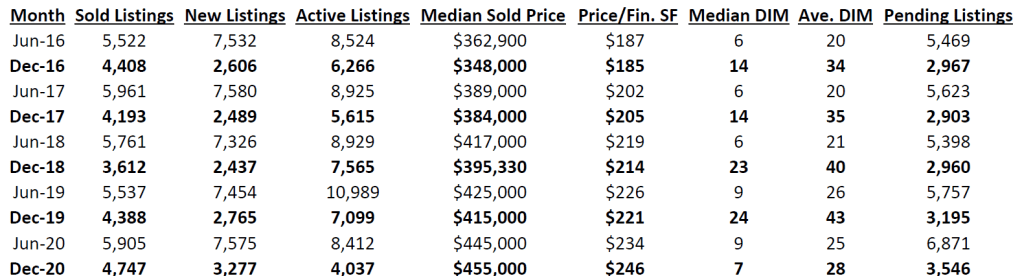
The chart below is a compilation of various market indicators for the Denver metro area, which I am defining as a 25-mile radius of the State Capitol. There are some surprising differences this December from previous Decembers to be discerned from looking at that chart. I have included June figures but put the December stats in bold type to make it easier to compare summer vs. winter statistics over the last five years.

Source: REcolorado

Historically, one would expect to see more sold listings, new listings and active listings in June than in December, and that trend held true in 2020, but the numbers for this December broke some new ground.

The number of sold listings and new listings were at record highs for a December, leaving the number of active listings at a record low. There has been lots of talk about how low our active inventory is, but, as I’ve written before, that’s not for lack of new listings but rather how quickly buyers are snapping up new listings.

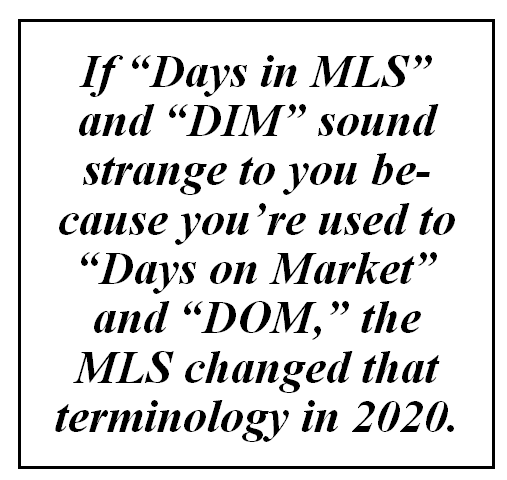
The strength of this sellers’ market becomes more evident when you look at the other columns. In past years, the median sold price in December was substantially lower than it was in June, but the opposite was true this year, rising to a record $455,000. Correspondingly, the average price per finished square foot surged above June’s number to a record $246, and the median days in the MLS (“DIM”) plunged from last December’s 24 to just 7 days this December — even lower than the DIM for June 2020. The average DIM of 28 is more typical of summer months than winter, reflecting the fact that even homes that had been languishing on the market (because they were overpriced) were selling at a faster clip last month. Indeed 22% of the listings sold were on the MLS for over 30 days. Of those, 5.8% were active over 90 days, and 3.4% were active for more than 120 days. Those older listings are responsible for raising the average DIM.

Because of the well-publicized migration away from densely populated areas because of Covid-19, I was curious to learn whether single-family detached homes represented a higher percentage of the closings this December, compared to December 2019, but in fact the percentage dropped a little this year — 66.7% this year vs. 69.5% last year. The same was true in June, when the pandemic was already raging and we believed that people were fleeing condos for detached single-family homes. This is counterintuitive, and I can offer no theory to explain it, but I have more to say about this topic below.

Another measure of the strength of the current sellers’ market is how many homes sold above their asking prices. With December 2019’s days in MLS number so high (24), one hardly needs to ask, but here are the numbers. This December, 16.6% of the listings sold for their full listing price, and 42.2% sold above their listing price. Last year, those numbers were dramatically lower. While 15.8% sold for their full listing price, only 15.9% of listings sold above their listing price in December 2019.

So, what’s the prognosis for 2021?  January is positioned to have a record number of closings, considering that there are a record number of pending transactions left over from December, as shown in the chart. With mortgage interest rates projected to remain at record lows — currently at or below 3% — there is a strong incentive for buyers to keep buying. Another factor favoring buyers is the movement of service sector jobs towards working from home.

To measure that trend, I compared the December-over-December sales in Downtown Denver, part of Capitol Hill and the Golden Triangle (specifically, a 1.2-mile radius from 20th & Arapahoe Streets in downtown Denver) and found there were 63 sales in December 2019 compared to 77 sales in December 2020. Meanwhile, there were 272 active listings in December 2019, but that surged to 444 active listings in December 2020.  It’s a buyer’s market there.

In that same area, the days in MLS dropped from 43 days last December to 32 days this December (way higher than the 24 days vs. 7 days for the 25-mile radius in the above chart), but the median sold price plunged from $535,000 in December 2019 to $480,000 in December 2020. Compare that to the $40,000 increase in median sold price with the larger metro area, as shown in the above chart.

So, yes, it is still harder to sell a home in the densely populated central Denver area, and there is definitely an out-migration taking shape, but it’s still too early to call it an exodus.

Note: All these statistics were compiled from REcolorado, Denver’s MLS, excluding listings from other MLSs which are displayed on REcolorado.com. Often those listings from other MLSs are merely duplicates of REcolorado’s own listings, so I excluded them.

National Association of Realtors Promotes “Pathways to Professionalism”

As you are probably aware, members of the National Association of Realtors (NAR) are sworn to abide by the Realtor Code of Ethics. It’s what separates them from the men and women who are licensed to practice real estate but choose not to pay roughly $500 in annual dues to be a member of the local, state and national Realtor associations.

Golden Real Estate requires all its broker associates to join the local Realtor association, which automatically enrolls them in the Colorado Association of Realtors and NAR. Most of us are members of the Denver Metro Association of Realtors, although agents have the choice of which local Realtor association to join.

In addition to the Code of Ethics is the voluntary and lesser known Pathways to Professionalism. It is a collection of recommended courtesies which all Realtors should embrace, as we certainly do at Golden Real Estate. Here are those courtesies, broken down into three categories. It should be noted that failure to practice these courtesies cannot form the basis of a complaint by fellow Realtors or members of the public. Here they are, highlighting ones I particularly like:

Respect for the Public

1) Follow the “Golden Rule”: Do unto other as you would have them do unto you.

2) Respond promptly to inquiries and requests for information.

3) Schedule appointments and showings as far in advance as possible.

4) Call if you are delayed or must cancel an appointment or showing.

5) If a prospective buyer decides not to view an occupied home, promptly explain the situation to the listing broker or the occupant.

6) Communicate with all parties in a timely fashion.

7) When entering a property ensure that unexpected situations, such as pets, are handled appropriately.

8) Leave your business card if not prohibited by local rules.

9) Never criticize property in the presence of the occupant.

10) Inform occupants that you are leaving after showings.

11) When showing an occupied home, always ring the doorbell or knock—and announce yourself loudly before entering. Knock and announce yourself loudly before entering any closed room.

12) Present a professional appearance at all times; dress appropriately and drive a clean car.

13) If occupants are home during showings, ask their permission before using the telephone or bathroom.

14) Encourage the clients of other brokers to direct questions to their agent or representative.

15) Communicate clearly; don’t use jargon or slang that may not be readily understood.

16) Be aware of and respect cultural differences.

17) Show courtesy and respect to everyone.

18) Be aware of—and meet—all deadlines.

19) Promise only what you can deliver — and keep your promises.

20) Identify your REALTOR® and your professional status in contacts with the public.

21) Do not tell people what you think — tell them what you know.

Respect for Property

1) Be responsible for everyone you allow to enter a listed property.

2) Never allow buyers to enter a listed property unaccompanied.

3) When showing a property, keep all members of the group together.

4) Never allow unaccompanied access to a property without permission.

5) Enter a property only with permission even if you have a lockbox key or combination.

6) When the occupant is absent, leave the property as you found it (lights, heating, cooling, drapes, etc.) If you think something is amiss (e.g., vandalism), contact the listing broker immediately.

7) Be considerate of the seller’s property. Do not allow anyone to eat, drink, smoke, dispose of trash, use bathing or sleeping facilities, or bring pets. Leave the house as you found it unless instructed otherwise.

8) Use sidewalks; if weather is bad, take off shoes and boots inside property.

9) Respect sellers’ instructions about photographing or videographing their properties’ interiors or exteriors.

Respect for Peers

1) Identify your REALTOR® and professional status in all contacts with other REALTORS®.

2) Respond to other agents’ calls, faxes, and emails promptly and courteously.

3) Be aware that large electronic files with attachments or lengthy faxes may be a burden on recipients.

4) Notify the listing broker if there appears to be inaccurate information on the listing.

5) Share important information about a property, including the presence of pets, security systems, and whether sellers will be present during the showing.

6) Show courtesy, trust, and respect to other real estate professionals.

7) Avoid the inappropriate use of endearments or other denigrating language.

8) Do not prospect at other REALTORS®’ open houses or similar events.

9) Return keys promptly.

10) Carefully replace keys in the lockbox after showings.

11) To be successful in the business, mutual respect is essential.

12) Real estate is a reputation business. What you do today may affect your reputation — and business — for years to come.