Geothermal Energy, the Big Sister of Geothermal Heating & Cooling, Is Coming Along

I have written often about geothermal heating and cooling. To remind you, by drilling either horizontally or vertically beneath your house or yard, you can use the 50-degree warmth of the earth, combined with a heat pump, to heat your home in the winter and cool it in the summer with minimal electrical energy to run a heat pump compressor.

The most common geothermal system involves several wells that are 300 feet deep, through which water or glycol is circulated to bring 50-degree liquid to a heat pump where it is heated to over 100 degrees in the winter or cooled to, say, 40 degree in the summer. Alternatively, you can install a horizontal loop over a wide area 10 feet below the surface and still get that 50-degree liquid for your heat pump to work with.

That’s called a “ground-source” heat pump system. More common (because it’s less expensive) is an “air-source” heat pump system, which warms or cools the outside air, extracting heat from outside air that can be as cold as zero degrees Fahrenheit. In the summer, the heat pump reverses its function and extracts heat from your indoor air, thereby cooling your home. The heating cycle requires more electrical energy for the air-source heat pump, especially when it’s really cold outside.

So geothermal is definitely the “gold standard” of household heating, but I’ve only seen it in a few homes because of its cost. I’ve visited homes in South Golden, Applewood and Centennial, plus single-family homes in the Geos Community in Arvada, that have geothermal heat pump systems.

Until I heard about ground-source heat pumps, the word “geothermal” brought to mind places like Iceland where volcanic rock is so close to the surface that you could heat your home without the additional input of a heat pump. (Cooling is another matter, of course.)

In Iceland, geothermal is used to create electricity from the steam created by that near-surface heat. I had assumed that running a power plant without such near-surface molten rock was impractical until I read an August 28th article in The New York Times which made me aware of progress being made using geothermal resources six miles or deeper underground to run power plants. The map below shows the temperature at 6.5 kilometers depth (~4 miles deep) in Centigrade, where 100º is the boiling point of water. According to the article , there is enough heat that deep to provide five times the total energy needs of our country — if it can be tapped.  (That’s reminiscent of the claim that one hour of mid-day summer sun produces as much energy as the country’s entire electrical demand — if it can be tapped.)
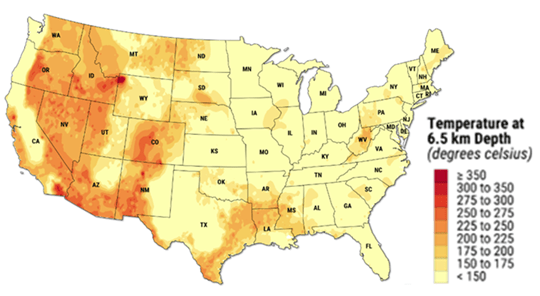
Here’s another view:
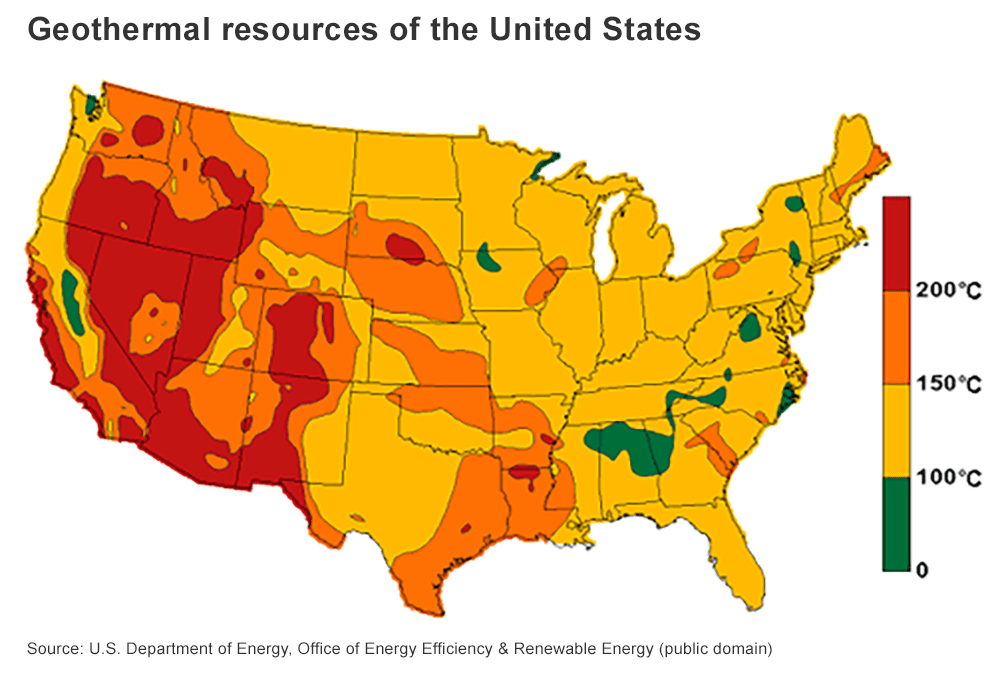
Ironically, the tech breakthroughs of the oil and gas industry, especially fracking, are making it more practical to tap that geothermal energy. As Brad Plumer of the Times writes in his article, “by using advanced drilling techniques developed by the oil and gas industry, some experts think it’s possible to tap that larger store of heat and create geothermal energy almost anywhere.”

The U.S. Department of Energy, under which Jeffco’s National Renewable Energy Laboratory (NREL) operates, has created a Geothermal Technologies Office to advance what it has trademarked as the Enhanced Geothermal Shot™.  (Here’s a link for their website. There’s a really effective minute-and-a-half video on that website explaining “Enhanced Geothermal Systems.”)

Plumer writes, “Dozens of geothermal companies have emerged with ideas. Fervo is using fracking techniques — similar to those used for oil and gas — to crack open dry, hot rock and inject water into the fractures, creating artificial geothermal reservoirs. Eavor, a Canadian start-up, is building large underground radiators with drilling methods pioneered in Alberta’s oil sands… The growing interest in geothermal is driven by the fact that the United States has gotten extraordinarily good at drilling since the 2000s. Innovations like horizontal drilling and magnetic sensing have pushed oil and gas production to record highs, much to the dismay of environmentalists. But these innovations can be adapted for geothermal, where drilling can make up half the cost of projects.”

What excites me about this effort is that because it utilizes the same drilling and fracking methodologies,  to reach the hot rocks, it’s a more attractive transition for the oil and gas workforce, compared to training the workers to service wind turbines or install solar panels.

Sixty percent of Fervo’s employees, according to Plumer’s article, came from oil and gas, and oil companies and drilling-service companies are investing in the startups which are pioneering geothermal energy drilling in Utah and elsewhere. “Devon Energy invested $10 million into Fervo, while BP and Chevron are backing Eavor. Nabors, a drilling-service provider, has invested in GA Drilling, Quaise and Sage. In Oklahoma, a consortium of oil and gas firms led by Baker Hughes recently launched an effort to explore converting abandoned wells into geothermal plants.”

The “roadmap” created by the Energy Department’s Geothermal Technologies Office breaks down as follows:

  • Predicting the Subsurface with Greater Precision 
  • Seeing the Subsurface with Greater Precision: New Sensing Technologies for Stress, Strain, & Fracture Mapping 
  • Accessing the Subsurface: Improving Drilling Efficiency and Drilling in Extreme Environs 
  • Designing and Building Wells 
  • Manipulating and Creating Durable Reservoirs: Controlling Fluid Flow and Developing Innovative Stimulation Methods 

I included that hard-to-read list only to reinforce what I said above, namely that this is the kind of work that’s a natural fit for the oil and gas industry. Instead of drilling for oil, they’re drilling for heat.

By the way, there are already 11 geothermal power plants operating along California’s Salton Sea.

Is Losing Your Gas Fireplace Keeping You From Making Your Home All-Electric?

There’s a growing movement, with good reasons, to eliminate natural gas from our homes. Think carbon monoxide poisoning. Or the bad health effects of inhaling methane. Or home explosions from gas leaks. Or how the use of natural gas (which is methane) contributes to greenhouse gas emissions, exacerbating climate change.

While it’s easy (and financially incentivized by state, federal and utility re-bates) to replace your gas furnace with a ducted or ductless heat pump system and your gas-fired water heater with a heat-pump water heater, many homeowners — myself included when I owned a single-family home — find it hard to accept giving up their gas fireplaces and gas grills.

Rita and I had to give up our gas grill when we moved into an apartment with balcony, but the George Foreman electric grill is a great replacement — and costs less to buy and operate. (You can also use it indoors!) But I didn’t know until recently that there are some fine alternatives if you are willing to give up your gas fireplace.

As an active Realtor, I have seen and listed many homes with electric fireplaces. One of my recently sold listings, which you can still view at www.GreenMountainHome.info, has an electric fireplace sitting on the hearth of the wood-burning fireplace in the basement. Fast forward to 3:45 in that listing’s video tour to see it. The seller explained that the wood-burning fireplace would always overheat the basement, but the electric fireplace can be controlled with a thermostat.

Temperature control is just one of the challenges with wood-burning and most gas fireplaces. I mentioned others in the first paragraph above, but cost of operation is another one.  Many people just want the ambiance of a burning fireplace, which you can get for pennies per hour from an electric fireplace, but most electric fireplaces also having heating modes, and if you want heat from it, the electric cost is still less than the cost of gas for an equivalent amount of heat generation.

Much of the heat generated by a gas (or wood) fireplace goes up the chimney, whereas electric fireplaces are unvented and therefore 100% efficient in that respect. No chimney also means no rodents or birds taking up residence in them.

 At www.ElephantEnergy.com you’ll find a web page devoted to electric fireplaces, from which I downloaded the two pictures below. On that page they describe seven different types of electric fireplaces, two of which —  an insert and wall-mounted — are shown here.

That web page addresses the following considerations: Lower costs; reduced carbon emissions; increased energy efficiency; improved safety; ambiance options; and model types.

In terms of costs, the web page claims a 30% savings over the cost of a gas fireplace.  The electric fireplace generates less heat at lower cost, but when it’s used to supplement, not replace, your central heating or for ambiance, that should be fine. If your home is solar-powered, it can be free. You can’t create gas!

Model types which offer ambiance and/or heating options are broken down as follows:

Pre-fab fireplaces can be either free-standing or wall-mounted and can be plugged into any 120 Volt outlet. They range from $400 to $4,000 depending on the features you want.

Custom fireplaces require unique installation and can range in price from $2,000 to $10,000.

Wall-mounted fireplaces resemble flat-screen televisions and can cost as little as $300.

Electric fireplace inserts allow you to make attractive use of your existing fireplace hearth and firebox.  According to the website, they range in price from $400 to $3,000.

Recessed electric fireplaces are nice if you’re willing to build out a wall to accommodate the unit’s depth, and can be quite attractive.  The design options are limited only by your imagination. Cost can range from $400 to $7,000 or more.

Built-in electric fireplaces are just a variation on the above, but typically include a hearth, mantel and surround. Intended for heating, not just ambiance, they can range from $3,000 to over $10,000. 

Water vapor electric fireplaces are my favorite.  No one will mistake them for a gas or wood-burning fireplace, but they “spark” elegance and style.  That’s the other example included above. They create 3-di-mensional “flames” through the use of water vapor and LED lights.  Heating is not an option.

Elephant Energy does not sell fireplaces (or other systems), but they link to ModernBlaze.com, which sells a wide variety of all the types of fireplaces listed above. They offer free shipping and returns and a 10% discount if you sign up for text messages.

If You Want an Actual Flame, Ethanol Is a ‘Green’ Option

Last week I shot a narrated video tour of an all-electric home that will be in October 7’s Metro Denver Green Homes Tour. It’s Michele Merritt’s Lakewood home, and she has two fireplaces that burn liquid ethanol.  (Fast forward to 2:33 in my video tour.)

Ethanol fireplaces are the easiest kind to install because they require no venting, construction or electrical outlet. You can build it into a wall, like a regular fireplace, but you can also have one as an indoor firepit (see picture below), since CO2 is the only fume. You pour the liquid ethanol (basically just alcohol) into the reservoir and light it. A one-liter bottle of ethanol will burn for several hours. ModernBlaze.com sells 6 bottles for $87 including shipping.  They sell a 24-inch ethanol burner for $1,895.

Here’s a link to the full writeup on ModernBlaze.com about ethanol fireplaces (from which I downloaded the above picture).

.

I Found a Great Website on Home Electrification – LoveElectric.org

Home electrification is all the rage, and www.LoveElectric.org is a one-stop shop for getting information about the rebates available from utilities, local governments and non-profits throughout Colorado designed to promote the abandonment of fossil fuels for heating and powering your home/business.

The website is an initiative of the Beneficial Electrification League of Colorado (BEL-CO), a coalition of stakeholders in Colorado committed to enhancing the market acceptance of electric appliances such as heat pumps, induction cooktops, etc. to replace fossil fuel-based appliances such as forced-air gas furnaces, gas boilers, gas fireplaces and gas ranges. Their website provides statewide information on rebates for the installation of such electric appliances.

Here’s a screenshot of their rebates web page, which is many times as long as shown here:

‘Solar Village & Electric Vehicle Show’ This Friday

Join the American Solar Energy Society for the Solar Village & Electric Vehicle Show on Friday, August 11th, 10am to 4pm, in front of CU Boulder’s University Memorial Center. There will be solar energy workshops, exhibits, EV shows, and activities for kids that are free and open to the publicAnyone interested in sustainable energy and energy efficiency is invited to visit this event, sponsored by the American Solar Energy Society, New Energy Colorado, and the Colorado Renewable Energy Society.

The Solar Village will offer a variety of educational displays and experts covering photovoltaic systems, heat pumps, passive solar design, super insulation, and other sustainable energy technologies and processes.

Also free and open to all is a Solar 101 Workshop from 11:45 to 1pm in an adjoining tent at which four experts in these topics will speak and answer questions. More information can be found at www.ases.org/conference.

Learn What It Takes to Make a Building Net Zero Energy

This Thursday, July 6th, from 5:30 to 7:30 pm, I’m hosting an open house at The Net Zero Store, 17695 S. Golden Road (our former office), where I’ll show visitors the steps we took to make that 1,318-sq.-ft. building net zero energy.

By installing heat pump mini-splits to heat and cool the building, and a tankless electric water heater, we had the gas meter removed, saving $50/month in connection charges. The building is now fully powered by the 20-kW solar array, no matter how much electricity is used both by the occupant and to charge up to three electric vehicles at once.

Refreshments will be served.

Survey of 2,500 UK Households With Heat Pump Heating Systems Showed 81% Satisfaction Level

Because of their higher fossil fuel costs, other countries are far ahead of the United States in the adoption of home electrification, including for heating. The United Kingdom is one of them, and The Guardian recently reported on a survey of 2,500 UK households that made that switch. I’m not aware of a similar survey here, where there may not be enough heat pump households to do a proper survey.

HVAC contractors here in America have been slow to offer or recommend the replacement of gas forced air and gas boiler heating systems with heat pumps, mostly because they are unfamiliar with them. When a homeowner needs to replace their current HVAC system, the vendor who has been servicing their system is most likely to recommend replacing it with a “newer, more efficient” model. So far, I have found only one company which installs and services both traditional gas-fueled heating systems and electric heat pump systems — always recommending the latter. That company, which I have mentioned previously, is Sensible Heating & Cooling, 720-876-7166.

Below are some key excerpts from The Guardian’s article. Click here for the full article.

The survey of more than 2,500 domestic heat pump owners and more than 1,000 domestic gas boiler owners in England, Scotland and Wales over the last winter is thought to be the largest investigation into how households have responded to date….

Households have been slow to take up government vouchers worth £5,000 to help cover the cost of replacing a gas boiler with a new heat pump. Slightly more than a third of the scheme’s grants were taken up in the last financial year.

However, the survey, which was undertaken by Eunomia Research and Consulting, found that 81% of households were     as satisfied or more satisfied with heat pumps compared with previous heating systems, including gas boilers, electric heating, or oil and LPG boilers….

On running costs, which is another key area of concern for households considering a heat pump, the survey found that two-thirds of heat pump owners and 59% of gas boiler owners were satisfied even without extensive energy efficiency upgrades….

“The government should now have the confidence to move forward quickly with its proposal   to.… streamline out-of-date planning rules to make it easier and cheaper for everyone to make the switch to cleaner, safer and more efficient heating with a heat pump,” [said Clem Cowton, director of external affairs for Octopus Energy, a local energy supplier.]

Governor Polis Signs into Law Massive Tax Credits for EVs and Home Electrification

A package of new climate-related legislation signed this year by Governor Polis is designed to make it more attractive for Colorado households to ditch fossil fuels.

Many of the discounts are designed to be combined with other incentives, but not all the savings will be available right away.

Here’s a guide to what’s coming and when:

Electric Vehicles: Right now, Colorado has 80,000 registered plug-in hybrids and battery EVs, a long way from the state’s goal of 940,000 EVs on the road by 2030. The new incentives are intended to speed up their adoption through a $5,000 tax credit on the purchase of a battery-electric or plug-in hybrid vehicle with a suggested purchase price of less than $80,000. For cars priced under $35,000, buyers can get an additional $2,500 credit. Any Colorado resident qualifies, beginning on July 1, 2023. After Jan. 1, 2025, the base rebate decreases until it’s phased out in 2029. 

E-bikes: Denver proved the power of e-bike rebates last year. The state is now hoping for similar success. The Colorado Energy Office plans to launch an e-bike rebate program for low- to moderate-income residents this summer but hasn’t detailed the size of the discounts. 

The plan for all Coloradans regardless of income is clearer. Under legislation signed into law this year, the state will offer a $450 discount on e-bikes starting on April 1, 2024 and continuing through 2032. The discount will be applied at the point of sale. 

Electric lawn equipment: Because gas-powered lawnmowers and other lawn equipment is a major source of ozone pollution, the state will institute a 30 percent discount on electric lawnmowers, leaf blowers, trimmers and snowblowers, applied at time of purchase, starting Jan. 1, 2024 and continuing through December 2026.

Heat pumps: Heat pumps for household space heating and water heating, powered by electricity, are seen as key to reducing pollution from natural gas. Colorado currently has a rebate worth 10 percent of the cost of installing heat pump equipment. It was scheduled to expire at the end of this year, but recent legislation extended it through 2024. The same bill also includes new incentives depending on the technology. 

For air-source heat pumps, a resident is eligible for a one-time $1,500 tax credit from 2024 through 2026. After that, it drops to $1,000 until 2029, then to $500 through the end of 2032. 

For ground-source heat pumps, residents are eligible for a $3,000 tax credit from 2024 until 2026. After that, it drops to $2,000 until 2029, then again to $1,000 through the end of 2032. 

For heat pump water heaters, residents can apply for a $500 tax credit from 2024 until 2026. After that, it drops $250 until 2032. 

You can expect vendors of such equipment to be well versed on all these discounts and rebates.

Geothermal Heating and Cooling Can Be Practical and Affordable When Done on a Community Scale

When it comes to “kicking natural gas” and reducing a home’s carbon footprint, geothermal heating & cooling is the “gold standard.” But it’s extremely expensive to implement as a retrofit and still quite expensive on new construction.

My friend, Martin Voelker, a leader with the Colorado Renewable Energy Society, recently replaced his gas forced air heating system with geothermal, and the cost for drilling the 300-foot-deep wells in his backyard was $18,000, which included running the pipes into his house but didn’t include the heat pump itself. Even though such a project would garner a 30% rebate under the Inflation Reduction Act, that’s still a heavy lift for any homeowner.

I know of another home which installed geothermal pipes horizontally in their large backyard at far less cost.

New construction is more affordable, because you can have the wells drilled within the footprint of the future home while it’s still open ground. And if it’s an entire subdivision, such as the Geos Community in Arvada, the cost is reduced because all the wells can be drilled one after the other.

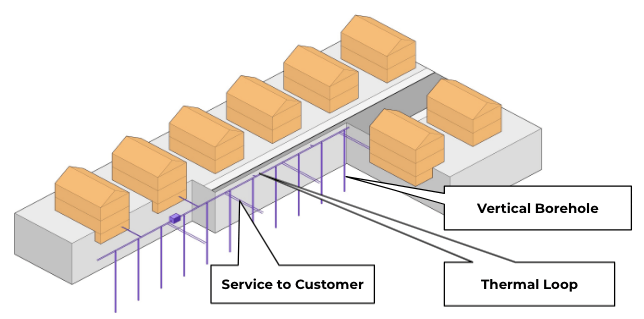
In that scenario, each home still has its own geothermal well, but what if you could drill a geothermal well that was extensive enough to feed multiple heat pumps in multiple buildings?

That was the concept proposed by a group of Harvard students in Ivory Innovation’s annual Hack-A-House competition, for which they won first place in the “Environmental Solutions and Construction Technology” category.

Those Harvard students may have known something the judges didn’t — that Eversource Gas, a Massachusetts utility, had already begun a “networked geothermal” demonstration project 17 miles west in Framingham. That project is featured at www.HEET.org, short for Home Energy Efficiency Team, which in 2017 started promoting the concept of gas utilities delivering 55º water instead of gas to multiple buildings from a grid of geothermal wells. (The above graphic is from their website.) Think of it as a 21st Century version of what Con Edison still does in NYC, which is to deliver steam from its central boilers to local buildings through pipes under Manhattan’s streets. But steam, unlike water, can’t be used in the summer for air conditioning.

A local vendor that I recommend for both geothermal and air source heat pumps is Sensible Heating and Cooling, (720) 876-7166.

How Does Geothermal Work?

Geothermal heating does not require the presence of a thermal feature such as a hot spring. In fact, if you dig down about 10 feet anywhere at our latitude, you’ll find that the soil temperature is about 55ºF year-round. Circulating a fluid through underground piping heats that liquid to 55º so a heat pump can then raise its temperature to 100º or so for heating purposes utilizing either radiant floor heating, baseboards or forced air.

Geothermal is far more efficient than an air-source heat pump system which takes in outdoor air as cold at 10 degrees below zero and works much harder to achieve the desired temperature for heating.

In the summer the 55º fluid from geothermal requires far less energy to be cooled further for air conditioning your home.

‘Everything You Need to Know About the Wild World of Heat Pumps’

That’s the title of an article in a February 14th post from MIT https://www.technologyreview.com/2023/02/14/1068582/

I have written about and provided my own explanations regarding how heat pumps differ from forced air furnaces and traditional A/C systems, but the article cited above goes the extra mile.

If you’ve spent a night in a hotel or motel, you have probably slept in a room that was heated or cooled by a heat pump, because invariably that’s what those units are which you saw and controlled under each window.

In my other post today, heat pumps provide the heating and cooling for every Boxabl home. They are also what heats and cools many electric vehicles, since they require less battery power than conventional electric car heaters.

I was surprised to hear that heat pumps were invented in the 1850s but only started being used to heat and cool homes in the 1960s. It took the global climate crisis and the need to reduce our dependence on fossil fuels to make them the hottest trend in new homes.

Speaking of new homes, however, I lamented as recently as last fall that I haven’t found a single new Denver area home builder which has abandoned gas-based home heating or even offers an upgrade to heat pumps. If you know of one, please tell me, because I’d be happy to promote that home builder in a future column.

The MIT article provides some useful information, including about the rebates being offered for heat pump installations. It also debunks the myth promoted by fossil fuel interests that heat pumps don’t work in colder climates. They are actually in use from Alaska to Maine, where, for example, my sister in Kingfield, Maine, installed a heat pump in her home to save on her fuel oil bill. Her fuel oil vendor told her that the adoption of heat pumps by her neighbors has noticeably reduced his sale of fuel oil in that rural community near the Canadian border.

According to the article, 60% of the homes in Norway are heated by heat pumps, as are 40% of the homes in Finland and Sweden (where another of my sisters lives).

“Wherever you look,” the MIT article concludes, “the era of the heat pump has officially begun.”

Here’s a Guide to the Tax Credits and Rebates Available for Making Your Home More Energy Efficient

Inspired by a recent article in The Washington Post, I’m able to provide you with a simplified guide to the improvements you can make to your home that might earn you a tax credit or other benefit under the Inflation Reduction Act (IRA).

If you are wealthy, some of those IRA benefits may not be available to you, so check with your tax advisor. Even if you don’t qualify for the tax credits or rebates, almost all of the following investments will produce savings down the road as well as being “the right thing to do.”

Heat pumps to replace your HVAC system and water heater are the first and greatest improvement you can make. Unlike gas and resistance-based electric devices, heat pumps move heat, they don’t generate heat. And a heat pump HVAC system uses far less electricity that a baseboard or other electric HVAC system does. The IRA provides for up to $2,000 tax credit for heat pump purchases, with extra benefits for low- and middle-income homeowners. I haven’t used this company yet myself, but you might contact Sensible Heating and Cooling, 720-876-7166, www.SensibleHeat.net, one of those rare vendors who will talk you into a heat pump HVAC system over a traditional one.

Many heat pump systems, including water heaters, are “hybrid,” meaning they have backup gas or electric resistance functions that kick in or can be activated when the heat pump can’t produce the needed heat. For example, a water heater in heat pump mode has a slower recovery than in conventional electric mode, so if you have a big family (or a teenager) you may find that you run out of hot water quickly and it takes longer than you want to reheat the water in the tank. In electric mode, you’ll get the quick hot water recovery you’re used to.

A heat pump HVAC system will probably work just fine without backup so long as you don’t turn down the thermostat too much overnight. Our office is heated solely by heat pump, and we leave it on 70 degrees 24/7, and it’s still way more affordable than the gas forced air furnace it replaced.

Xcel Energy charges commercial customers about $50 per month (that’s $600 per year!) just to have a gas meter before you burn any gas, which contributes greatly to making gas forced air more expensive than heat pump heating. Note: you need to have the gas meter removed, not just stop using gas, to save that $50 per month. Even in a residential application where the monthly meter fee is less, consider replacing all your natural gas appliances (including your fireplace and grill) so you can have the gas meter removed and save that facility charge plus those other gas-related fees that have exploded of late. There are great electric fireplaces on the market, and Rita & I love our electric grill!

Here’s food for thought: If you get rid of gas in your home and have only electric cars in your garage, you’ll never have to worry about your family being killed by carbon monoxide poisoning. In addition to spending less on home energy and fuel for your car(s), the IRA will reward you for every aspect of that conversion! And with enough solar panels on your roof, your home energy bill will be under $10 per month (to remain on the electrical grid), and you’ll pay nothing to fuel your transportation!

Induction stoves to replace gas ranges not only save you money (including an $840 rebate if you qualify based on income) but can improve you family’s health. Despite right-wing raging about this topic, it has been proven statistically that gas cooking has increased asthma cases in children and some adults. (Click here to read a study on this topic.) The rebate is available on non-induction electric stoves, but induction cooking costs less to operate and heats food and water faster. You can dip your toe in this technology by buying a single countertop induction burner for $50 to $70, as I did. You’ll be amazed. Click here to read an article about how chefs have come to prefer induction cooking. As they say, “try it, you’ll like it!”

Electric cars that cost under $55,000 and trucks or SUVs under $80,000 that are assembled in North America qualify for a federal tax credit of up to $7,500 and a Colorado tax credit of $2,000 (without those federal restrictions, which include an income cap of $150,000 single or $300,000 filing jointly). Even the Tesla Model Y’s base price is now below those price limits.

What’s new with the IRA is that you can get a federal tax credit of $4,000 or 30% of the purchase price (whichever is less) of a used EV that is at least 2 years old, has a purchase price under $25,000, and is purchased from a dealer. I have always advised that a used EV is your best buy, because a used EV is as good as a new EV since it has none of those components of a gas-powered car (such as transmission or engine) which may be about to fail. Google “used electric cars” and you’ll see many for sale by dealers. I just ran that search and found 72 EVs under $25,000 on autolist.com alone!

The IRA increased the tax credit on solar panels to 30% for the next 10 years, and, given the steady reduction in the cost of solar over the past two decades, this investment is a no-brainer, assuming you have a roof that’s not shaded by trees. (Ground mounted solar panels is an option if you have a large unshaded backyard area. Otherwise, consider buying solar panels in a “solar garden.”) Xcel Energy allows you to install enough panels to provide up to twice your average usage over the last 12 months, which is great, because that could provide all the electricity you will need for a not-yet-purchased EV or not-yet-electrified heating system.

My advice is to purchase your solar photovoltaic system outright, not lease it or sign up for a Power Purchase Agreement (PPA). When it comes to selling your house, anything other than a system that is seller-owned could complicate the sale. I’m a repeat customer of Golden Solar (303-955-6332), but also like Buglet Solar (303-903-9119). What these companies have in common, and which I think is important, is that they are local family-owned businesses, which I much prefer over a national firm such a Tesla or Sunrun Solar.

One situation in which a Power Purchase Agreement or lease works better is if the customer is a tax-exempt non-profit (which can’t benefit from tax credits).  Golden Solar put a solar array on the roof of a Golden museum doing a PPA that Golden Solar financed, taking the tax credit for it.  The museum pays no more than they were paying Xcel Energy to Golden Solar but will own the system after a few years. If you know of a non-profit that would like to go solar, have them contact Don at Golden Solar.

Improving your home’s insulation should always be the first step in saving money on energy. The IRA provides a 30% tax credit, up to $1,200 annually, for such improvements, specifying $600 for windows and $500 for doors. The gold standard in windows and doors is Alpen High-Performance Products, a Louisville CO company, which made the triple-pane windows we purchased for our South Golden Road office — expensive but worth it in terms of comfort and energy savings. Contact Todd Collins of AE Building Systems, 720-287-4290.

Whole-house energy efficiency retrofits are eligible for a rebate under the IRA, based on proven reduction in your home’s energy costs. Speak with someone from a company like Helio Home, Inc.  (720-460-1260) which covers most aspects of reducing home energy use covered by the IRA, from solar to insulation to appliances. The IRA also provides a $150 rebate on a home energy audit, which is an essential first-step to figuring out the best and most cost-effective efficiency improvements you can make. You can learn more about energy audits at www.REenergizeCO.com.

Buy a new washer and dryer! The new top-loading high-efficiency washers are the best, speaking from personal experience. The washer automatically reduces water consumption based on the size of the load; and a heat-pump electric dryer saves on electricity.

Landscaping, done right, can save on energy and water. Think shade trees and xeriscaping, or installing buffalo grass, which requires little watering or mowing. Call Darwin at Maple Leaf Landscaping, Inc. (720-290-8292), a client of mine, to discuss the possibilities at your house.

If your house doesn’t already have one, a whole-house fan is a great energy saver, allowing you to flush hot daytime air out of your house before activating the A/C when you come home. It can also allow you to leave the A/C off overnight by bringing in cool nighttime air on a quiet, low-speed setting. Whole-house fans cost between $500 and $2,000 installed. They don’t earn their own IRA benefit, but would contribute to the benefit you earn with the whole-house retrofit mentioned above. I am a happy repeat customer of Colorado Home Cooling, now part of Colorado Home Services, 303-986-5764.

Not mentioned in that Washington Post article was daylighting of your home, which is one of my favorite ways to reduce electricity consumption by drawing sunlight into dark interior spaces. I installed Velux sun tunnels in two of my past homes, including in a windowless garage, and in our former office on South Golden Road. For that, I used Mark Lundquist, owner of Design Skylights (303-674-7147).