Do You Practice Sustainability? Home Renovation Can Be Done Sustainably, Too

Tonight is the fifth in Golden Real Estate’s Sustainability Series. Previous sessions were about home insulation (January), home heating technology (February), solar power (March), and electric cars (April).

This month, the topic is sustainable renovation. Our presenter is an expert in sustainable practices when it comes to home renovation.  His name is Steve Stevens, and he has been my mentor regarding sustainable practices for nearly two decades.

A retired scientist from Bell Labs, Steve has made a lifelong project, it seems, out of reducing the carbon footprint of his 1970s brick ranch in South Golden.

Retired and living on a fixed income, he has developed several habits/practices that are not only sustainable but also have saved him a boatload of money.

For example, he only buys cull lumber from Lowe’s, and he buys returned products (typically mis-ordered) such as windows  and doors, which are then sold for a fraction of their original price.

Steve also seeks out salvaged goods such as windows and doors. As with buying cull lumber and returned products, collecting salvaged products means zero new carbon footprint for doing your renovation. 

Steve, being a scientist by training and passion, always considers the embedded carbon footprint of products, whether it’s food or building materials. How much energy is used to transport the goods you purchase?  For example, are you buying slab granite mined and shipped from Asia, or an alternative material mined or created closer to home?

Steve will share his shopping and construction tips that save money and are also sustainable.

For example, he emphasizes insulation, which should always be your first measure when it comes to saving energy. But what products should you buy, and where should you start?

The session will be held tonight, May 16th, from 5 to 6 pm in the Golden Real Estate office at 17695 S. Golden Road, Golden. There are still seats available. Reserve yours by emailing me at Jim@Golden RealEstate.com

Each of our sessions is video recorded by our friend, Martin Voelker, from the Colorado Renewal Energy Society.  You can watch videos of the first four sessions at Sustain-abilitySeries.info.  This session will also be recorded and posted there.

Lookout Mountain 2-Story Has Walk-Out Basement

This 2-story home with walkout basement at 494 Mount Vernon Circle is in the Paradise Hills neighborhood, less than one mile from I-70. It was just listed for $825,000.

It is perched high on a hillside with terrific views of Mt. Vernon Canyon and beyond. The interior was updated last month with refinished hardwood floors, new paint, and new Stainmaster carpet with a lifetime transferrable warranty. This home shows really well! The main floor features a large master suite with 5-piece bath and walk-in closet, a great room with gas fireplace, vaulted ceilings and large south-facing windows, and a study with connected 3/4 bathroom which could serve as a second main-floor bedroom. Upstairs you’ll find a large loft and two guest bedrooms sharing a full bath. The walkout basement has a bedroom, 3/4 bathroom, recreation room, and a large storage room which could be made into another office or workshop.  View a narrated video tour on the MLS or at www.ParadiseHillsHome.info, then call your agent or broker associate Chuck Brown at 303-885-7855 for a private showing.  Open on Saturday, May 18th, 11 to 3.

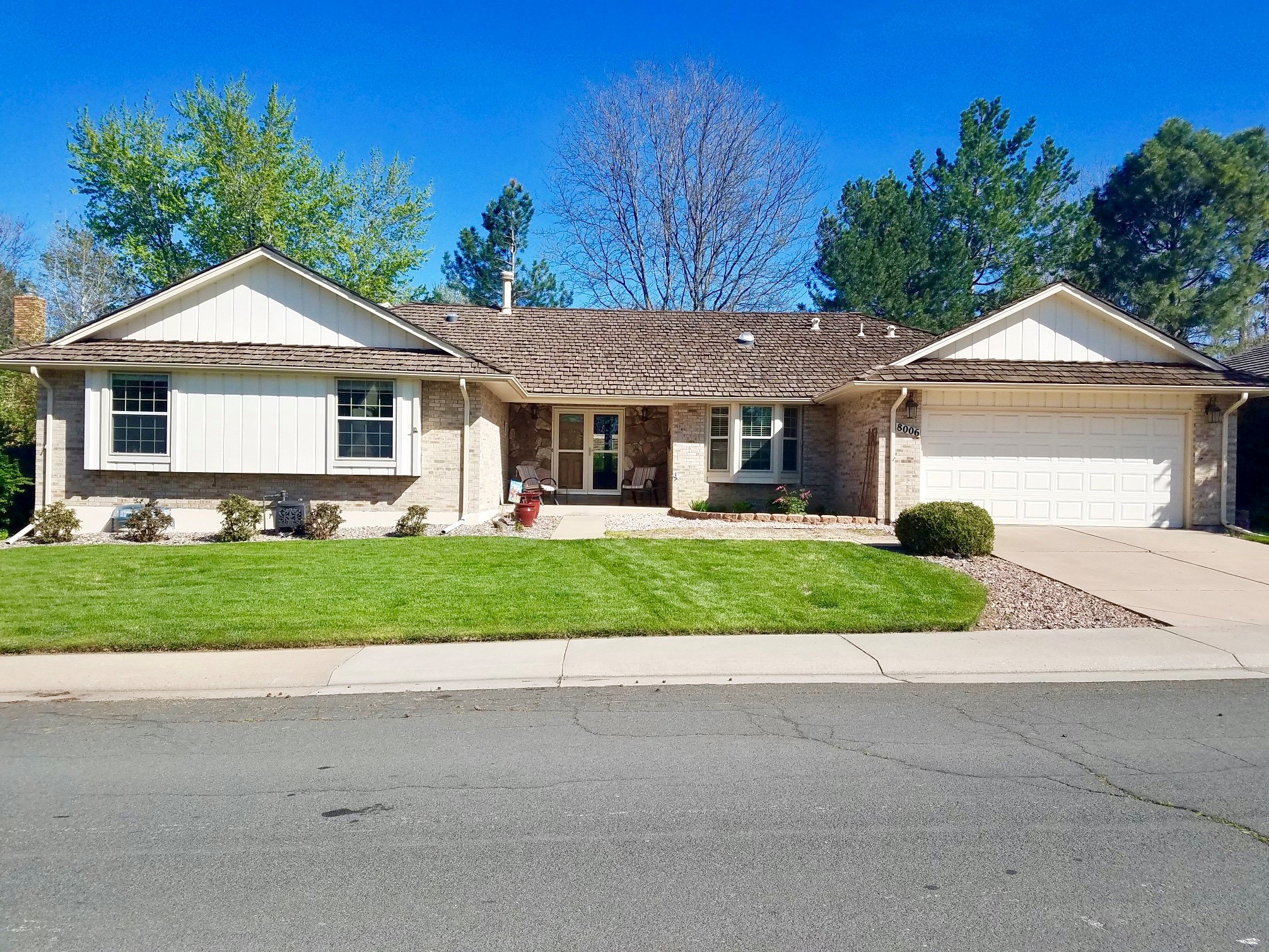
5-BR Littleton Ranch Has a Finished Basement

This 2,963-sq.-ft. brick ranch at 8006 S. Vance Court is in the Columbine Knolls South subdivision, north of Chatfield Ave. between Wadsworth & Pierce. It was just listed for $498,000.

It has four bedrooms and 2½ baths on the main floor, plus a 5th bedroom and 3/4 bath in the basement, along with a rec room and plenty of unfinished storage. It’s a super quiet location, as you’ll observe on the narrated video that you can view at www.ColumbineKnollsHome.info.  Some features that caught my attention include the three Solatubes and one skylight bringing natural light into the home’s interior spaces, including the kitchen, plus the beautiful family room with rock fireplace and vaulted ceiling. Watch that video tour, then call your agent or me for a private showing — or come to our open house this Saturday, May 18th, from 11 a.m. to 1 p.m.

Updated Golden Tri-Level Home Backs to Greenbelt

This 3-bedroom, 2½-bath home at 491 Somerset Drive is in the Lakota Hills subdivision, also known as Eagle Ridge. It was just listed for $638,000.

It sits on top of a ridge overlooking Rooney Gulch and offering unobstructed views of Lookout Mountain.  It has been beautifully updated with slab granite countertops, new stainless steel appliances, new carpeting and paint throughout. The sellers purchased it earlier this year, but personal developments make it necessary for them to sell it.  Their loss is your gain. Take a narrated video tour, including drone footage, at www.SouthGoldenHome.com, then ask for a private showing. I’ll be holding it open this coming Sunday, May 19th, from 11 a.m. to 1 p.m.  Or call me at 303-525-1851 for a private showing.

Here’s What You Need to Know About Appealing the Assessor’s Valuation of Your Home

By the time this column appears in print, all Denver and Jefferson County homeowners will have received in the mail a letter from their County Assessor declaring the “Actual Value” of their real estate holdings. The same is happening in all Colorado counties. The letters give taxpayers until June 3rd to file an appeal of that valuation which, if successful, could lower the “Assessed Value” (explained below) against which taxes will be levied for 2019 and 2020.

Property taxes in Colorado are paid in arrears, which means that the property tax for 2019 isn’t payable until April 2020, and the property taxes for 2020 will be payable in 2021. The valuation you just received in the mail, however, is not a statement of your home’s current value.  Rather, it is a statement of your home’s market (or “Actual”) value as of June 30, 2018, based on its condition on January 1, 2019.

In other words, if your house was significantly improved between June 30, 2018 and January 1, 2019, the assigned value should be what your home in its new condition would have been able to sell for on June 30, 2018, based on what comparable homes did sell for prior to that date. (You may need to read these two paragraphs a few times!)

The good news is that even though your home’s value has continued to increase since last June and will likely continue to rise for the next year or two, you will only pay property taxes for the next two years based on what it might have sold for in June of last year.

Nevertheless, many of us (me included) are going to be shocked at how much the assessor claims our homes have increased in value.

Additional good news for homeowners is that, because of both TABOR and the Gallagher Amendment — too complicated for me to explain here — the percentage of “Actual Value” against which your local mill levy will be applied keeps going down—from 21% of actual value in 1982 to 7.15% today. That percentage creates the “Assessed Value.”

To keep it simple, here’s an example using round numbers. If the assessor said the market value of your home as of June 30, 2014 was $500,000, your “Assessed Value” was 7.96% of that, which equaled $39,800.  If your mill levy was 100, then your tax bill was $3,980 (100 x 39.8).  Let’s say your home’s “Actual Value” as of June 30, 2018 rose to $600,000, a 20% increase. Your new “Assessed Value” is 7.15% of that, or $42,900. Thus, your tax bill, at 100 mills, will be $4,290, a 7.8% increase in your property taxes despite a 20% increase in market value. That’s only $90 more than if your home was worth $200,000 in 1982 when the assessment rate was 21%!

And it gets even better. Unless the voters in a particular tax district voted to “de-Bruce” the mill levy, that tax district must lower its mill levy as much as necessary to keep its revenue from increasing beyond TABOR limits based on population growth plus any increase in the cost of living.

Nevertheless, since your property taxes are the sum of multiple mill levies from various districts, that hypothetical rate of 100 mills that I used above might actually be lower this year, further reducing your property tax bill.

Here are two key points you must keep in mind when appealing the valuation assigned to your home by the Denver assessor:

1) You can only appeal the assessor’s valuation by citing comparable sales during the 24 months prior to June 30, 2018. Unless your home was mischaracterized (wrong neighborhood, style, etc.), all eligible comps are listed under “Comparables” on the assessor’s web page for your home.

2) You must “age” every comp you cite in your appeal by about 1% per month, since the median increase in our residential property values was about 24% over that 24-month period.  Thus, if a comp sold in January 2018 for $500,000, you can’t cite it as a comp at that price, but must increase that price by 6% to obtain its value as of June 30, 2018.

To find your home on the Denver assessor’s website, visit http://www.denvergov.org/property and enter your address. When your property is displayed, then click on the address and you’ll be able to click on a “Comparables” tab where you’ll be able to see exactly how the value of your home (the “Subject” property) was determined against three or more comparable sales identified by address. If you feel that those comps are not truly comparable to your home, you can click on the “Neighborhood Sales” tab and choose three or more other comparable sales and cite those in your appeal. You have to file your appeal by June 3rd.  Over the years, I’ve found in-person appeals to be most successful.

To find your home on the Jefferson County assessor’s website, visit http://assessor.jeffco.us and click on “Prop-erty Records Search” in the lower middle of the screen, then click on “Address” on the left of the screen.  “Sales” is on the top center. This is all explained on a website that I created for Jefferson County appeals, www.HowtoAppealValuations.info.


Many Renters Are Unaware of Programs That Make Homeownership a Possibility

Last week I wrote about the challenges facing buyers who must sell their current home in order to buy a new home and are not sure how to accomplish that.

This week, I’m going to address the different challenges facing renters, including first-time home buyers.

There are many programs for first-time home buyers, but did you know that anyone can qualify as a first-time home buyer if he or she hasn’t owned a home for at least three years? You could have owned many homes in your lifetime, but if you haven’t owned one in the past three years, you can take advantage of these special programs.

A common misconception among people who want to buy a home is that a 20% down payment is required, but that is simply not true. Another misconception is that if you put down less than 20%, you’d be required to pay for mortgage insurance. There are conventional loans available with as little as 3% down that don’t require mortgage insurance. That differs from the 3.5% minimum down payment required for FHA loans which do require mortgage insurance which continues for the life of the loan.

One of our preferred lenders, Scott Lagge of Movement Mortgage, compares the low costs of available programs to what renters pay when they lease a condo or home. Typically, renters need to come up with the first and last month’s rent plus a damage deposit.  Some first-time home buyer programs have out-of-pocket costs as low as $500.  Moreover, your partially tax-deductible mortgage payments could be as low or lower than what you’d pay in totally non-deductible rent.  

When I bought my first home in Golden in 1997, I was single but I had a good friend (also renting) who agreed to rent a room from me if I bought a suitable home. I found a ranch-style home with a walk-out basement that worked perfectly. He lived in the basement, I had a main-floor master suite, and he had access to the kitchen. We both saved money over renting, and I was building equity in my home. This is a formula that can work for anyone – if they have someone they’d like to have living in their basement!

There are programs from CHFA (the Colorado Housing & Finance Authority) that offer a grant of up to a 3% of the first mortgage loan amount, or up to 4% through a “silent” second mortgage that accrues no interest and requires no payment until the first mortgage is paid off, either at maturity, refinance or resale.

Scott claims that the best first-time homebuyer program of all is his company’s Dream to Own Loan.  This loan includes a silent second of 4% of the purchase price to be used for down payment and closing costs. This is the closest thing to a no-money-down loan that Scott’s aware of for first-time buyers.  There’s no mortgage insurance and the rates are competitive.  Call Scott at 303-944-8552 for more details.

Another great option for renters is a rent-with-option-to-buy program which you can read about at www.HomePartners.com.  The way it works is that you only have to qualify to rent a home which that company then purchases so you can rent it.  They’ll pay up to $500,000 for almost any home (except a condo) that’s on the MLS once you agree to rent it at a pre-determined rental amount based on the purchase price.  You can rent the home for up to five years, knowing in advance what your rent will be for all five years, but at any time you can buy that home at a price that is also agreed to in advance. Call Golden Real Estate to apply for this program.

That program is also a good option when your credit isn’t strong enough to buy right away but you know it will be better within five years. You can also use the program for the peace of mind that comes from knowing what you’ll pay in rent for five years and that you won’t have to move.

It’s also a good program for people relocating to our area who see a home they may want to buy but feel better renting it with an option to buy it later on if they like it — but they don’t have to.

Timing the Sale of Your Current Home and Purchase of New Home Can Be Challenging

Have you faced this dilemma? You want to buy a home that better fits your family’s needs, but you are stymied by the need to sell your current home to pay for the next one.  So you stay put in a home that doesn’t quite meet your needs.

There are several ways to tackle the challenge of buying a home when it depends on selling your current home. Let’s look at different scenarios based, first of all, on the amount of equity you have in your current home.

If you own your home “free and clear” and are downsizing to a lesser priced home, the easiest path is to take out a home equity line of credit (or HELOC) on your current home. This kind of loan is easier to obtain than a standard mortgage, especially when done through a credit union. Note: You must do this before going on the market.

When I obtained a HELOC from a credit union, they didn’t even charge for title insurance and did only a “drive-by” appraisal, and the closing took place at the loan officer’s desk with no closing fee. It couldn’t have been easier.

If you have a mortgage on your home but still have substantial equity, a HELOC can provide the cash you need for a 20% down payment, which is what’s required to get the most favorable interest rate on the mortgage for the home you’re buying. You would no longer be a cash buyer for your new home, and the mortgage lender for your home purchase may make the sale of your current home a condition for approving the loan on your new home, depending on the size of your income and the ratio of your debts to your income. But that doesn’t mean you can’t succeed in buying the new home.

Under the right circumstances, a seller and his/her listing agent will consider an offer that is contingent on the sale of the buyer’s current home. I have succeeded in this process as a buyer’s agent by showing that the buyer’s home is ready to be listed immediately and will be priced to sell quickly based on a market analysis.

Don’t expect, however, to win a bidding war against non-contingent buyers. You can avoid bidding wars and succeed with a contingent offer by looking only at homes that have been on the market over two weeks. Your agent can set up an email alert with that being one of the search criteria. Then be sure to include in the contract the price that you are going to list your home and submit with it a market analysis demonstrating that it is priced to sell quickly. That market analysis should include a spreadsheet of comparable homes sold in the last six months, showing days on market, and a price per square foot that is higher than the price per square foot of your home at the listing price specified in your offer. Your agent could even enter the home on the MLS as an “incoming” (not yet active) listing, complete with high quality photos, showing that you’re ready to “pull the trigger” immediately after your contract is accepted on the new home.

The contract to purchase your new home could have a closing date of 45 to 60 days, and if you have priced your current home correctly, you should get multiple offers and be under contract within, say, four days with a buyer who has agreed to match the closing date on your new home.

One of the deadlines in a contract to buy a home is the contingency deadline, after which you would lose your earnest money if you fail to close on your purchase.  That date should not be the day of closing but maybe a week earlier. If the contract to purchase your current home has the same date for that last opportunity for your buyer to terminate and get their earnest money back, you can have some peace of mind about everything working out well.

When I write a contingent contract, I like to add a provision that the seller can terminate if my buyer’s home is not under contract within, say, a week or 10 days after going under contract. That increases the likelihood of acceptance.

(I’ll write about the challenges facing renters who want to become home owners in next week’s column.)

Readers Responded in Great Numbers to Our Offer of Free Neighborhood Alerts

In last week’s column, I offered to set up Free Neighborhood Alerts for any reader who wanted to keep track of real estate activity in his or her subdivision or larger area. The response was overwhelming. I myself have received over 40 requests, keeping me so busy that I’ve had to make time to write this week’s column!

I’m not complaining. My broker associates and I are pleased to make this service available to everyone who wants it, and we’ve become pretty efficient at creating these free alerts.

We’re able to fulfill more requests, so feel free to ask for your own neighborhood alert. All our broker associates are able to create these highly personalized reports.  Just give us your address and the boundaries of the area you wish to monitor. The initial alert will tell you all the active, under contract, sold, withdrawn and expired listings in that area, going back 90 or 180 days or longer. Future alerts will come to you within 15 minutes of a new or changed listing being entered on the MLS. You will literally be up-to-the-minute in your knowledge of real estate activity in your neighborhood!

I’m happy to handle every request I get from readers, but if you know one of our broker associates, feel free to direct your request to him or her. They are more than happy to provide this free service.

Send your requests by email only, please. Here are the names and email addresses of our broker associates:

Chuck Brown — Chuck@GoldenRealEstate.com

Kristi Brunel — Kristi@GoldenRealEstate.com

David Dlugasch — David@GoldenRealEstate.com

Debbi Hysmith — Debbi@GoldenRealEstate.com

Norm Kowitz — Norm@GoldenRealEstate.com

Andrew Lesko — Andrew@GoldenRealEstate.com

Carrie Lovingier — Carrie@GoldenRealEstate.com

Carol Milan — Carol@GoldenRealEstate.com

Jim Swanson — Swanson@GoldenRealEstate.com

In addition to setting up the neighborhood alert for you, we will also send you valuation reports on your home using two different software packages that you will find are much more accurate than, say, the Zillow “Zestimates” which home owners are used to seeing. We can also provide a spreadsheet of active, under contract and sold listings that are comparable to your own home as a double-check on those valuations.

Why Be in the Dark About Real Estate Activity in Your Neighborhood? We Can Help.

If you’re like most people, you probably consult Zillow to find out what your home is worth, and you track the activity in your area by watching for yard signs and looking online to learn their listing and selling prices.

At Golden Real Estate we offer a Free Neighborhood Alert, which notifies you by email within 15 minutes every time a home is listed, goes under contract and is sold.  Wouldn’t it be nice to have that information automatically and instantly?

Such alerts cost us nothing to set up, and the emails are sent by computer without any additional work on our part, so please take advantage of this free service. Send your request (by email) to me or any of the other agents at Golden Real Estate, who are listed on our website, GoldenRealEstate.com. All our agents’ email addresses are [firstname]@GoldenRealEstate.com.

What we’ll do is identify your subdivision or neighborhood and send you alerts only for real estate activity in that area. Feel free in your request to identify the boundaries of the area you want to include in your email alert.

By giving us your own address when you request the Neighborhood Alert, you’ll automatically receive two free valuation reports for your own home using different software packages that are considered to be more accurate than Zillow’s “Zestimates.” 

One of them is by Realtor Property Resource (RPR), which is available only to members of the National Association of Realtors. (All of us are NAR members.) The other is the Realist Report, which is part of REcolorado, the Denver MLS on which virtually all local homes are listed for sale.

These two software packages use propriety algorithms which combine public records information about your own house with MLS transactions of comparable homes.  These valuations can be, but are not always, close in their estimation of your home’s value, but, of course, neither knows the condition of your home or of those “comparable” homes. But, then again, Zillow doesn’t know that either!  If you are more than just curious and want to know the true market value of your home, we need to visit your home in person, which we are happy to do.  Just ask us!

Meanwhile, if you ask, we can send you the full MLS listings (including pictures and virtual tours) of the homes that appear to be comparable to yours, so that you (and we) can get a better sense of how your home actually compares to those sold and competing listings.

We also like to provide a single-page spreadsheet of those comparable sales, as well as any active or under contract comparables, so you (and we) can readily compare such variables as price per above-grade square foot and per finished square foot.  We’re happy, of course, to help you interpret that raw information, as we do in actual listing presentations.

If you are contemplating the sale of your home and if we are not the right brokerage for one reason or another, we’re happy to provide a spreadsheet similar to the one shown below for the brokers or brokerages you are considering so you can properly compare and contrast them. 

If we’re not the right brokerage for you, we want to assist you in finding the best broker and brokerage. We can also evaluate and refer you to excellent agents in other markets.