Should You Consider a Reverse Mortgage as Part of Your Retirement Plan?

10,000 people reach retirement age every day in the US, and Census statistics show that the “Silver Tsunami” will crest in 2034.  More people will be over the age of 65 than under the age of 18. That may be why I am often asked about “reverse mortgages.”

I spoke with one of my preferred lenders, Jaxzann Riggs, recently and was reminded that while most people know that a Home Equity Conversion Mortgage (HECM) can be used to refinance an existing mortgage to access equity, few people realize that a reverse mortgage can also be used to purchase a new home. Fewer people know this because the HECM for Purchase program was not established until 2008.

Prior to 2008, a borrower who wanted to use a HECM as part of their retirement strategy would be required to purchase their new home with a traditional loan and then to refinance into a HECM, doubling the closing costs.

The fundamentals of a HECM refinance and a HECM for purchase are identical. HECMs allow homeowners to access the full amount of their home equity (and, potentially, even more).  Borrowers have flexibility regarding how they choose to access their equity. The borrower can eliminate monthly mortgage payments entirely or receive monthly payments from the lender, establish a growing line of credit or they can opt for a combination of all three. Because a HECM is a loan, monthly payments received by the homeowner from the lender are not taxable and do not reduce Social Security or Medicare benefits in any way.

Although they are relatively easy to obtain, reverse mortgages are not for everyone. You must be at least 62 years of age, have substantial equity in your property, and occupy the home as your primary residence. A reverse mortgage also provides security for a “non-borrowing” spouse (younger than 62 years of age), who may continue to live in the home until his or her death following the death of the “borrowing spouse.”

Some of the misconceptions about reverse mortgages that prevent people from considering this option are:

  • That the lender takes ownership of the home, when in fact, the title stays with the homeowner.
  • That your family won’t be able to inherit the home when you pass. Any equity that remains from a sale after paying off the mortgage will go to your heirs. If they choose to keep the home, they can refinance into a conventional mortgage.
  • That you or your heirs may end up owing more than the home is worth. HECM’s are “non-recourse” loans meaning that you or your heirs will never owe more than the home is worth. If you live so long that you exhaust all the equity in your house, FHA insurance covers the loss.

While there are many benefits to a HECM they are not inexpensive. They are “insured” by the Federal government. The “Up Front” premium is 2% of the home’s value and there is an annual premium of .50% of the loan balance (paid monthly). Homeowners pay traditional closing costs as well as an “Origination Fee” which cannot exceed $6,000. While the upfront and annual mortgage insurance premiums may seem steep, they protect you and your heirs from owing additional funds if your loan balance exceeds the home’s value when it is sold. Remarkably, the “note” that you sign for a HECM allows you and your spouse to live in the home for up to 120 years.

The terms offered to a borrower are based upon the age of the youngest borrower and the equity in the home.  Jaxzann Riggs, owner of The Mortgage Network is happy to discuss whether a Home Equity Conversion Mortgage is right for you. Contact her at 303- 990-2992.

‘Community Solar’ Makes Solar Available to Condo Owners and Apartment Dwellers

Driving around the metro area and elsewhere, you have probably noticed huge installations of solar panels on open land and wondered who built and who benefits from them. Installations, such as the one north of 64th Avenue on Highway 93, are owned by community solar companies or nonprofits. 

The concept of community solar is to rent or sell portions of such installations to individual consumers. The kilowatt-hours generated by those solar panels are then credited to the usage on subscribers’ electric meters.

It’s a perfect solution for people who live in an apartment or condo building where they can’t install their own solar panels. The really neat thing about community solar is that when you move, your solar generation is merely reassigned to your new electric meter — no need to install new panels. 

Small businesses can also take advantage of community solar. Golden Real Estate, for example, moved in Nov. 2021 from its solar-powered office on South Golden Road into a storefront on Washington Avenue in downtown Golden. Community solar is the only way that we can continue to be solar-powered since we can’t install solar panels.     

Denver-based SunShare describes itself as the nation’s oldest community solar company with over 10 years’ experience building and maintaining “solar gardens” across the state. Their website says that they have built 116MW of solar panels and have 14,000 subscribers and three utility partners. Find more info at www.MySunShare.com

Community solar was legalized in Colorado in 2010 with the passage of the Community Solar Gardens Act  (HB 1342). The following year, SunShare opened for business, and in 2015 the Colorado Energy Office partnered with GRID Alternatives to construct a community solar demonstration project to serve low-income Coloradans. 

Colorado Springs Utilities was the first utility to create its own solar garden for 278 subscribers in 2011. That 0.5-MW installation has since grown to a 2-MW installation serving 435 customers.

Community solar can be a good deal for rural landowners, providing a predictable revenue stream for otherwise non-producing acreage. 

Renting or buying photovoltaic panels in a solar garden costs money, so you’re still paying for electricity, but the rule of thumb is that what you spend on community solar is about 10% cheaper than buying the same amount of electricity from the utility.

Some of us don’t worry about the size of the savings but simply “go solar” because it’s the right thing to do. Any savings are just a bonus.

To learn more, in addition to visiting SunShare’s website, I suggest Googling “community solar Colorado.” You will find other companies offering community solar, learn the history of it in Colorado, and decide whether it is right for you.    

You may find that existing solar gardens are sold out and you’ll be put on a waiting list for a future solar garden.

Whether you are putting solar panels on your own property or subscribing to a solar garden, consider upsizing your investment instead of basing it on your current usage, since the chances are that you’ll be buying an electric vehicle and you’ll want electricity from the sun to power it, too.  Xcel Energy allows you to install solar panels based on twice your last 12 months’ usage for that reason.

New Laws Limit What Landlords Can Include in Leases

If a landlord rejects a prospective tenant’s application, the landlord must now provide a copy of the background report they used, and tenants are allowed to challenge that report’s contents.

One new law prohibits landlords from requiring that tenants waive certain legal rights in their leases, such as the ability to participate in class action lawsuits or jury trials. It also prohibits landlords from charging renters a penalty if the renter doesn’t give notice that they aren’t renewing their lease, unless the landlord suffers an actual loss because he/she didn’t receive notice.

The new law also limits how much landlords can charge in third-party fees, such as for pest control or trash collection.

Under the law, income requirements are capped at double the cost of rent. Proponents have said that some landlords have required that tenants earn three to five times as much as they’ll pay in rent.

The law also caps security deposits at double the cost of a month’s rent, and it limits how a landlord can use a prospective tenant’s credit or rental history.

July Real Estate Market Analysis

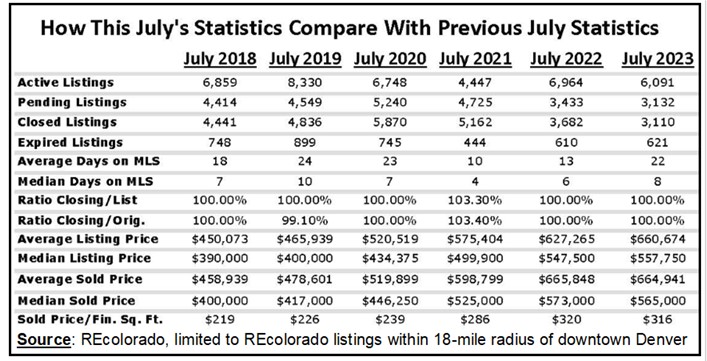
Denver’s real estate market has undergone notable shifts this year when compared to past averages. Typically, around 8,757 active homes are on the market in July. However, this year, the number of homes for sale was under 6,000. 

High interest rates reduce the motivation for homeowners to sell, even if downsizing to a smaller property. Buyers face the same challenges due to higher interest rates. Many have postponed their real estate plans, waiting for lower rates.

The result is fewer transactions. This pattern is expected to continue through 2023. It resembles market activity from 2013 to 2019, with one notable deviation. This year, we’re observing more frequent and larger price reductions in both size and number of properties. These dynamics are shaping the landscape for both buyers and sellers, prompting strategic decisions in the face of evolving market conditions.

Megan Aller of First American Title contributed to this report.

Just Listed: 3-Bedroom Lakewood Home in Country-Like Setting

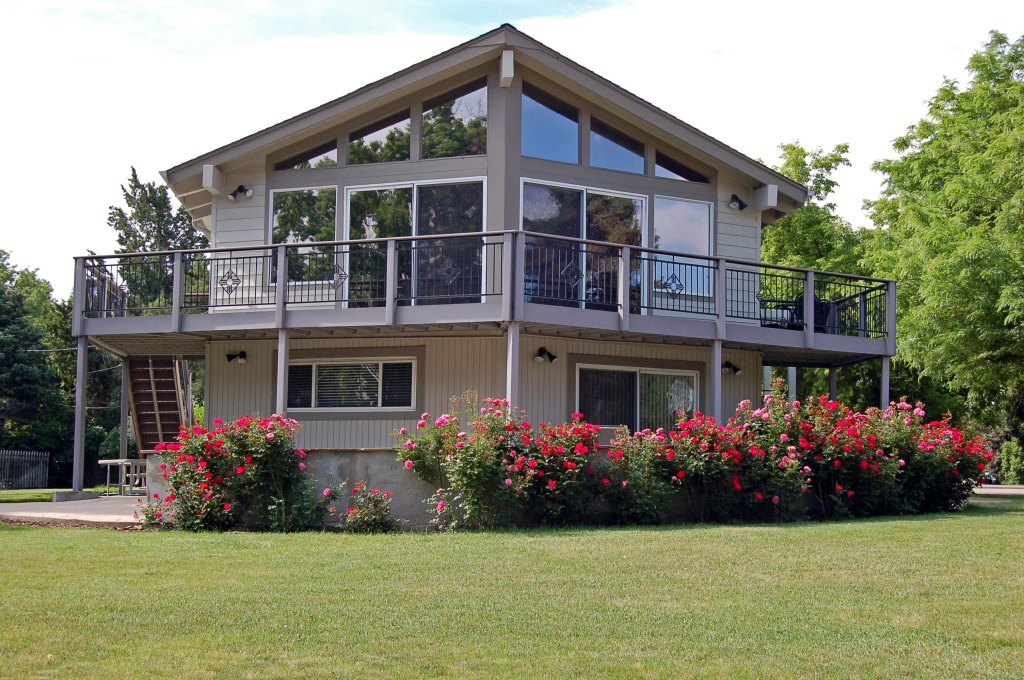
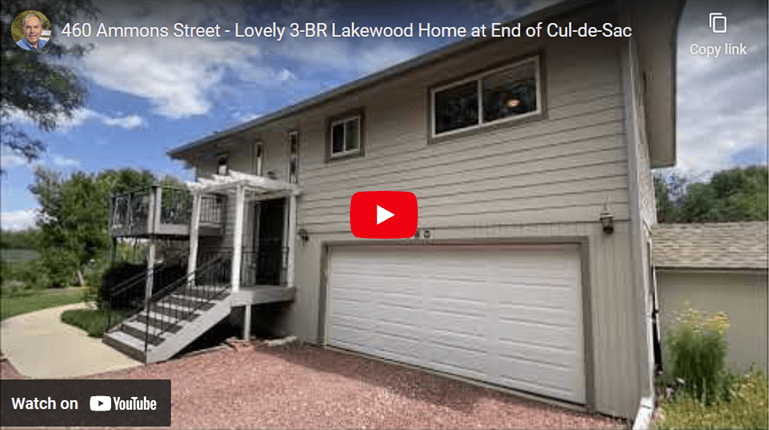
Set at the back of a quiet, off-the-beaten-path cul-de-sac, this home at 460 Ammons Street will check all the boxes for many house hunters. Just listed at $700,000, it has lots of light thanks to  the floor-to-vaulted-ceiling north-facing windows in the main-level living room/dining room. The 0.46-acre lot provides plenty of room for gardening. An expansive rock driveway includes tons of space for guest parking and all your toys — boat, RV, trailer, you-name-it! There are RV hook-ups for water, sewer & electrical. A riding lawn mower is included. There’s no HOA to limit your use of this country-like property. You’ll make good use of the wrap-around composite deck! The roof was replaced in 2017 with architectural hail-resistant shingles to save on insurance premiums. HVAC was new in 2018, and the sewer line was replaced in July 2021. Belmar shopping district and light rail are each 1.5 miles from this home. Visit www.LakewoodHome.info to take a narrated video tour of this listing inside and out, including drone footage. Open house is Saturday, Aug. 19th, 11am to 1pm. Or call listing agent Jim Smith at 303-525-1851 to request a showing! See how many boxes this home checks for you!

What Are Some of the Common Mistakes That Homeowners Make When Selling?

I received an editorial submission on this topic, and it’s a good one, but I have my own points to make. The subheads below are his, but the paragraphs are mine.

Overpricing Your Home: We all make this mistake at times. The important thing is to take quick action. You know it’s overpriced when there are few or no showings and no offers. Don’t wait—reduce the price immediately or risk it becoming “stale.”

Neglecting Necessary Repairs: But what’s necessary? A furnace at the end of its expected life may be needed, but it’s not going to generate more showings or offers. Leave it as an issue to be brought up at inspection. Call it “lipstick on a pig” if you want, but I favor spending money on making your home more appealing visually to buyers, starting with your lawn care/landscaping and the exterior look of your home.

I focus on what I call “eyesores”: things that draw negative attention from a visitor to your home — carpet stains or noticeable wear; hardwood that badly needs refinishing; damaged countertops, peeling paint, etc. Note: the further the eyesore is from the front door, the less serious it is. The buyer has already fallen in or out of love with your house by the time he or she notices the shag carpeting in the basement bedroom. They are not going to change their minds by then.

Poor Home Staging / Presentation: I provide a free home staging consultation because this is so important. Decluttering and thinning your possessions is the one improvement that costs almost nothing. If you don’t want to do this, I’ll refer you to another Realtor and get a referral fee! I want my sellers to appreciate the importance of “looking good.”

Mistakes in Marketing/Listing: This is why you should use Golden Real Estate! We don’t skimp on marketing, as you have probably noticed. We do only magazine quality HDR photos using a professional photographer. We do narrated video tours with drone footage. Our “for sale” signs are classy and have solar powered lights. (And we make sure our signs are vertical.) We purchase a website URL for every listing. And we do all this whether it’s an inexpensive condo or a multi-million dollar home. Oh, yes, we also have a full-page weekly newspaper ad in the Denver Post plus three weekly newspapers which puts our listings in front of over 200,000 people who still read! (That’s a great demographic, but millennials are becoming an important demographic too, and we reach them through the blog posts and social media presentation of every article and listing that appears in our full-page ads.)

One piece of marketing that costs the agent only time, not money, is to complete ALL MLS data fields, not just the mandatory ones. Some of those optional fields, such as descriptions of each room, add a great deal of information for buyers. We complete those optional fields.

Ignoring Local Market Trends: We are currently in a “balanced” real estate market. The “seller’s market” of last year is over, but some sellers and their agents price their homes at a wished-for price that isn’t reflective of the slower market that we are now in.  I like how Megan Aller of First American Title puts it in her market presentations: “Sellers think it’s 2020 and buyers think it’s 2008.” 

Above all, remember that all real estate is local — it can be rising in one neighborhood and falling in another. And real estate is also emotional; sellers and buyers don’t always act rationally in the decisions they make about their home. Personally, I utilize three different valuation models when creating a market analysis for a prospective listing. 

Keep in mind the mortgage market, not just the real estate market. Yes, the interest rates are high right now, and no one can accurately predict when they will be lower. But there are programs for first-time homebuyers (defined, by the way, as someone who hasn’t owned for three years), for first responders, teachers and others. And there are ways to buy down the interest rate for one or two years in hopes of refinancing when rates are lower. If you don’t have a knowledgeable and hard-working loan office on your side, we have a couple we can recommend.

I Found a Great Website on Home Electrification – LoveElectric.org

Home electrification is all the rage, and www.LoveElectric.org is a one-stop shop for getting information about the rebates available from utilities, local governments and non-profits throughout Colorado designed to promote the abandonment of fossil fuels for heating and powering your home/business.

The website is an initiative of the Beneficial Electrification League of Colorado (BEL-CO), a coalition of stakeholders in Colorado committed to enhancing the market acceptance of electric appliances such as heat pumps, induction cooktops, etc. to replace fossil fuel-based appliances such as forced-air gas furnaces, gas boilers, gas fireplaces and gas ranges. Their website provides statewide information on rebates for the installation of such electric appliances.

Here’s a screenshot of their rebates web page, which is many times as long as shown here:

3-BR Bungalow in Denver’s Park Hill Just Listed by Greg Kraft

This charming brick ranch is at 2670 Kearney Street in the sought-after Park Hill neighborhood, minutes from City Park, the Denver Zoo, and the Denver Museum of Natural History. Downtown Denver is a 15-minute drive away. It was just listed by Greg Kraft at $659,900.

The home is on a double lot with extensive flower and vegetable gardens. Both the bathroom and kitchen have been updated, the latter with new granite countertops and a Bosch dishwasher. New double-pane Anderson windows are throughout the house. Inside, one can find original hardwood floors across the main level. The main sewer line was replaced in 2009. The other kitchen appliances and the A/C unit are about five years old. Outdoor amenities include a newer storage shed, a children’s play structure with swings and a slide (removed if you don’t want it), and a large concrete patio. There’s an attached two-car garage (unusual for this 1946 home) and a non-conforming third bedroom in the basement. Perfectly situated on a tranquil, wide street, the house is just a block from McAuliffe International Middle School. A new roof was installed two weeks ago.

Listing agent Greg Kraft will hold an open house on Saturday, August 12th from 11 to 1. Take a narrated video tour, including drone footage, below or at www.ParkHillHome.site, then call or text Greg at 720-353-1922 to schedule a private showing.

‘Solar Village & Electric Vehicle Show’ This Friday

Join the American Solar Energy Society for the Solar Village & Electric Vehicle Show on Friday, August 11th, 10am to 4pm, in front of CU Boulder’s University Memorial Center. There will be solar energy workshops, exhibits, EV shows, and activities for kids that are free and open to the publicAnyone interested in sustainable energy and energy efficiency is invited to visit this event, sponsored by the American Solar Energy Society, New Energy Colorado, and the Colorado Renewable Energy Society.

The Solar Village will offer a variety of educational displays and experts covering photovoltaic systems, heat pumps, passive solar design, super insulation, and other sustainable energy technologies and processes.

Also free and open to all is a Solar 101 Workshop from 11:45 to 1pm in an adjoining tent at which four experts in these topics will speak and answer questions. More information can be found at www.ases.org/conference.

Our ‘Styrofoam Corral’ Closes Forever on Aug. 31

For over a decade and a half, Golden Real Estate has hosted a “Styrofoam Corral” behind its former location at 17695 S. Golden Road.  Perhaps you or someone you know brought some of the 36,000 cubic yards of the Expanded Polystyrene (Styrofoam is a brand name) that we have kept out of landfills.

Well, we sold that building last week to Joe & Stacy Fowler, proprietors of The Golden Hayride, and they need the space currently occupied by the Corral for other purposes. Our contract of sale requires us to close and remove the Styrofoam Corral by August 31st. We had hoped to find another host for this valuable community amenity, but have had no luck so far.  Call Jim Smith ASAP at 303-525-1851 if you can help find a new home for it!

After Aug. 31, 2023, you’ll have to take your Styrofoam to SustainAbility Recycling’s facility at 6240 W. 54th Avenue in Arvada. Their website is www.sustainability-recycling.com.