We’ve all heard some crazy examples of bidding wars in which homes have sold for way over their listing prices, so I took a snapshot of just one day’s closings, limited to a 15-mile radius of downtown Denver. That takes in an area from Broomfield to Highlands Ranch and from Golden to Aurora. It does not include the City of Boulder.
The day I chose was last Friday. The source was REcolorado.com.
I limited my search to homes, condos and townhouses that were on the MLS at least one day and no more than 6 days before going under contract. Those are the listings that experienced bidding wars. I divided the results into homes which sold up to $500,000 and those that sold for more than that.
On April 16th there were 48 closings up to $500,000. The median home sold for 4.7% over its asking price. It was a tri-level home in Aurora listed at $420,000 which sold in 3 days for $440,000. Only 3 homes sold for the listing price and 2 sold for less. The highest ratio was 25.8% for a home in Aurora that sold in 1 day.
There were 68 homes that closed on April 16th for more than $500,000. The median home in that group sold for 8.3% over its listing price. It was a 1950 ranch in Denver’s North Hilltop neighborhood listed for $600,000 that sold in 3 days for $650,000. The highest overbid in this group was 18.8% for a 2-story home in Westminster listed for $425,000 that sold in 5 days for $505,000. Only 5 sold for the listing price and 4 sold for less.
To get a statistically meaningful number of closings over $1 million, I looked at 68 such closings from April 1-16. The median ratio was 4.3% over listing price. The highest was for a 1954 bungalow in Denver which was listed at $965,000 and sold for $1,205,000, 24.9% over listing.
Note: These statistics reflect the bidding wars that were taking place during late March, when most of these listings went under contract. Today’s bidding wars appear to be even more intense. Stay tuned!
Broker/owner Jim Smith and broker associate David Dlugasch pose with the Golden Sustainability Award in front of their two Teslas.
Back in 2010, Golden Real Estate was awarded the “Sustainability Award for Business” from the City of Golden for the brokerage’s solar-powered office. Eleven years later, we have been awarded this recognition a second time because of how much further we have taken our passion for sustainability.
Back in 2010 we had a 5kW solar array on our roof — enough to power our office, but little else. We had a couple other features — sun tunnels to daylight our office reducing the need for artificial lighting, extra insulation to reduce the amount of natural gas needed to heat the office, and we accepted polystyrene (aka Styrofoam) for recycling.
Now, we have 2 ground-mounted solar arrays adding another 15kW of solar power, providing enough electricity to heat and cool our office with heat pumps and to power our five agent-owned Teslas as well as offering free EV charging to the general public. We had our gas meter removed in 2017 and now our Xcel Energy bill is $10 to $11 per month, which is the cost of being connected to the electric grid. We are now a “net zero energy” facility — and we’re taking two truckloads of Styrofoam to a reprocessing center in Denver every month.
Thanks to “net metering,” the electric grid functions like a battery, receiving our excess energy during sunny days and giving it back to us when we need it. We like to consider our office an example that other businesses can aspire to, and we are grateful for this week’s recognition by Golden. Click on the following 2-minute YouTube video tour of our net zero office:
Lakewood Earth Day 2021 features this video tour of Golden Real Estate’s Net Zero Energy office.
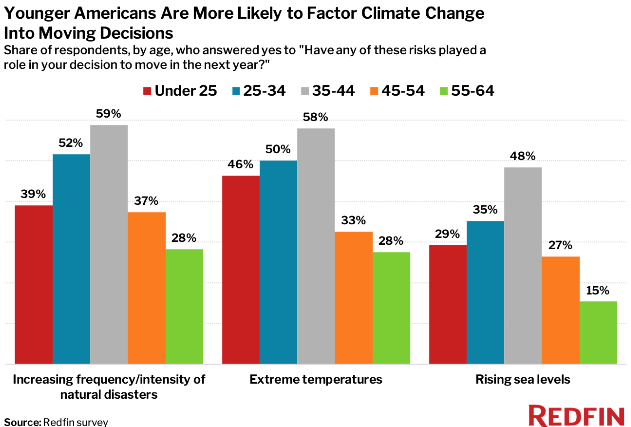
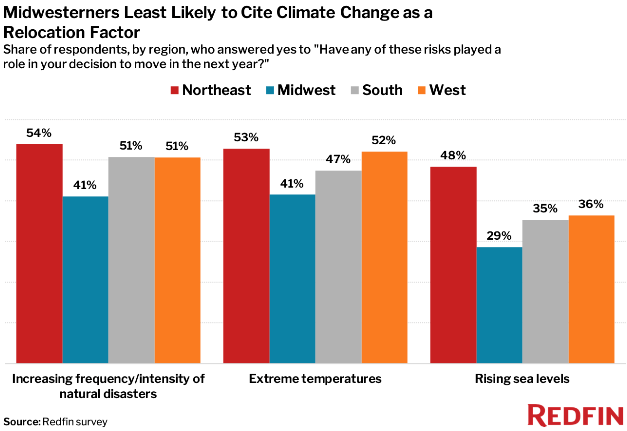
A recent survey of 2,000 U.S. residents by Redfin found that three-quarters of Americans are hesitant to buy homes in areas with a high climate risk. Those risks include more severe hurricanes & tornadoes, flooding, higher temperatures, wildfires, and rising sea levels.
It’s not hard to see why Colorado would be a favored destination for “climate refugees.” I have sold several homes to Californians recently, including just this month to my stepson, who currently lives in Sherman Oaks.
We Realtors are seeing more and more of our listings going to out-of-state buyers, subjecting local buyers to increased competition in bidding wars.
If you’ve been paying attention to national weather reports, you can understand this trend. In California, the last two fire seasons have been terrifying. Last week’s earthquake in Los Angeles could have added to the situation.
In the Midwest, we have seen tornado after tornado destroying entire neighborhoods. And rising water temperatures in the Atlantic Ocean and the Gulf of Mexico are promising increasingly severe hurricanes and flooding.
The Redfin survey broke down by age the reluctance of home buyers to purchase a home in such areas. What it found was that buyers between 35 and 44 years old have the highest reluctance, with buyers between 25 and 34 years old having the second highest reluctance to buy in such areas.
Fifty-nine percent of persons between 35 and 44 years old said that the increasing intensity and frequency of natural disasters played a role in their decision about where to move. Fifty-eight percent said that extreme temperatures played a role, and 48% said that rising sea levels played a role in their decision.
For people 25 to 34 years old, the percentages were 52%, 50% and 35% respectively.
The lowest percentage of reluctance was among the oldest buyers surveyed, those between 55 and 64 years old. (For some unexplained reason, Redfin didn’t survey people 65 and older.) Only 28% of that age group said that natural disasters and rising temperatures were a factor in their decision to buy, and only 15% cited rising sea levels as a factor.
Among my own clients, I have been surprised at how many sellers — all of them seniors — have relocated to Texas and Florida. For some it was to be close to family. For others it was because of lower home prices. They benefited from our runaway seller’s market, buying equivalent homes for much less money in those states.
“Climate change is making certain parts of the country less desirable to live in,” says Redfin’s chief economist. “As Americans leave places that are frequently on fire or at risk of going underwater, the destinations that don’t face those risks will become increasingly competitive and expensive.”
Perhaps the Denver Post should bring back the phrase, “Climate Capital of the World,” below its front-page logo.
For the second time, Golden Real Estate has been recognized by Quality Service Certification, Inc. for being among the top 20 small real estate brokerages for excellence in quality service.
The “Quality Excellence” Award is “awarded in recognition of the highest level of service quality and customer satisfaction in the real estate industry.”
The award is known as the QE Award. This year’s award recognizes the top 5 large companies, the top 10 midsize companies and the top 20 small companies, with the winning brokerages spanning 22 states and including some of the most respected independent and well-known national and regional brand names. We were recognized as one of those top 20 small companies.
The award is based upon the results of a post-closing survey of buyers and sellers who were in a real estate transaction with participating real estate companies. All Golden Real Estate clients have been surveyed since 2013.
Quality Service Certification, Inc. (QSC) and Leading Research Corporation of Laguna Niguel, CA, administer the survey process to ensure that every past buyer and seller is surveyed, preventing agents or companies from influence, interference or manipulation in any way.
Larry Romito of QSC said that the QE Award is based on aggregated overall Customer Satisfaction as a percentage of all returned surveys of real customers, where every past customer has been surveyed without selectivity, editing, deletion, cleansing or manipulation. “No other system exists, anywhere in the real estate industry that can legitimately make that claim,” he said.
Find the reviews of all Golden Real Estate agents (including me) at www.RatedAgent.com .
This amazing seller’s market is raising everyone’s real estate values, which is bound to be reflected in higher property taxes.
Early next month all property owners in the state will receive a notice from their county assessor assigning a new “full valuation” on which 2021 and 2022 property taxes will be based.
The good news is that the valuation will be as of June 30, 2020, avoiding the worst of the increases which we have see since then.
Look for another blog post in early May in which I will instruct you on how to tell whether your home’s valuation is too high and how to appeal it.
There has been some confusion in the real estate world over the term “manufactured” homes. Most recently the term has been applied to mobile homes — also referred to as single-wide or double-wide homes, which are transported fully finished to mobile home parks.
But “manufactured,” as I understand it, can be applied to a home whose walls, trusses and other components are put together in a warehouse, then shipped on flatbed trailers to a construction site where they are assembled and installed on a standard concrete foundation.
A “modular” home goes a step further, in that entire rooms might be assembled in a warehouse, transported to a work site and then assembled with other modules to make a complete house.
The first home I bought in Colorado was a ranch with walk-out basement in Golden’s Mesa Meadows subdivision. Only after I had moved in did a neighbor share with me how my home was put together in a day or two. Its components were manufactured in Fort Morgan and delivered to Golden only after the concrete foundation was ready to receive them. Anyone looking at the home would think it was a “stick-built” home like the other homes in the neighborhood. When I bought it and when I later sold it, it wasn’t listed on the MLS as “manufactured,” because that would have felt like a misrepresentation, given the type of home it was.
The neighbor who explained that my home was actually built in Fort Morgan and assembled on site, explained how that process made for a better home. The exterior walls were 2×6 construction (to withstand the rigors of shipment) and they were fully insulated on the factory floor rather than on-site, resulting in better quality control. It made sense to me. It also made me wonder why more homes aren’t built that way.
I remember learning that an affiliate of Habitat for Humanity in Minnesota or Wisconsin constructs homes that way during the cold winter months — having volunteers assemble entire wall units in heated warehouses during cold spells, then delivering them to the site later on.
Every conventionally built home uses roof trusses that are made to order on factory floors and shipped to work sites on flatbed trailers, so why not have wall units made to order as well?
From 1933 to 1940 Sears Roebuck sold mail-order “Kit Homes” that were “pre-cut and fitted.” A 2-story colonial-style home called the “Martha Washington” was sold by Sears for $3,727. Other kit homes had names like the Cape Cod, the Ridgeland, the Franklin, the Dayton, and the Collingwood. See below for that model’s description from the Sears catalog. Many homes in Denver were built from Sears kits, but you’d never know it. Original owners of those homes are long gone, and the current owners of them probably have no idea.
There are definite economies to building homes that are “pre-cut” and partially pre-assembled off-site. For one thing, the factory workers can work every day regardless of the weather and even in multiple shifts. They can be more productive in a heated warehouse. There will be more efficient use of materials and more recycling and reuse as well.
Right now, the growing “tiny home” market is doing such construction and delivering modules or even entire homes to work sites, enjoying great economies in doing so. There is no reason that more elements of larger homes couldn’t be built off-site and delivered to construction sites for final assembly.
One example of off-site modular construction utilized in the building of sustainable homes is Structural Insulated Panels or “SIPs,” shown here. Two sheets of sheathing have 4 to 5 inches of foam insulation between them. SIPs can replace walls built with wood framing and provide superior insulation.
Impresa Modular is a West Virginia company with a great website (www.ImpresaModular.com) describing the many kinds of off-site home construction methodologies they employ and sell.
There is so much innovation happening in home construction, much of which can not only reduce construction costs but can result in better insulated homes.
Here’s a picture of the manufactured home belonging to Butch Roberts of Salida, who sent the comment below:
As you probably know, not all licensed real estate agents are “Realtors.” To be a Realtor, one has to be a dues-paying member of a local Realtor association, which automatically makes the agent a member of the state Realtor association and the National Association of Realtors (NAR).
Many low-producing real estate agents are reluctant to cough up roughly $500 per year in Realtor dues, so they join a non-Realtor brokerage like HomeSmart Realty in Greenwood Village or Trelora Colorado in downtown Denver. Agents with those firms can’t call themselves “Realtors.”
You’ve probably seen TV commercials by NAR saying “Make sure your agent is a Realtor.” Their current campaign features the theme, “That’s Who We R.” Both campaigns stress the point that only Realtors subscribe to the Realtor Code of Ethics. There is no code of ethics for non-Realtors.
In fact, however, violations of the Code, such as failure to disclose negative information about a listing or contacting another agent’s client directly, are also violations of state licensing laws. To me, the greater value of dealing with a Realtor like those of us at Golden Real Estate is our commitment to professionalism and to the industry, expressed in part by our willingness to pay those dues.
NAR’s lobbying on behalf of property rights benefits all agents as it does all property owners, and deserves the support of all licensees.
Here’s a video Jim Smith took at 2:30 p.m. April3rd, when the parking lot at Golden Real Estate was already full. Among the cars you’ll see in this video are the Mustang Mach E, the Polestar 2 and the Jaguar I-Pace, along with the usual complement of Teslas (all 4 models), Chevy Bolts, Nissan Leafs and others. Enjoy!
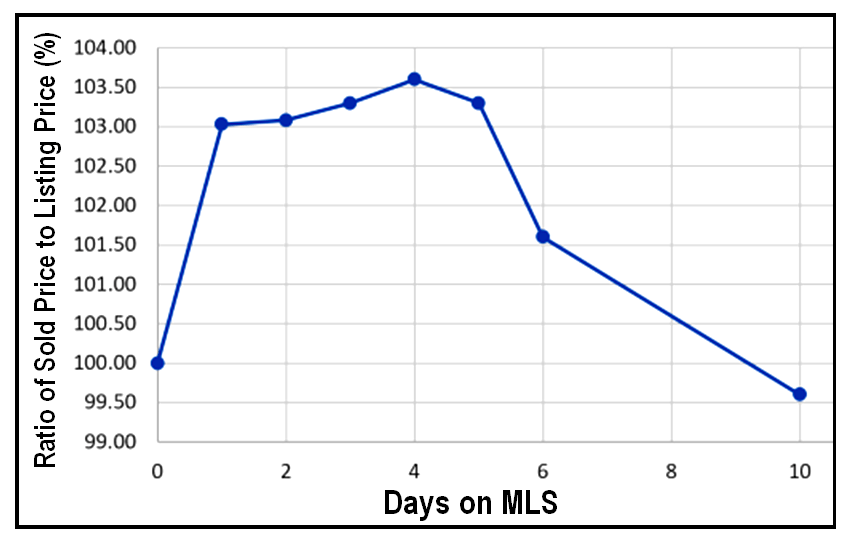
I have written before that 4 days on the MLS is the right amount of time to get the highest price for your home. That was based on an analysis I did several years ago, so it’s time to do a new analysis.
Looking at the 4,015 most recent sales in Jefferson County, here’s what I discovered.
Roughly 5% of those sales showed zero days on the MLS, meaning that they weren’t even exposed to agents or the public until they were under contract. The median ratio of sold price to listing price for them was 100%. Some sold for over the listing price and some for less, but the median was the listing price.
Meanwhile, 200 homes went under contract after being on the MLS only 1 day. The median home for this group sold for 3.03% over its listing price.
There were 379 homes that were active on the MLS for 2 days before going under contract. The median home in that group sold for 3.08% overits listing price.
502 homes went under contract after 3 days on the MLS. The median home in that group sold for 3.3% overits listing price.
The highest number of homes, 608, were active on the MLS for 4 days before going under contract. The median home in that group sold for 3.6% over its listing price.
As in my prior analysis, being on the MLS for 4 days netted the highest price for the seller.
413 homes went under contract after 5 days on the MLS. The median home is that group sold for 3.3% overits listing price.
Another 206 homes went under contract after 6 days on the MLS, but the median home in that group sold for just 1.6% overlisting price.
Skipping ahead to the homes that were on the MLS for 10 days before going under contract, the median home in that group sold for 0.4% belowthe listing price.
Those statistics are displayed graphically on the chart above. Not shown in that chart is how low the ratio of sold price to listing price went for homes that languished on the market, usually because they were overpriced at the beginning. Here’s that other data:
223 homes were active on the MLS for 30 to 45 days before going under contract, and the median home in that group sold for 3.8% below the listing price. Looking at the 106 homes that were active on the MLS for 46 to 60 days, the median home in that group sold for 4.3% below listing price.
Lastly, 285 homes were active on the MLS for over two months. The median home in that group sold for 5.7% below the listing price.
The lesson for sellers is that you need to price your home to attract multiple offers and not accept the first (or second) good offer that you receive. Four days is the right amount of time, with proper marketing, for all potential buyers to learn about your home and enter the competition for it.
Selling it without making it active on the MLS at all, as too many sellers are currently doing, may be convenient, but it likely leaves money on the table.
There’s another way that sellers leave money on the table, and that is to hire a listing agent who uses the “highest and best” approach to handling multiple offers. It is the most common method used, but the agents of Golden Real Estate use a better approach — being open and transparent, handling bids auction-style.
The auction style of handling multiple offers is simple, but it does require more work by the agent and more patience on the part of the seller. Buyers and their agents appreciate this approach — and sellers are likely to net more money.
I have a good example from last week. I listed a home for $595,000 and got it under contract for $725,000, and I did it with only four bidders. If I had asked for “highest and best,” I would have had many more offers, and maybe the highest and best would have been $625,000 or maybe $650,000. But because I let every agent know the details of every offer I received, I received fewer offers, and those I did receive knew when their offer was exceeded by another offer. At that point they could either resubmit or drop out.
This process truly resembles a public auction, in which everyone knows where they stand and can choose to raise their bid or drop out. No one is blindsided. The worst thing for a buyer is to discover later that if they had only offered a little more money they could have purchased the home they wanted.
It’s hard for me to understand why listing agents won’t reveal their highest offer to other agents. There is no rule against it, but some agents seem to think there is. Some agents claim that their seller doesn’t want them to reveal details of the offers in hand, but I don’t believe that. And if it’s true, then the seller wasn’t told about the advantages of the auction style of managing offers.
If you want to get the most money for your home, use an agent like those of us at Golden Real Estate who are willing to do the extra work of handling multiple offers auction-style.
You can blame “Monopoly” for some of the confusion. That board game taught us all that there is such as thing as a “deed” to a property. With a “deed” to Boardwalk and some houses or a hotel on it, you could charge rent to those who landed on it — and hopefully win the game.
Meanwhile, the Department of Motor Vehicles has taught us that there is such a thing as a “title.” Meanwhile, when you purchase a home, you receive a “title policy” which guarantees “clear title” to your property.
But surprise! There is no such document as a “title” to your home the way there is a title to your car. There is a document called a “deed” but that is the document which transfers ownership, it is not proof of ownership. Sorry, I know this is confusing!
So where is the proof that you own your home? It is held by the Clerk & Recorder of your county, and it’s based on the most recent deed recorded with the county. The only proof that Rita and I own our home in Golden is that the most recently recorded deed transferred the property to us. There is no other document which we have or can produce to prove we own our home.
Last year the state-mandated contract for the purchase and sale of real property changed the way deeds are specified. The agent preparing the contract specifies whether the buyer wants to obtain ownership through one of several deeds.
First is the “Special Warranty Deed,” by which the seller warrants that he is transferring ownership of his property free of any known lien or claim of ownership during the time he/she or they owned the property. That is the most limited type of deed.
The buyer might, however, demand a “General Warranty Deed,” by which the seller is warranting that there is no other claim of ownership (or lien against the property) going back to the beginning of time.
What you need to know, however, is that, regardless of which type of deed is used to transfer ownership, the buyer should receive an “owner’s title policy” (typically paid for by the seller) guaranteeing free and clear title to the buyer. In other words, it hardly matters which type of deed is used to transfer the property. You’re still protected.
Title insurance differs from other kinds of insurance because it has no term. It is a one-time purchase that covers the new owner of the property forever. It never has to be renewed.
Prior to issuing the title policy, the title company does a “title search” looking for any recorded claim of ownership or lien against the property in question. If a claim or lien is not recorded with the county in which the property is located, it can’t be enforced.
It is possible, of course, that a claim or lien might be overlooked during the title search, but it’s pretty rare. I recall once in 1991 I purchased an older (1905) office building in Denver, receiving a title policy from Land Title Guaranty Company. Within a year or so, I was notified of a lis pendens against the property, but the lawyers for Land Title did whatever they had to do in order to clear it, costing me nothing. Since that time I can’t think of any claims against any title policy held by me or any of my clients — and I’ve had quite a few!
There are other types of deeds beside Special Warranty and General Warranty. If the property is owned by the estate of a deceased person, the property is transferred by a “Personal Representative’s Deed.” If the property is purchased at a foreclosure auction, it is transferred by a “Public Trustee’s Deed.” If a property is purchased out of bankruptcy, it is transferred via a “Trustee’s Deed.”
A “Quit Claim Deed” is used when real estate is transferred without being sold for money. For example, if John Doe were to marry Jane Doe and wanted to put a home he owned in both their names, he could “quit claim” it from John Doe (as “grantor”) to John & Jane Doe (as “grantees”). If they divorce later on, John & Jane Doe might quit claim the house to either John or Jane, with or without a monetary settlement on the side.
With such examples, I hope you now understand that a “deed” is in fact an instrument of transfer, and not a title to property.
Because there is no physical title to real estate, the first thing that a title company does when asked to execute a contract to sell a parcel of real estate is to issue a “title commitment,” which is a document asserting who the recorded owner of the property is and to whom it is to be transferred.
There is one other use of the word “deed,” and that’s for the “Deed of Trust” which a mortgage or other lender has you sign when you take out a loan of any kind which is secured by your home. That document is recorded with the County Clerk & Recorder and is the basis for that official to hold a foreclosure auction if you default on the loan.
I am not a lawyer, and I am providing this information as I understand it from real estate classes and from my experience as a real estate licensee. You’ll want to engage a lawyer if you require further explanation, and I, like any real estate licensee, can refer you to one.