Interestingly, ‘Seller Concessions’ Can Benefit Both Buyers & Sellers

If you’ve been following my “Real Estate Today” column, you know that homes are taking longer to sell, and in some areas sales prices have decreased slightly.

Jaxzann Riggs, owner of The Mortgage Network, has been serving Colorado borrowers for 37+ years and she has witnessed more market fluctuations than I have in my 20 years. I asked her what “old and new” marketing and financing strategies she suggests for both buyers and sellers in this dynamic market.

   Her response: “First, buyers need to understand their highest priorities. Is investing the smallest amount of cash their priority, or are they more interested in minimizing the monthly housing expense in the early years of the loan? If they expect to own the property for many years, having the lowest possible 30-year fixed rate may be the highest priority. Buyers who are fortunate enough to be paying cash for a home are normally looking for the lowest possible purchase price, in which case seller concessions won’t matter to them.”

Let’s analyze each goal and how a seller concession built into a purchase contract can help you.

Goal #1:  Lowest Cash to Close

If your income is good and you are not concerned about your monthly housing expense, but you don’t have much cash to work with, a popular seller concession is one that covers your closing costs. That way, you only need cash for the down payment.

Goal #2:  Lowest Payment in the Early Years of Your Mortgage

If your income is likely to increase in the near future, and you want to minimize your monthly housing expenses until your pay increases or you receive an expected bonus, a temporary interest rate buydown funded by a seller concession might make sense. The simplest explanation of this strategy is that the buydown subsidizes a reduced monthly mortgage for the first one or two years of the mortgage.

Goal #3:  Lowest Interest Rate for the Term of the Mortgage

If this is a property that you expect to own for many years, it makes sense to ask for a seller concession that is utilized to buy the interest rate down on your mortgage for its full term.

So, the next question is, what is a reasonable dollar amount for a borrower to request from the seller as a concession? Each borrower and seller circumstance will vary, so there is no set rule, although Fannie Mae and Freddie Mac underwriting guidelines limit the seller to a contribution of 6% of the sales price (or 3% if the borrower is making a minimum down payment).

Seller concessions may only be utilized to offset closing costs, reduce the interest rate on a temporary or permanent basis, or to prepay mortgage insurance on behalf of the borrower. Seller concessions may NOT be used to reduce the down payment made by the borrower.

It might surprise a prospective buyer to understand the different impacts that a seller concession versus a price reduction can have on the monthly cost of their mortgage. And it might surprise sellers to learn that offering a concession in the form of an interest rate buydown can increase the pool of prospective buyers.

I am happy to explore buyer and seller wants, needs, and goals. Structuring a seller concession so that both buyer and seller benefit is possible once all parties agree upon the anticipated appraised value of a property. Of course, this is best done with the assistance of an experienced Realtor like me who knows how to evaluate the market trends in a particular community.

    If you are buying or selling and have questions about the different possible concessions, call Jaxzann at 303-990-2992.

Report Details How the Inflation Reduction Act Will Transform the Building Sector

One of the best analyses of the impact of the IRA on sustainability and the mitigation of climate change was released on Aug. 31st by the Rocky Mountain Institute. Below is a graphic from that report summarizing the IRA’s biggest direct impacts. Click here to view the full report.

As reported by Fast Company, the report “finds that the IRA’s main rebates and tax credits could bring electrification and energy-efficiency upgrades to millions of homes. In total, the bill’s new rebates and expansions of existing tax credits will create more than $23 billion in funding to electrify homes, upgrade heating, cooling, and ventilation equipment, and develop entirely new buildings that meet the highest federal standards for efficient energy use.” The IRA provides funds or rebates for:

Electric heat pumps that can both heat and cool your home, which the Department of Energy estimates will save families $500 to $1,000 every year. There’s a rebate of up to $14,000 for installing them.

Induction cooktops, which replace dangerous and health-harming gas stoves that contribute to asthma and other respiratory diseases.

Insulation, windows, doors, and sealing ductwork, which will ensure a home’s heating and cooling systems don’t have to work as hard to keep families comfortable.

Upgraded electrical panels and wiring for homes that have older electrical service.

The tax credits provided for in the IRA are available immediately, but the rebate program will take some time to be implemented, since it requires the creation of rules and forms.

Big Brokerages’ Stocks Plummet Due to Slowing Market

The publicly traded brokerages are taking a beating, trading near their 2022 lows, as the following stock prices quoted last Wednesday by Inman News Service show:

Compass (COMP)     $3.28 +.07   (year range: $3.20-17.70) 

eXp World Holdings (EXPI)     $14.23  -.06   (year range: $11.06-55.43) 

Redfin (RDFN)    $9.40  -.08   (year range: $7.13-55.87) 

Zillow (Z)    $34.39   +.96  (year range: $28.61-104.05)

Offerpad (OPAD)  $1.61 -.02 (year range $1.60-20.97)

Opendoor (OPEN)   $4.62 -.03 (year range $4.30-25.32)

Anywhere Real Estate (HOUS)     $11.18 +.14 (year range: $9.06-21.03) 

(Anywhere Real Estate is the new name for Realogy, which owns and franchises Century 21, Coldwell Banker. Corcoran, Better Homes & Gardens Real Estate, and ERA Real Estate.)

Golden Real Estate was founded in July 2007, just before the market crash of 2008, but we prospered through that downturn, and we will prosper through this one.

MLS Statistics Confirm a Rapidly Slowing Real Estate Market in Metro Area

As I write this on Sunday evening, I can’t know what the statistics will be at the end of August, so I ran some numbers for the first 28 days of the month to see how they compare to the previous 12 months. The result of that number crunching is in the chart below, and it confirms what we have all been feeling — that the real estate market in the metro area is indeed slowly abruptly.

The chart, limited to REcolorado listings within an  18-mile radius of the state Capitol, shows four metrics which I consult regularly to read the temperature of the market: the average and median days that a listing is active before going under contract, the ratio of sold price to listing price, and the average sold price. As you can see on the bottom four lines of the chart, the market started coming off its peak in May, slipping seriously by July.

During the seller’s market triggered by low mortgage interest rates and the pandemic, we saw the median days on the MLS in the mid single digits, as shown in column two. The average days on the MLS was higher, but not as high as in pre-pandemic times when it was in the 30s and 40s. Amazingly, that metric slipped into the single digits this April and May.

The last time the ratio of sold price to listing price was below 100% was in January 2020. In April of this year, before the impact of rising mortgage interest rates, it peaked at 106.1%, but it fell to 100% in July for the first time in 18 months, and during the first 28 days of August, it slipped to 99.57%.

The average sold price, which fell almost $30,000 in July, fell an unprecedented $58,136 during Aug. 1-28, a 9.2% drop in just one month.  When the full month is tabulated, it could well be worse.

For buyers who have cash or are not scared away by 5% interest rates, this represents an opportunity, and I have had my busiest open houses in a long time over the past three weekends, so I think buyers are ready to capitalize on that opportunity.

This is not to say there will be a market rebound anytime soon. There is a lot of uncertainty in the air in terms of politics, economics, and other matters, which will continue to keep many buyers on the sidelines.

Crested Butte Bans Natural Gas in New Construction — A New Statewide Trend?

Given our commitment to addressing climate change, one of my favorite email newsletters is “Big Pivots,” written by Allen Best of Arvada, The mission of his non-profit is to document, understand and educate about the changes made necessary by climate change.

Among those changes is the transition from fossil-fuel heating of homes and water using natural gas and propane now that electric heat pump units are practical and affordable.

The latest Big Pivots email newsletter (which you can subscribe to at bigpivots.com) was about Crested Butte’s recent decision to outlaw natural gas in new construction. Rather than rewrite what Allen wrote, here is his article with some minor edits:

By ALLEN BEST

Crested Butte, a one-time coal mining town, has now turned its back on natural gas. Town councilors unanimously agreed that any new building erected on the 60 vacant lots cannot be served by gas. Major remodels must be electric-ready. It’s Colorado’s first natural gas ban, although 80 other jurisdictions around the country have taken similar measures.

“There was a lot of talk at council about it being a bold decision, but I don’t see it that way,” said Crested Butte Mayor Ian Billick. “Not only is it what we need to do, but we have all the tools to do it cost effectively.”

Billick arrived at Crested Butte several decades ago as a biologist at the nearby Rocky Mountain Biological Laboratory. Many experiments there have focused on the effects of warming temperatures on existing plants. One experiment involving year-round heat lamps specifically foretells a shift from the showy wildflowers for which Crested Butte is famous to an ecosystem dominated by sagebrush.

Temperatures continue to creep higher, but at more than 8,900 feet in elevation, Crested Butte still has chilly winters. The overnight temperature during January averages 6 below.

The takeaway here is that if Crested Butte is comfortable with the replacement technologies for natural gas, most other places in Colorado should be, too. Instead, builders are still tethering tens of thousands of homes and other new buildings each year to natural gas pipelines.

Denver and Boulder have taken steps to push alternatives. Here and there individual action has occurred. In Westminster, John Avenson in 2017 ordered his natural gas meter removed after maximizing the passive solar potential of his house. (YouTube video tour of John’s home.) In Arvada, Norbert Klebl developed 30 homes without natural gas in a project called GEOS. In Basalt, two affordable housing complexes have been built without natural gas. An all-electric hotel is under construction in Snowmass. North Vista Highlands is slowly taking shape in Pueblo. In Fort Collins, plans have been drawn up for Montava, a  500-unit project.

We have been pivoting slowly, but the transition is accelerating.

Granted, the generation of electricity still causes atmospheric pollution. Emissions will dramatically drop by 2030, however, as Colorado’s utilities close nine of today’s 10 coal-burning units.

Colorado legislators in 2021 passed several laws that collectively seek to squeeze emissions from our buildings. The laws reflect the state’s political makeup. Colorado may be dominated by Democrats, but it’s still a purplish state. In other words, don’t expect a wave of Crested Butte-type mandates such as occurred in California beginning in 2019. We walk on a different balancing beam.

Most important among Colorado’s legislative squeezes is Senate Bill 21-264, which requires Colorado’s four regulated natural gas utilities to incrementally reduce emissions.

The law identifies several pathways. They can, for example, help customers improve efficiency of buildings, so buildings need less gas to provide comfort. They can augment the methane obtained by drilling with methane diverted from sewage plants, feedlots and other sources. The first of their plans will be filed with state regulators in 2023. The bottom line is that the gas companies will have to adjust their business models.

The Colorado Public Utilities Commission has now set about creating rules for evaluating clean-heat plans. In filings beginning last December, real estate agents, home builders and even some municipalities have argued that converting from natural gas will add costs. That was the same message at recent meetings in Montrose and Grand Junction. Their message was simple: Don’t change.

In metro Denver’s more affluent northwest suburbs, Christine Brinker of the Southwest Energy Efficiency Project reports a draft policy would give builders a choice between either all-electric or natural gas with extra energy efficiency.

Unless a way can be found to cost-effectively sequester carbon emissions, natural gas will slowly be phased out in coming decades. Ironically, the arrival of natural gas was one reason that coal mining ended in Crested Butte in 1952 after a seven-decade run.

We Reduce the Cost of Moving for Homebuyers

We have offered buyers and sellers free use of our box truck since 2004, saving each of them thousands of dollars in moving costs. We also provide moving boxes and packing materials. The truck comes with blankets and dollies, too. For new clients who sign with us in the month of September, we are offering Totally Free Moving. That means we not only give you free use of the truck, we also pay for the labor and gas for any move within the Denver metro area. Call any of us (see list below) for the full details of this special one-time offer!

Jim Smith, Broker/Owner,       303-525-1851

Broker Associates:

Jim Swanson, 303-929-2727

Chuck Brown, 303-885-7855

David Dlugasch, 303-908-4835

Ty Scrable, 720-281-6783

Greg Kraft, 720-353-1922

Pricing Your Home Right Is More Important Than Ever

The “seller’s market” is slowing. You can still sell your home quickly and even attract a bidding war, but that requires pricing your home correctly. Overprice it, and it could sit on the market for a long time, go through multiple price reductions, and end up selling for less than if you had priced it correctly in the beginning. The agents of Golden Real Estate and I can help you thread that needle.  Call any of us for a free consultation.

The softer real estate market also makes marketing your home well more important than ever, and no brokerage provides the kind of marketing — including promotion of your home in this column and our trademark narrated video tours — that Golden Real Estate provides. Our phone numbers are below.

Jim Smith, Broker/Owner      303-525-1851

Broker Associates:

Jim Swanson, 303-929-2727

Chuck Brown, 303-885-7855

David Dlugasch, 303-908-4835

Ty Scrable, 720-281-6783

Greg Kraft, 720-353-1922

Statistics Help to Quantify the Slowing Real Estate Market in Metro Denver

Here are some ways I’ve been able to quantify what we are all seeing, namely the slowing of our local real estate market.

Looking within 14 miles of downtown Denver, the currently active (i.e., unsold) listings have a median days on MLS (DOM) of 27 days. However, the currently pending listings have a median DOM of 13, and the listings that closed in the last 30 days have a median days on the MLS of 7.

The listings that closed in the prior 30 days had a median DOM of just 5, which is what it has been, more or less, through the past couple years. So the market is definitely slowing, and slowing rather abruptly.

The number of active listings —  what we refer to as “inventory” — has surged as homes sit on the market longer.

As I write this on Tuesday morning, there are 4,133 active listings on REcolorado, the Denver MLS, in that same 14-mile radius. That’s down from the peak of 5,521 at the end of July, but you have to go back to September 2020 to find a higher number of active listings than this July, as shown in the chart below.

In prior years, you’d see the number of active listings increase by 50%, more or less, from January to July, but look at this year’s more than triple surge from January to July in that chart.

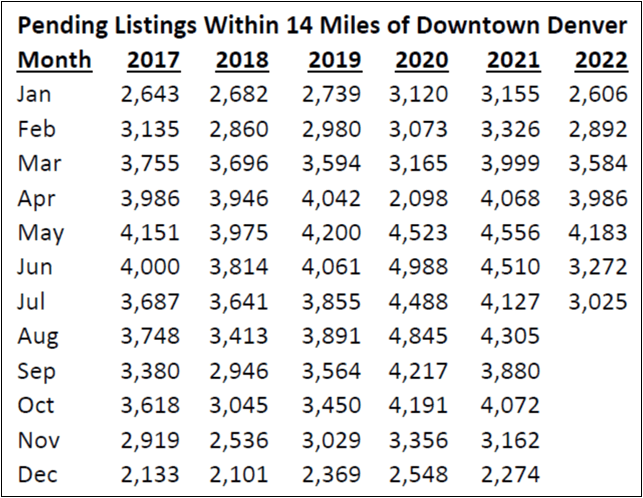
The chart of pending listings (below) is also instructive. Notice that in most months during 2021 and 2022, the number pending listings was almost always higher than the number of active listings (above chart), but that changed in June and July, when the numbers dropped dramatically.

You’d expect, in a normal market, with a lot more listings to choose from, that more listings would go under contract, but the reverse was true. As the number of listings surged in June and July, the number of listings going under contract went down substantially. That, too, reflects an abrupt slowing of Denver’s real estate market.

(As an aside, notice the effect of the pandemic on the April 2020 number of pending listings. April was the first full month of the pandemic, and the number of listings going under contract plummeted at a time of year when they would normally surge. Notice, however, the quick recovery in the following months. It has been surmised that Covid soon caused a surge in sales as people began to work at home and saw the need for more home office space and the opportunity to move further from their place of work since they were no longer commuting.)

Another statistic demonstrating the slowing of Denver’s real estate market is the extent to which the median sold price of homes has fallen as the market has turned.

The median sold price for that   14-mile radius peaked at $582,950 in June, but it fell to $550,000 in July and has fallen to $520,000 for closings during the first half of August — going down, but still higher than in any prior year.

NOTE: The above article was adapted for a Jefferson County audience using only Jeffco statistics. You can read a PDF of that version at www.JimSmithColumns.com.

Looking for a Good Deal? Opendoor Is Slashing Prices to Clear Its Inventory

I wrote about Opendoor last week. They’re one of the “iBuyer” companies that buys off-MLS listings and flips them for a profit. Or at least that’s how it’s supposed to work, but too many homes haven’t sold, and they drop their listing prices twice each month until they sell. For too many of their listings, that means they will be getting far less than what they paid for them.

As I write this on Sunday evening, there are 446 unsold Opendoor listings on Denver’s MLS, and the median days on the MLS is 58!  It’s apparent that they bought many of these listings during those heady days before the market softened and now they can’t sell them for a profit or even at the price they paid for them.

To keep it manageable, I studied only the 45 Opendoor listings currently active in Jefferson County. The median days on the MLS for those listings is 75!  That’s three times the median days on the MLS for all active listings in Jefferson County. All but two of those listings have been active for at least 12 days, and all 43 of those have had their prices cut to try to clear the company’s inventory. They’re going to lose money on most if not all of them.  Here are some examples:

They purchased 11022 Trailrider Pass, Littleton, for $631,400 on Dec. 2nd and listed it on Feb. 17th for $820,000.  Nine price reductions later, it’s now listed at $643,000 and has yet to go under contract. At the current price, they will pay their usual 2.5% buyer agent commission, netting them about $5,000 less than they paid for it. Presumably they also had some repairs, repainting and other expenses during the two months between buying and listing.

Opendoor’s oldest listing, 2090 Braun Drive, Golden, was purchased last September for $638,300, and is currently listed for $621,000 after one failed contract and three subsequent price reductions.

4740 S. Tabor St., Morrison, was purchased for $500,500 in December, listed for $612,000 two months later, and after nine price reductions and no contracts, it’s listed at $527,000. Depending on how much money they spent dressing up that listing during those two months, they might break even.

Here are some of the Jeffco listings on which Opendoor will lose a lot of money:

Unsold Jeffco listings priced as much as $50,000 below what Opendoor paid for them:

6384 Newland St., Arvada ($579,000)

7076 Parfet Street, Arvada ($626,000)

6975 W. 63rd Ave., Arvada ($577,000)

12463 W. 68th Ave., Arvada ($693,000)

7155 Fenton Circle, Arvada ($568,000)

9010 W. 5th Pl., Lakewood ($594,000)

289 Marshall St., Lakewood ($657,000)

10112 W. Dartmouth Ave., Lakewood ($379,000)

10946 W. Texas Avenue, Lakewood ($558,000)

11266 W. Kentucky Dr., Lakewood ($575,000)

5645 S. Zang Street, Littleton ($481,000)

6309 W. Fair Dr., Littleton ($649,000)

10679 W. Cooper Place, Littleton ($776,000)

7782 W. Alder Dr., Littleton ($786,000)

6230 W. Maplewood Place, Littleton ($666,000)

5683 W. 118th Place, Westminster ($556,000)

11526 Marshall Street, Westminster ($495,000)

10012 Holland Court, Westminster $464,000)

10063 Flower Street, Westminster ($723,000)

9679 Teller Court, Westminster ($576,000)

6280 W. 45th Avenue, Wheat Ridge ($573,000)

Of the 177 Opendoor listings (in all counties) which closed in the last 90 days, only 18 sold at or above their original listing price. More than half sold for at least 5% below their original price.  In the same 90-day period a year ago, 55% of Opendoor’s listings sold at or above their original listing price.

One could argue that the iBuyer model is still valid and that the company just suffered from the abruptness of the change in the real estate market. Meanwhile, it is also reported that although the market has slowed, prices are still increasing, so perhaps there are some bargains to be had among Opendoor’s “stale” listings.

Although Opendoor Brokerage is difficult for brokers and buyers to work with (they are managing 446 Colorado listings from their office in Tempe, Arizona), my broker associates and I would be happy to show you any of their listings and see if we can get you a good deal!

Let’s Hear It for the Multiple Listing Service: The Best Tool for Buyers & Sellers  

We hear a lot about “off-MLS” sales of homes, particularly by investors. Investors love to buy homes off the MLS, but they turn to the MLS to sell the homes they bought. Prospective sellers should read that sentence again, because it says everything you need to know about the value of the MLS: Buyers can pay less if the seller doesn’t put their home on the MLS; and sellers net more money by putting their home on the MLS.

Investors know they would pay “market value” for MLS listings, because that’s what the MLS is — it’s the market! Investors know they’ll be competing with other buyers if the home is on the MLS. That’s why they find the homes they buy by soliciting homeowners who do not have their home on the market.

They make an appealing pitch — no showings, no open houses, and a quick cash closing. Remember, investors are in business to make a profit, and the only way to make a profit is by paying you less than your home is worth by buying it off the MLS, and then selling it on the MLS.

Now, if money doesn’t matter that much to you — for example, you’re the personal representative of an estate, but you’re not a beneficiary — that’s probably an attractive pitch. After all, it’s not your money! But, if it’s your house and your money, just know that you’ll make more money from the sale of your house if you let a professional like one of the agents at Golden Real Estate expose your home to the full market — which is only accomplished by putting the home on the MLS.

I have written in the past about “iBuyers,” such as Open Door, which buy homes off the MLS, then flip them with minimal improvement by listing them on the MLS. You can find columns on that topic dated Jan. 2, 2020, and Aug. 22, 2019, at JimSmithColumns.com, where all these columns are archived. In those columns I point out that the iBuyer companies typically convince homeowners to meet with them by offering a high sight-unseen price, which is thousands above what they finally offer the seller. It’s a bait and switch approach, so beware!

The essence of the MLS is “cooperation and compensation.” Sellers hire a listing agent for a negotiable commission — currently averaging under 6 percent — which is large enough for the listing agent to compensate another MLS member for producing the buyer of that listing.

There’s an understandable misconception that the seller pays both the listing agent and the buyer’s agent and that somehow that’s unfair — that the buyer should pay his or her own agent.

But, although it may look as if the seller is paying both agents — because it is taken from the seller’s proceeds at closing — in fact, as I said above, the listing agent is paying the buyer’s agent out of his or her listing commission.

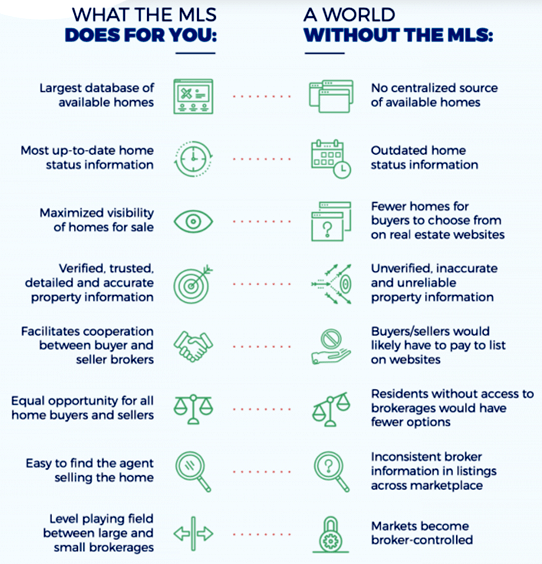
As shown in the graphic below, the MLS is at the heart of making the real estate market work efficiently to expose listings to the full universe of buyers. No other industry that I can think of works as well as the real estate industry, because no other industry has an MLS.

Last year, the National Association of Realtors introduced the Clear Cooperation Policy to make the MLS system work even better, telling participating Realtors, in effect, that if they want to be a member of the MLS, they must commit to giving fellow members a reasonable opportunity to find and sell their listings.

That policy has yet to achieve its goal because some MLS members find a way around it so they can sell their listings without sharing their commission with other MLS members. Golden Real Estate’s agents, however, are in full compliance.