The summer 2022 edition of Realtor Magazine focuses on sustainability, and one of its articles is titled “Learning to Love EVs.” Click here to read the article online.
The article encourages NAR’s one million members to make their next car electric, but omits one selling point I take advantage of every April — I deduct over $10,000 for business mileage even though the cost of charging is near zero thanks to an abundance of free charging stations. Even if pay for the electricity — whether at home or at Tesla Supercharger or a DC Fast Charging station — the cost of the electricity is so much lower per mile than the cost of a gas-powered car, that the standard IRS deduction per business mile traveled becomes a nice source of tax-free income for Realtors or any other person who uses their personal car for business.
Regular readers of this column know that home electrification has been “now” for many years here at Golden Real Estate. At the Net Zero Store in our former building at 17695 S. Golden Road, Helio Home Inc. is busier than ever responding to people who want to replace their gas forced air furnaces with heat pump units and their gas water heaters with heat pump water heaters. (You can reach the Helio Home sales team at 720-460-1260.)
The primary focus of the Realtor Magazine article is on the need for home builders to include a larger electrical service as fossil fuels are phased out. Number one, it said, was to accommodate an electric car, since the major car manufacturers are committed to going all-electric or mostly so by 2030.
The article promotes the idea of installing solar photovoltaic (PV) systems to generate electricity for your home and car. With such a system, the author of the article correctly points out that the electrical grid can function as your home battery (thanks to net metering), but seems not to understand how it really works. He states that the utility will buy your excess solar generation but you might have to buy electricity for your car on a cloudy day. In fact, net metering allows you to send surplus electricity to the grid when you don’t need it, but you get it back at full value when needed. Everyone with a solar PV system should take advantage of the “roll-over” option allowing you to be credited for that surplus production long-term rather than get a check each January for the previous year’s over-production.
When the utility pays you for your surplus production, it does so at its cost of generating electricity — a couple cents per kilowatt-hour. But if you use your surplus electricity, you save the full retail rate (over 10¢ per kilowatt-hour) versus purchasing those kilowatt-hours from the utility.
Not understanding that process, the author promotes the idea of a home battery system, but, as I wrote before, that only needs to be considered if you have medical equipment which must run during a blackout.
The author promotes the installation of a 240V car charging station, suggesting that this could require a larger electrical panel in older homes. I disagree. The Level 2 charging station only draws the same electricity as your electric clothes dryer. If your panel can’t accommodate a dedicated circuit for the car, you could use the same one as the clothes dryer and not use both appliances at the same time. (I recognize that this is not what the code dictates, but it’s still safe if you have a 40-amp breaker on that circuit, because if you do run the dryer and the car charger at the same time, it would trip the breaker.)
Also, every EV comes with a 120V cord to plug your car into a standard household outlet. Although that only gets you 4 miles of range per hour, that’s still over 50 miles of range overnight, which may suffice, especially if you have other charging options during the day. Downtown Golden, for example, has ten free Level 2 charging stations in its garages and elsewhere.
Of course, there’s more to home electrification than car charging. The article points out that there are now electric outdoor tools—lawn mowers, leaf blowers, snow blowers, chain saws and more—that you can buy online or at Lowes. Ego Poweris the biggest brand in this field, and their various tools all use the same interchangeable batteries.
Not mentioned in the article are the biggest consumers of fossil fuels—your gas furnace and water heater. As I said, you can speak to Helio Home about converting gas units to electric heat pump units.
For cooking, I have written in the past about induction electric ranges, and I’m really fond of our electric grill shown here. Lift it off its stand and you can use the grill on your countertop. You can’t do that with a gas grill! And it plugs into a standard 120V patio outlet. We bought ours at Home Depot for $100. Food grilled on it tastes just as good as when cooked on a gas grill.
Can the electrical grid handle the increased use of electricity over fossil fuels, given, for example, that by 2030 over 50% of car sales in America will be all-electric? You may have read warnings that widespread adoption of EVs will overwhelm our electrical transmission systems, but I disagree. Solar panels are being installed just as quickly and perhaps more so, and that electricity is consumed within your neighborhood if not by yourself, reducing the needed distribution from the utility. And, as I said, even with Level 2 charging, an EV only draws the same amount of electricity as a clothes dryer.
Home builders can and should adapt to this trend, and are in fact required to do so in some jurisdictions. Every new home should be solar-ready if not solar-powered, by building chases into the home which could accommodate the electrical lines serving roof-mounted solar panels. Also, garages should be wired with a 240V outlet on their front walls in addition to the usual 120V outlets on three walls.
I was encouraged to see that a new 300-unit apartment complex about to break ground in Lakewood between Colfax and 15th Place and between Owens and Pierson Streets is, according to the plans I saw, going to have over 40 EV parking spaces in its garage.
One of the more interesting flaws in the Realtor Magazine article was the suggestion that home garages should be insulated or even heated to avoid shortening the life of an electric vehicle’s battery. This is a misinterpretation of the fact that EVs lose range in the winter. It’s not that the battery loses power in cold weather, but rather that heating the car’s cabin uses battery power which thereby reduces the car’s range, as does the heating of the battery itself to its optimum operating temperature.
It’s that time of year when I like to remind readers about the advantages of electric vehicles (EVs) in cold weather. Here’s what you need to know.
1) No warming up is needed. Put the car in Drive and go! Also, the cabin will be warm within 1/2 mile because it doesn’t require an engine to warm up first. In my Tesla I can turn on the heat with my phone app a few minutes earlier so the cabin, steering wheel and seat are all warm when I get in the car. Also, I can leave the heater on when I park the car so it’s warm when I return, if I am just going into a store for a short time. (I do the same thing on hot summer days, so it stays cool!)
2) Your car will never break down, stranding you in a freezing car on the side of the road. The only time you see an EV on the side of the road is if there’s a flat tire or an accident. Stuck in a snow drift? The EV’s heater will keep you warm as long as you need, consuming only 3 to 5 miles of range per hour — and producing no carbon monoxide!
3) Because of its low center of gravity, an EV handles snow-covered (and dry) roads great — better than any car I’ve owned.
4) Used EVs are your best buy. The older (pre-2018) Tesla Models S & X are a great buy because most come with transferrable lifetime free supercharging coast-to-coast when purchased privately, not as Certified Pre-Owned from Tesla. Ask before buying.
It’s still going on as I write this blog post, and won’t end until 5 pm or later. If you’re reading this now, come on down! This video shows our parking lot at Golden Real Estate, 17695 S. Golden Road, completely filled with electric cars and their owners talking to lots of people interested in knowing more about EVs. Here’s the video link: https://youtu.be/4vY2K6OZt0k.
Other than for a flat tire, you’ll almost never see an electric car on the side of the road awaiting a service vehicle or tow truck. That’s because an EV will never need any of the following expensive repairs — the parts simply don’t exist on an EV:
Transmission
Timing belt
Fuel pump
Muffler or stolen catalytic converter
Water pump
Fan belt
Power steering pump
Power brakes pump
Radiator leak/anti-freeze
Engine work of any kind
Spark plugs/points
There’s no “check engine” light because there’s no engine, so you won’t pay to “pull codes” and reset it. And no emissions testing. The electric motors in EVs, like those in other devices, are dependable, only failing if they are worked too hard, and the computers in Teslas (and presumably other EVs) don’t let that happen.
EVs have Battery Management Systems (BMS) which are critical to maintaining battery health and performance. In Teslas, there is a sealed coolant system which maintains the battery at its optimum performance temperature (70° F) year-round, including cooling it when it is being supercharged or when it sends a high level of power to the electric motor(s).
Lithium batteries, unlike lead acid batteries, do not fail abruptly, but rather degrade over time. The reason lead acid batteries fail abruptly, I’m told, is that they consume the lead when they are charged and discharged. Lithium ion batteries don’t consume the lithium. The rate of degradation has been estimated at 1% per year, so a battery with 300 miles of range might degrade to 270 miles of range in 10 years. That matches my experience.
As people wait for the purchase price of EVs to equal that of a gas-powered car — which has largely happened — they shouldn’t overlook the lower cost of fuel (3 to 4 cents per mile vs.10 cents and higher) and the dramatically lower cost of maintenance and repair. And fleet buyers won’t have to buy 12 EVs in order to always have 10 on the road because of how rarely EVs will be in the shop.
Golden Real Estate is justly proud — if I say so myself — of having a Net Zero Energy office, meaning that our solar photovoltaic panels produce all the electricity needed to heat, cool and power our office as well as to the charge the five Teslas owned by our agents and me and offering free EV charging to the general public. (We have four EV charging stations at our office — two for our own use and two for the public.)
Meanwhile, Xcel Energy boasts that it is moving in the direction of 100% renewable energy and facilitating the adoption of electric vehicles. A big part of that is promoting “workplace charging.”
Xcel is right to promote workplace charging over, say, charging stations at retail stores, because cars are parked for up to 8 hours at one’s workplace — long enough to fully charge almost any EV using a standard Level 2 (240V) charging station.
So why is Xcel Energy penalizing small companies like Golden Real Estate which have already installed workplace charging stations for EVs?
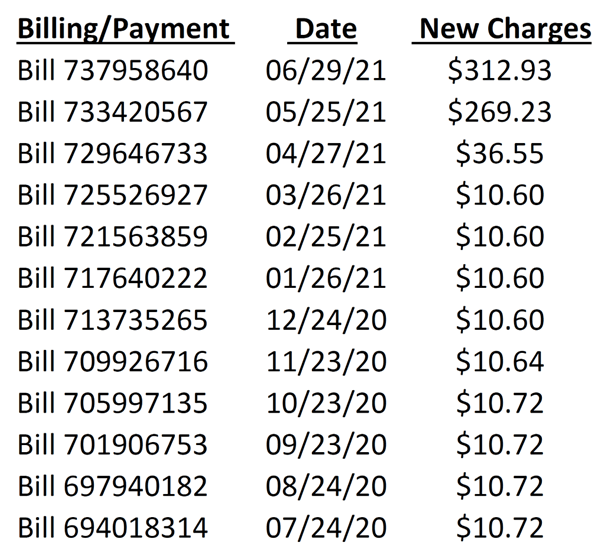
As stated above, we generate all the electricity needed at our office on South Golden Road. Until this March, our monthly Xcel bill was under $11 every month — the cost of being connected to Xcel’s electric grid.
But now our Xcel bill is over $300 per month, even though we are still generating all the electricity we use. How can that be? It’s because one day in March we drew over 30,000 watts of energy during a single 15-minute period, converting us automatically from standard “commercial” service to “demand” service. That means that in addition to the charges for electricity consumption, we are now charged for the highest amount of electricity that we draw during each month.
So our electric bill at Golden Real Estate is now over $300 per month regardless of the amount of actual electricity we consume during any particular month. To put it in numbers, we are charged about $15 per kilowatt for peak demand, and our monthly maximum draw of power is usually about 20 kilowatts. Thus, we are charged $300 each month even though our net consumption of electricity is zero!
The only way we could draw over 25 kW of electricity at a given time is because we are charging cars at all four charging stations, something Xcel says they want to encourage.
When I communicated my dilemma to Xcel Energy, the response was to tell me that they’re introducing a new EV charging tariff later this summer. Unfortunately, the tariff requires that Xcel install the charging stations and offers nothing to those of us who were early adopters and already have charging stations in place.
Under Xcel’s proposed EV tariff, my penalty would drop to a little over $100 per month. But that’s still a $100 penalty.
The logical solution would be for Xcel to modify its commercial tariff to make the demand threshold 50 or 75 kW instead of 25 kW for forcing small businesses like us into their demand tariffs.
Now some good news.
I made these same arguments during public comments at a May 13th virtual hearing before an administrative law judge (ALJ) adjudicating an Xcel Energy rate case. This Monday, that ALJ published his ruling and cited my own testimony in ordering Xcel to increase its demand threshold to 50 kW.
I had made the same argument a couple years ago during public comments at a regular PUC meeting, but I got no satisfaction at that time, so I wasn’t expecting to be more successful this time, but I was.
Ironically, I had already written this column with no clue that the ruling was about to be handed down. Indeed, this column was uploaded to three Jeffco weekly newspapers Monday morning without this news.
The ALJ’s ruling has a few more steps before it is finalized. Parties to the case can make final pleas and seek Commission reconsideration, akin to last ditch arguments, but I’m hopeful that my Xcel bill will return to $10.26/month soon.
There’s a lot to like about Ford’s electric version of their popular F-150 pickup truck, and I joined more than 50,000 others who reserved one of them on the first two days it was available for reservations.
I’m a big fan of Teslas — Rita has a Model S and I have a Model X — but I’m no fan of its long anticipated Cybertruck. I like that Ford’s EV has the same styling and functionality of the standard F-150, plus over-the-air software updates (like Tesla), and its battery can power my home in the event of a power failure. You can reserve your own at www.Ford.com. The starting price is under $40,000, so the cost after federal and state tax credits will be under $30,000.
For a detailed article about the F-150 Lightning Pro by Green Car Reports, click here.
Here’s a video Jim Smith took at 2:30 p.m. April3rd, when the parking lot at Golden Real Estate was already full. Among the cars you’ll see in this video are the Mustang Mach E, the Polestar 2 and the Jaguar I-Pace, along with the usual complement of Teslas (all 4 models), Chevy Bolts, Nissan Leafs and others. Enjoy!
I’ve been driving electric cars, buying little or no gasoline, since 2012, happy to be a freeloader when it comes to the cost of building and maintaining our state and federal roads and bridges.
My first Tesla in 2014
But the adoption of electric cars is accelerating, as expected, to the point where we can’t continue to depend on gas and diesel taxes to pay for our transportation infrastructure.
Yes, I have paid a $50 registration fee each year for my EVs, but that doesn’t come close to paying my fair share of the costs, and it contributes nothing to the federal highway trust fund.
In Colorado, there is a 23-cent-per-gallon gas tax, plus an 18.4-cent federal gas tax. Rita and I drove our three EVs a total of 16,380 miles in 2020. If they had been fueled by gas and got 25 miles per gallon, we would have purchased 655 gallons, paying $271 in state and federal gas taxes.
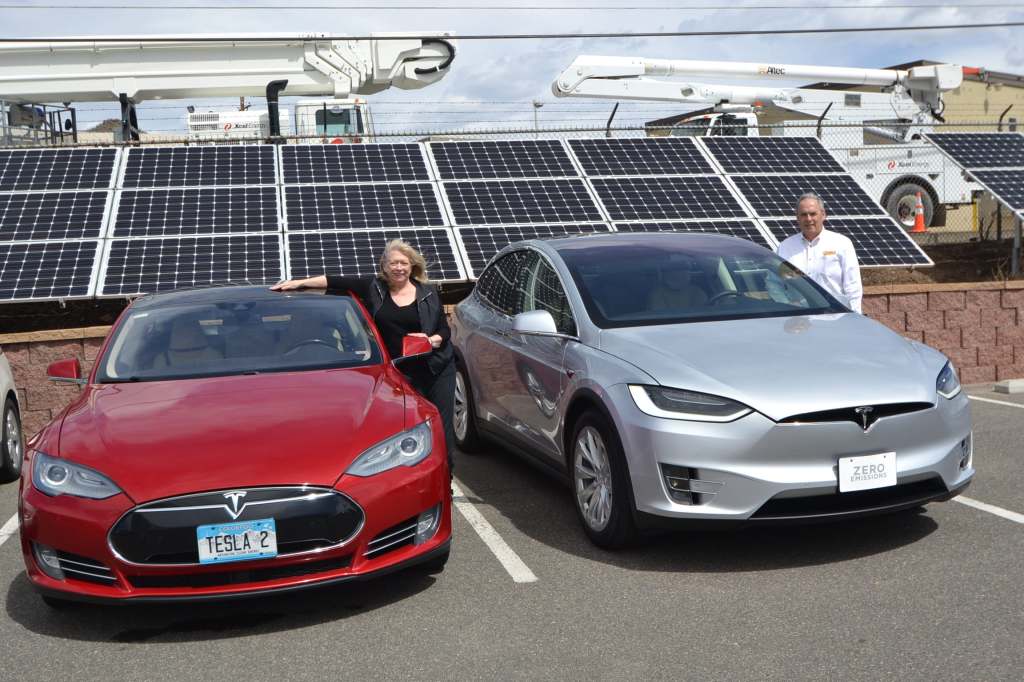
Rita and Jim with their 2 Teslas
Raising the gas tax makes no sense as fewer and fewer vehicles will be consuming gas in coming years.
As much as I’d like to keep being a freeloader in this regard, I am willing to pay 1.5 cents per mile traveled on my combined state and federal tax returns instead of paying $50 in annual registration fees per vehicle. This is referred to as a VMT (vehicle miles traveled) tax.
Critics of a VMT tax say people will lie about miles traveled, but our tax system is based on voluntary reporting, and mileage is easily audited now that cars, like Tesla, are connected to the internet.
Previously I wrote about 2021 being “the year of the electric pickup.” Well, this year is also going to see the arrival of multiple box trucks, buses (including school buses), and big rigs with electric drive trains.
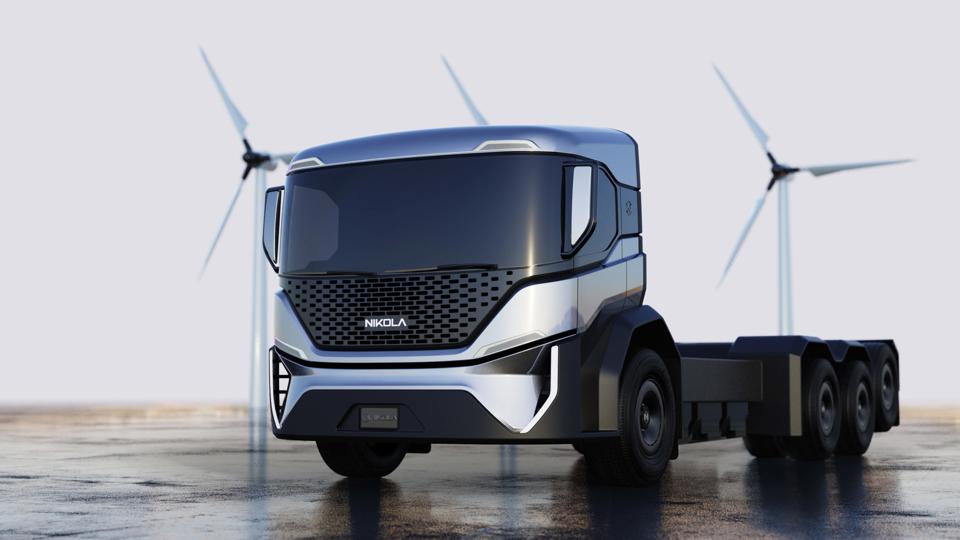
Rivian is already delivering on its order of 100,000 electric delivery trucks for Amazon, shown here. Nikola has an order from Republic Services for 5,000 trash trucks using the same platform as their semi tractor (below). Even Detroit Diesel, despite its name, is going to be producing a battery-electric semi tractor (also below) for its biggest customer, Freightliner.
The Tesla Semi (bottom) begins production by the end of 2021. Introduced with great fanfare in 2017, it has been field tested, I’m told, delivering trailer loads of Tesla cars to local Tesla stores. One was spotted last year at the Littleton store.
Want to keep up with EV news? Subscribe to a great weekly newsletter at www.GreenCarReports.com.
Nikola semi tractorDetroit Diesel electric tractor schematicTesla Semi








 Jim Smith's Blog