It’s January — Time to Think Again About Losing Weight and Getting Fit

By JIM SMITH, Realtor®

It was four years ago this month that Rita and I made a decision that has changed our lives for the better — we enrolled in a program called “8 Weeks to Wellness” at Body In Balance Wellness Center, located near our home in Golden.
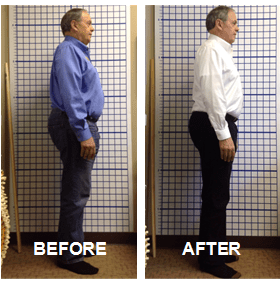
At the time, we were 68 years old and technically obese. I had a bit of a “beer belly” and weighed in the mid-240s. When the program ended in March 2016, I weighed under 220. At right are before and after pictures showing that much of my belly fat was gone.  As I write this, I weigh 206, because I have continued with the lifestyle which I learned during the 8-week program.

What is that program?  It’s a holistic program combining nutritional training, mindfulness, regular chiropractic adjustments and massages, and twice-weekly workouts with a trainer.

Since January is a time of year when we all think about shedding the weight we gained over the holidays and making other healthy resolutions, I thought it appropriate to share my personal story of making lifestyle changes that I know are leading to a longer, healthier life, and I invite you to learn about “8 Weeks to Wellness” and if it’s right for you — whether or not you’re a senior like us.

Let’s talk about nutrition first. Rita and I learned things we didn’t know from Drs. Leah and Scott Hahn during the program and at free lectures which they give each month. 

Dr. Leah’s class on sugar was particularly enlightening. We learned how much sugar is in processed foods and how bad it is for us.  Cancer feeds on sugar, and because so many foods contain sugar, Americans are consuming an average of 57 lbs. of added sugar per year.  That’s eleven 5-lb. bags of sugar per person! Our bodies can only metabolize between 1/2 and 1/3 that much sugar, so the rest of it has to be stored as fat — belly fat.

The key, I learned from the doctors, is to learn where that “added” sugar is hidden. They taught us about the glycemic index, which ranks carbohydrates according to how they affect blood glucose levels. Carbohydrates with a high glycemic index (such as in many snacks, bread and potatoes) raise blood glucose levels too quickly. The body needs time to absorb the sugar created by carbs, so you want to choose foods with a low glycemic index such as green vegetables. Also, sugar is literally addictive, creating appetite rather than satisfying it. It’s true — you can’t eat just one potato chip!

We also learned about “good fats” and “bad fats.” Did you know that the low-fat movement created by the government had the unintended consequence of increasing our sugar intake?  Since removing fat from foods makes them less tasty, food producers started adding sugar to low-fat products they sell us.

Obesity, we learned, is caused by all the excess sugar in our diets, and Type 2 diabetes is a natural biproduct of obesity caused by excess sugar intake.

So, in addition to reducing the granulated sugar we add to our foods, Rita and I have dramatically reduced our intake of added sugar by eliminating fast foods and soda beverages from our diet. We purchase only “real” foods, avoiding processed foods as much as possible, and we buy organic food, grass-fed beef and eggs from free-range chickens. (We shop at King Soopers, not at Whole Foods or Natural Grocers.)

It’s funny to think that we’re more concerned about the fuel we put in our cars than the fuel we put in our bodies. My handyman buys premium gasoline for his truck because he thinks it’s better for his engine, but you should see the food in his pantry!

Nutrition, however, is only one component of keeping our aging bodies healthy. We’ve all heard that we should exercise, but the doctors at Body in Balance have given Rita and me more context for its importance.

As we age, we all experience a loss of muscle mass. One evidence of muscle loss is the loose skin hanging from most old folks’ out-stretched biceps. That’s why I kept up my twice-weekly training sessions after the end of “8 Weeks to Wellness.”  And it’s working.

I used to think that hiring a personal trainer was a waste of money, but I was wrong. My Monday afternoon and Friday morning sessions last one-hour under the guidance of a certified personal trainer who creates a “workout of the day” that works all the different muscle groups in my body in a manner that never gets tedious or repetitive.  Through “bio-impedance analysis” I have seen the actual results of continuing this program — decreased fat and increased muscle mass in my body. Combined with my good nutrition and reduced weight, I will continue to age in good health and be less prone to falls and breaks. We should all strive for that as we age, and I urge you to consider the benefits.

Body In Balance Wellness Center, located in Golden, is a chiropractic office specializing in Network Spinal Analysis (NSA), which is more gentle than traditional chiropractic. In addition to their three chiropractors, they have two personal trainers in their fitness center, a functional medicine nutritionist, and two massage therapists on site. See www.BodyInBalanceChiropractic.com.

Because “8 Weeks to Wellness” made such a difference in Rita’s and my life, I encourage you to attend a free introduction to the program to be held at Body In Balance’s Golden facility, 755 Heritage Road, on Wednesday, January 22nd, at 6:15 p.m.

Call 303-215-0390 to reserve a seat. I’ll be there to share my story and answer questions.

Denver Post Series Uncovers the Corruption of Tax Districts Created by Developers

Four years ago, on Dec. 17, 2015, I devoted this weekly column to explaining why property tax rates vary so much around the metro area, mostly due to the creation by developers of “metropolitan  tax districts” to reimburse themselves for the cost of building the infrastructure for their subdivisions. A follow-up column on July 21, 2016, went into greater detail, giving examples of such tax districts created for Stapleton and Green Valley Ranch in Denver and Solterra and Candelas in Jefferson County. For example, in Candelas, adjacent to Rocky Flats, homeowners are paying a 70-mill tax levy on top of Arvada’s mill levy until the tax district infrastructure bonds are paid off. For a home valued at $500,000, that would be an additional property tax burden of nearly $3,000 per year, which would only increase based on rising property values for 30 years following construction. Below is an excerpt from that column, which quoted mill levies in effect that year:

You can read both columns at JimSmithColumns.com, where all my prior columns are archived – or simply click on the links provided above.

It was clear to me back then that homeowners would not recognize the special tax burden they would be facing as they purchased homes, since disclosure of that tax burden is buried in the flurry of documents buyers have to sign at closing.

Now, with more and more owners of homes in such subdivisions realizing what they got themselves into and how unfair it is, it was inevitable that some investigative reporter would dig into this topic in a way that I could not as a full-time Realtor. 

Earlier this month, investigative reporter David Migoya’s multi-part series on this important topic was published in the Denver Post following eight months of research. Perhaps you read that series.

Migoya provides an excellent summary of what these districts are: “Metro districts are taxing authorities created by subdivision developers, with the consent of the local government, for the sole purpose of selling government-like bonds to finance their projects. Repayment of the bonds is tied to future property taxes assessed to the homes that will eventually be built.”

Among the things I learned from Migoya’s multi-part series that I did not know or realize when I wrote about metropolitan tax districts in 2015 and 2016 was that this device of creating special tax districts for infrastructure investments began to be utilized because 1992’s Taxpayer Bill of Rights (TABOR) made it harder for cities or the county to invest in the infrastructure of new subdivisions, even though these subdivisions would ultimately pay for themselves through new property taxes. (I’m not fully convinced of that argument, since many newer subdivisions, including mine, were built without such tax districts.)

Migoya’s series went further to describe the scheming which kept property owners from being able to control the tax districts once the subdivisions were fully built out.

If you are in one of those newer subdivisions, you probably are subject to such a mill levy. If you didn’t read the series when it was published in the main section of this newspaper, I suggest you Google “Denver Post metropolitan tax districts” and read the full series. It should make your blood boil.

One could apply “scandalous” to how these tax districts were created and are run to profit developers at the expense of unwitting future homeowners, but the fact is that what the developers have done is legal, manipulating laws passed by the General Assembly and signed into law by previous Governors.

As Migoya explained so well in his opening installment on Dec. 5th, “Colorado law permits developers to elect themselves to serve on a district’s board of directors, then use that position to approve tens of millions of dollars in public financing for their businesses, and leverage the property taxes on homes they haven’t yet built. No regulations stop these developer-controlled boards from approving arrangements that are financially advantageous to their business, allowing them to finance overly ambitious plans without fear of liability, knowing future homeowners ultimately shoulder the burden.”

Surely the upcoming legislative session will feature hearings and legislation to address the worst abuses of this tax district tool, but the damage may be irreversible in the state’s 1,800 such existing tax districts, since they were created pursuant to existing laws.

Depending on how aware buyers and their agents become of these oversized tax burdens, the resale value of homes in those subdivisions should reflect the fact that they have a far greater tax burden than comparable homes in areas without such a developer-created tax district.  You can count on Golden Real Estate’s brokers being knowledgeable in this area.

The Value of Local Journalism

I have been concerned that the reduction in the reporting staff at the Denver Post would make investigate series like the one above a thing of the past. The “Afghanistan Papers” series by the Washington Post is another example. Subscribers make the investment in such journalism possible, so thank you for subscribing to the Denver Post.

By the way, please note that our “Real Estate Today” column in the Denver Post also needs your support. It is our primary marketing tool. You can assure this column’s continuation by coming to us with your real estate needs and recommending us to others. Thank you!

The Future of Heating is Heat Pumps, Not Gas Forced Air

Here in Colorado, as in much of the country, the typical home heating system is gas forced air. A gas flame heats up a plenum across which a fan blows air through ductwork into the various rooms of a house.  For cooling, the same ductwork and fan are used, but instead of the flame heating that plenum, the air passes over a set of coils beyond the plenum with super-chilled fluid created by an outdoor compressor.

Gas forced air, however, is relatively inefficient and is only common in the United States because of our exceptionally low cost of natural gas and other fossil fuels.

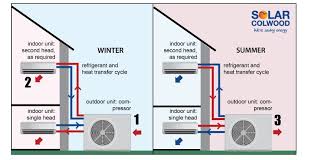
Elsewhere in the world, heating is done using heat pumps. What is a heat pump? Your central air unit is a heat pump, but it operates in only one direction—extracting heat from indoor air and dissipating it outdoors. A heat pump heating system simply reverses that process, creating heat by extracting heat from outdoor air and dissipating it in your home, either through your existing ductwork or through wall-mounted “mini-split” units. Unlike gas, a heat pump moves heat instead of creating it.

How a heat pump works to heat and cool a home using wall-mounted mini-split units heated and cooled by an exterior compressor.

Rita and I replaced our gas furnace in 2012 with a hybrid system by Carrier. It heats our home using the heat pump unless the outdoor temperature falls below freezing, at which point a gas burner kicks in. With our solar panels providing the electricity for the heat pump, our highest mid-winter Xcel bill is under $50. Meanwhile, at Golden Real Estate’s office, as described in my Jan. 4, 2018, newspaper column, we got rid of our furnace and ductwork and installed a ductless mini-split system (like in the above diagram), also powered by solar panels. As a result, our Xcel bill is under $11/month year-round.

Denver’s Winter Real Estate Market Isn’t Slowing As Much As Reported

Here at Golden Real Estate, we are used to having a pretty active real estate market during the winter months, but recent news reports suggested that the market has slowed dramatically, with sellers more reluctant than in the past to put their homes on the market. Statistics show that analysis to be overblown.

Below is a chart showing 6 years of June and November listing activity on REcolorado.com (Denver’s MLS) limited to the City & County of Denver. (Further down I analyze Jefferson County statistics.) December numbers are not available yet, so I’m only showing November activity. It’s not exactly winter, but the trend over 6 years is still useful for the purpose of this analysis.

What the analysis shows is that there was in fact an increase of sales during November over the previous year and nearly as many new listings. The number of active Denver listings in November was less than last year’s peak but still higher than the four previous Novembers. Both median and average days on market were only slightly higher, and the median sold price was much higher than last November. Moreover, the ratio of sold price to listing price was even higher this November than it was in November 2018.  As for this month, there have been 384 new listings through Dec. 16th — exactly the same as during the first 16 days of December 2018.

In contrast to Denver and the full MLS, Jefferson County showed a slight slowdown in every metric except the number of sales and the median sales price, as show in these statistics garnered from REcolorado:

While the number of November closings in Jefferson County this year is comparable to previous years, the number of new and active listings this November is markedly lower than last year, and the median and average days on market are markedly higher. Despite the slowdown, the median sold price is higher—a new record for November—but the ratio of sold price to listing price is lower than all five prior years..

As for this month (through last Sunday) we have 257 new listings here in Jeffco, compared to 250 new listings for the same 15 days in December 2018, so that’s unchanged, but almost every agent I’ve spoken to senses a slowdown in real estate activity that is greater than we typically experience at this time of year.

As I’ve written before, winter is, in fact, a good time to sell a home, but it’s true some sellers continue to think otherwise. If a home is not overpriced, it can sell quickly in the winter months for a variety of reasons, the biggest one being that there is less competition from other listings, but there are countless buyers still getting alerts from the MLS, Zillow and other websites when a new listing matches their search criteria.  Sellers also appreciate that only serious buyers ask their agents to show homes at this time of year. Lookie-loos are really a fair-weather phenomenon.

Call one of us at 303-302-3636 for a market analysis, including localized winter statistics. By the way, Golden Real Estate, although based in Jefferson County, is also active and successful in the Denver market. Please consider us when it’s time to sell or buy!

Golden Real Estate Uses an App to Protect Clients From Being Scammed

For over a year, we at Golden Real Estate have had access to an app that is only available to licensed real estate professionals for the purpose of protecting our clients (and us) from would-be criminals or scammers.

The app is called Forewarn, and it enables us to trace any phone number within seconds to verify the age, address, criminal record and other information about the caller.

At right is a screen shot from the app when I enter my own cell number, showing the many categories of information available for any person identified using the app. I urge my broker associates to use the app themselves or ask me to use it when they want to verify the background of any stranger who asks them to set up a showing. Any Realtor who joins Golden Real Estate has free access to this information to assist clients and for their personal safety.

We originally subscribed to this service to protect ourselves — especially our female agents — following the murder of a Louisiana agent by a person posing as a buyer. However, we have learned that it’s a service that could help clients and us from being scammed.

This app is not available to people outside the real estate profession, and any agent who applies for the app is also screened so the tool does not get into the hands of the wrong people.

We use this app to protect our clients from scammers who are increasingly targeting homeowners as well as home buyers.

As explained by Forewarn, fake internet listings, fake homeowners or sellers, and fake investors are just some of the reasons working with a real estate agent who has purchased this app can help buyers and sellers avoid scammers and avoid potentially losing thousands of dollars.

According to the FBI, there were 11,300 victims of fraud involving real estate in 2018, with victims losing almost $150 million  We can use the app to verify the identity of anyone pretending to be a landlord, seller, buyer or renter.  If we don’t have a phone number for the person, we can use the app to look them up by their name and city. If it’s an unusual name, we don’t even need the city, just the state.

Perhaps you, like so many, have received phone calls, letters or postcards from investors or individuals offering to buy your home. Homeowners have very few resources for verifying such a person’s identity or legitimacy. With this app, we can help you verify a buyer’s identity, and verify their financial history (bankruptcies, liens, judgments), while helping you get the best price for your home. On the other side, there are real estate investors being scammed as well. Being able to quickly verify identity and property ownership may help reduce the chance of fraud.

There are plenty of fraudulent activities in the real estate industry. Using the app, not only to verify prospects but also the other parties involved in a transaction, can reduce financial risk for you as well as bring to light fake identities.

There are so many kinds of scams that we can help you avoid. It’s one of the ways that our broker associates and I can add significant value to each real estate transaction and to our community.

As Realtors, we have many other resources available to us, such as an app which provides detailed information about properties anywhere in America, including the name of the owner(s) and estimated valuation.

This is another reason to work with a broker from Golden Real Estate.  Call one of us today!

Putting Your Heirs on Title so They Inherit Your Home May Not Be the Best Strategy

It’s a common practice for seniors to add their children or other would-be heirs to the title of their home, but that well-intentioned act could end up costing those heirs increased capital gains taxes when they sell the property later on.

Let me explain.

I’m not a tax advisor or accountant, but I’ve learned the following. If you add an heir to the title of your home as “joint tenant with right of survivorship” and you die, the heir becomes the owner once your death certificate is filed with the county clerk and recorder. But that heir also inherits the “basis” for your home.

The basis is what you paid for your home when you bought it, plus any capital improvements made over the years. When your heir goes to sell your home after your demise, they will be subject to capital gains tax for the increase over that basis.

Let’s say you purchased your home in the 1960s or 1970s for $30,000.  It may be worth over $500,000 now.  Even if the basis is increased to $100,000 thanks to improvements plus the cost of selling it, your heir will pay capital gains tax on $400,000. That comes to about $80,000 in combined state and federal taxes on that $400,000 gain.

However, if you don’t add that heir to the title of your home and let him or her inherit the home through your last will and testament, the basis is stepped up to the home’s value at the time of your death, and that capital gains tax liability disappears.

Talk to your tax advisor and a lawyer about this issue. It is easy to remove your heir from the title to your home through a simple “quit claim deed.”  The form is widely available online.

Reader Asks: Should I Spend Money on Home Staging?

There are two kinds of home staging: 1) vacant home staging where you rent furniture and accessories; and 2) rearranging your furniture and other “stuff” to make the home show its best.

The jury is out on the former (which can cost a lot of money), but the latter is essential and doesn’t need to cost you anything. At Golden Real Estate, we provide staging consultations free to our sellers. One of our broker associates, David Dlugasch, is a Certified Home Stager®. Like all our associates, I can give general advice on staging your home, but I hire David to provide a full staging consultation free to my sellers.

Property Tax Is the Original ‘Wealth Tax’

Like you, perhaps, I was surprised and not quite sure what to make of the proposal from more than one presidential candidate to impose a wealth tax, not simply an income tax, on the super-rich. 

Then it occurred to me that it’s really nothing new. Homeowners already pay a “wealth tax” in the form of  property taxes, but it’s not a graduated tax paid only by the super-rich, as proposed by Elizabeth Warren and others.

Thanksgiving’s Here, and We at Golden Real Estate Are Thankful

Some weeks I struggle to come up with a topic for this column, but not so this week. Allow me to share some of the ways in which our broker associates, my wife and I are all thankful.

First, Rita and I are so thankful to be Americans. In school I studied many languages — French, Russian, Latin, Greek, German and Japanese — and I have traveled extensively around the world, although not so much recently. I attended my sister’s wedding in Sweden, attended “citizen diplomacy” conferences in the Soviet Union, and visited Beijing right after the 1989 Tiananmen massacre (and twice since).

I have visited and marveled at Japan and its culture more than once. I visited the Russian port of Vladivostok (the terminus of the Trans-Siberian Railway) on the 50th anniversary of the end of World War II in the Pacific. I remember noting that pay phones there were free because Russian coins were essentially worthless due to inflation, and that most of the cars on the road were right-hand drive Toyotas and Nissans purchased used from nearby Japan.

Rita and I particularly like France and Italy and long to return there again soon. We enjoyed a week in London following a two-week Atlantic crossing on Cunard’s Queen Victoria with stops in  Bermuda and the Canary Islands. When and if I retire from real estate, we look forward to more international travel. 

Every trip is great, but we are always happy to be back in America and especially in Colorado. We are, as I said, thankful most of all to be Americans — and Coloradans.

Part of being an American is the opportunity to participate in our capitalist free enterprise system. I’ve always been an entrepreneur. I like to say that, except for my stints at the Washington Post and the New York Post, every paycheck I’ve ever received was signed by me. I remember when I visited the Soviet Union in 1978 learning that Russians could be self employed but only the state could have employees. I realized then that the freedom of enterprise was the core freedom I value most.

Nearly every real estate agent is self-employed, even if they work for a brokerage. I suspect that 95% or more of all Realtors are independent contractors (1099 workers) responsible for their own taxes and expenses (phones, cars, computers, software, etc.) and receive no benefits of any kind. The dropout rate among new agents is as high as 90% and those who make it five or more years have demonstrated a fortitude that deserves respect. I am thankful for Golden Real Estate’s seven top-producing, highly-experienced broker associates whose cell numbers I am pleased to list below.

Next I am thankful for the readers and other members of the public who recognize that we are professionals, not just entrepreneurs, and that we earn what we charge by providing an invaluable service for one of life’s most significant financial transactions. Not everyone sees our value or respects what we provide, so we thank you.

Not every licensed real estate agent is a Realtor — that is, a member of the Realtor association.  Everyone who joins a Realtor brokerage like ours must join the Realtor association and pay Realtor dues, which run about $500 per year. But there are non-Realtor brokerages such as HomeSmart Cherry Creek Properties, Redefy, and Trelora Colorado, whose agents don’t pay Realtor dues and don’t have to abide by the Realtor Code of Ethics. I’m thankful for all those firms, like ours, that have chosen to be Realtor brokerages.

Why? Because the National Association of Realtors (NAR) lobbies for your property rights, not just the interests of its members. For example, when the Trump administration tried to dilute the capital gains exemption for home owners ($250,000 single and $500,000 married), it was NAR which lobbied successfully against that change. I could cite countless other examples where NAR’s lobbying efforts have benefited home owners and all those agents who don’t pay NAR dues. To me it’s a matter of professional and corporate responsibility to support NAR with our dues. So, yes, I am thankful for NAR, even when I gripe about dues increases!

Like everyone in our profession, I have individual clients — buyers and sellers — for whose friendship and patronage I am grateful.  You know who you are! You have not only granted me the opportunity to be of service, but you have allowed me to learn new things from every transaction. Perhaps you have introduced me to a new service provider such as an estate sales company, a roofer or plumber, or just a great new restaurant! As I have said many times, judge us agents not by our years in the business but by the number of transactions we have completed, because that’s our most valuable continuing education program.

I’m also thankful for my colleagues from other brokerages. Real estate is different from many other professions because of the tradition of “cooperation and compensation” embodied in our shared multi-list service, aka “MLS.” Some people compare us to car salesmen, but consider the following scenario: You go to a Ford dealership and describe what you’re looking for. The salesman realizes that the right vehicle for you is not a Ford but another brand, so he shows you other cars on his computer and then takes you to those dealerships for a test drive, knowing that he can write the purchase contract and get paid for selling you another dealer’s car just as he can get paid for selling a car from his own dealership. That’s how real estate works, made possible by the MLS.

You’d be impressed to see how agents share the keys to their success with each other. I recall once when I made a presentation at a Realtor meeting on how to shoot and edit video tours of listings, happy to have others do videos for their listings, even though video tours are a point of differentiation for us at Golden Real Estate.

So I’m thankful for how the real estate business works and for the many Realtors whom I consider friends, not just competitors.  If I or one of my Golden Real Estate broker associates is not the perfect agent for a given buyer or seller, I don’t hesitate to recommend one of them.

Lastly, I’m thankful for the Denver Post and four Jefferson County weekly newspapers which publish this column. Remember, you can also receive it by email, so just send me an email with your request.  Several years of prior columns are online at JimSmithColumns.com.

Our Broker Associates:

Jim Swanson — 303-929-2727

Carrie Lovingier — 303-907-1278

Kristi Brunel — 303-525-2520

Chuck Brown — 303-885-7855

David Dlugasch — 303-908-4835

Andrew Lesko — 720-710-1000

Carol Milan — 720-982-4941

High-Tech, Low-Tech and No-Tech Ways to Make a Home More Senior-Friendly

Most seniors would like to age in place — that is, to stay in the home they know and love instead of relocating into assisted living. At the same time, there are practical considerations, especially if a senior lives alone.

There are no-tech and low-tech ways to address the issues associated with aging in place.  What’s new and perhaps less known to you are the high-tech and “smart home” solutions that are becoming more and more common. But let’s talk first about those better known no-tech and low-tech solutions.

The common no-tech solution is, of course, to have a caregiver who either lives in or visits you on a schedule. This, however, can be very expensive, unless you’re lucky enough to have a loving family member or two who can serve that function, perhaps trading free rent in your home for assistance with household chores, such as cooking and laundry.

The ideal home for aging in place, according to Jenn Gomer of CarePatrol, has a main-floor master bedroom, main-floor laundry room and a walk-in or roll-in shower — typically a ranch-style home with few or no stairs, although there are 2-story homes with main-floor masters and main-floor laundry. Ideally, the home should be close to at least one family member or friend on whom you can count in a pinch. 

If a senior has a fall or is hospitalized, Jenn suggests meeting with an occupational therapist, who can look for trip hazards and suggest grab bars or railings where they could be beneficial. However, multiple falls should be seen as a warning sign that you may need to change the home environment.

Jenn encourages her clients to be open to getting outside help with difficult activities. For instance, if you have a bad knee and your laundry is in the basement, consider allowing a friend or family  member to help with laundry or getting an outside home care service to assist. Installing laundry hook-ups on the main-floor is another option, if practical.

A classic low-tech tool is the medical alert button you wear on your person. The original product was introduced by Life Alert Emergency Response in the 1980s, but there are numerous other companies now offering such a product.

Another challenge can be grocery shopping, but one low-tech option nowadays is to order groceries online or by phone and having them delivered, rather than going out on icy sidewalks and parking lots. 

If adapting your multi-level home into one that works for you is not practical, Golden Real Estate’s agents can help you find a home with one-level living.  In addition to identifying currently available homes that meet your needs, we can alert you every time a new home matching those needs comes on the market

Golden Real Estate can make a senior’s move easier by providing totally free moving from his or her current home to their new home, or to a senior community if that’s their choice. (Jenn Gomer can help with that.) We have our own trucks and movers and provide you with free moving boxes and packing materials, including wardrobe boxes and bubble wrap. You just pack and unpack, and we can even find someone to assist with that. (If you know someone who would like to be on our call list for moving or packing assistance, let me know.)

Patio homes, typically ranch-style homes with exterior maintenance done by an HOA, are few and far between, but if they’re out there, we can find them within 15 minutes of them going on the market.  I just sold one this fall.

We’d love to live in a patio home with grounds maintenance handled by the HOA, but we have the equivalent of that at less expense by hiring someone to mow our lawn in the summer and do spring and fall yard clean-ups. It’s great!

Regarding making your current home more senior friendly, Rita and I love the stair elevator which we have on the stairs to our basement in our ranch-style home. We got a great deal on a used one, and they’re easy to install, assuming you have a straight staircase. The seat and armrests fold up when not in use, so they can work on any staircase that is at least 3 feet wide. Rita and I are still quite mobile and don’t need to use our stair elevator currently, but we like knowing it’s already in place for when the need arises. Meanwhile, it’s handy for transporting cases of wine and other heavy items to and from the basement.

If you have stairs with landings and turns, custom-made stair elevators can be purchased, but they get pricey. I can recommend some vendors. For those straight staircases, I can help you find a used one and someone to install it.

A senior friend who lives alone buddied up with a neighbor and texts that neighbor every morning when she gets up. If she forgets, the neighbor texts her asking if she’s okay. Also, that neighbor and two others have keys to her house.

Now, let’s talk high-tech solutions. For such devices, you need to have a smartphone and have internet and Wi-Fi installed in your home.

As a matter of personal safety, I think everyone should consider a video doorbell. When someone rings the bell, it sounds as usual in your home, but it also rings on your smartphone, with a video of the person ringing the doorbell and the ability to converse with him or her. The device can also alert you when there is motion at your front door, and the video is stored online where it can be shared with police. The best part of such a video doorbell is that you don’t need to be home, you only need to have your smartphone with you. The visitor has no way of knowing that you’re not home. Simply having a video doorbell is a good crime deterrent, because thieves recognize it. We bought our video doorbell from www.Ring.com.

There are so many other Wi-Fi connected devices that you can install in your home which alert you on your smartphone. You can even buy Wi-Fi-connected “smart outlets” which make any non-internet connected lamp or appliance controllable (and easily monitored) on your smartphone. I suggest viewing all the many different devices available from various manufacturers at www.SmartHome.com.