Even if You’re a Sophisticated Buyer or Seller, You Need Us — And Here’s Why…

Perhaps you’ve heard the expression, “A lawyer who represents himself has a fool for a client.” Most lawyers respect that truism, which is why you see lawyers hiring other lawyers when they are sued or criminally charged..

The same truism can be applied to real estate. Just this week I received a contract to buy one of my listings from a couple who are both real estate agents, but the offer was written by another agent.  (I suspect he will share his 2.8% co-op commission with the buyers.)

There are also many buyers and sellers who aren’t agents but who are sufficiently experienced at buying and selling real estate to be considered “sophisticated” buyers or sellers. These persons may understandably think that they don’t need professional representation, saving themselves (if they’re selling) 3% or so on a listing commission. If they are buying without representation, they may think they can negotiate a lower purchase price by sparing the seller the 2.8% co-op commission typically paid to a buyer’s agent.

Let me debunk some misconceptions about each scenario separately — first for buyers.

Buyers typically pay nothing for professional representation, since buyers’ agents are universally compensated by the listing agent at a rate spelled out in the multi-list service (or “MLS”) to which all agents belong. Our Denver metro MLS is called REcolorado. Its website is www.REcolorado.com, which has both a consumer-facing and agent-facing side.

If you’re a buyer, you can go to that website and see all the listings which are currently available for purchase, and you can click on a link to email or call the agent for each listing. After that listing agent has determined that you don’t have an agency agreement with another agent, he or she will be delighted to help you buy his (or her) listing because he won’t have to give away half his commission to another agent. And he’ll probably ask you to hire him as a buyer’s agent if his own listing is not what you choose to buy, in which case he could earn 2.8% on that purchase.

If you, as a buyer, work with the listing agent, he or she will not, by law, be working in your best interest. At best, he’ll be a transaction broker, advising neither you nor his seller in the transaction. He won’t be able to advise you on the true value of the home or what you should offer, or how to respond to a counterproposal from the seller. He also won’t be able to advise you on inspection or other issues that arise during the transaction.  You’re on your own — literally helpless.

Moreover, the chances are that you’re not saving the seller any money by being unrepresented, since the listing agent gets to keep the entire commission when he doesn’t have to share it with a buyer’s agent.  My own research has shown that only 15% of listing agreements have a provision in which the commission is reduced if the agent doesn’t have to share his commission with a buyer’s agent. I know this to be true, because the MLS requires listing agents to disclose the existence of a “variable commission” in their listings. That’s one of the fields that is not displayed on the consumer-facing side of the MLS.

There are additional reasons why a buyer (in my opinion) should hire an agent instead of working directly with a listing agent — except when it’s a Golden Real Estate listing, as I’ll explain below. The most important reason is that a buyer’s agent, in addition to being your advocate in a transaction, has more access to information about listings than you have as a consumer.

For starters, agents have valuation software not available to consumers and can create a spreadsheet of comparable sales, so you’ll know whether a home’s listing price is reasonable. Zillow’s famed “zestimates,” by themselves, are not a dependable indicator of a property’s value.

Second, agents can do searches using any field on the MLS, not just the fields that are available to you as a consumer. Do you require a main-floor master? A second master suite? A fenced yard for your dog? An unfinished (or finished) basement? An agent can set up MLS searches on virtually any criterion that is important to you, and the system will notify you and your agent within 15 minutes of a new listing matching your specific search criteria.

As a buyer working with Golden Real Estate, you’ll enjoy added advantages to having representation, up to totally free moving using our own moving trucks, boxes and packing materials. With our focus on sustainability, one of my favorite closing gifts to buyers is a free energy audit of your new home — a $350 value. And if you have a home to sell, we reduce our commission on selling your current home. These benefits also apply when you’re buying one of our listings without your own agent. Call us for details.

Now let’s look at why sellers need to have professional representation.

Understandably, sellers have a huge incentive not to use an agent — they pay the commission for both agents in a transaction, which they assume (wrongly) is fixed at 6%. That would be a violation of federal antitrust laws. All commissions are negotiable. My personal rate is 5.6%, which I reduce to 4.6% if I don’t have to give 2.8% to a buyer’s agent. And I reduce those figures by another 1% if I earn a commission on the purchase of your replacement home. Because of federal laws against price fixing, I can’t dictate (or even discuss) what our other agents charge.

That’s still a lot of money, so you need to know what you’re getting for it.

At Golden Real Estate, sellers enjoy a free staging consultation, magazine quality still photos and professional quality narrated video tours which are posted on YouTube, the MLS, consumer real estate websites and on the custom website which we create for each listing. (Visit www.GRElistings.com to see the custom websites for our current active listings.)

We also provide free use of our moving trucks and moving boxes both to our sellers and to whoever buys our listings, even if their agent is with another brokerage. And, of course, all listings are featured in this column, which appears in eight editions of newspapers throughout both Denver and Jefferson counties.

We also have a proven track record of getting the highest possible prices for our sellers because of our skill at negotiating with buyers and their agents. Most agents will not reveal the offers they have in hand when they get multiple offers. We treat that situation like an auction, where everyone knows the highest current offer, and we regularly bid up the purchase price for our sellers — and the buyers and their agents appreciate not losing out in a blind bidding situation.

Ways to Defer Capital Gains Tax Exposure When Selling Investment Properties

With the new year upon us, many of us are thinking about taxes. While it’s too late to strategize for 2018, let’s look at tax strategies going forward.

Owners of duplex, triplex and small multi-unit properties sell their properties for many reasons. Sometimes an owner wants to leverage equity into another property with better upside potential or a higher return on their investment or into multiple income producing properties.

Perhaps a duplex property was inherited but the responsibility of being a landlord has become overly burdensome. Whatever the situation, there are times when selling a multi-unit rental property and transferring the equity into an alternative “hands-off” type of investment makes sense. You can defer your capital gains tax obligations and keep your pre-tax capital growing for you by utilizing one of these IRS-approved options.

1031 Real Estate Exchange: The 1031 real estate exchange is a tax-deferral strategy that applies to investors who have sold or are about to sell investment real estate. This strategy allows a client to defer capital gains tax on all sales proceeds that are reinvested into other investment real estate properties, as long as the seller:

1) does not take “constructive receipt” of the funds within the exchange transaction.  This means that the proceeds must go directly to a “qualified intermediary” and not at any point be in the seller’s own bank account.

2) meets all requirements outlined in the Internal Revenue Code.

721 Exchange: Less well-known than the 1031 exchange, the 721 exchange is another tax-deferral strategy which applies to investors who have sold or are about to sell investment real estate. This strategy is similar to the 1031 exchange but allows an investor to exchange his property for an interest in a diversified real estate portfolio known as a Real Estate Investment Trust (REIT). As with the 1031 exchange, the seller must not take constructive receipt of the sales proceeds within the transaction.

Delaware Statutory Trust is offered as replacement property for those seeking to defer capital gains taxes via a 1031 exchange. The DST allows for fractional interest ownership in various managed commercial properties with other investors, as individual owners within a Trust. Each owner receives a share of the cash flow income, tax benefits, and appreciation of an entire property. There is potential for annual appreciation and depreciation. Investments begin at $100,000 and allow investors to diversify into several properties.

Deferred Sales Trust is a tax-deferral strategy that applies to many different capital gains situations. These include the sale of a business, real estate, stocks, or bonds, as well as the maturity of principal on a note or carry-back, and even applies in certain debt forgiveness situations. The Deferred Sales Trust is different from the 1031 and 721 exchanges in that it does not require any reinvestment of the sales proceeds into real estate. It is similar to 1031 and 721 exchanges insofar as an investor cannot take constructive receipt of the funds within the transaction.

For expanded, detailed information on each of these tax strategies, visit www.DuplexAlerts.com and click on the  “Sellers” tab in the main menu.

Always consult with your tax or wealth management professional when considering the sale or purchase of an investment property.

A quick caveat:  Neither I nor any agent at Golden Real Estate is a CPA or tax advisor.  Broker associate Andrew Lesko did the research for this article.  Email Andrew at Andrew@GoldenRealEstate.com or 720-710-1000 with your questions or comments.

Statistics Seem Not to Reflect a Coming Slowdown in the Real Estate Market

By JIM SMITH, Realtor

Because of recent national and regional reports that the real estate market is changing from a seller’s market to a balanced, or even a buyer’s market, I have drilled down into the statistics for real estate activity in Denver and Jefferson County, looking for evidence of that shift. After all, as in politics, all real estate is local, and even reports about Metro Denver’s real estate market don’t necessarily reflect what is happening in each of the metro area’s six counties.

So, are the Denver and Jeffco real estate markets changing from a seller’s market to a balanced or buyer’s market?  The answer appears to be “yes,” as I’ll show below, although the data in the 25-month charts above provide no indication of a coming slowdown. While 25 months might seem like an odd timeframe for a chart, I used it so you could compare this November (on the outer right) with November 2016 (on the outer left) as well as all the months in between.

Two measures of a market’s health are the trends in median sold price and the median days on market. The charts show continued year-over-year increases in the median sold price in both Denver and Jefferson County and only seasonal changes in the days on market. When median days on market are this low — ranging from 5 to 16 days in both Denver and Jefferson County over the past two years — you know it’s a seller’s market.

However, the listings that are currently active or under contract and those which have sold thus far in December suggest that, from a purely mathematical standpoint, 2019 statistics will document a shift in Denver’s and Jeffco’s real estate market.

As I write this on Tuesday, December 11th, there are 1,832 active Denver listings on REcolorado. The median days on market of those listings is 54, more than triple the median days on market for last month’s sales. There are 1,230 Denver listings that are under contract, and their median days on market is 24.  Of the 200 Denver listings which closed between December 1st and 11th, the median days on market was only 20.  Clearly, as those currently active and under contract listings change their status to “sold,” the median days on market will rise significantly by month’s end and into 2019.

The figures for Jefferson County mirror those of Denver. Median days on market for active listings is 42, median days on market for under contract listings is 25, and median days on market for listings sold December 1st to 11th is 19. As with Denver, it’s safe to say that Jeffco’s market has already begun to slow, and statistics will reflect that in coming months. 

If you’re thinking of selling your home, don’t let yourself be blindsided by this evolving market. You can still sell a home quickly in a slowing market, but only if you price it correctly. As I have written before, you can’t underprice a home, because competing offers will drive the price upward. And by pricing your home correctly, you’ll benefit from those competing listings that were not priced appropriately. Call me or another Golden Real Estate agent at 303-302-3636 if you’d like advice on pricing your home to sell.

What Are the Implications When a Buyer Waives Appraisal in a Bidding War?

Real_Estate_Today_bylineWhen a home is priced at or below its likely selling price based on recent sales of comparable homes, there’s a good chance in this seller’s market that multiple offers could bid it up, possibly above the value an appraiser might give it. So what happens then?

Fortunately, I can report that the homes I have sold above the value suggested by comparable sales have not, as a rule, had trouble appraising for the contract price. Showing the appraiser the multiple offers that were received can demonstrate real-world market value. Without seeing those competing offers, the appraiser might determine that the buyer paid more than they should have. The presence of multiple, nearly equal offers gives appraisers an important tool for justifying value in our rising market.

Whenever a purchase is financed by a lender, there will be an appraisal. Lenders require them to make sure they’re not lending based on an overstated valuation. That doesn’t mean that the buyer can’t waive appraisal objection and bring additional funds to cover the discrepancy between appraised value and contract price. The contract may or may not specify a limit to the size of discrepancy the buyer will cover. Regardless, it is important for the seller’s agent to ascertain that the buyer is able to bring that additional cash to the closing table.

If the buyer is borrowing 95% or more of the purchase price, one might ask whether bringing several thousand extra dollars to the closing table is possible. This is where it is advisable for the listing agent to interview the buyer’s lender — something we do regardless of the size of the down payment. Typically, a buyer who is putting down 20% or more of the purchase price is more likely to have available cash to cover an appraisal discrepancy.

With Golden Real Estate’s auction approach, which maximizes the purchase price for our sellers, it is not unusual for the final price to be well above what comparable sales might support.  And because one can never be certain that the appraiser will be impressed enough by the existence of those other competing offers to justify the contract price, it’s a good idea to ask that buyers cover some or all of any appraisal discrepancy and that they provide evidence of their ability to bring extra funds to closing for that purpose.

Few buyers start out offering to waive appraisal, but once the bidding enters a range that is considerably above an appraisal based solely on recent sales of comparable homes, the listing agent can and should encourage waiving of the appraisal objection by the highest bidders.

One should remember, however, that an offer to waive appraisal objection is not iron clad when a lender is involved, because the buyer can still terminate based on loan objection if the appraisal ordered by the lender comes in too low for the buyer’s comfort. I’ve witnessed the scenario where a buyer who has agreed to waive appraisal objection still threatens to terminate because of the low appraisal, at which point the seller offers to lower the price to keep the contract from falling (assuming he doesn’t have a backup contract).

This is not unlike when a buyer agrees to purchase a home “as is” and use the inspection deadline only to terminate, not to demand any repairs. That can be a hollow promise.  If, for example, the buyer decides to terminate because the furnace needs to be replaced, the seller is likely to say, “Wait! I’ll replace the furnace!” Why?  Because the seller now knows the furnace needs to be replaced and would have to disclose that fact to the next buyer. Indeed, when I’m representing a buyer in what appears to be a bidding war, I will suggest making our offer “as is” while advising the buyer that it doesn’t mean we can’t get serious items repaired. The only time this doesn’t work is when the seller has received a backup contract that’s more attractive than ours. I point out to my buyer that the seller might be happy to have him or her terminate so that back-up offer can become the primary contract.

These two areas — appraisal and inspection — require deft skill in order to navigate the negotiation process effectively — a good reason to employ an experienced listing agent like one of us at Golden Real Estate instead of trying the for-sale-by-owner (FSBO) approach. A good listing broker can definitely justify his or her commission both in getting a higher selling price and saving money through effective negotiation.


Great Golden Listing Coming Soon from Debbi Hysmith

Better_front_pictureEnjoy incredible mountain views from this special home at 17425 Rimrock Drive!  Take advantage of the opportunity to own this 4-bedroom, 3-bathroom custom home.  It backs to South Table Mountain open space, with unbeatable views of the foothills!  It features an extra-tall garage — tall enough for your large truck —- with a mud room and laundry room on the main level. Look for more information in next week’s column. We have created a website for this home at www.SouthGoldenHome.com, where you can see more pictures and take a narrated video tour. That website will also have information about an open house the weekend of July 14-15. Or call your agent or Debbi Hysmith at 720-936-2443 to arrange a showing.
 

Just in Time: A Breakthrough in ‘Rent-to-Own’ for Those Who Can’t Buy Now

Real_Estate_Today_byline      It’s not uncommon for us to get a phone call or drop-in from someone who would like to buy but who might not be in a position do so at this time. They are looking for a rental, and for that we refer them to trusted companies that specialize in rentals. Sometimes the caller or visitor will inquire about rent-to-own, but we explain that it is nearly impossible to find a seller in this market who would consider rent-to-own when they can sell now for top dollar.

I’m happy to announce a breakthrough. Last week our office was presented with a new business model that could fill this gap in the real estate market. The way it works is this: we submit the prospect’s name to a company which, upon approving the person as a tenant, agrees to purchase a house, which that pre-approved tenant can rent.

Once approved, the prospect goes on the company’s website which contains all the MLS listings (sub-ject to company approval) that qualify for this program. The homes can range in price from $100,000 to $550,000. Only townhomes and single family homes qualify for this program — condos do not.

If you’ve looked online for rentals, you are familiar with the limited inventory of rental homes.

The fact that the sellers and listing agents of the qualified MLS listings are offering their homes for sale, not for rent, doesn’t matter. If a prospective tenant finds a for-sale home they’d like to rent, our partner company can offer a lease for that home which states what the rent will be for the next five years, and which also provides a pre-determined purchase price for that home over the same 5-year period.

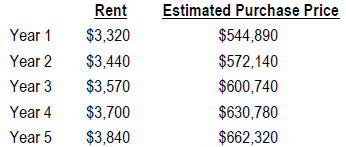
Let’s say you find a $500,000 home you’d like to rent.  If you click on that listing, you’ll find the following grid of rental and purchase prices:

Rent_to_own_grid As you might expect, these figures are subject to adjustment, since (1) the listed price may not be the final sale price, (2) the home may need renovation work, and (3) there may be other costs associated with purchasing and owning the property. These and other conditions are spelled out in the lease agreement that is signed by the prospective tenant.

At that point, we represent the rent-to-own company in negotiating a purchase of the identified property. To the seller and to us as a buyer’s agent, it’s an ordinary transaction by an investor.   In this case, however, the investor has already identified a qualified tenant for the property.

Although the landlord is bound by the specified rents and purchase prices for five years, the tenant is only locked into a one-year renewable lease and can choose to purchase the home at any time.  They can also choose to not renew the lease and simply walk away.

This flexibility will be particularly attractive, I expect, to people relocating to our area who may be able to buy immediately, but don’t want to lock themselves into purchasing the first home they find. They can rent a home they think they might want to buy, then buy another house after the first 1-year lease period is up.  They can also opt to exercise their option to buy the house for a pre-determined price — an increase over what their landlord paid for it.

Home_Partners_screen_shot  At right is how an MLS listing appears when displayed on the company’s website, showing the listing price on the right and the estimated initial rent on the left.

Although the prospective tenant is not our client — the landlord is — we set up showings for that tenant just like we would for any buyer. When the tenant identifies the home they’re interested in, we tell the company and together we go about buying the property so that tenant can rent it.

If you or someone you know can’t (or doesn’t want to) buy at this time, have them call any Golden Real Estate agent at 303-302-3636 or send an email to info@GoldenRealEstate.com.


What Is an ‘Escalation Clause’ and How Should Sellers Respond to One?

In our competitive seller’s market where a listing might attract five, ten or more competing offers, submitted contracts often include something called an “escalation clause.”

An escalation clause is an additional provision worded something like this: “In the event Seller receives a competing contract with a purchase price, net of concessions, in excess of the Purchase Price in this Contract, Buyer agrees to increase the Purchase Price of this Contract to $1,000 in excess of the purchase price of said competing contract, up to a maximum of $______.” I have seen contracts offering as much as $5,000 over a competing contract.

Two things you need to know about this strategy. Most importantly, the seller is completely free to ignore the escalation clause and does not even have to accept the best offer. Secondly, when it’s you submitting the contract with an escalation clause, I recommend not inserting a maximum price. That makes it more likely you’ll receive a call from the seller’s agent telling you what that higher offer is.


What Makes for Success in Real Estate? Here’s What Golden Real Estate Does

Real_Estate_Today_bylineLast week I mentioned how Golden Real Estate was honored for coming in third among metro brokerages of our size in the number of transactions completed in 2016.

In this week’s column, I’d like to share my personal strategy for success in real estate, which has evolved into a company-wide strategy serving all agents — and benefiting clients.

Decades ago I adopted what I thought was a quote by Confucius. My sister had it posted on her refrigerator. Thanks to Google, I discovered that it wasn’t a quote by Confucius, but it could have been. “Concentrate on giving, and the getting will take care of itself.”  That philosophy underlies this column and its success in attracting clients for me and our agents. The time most real estate agents spend prospecting, I spend coming up with topics on which I can educate myself and then share that knowledge with my readers.

That’s how journalism works. A reporter is given an assignment, learns all he can about it, and then reduces it to a concise article that summarizes what he learned. That’s what I do every week — learn more than I already know about a given topic, then share what I have learned.

I never run out of topics to write about which educate the public — and thereby myself — regarding some aspect of real estate. Sometimes, I’m able to clarify or contradict statistics or statements which I see in the press or on TV.  For example, is the market cooling down or heating up? Are we in another bubble? As a Realtor, I have access to raw data that allows me to address such topics in a way that general assignment reporters can’t.

Giving back is important. Golden Real Estate is a member of two chambers of commerce (Golden & the West Chamber) and one business association. Rita and I are active members the Rotary Club of Golden, and I’m also a member of the Golden Lions Club. Serving in this way is satisfying in itself, and demonstrates our values.  [We are also big supporters of Habitat for Humanity of Metro Denver (through Jeffco Interfaith Partners, now called West Metro Interfaith Partners) and Family Promise of Greater Denver.  Two of our agents are big-time volunteers with Golden’s Christian Action Guild.  Myself, I’m a long-time member of the Colorado Renewable Energy Society, Golden Solar Tour (now called the Metro Denver Green Home Tour), and the Denver Electric Vehicle Council.]

Another business principle that underlies my practice of real estate is authenticity. Misrepresenting one’s level of success, for example, is not only a violation of the Realtor Code of Ethics, it is not good salesmanship. I consider myself a lifelong learner and don’t “know it all.”

That principle expresses itself in me by being a news and public affairs sponge. I love listening to music as much as the next person, but my car radio is always tuned to the only all-news radio network we have — NPR.   I often hear local real estate stories, since it’s a popular topic these days, but being well informed on other national and world affairs is also important to me.

On the other hand, I have little patience for talk radio, whether conservative or liberal. I’ll listen to analysis and hard news, but I consider opinions a waste of my attention.

In terms of the day-to-day practice of real estate, I know I can’t do it all, so I surround myself with a support team. That team includes, among oTeam picture on bridge 2016thers, a transaction coordinator, a stager, a photographer, a drone pilot, several lenders, inspectors, and a handyman (who works only for our clients). That said, I don’t over-delegate. I like to get my hands dirty. I’ll put signs in the ground and do my own narrated video tours of each listing, including for my broker associates. Our office manager, Kim Taylor, helps with every aspect of listing and selling homes, but I’m happy to show listings, hold open houses, enter listings on the MLS, create websites for each listing, etc. I don’t just have a team, I’m part of the team.

Another factor in my personal success is surely my full-time accessibility. My cell phone (303-525-1851) is never turned off. I was in Puerta Vallarta all last week, which may come as a surprise to those clients and future clients who reached me on my cell phone and made appointments to meet with me this week. (I also submitted last week’s column from Mexico and will be submitting next week’s column from a ship in the middle of the Atlantic Ocean.)

Experience has taught me that “to make money, you need to spend money,” and I never forget that. One example of an expenditure that paid off was our moving truck. I bought our first one at a convention in 2004 and it has been so useful to clients and has built so IMG_1256much goodwill for us among non-profits and community organizations, that I bought a second one last year. In 2008 I also invested in a storage shed for the moving boxes and packing materials that we provide free to clients.

Another “investment” was the purchase of a 10’x20’ chain link enclosure for collecting polystyrene (“Styrofoam”) for recycling. We take at least one truckload per month to a reprocessing facility in Denver, keeping over 200 cubic yards of that material out of landfills every year. Our investment in 20kW of solar panels not only powers our electric cars and our office, it allows us to provide free EV charging to the general public. Both these expenditures send a statement about our values that resonates with our clients and prospective clients.

Back to real estate, we have been early adopters in sometimes expensive ways to improve the quality and exposure of our listings. Years before they were adopted by other brokerages, we invested in drones to take aerial photos and videos of our listings. We also were early adopters of HDR (High Dynamic Range) technology for still photographs of our listings. This produces magazine quality photographs in which every element of a picture, including the view out each window, is perfectly exposed.

By now, you may be thinking I’m a workaholic, but Rita and I do enjoy a personal life, going to the theatre, traveling often, and watching many entertainment programs at home. But when my phone rings (except in a theatre!), I answer it.  I feel my clients deserve that.

Some listing agents put under “broker remarks” (which their sellers don’t see) that “Seller requests no Sunday deadlines.” What they’re really saying is that they don’t work on Sunday.  That’s not us!

Published April 20, 2017, in the Denver Post’s YourHub section and in four Jefferson County weekly newspapers.