Sellers Ask: Should I Wait Until Spring to Put My Home on the Market?

About this time of year I like to remind readers why winter can be the best time of year to put their home on the market.

First of all, there is less competition because, frankly, most sellers don’t know that homes sell well year-round. If your agent says you should wait until spring, get an agent who understands this!

Second, buyers continue to get alerts of new listings year-round.  You know this yourself if you’ve been looking at listings. Nowadays every serious home buyer has asked their agent to set up an MLS alert matching their search criteria, or done it themselves on Zillow, and these alerts are generated 24/7/365 — even on Christmas morning!

This is a change from years past, when buyers depended on their agent to monitor the market and find listings that matched their buyers’ needs and wants. No more! Buyers do their own searching, even if it’s on Zillow, and call their agent when they want to see a listing which appears to meet their needs and wants.

Third, you won’t be bothered by lookie-loos.  Only serious buyers, ready to make an offer, will be asking to see your home in the winter. The buyers who just like looking at other peoples’ homes are less inclined to go out at this time of year.

Fourth, you’ll have your agent’s and mortgage broker’s full attention.  With less traffic in the winter, these professionals can give you their undivided attention.  Others, including title officers and home inspectors, are also less busy in the winter, which is to your advantage.

Fifth, you can light your fireplace. I love going into a warm, cozy home when it’s cold outside. Unless your home is drafty and cold, this makes for great staging!  And if you have a wood-burning fireplace, it’s even better. I love the smell of a wood-burning fireplace, don’t you?  Also, put some cider on the stove, with cinnamon sticks in it and have a ladle and cups next to it with freshly baked cookies, and you’ve made my day! Your visitors will feel like they are in their new home!

Sixth, holiday decorations are good staging, too.  Most stagers will urge you to depersonalize your home, including removal of crucifixes or other religious symbols, but this is Colorado, and people of all religions enjoy our Christmas holiday decorations. Again, like the fireplace and hot cider, holiday decorations can add a welcoming, homey feeling to your home.

Remember, buyers need to move year round. The concept of selling during the children’s summer vacation may be valid for a limited segment of the population, but even in that case many families move locally, and the MLS allows us to set up searches based on school district or even specific elementary, middle or high school service areas. Other moves are triggered by job changes, health changes or seniors moving to be closer to grandchildren, and these needs arise year-round.

Call any of us at Golden Real Estate — our phone numbers are below — if you’d like a free market analysis of your home or for any other reason.

Jim Smith, Broker/Owner –  303-525-1851

Jim Swanson — 303-929-2727

Carrie Lovingier — 303-907-1278

Kristi Brunel — 303-525-2520

Chuck Brown — 303-885-7855

David Dlugasch — 303-908-4835

Andrew Lesko — 720-710-1000

Carol Milan — 720-982-4941

The Crackdown on Hispanic Immigration Is Hurting the Construction Trades

Like any homeowner who has lived in Colorado for a long time, I have experienced roof replacements due to a hail storm more than once, and have observed that the roofing industry, like many construction trades, is particularly dependent on Mexicans and other Hispanics for their work force.

So I’ve been wondering how the President’s unrelenting (and increasing) crackdown on immigration from Central American countries has been affecting construction trades, including roofing.

Fortunately, my last big hail storm requiring roof replacement was in May 2017, before the crackdown on such immigrants had matured into what we are seeing today.

Googling the topic and surveying the many roofing companies with which I’ve dealt over the years, I find that what I suspected is indeed the case.  Roughly 20% of that industry’s work force has been lost directly or indirectly. It makes me wonder how we will fare in the event of another widespread hail disaster.

The problem is that few non-immigrants jump at the offer of earning minimum or higher wages climbing on roofs in the hot sun and doing the back-breaking work of removing and replacing a roof.  The same is true in the farming industry where migrant labor has been essential to getting seasonal work done.

I remember Elliot Eisenberg, the “Bowtie Economist,” telling Realtors at a 2017 event that immigration is essential to growing the economy, and that we need at least 1 million immigrants every year to achieve the kind of growth which President Trump was promising. (He also pointed out that cutting taxes while the economy is doing as well as it was in 2017 was not smart and could only have a short-lived effect, which is now evident.)

I was reminded of all this on Sunday night, watching a 60 Minutes segment on the Japanese economy hurting because of its historic limitation on immigration in addition to its declining birth rate.

Immigration is good, and it’s necessary to maintain and grow our economy.  The effect of restricting immigration and terrorizing immigrants by raiding businesses with immigrant work forces ends up hurting us all.

According to one website I Googled,

> A U.S. Department of Labor study prepared by the Bush Administration noted that the perception that immigrants take jobs away from American workers is “the most persistent fallacy about immigration in popular thought” because it is based on the mistaken assumption that there is only a fixed number of jobs in the economy.    

> Experts note that immigrants are blamed for unemployment because Americans can see the jobs immigrants fill but not the jobs they create through productivity, capital formation and demand for goods and services.  

> Immigrants pay more than $90 billion in taxes every year and receive only $5 billion in welfare. Without their contributions to the public treasury, the economy would suffer enormous losses. 

Personally, I think we should welcome, not shun, immigrants.

Golden Real Estate Has Opening for 1 or 2 More Realtors

Do you know a Realtor who would be a good “fit” at our brokerage?  Due to a couple departures we have openings for 1 or 2 experienced agents who share our values of integrity and sustainability. Candidates should call Jim Smith at 303-525-1851.

Inspection: The Most Important Step in Homebuying

A key element of every contract to buy a home is the inspection contingency, giving the buyer the opportunity to inspect the home for hidden or not-so-hidden defects.

The process begins with a general inspector, who looks at every component of the house. Expect to pay $300 or so, depending on house size. This inspector will typically…

> Run all the appliances—washer, dryer, disposal, dishwasher, cooktop burners, ovens, hood fan, etc.

> Fill, then drain, all sinks and tubs and run all showers, searching for leaks.

> Test the garage door opener, including checking to see if it has working sensors which reverse the closing door if something is detected or if it will reverse upon hitting an obstruction.

> Check the garage for holes in the fire break (drywall) and if the door between the garage and home is fire rated and has a working door closer.

> Use a moisture meter to detect moisture within or behind the drywall.

> Operate all electrical switches to see if they are working.

> Check a sampling of (or all) electrical outlets for correct polarity, and all outlets within 5 feet of water sources (and in the garage or outdoors) for ground-fault protection.

> Open the breaker box, checking for proper wiring and no double-tapping of individual breakers. Note whether the breaker box in Federal Pacific or Zinsco, which lost their UL approval due to fire risk.

> Determine whether to recommend a secondary inspection for asbestos (such as for popcorn ceiling), mold (if moisture has been detected), sewer scoping (if the home might have clay sewer pipes), or a more thorough electrical or plumbing inspection based on observations made by the inspector.

> Look for foundation problems.

> Check all windows and doors for operability and for missing or damaged screens.

That’s just the beginning! Your agent can recommended a trusted inspector.

Regulation of Inspectors Nixed by Sunrise Review

Home inspectors are the last remaining professional in the real estate transaction process who is not regulated by the State of Colorado. I have long recommended that they be regulated.

Typically, home inspectors are given the lockbox code to enter a home, since the buyer’s real estate agent may not be there to provide access. That alone should justify the regulation, including criminal background check, of inspectors by the Division of Real Estate. 

However, Colorado will remain one of the few states that doesn’t register or regulate home inspectors, based on a “sunrise review” by the Colorado Office of Policy, Research & Regulatory Reform.

Before Putting Your Home on the Market, Take Care of the ‘Little’ Things!

I show a lot of homes to a lot of buyers each week, and I’m shocked at some of the conditions I see, many of which could have been taken care of at little or no cost. Here’s a list of the “Dirty Dozen.” Do any of them ring a bell for you?

1. Windows need washing. No home should be put on the market without washing the windows inside and out. I’ve seen homes with great views, but the dirty windows left a bigger impression than the views!

2. Screens are damaged. With our strong winds and sun, window screens don’t last forever. As they age, the damage from wind and sun really gets the attention of buyers, even more than those dirty windows. And replacing screen material is less expensive than you might think. I’ve taken mine to Ace Hardware and had them rescreened at low cost.

After rescreening your weather-beaten screens, I suggest removing and labeling them (with masking tape), and storing them in the basement or garage. Even if screens are not damaged, removing them is as effective as washing your windows.

3. The home is cluttered.  We all have too much “stuff” in our homes, so selling your home is a great time to thin out your possessions. Rita and I aren’t thinking of selling our home, but she’s on a decluttering kick, which I love and support!  Most things go to Goodwill or the Christian Action Guild or the Habitat ReStore. Others go on Nextdoor.com as giveaways or “for sale.” (On a personal note, call or email me if you’d like some great wooden shelves which cost $600 new but which we want to give away now that we have donated most of our books to a book drive.)

Some things, of course, go in the trash can or get added to our box truck the next time we do a dump run for a client.

5. The yard needs clean-up.  We all have bushes that need trimming or seasonal cutting back, or weeds in our gravel areas that need pulling or killing. This is especially important in the front yard, where they can make a bad first impression. If your yard needs a large-scale fall cleanup, I recommend the  Vietnamese family which performs that service for Rita and me.  It costs more, but it’s worth it!

6. Wall-to-wall carpeting needs stretching.  This is a task for which you need to hire a vendor , but nothing generates a bad impression quite like ripples in wall-to-wall carpeting.  It will set you back a few hundred dollars, but it’s money well spent.  If the carpet itself is old and worn and terribly out of style, consider replacing it. The few thousand dollars you spend has a good payback in that your home will actually sell instead of sitting on the market turning off visitors! We recommend buying neutral color berber carpet.

7. The home is dark.  A bright, well-lit home sells!  I applaud you for replacing your incandescent bulbs with compact fluorescent bulbs, but CFLs are obsolete now that LED bulbs are available and inexpensive.  Last week I went to Batteries + Bulbs, and they were having a special on 60-watt equivalent LEDs. I left with 12 LED soft-white bulbs (same shape as traditional bulbs) for $4! Even if you pay more at Lowe’s or Home Depot, go ahead and splurge. I replaced all my home bulbs with LEDs, including the can lights in my vaulted ceilings. LEDs last forever, so it’s nice to know I won’t have to pull out my 8-foot ladder again anytime soon!  Many LED bulbs are now dimmable, too, unlike CFLs.

CFLs take a while to reach their full brightness, but LEDs are instant on.  In my garage I’m replacing two 8-foot fluorescent fixtures (drawing 300 watts) with a couple 2’ x 2’ flush mount LED fixtures which draw 9.2 watts each and provide equivalent lighting. I splurged on a motion sensor, so every time I enter the garage, the lights turn on until five minutes after I leave. Sweet!

Also, open your drapes and shades to maximize sunlight.

8. There are too many personal things.  This is rule #1 of staging a home for sale. Your family pictures, snapshots and refrigerator notes may make your house a home for you, but they create a distraction for visitors. Take them down.

9. There’s too much furniture. I showed a home last Sunday where the furniture had been thinned — but it was crammed into the garage. We couldn’t even enter the garage. Looking through the door, my buyer muttered “small garage.” In fact it just looked small because it was so full. (This is a basic principle of staging — a full closet, book shelves or whatever conveys a lack of space, whereas a partially full closet, etc., conveys abundant space.)  The stuff that you know you’ll take with you could go in a storage unit or into a POD. For the rest, see item #3 above. Note: I know a storage place that gives the first month free without requiring a contract, if they have vacancies.

10. The toilet lids are open. Closing your toilet lids is easy! It’s good Feng Shui, too.

11. Plug-in odor devices are in use. Every time I see one of these, it makes me wonder what the seller is covering up. Smoke? Cat smell? The “pleasant” smell is also unpleasant to many, myself included, so why use them?

12. The alarm system is armed. Some showing instructions include disarming and re-arming an alarm system. Do you want buyers to think your street has a burglary problem? In most cases, it doesn’t, so why raise the question?

Sunset Review Recommends HOA Dispute Resolution Function

Advocates of homeowner rights (like myself) were disappointed when Gov. Polis vetoed the bill that would have retained licensing of Community Association Managers. Now, the Colorado Office of Policy, Research and Regulatory Reform (COPRRR) has released its 2019 Sunset Review Report concerning the HOA Information and Resource Center.

COPRRR recommended continuing the HOA Information and Resource Center through 2025 and directing the Center to implement a dispute resolution process for HOA complaints, which it lacks now. A bill to that effect would have to be passed and signed by Gov. Polis.

Have You Noticed How Many Homes Are Selling for Over $1 Million? Here Are the Stats.

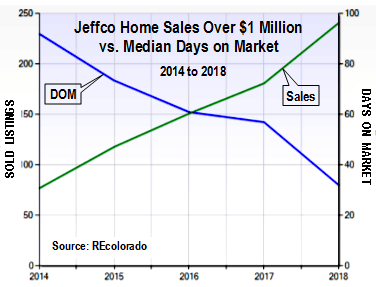
We Realtors are as surprised as anyone at the increase in home values, especially of the most expensive homes. The charts below speak for themselves. Not only are sales of million-dollar homes in Denver and Jefferson County increasing, but the time it takes such homes to go under contract has continued to go down.

Not shown in these charts is 2019, since we’re only 9 months into the year, but the number of sales for both counties thus far in 2019 is already about to surpass the sales for all of 2018, and the median days on market (DOM) is about the same as last year. Evidently, the number of sales over $1 million will continue to increase, while the days-on-market line may level off.

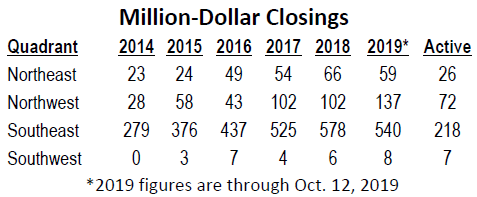
The number of sales of Denver homes over $1 million thus far in 2019 is 739, vs. 746 for all of 2018.  The yearly increase in million-dollar closings has ranged from 9.2% to 40% over the past 5 years.

Those are the statistics for all of Denver. The figures for Denver’s four quadrants (divided from each other by Colfax and Broadway) present differing market trends, as follows:

It’s worth noting that two of the quadrants — northwest and southwest Denver — have already recorded a big increase in sales for 2019 over all of last year. And the other two quadrants are likely to top last year’s sales, since there are currently enough homes under contract to make that happen. At press time there were 125 Denver homes over $1 million under contract — 78 in southeast Denver and 13 in northeast Denver, most of which can be expected to close in coming weeks. There are another 323 active Denver listings over $1 million, many of which could also sell by year’s end.

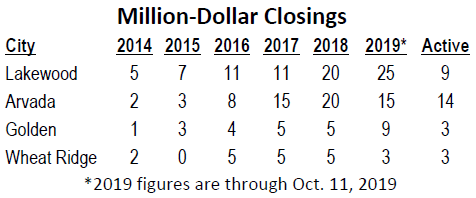
The number of Jefferson County homes over $1 million sold in 2019 through press time was 235, vs. 242 for all of 2018.  The yearly increase in million-dollar closings has ranged from 21% to 53% over the past 5 years. Those, however, are the statistics for all of Jefferson County. The figures for the four biggest Jeffco cities present differing market trends, as follows (Note: Golden stats are within city limits only):

Only Wheat Ridge is lagging in this trend of massively increased sales of Jeffco homes for over $1 million.  The other three cities are beating the county trend. The days on market for these four cities varied significantly from each other and from the Jefferson County statistics. 

For example, those five sales last year of million-dollar homes in Wheat Ridge had a median DOM of 298, while the 20 homes that sold last year in Lakewood had a median DOM of 25 and the 5 homes that sold in Golden had a median DOM of 89. The Arvada homes had a median DOM of 21 days.  The 15 Arvada homes that have sold thus far in 2019 have a median DOM of just 14 days.

While the market for lower-priced homes does show signs of slowing, the market for homes over $1 million seems only to be strengthening. This may be a reflection of the Trump tax cuts which are known to have helped the ultra rich more than those in lower income brackets. That discrepancy has also evidenced itself in the rates for jumbo loans, which have been lower in recent years than the rates for conventional mortgages. When I checked on Sunday, Wells Fargo was quoting jumbo loans at 3.5% and conventional loans at 3.625%.

There’s a lot of uncertainty in the world right now, especially in the Middle East and on the domestic political scene, and I’m frankly surprised that the markets remain so stable.  It will be interesting to see how things shake out in the coming months and how that impacts the real estate market.

Golden Real Estate’s Agents Featured on RatedAgent.com

The website RatedAgent.com stands out from other websites which provide agent ratings, because it only surveys actual past clients shortly after the closing of real estate transactions. Because of that, there are no phony reviews or reviews by people who haven’t actually done business with the agent in question.

Not all brokerages pay the company that operates that website to survey its buyers and sellers, but we’ve been doing so for nearly a decade. That provides a lot of data which you can trust for each of our broker associates.

You can use the website to search for agents by name or to look for agents in specific cities.  It’s the first place I go when asked to recommend an agent for a buyer or seller outside our primary service area of Metro Denver.

If, for example, you search “Golden CO” on their website, you’ll see that all nine Golden Real Estate agents appear in the top 15 agents.  If you search other cities, some of us also show up.  (I myself am listed first in Golden, and second in Arvada.)

Check it out! It’s a valuable resource. It will give you comfort in asking any Golden Real Estate agent to help you buy or sell.

Were Last Week’s “Climate Strikes” Enough of a Wake-up Call on Climate Change?

We can thank Al Gore for educating us about global warming, but I wish a non-politician such as Carl Sagan had performed that service. I can’t think to any other scientific research which became partisan in a similar way.

Remember CFCs and the ozone hole? It wasn’t a partisan issue. The issue was addressed quickly in a bi-partisan manner.

It was meteorologists, not politicians, that taught us about El Nino and La Nina—the cyclical events in which changes in ocean temperature create weather patterns affecting our entire continent. No one has said El Nino is not real.  It is accepted science — like climate change.

It’s only because Al Gore introduced us to the “inconvenient truth” about climate change that his teachings were disputed and rejected as left-wing propaganda by those on the right. How sad, how unfortunate, and how deadly the consequences.

Last Friday I attended the “Climate Strike” event on the Colorado School of Mines campus and watched news coverage of bigger events around the world.  I’m 72 now, and, yes, the climate will worsen before I die. But those under 40 and certainly those under 20 are seeing the early effects of global warming and worry that their world will be unlivable by the time they’re my age.  For them, it’s a huge crisis.

Back in June, I attended my 50th reunion at M.I.T, during which there was a Technology Day symposium on climate change. One of the speakers, Prof. Noelle Selin, told us that the global concentration of carbon dioxide was 325 parts per million when we graduated in 1969, but now it was 410 ppm. She made us think about those who graduated in 2019 (who she dubbed “the Class of 410 ppm”) and speculated on the class that would be graduating at their 50th reunion. “Will it be the Class of 600 ppm or the Class of 700 ppm?” she asked. And what will life be like for them at their 50th reunion?

It was a sobering presentation. And you can be sure that it was even more sobering for the Class of 2019 and for M.I.T. students who have yet to graduate.  To view her 19-minute presentation, click here.

The impact on real estate — and national security — is apparent when you consider all the “climate refugees” who are likely to migrate from heavily impacted areas such as the Bahamas, Florida, Houston — and Syria, where drought, as much as civil war, contributed to the exodus of Syrians to Europe. Indeed, over a decade ago the U.S. Defense Department labeled climate change a threat to national security. You can understand why.  I do.

The headline of my column on Jan. 14, 2014 was, “We May Have Already Passed the Tipping Point on Climate Change.” That statement was based on the already dramatic reduction in summer sea ice in the Arctic Ocean, as documented by the Earth Policy Institute at Rutgers. I published their chart showing a correlation between the increase in atmospheric CO2 from 300 to 400 ppm since the Industrial Revolution, and the 50% loss of summer sea ice in the Arctic between the late 20th Century and 2013. 

The reason loss of sea ice creates a tipping point for our climate is that sea ice, being white, reflects sunlight, whereas open ocean, being dark, absorbs sunlight, causing more ice to melt and to melt faster. A warmer Arctic region in turn upsets weather patterns worldwide.

Almost six years have passed since I wrote that column, and now the Arctic Ocean is open and navigable for part of the summer. We have learned the term “polar vortex” and experienced the effects of wilder than normal fluctuations of the jet stream. Warmer oceans in the tropics have caused stronger, slower hurricanes, causing 100-year floods to become frequent, as we have already seen in Houston. These effects were already happening back in 2012 with superstorm Sandy in New York and New Jersey and even here in Colorado with the heavy rains and flooding of Sept. 2013.

Unfortunately, we have a president who will never admit he was wrong, so he will never admit that climate change is real, that it is exacerbated by CO2 emissions, and that the only hope, if there is any this late in the game, of reducing the impacts of climate change is to drastically reduce the output of greenhouse gases like CO2 and methane. Instead, inaction on climate change, and worse, may be this president’s #1 legacy.  How sad.

Nothing Would Spur the Real Estate Market More Than Relief of Student Debt

A recurring idea among many of the Democratic presidential candidates is the payoff of student debt combined with making public universities and colleges tuition-free.

If that were to be done, I think we’d see an amazing increase in home purchases by those who are currently saddled with tens of thousands of dollars in debt. Freeing them from monthly payments of that debt could unleash a lot of buying power, and not just for real estate. Dollar-for-dollar, there is probably no investment the government could make of equal scope that would have as great a stimulating effect on the economy.

According to the Center for Responsible Lending, “Student loan debt has topped $1.5 trillion in recent years, making it the largest type of consumer debt outstanding other than mortgages. The average student loan borrower graduates with nearly $30,000 in debt.”

Moreover, according to the Center, The CFPB estimates that over a quarter of borrowers are delinquent or have defaulted on their student loan debt. Such defaults wreak havoc on the borrower’s credit rating, making home financing impossible rather than just difficult.

It’s hard to imagine the impact of having literally millions of home buyers entering the market if this were to happen. It may, in fact, prove to be too much stimulation of an already tight housing market. Meanwhile, the rental market could have the depressing impact of so many renters vacating rental units to buy their own condos and homes.

Speaking of the economy, I read an article last week that the RV industry is experiencing a 20% decline in sales, and that it’s considered a leading indicator of recessions. In my Sept. 5th column I wrote about fears of recession stoking a reduction in home buying activity, although market statistics don’t yet show that happening .

However, the article on declining RV sales got me to thinking. What makes it a leading indicator of a coming recession is that RVs are an extreme example of discretionary spending, the kind that is reduced when consumers fear for their financial future.

Well, real estate purchases are often discretionary, too. People don’t always have to sell their current home or leave their rental to purchase a home. If they are in fear of economic pain, it’s understandable that they would postpone such a purchase.

So, although the statistics don’t yet reflect such a slowdown in real estate activity, I think the prospect of that slowdown is quite real, and I’ll be watching for statistical evidence of it.

If indeed a recession is looming, relief of student debt could have a strong countervailing effect on the economy as a whole, and not just the real estate market.

Note: Some readers of this column got the impression that I supported the forgiveness of student debt. I still need to be convinced that it would be a good thing to do. The point of this column was merely to speculate on the market effect if that idea were to be implemented.