
A Fair Housing Violation Could Ruin a Real Estate Professional’s Career

From my first classes in real estate, back in 2002, I was made aware of our obligation under law as well as under the Realtor Code of Ethics, to avoid even the hint of racial and other discrimination, including “steering” buyers to or from neighborhoods based on race or other criteria.

We continue to be warned about “testers” from the U.S. Department of Housing & Urban Development who pose as buyers to see whether we are in fact engaging in steering or other discriminatory practices.

I am reminded of this topic by an article in the current issue of Realtor Magazine about “The Gentrification Conversation.”  You are probably familiar with this term, which refers to the upscaling of traditionally poor and usually minority neighborhoods, resulting in the displacement of minority homeowners and tenants as they are priced out of their long-time neighborhoods.

While we don’t see a lot of gentrification in our suburban counties, it has been and remains an issue in inner cities such as Denver, and I see it a lot in West Denver, between Sheridan Blvd and I-25.

The Realtor Magazine article talked about the large-scale gentrification taking place in Detroit and about the deployment of HUD testers:

“An investigation by Newsday [a Long Island daily newspaper] published in November found disparate treatment and evidence of fair housing violations when undercover testers posing as home buyers visited real estate agents throughout Long Island, N.Y. A total of 93 agents were tested over three years, and the probe found unequal treatment occurred 49% of the time with black testers, 39% with Hispanic testers, and 19% with Asian testers. Unequal treatment included showing minority testers fewer properties, steering testers toward certain neighborhoods, and refusing to serve minority testers who weren’t preapproved for financing but not requiring the same for white testers. Agents also used euphemisms to communicate the racial makeup of an area and imply racial bias.

“[National Association of Realtors] President Vince Malta says he was deeply troubled by Newsday’s findings…. ‘NAR maintains its strong support of fair housing testing to unmask housing discrimination and hold our industry to the highest standard,’ he says.”

It should be noted that race is only one of several “protected classes” under both state and federal laws.  The federal Fair Housing Act of 1968 also prohibits discrimination based on sex, color, religion or creed, national origin and disability. Colorado law goes further, prohibiting discrimination based on sexual orientation (including transgender), gender identity, and familial status (single, married, having children under 18, being pregnant, etc.).

Avoiding fair housing violations can be tricky. Did you know that hoarding and peanut allergies are classified as disabilities?  Or that age discrimination is not prohibited in Colorado?  Or that drug addiction is protected as a disability, but illegal drug activity isn’t?  Or that you can’t discriminate based on how a person earns their income?  Or that you can be held liable for violating the Fair Housing Act even if you did not intend to discriminate?

The Realtor Magazine article provides guidance on how to avoid committing a fair housing violation.  For example, we cannot answer questions about a neighborhood’s demographics, but we can provide a neighborhood report from Realtor Property Resource (RPR) which does provide such information. We cannot characterize a neighborhood’s level of crime, but must refer the buyer to the local police department.

We can avoid “steering” by entering the buyer’s search criteria into the MLS and letting the computer pull all listings matching those search criteria.  We can enter geographical criteria such as city or draw an area on a map, as long as we are following the buyer’s request and are not knowingly avoiding one area or another based on discriminatory preferences.

If a buyer asks us to help them identify areas based on discriminatory criteria, we are advised to decline to serve that buyer. Since I have never had a buyer make such a request, I would suspect such a buyer to be a HUD tester.

The trickiest conversation to navigate would be one asking about the trends in a given neighborhood.  Is it “going up” or “going down”?  All we should do is provide actual statistics about the past few years, just giving the numbers, but no interpretation of them that could include demographic changes.

I can’t recall dealing with a buyer who presented a fair housing challenge, and I make an effort to stay aware of fair housing laws and understand the importance of non-discrimination.  However, it can be a challenge keeping up with current housing laws, as suggested by those questions I posed above.

Most Feedback Requests Ask Unproductive Questions

Just a few years ago, there were several services which handled showings of homes for sale so that listing agents and their offices didn’t have to handle showing requests themselves.  Each of those showing services would send email feedback requests to the showing agent beginning right after the showing.

Last year, a company called ShowingTime bought Centralized Showing Service (which we used) and now virtually all brokers are utilizing that one company to send feedback requests to showing agents and to forward responses to listing agents and their sellers.

As I’ve written in the past, the best feedback request is one which asks a single question — “What’s your buyer’s feedback on this listing?” — and provides an open text area for the response.

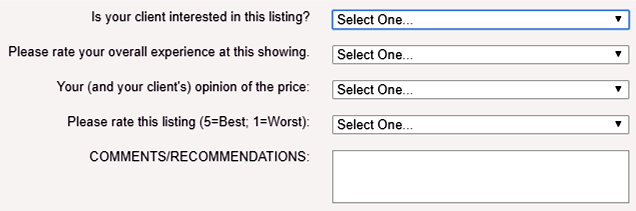
Instead, ShowingTime’s default email asks a few stock questions such as rating the showing “experience” and saying whether the listing price is high or low. It looks like this:

Asking the buyer’s opinion of the price is useless and not smart — if I were submitting a contract I’d say it was high even if it’s not. If I were previewing the house before listing a competing home for sale, I might say it’s too low. Here’s the custom feedback template I created for all my listings:

Agents can change the default to one question with open text, but it’s not easy to do.  I had to ask support how to do it.

Here are the instructions for readers who are agents using ShowingTime: 1) Log in to ShowingTime. 2) On the left, expand “Feedback” 3) Below “My Feedback,” click on “Form Design & Settings.” 4) Enter name of your template. 5) After making any changes to the Settings, click on the tab “Feedback Form.” 6) Click on “Add Free Text Question.” (You can enter more than one.) 7) Click “Save Changes” 8) Click on Preview Survey to make sure the form you designed is the one that will be sent to all showing agents.

If You’re Surviving Covid-19 Financially, This May Be a Good Time to Buy or Sell

Despite the best efforts of state, local and federal governments, there will surely be people who are suffering financial hardship and have had to put their dreams of homeownership on hold.  I wish them well as they dig themselves out of this terrible situation.

For those who are surviving Covid-19, however, and don’t get sick from it in the coming months, the continued record-low interest rates are making home purchase more attractive and more affordable.

As you’ve no doubt heard, the Federal Reserve has plunged hard into softening the impact of the virus and its attendant effects on the economy by reducing the Fed Funds interest rate used by banks to near zero. While this rate is unrelated to mortgage rates, we are also seeing those rates staying below 4% and approaching 3%, which is propping up the real estate market in a big way.

People who can afford to buy a home and have the income to qualify for a mortgage are getting off the fence. This is evident from how many homes are going under contract quickly, often with competitive bidding.

In the first 10 days of May, there were 2,306 homes within 25 miles of the State Capitol entered on Denver’s MLS. 615 of them were under contract by May 10th. Another 171 homes were entered as “Coming Soon” as of this Tuesday.

May 5-12 Stats within 25 miles of State Capitol

While that’s less than the first 10 days of May 2019, when 3,348 homes were entered on the MLS and 795 of them went under contract by May 10, it’s still an impressive amount of activity, and is probably due in part to the excellent mortgage situation.

Another factor that will stimulate purchasing among the wealthy is that the stock market has recovered more than half of its early losses due to the virus. That makes it more likely that investors would be willing to liquidate stocks to finance a cash purchase of real estate.

In April 2019, about 48% of homes sold at or above their asking price, and 46% of them sold in a week or less. This year’s performance is better. Of the homes that closed during April 2020, about 58% sold at or above their asking price, and about 62% sold in a week or less. Those statistics tell me that we have a pretty active sellers market, which stands in contrast to the gloomy economic situation caused by Covid-19.

It’s hard to believe that the real estate market will tank later this year if it is not tanking already.

I’m seeing that dynamic myself. As of this writing, all my own listings are either under contract or closed, including the Wheat Ridge home featured as “coming soon” a couple weeks ago.  That $550,000 brick ranch was only listed as “active” on the MLS last Tuesday, and showings didn’t begin until Saturday, but our first offer came in on Sunday, and it was under contract at better than full price by Tuesday morning.

Zillow Shortchanges Both Agents & Buyers on Video

Despite the increased emphasis on virtual tours because of stay-at-home orders, Zillow continues to stymie those of us who want to provide narrated video tours of our listings.

Unlike our MLS — and most other MLSs around the country — Zillow does not let us link a YouTube video to our listings on their platform.  Zillow gets those links from our MLS but does not display them.  Instead it wants agents to become Premier Agents (which costs money) and then makes agents use a Zillow app to shoot a walk-through video using their smartphone.

That walk-through is limited to 2 minutes and does not carry sound, which is ridiculous, since the whole point of a walkthrough is for the agent to point out the features of the home. “Don’t worry about barking dogs,” we are advised, “since your video won’t have any sound.”  Isn’t that comforting?

In my opinion, there is simply no substitute for a narrated long-form video tour of a listing.  We’re told that videos should be short to match the short attention span of online lookie-loos, but I do the videos for people who like what they see in the description and photographs and want to take a deeper dive into the features of a home before seeing it.

Last month I sold a $1,250,000 home in the foothills to a couple from Washington, DC, who never saw the home in person. They had a daughter look at it in person, but they only had my 18-minute video tour to go by before signing the contract. They didn’t even come for the inspection or closing.  And that’s not the first such instance of a Golden Real Estate video tour selling a home to an out-of-state buyer who didn’t see it in person until at least the final walk-through.

We can thank Zillow for getting us more comfortable with shooting a two-minute silent walkthrough video, but all agents need to become comfortable with doing a video tour that functions like an actual showing.  Who would show a home in two minutes — and without saying a word?  Not me!

Some agents are simply shy about being on camera or speaking into a recording.  Well, you don’t need to be in front of the camera, so let go of that excuse. And if you simply think of the camera as a buyer that you’re showing the home to, you know exactly what to say as you go through the home. Point out the flooring, the counters, the view out the window.  It will come easily.

Lastly, don’t use your smartphone. Buy an HD video camera such as the Osmo Pocket (shown here), which we use. It has a gimble so that your video does not have the shakiness of a handheld camera. It costs about $350 at Best Buy, where we purchased it.

What Will Be the Short- and Long-Term Effects of Covid-19 on Real Estate?

As I write this column on Tuesday, April 28th, the infection rate of Covid-19 seems to be leveling off, and the rule against in-person showings has been relaxed, although open houses are still banned.

The inability during much of April to show listings not only made it harder to sell homes, it also resulted in a reduction of roughly 50% in the number of homes being listed. Despite that, homes that were listed continued to go under contract quickly, thanks in part to good pictures and virtual tours.

It may be that the smart thing to do in April was to list your home. It was a matter of supply and demand — many fewer listings meant less competition for the homes that were listed, while buyers were apparently still willing to “pull the trigger.”  The key was to have good pictures and a narrated video tour because of the limit on showings.

I predict that there will be a bigger than usual surge of new listings in May and June, now that the no-showings rule has been relaxed. Although Denver and five other metro counties have extended their stay-at-home orders through May 8th, it was the Division of Real Estate and the state Attorney General’s office that were setting the rules about showings and open houses, and they don’t enforce local ordinances, so it’s expected that in-person showings will be happening throughout the metro area starting this week. Don’t, however. expect real estate offices to be open for walk-ins during this period.

So, what about the market going forward? The fact that mortgage rates are staying low, heading inexorably in the direction of 3% for a 30-year fixed loan, means that buyers are going to be supercharged as they go house hunting under fewer restrictions. There is pent-up demand, and there is also pent-up supply.

Nevertheless, we can’t ignore the near-depression economic conditions we face nationally in May. There will be many buyers not going back to work and unable to qualify for a home loan. However, the estimated 70% of Americans who were able to keep working from home or who had “essential” jobs, such as construction and health care, have been making good money — many earning overtime and/or hazard pay — and may want to reward themselves with a new home once things calm down.

So, while we real estate professionals have remained fairly busy during April,  I expect we’ll be even busier in May and throughout  the summer — especially as rules are relaxed. There will, however, be some subtle and not-so-subtle changes to the way we practice.

Most real estate agents were already accustomed to working from home, only going to their offices for floor duty, to handle paperwork, or to meet with buyers and sellers. Contract software has been online for a decade or more. We are used to emailing documents and having clients sign contracts electronically instead of on paper, which has served us well during the stay-at-home period. That will continue unchanged.

Showing appointments for nearly all MLS listings are handled by one company, ShowingTime, and increasingly the showings are being set online instead of speaking with an operator.

Where we will see the most changes will be with those activities that still require personal contact. Fist bumps and elbow bumps will probably replace handshakes long-term. We’re becoming hardwired as germophobes, I suspect.

Offices will be much cleaner. We’ll disinfect hard surfaces and wash hands more often. We’ll go back to having open houses eventually, but there may be fewer lookie-loos.

It will be a while before buyers want to ride in our cars, preferring to follow us to showings in their own cars.  I will continue to carry disposable gloves and Clorox wipes in my car, to use when showing homes.

More agents will learn to do their own narrated video walk-throughs of their listings, as Golden Real Estate agents have been doing for 13 years. And more buyers will look for those video tours and be more selective about the homes they choose to see.

In conclusion, real estate has shown great resilience during the pandemic thanks to how online the industry has already become, and I believe it will emerge from the current situation stronger than ever.

Why Real Estate Won’t Crash Like It Did Before

Many buyers and sellers of real estate are wondering whether we’ll see the kind of crash in real estate values that we saw in the Great Recession of 2008 onward. Experts agree that we will not.

In an April 22nd post, realtor.com explained that circumstances this time are quite different from then. Reasons cited by realtor.com’s economist, Danielle Hale, include the following:

First, the 2008 crash was created by a rash of bad mortgages — a situation that was remedied because of that crash. Second, there was an oversupply of houses for sale, whereas today there is an undersupply.

According to the realtor.com post, “There are simply too many would-be buyers out there: millennials eager to put down roots and start families, folks who lost their homes during the last recession and want to buy another property, and boomers looking to downsize.”

Lawrence Yun, chief economist at the National Association of Realtors, predicts that home sales will pick up again quickly and that prices will not fall.  He sees the luxury market taking the biggest hit, largely because the buyers of those homes may have lots of financial liquidity, but it is in stocks which they don’t want to sell while prices are low.

Also, widespread mortgage forbearance will prevent the surge in foreclosures we saw before.

Real Estate, Oddly Enough, May Be the Last Industry to Adopt Live-Action Video

The term “virtual tour” was introduced to the real estate industry a couple decades ago, but only because photography vendors were able to convince listing agents to hire them and competed to offer the coolest technology.

Early vendors wowed us with 360-degree still photos of each room, although that is now out of style.

The latest “shiny object” is a 5- or 6-year-old product by Matterport. I remember getting a demo of it at a trade show in San Francisco. They call their product an interactive virtual reality (VR) tour of still photos in which you can use your mouse or finger to rotate each photo manually left to right or up and down. Gray circles indicate new photo points. You click or touch them and you are taken to that place where you can, again, rotate horizontally or vertically. Thus, you can, at your own pace, navigate around the entire listing choosing which room you want to enter and leave.

The “coolest” feature of Matterport is the “dollhouse” view, shown here. You remember dollhouses, where one side was open so you could look inside each room? That’s what Matterport’s dollhouse view is like except that it’s on your screen and you can rotate it on any axis. 

Still, it’s only a collection of still photos with no narration.  Personally I find it kind of dizzying and nowhere near as useful as being walked through the home by a listing agent with a video camera who explains the obvious and not-so-obvious features of the home. I wouldn’t call anything less a “virtual” tour.

I have been selling real estate now for 18 years and seen maybe a dozen different variations of the “virtual tour” concept, but almost all of them are nothing more than still photos presented in different, often interactive ways. None have the advantage of a simple video walk-through of a home by the listing agent.  That’s what we do at Golden Real Estate, and have been doing since 2007. Click on any of our listings at www.GRElistings.com to see what a good narrated video tour looks like.

What amazes me is how few agents do what we do. In the article below, I mention that 114 homes listed last week went under contract by week’s end, at a time when in-person showings and open houses were not allowed. Assuming they followed the 2-week-old rule against in-person showings, buyers of those listings had only the photos and “virtual tours” on the MLS to go by in making their decision to submit an offer.

One might assume that those 109 listings had great virtual tours, but almost none of them did. Surprisingly, only 65 of the 114 had any “virtual tour” on the MLS, but more surprisingly only two of them had a narrated video tour. Five of them had video walk-throughs with music. One had no sound track at all, and one really cracked me up. The agent held his smartphone horizontally, but his footsteps and breathing were all you could hear. Imagine if an agent walked you through his listing in person and never said a word about anything — that’s what it was like!

The two narrated tours were quite good in the detail which the agents shared, but they both shot with their phones in vertical mode and one was quite shaky since it was handheld. Too bad she wasn’t using the Osmo camera that we use, which has a gimbal, making the picture totally steady.

About half of th0se 65 listings with virtual tours had Matterport tours, which I found very disappointing. Others were just slide-shows with music, and many were just a collection of still photos or brochures.

The Number of New Listings Remains Low, But They’re Selling Fast

Each week I have been checking the MLS to see how many homes are being listed afresh and how many are going under contract as the Covid-19 stay-at-home order remains in place.

In last week’s column I reported that during the 7-day period from Sunday April 5th to Saturday April 11th, a total of 819 homes within 25 miles of downtown Denver were entered on Denver’s MLS, This past week — from Sunday April 12th to Saturday April 18th — that number dropped slightly to 799.  Of those, 23 had already been sold privately, compared to 22 the previous week, so there were only 776 new active listings last week. Amazingly, 114 of those went under contract by Saturday, compared to 124 the previous week, despite stricter enforcement of the “no-showings” guidance from the Division of Real Estate. Another 74 of those new listings went under contract by Tuesday evening, April 21st.

Bottom line?  The roughly 50% drop in listings from previous years which we saw last week has become the “new normal” for the current situation in which in-person showings are not allowed until a buyer has signed a contract to buy a home.

This is actually a great time to list your home! The fact that so many buyers are still submitting offers without even seeing a home in person should inspire more sellers to offer their homes for sale. Just be sure you do it with a narrated video tour like we do for all Golden Real Estate listings.

Some Practical Advice on Preparing Your Home to Show Its Best and Sell With Ease

Submitted by Suzie Wilson of HappierHome.net

Whether you’re moving because of a job, family expansion or retirement, you’ll have to roll up your sleeves and get to work if you want your property to appeal to the most buyers. Before you start packing, however, there are a few minor home improvements you should tackle, which will speed up the process and get you on the road.

Start with aesthetics

No matter how short a time you’ve lived in your home, there are likely lots of little things that you’ve learned to overlook. The vast majority of these will be minor aesthetic imperfections that are cheap and easy to rectify. ProfessionalStaging.com notes that buyers are on the lookout for issues and will notice every little crack, stain, or chipped tile. Here are a few DIY projects that will reduce the lived-in look of your home:

  • Replace moldy or damaged caulk in the bathtub and shower
  • Clean or stain grout in the kitchen and bathroom
  • Fill nail holes in the wall and gaps around the trim
  • Plant colorful flowers by the mailbox and entryway
  • Organize storage spaces (buyers love to look in closets, under the stairs, and in the garage and attic)
  • Paint rooms that don’t already have a neutral color scheme
  • Install functional smoke and carbon monoxide alarms
  • Pull weeds and add a layer of fresh mulch to flower beds
  • Repair brown spots on the lawn
  • Replace outdated bronze and brass doorknobs, handles, and drawer pulls

Manage major malfunctions

There are plenty of small things you can tackle on your own, but you’ll also need to invest time and money making sure there are no major defects that may derail your home sale at inspection time. These include:

  • Foundation problems (Homes.com estimates this can devalue your property by up to $100,000)
  • HVAC issues
  • Mold
  • Leaks in the roof/missing shingles
  • Major plumbing problems, such as a clogged mainline
  • Outdated electrical panel
  • Windows that won’t open up or lock
  • Musty/animal smell
  • Rotted wood behind walls – most likely in the kitchen or bath
  • Damp basement

Small issues won’t necessarily be deal-breaker for most of your buyers but the less work they have to do the more likely they will be to give your home a second look. Large issues such as a crumbling foundation may designate your home as a fixer-upper, which won’t attract “everyday” buyers who want to move in immediately.

What do buyers want?

Buyers in different demographics will seek out home features that appeal to their lifestyles. There are, however, a few universal want-list items you can play up in your listing to cast as wide a net as possible. According to American Home Shield, the features homebuyers want are:

  • Separate laundry room
  • Energy-efficient appliances and windows
  • Exterior lighting
  • Outdoor entertainment space
  • Ceiling fan
  • Full bathroom on the main level
  • Hardwood flooring
  • Proper insulation
  • Garage storage
  • Eat-in kitchen

When it’s time

Once you’ve completed these repairs and renovations, there are a few finishing touches that will put the icing on the cake and sweeten the deal for your buyers. First, you should declutter, so that buyers can see more of the house and less of what you own. Before you declutter, though, it’s a good idea to buy an air filter. Since digging through those items is going to stir up a lot of dust, it’s important to keep the air clean for you and home buyers. [Note: Golden Real Estate provides its sellers with a free staging consultation.]

After you declutter, deep clean the entire home and weed out any belongings or furniture that don’t look quite right. To get your home sparkling clean, spend a little money on a housekeeping service. For an average of $166 a visit in Golden, housekeepers can help you keep up with laundry, mopping, sweeping, vacuuming, and straightening. Just keep in mind that the more you request from the housekeeping service, the more you’ll ultimately pay for the privilege. 

Also, staging and investing in high-quality professional listing photos (a real estate photographer usually charges between $110 and $300 for a shoot, depending on your location) will give online searchers a reason to pay your house a visit.  [Note: Golden Real Estate pays for professional photography and shoots a narrated video tour for all its listings. See examples at www.GRElistings.com.]

Perhaps most importantly, you’ll need to choose the best listing agent. Interview multiple individuals and ask about their recent local sales history and how many current listings they manage. A good agent will encourage you to price your home competitively and will go above and beyond simply listing on the MLS to promote the property. [Call 303-525-1851 for a free market analysis by broker/owner Jim Smith.]

Click here for a list of all the free services which Golden Real Estate provides to its sellers.

The Rule Against Showings and Open Houses Shouldn’t Hamper Home-Buying…

…that is, if the listing agent does what Golden Real Estate has done for over 13 years — create a narrated walk-through video of each listing.

Our narrated video tours are just like a showing. They are live action videos which start in front of the house (just like a real showing) and then go through the house and into the back yard, pointing out features as we go. 

Check out the video tours for any of our current listings at www.GRElistings.com to see what I mean. They really are like an in-person showing with the listing agent. For example, the video camera points down to the floor and up to the ceiling as I describe the hardwood floor or the sun tunnels which bring natural light into the home’s interior.

But, you say, you’re not going to buy a home that you can’t see in person.  Right? You don’t have to, because the rules allow for inspection once the buyer has signed a purchase contract. Your visit (presumably with an agent)  the very next day constitutes an inspection. That can be before you even have to deliver your earnest money check, since you may not even be under contract yet. The guidance from the Division of Real Estate says, “home inspections and final walkthroughs after a buyer has signed a purchase contract (emphasis added)… is also considered to be an essential part of the real estate transaction.” The buyer is not under contract simply by signing a contract that has not also been signed or countered by the seller.

That “guidance” from the Division of Real Estate was issued on April 9th and has not been updated as of April 18th, which is when I am updating this blog post.

Scott Peterson’s April 15, 2020 “Legal Bite”

However, Scott Peterson, general counsel for the Colorado Association of Realtors, maintains in a video recorded from quarantine on April 15th that the governor’s executive order prohibits any “marketing” that involves entry into a property – no photos, no video, nothing at all – without a contract in place. If that’s true, however, why isn’t it reflected in the April 9th guidance and why hasn’t that guidance been updated?

I tried Googling the governor’s executive orders and looked at his web page on www.colorado.gov/governor and saw only two executive orders on other matters and no link for all his executive orders. So, for now, I lack evidence of Scott Peterson’s claim and am relying on the April 9th guidance, which I keep checking for updates.

Therefore, a visit to the home by a buyer immediately after signing an offer to purchase the home does, in my opinion as a broker, comply with guidance currently in effect from the Division of Real Estate. Then, if the buyer is able to get under contract with the seller, he or she can schedule a second inspection by a professional inspector.

So, here’s a possible scenario: You look at the video tour of the patio home or the ranch-style luxury which you found at www.GRElistings.com. I guarantee you’ll have a pretty good sense of the home from viewing that video. You’ll experience the flow from kitchen to dining room, to family room, to back yard, etc., because you are being walked through the home. It is not a slideshow of different rooms, giving no indication of flow from one room to the next.

Let’s say you call me or your agent to submit a contract and let’s say that it is accepted by the seller. You’re under contract!  The typical contract has a 7- to 10-day inspection period. You schedule your personal inspection with your agent (or me, if you don’t have one) the next day, before delivering your earnest money check, which is typically due in 3 days.  You can terminate immediately if you have buyer’s remorse, and go back to looking at other houses.

If you don’t terminate, you still have a week to hire a professional inspector and submit a detailed inspection objection.

What if you’re a buyer, and there’s no such video for a house that interests you, but you don’t want to sign a purchase contract? I believe you’ve got three choices here.  One, your agent (me, for example) could ask the listing agent to create and provide a narrated walk-through video. Second, I could preview the home for you since the guidance make no mention of banning previews, and shoot my own rough-cut video tour of the home, post it as an “unlisted” video on YouTube and send you the link. Or, third and perhaps best, we could use Facetime, Zoom, or another app to have you see what I’m seeing as I walk you through the house. (NOTE: Scott Peterson believes that previews and videos shot by anyone other than the seller are not allowed. I just don’t have any documentation supporting that position.)

Therefore, while it may be inconvenient not to have an in-person showing of a listed home, there are work-arounds that can make it possible to get under contract and confirm your interest in the property before you are fully committed to it or put down any earnest money.

Finally, I’d like to note that many listings are empty and vacant.  I see no reason why in-person showings of those listings should not be allowed. I know that builders are letting buyers view their empty homes. Again, Scott Peterson maintains that empty homes cannot be visited either. Show us the actual orders from the Governor or guidance from the Division of Real Estate, Scott!