As you probably know, not all licensed real estate agents are “Realtors.” To be a Realtor, one has to be a dues-paying member of a local Realtor association, which automatically makes the agent a member of the state Realtor association and the National Association of Realtors (NAR).
Many low-producing real estate agents are reluctant to cough up roughly $500 per year in Realtor dues, so they join a non-Realtor brokerage like HomeSmart Realty in Greenwood Village or Trelora Colorado in downtown Denver. Agents with those firms can’t call themselves “Realtors.”
You’ve probably seen TV commercials by NAR saying “Make sure your agent is a Realtor.” Their current campaign features the theme, “That’s Who We R.” Both campaigns stress the point that only Realtors subscribe to the Realtor Code of Ethics. There is no code of ethics for non-Realtors.
In fact, however, violations of the Code, such as failure to disclose negative information about a listing or contacting another agent’s client directly, are also violations of state licensing laws. To me, the greater value of dealing with a Realtor like those of us at Golden Real Estate is our commitment to professionalism and to the industry, expressed in part by our willingness to pay those dues.
NAR’s lobbying on behalf of property rights benefits all agents as it does all property owners, and deserves the support of all licensees.
Here’s a video Jim Smith took at 2:30 p.m. April3rd, when the parking lot at Golden Real Estate was already full. Among the cars you’ll see in this video are the Mustang Mach E, the Polestar 2 and the Jaguar I-Pace, along with the usual complement of Teslas (all 4 models), Chevy Bolts, Nissan Leafs and others. Enjoy!
I have written before that 4 days on the MLS is the right amount of time to get the highest price for your home. That was based on an analysis I did several years ago, so it’s time to do a new analysis.
Looking at the 4,015 most recent sales in Jefferson County, here’s what I discovered.
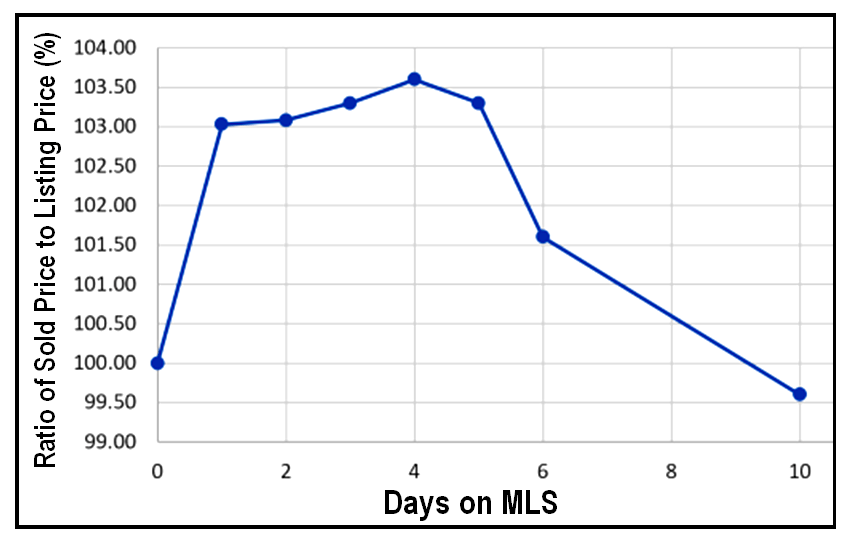
Roughly 5% of those sales showed zero days on the MLS, meaning that they weren’t even exposed to agents or the public until they were under contract. The median ratio of sold price to listing price for them was 100%. Some sold for over the listing price and some for less, but the median was the listing price.
Meanwhile, 200 homes went under contract after being on the MLS only 1 day. The median home for this group sold for 3.03% over its listing price.
There were 379 homes that were active on the MLS for 2 days before going under contract. The median home in that group sold for 3.08% overits listing price.
502 homes went under contract after 3 days on the MLS. The median home in that group sold for 3.3% overits listing price.
The highest number of homes, 608, were active on the MLS for 4 days before going under contract. The median home in that group sold for 3.6% over its listing price.
As in my prior analysis, being on the MLS for 4 days netted the highest price for the seller.
413 homes went under contract after 5 days on the MLS. The median home is that group sold for 3.3% overits listing price.
Another 206 homes went under contract after 6 days on the MLS, but the median home in that group sold for just 1.6% overlisting price.
Skipping ahead to the homes that were on the MLS for 10 days before going under contract, the median home in that group sold for 0.4% belowthe listing price.
Those statistics are displayed graphically on the chart above. Not shown in that chart is how low the ratio of sold price to listing price went for homes that languished on the market, usually because they were overpriced at the beginning. Here’s that other data:
223 homes were active on the MLS for 30 to 45 days before going under contract, and the median home in that group sold for 3.8% below the listing price. Looking at the 106 homes that were active on the MLS for 46 to 60 days, the median home in that group sold for 4.3% below listing price.
Lastly, 285 homes were active on the MLS for over two months. The median home in that group sold for 5.7% below the listing price.
The lesson for sellers is that you need to price your home to attract multiple offers and not accept the first (or second) good offer that you receive. Four days is the right amount of time, with proper marketing, for all potential buyers to learn about your home and enter the competition for it.
Selling it without making it active on the MLS at all, as too many sellers are currently doing, may be convenient, but it likely leaves money on the table.
There’s another way that sellers leave money on the table, and that is to hire a listing agent who uses the “highest and best” approach to handling multiple offers. It is the most common method used, but the agents of Golden Real Estate use a better approach — being open and transparent, handling bids auction-style.
The auction style of handling multiple offers is simple, but it does require more work by the agent and more patience on the part of the seller. Buyers and their agents appreciate this approach — and sellers are likely to net more money.
I have a good example from last week. I listed a home for $595,000 and got it under contract for $725,000, and I did it with only four bidders. If I had asked for “highest and best,” I would have had many more offers, and maybe the highest and best would have been $625,000 or maybe $650,000. But because I let every agent know the details of every offer I received, I received fewer offers, and those I did receive knew when their offer was exceeded by another offer. At that point they could either resubmit or drop out.
This process truly resembles a public auction, in which everyone knows where they stand and can choose to raise their bid or drop out. No one is blindsided. The worst thing for a buyer is to discover later that if they had only offered a little more money they could have purchased the home they wanted.
It’s hard for me to understand why listing agents won’t reveal their highest offer to other agents. There is no rule against it, but some agents seem to think there is. Some agents claim that their seller doesn’t want them to reveal details of the offers in hand, but I don’t believe that. And if it’s true, then the seller wasn’t told about the advantages of the auction style of managing offers.
If you want to get the most money for your home, use an agent like those of us at Golden Real Estate who are willing to do the extra work of handling multiple offers auction-style.
You can blame “Monopoly” for some of the confusion. That board game taught us all that there is such as thing as a “deed” to a property. With a “deed” to Boardwalk and some houses or a hotel on it, you could charge rent to those who landed on it — and hopefully win the game.
Meanwhile, the Department of Motor Vehicles has taught us that there is such a thing as a “title.” Meanwhile, when you purchase a home, you receive a “title policy” which guarantees “clear title” to your property.
But surprise! There is no such document as a “title” to your home the way there is a title to your car. There is a document called a “deed” but that is the document which transfers ownership, it is not proof of ownership. Sorry, I know this is confusing!
So where is the proof that you own your home? It is held by the Clerk & Recorder of your county, and it’s based on the most recent deed recorded with the county. The only proof that Rita and I own our home in Golden is that the most recently recorded deed transferred the property to us. There is no other document which we have or can produce to prove we own our home.
Last year the state-mandated contract for the purchase and sale of real property changed the way deeds are specified. The agent preparing the contract specifies whether the buyer wants to obtain ownership through one of several deeds.
First is the “Special Warranty Deed,” by which the seller warrants that he is transferring ownership of his property free of any known lien or claim of ownership during the time he/she or they owned the property. That is the most limited type of deed.
The buyer might, however, demand a “General Warranty Deed,” by which the seller is warranting that there is no other claim of ownership (or lien against the property) going back to the beginning of time.
What you need to know, however, is that, regardless of which type of deed is used to transfer ownership, the buyer should receive an “owner’s title policy” (typically paid for by the seller) guaranteeing free and clear title to the buyer. In other words, it hardly matters which type of deed is used to transfer the property. You’re still protected.
Title insurance differs from other kinds of insurance because it has no term. It is a one-time purchase that covers the new owner of the property forever. It never has to be renewed.
Prior to issuing the title policy, the title company does a “title search” looking for any recorded claim of ownership or lien against the property in question. If a claim or lien is not recorded with the county in which the property is located, it can’t be enforced.
It is possible, of course, that a claim or lien might be overlooked during the title search, but it’s pretty rare. I recall once in 1991 I purchased an older (1905) office building in Denver, receiving a title policy from Land Title Guaranty Company. Within a year or so, I was notified of a lis pendens against the property, but the lawyers for Land Title did whatever they had to do in order to clear it, costing me nothing. Since that time I can’t think of any claims against any title policy held by me or any of my clients — and I’ve had quite a few!
There are other types of deeds beside Special Warranty and General Warranty. If the property is owned by the estate of a deceased person, the property is transferred by a “Personal Representative’s Deed.” If the property is purchased at a foreclosure auction, it is transferred by a “Public Trustee’s Deed.” If a property is purchased out of bankruptcy, it is transferred via a “Trustee’s Deed.”
A “Quit Claim Deed” is used when real estate is transferred without being sold for money. For example, if John Doe were to marry Jane Doe and wanted to put a home he owned in both their names, he could “quit claim” it from John Doe (as “grantor”) to John & Jane Doe (as “grantees”). If they divorce later on, John & Jane Doe might quit claim the house to either John or Jane, with or without a monetary settlement on the side.
With such examples, I hope you now understand that a “deed” is in fact an instrument of transfer, and not a title to property.
Because there is no physical title to real estate, the first thing that a title company does when asked to execute a contract to sell a parcel of real estate is to issue a “title commitment,” which is a document asserting who the recorded owner of the property is and to whom it is to be transferred.
There is one other use of the word “deed,” and that’s for the “Deed of Trust” which a mortgage or other lender has you sign when you take out a loan of any kind which is secured by your home. That document is recorded with the County Clerk & Recorder and is the basis for that official to hold a foreclosure auction if you default on the loan.
I am not a lawyer, and I am providing this information as I understand it from real estate classes and from my experience as a real estate licensee. You’ll want to engage a lawyer if you require further explanation, and I, like any real estate licensee, can refer you to one.
If you’re thinking of 20th Century home construction, promoting the all-electric home would make little sense. Electric baseboard heating has its place, but no longer as a whole house solution. One advantage of it is that each room can have its own thermostat, so you’re only heating rooms when you use them. For the heat it produces, however, it is many times more expensive than using a mini-split heat pump solution. Recently I showed a home where a heat pump mini-split was used to heat a detached and insulated garage which doubled as a workshop. That’s a great application for that kind of heating — also because the mini-split can cool the garage in the summer, not just heat it in the winter.
There has been a revolution in the development of electric appliances, too. The induction cooktop, for example, is a highly efficient replacement for earlier electric ranges or cooktops which used resistance-based cooking elements.
Another change from the 20th Century: you can now generate your own electricity with highly affordable roof-top solar photovoltaic installations.
Basically, iBuyers such as Opendoor and Zillow Offers attempt to lure homeowners in-to selling their home for what appears to be a good price but which is literally intended to net the seller less than if they exposed their home to the full universe of potential buyers.
Literally intended? Yes, all you need to know is that if a company wants to buy your home in order to resell it, it’s because they will make a profit from doing so. Wouldn’t you want to keep that profit for yourself?
Now Zillow has weaponized its much criticized “Zestimate” for the purpose of getting their “foot in the door” with you. Let me share with you a few points to ponder before responding to Zillow’s pitch.
First of all, you and I both know that the Zestimate is a computer-generated number that is by definition not particularly accurate. (Zillow’s estimate on my own home is at least $100,000 over its true value.)
To facilitate their iBuyer program in Colorado and elsewhere, Zillow made big news recently when they opened brokerages and started hiring brokers. They have opened an office in Centennial and, as of this week, have 15 broker associates, 12 of them members of the Denver Metro Association of Realtors. The others belong to an out-of-state Realtor association. So far that brokerage has put zero listings on REcolorado, our MLS, whether active, pending or closed. Presumably those 15 broker associates are busy responding to homeowners who responded to Zillow’s pitch about buying their home for the Zestimate price. How will those meetings go?
First, the broker associate will do a true market analysis and explain that the Zestimate was computer generated and overstated their home’s value. “Here’s what we will offer you, now that we know the true value.”
If the seller accepts the lowered price and signs a Zillow purchase contract, it will have the following provisions, assuming it’s similar to the contract from Opendoor that I was able to study.
First of all, the seller will have accepted a 7½% “service fee” in lieu of a commission. Next, they will have agreed to an inspection or “assessment” of the property, which will be followed by “adjustments” to the purchase price based on “needed repairs,” including, for example, a new roof, a new furnace or water heater based on age — whatever can be justified. The example I cited in my August 2019 column mentioned $38,563 worth of “repairs found in assessment.”
That contract had an escape clause for the seller, which Zillow’s contract probably does too, allowing the seller to terminate at any time, which is what that buyer did. The combination of the “service fee” and the reductions to cover supposed “repairs” was so great that they called me. I listed their home for the right price and sold it above asking price due to multiple offers, netting the seller more than they would have netted under their contract with Opendoor.
I got the seller more money, because, as I said above, the only reason for Opendoor or any iBuyer to purchase a home is to sell it at the market, which requires them to purchase the home below its market value.
In the iBuyer marketplace, Zillow clearly has the advantage, because virtually every homeowner is already being dazzled by the Zestimates they get routinely by email, whereas Opendoor and other iBuyer competitors have to canvass and cold-cold homeowners about selling their home “without putting it on the market or paying a commission.” Zillow enjoys what every brokerage wants — sellers calling them! All the Zillow brokerage has to do is employ enough agents to answer the phone and arrange those in-home “selling” appointments, which are really for the purpose of listing the home for sale once it is owned by Zillow.
It’s a great business model — for Zillow, but not necessarily for the homeowner. That is, unless the homeowner is willing to give up thousands of dollars in proceeds in return for the “convenience” of selling without any showings or other intrusions.
For some homeowners, that convenience is worth the loss of proceeds, and there are probably enough such homeowners to make the iBuyer model successful. What bothers me is that for some it will feel like a “bait and switch” situation. After all those “adjustments” have been made, they might be un-able or unwilling to exercise their right to terminate the contract because they have made life plans based on the expectation of selling their home for an acceptable price.
Some will have already signed contracts for a new home or at a senior community. They will have already packed some of their belongings or put them in storage, and they may have told their friends that they are selling and moving. For these persons, it may be psychologically difficult or financially costly to reverse course when they discover they have been fooled into selling their home for less than its worth.
If you have responded to the Zillow pitch and would be willing to share your experience, I’d like to hear from you. My email address is Jim@GoldenRealEstate.com. I’ll share what I learn in a future column. Subscribe to this blog to get alerts about future postings on this or another topic of interest.
Sellers love bidding wars. Buyers not so much. If you’re a buyer and want to avoid a bidding war, simply ask one of our agents (below) to set up an MLS alert including this criterion: Days in MLS >9. As I write this, there are 1,021 listings that have been active on REcolorado 1 to 9 days on MLS, but 4,044 that have been active over 9 days. A listing that has been on the MLS 10 days or longer is far less likely to have multiple offers (unless it just posted a big price drop).
As much as we Americans love our gas fireplaces, gas ranges and gas grills, we need to recognize that the move to an all-electric home, with the electricity being generated using minimal fossil fuels, is central to the goal of mitigating the effects of climate change.
And it can be a good future, especially if you’re able to generate all the electricity that your home and cars use.
That’s the future Rita and I have created for ourselves. We have 10 kW of solar panels on our Golden home, enough to heat and cool our home and charge our two electric cars. Our forced air furnace only burns gas when the outside temp dips below freezing. Otherwise, a heat pump provides all the heat we need. And recently we replaced our gas water heater with a hybrid water heater that heats all the water we need using its built-in heat pump. It has a standard electric heater coil in case we need faster recovery. (We never have needed faster recovery.)
Yes, we still have a gas cooktop and gas fireplace, and our BBQ grill is plumbed with gas. I can picture us moving to an induction electric cooktop, electric fireplace and electric grill, but for now we comfort ourselves with the knowledge that we have drastically reduced our carbon footprint and our monthly energy bills with the use of heat pumps for heating, cooling and water heating, as well as by driving EVs.
A December article on axios.com reported that some progressive jurisdictions are now banning gas hookups in new residential and commercial construction. According the article, 40 California municipalities, starting with Berkeley in 2019, have banned the installation of natural gas service in new construction.
The most common argument against this anti-natural gas trend relates to the cost of electric heating vs. gas heating, but the people who make that argument are probably thinking of conventional resistance heating, such as baseboard electric heating.
Resistance heating is similar to your kitchen toaster, sending electricity to a coil causing it to generate heat. There is a more efficient way to heat, however, which is to use a heat pump. A heat pump moves heat instead of generating heat, and the cost is as little at one quarter that of resistance heating for the same BTU (heat) output. Here’s a article comparing the two kinds of electric heating.
Moreover, a heat pump can provide both heating and cooling, merely by reversing the direction in which it moves heat, replacing both the gas furnace and electric air conditioning unit which most of us have in our homes.
Another argument against increased electrification is that electricity is itself created by the burning of coal and natural gas. The current fuel mix of Xcel Energy in Colorado is 36% natural gas, 32.5% coal, and the rest renewable energy (mostly wind). The company’s goal is 55% renewable by 2026 and 100% “carbon-free” by 2050, so it makes sense to start now replacing gas appliances with high efficiency electric ones such as heat pumps.
Keep in mind, too, that we can generate our own electricity at home and on our office buildings, taking advantage of “net metering,” paying only to be connected to the electric grid. With net metering, Xcel’s grid functions like a battery, taking excess electricity from our solar installations during the day and delivering it back to us when the sun goes away — or when our solar panels are covered with snow!
For kitchen appliances, there’s a move toward more intelligent and colorful appliances. Rita and I have one of Samsung’s Family Hub refrigerators, and we like it! You can display a slide show of pictures from a thumb drive, or even mirror your WiFi-connected TV from another room.
Samsung is offering its Bespoke refrigerators in eight glass or steel colors: gray glass; sky blue glass, navy steel, champagne steel, matte black steel, navy glass, white glass, and rose pink glass.
LG introduced its “Furniture Concept Appliances,” which make sense now that open floor plans are commonly combining kitchen, dining room and family room. Their appliances come in several materials and color combos.
Another trend featured in the article was toward a “wellness” design for bathrooms, inspired by the greater amount of time everyone is spending at home because of Covid. Kohler’s $16,000 “Stillness Bath” (above) is an extreme example of this: “It mixes water, light, fog, and essential oils and features an infinity-style water cascade that falls onto a Hinoki wood moat that then recirculates the water back into the bathtub.” No thanks!
LG also introduced a $2,599 “Wash Tower” which is nothing more than a stacked washer and dryer in a single unit with controls of both units between the two. I don’t like this because Rita and I are completely sold on the new style of high efficiency washing machines which are top loading with a glass top and no agitator, also sold by LG. They are smart units which, among other things, sense the size of your load and only introduce the amount of water needed for that load.
As you’d expect, there were lots of innovations displayed by TV manufacturers. I like the idea of Samsung’s The Frame (above): “An extra-slim 4K television, attempts to turn the TV into actual artwork that you can hang on your wall like a picture frame.” When you’re not watching TV, it can display a painting or picture of your choosing or, presumably, a slide show like you are used to viewing on the electronic picture frames available for years.
Of all the movies I watched during last month’s Colorado Environmental Film Festival, “Kiss the Ground” was by far the most impactful. It won the festival’s top award, and deservedly so.
You will learn so much, as I did, from this 84-minute documentary about agriculture, farming, carbon sequestration and climate change. Schools can stream a 45-minute version of it free, including if you are doing home schooling. Visit www.KissTheGroundMovie.comto stream it. The rest of us can rent it for a dollar, or find the full-length documentary on Netflix.
The central thesis of the movie is that the mass tillage and spraying of farmlands under industrial farming is destroying the soil’s natural ability to sequester carbon. By the end of the movie you’ll be convinced that “regenerative farming” is the solution of our CO2 crisis.
The narrator of the movie is Woody Harrelson, who starts out by saying that he had given up on saving the planet from the effects of climate change, until he realized that the solution is “as old as dirt.”
A key character in the documentary is Ray Archuleta, a conservation agronomist with the USDA’s Natural Resources Conservation Service (NRCS), formerly the Soil Conservation Service created by FDR to deal with the causes of the “Dust Bowl” of the 1930s, when excessive tillage of farmland had caused massive erosion and dust storms.
The goal of NRCS agents like Archuleta is to reduce tillage and the use of chemicals that damage the soil. Achieving that counter-revolution would allow the soil to absorb and sequester enough carbon to solve the climate crisis, the film asserts. It’s a powerful argument.
I challenge you to watch the first 10 minutes of this film, and you will want to watch the remaining 74 minutes. You’ll get a huge education about the importance of soil health to the future of our planet. There’s a trailer on the website.








 Jim Smith's Blog