This 3-bedroom, 2⅓-bath home sits on a 0.45-acre lot atop the hill behind Colorado Mills at 13400 W. 10th Avenue, Golden. Built in 1937, it has a country feel to it, with its gravel driveway circling an old tree and its split-rail fencing. Every room has either birch or walnut wood paneling — not synthetic paneling, but real wood paneling, in-cluding on the slanted ceilings upstairs! The kitchen cabinets are not factory built, but built to fit from birch wood by the now-deceased master craftsman who lived here. The living room fireplace is set in a wall of Silver Plume granite, with a walnut mantel. Built-in cabinetry abounds, and there are even built-in desks and shelving (of birch) in the upstairs bedrooms. Originally on well and septic, the home is now on public water. The grounds include multiple fruit trees — pear, apple, apricot and walnut — and all the trees are maintained by Schulhoff under a yearly contract. I love this house, and you will too! To fully appreciate it, watch my narrated video tour at http://www.WideAcresHome.com, or just click on this photo thumbnail:
Last November, the National Association of Realtors (NAR) board of directors voted into existence a “Clear Cooperation Policy” (see below). The rule required all MLSs in the country to implement the policy by May 1st of 2021. Although there were some technical delays, the rule is in full force now and our MLS, REcolorado, is enforcing it with substantial fines for violations. (I know because I’m on the Rules & Regulations Committee.) Many MLS members have already received fines starting at $1,500, with only one warning notice given.
The rule basically says that there can be no advertising of any kind for a listing without making the listing active on the MLS so that all members of the MLS have the opportunity to show and sell it. If a “for sale” sign is put on a listing or there is a social media ad for it, or any other kind of public promotion of the listing, the agent must put it on the MLS within one business day. Currently that means that if the sign or advertising appears in the morning, it must be on the MLS by 6:30 pm the same day. If it is promoted in the afternoon, it should be on the MLS the following morning.
A listing can be listed on the MLS as “Coming Soon,” but that means no showing by anyone including the listing agent. Once a showing takes place, it must be changed to “Active” immediately, making it available to other MLS members. Also, if it’s “Coming Soon” on the MLS, there must be a Coming Soon sign rider on the yard sign.
Most NAR rules only apply to NAR members (aka “Realtors”), but since NAR requires all MLSs to implement the rule, it does apply to the thousands of agents who do not belong to a Realtor brokerage.
The policy was intended to reduce the number of “pocket listings.” A pocket listing is one which an agent withholds from the MLS (i.e., keeps in his pocket) in hopes of selling it himself or herself and thereby not sharing the commission with another agent.
With such stringent enforcement of the rule — other MLS violations carry penalties as small as $25 — you’d think there would be a widespread shift away from agents selling their listings before they are shared on the MLS.
To see if that was the case, I did some analysis of my own, counting the number of closings entered on REcolorado showing zero days on the MLS. I fully expected to see a drop in the number of such closings.
The first day that a listing is on the MLS, it is shown as 0 days in the MLS. If it is changed to pending (or closed) the same day, one can assume that the listing was not active on the MLS long enough for other agents to set a showing and submit an offer.
Much to my surprise, the number of homes listed as closed with zero days on the MLS has only increased over the last 24 months, as shown by the chart below. In fact, the highest number of such closings has occurred since the rule went into effect.
So what gives? This harsh penalty does not appear to be having the desired effect, but maybe some more publicity about it will create more awareness and more compliance. Agents can be suspended from membership in the MLS after enough violations, basically putting them out of business.
After three violations within the same brokerage, the brokerage itself starts getting penalized, with the fine starting at $5,000, so that should certainly increase the in-house training about the rule. I have made sure that my own broker associates are aware of the rule.
Homeowners can, of course, make their own private deals with a buyer and then call upon an agent to handle the paperwork, which is fine, since there’s no advertising or promotion of the listing by the agent.
Also, there’s a “brokerage exclusion” which allows an agent in a large brokerage to tell other agents within that brokerage about the listing, but that cannot include posting it on social media where other buyers could learn about it. These two work-arounds could explain many of the homes contributing to the chart’s high numbers.
Why Is It Called ‘Clear Cooperation Policy’?
The real estate industry is unlike any other industry I know. Through our many Multi-List Services or MLSs, we members agree to “cooperation and compensation.” In other words, each member agrees to share his/her listings with every other member, allowing them to sell that listing to a buyer, and to be compensated by the listing agent by an amount displayed on the MLS.
I like to compare our industry to the new car business. Imagine if you went to a Chevy dealer and described the kind of car you wanted, and the salesman said, “I think the Ford Explorer would be perfect for you.” The salesman takes you to the Ford dealer, gets the keys, and then joins you on a test drive. If you like it, the salesman writes up the contract and presents it to a Ford salesman, who then gives the Chevy salesman half his commission (which the Chevy salesman then splits with his dealership).
That’s how it works in real estate. The commission earned by a buyer’s agent (who is the selling agent) is called the co-op commission, short for cooperation.
The MLSs have rules requiring a member to put all their listings on the MLS, typically within 3 business days. NAR’s “Clear Cooperation Policy” tightens that rule to say that any agent who promotes a listing to prospective buyers in any way (including with a sign in the yard or a social media post) must put the listing on the MLS within one business day.
The NAR policy — now an MLS rule — was instigated by members upset that other members were withholding their listings from the MLS until they were sold, further frustrating both the agents and their buyers looking for homes to buy at a time of especially low inventory.
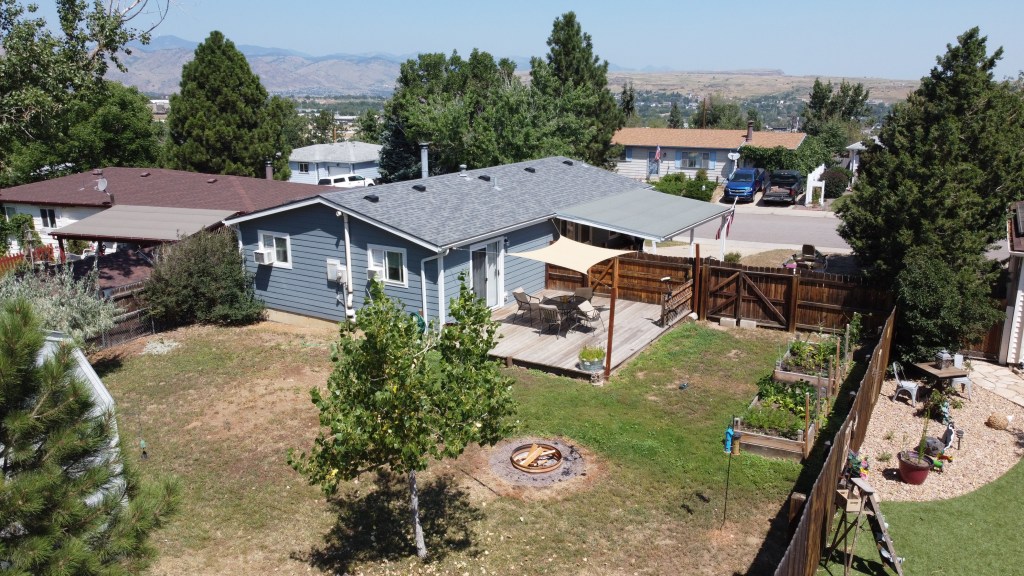
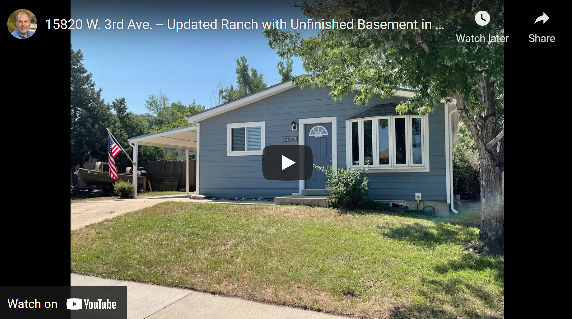
Come see this beautiful ranch home at 15820 W. 3rd Ave. with 3 bedrooms and 1½ updated bathrooms in a quiet location. It was just listed by David Dlugasch for $498,000.
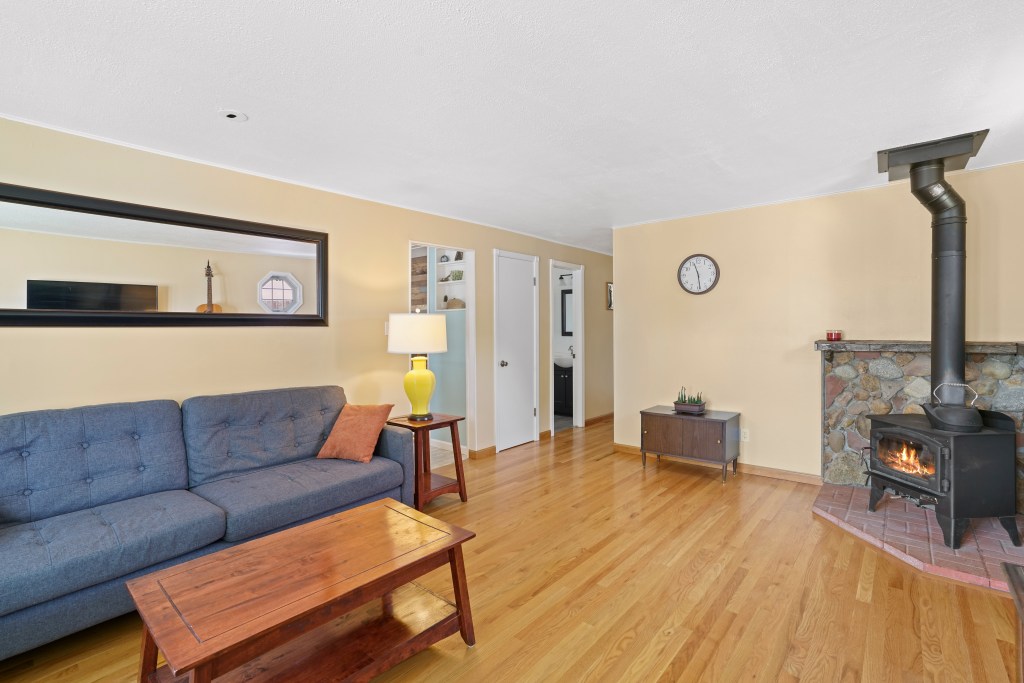
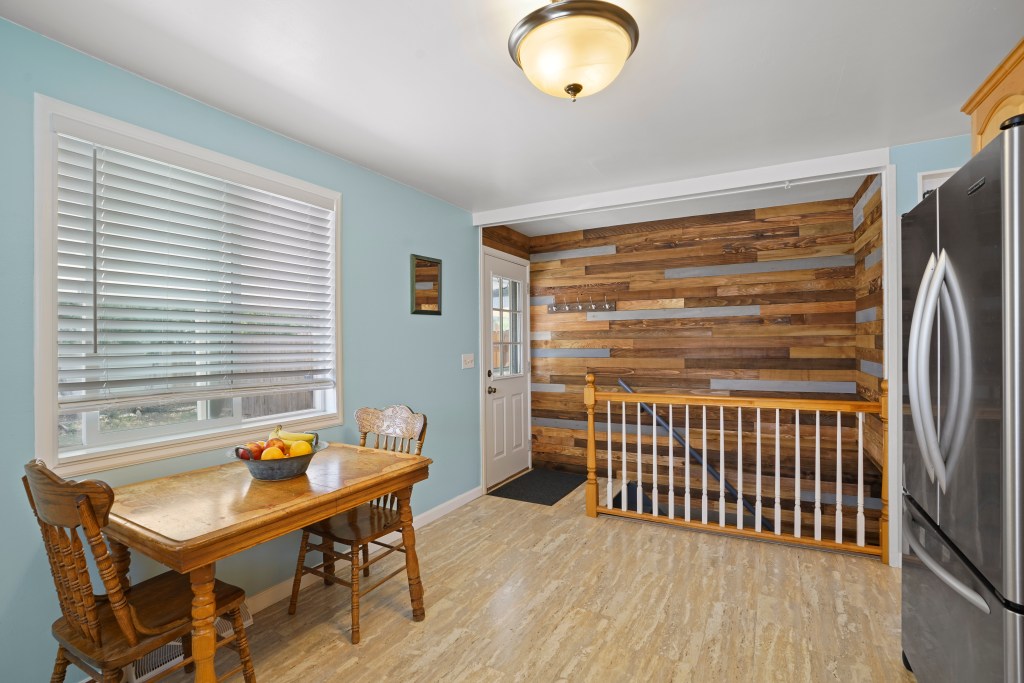
The living room and hallway have newer hardwood floors and the bedrooms have wood-like COREtec vinyl flooring. A bay window with mountain views and a wood-burning stove make the living room very bright and cozy. The rest of the home has double-pane windows, a 4-year-old roof and new Hardie Board siding, newer furnace and water heater. The spacious family kitchen has maple cabinets and stainless steel appliances. The master bedroom has a double and single closet plus its own half bath. In addition to the carport, there is room for additional cars or an RV through the double gate into the backyard. The large backyard has a deck with canopy, a fire pit and a 10’x16′ custom Tuff Shed. From the elevated rear of the yard you get a great view of the mountains. Nearby 6th Ave. Expressway can get you to downtown Denver in 15 minutes or downtown Golden in 10 minutes. Or take I-70 up to the mountains. The basement has a workshop, is framed out and ready for a new bedroom, 3/4 bathroom, game room, home theater, or whatever you can imagine. Take a narrated video tour by clicking on the thumbnail below, or visit www.SouthGoldenHome.com, then come to the open house on Saturday, August 7, 11am to 2pm. Or call David at 303-908-4835 for a private showing.
In my June 17th column (which is archived at JimSmithColumns.com), I wrote about “title lock” insurance, which is being widely advertised. The headline for that column said it all: “Don’t Fall for ‘Title Lock’ Services. They Are a Waste of Money and Don’t Provide Much Protection.” Unfortunately, some readers thought I was referring to title insurance and asked me if it was really necessary.
Yes, any purchase or sale of real estate should include the purchase of an “owner’s title policy,” typically paid for by the seller. This policy in unlike other insurance policies, in that it is a one-time premium issued by a title insurance underwriter and sold either directly by the underwriter or by a title agency. It insures the buyer of the real estate against any liens against the property recorded with the county clerk and recorder.
If the purchase is being financed by a lender, that lender will require a “piggy-back” lender’s policy (paid by the buyer) from the same underwriter covering the lender against such claims up to the amount of the loan. (The owner’s policy covers the buyer up to the full purchase price.) Title insurance should provide all the protection a buyer needs.
I also recommend requesting a credit freeze from the three credit bureaus. It costs nothing, and it prevents anyone from taking out a loan in your name and disappearing with the proceeds.
Every year you should get a notification of value from your county assessor. If you didn’t get one this year, you can look up your address on the county assessor’s website to make sure your home is still in your name.
In Jefferson County, you can visit http://assessor.jeffco.us. Use Google to find other county assessor sites.
Last week I did my regular update on the state of the bidding wars, but it left me unsatisfied because I knew that the market was slowing, yet the bidding wars seemed just as real, especially in the under-$500,000 price range.
The problem with my analysis was that I only looked at the homes which sold in 1 to 6 days because those are the listings which likely had bidding wars.
This week, I looked at the bigger picture but still limiting my analysis to residential listings on REcolorado that are within 15 miles of downtown Denver.
A chart containing some key statistics over the last 11 months is shown below. Here are my observations, which you can follow by looking at the chart’s columns from left to right.
First, it’s clear that the bidding wars started in earnest in February, when the ratio of closing price to listing price went above 100% for the first time. That ratio peaked in June and fell significantly in July, but is still far above 100%.
The number of active listings is still unseasonably low, but higher than it has been since last November. The number of listings under contract (pending) is lower than it was in May and June, but still higher than any of the other months on the chart.
The number of July closings is probably a bit higher than shown in the chart since I did this analysis on August 1st, and not all July closings had been reported, but it is clearly lower than June’s number, while higher than any other month since last October.
The number of new listings in July was higher than any other month except June, which reinforces what I’ve said for months, namely that the lack of inventory is not due to sellers keeping their homes off the market. Rather, homes sell so quickly that the number of active listings remains low.
The median days active in the MLS (DIM) has not risen, but the drop in average days in the MLS is very telling. The drop to 10 days is stunning and shows that even the homes that don’t sell immediately are selling faster than ever. Last July the number was 21 and in July 2019 the number was 23. In the past five years the average days in the MLS never fell below 16 until this April.
The last column shows that the inventory (in months) of homes for sale hasn’t been above one month since January, although it is the highest it has been since February.
The bottom line, then, is that, yes, the market is slowing but is still crazy hot. The trend, if there is one, is toward a gradual easing of the seller’s market in the Denver metro area, but it is well short of becoming a “balanced” market.
Will the end of the eviction moratorium have a big effect on the market? My guess is that it may increase the number of new listings as landlords, especially small landlords, decide to sell rather than replace their evicted tenants. The opportunity to cash in on their properties’ increased value may be too much for some to resist, and the risk of continued lost income too great for some landlords.
There will not, I believe, be an increase in foreclosures or short sales, because very few property owners are likely to owe more than their property is worth. Because of that, they will simply sell.
At Golden Real Estate, each agent (under my supervision) enters and updates their own listings on the MLS. I believe that helps to promote accuracy.
But many brokerages block their agents from accessing their own listings, sometimes resulting in incomplete or inaccurate data. One would hope that agents in those brokerages check to see how their listings were entered and tell their admins when mistakes have been made or data omitted, but there’s no way to know that.
Did you know that in addition to the “public remarks” for listings, there is a place to enter a description of every room in the house?
Very few listings — under 50% by my count — include a description of any rooms, and some listings don’t even list rooms other than bedrooms and bathrooms.
Dimensions can be entered for each room, too (rounded to the nearest foot), but I find very few listings with that information either. Our office policy is to enter room dimensions and descriptions for every room in every listing.
Brokerages which require all agent listings to be entered by their unlicensed administrative staff are less likely to have these non-mandatory fields entered. If they would make each agent responsible for such data entry and then monitor their work as we do, I believe that buyers would have much more useful and accurate information for each listing. Other non-mandatory fields in the MLS include the following:
> Is the property owner-occupied, tenant-occupied, or vacant?
> What is the zoning?
> What direction does the home face?
> How close are bus stops and light rail stations?
> Is it in an incorporated or unincorporated area?
> What are the dimensions and features of the garage/carport/RV parking?
> What appliances are in the house?
> What kinds of flooring is there?
> Does the home have any fireplaces, and where are they?
> If there’s an HOA, what are the fees and what do those fees cover?
Our office policy is not only to complete every field on our company’s MLS listings, but to share our MLS data entry in draft form with the seller before making the listing live on the MLS, which also helps to assure accuracy and completeness of our listings.
This is my regular update on the real estate bidding wars.This week I chose to analyze the closings that occurred last Thursday, July 22nd, to see how the bidding wars have evolved over the past few weeks. As before, the source for this monthly analysis is REcolorado.com.
As I did in previous months, I limited my analysis to sales within a 15-mile radius of downtown Denver. I limited my search to listings that were active on our MLS at least one day and not more than 6 days before going under contract. Those are the homes that likely had bidding wars.
On July 22nd there were 36 closings up to $500,000, compared to 55 closings on June 28th. The median home sold for 6.3% over its asking price, compared to 5.4% on June 28th. The highest ratio this time was 18.5% for a home in SW Denver, compared to 20.8% on June 28th for a townhome in Littleton. Three listings sold for the asking price, and three sold for less than listing price, compared to four and six respectively on June 28th.
There were 48 homes that closed on July 22nd for more than $500,000, compared to 53 homes on June 28th.The median home in that group sold for 3.2% over its listing price, compared to 8.7% on June 28th. Only six sold for the listing price, and six sold for less than the listing price. The highest overbid in this group was 18% for a home north of Denver’s City Park, compared to 32% on June 28th.
To have a statistically significant number of closings over $1 million, I analyzed the 87 such closings that occurred from July 12 to 26. The median closing for those high-end homes was 5.4% over listing price, compared to 6.6% from late June. Nine homes sold for the listing price and 8 homes sold for less than the listing price, compared to 12 and 6 respectively in late June. The highest overbid was 24.8% for a bungalow in the Hilltop neighborhood, which was listed at $950,000 and sold in three days for $1,186,000. Of those 87 homes, 24 were listed under $1 million. Last month four million-dollar homes sold for more than 30% over their listing price.
Other than for a flat tire, you’ll almost never see an electric car on the side of the road awaiting a service vehicle or tow truck. That’s because an EV will never need any of the following expensive repairs — the parts simply don’t exist on an EV:
Transmission
Timing belt
Fuel pump
Muffler or stolen catalytic converter
Water pump
Fan belt
Power steering pump
Power brakes pump
Radiator leak/anti-freeze
Engine work of any kind
Spark plugs/points
There’s no “check engine” light because there’s no engine, so you won’t pay to “pull codes” and reset it. And no emissions testing. The electric motors in EVs, like those in other devices, are dependable, only failing if they are worked too hard, and the computers in Teslas (and presumably other EVs) don’t let that happen.
EVs have Battery Management Systems (BMS) which are critical to maintaining battery health and performance. In Teslas, there is a sealed coolant system which maintains the battery at its optimum performance temperature (70° F) year-round, including cooling it when it is being supercharged or when it sends a high level of power to the electric motor(s).
Lithium batteries, unlike lead acid batteries, do not fail abruptly, but rather degrade over time. The reason lead acid batteries fail abruptly, I’m told, is that they consume the lead when they are charged and discharged. Lithium ion batteries don’t consume the lithium. The rate of degradation has been estimated at 1% per year, so a battery with 300 miles of range might degrade to 270 miles of range in 10 years. That matches my experience.
As people wait for the purchase price of EVs to equal that of a gas-powered car — which has largely happened — they shouldn’t overlook the lower cost of fuel (3 to 4 cents per mile vs.10 cents and higher) and the dramatically lower cost of maintenance and repair. And fleet buyers won’t have to buy 12 EVs in order to always have 10 on the road because of how rarely EVs will be in the shop.
For years I have complained about colleagues who claimed that 5280 Magazine had honored them as “Five Star Professionals” when in fact the magazine had nothing to do with the honor.
Rather, Five Star Professionals is a Minnesota company which runs the program by that name and would purchase a large block of pages in the September issue of 5280 Magazine every year to promote the “winners” of that award.
Each year I am notified of my “nomination” to be named a Five Star Professional, and one time I responded to see how their program operates. It’s basically a scheme to get agents to buy, among other things, large display ads at inflated prices within that large block of advertising within 5280 Magazine’s September edition. What bothered me the most was that both 5280 Magazine and Five Star Professional looked the other way when the “winners” would then promote themselves as “5280 Magazine Five Star Professionals” for years to come.
I won’t dispute Five Star Professionals vetting process here (although I have in the past), but I welcome the fact that their advertising may no longer appear in 5280 Magazine and that “winners” can no longer mislead clients and colleagues by implying that the magazine awarded them the Five Star Professional citation.
I only realized this change when I saw Five Star Professional’s block of advertising in last Saturday’s real estate section of the Denver Post. My question now is whether the “winners” will now claim to be “Denver Post Five Star Professionals.”
Searching my email inbox just now, I found several emails with phrases such as the following in some agents’ email signatures: “Recipient of 5280’s ‘Five Star Real Estate Professional’ Award 2019 & 2020!”; and “5280 Magazine Five Star Professional Ten Year Award Winner.”
Most recipients of this “award” are also Realtors, meaning they are bound by the Realtor Code of Ethics, which they are violating when they represent that 5280 Magazine gave them an award that it has nothing to do with.
In my email, I also found a 2017 email from Five Star Professional, offering me, as an awardee, a 1/9th-page display ad in 5280 Magazine for $1,250. A 1/4-page ad was available for $2,095.
One red flag in Five Star Professional’s program of identifying nominees and awardees was that they would never disclose, even to me, who nominated me. Instead, I got an email which said, “One or more of the clients you work hard to serve every day has nominated you for the Five Star Real Estate Agent Award.”
I consider the whole program suspect and just another example of profiteering on real estate agents who are easy targets for such promotional programs.
Regular readers of this column know that I’m a big proponent of addressing climate change. We are definitely feeling the effects of not addressing it this year with the “heat domes.”
Years ago, I suggested we refer to climate change as “climate destabilization,” because the kinds of flood/drought, hot/cold episodes we are witnessing demonstrate exactly that. Although I’m not a scientist, I understand science, and I know that the jet stream is affected by changes in the Arctic, and the Arctic has been warming faster than the rest of the planet, as proven by the rapid reduction in summer ice. The heat domes of summer and the polar vortexes of the winter are direct results of that polar warming.
We are fortunate to have the climate change deniers out of power so that we can finally address climate change. Have we passed the tipping point? A few years ago, citing the loss of summer ice in the Arctic, I said we may be, but we shouldn’t use that as a reason to stand by as the jet stream continues to lash the planet and as the Gulf Stream, responsible for keeping Europe temperate.
We can’t do everything the world needs, but the world needs everything we can do.