We watched this program when it aired on PBS a few weeks ago, but I’ve registered for an online screening this Thursday, Dec. 10th, 7 to 10 pm, because it will include a post-screening panel discussion about the topic of roof-top and community solar programs, which are under attack by utilities in different states. Here in Colorado, we’re blessed with a government which is supportive of clean energy, but that’s not the case everywhere, and there is always the risk that a less friendly government on the state or federal level could frustrate the goal of moving away from an economy based on fossil fuels and to an economy based on clean, renewable energy. Click here to register for it on Eventbrite.com.
An Austin, Texas, technology company named Icon was the winner of the “general excellence” category in this year’s World Changing Ideas Awards by Fast Company for their development of a 3D printer for building houses.
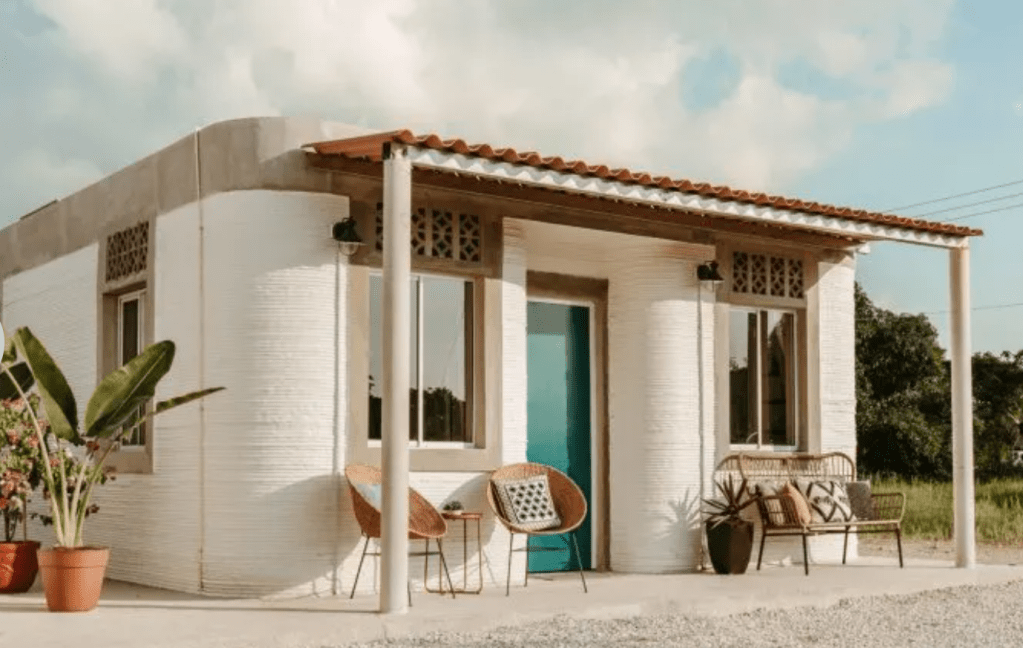
Their Vulcan II machine is already at work building a neighborhood of homes for Austin’s homeless population and building homes in Mexico for that country’s poor population currently living in shacks. Below is a picture of one of those Mexican homes and a closeup showing how Icon’s 3D printer works, applying layer upon layer of a specially designed mixture called Lavacrete. That product sets quickly enough that another layer can be applied on the machine’s next go-round.
All the walls of a home can be poured in 24 hours spread out over two or three days. The framing of windows and doors and construction of a wooden roof is then done using, when possible, local workers who get on-the-job training, learning skills they can apply in other jobs.
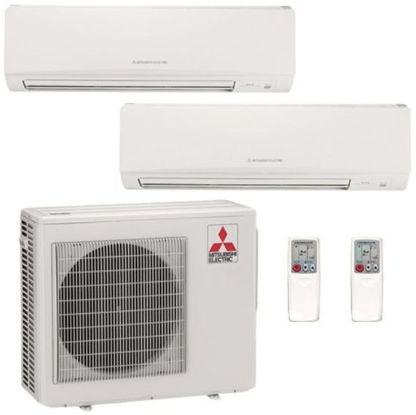
Lavacrete is a propriety adaptation of concrete which overcomes many of the shortcomings of concrete, especially in terms of aging. Because the walls are solid (no room for ducts), the homes are heated and cooled using my favorite method — heat pump mini-splits — which are also far more economical than gas forced air furnaces.
The Mexican project is in a rural area near the southern city of Nacajuca under a partnership with New Story, an international non-profit whose mission is to “pioneer solutions to end global homelessness.”
I remember seeing TV footage showing Icon’s 3D printing machine at work. Prior to that, I attended a presentation by New Story at the Rotary Club of Golden, which, as I recall, joined Rotary International in providing financial support. I am proud to be a financial supporter myself, and you can do so too at www.NewStoryCharity.org.
3D printing of homes makes sense. I have seen how 3D printers can build various products applying layer upon layer of resin as instructed by a computer program. As with those table-top machines, all that’s needed to build the interior and exterior walls of a home is a larger flat surface (a concrete slab) and a massively larger printer to float above it. Taking the process to yet a higher level, Icon has successfully built the walls of three side-by-side homes simultaneously in Austin, which is impressive and, of course, more cost effective. Here’s an aerial view of 3D printing at work:
Partnering with local non-profits and using local materials and laborers, New Story delivers its fully finished homes free to the Mexicans it is serving, but I can see it being practical in our country to offer such homes with low-cost mortgages and nominal down payments to the homeless or working poor.
Golden Real Estate is proud to be a charter member of Good Business Colorado, a 3-year-old organization of now 300 companies and non-profits which share a commitment to creating a prosperous, equitable and sustainable Colorado. You can learn more about this great organization at www.GoodBusinessColorado.org.
The first Saturday of October is when the Metro Denver Green Homes Tour happens, and this year the tour is better than ever because it’s virtual. What that means is that instead of having to visit some or all of the homes between 9 am and 4 pm on a single day, you can watch short videos of each home. It’s possible you could “visit” all 16 homes and the one business in just one or two sittings at your computer and likely learn more about their sustainable features than if you had visited them in person. That’s what I call a green tour of green homes!
Since I shot all those videos myself and thereby learned all those homes’ sustainable features, you can consider me an expert on what’s new and exciting as well as what’s old and proven when it comes to making a home sustainable.
The theme this year is the Best Homes From the Last 25 Annual Tours. The home owned by Rita and me is on the tour, and since I just turned 73 I’d like to share with you how making our home sustainable also secured for us an affordable retirement — if and when I retire!
It all starts with solar power. Nowadays you can install enough solar panels on your home for under $20,000 so that you never pay Xcel or your other electrical provider more than the cost of being connected to their electrical grid. With Xcel Energy, that’s under $10 per month. The electricity you use is free, created from the sun.
You need to be connected to the grid, because the grid functions as your “battery.” Your electric meter runs backward during the day when you’re creating more electricity than you use, and it runs forward at night. Your goal is to have it run backward more than it runs forward.
Plan ahead and buy enough electrical panels so that over time you can replace your gas-fired appliances with electrical ones — a heat-pump water heater, a heat-pump system for heating and cooling, and an electric range — and replace your gas-powered car with an electric one. Now everything in your life is sun-powered!
You can buy a used electric car for under $30,000 or even under $10,000 (Google “used electric cars” and see for yourself) and never buy gasoline or pay for an oil change or tune-up again and probably never have an expensive car repair either. Buying a used electric car is smarter than buying a new one because there’s hardly anything to go wrong with an EV — no transmission, timing belt, motor or hundreds of other expensive parts that could fail. See the article at right about our electric vehicle event. It’s the only in-person part of the tour.
So there you have it. Once you’ve paid off your mortgage (or transitioned to a reverse mortgage), the only costs of living in your home will be your property taxes and water bill, plus $10 per month for being on the electrical grid.
Be sure to “attend” this year’s tour of green homes. Register at www.NewEnergyColorado.com/home-tour. It’s free, although you will be asked for a donation. Another feature of the tour this year is three video presentations.
Hear Bill Lucas-Brown from GB3 Energy on “Reducing your Carbon Footprint with an Electric Mini Split”; John Avenson, from PHIUS.org and Steve Nixon from the National Renewable Energy Laboratory discussing “New Home vs Renovation: 2 alter-native Paths to Zero Energy”; and Peter Ewers from Ewers Architecture Golden presenting “All Electric Buildings, the Key to our Energy Future.”
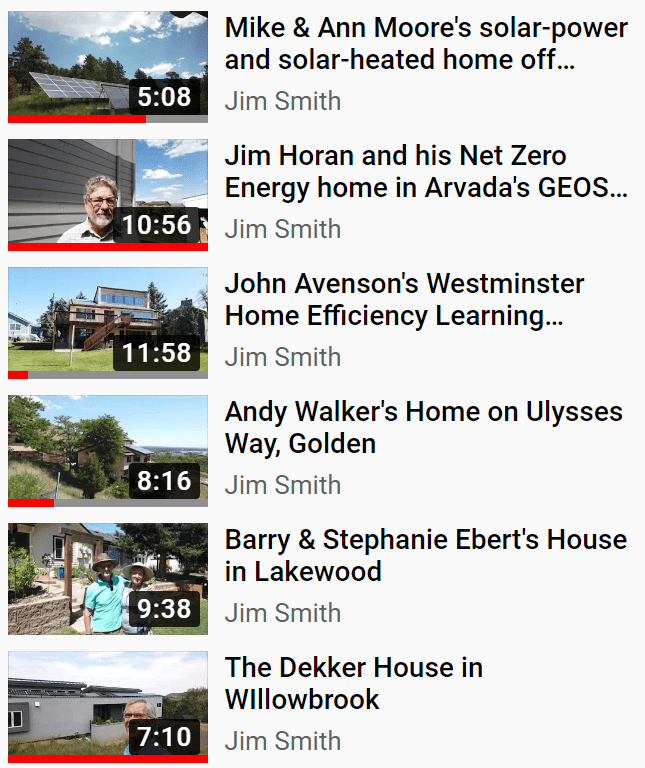
Below are twelve of the videos in the YouTube playlist which you’ll get to view when you register for this year’s tour.
One of the reasons I enjoy showing homes to buyers is that I get to educate them about home systems and how they work, as well as identify the sustainable and not-so-sustainable features of each home.
The agents at Golden Real Estate have a thorough understanding of home systems as a result of our combined decades of experience and hundreds of transactions. In addition, we have taken classes on energy efficiency, insulation, solar power and home construction which allow us to serve buyers better when we show them homes.
Together, for example, we toured the model homes at Richards Farms when they were under construction, where we learned, among other things, about that builder’s foam insulation process.
There are so many aspects of energy efficiency and sustainability. Everyone by now knows about solar photovoltaics — creating electricity from the sun. Our office has 20 kW of solar panels, but having solar power is only the beginning. It’s how efficiently you use that power that makes the difference.
Heating and cooling is the biggest user of energy in any home, and the number and variety of HVAC systems have become more extensive and more complicated, and we understand and can explain them. They include: gas forced air heating and compressor-based air conditioning (most common in Colorado and much of the country), hot water baseboard heat, hot water radiant floor heating, wall-mounted heating panels or strips, heat pump mini-splits for both heating and cooling, hybrid heat-pump with gas forced air (which Rita and I have in our home), ground-source heat pump for both heating and cooling (the “gold standard” of efficient heating and cooling) — and let’s not forget heating with wood or wood pellets!
Windows can vary greatly. Double-pane windows may be standard now, but a Colorado company, Alpen, has made a name for itself with triple-pane windows and now quadruple-pane windows. Recently I wrote about John Avenson’s Westminster home, in which some of his south-facing Alpen windows have micro-etching to divert sunlight toward the ceiling of his kitchen, a high-tech alternative to reflective window shelving, which we saw when we toured a newer building at the National Renewable Energy Laboratory.
Skylights are so 20th Century. Today’s modern replacement are sun tunnels (Solatube is a leading brand), which are great for illuminating interior rooms. Just last week I showed a home with five Solatubes in it, lighting up the living room and an interior bathroom amazingly well from the mid-day sun. My buyer didn’t realize they weren’t ceiling light fixtures until I pointed them out. (We have two sun tunnels in our home illuminating our windowless garage and laundry room, and we have four sun tunnels in the Golden Real Estate office. We don’t have to turn on any lights on sunny days!)
A knowledgeable agent can also point out passive solar features of a home, which others might not recognize. These include proper window configuration, wide overhangs above south-facing windows, thermal masses in south-facing sunrooms, and deciduous trees providing strategically positioned shade in the summer but allowing more sunlight in the winter. I like to see (and point out) cellular shades, especially vertical ones covering patio doors for cold-weather insulation.
Often I notice that the listing agent didn’t mention the features (such as the Solatubes) that my buyers and I recognize as selling points. Of course, when doing the narrated video tours of our own listings, my broker associates and I don’t miss the opportunity to point out those features. And, of course, we are sure to mention those features in the MLS listing.
Many agents miss the opportunity to write a separate description on the MLS for each individual room. It’s not a mandatory field, but it’s the best place to mention a room’s Solatube, heated floor, porcelain tile, hardwood or other feature.
That’s what it’s like for Jim & Patty Horan, who bought their 3-bedroom, 3-bath, 2,135-sq.-ft. home at 15062 W. 69th Place in Arvada’s Geos Community. They paid $525,000 for it three years ago (July 2017).
Like all Geos homes, this one has no gas service. With only 6kW of solar panels on the roof, the home is heated by a ground source heat pump. It draws heat from the earth via a 300-foot-deep loop under the home. The heat pump uses very little electricity during the summer to further cool the 55° fluid in that loop, and not much more energy during heating season to heat that fluid to 100 degrees.
On Saturday, June 27th, Jim Horan gave me a tour of his home which I recorded for this fall’s Metro Denver Green Homes Tour. You can view the video at YouTube.com/jimsmith145.
Geos Community’s website describes it as “Colorado’s first geosolar development” and is the only subdivision I know that’s built entirely “net zero energy.” There are developers building solar-powered communities like KB Home’s subdivision on the northeast corner of Hwy 93 and 58th Ave., but they don’t come close to being net zero.
There’s a term for such homes — “greenwashing,” which Wikipedia defines at “a form of marketing spin in which green PR and green marketing are deceptively used to persuade the public that an organization’s products, aims and policies are environmentally friendly.” I’ve always marveled that those KB Homes were built with many of the solar panels installed on north-facing roof surfaces.
Getting back to the Horans’ home, there’s more to going net zero than having solar panels and a ground-source heat pump. Those features must be coupled with energy saving features so that the limited number of solar panels are enough to meet the home’s energy needs — with energy left over to charge an electric car.
Here are some of those features which I covered in my video tour with Jim Horan.
First and foremost is the passive solar orientation of the building with lots of south-facing windows and a south-facing roof for solar panels. Also, there are overhangs above each south-facing window designed to shade it from the sun during the summer while allow full sun in the winter when the sun is lower in the southern sky.
Next, the building’s “envelope” has to be very tight. That starts with foam insulation blown onto the interior surfaces of the roof and exterior walls, replacing the blown-in cellulose and fiberglass batting typical of tract homes built by other developers. The windows are Alpen triple-pane windows which also have foam-insulated fiberglass framing. (Fiberglass is better for window framing than vinyl – not as prone to aging and warping.)
Those elements make a house too air-tight for healthy living, so an energy recovery ventilator is installed which constantly brings in fresh air, using a heat exchanger designed so that the heat (or coolness) of the air being exhausted is used to heat or cool the fresh air being brought into the house. A heat pump within this device, called a CERV, provides further heating or cooling of that fresh air as needed.
In the townhomes at the Geos Community, the CERV works with an air-source heat pump mini-split instead of a ground-source heat pump to heat and cool the home year-round.
Have you heard the term “indoor air quality” or “sick building syndrome”? It refers to high levels of CO2 or volatile organic compounds (VOCs) which can build up in a home, especially in a home as air-tight as the Geos homes.
The CERV monitors both CO2 and VOC levels in the house and will bring in additional fresh air when those gases exceed the level set by the homeowner. (The Horans have the level for each gas set at 950 parts per million, or ppm.)
What are VOCs? If you can smell it, it’s probably a volatile organic compound. Examples include new carpet smell and, worst of all, cat litter smells.
Two appliances in Geos homes also contribute to their low energy load. One is the Bosch condensation clothes dryer, which pulls in cool, dry air from the room. The air is heated and passed through the clothes; but instead of being vented outdoors, the air travels through a stainless steel cooling device or heat exchanger. It does heat the room it is in, so the Horans choose to dry their clothes on an outdoor line during the summer, even though their heat pump could handle the additional cooling load if they didn’t do that. Home Depot sells the Bosch 300 “ventless” dryer for $989.
The other appliance is the heat-pump water heater. It has a heat pump above the tank which transfers the heat from the room into the water. I’ve written about this product before. Home Depot sells a 50-gallon Rheem model for $1,299which earns a $400 rebate from Xcel Energy and another $300 in federal tax credit if purchased by December 31, 2020. Because this appliance emits cold air, it’s in a pantry which the Horans keep closed in the winter and open in the summer. (I would put it in a wine cellar or in a room with a freezer, which emits hot air — a symbiotic arrangement within one room.)
As you are beginning to gather, building a net zero energy home is best done from scratch, when the additional cost is less than retrofitting a home. (My home is net zero in terms of electricity, but we still burn $30 to $50 of natural gas each month, and it takes twice as many solar panels for my home, which has about the same square footage as the Horans’.)
You may be wondering how much more it cost to build the Horans’ house, which they bought new in July 2017. To answer that, I searched all the comparable homes (2– or 3-story, between 1,500 and 2,500 square feet within 1 mile radius) sold during the summer months of 2017, and I found that the $246 per finished square foot paid by the Horans was actually below the median price ($253 per finished square foot) for the seven comparable sales. And those homes probably pay thousands of dollars per year more for electricity (and gas) than the Horans.
If you want to learn more about Geos community, give me a call at 303-525-1851 or visit the Geos website, www.DiscoverGeos.com.
The sponsors of the annual Metro Denver Green Homes Tour, held on the first Saturday each October, are preparing to “go virtual” in case an in-person tour is not allowed.
John Avenson’s house at 9988 Hoyt Place, Westminster
That will be accomplished by creating online video tours of the most notable “green” homes featured over the past 20 years. Since I’m on the steering committee for the tour and have the equipment and experience from creating video tours of homes for sale, I volunteered to create those video tours, starting with John Avenson’s home at 9988 Hoyt Place in Westminster.
By clicking here, you can view the 41-minute video tour, led by John, which I created last Friday. It is highly educational.
John Avenson
Many people, myself included, have created homes which can be considered a “model” of sustainability, solar power, and energy efficiency, but John is surely the only homeowner who has turned his home into a classroom for teaching it. He even posted pictures and diagrams throughout the house with instructional content about this or that feature, as you will see on that video.
John’s house was originally built by the Solar Energy Research Institute (SERI, now the National Renewable Energy Laboratory or NREL) in 1981 using then-state of the art technology, but John has diligently, and at great personal expense, kept retrofitting his home with newer technology, which he is happy to explain to visitors and which he explains on the 41-minute video.
CERV monitor screenshot
For example, because of increased insulation and Alpen quadruple-paned windows, he was able to get rid of SERI’s supplemental natural gas furnace, installing a conditioning energy recovery ventilator (CERV) which is powered electrically. His grid-tied solar PV system provides all his home’s energy needs and has reduced his Xcel Energy bill to under $10 per month — the cost of being connected to the electrical grid.
Some of the technological innovations featured in my video with John were new to me. For example, the Alpen windows across from his kitchen have horizontal micro-etching which redirects the sun’s rays 90° upward to his ceiling instead of straight through the glass, reducing the need for lighting.
John provided his email address in the video, saying that his “learning center” is open 24/7 and that he welcomes all inquiries and visitors.
I love showing homes in Arvada’s Geos Community to buyers individually, but there’s a live Zoom presentation sponsored by First Universalist Church of Denver next week which will teach you all you need to know about this great community.
The homes and townhouses in this community are not only “net zero,” they are “net positive,” creating more energy than the homeowners use, including when they charge an electric car. The homes are so well insulated that they need no furnace, only a CERV, which also monitors and maintains indoor air quality.
“Passive House” is a concept born in Germany as “PassivHaus” but growing in popularity here in America. Although its primary focus is on reducing the heating and cooling needs of a home through proper north/south orientation, the placement of windows, and roof overhangs, it also includes design elements that make a home better for its inhabitants. It has many other positive impacts as well, including healthier and quieter spaces, greater durability, and greater comfort for inhabitants.”
Prior to the oil embargo of 1973, home builders did not concern themselves much with making homes energy efficient, but that all changed as we quickly realized how dependent we were on foreign countries for fossil fuels to heat our homes and fuel our cars. Homes built before then were poorly insulated, drafty and less healthy. (For example, lead-based paint wasn’t banned until 1978.)
The passive house concept took off in America as a result of that wake-up call. The “Lo-Cal” house created in 1976 consumed 60% less energy than the standard house at the time, and the concept continues to mature.
If you participated in any of the “green home” tours that Golden Real Estate co-sponsors each fall, you’ve learned about various passive home strategies in addition to “active” strategies such as solar power, heat pumps, geothermal heating, and energy recovery ventilators.
When “active” systems are introduced to a home with passive house design, they work more easily to create the ultimate goal of a “net zero energy” home — one which generates all the energy needed to heat, cool and power the home and, perhaps, charge the owner’s electric vehicles. Without passive house design features, you can still achieve net zero energy, but it may require substantially more solar panels to compensate for such factors as inferior orientation, fenestration (windows) and insulation.
You can learn all about passive home technology, including trainings and public events, online at www.phius.org. Also, search “Passive House SW” at www.meetup.orgfor local events.
An excellent example of new construction which combines passive house design with smart active systems in the Geos Community in Arvada, which you can learn about online at www.DiscoverGeos.com. The homes in Geos are all oriented to maximize solar gain in the winter, but also designed for sun shading in the summer. Some have a geothermal heating, while others have air source heat pumps and conditioning energy recovery ventilators (CERVs). The CERVs installed in the Geos homes not only provide heat when needed but also track the level of CO2 and volatile organic compounds (VOCs) in the air and adjust their function to reduce those levels, thereby improving indoor air quality.
None of the Geos homes uses natural gas, just solar-generated electricity.
A reader called me last week because her gas furnace had quit working and, knowing my expertise regarding sustainability, she wanted my advice on replacing it.
I told her that this was an opportunity to do something other than buy a new gas furnace. I told her about my Carrier “Hybrid Heat” furnace which uses an air-source heat pump for heating as well as cooling and only burns gas when the outdoor temperature dips well below freezing. With her solar panels, it’s possible she won’t even pay for the electricity consumed by the heat pump, and her gas consumption will plummet.
That hybrid system would use her home’s existing ductwork, but, since she has a one-story home, I suggested she consider a ductless mini-split heat pump system like the one we have at our office. I gave her the name of the vendor who installed both my home and office systems who could advise her which system was best for her.
I also suggested that she look into replacing her gas water heater with a heat-pump model when it fails. My gas water heater is over 15 years old, so I’m thinking of replacing it before it fails. Home Depot sells a Rheem 50-gallon heat pump water heater (model #XE50T10HD50U1) for $1,299. Best off all, Xcel Energy gives its customers a $500 rebate for purchasing it. I have enough solar panels to handle the extra electrical demand and eliminate much of my current gas usage, which is mostly for water heating, since I have that Carrier hybrid furnace. Our only other gas usage is for cooking and grilling.











 Jim Smith's Blog