Harvesting ‘Atmospheric Rivers’ to Replenish Aquifers and Fill Reservoirs

A recent article in the San Francisco Chronicle caught my attention. It spoke of harvesting the rainfall from otherwise catastrophic “atmospheric rivers” to refill reservoirs. Another piece by the Environment Defense Fund in Oct. 2021 discussed research being conducted by the California Department of Water Resources and UC Santa Barbara on harvesting excessive rainfall to replenish underground aquifers.

Meanwhile, we are reminded daily that the Colorado River is drying up and both Lake Mead and Lake Powell, as a result, are suffering reduced levels that threaten the water supply and could even sideline vital hydro-electric turbines.

 I’m reminded of those amazing 20th Century California projects which moved water all over that state to meet both agricultural and urban demands, and it got me thinking about the possibility of creating another grand project to divert some of those ocean-bound flood waters to both in-state reservoirs and to the Colorado River.

Not only could that help with the Colorado River shortfall, but it might help in some small way to reduce flooding. 

Replenishing aquifers is a good idea, but can that be done at speed? I’m not knowledgeable in this area, but it seems to me that new reservoirs would have to be built to hold the water that is to be pumped into those aquifers.

Capturing flood waters on our side of the Continental Divide is already handled by the many reservoirs such as Chatfield and Cherry Creek Reservoirs designed for that purpose. Chatfield is owned by Denver Water, but Cherry Creek is owned by the Army Corps of Engineers. The dams for each are higher than needed in order to accommodate sudden downpours, flooding only open land and park facilities.

PS: Here’s a related article from TheConversation.com:

You’re About to Adopt a New Habit – Reusable Shopping Bags

By now you are probably aware that starting on Jan. 1st, supermarkets and most other retailers must charge 10 cents per plastic or paper bag, as dictated by a state law passed in 2021. Several cities across Colorado, including Denver and Boulder, already banned plastic bags, garnering 60-90% compliance, but this week the 10-cent charge and future ban goes statewide.

Plastic bags won’t be banned until a year from now, although Walmart is eliminating plastic and paper bags immediately. This time next year, you’ll still have the option of paying 10 cents for a paper bag, but plastic bags will not be available at most stores and restaurants. In addition, restaurants will be barred from using polystyrene (aka Styrofoam) containers for carryout food.

King Soopers is preparing its customers for the change by selling bags at its checkout stations. Better ones cost $5-6, but there’s one for 99 cents (shown here in Rita’s hand) that I’m keeping in my car so it’s not forgotten when I go shopping. Rita has been taking reusable shopping bags with her for months.

Another option is to take your own cart into the store, instead of using the store’s shopping carts. Fill it with your selections, and put your selections back in the cart, bagged or unbagged, after paying for them. In addition to the typical wire cart, Google can show you lots of personal shopping carts or wagons.

If, like me, you’re open to other ways to “save the planet,” here are some ideas.

Starbucks stopped filling your own cup or mug for a “personal” drink during the pandemic, but now it’s back, and they give you a 10-cent discount.

Recently I was at lunch with a friend who pulled out a Tupperware container to take leftovers home. When I told Rita, we immediately decided to adopt the practice, and she now puts a plastic container in her purse every time we go out to a restaurant.

At Avenida, we enjoy the continental breakfast served six mornings a week, and several residents bring their own coffee mugs and cereal bowls so they don’t have to use the provided single-use coffee cups or bowls. Tell me your ideas!

Have You Considered Cohousing? Here’s an Explanation and Some Examples

Cohousing puts like-minded people together in “intentional communities.” Many people, Rita and me included, resonate with the idea of community housing, where everyone has their own private home with kitchen and living room, but shares meals occasionally in a common house, perhaps work a community garden, but above all share the same values.

But bringing together like-minded families with the money to buy the land and build the individual units as well as the common elements can be difficult, resulting in few local examples of cohousing communities.

Just ask the people who tried a couple years ago to create the Ralston Creek Cohousing community next to the Geos Community in Arvada. They did all that work and were ready to put down the money when the land they wanted to buy was snapped up by a developer. Deeply disappointed, the community-without-a-home has now disbanded, no longer even publishing an email newsletter, according to www.RalstonCreekCohousing.org.

The concept of cohousing with like-minded neighbors has always appealed to me, but the opportunity never presented itself. In Golden there’s a long-established and highly successful 27-townhome cohousing community called Harmony Village, but turnover is close to zero because the members are so happy — and healthy!

Most cohousing communities are designed to leave cars on the periphery, as in Harmony Village.

Here are some other cohousing communities in the metro area, if you want to check them out.

Aria Cohousing, just east of the Regis University campus in northwest Denver, has 28 units under one roof. It was founded in 2017.

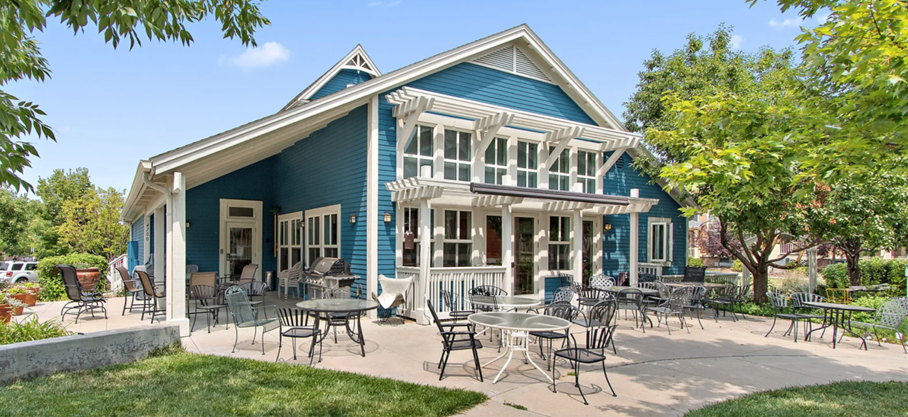
A community meal at least once a month is typical in cohousing communities, as at the Aria Cohousing community, allowing members to get to know each other better, part of being an “intentional community.”

Hearthstone Cohousing, on the former Elitch Gardens site in northwest Denver, has 33 townhomes plus a common house. I sold a unit there in 2021.

Common houses are a typical feature of cohousing communities, such as this one at the Homestead Cohousing community. It has a guest apartment, woodworking shop, laundry room, mail room and meeting/dining room with a kitchen for preparing community meals.

Highline Crossing Cohousing, along the Highline Canal east of Santa Fe Drive and north of C470, has 40 homes, built in 1995.

Wild Sage Cohousing, in north Boulder’s Holiday neighborhood, has 34 attached townhomes. A block south of this community is Silver Sage Village, an 18-unit cohousing community restricted to senior citizens — the first in the country. It offers only independent living, no assisted living or nursing care.

Other cohousing communities in our state can be found in Colorado Springs, Ft. Collins, Bayfield, Lyons, Ridgway and Lafayette.

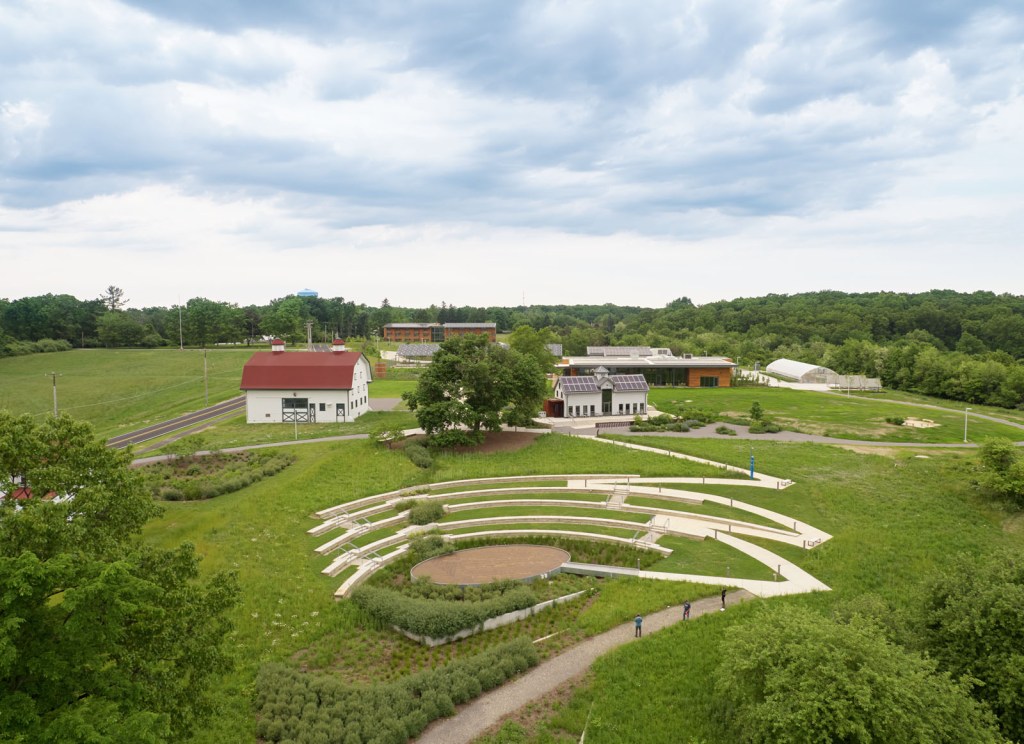
Looking beyond Colorado, I’m inspired by a project taking shape 20 miles north of Pittsburgh. It will be built on the campus of Chatham University’s Falk School of Sustainability and Environment. (See aerial photo below.) Chatham is the alma mater of Rachel Carson  when it was called the Pennsylvania College for Women. You probably know Carson’s groundbreaking 1962 book, Silent Spring, which is widely credited with sparking environmental consciousness in the United States and worldwide, leading initially to the banning of DDT.

The cohousing community being built there is appropriately named the Rachel Carson Ecovillage. What makes this project particularly exciting is that, by being located on the campus of a college devoted to sustainability and the environment, it serves as an onsite laboratory and example for the students as well as a great intergenerational home for environmentally conscious families.

As you might expect, the homes will be all-electric, built to Passive House standards, and solar-ready.

The Falk School of Sustainability and Environment was created in 2010 and occupies land donated with a stipulation that the land must remain under Chatham University’s ownership, so the homes in the ecovillage can be purchased for prices ranging from $225,000 for a studio condo to $580,000 for a 2-BR suite that be customized as a 4-BR unit, but the land is subject to a 99-year land lease from the university.

While that may not seem ideal, it solves the problem of land acquisition which stymied the Ralston Creek Cohousing community. To quote from the Ecovillage website:

There is no profit built into these costs — they will be offered for sale at the cost to build them….  

The Common House is a shared facility of approximately 2,500-3,000 square feet. It includes a dining/meeting room, a kitchen, mail/package pick-up, and two guestroom suites. Other amenities may be included, as well. 

The units will be designed and constructed to conserve energy and minimize carbon emissions. To avoid combustion of fossil fuels, they will be all-electric, which makes it possible for them to be powered entirely by renewable energy. The units will be designed to meet high indoor air quality standards. It is our intent to be able to monitor building performance after construction to see how well they meet these goals.

Sustainability is a common theme in all cohousing communities, which makes sense, because valuing and caring for your neighbors translates logically to caring for the planet as a whole.

Learn more about the cohousing concept at www.Cohousing.org, or by reading Creating Cohousing: Building Sustainable Communities.

A Subdivision in Pueblo Sets the Standard for All-Electric Home Construction

One of my favorite newsletter subscriptions is to “Big Pivots,” written and edited by Allen Best. The focus is on sustainability, especially as it relates to real estate and home construction. This week’s newsletter featured an article which I am reprinting with permission because it would be hard to improve upon it.

By ALLEN BEST

It took Rod Stambaugh a couple of years before his vision of high-performance housing on the northeastern edge of Pueblo had anything to show. Now he and his two partners have begun getting results. In recent weeks they’ve sold three homes for an average price of $780,000.

“It’s been a long road, but it’s getting easier,” says Stambaugh.

The company, Pure Zero Construction,  has 14 of the single-family houses under construction with work underway on the first of 51 townhomes.

None of the homes will have natural gas or propane. The company has rights to build as many as 500 additional homes in North Vista Highlands.

“We will compete all day on the merits and benefits of high-performance, all-electric homes as compared to stick-built housing that uses natural gas,” says Stambaugh. “We will win that battle every time.”

The townhomes will have 2,200 square feet and come in at around $600,000, he says. The company expects buyers to come from Denver and the northern Front Range.

Pueblo has a well-deserved reputation for lower real estate prices, but it does have pricier homes, too. Pure Zero is staking its reputation on both environmental performance, which translates into cost savings over time, and on health benefits.

Accumulating evidence points to harmful impacts of indoor air quality from natural gas combustion, whether for space and water heating or for cooking.

Gene Meyers, long-time “green” builder in the Denver metro area, has said that if for no other reason than health considerations, it’s time to get rid of natural gas in homes.

Having no natural gas comports with Colorado’s goals for greenhouse gas reduction goals. Several laws passed in 2021 provide direction for the decarbonizing of buildings through various new metrics, including building codes that make natural gas less desirable. So far, however, Colorado has not imposed bans on natural gas. The lone exception is Crested Butte, and the restriction there applies to relatively few units.

Stambaugh got into the building technologies world about eight years ago when he began building 189-sq.-ft. “tiny” homes after returning to Colorado from California. That business is called Sprout Tiny Homes. He sold some of the tiny homes to the Aspen Skiing Co. for use in Basalt. He is now at work on a third generation of workforce housing for Aspen.

Then, in 2020, he purchased land in Pueblo’s North Vista Highlands subdivision. He had thought that there would be no natural gas available in that subdivision. That turned out not to be true, but it’s true for the housing he and his two partners are building — and he has no plans to change.

“We will not deviate from our mission,” says Stambaugh. “We are going to build high-performance homes where you can see, feel and breathe the difference. That is our mission.”

One measure of a building’s performance is a metric called HERS, short for Home Energy Rating System. The lower the HERS score, the more energy efficient the home. Existing homes may have HERS ratings of 130. New homes built to code have HERS scores of 100 – al-though some production builders are shooting for lower scores. KB Home has said it plans to achieve HERS scores of 45 nationally by 2025.

How do Pure Zero’s homes rate? “We’re in the low 40s and we actually had a -9 score after adding solar,” says Stambaugh.

High-performance building has several components. One is building tightly to avoid loss of heat in the winter and cool air in the summer. Unlike houses built from 2x4s and 2x6s, the Pure Zero houses were built with structural insulated panels, or SIPs. They provide superior insulation and, says Stambaugh, provide corners that are always on the mark. They used to cost more than wood, but no longer.

Eliminating natural gas is another fundamental of the houses. Instead, electrically powered Mitsubishi air-source heat pumps extract the heat from outside air efficiently down to 0ºF (and with less efficiency below zero). They do the reverse during hot weather, eliminating the need for a separate air conditioning unit.

Stambaugh swears by Mitsubishi’s heat pumps. They cost $1,500 more than other air-source heat pumps, but their superior performance at lower temperatures will result in less need for backup heating. Those lower costs will recoup the original investment in five years.

[Golden Real Estate installed Mitsubishi heat pumps in its South Golden office and downtown storefront, and they work great.]

Instead of natural gas ranges, the houses in Pueblo have induction ranges. Bathrooms are tiled from top to bottom. Temperatures throughout the 3,900-square-foot houses (with fully finished basements) are consistent. They’re so structurally tight that they are quiet even within a construction zone.

There used to be a higher cost premium for the materials. That has somewhat gone away.

But building high-performance homes requires rethinking, including finding subcontractors willing to learn new techniques. Stambaugh says his team had difficulty at first finding craftsmen willing to learn how to install the new technology. Some refused. Now, as the housing construction industry has slowed, some of those workers have returned, looking for jobs.

You can subscribe to the Big Pivots newsletter (and find lots of other interesting articles) at www.BigPivots.com. You will learn a lot, as I have, from Allen’s articles.

What Is a Heat Pump, and How Does It Work?

I came across a website that gives a great description of heat pumps, how they work, and why they are more efficient. Here’s the link for it.

Most Americans are accustomed to heating systems that generate heat using fossil fuels, wood, or electricity. But heat pumps don’t create heat, they move heat. Here’s how the process is explained on that website:

Heat pumps function similarly to refrigerators or air conditioners, which take warm air from one space and send it to another. In the winter, a heat pump transfers heat from the outdoors inside and, in the summer, it reverses this process.

There are two main types of heat pumps, and both can function as space heaters or coolers and as water heaters.

A ground-source (or “geothermal”) heat pump sends a mixture of water, antifreeze, and/or a refrigerant through a network of pipes buried below the frost line. As the liquid passes through the pipes, it absorbs the earth’s approximately 55-degree heat. The liquid is then drawn up into a compressor, which heats it further, creating a vapor. The heat pump then distributes the warm air through ducts or tubes throughout your home. In the summer, the heat pump reverses the process, taking warmth out of the house and transferring it to the earth.

An air-source heat pump extracts heat from the air rather than from the ground. It functions the same way, but because air temperature, unlike earth temperature, can get very cold, it has more work to do bringing up the temperature. As with a ground-source heat pump, a reversing valve inside the heat pump allows the same unit to function as an air conditioner in the summer. At right is an air source heat pump that was retrofitted into a ducted forced air heating/cooling system of one of my current listings in Golden.

Looking for a vendor who specializes in heat pumps? I recommend Sensible Heating & Cooling, 720-876-7166, or Helio Home, Inc., 720-460-1260.

KB Home Is Building All-Electric Homes – But Not in Colorado

I have expressed dismay in the past that builders of new homes in our area are not getting “with it” when it comes to incorporating the latest thinking and technology regarding energy efficiency.

Builders boast their Energy Star appliances and lower HERS scores, but they are still, for example, installing gas forced-air furnaces instead of heat pumps, gas water heaters instead of heat pump water heaters, and gas cooktops or ranges instead of induction cooktops.

The Geos Community in Arvada provided proof of concept for the  all-electric solar-powered, net zero energy home, and homes in that small, privately developed neighborhood have been featured for several years on the annual tour of “green homes.” But no production builder here has picked up on that concept, and when another builder acquired the undeveloped parcels at Geos last year, the first thing they did was bring a natural gas pipeline into the community to serve their new homes, greatly upsetting the happy homeowners of the original net zero energy Geos homes, which purposely have no natural gas lines.

Above is one of KB Home’s all-electric homes in Menifee CA, a smaller city south of Riverside. Not only is every home in that subdivision “net zero energy ready,” but they are tied together in an electric “microgrid,” designed to power itself cooperatively should there be an outage in the larger electric grid.

In the garage you can see both an EV charger and a wall-mounted battery backup system. The small print on the sign reads: “This all-electric, solar-powered home is equipped with smart technologies and a backup battery, plus community microgrid connectivity designed to help maximize home energy efficiency and comfort.”

Meanwhile, here in Colorado, neither KB nor any other builder, to my knowledge, is even offering heat pump HVAC units or heat pump water heaters as upgrades.

What’s the Cost of Converting a Home from Natural Gas to All-Electric?

In recent columns, I have promoted the idea of eliminating natural gas and converting one’s home to all-electric, using heat pumps for heating & cooling and installing a heat pump water heater. I have also promoted induction cooktops as an alternative to gas or standard electric cooktops.

One reader asked me to provide information on the cost of making the conversion to all-electric, so I have done some research and can also speak from personal experience.

First, I asked Bill Lucas-Brown of Helio Home Inc., who installed the heat pump mini-split system at Golden Real Estate’s former office on South Golden Road as well as in our storefront in downtown Golden.

I asked Bill for a rough estimate of the cost of making a typical 2,000 sq. ft. home all-electric, and he responded with the following numbers and comments.

Note that rebates and tax incentives are available from the state, feds, utilities, and local municipalities that typically range from 15 to 30 percent off total cost. The following are costs without those rebates.  Click here to view Helio Home’s web page about the rebates and tax credits available under the Inflation Reduction Act.

  • Air source heat pump for heating and cooling your home, $22,000
  • Heat pump water heater, $4,000 
  • Insulation and air sealing work to improve efficiency, $5,000
  • Ventilation system for indoor air quality, $4,000
  • 10kW solar system PV, $30,000
  • Electric panel upgrade, if needed, $4,000
  • Electric vehicle charger, $1,500

That said, Helio Home’s average job is around $50,000. With rebates, figure $35,000 to $43,000. You can get a proposal on the company’s website www.heliohome.io.

Sadly, there are few vendors who are experienced and competent in heat pumps for heating and cooling homes. Heat pump water heaters are less of a challenge, because they are sold by Lowe’s and Home Depot, and you just need a plumber to install them and an electrician to pull a 240-Volt circuit to it. I bought a 50-gallon heat pump water heater in 2021 for $1,200 (on sale – prices are higher now) and was able to do the electrical work myself because of a nearby 240V circuit that was no longer in use. The self-employed plumber I used charged just $500, and I got a $400 rebate from Xcel Energy, so the cost was less than the figure quoted above. The federal rebate taking effect in January under the IRA makes such a purchase almost free.

You may find it more practical to leave your gas forced air furnace in place and install a ductless mini-split system. A compressor (similar to an A/C compressor) is installed outside your home, and two coolant lines are run to wall-mounted units in different rooms of your house. This works best in a one-story home. These same wall units provide both heating and cooling, because that’s how heat pumps work — they are like an air conditioner that works in two directions, moving heat out of your home in the summer and into your home in the winter. As the name suggests, they don’t create heat, they move heat, and they do it more efficiently than baseboard electric heating or heating generated by burning natural gas (or propane).

Instead of wall-mounted mini-splits, you can install a ceiling-mounted “cassette” which functions the same way. That’s what Helio Home installed in our downtown storefront, and it works just as well. (Come by our office and I’ll show it to you.) I have also seen a wall-mounted cassette which has a picture frame on it. When the heat pump is operating, the picture moves out a couple inches from the wall to allow the movement of air.

As for an EV charger, the biggest variable is the cost of bringing a 240V circuit to your garage, which depends on the distance between the garage and your breaker panel. I spent less that $300 for that, again from a self-employed electrician.

Tesla vehicles have the charger built into the car, so you only need a 240V outlet (similar to the outlet for your clothes dryer) to plug the provided cord into. Don’t buy the Tesla Wall Connector — it’s totally unnecessary for home use. Just use the charging cord with a 240V head.

Other EVs may require you to purchase a Level 2 charging station, which I did when I had a Chevy Volt. By googling “Level 2 EV chargers,” I found prices as low as $200 (Home Depot, 16 amp model), and several under $500. So your real cost depends on what your electrician charges.  Here’s an idea: If you have an electric dryer outlet available close to your garage, you could adapt that circuit for your EV at minimal cost.

Another use of natural gas that you’re probably using is for cooking and grilling. You’ll really love induction cooking if you try it, because it is so much faster. Buy a countertop unit for under $100 and play with it. For grilling, we love the George Foreman electric grill we purchased for $100.

Above all, pay attention to the tax credits and rebates that take effect on Jan. 1, 2023, under the Inflation Reduction Act. They make going all-electric more realistic.

Study Reveals Why Certain Homes Survived the Marshall Fire While Ones Around Them Did Not

One of the free lectures associated with the Oct. 1st tour of “green” homes was a fascinating presentation by Paul Kriescher of Bowman Consulting based on a study of the few homes which survived the Dec. 31st Marshall Fire while the houses around them burned to the ground. Click here for a PDF of Paul’s PowerPoint slides.

You’ll recall that it was the hurricane-force winds that were responsible for the fast spread of the Marshall Fire. Flying embers were what caused homes to catch fire in rapid succession. According to Paul, there’s a simple reason why those embers didn’t torch certain houses. It was because they didn’t get inside the homes or their attics.

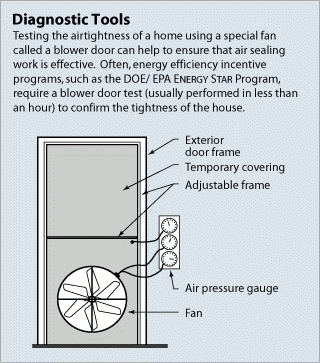
The standard developer-built homes are “leaky” and built with ventilated attics. As I have explained previously, the standard procedure for finding and sealing the places where air can enter your home is to conduct a “blower-door test.”  (See graphic.) This involves installing a computerized fan in a doorway and sucking the air out of a house. The computer on that fan will tell you how leaky your house is — how many air changes per hour your home can expect during a certain wind speed. While that fan is operating, the technician can go through your house and determine all the places where air is coming into your home so that they can be caulked or otherwise sealed.

Many of those places are going to be around windows or on the rim joist — where your floor joists rest on the concrete foundation.

The goal is to get your home to a degree of air tightness at which you achieve two air changes per hour or less. Once you achieve that degree of air tightness, you then install an energy recovery ventilator (ERV) to bring filtered outside air into your home while expelling air from your home.

Making your living quarters more air tight can keep burning embers from entering your home. Combine that with having non-combustible exterior siding, decks and landscaping, and you go a long way toward preventing burning embers from being sucked into your home — and to keeping ash and smoke from making your home unlivable if it doesn’t burn down.

But the most critical area to seal is your attic. Your home probably has an attic which is vented. Blown-in insulation sits on your attic floor to keep your living quarters warm in the winter, while soffit vents combine with roof vents to draw outside air through your attic. This controls moisture buildup but is also ideal for drawing burning embers into your attic which can then light your entire house on fire.

Some builders have switched to building homes with “conditioned” attics, meaning that the underside of the roof is insulated and all vents eliminated. Thus, the attic itself is heated and cooled like the rest of the house. With no vents in your attic, those flying embers blow past your house instead of entering it.

There’s a subdivision in Arvada built by Meritage Homes called Richards Farm. It’s on the north side of 72nd Avenue, across from the Apex Center. Our agents were invited to tour it while it was under construction, and the builder showed us their conditioned attics. The reason the attics were conditioned had nothing to do with fire prevention. They were running heat ducts through the attic, and by insulating the attic, it made the ducts more efficient. But now we know the most important reason for conditioning an attic, and I suspect we’ll see building codes changed to require conditioned attics.

I learned another disadvantage of vented attics from participating in the 1994 Jimmy Carter Work Project, which built 30 Habitat for Humanity homes on the Cheyenne River Sioux Indian Reservation in Eagle Butte, South Dakota. Those one-story homes all had vented attics. Within months of completing those homes there was a blizzard which filled the attics of those homes with snow, which entered through the soffit vents. The snow then melted, causing the drywall ceilings to fall, causing immense damage. The homes had to be vacated and rebuilt on the inside the very next summer. The reservation had no building codes to follow, but if it did it would probably not have allowed vented attics for that reason.

What Can You Do to Make Your Home More Energy Efficient?

In a previous column, I pointed out that making your home more energy efficient can save you money immediately if you finance the improvements, because the monthly payments could be less than your monthly savings. The recently enacted Inflation Reduction Act has some very generous tax credits and rebates that make such improvements even more practical and affordable. My intention this week is to give you a “roadmap” for doing so.

The logical starting point is to hire a professional to do an energy audit of your home — to identify the “low-hanging fruit,” meaning the quickest and easiest changes you can make or improvements you can install that will give you the most “bang for your buck.”

That low-hanging fruit is typically better insulation, and the energy auditor normally begins by performing a blower door test of your home. That involves installing a computer-calibrated fan in a doorway which sucks air out of your house. By depressurizing your home in this manner while all your other windows and doors are closed, the auditor can identify all the leaks which allow cold air into your home in the winter. That way you know where to caulk to make your home less “leaky.”

When it’s cold outside, the auditor can use an infrared camera pointed at your walls and ceilings to assess where you could improve your in-wall and in-ceiling insulation.

You’ll get a written report from you energy auditor with suggestions of things to do and how much benefit you will get from making those changes, whether it’s blowing insulation into your attic and walls, replacing your old gas furnaces and gas water heaters with heat pump versions, or installing better windows. Most recommended improvements will earn you a 30% tax credit under the Inflation Reduction Act.

There are more “roadmap” items, but you will learn about most of them by attending the Oct. 1 tour of green homes. See the blog post.

If you or someone your know is an energy auditor, let me know. We expect big demand for your services!

Looked at Correctly, It Costs No More to Build (or Buy) a Sustainable Home

“Conventional wisdom” says that it costs more to build a solar powered, highly sustainable or net zero energy home, but that’s not really true if you look at the issue a little differently.

As you surely know, such improvements reduce the operating cost of a home. Solar panels, for example, can virtually eliminate your electrical bill, if your system is sized correctly. They can even provide free fuel for your cars — if they are powered by electricity.

Super insulating your home can reduce the cost of heating it, whether by natural gas or electricity (using a heat pump system). Ditto for installing triple-pane Alpen windows and doors.

If you go all-electric, you not only save on the natural gas or propane you consume, you can have your gas meter removed, saving on the base cost of being connected to the gas distribution network. As a commercial customer, Golden Real Estate, saves over $600 per year from having removed our gas meter, since that’s what Xcel Energy charges before a business uses a single cubic foot of natural gas.  The savings is lower for residential customers.

So, yes, it may cost more to go all-electric, but the return on investment is substantial over a pretty short period of time.

But consider the following. Whether you build or buy a home with these cost saving features, and whether or not you pay a premium for them, you will likely be financing your home with a mortgage.

Let’s say, conservatively, that you pay an extra $50,000 or even $100,000 for those features, and it adds that amount to the principal of your mortgage. Your monthly savings from those solar panels or that heat pump system or those Alpen windows and extra insulation will be far in excess of the increased monthly payment for your mortgage.

And if you make those improvements in a home you already own, you can take out a Home Equity Line of Credit (or HELOC) to pay for them, and the monthly payments will again be less than your monthly savings.

Looked at it this way, does it make any sense at all to build a home powered by fossil fuels, that is not solar powered or that has “normal” insulation and have higher monthly cost of ownership, starting from day one?  Of course not.

You can apply the same reasoning to the purchase of an electric car. You could go with the conventional wisdom that electric cars are more expensive and you should wait until the price comes down, but that thinking substantially misrepresents the cost of ownership.

I haven’t purchased gasoline for my electric cars since 2014, during which time I have saved tens of thousands of dollars on gasoline as well as on repairs on components that don’t exist on an EV, such as transmission, engine, fuel pumps, water pumps, timing belts and so much more.

And I have never had a catalytic converter stolen — or lost any sleep after reading about the epidemic of such thefts in my city.

Forgetting for the moment that there are indeed EVs which cost no more than their gasoline-powered equivalents, even if you paid $10,000 more for an EV than you might for a gas powered car, the cost of financing that difference is far less than what you’ll save on fuel and repairs.

If I have changed your thinking about making your home (or transportation) more sustainable, here’s what you can do.  First, attend this year’s Metro Denver Green Homes Tour on October 1st. You’ll be able to visit a dozen or so homes whose owners have taken steps to make their homes more energy efficient or even net zero energy. You’ll also visit a home builder who is building net zero energy homes. If you can’t visit some of these homes in person, you can view the narrated video tours which I have created for most of them.

(You can also — right now — take video tours of 16 homes that were on this tour in previous years!)

You can register for the tour — and see those videos — at www. NewEnergyColorado.com.

And if I have changed your thinking about the cost of buying or owning an electric vehicle, plan on coming to the Electric Vehicle Roundup (mentioned below) which occurs the same day, October 1st, as the Metro Denver Green Homes Tour.  If that date doesn’t work for you, there are many other EV roundups in October around Colorado. Find those other events online at www.DriveElectricWeek.org.