Geothermal Energy, the Big Sister of Geothermal Heating & Cooling, Is Coming Along

I have written often about geothermal heating and cooling. To remind you, by drilling either horizontally or vertically beneath your house or yard, you can use the 50-degree warmth of the earth, combined with a heat pump, to heat your home in the winter and cool it in the summer with minimal electrical energy to run a heat pump compressor.

The most common geothermal system involves several wells that are 300 feet deep, through which water or glycol is circulated to bring 50-degree liquid to a heat pump where it is heated to over 100 degrees in the winter or cooled to, say, 40 degree in the summer. Alternatively, you can install a horizontal loop over a wide area 10 feet below the surface and still get that 50-degree liquid for your heat pump to work with.

That’s called a “ground-source” heat pump system. More common (because it’s less expensive) is an “air-source” heat pump system, which warms or cools the outside air, extracting heat from outside air that can be as cold as zero degrees Fahrenheit. In the summer, the heat pump reverses its function and extracts heat from your indoor air, thereby cooling your home. The heating cycle requires more electrical energy for the air-source heat pump, especially when it’s really cold outside.

So geothermal is definitely the “gold standard” of household heating, but I’ve only seen it in a few homes because of its cost. I’ve visited homes in South Golden, Applewood and Centennial, plus single-family homes in the Geos Community in Arvada, that have geothermal heat pump systems.

Until I heard about ground-source heat pumps, the word “geothermal” brought to mind places like Iceland where volcanic rock is so close to the surface that you could heat your home without the additional input of a heat pump. (Cooling is another matter, of course.)

In Iceland, geothermal is used to create electricity from the steam created by that near-surface heat. I had assumed that running a power plant without such near-surface molten rock was impractical until I read an August 28th article in The New York Times which made me aware of progress being made using geothermal resources six miles or deeper underground to run power plants. The map below shows the temperature at 6.5 kilometers depth (~4 miles deep) in Centigrade, where 100º is the boiling point of water. According to the article , there is enough heat that deep to provide five times the total energy needs of our country — if it can be tapped.  (That’s reminiscent of the claim that one hour of mid-day summer sun produces as much energy as the country’s entire electrical demand — if it can be tapped.)
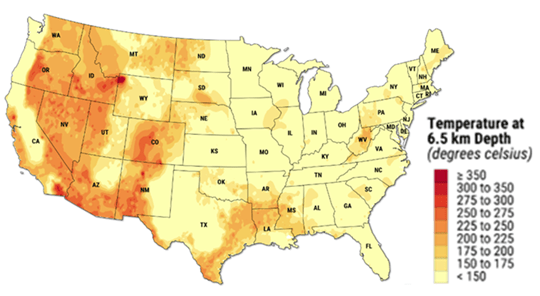
Here’s another view:
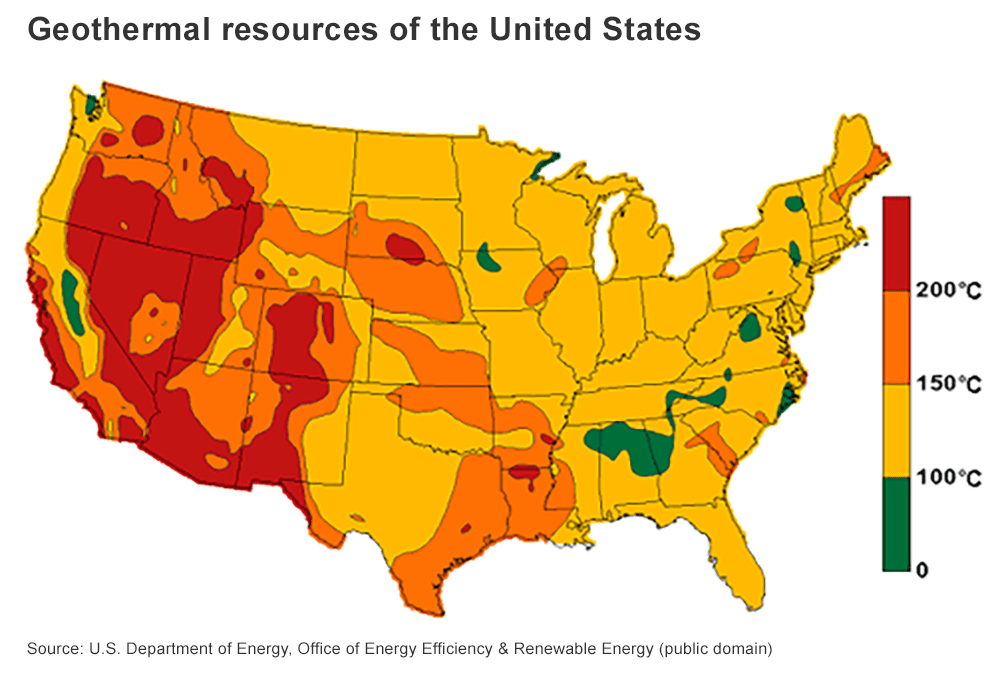
Ironically, the tech breakthroughs of the oil and gas industry, especially fracking, are making it more practical to tap that geothermal energy. As Brad Plumer of the Times writes in his article, “by using advanced drilling techniques developed by the oil and gas industry, some experts think it’s possible to tap that larger store of heat and create geothermal energy almost anywhere.”

The U.S. Department of Energy, under which Jeffco’s National Renewable Energy Laboratory (NREL) operates, has created a Geothermal Technologies Office to advance what it has trademarked as the Enhanced Geothermal Shot™.  (Here’s a link for their website. There’s a really effective minute-and-a-half video on that website explaining “Enhanced Geothermal Systems.”)

Plumer writes, “Dozens of geothermal companies have emerged with ideas. Fervo is using fracking techniques — similar to those used for oil and gas — to crack open dry, hot rock and inject water into the fractures, creating artificial geothermal reservoirs. Eavor, a Canadian start-up, is building large underground radiators with drilling methods pioneered in Alberta’s oil sands… The growing interest in geothermal is driven by the fact that the United States has gotten extraordinarily good at drilling since the 2000s. Innovations like horizontal drilling and magnetic sensing have pushed oil and gas production to record highs, much to the dismay of environmentalists. But these innovations can be adapted for geothermal, where drilling can make up half the cost of projects.”

What excites me about this effort is that because it utilizes the same drilling and fracking methodologies,  to reach the hot rocks, it’s a more attractive transition for the oil and gas workforce, compared to training the workers to service wind turbines or install solar panels.

Sixty percent of Fervo’s employees, according to Plumer’s article, came from oil and gas, and oil companies and drilling-service companies are investing in the startups which are pioneering geothermal energy drilling in Utah and elsewhere. “Devon Energy invested $10 million into Fervo, while BP and Chevron are backing Eavor. Nabors, a drilling-service provider, has invested in GA Drilling, Quaise and Sage. In Oklahoma, a consortium of oil and gas firms led by Baker Hughes recently launched an effort to explore converting abandoned wells into geothermal plants.”

The “roadmap” created by the Energy Department’s Geothermal Technologies Office breaks down as follows:

  • Predicting the Subsurface with Greater Precision 
  • Seeing the Subsurface with Greater Precision: New Sensing Technologies for Stress, Strain, & Fracture Mapping 
  • Accessing the Subsurface: Improving Drilling Efficiency and Drilling in Extreme Environs 
  • Designing and Building Wells 
  • Manipulating and Creating Durable Reservoirs: Controlling Fluid Flow and Developing Innovative Stimulation Methods 

I included that hard-to-read list only to reinforce what I said above, namely that this is the kind of work that’s a natural fit for the oil and gas industry. Instead of drilling for oil, they’re drilling for heat.

By the way, there are already 11 geothermal power plants operating along California’s Salton Sea.

Is Losing Your Gas Fireplace Keeping You From Making Your Home All-Electric?

There’s a growing movement, with good reasons, to eliminate natural gas from our homes. Think carbon monoxide poisoning. Or the bad health effects of inhaling methane. Or home explosions from gas leaks. Or how the use of natural gas (which is methane) contributes to greenhouse gas emissions, exacerbating climate change.

While it’s easy (and financially incentivized by state, federal and utility re-bates) to replace your gas furnace with a ducted or ductless heat pump system and your gas-fired water heater with a heat-pump water heater, many homeowners — myself included when I owned a single-family home — find it hard to accept giving up their gas fireplaces and gas grills.

Rita and I had to give up our gas grill when we moved into an apartment with balcony, but the George Foreman electric grill is a great replacement — and costs less to buy and operate. (You can also use it indoors!) But I didn’t know until recently that there are some fine alternatives if you are willing to give up your gas fireplace.

As an active Realtor, I have seen and listed many homes with electric fireplaces. One of my recently sold listings, which you can still view at www.GreenMountainHome.info, has an electric fireplace sitting on the hearth of the wood-burning fireplace in the basement. Fast forward to 3:45 in that listing’s video tour to see it. The seller explained that the wood-burning fireplace would always overheat the basement, but the electric fireplace can be controlled with a thermostat.

Temperature control is just one of the challenges with wood-burning and most gas fireplaces. I mentioned others in the first paragraph above, but cost of operation is another one.  Many people just want the ambiance of a burning fireplace, which you can get for pennies per hour from an electric fireplace, but most electric fireplaces also having heating modes, and if you want heat from it, the electric cost is still less than the cost of gas for an equivalent amount of heat generation.

Much of the heat generated by a gas (or wood) fireplace goes up the chimney, whereas electric fireplaces are unvented and therefore 100% efficient in that respect. No chimney also means no rodents or birds taking up residence in them.

 At www.ElephantEnergy.com you’ll find a web page devoted to electric fireplaces, from which I downloaded the two pictures below. On that page they describe seven different types of electric fireplaces, two of which —  an insert and wall-mounted — are shown here.

That web page addresses the following considerations: Lower costs; reduced carbon emissions; increased energy efficiency; improved safety; ambiance options; and model types.

In terms of costs, the web page claims a 30% savings over the cost of a gas fireplace.  The electric fireplace generates less heat at lower cost, but when it’s used to supplement, not replace, your central heating or for ambiance, that should be fine. If your home is solar-powered, it can be free. You can’t create gas!

Model types which offer ambiance and/or heating options are broken down as follows:

Pre-fab fireplaces can be either free-standing or wall-mounted and can be plugged into any 120 Volt outlet. They range from $400 to $4,000 depending on the features you want.

Custom fireplaces require unique installation and can range in price from $2,000 to $10,000.

Wall-mounted fireplaces resemble flat-screen televisions and can cost as little as $300.

Electric fireplace inserts allow you to make attractive use of your existing fireplace hearth and firebox.  According to the website, they range in price from $400 to $3,000.

Recessed electric fireplaces are nice if you’re willing to build out a wall to accommodate the unit’s depth, and can be quite attractive.  The design options are limited only by your imagination. Cost can range from $400 to $7,000 or more.

Built-in electric fireplaces are just a variation on the above, but typically include a hearth, mantel and surround. Intended for heating, not just ambiance, they can range from $3,000 to over $10,000. 

Water vapor electric fireplaces are my favorite.  No one will mistake them for a gas or wood-burning fireplace, but they “spark” elegance and style.  That’s the other example included above. They create 3-di-mensional “flames” through the use of water vapor and LED lights.  Heating is not an option.

Elephant Energy does not sell fireplaces (or other systems), but they link to ModernBlaze.com, which sells a wide variety of all the types of fireplaces listed above. They offer free shipping and returns and a 10% discount if you sign up for text messages.

If You Want an Actual Flame, Ethanol Is a ‘Green’ Option

Last week I shot a narrated video tour of an all-electric home that will be in October 7’s Metro Denver Green Homes Tour. It’s Michele Merritt’s Lakewood home, and she has two fireplaces that burn liquid ethanol.  (Fast forward to 2:33 in my video tour.)

Ethanol fireplaces are the easiest kind to install because they require no venting, construction or electrical outlet. You can build it into a wall, like a regular fireplace, but you can also have one as an indoor firepit (see picture below), since CO2 is the only fume. You pour the liquid ethanol (basically just alcohol) into the reservoir and light it. A one-liter bottle of ethanol will burn for several hours. ModernBlaze.com sells 6 bottles for $87 including shipping.  They sell a 24-inch ethanol burner for $1,895.

Here’s a link to the full writeup on ModernBlaze.com about ethanol fireplaces (from which I downloaded the above picture).

.

If the Energy Efficiency of the Home You Buy Matters, Hire Golden Real Estate as Your Buyer’s Agent

One of the two value statements on our yard signs is “Promoting and Modeling Environmental Responsibility.” (See logo.) If you’re a buyer wanting to assess the sustainability of the homes you are considering, you owe it to yourself to hire one of our agents, because we know this topic better than most real estate agents.

In addition to our agents pointing out the good and bad points of the houses we show you, our inspectors “speak green” too, and, as a fall special, we are offering new clients a Free Energy Audit after closing.  Call 303-525-1851 for details.

‘Community Solar’ Makes Solar Available to Condo Owners and Apartment Dwellers

Driving around the metro area and elsewhere, you have probably noticed huge installations of solar panels on open land and wondered who built and who benefits from them. Installations, such as the one north of 64th Avenue on Highway 93, are owned by community solar companies or nonprofits. 

The concept of community solar is to rent or sell portions of such installations to individual consumers. The kilowatt-hours generated by those solar panels are then credited to the usage on subscribers’ electric meters.

It’s a perfect solution for people who live in an apartment or condo building where they can’t install their own solar panels. The really neat thing about community solar is that when you move, your solar generation is merely reassigned to your new electric meter — no need to install new panels. 

Small businesses can also take advantage of community solar. Golden Real Estate, for example, moved in Nov. 2021 from its solar-powered office on South Golden Road into a storefront on Washington Avenue in downtown Golden. Community solar is the only way that we can continue to be solar-powered since we can’t install solar panels.     

Denver-based SunShare describes itself as the nation’s oldest community solar company with over 10 years’ experience building and maintaining “solar gardens” across the state. Their website says that they have built 116MW of solar panels and have 14,000 subscribers and three utility partners. Find more info at www.MySunShare.com

Community solar was legalized in Colorado in 2010 with the passage of the Community Solar Gardens Act  (HB 1342). The following year, SunShare opened for business, and in 2015 the Colorado Energy Office partnered with GRID Alternatives to construct a community solar demonstration project to serve low-income Coloradans. 

Colorado Springs Utilities was the first utility to create its own solar garden for 278 subscribers in 2011. That 0.5-MW installation has since grown to a 2-MW installation serving 435 customers.

Community solar can be a good deal for rural landowners, providing a predictable revenue stream for otherwise non-producing acreage. 

Renting or buying photovoltaic panels in a solar garden costs money, so you’re still paying for electricity, but the rule of thumb is that what you spend on community solar is about 10% cheaper than buying the same amount of electricity from the utility.

Some of us don’t worry about the size of the savings but simply “go solar” because it’s the right thing to do. Any savings are just a bonus.

To learn more, in addition to visiting SunShare’s website, I suggest Googling “community solar Colorado.” You will find other companies offering community solar, learn the history of it in Colorado, and decide whether it is right for you.    

You may find that existing solar gardens are sold out and you’ll be put on a waiting list for a future solar garden.

Whether you are putting solar panels on your own property or subscribing to a solar garden, consider upsizing your investment instead of basing it on your current usage, since the chances are that you’ll be buying an electric vehicle and you’ll want electricity from the sun to power it, too.  Xcel Energy allows you to install solar panels based on twice your last 12 months’ usage for that reason.

I Found a Great Website on Home Electrification – LoveElectric.org

Home electrification is all the rage, and www.LoveElectric.org is a one-stop shop for getting information about the rebates available from utilities, local governments and non-profits throughout Colorado designed to promote the abandonment of fossil fuels for heating and powering your home/business.

The website is an initiative of the Beneficial Electrification League of Colorado (BEL-CO), a coalition of stakeholders in Colorado committed to enhancing the market acceptance of electric appliances such as heat pumps, induction cooktops, etc. to replace fossil fuel-based appliances such as forced-air gas furnaces, gas boilers, gas fireplaces and gas ranges. Their website provides statewide information on rebates for the installation of such electric appliances.

Here’s a screenshot of their rebates web page, which is many times as long as shown here:

‘Solar Village & Electric Vehicle Show’ This Friday

Join the American Solar Energy Society for the Solar Village & Electric Vehicle Show on Friday, August 11th, 10am to 4pm, in front of CU Boulder’s University Memorial Center. There will be solar energy workshops, exhibits, EV shows, and activities for kids that are free and open to the publicAnyone interested in sustainable energy and energy efficiency is invited to visit this event, sponsored by the American Solar Energy Society, New Energy Colorado, and the Colorado Renewable Energy Society.

The Solar Village will offer a variety of educational displays and experts covering photovoltaic systems, heat pumps, passive solar design, super insulation, and other sustainable energy technologies and processes.

Also free and open to all is a Solar 101 Workshop from 11:45 to 1pm in an adjoining tent at which four experts in these topics will speak and answer questions. More information can be found at www.ases.org/conference.

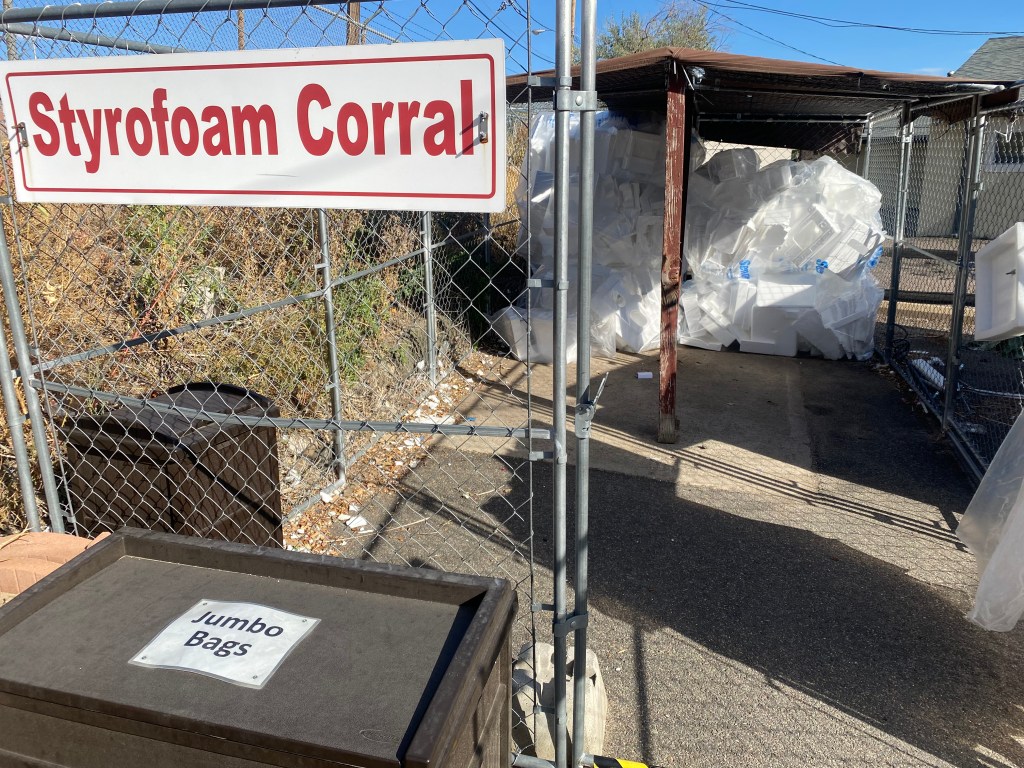
Our ‘Styrofoam Corral’ Closes Forever on Aug. 31

For over a decade and a half, Golden Real Estate has hosted a “Styrofoam Corral” behind its former location at 17695 S. Golden Road.  Perhaps you or someone you know brought some of the 36,000 cubic yards of the Expanded Polystyrene (Styrofoam is a brand name) that we have kept out of landfills.

Well, we sold that building last week to Joe & Stacy Fowler, proprietors of The Golden Hayride, and they need the space currently occupied by the Corral for other purposes. Our contract of sale requires us to close and remove the Styrofoam Corral by August 31st. We had hoped to find another host for this valuable community amenity, but have had no luck so far.  Call Jim Smith ASAP at 303-525-1851 if you can help find a new home for it!

After Aug. 31, 2023, you’ll have to take your Styrofoam to SustainAbility Recycling’s facility at 6240 W. 54th Avenue in Arvada. Their website is www.sustainability-recycling.com.

The National Heat Crisis Is Keeping Climate Change & Its Mitigation Top of Mind

Most Americans are conscious of the need to reduce carbon emissions which lead to global warming such as we are experiencing to a limited extent here in the metro area but to a much greater extent elsewhere in the country, Europe and the rest of the world.

Because of the increased attention to this topic, we’ll all be hearing a lot more about “embedded” carbon, not just greenhouse gas emissions.

I’ve written in the past about the outsized contribution of cement and steel manufacturing to our climate change crisis. It is estimated that the manufacture of cement and steel is responsible for 5% and 7% of global greenhouse gas (GHG) emissions respectively, so much attention is being focused on the “greening” of these two industries.

Both the Biden administration and the State of Colorado have enacted measures using “Buy Clean” terminology to accomplish a reduction of embedded GHG emissions in these two products in the bidding and construction of federal and state facilities — both buildings and highways/bridges.

Colorado is leading the nation with the passage of HB21-1303, the Buy Clean Colorado Act, which requires the Office of State Architect and CDOT to make sure that new projects are built with reduced embedded carbon.

Because the state and federal governments are such major buyers of new construction, cement and steel producers are being forced to focus on reducing GHG emissions, the benefits of which will likely spill over to private construction projects.

Here’s a link to how Colorado is tackling the implementation of this law on all projects that are put out to bid starting Jan. 1, 2024.

Bidders will have to provide “Environmental Product Declarations” (EPDs) on the following “eligible materials” used in the construction of state projects: asphalt & asphalt mixtures; cement and concrete mixtures; glass; post-tension steel; reinforcing steel; structural steel; and wood structural elements.

HB21-1303 even seeks to reduce the GHG emissions involved in the transportation of building materials from their place of the manufacture to the build site. The state will want a report on any materials transported over 100 miles, including the weight, method of transportation and total distance traveled in order to compute the “global warming potential” of their transport for future possible consideration/regulation.

Free Webinar: Is Solar a Good Investment for You?

The Colorado Renewable Energy Society presents a free virtual event this coming Sunday, July 30th, at 6pm to help you determine if the benefits of adding solar outweigh the cost. Adding solar to your home or business is a substantial investment, but one which can provide tangible long-term benefits. This lecture will cover the financial considerations of adding a solar PV system to your home, including size, cost, increase in property value, payback timeline, return on investment, tax credits, and local rebates and incentives. It will also discuss no-upfront-cost options such as power purchase agreements and solar leases.  Click here to register for this free event.

Here’s Why I’m Not a Fan of Tankless Water Heaters

    Tankless water heaters have been promoted as an energy-saving appliance. The reasoning is simple. A traditional water heater is tasked with keeping a large tank of water hot — typically at 120º F.  A tankless water heater only heats water as needed. 

    The development of heat pump water heaters has changed that calculation. And they are the only water heaters that can earn you a 30% federal tax credit in addition to the $600 to $800 rebate earned by Xcel Energy customers. Xcel says heat pump water heaters are 65% more efficient than standard electric water heaters and can save you $900 in energy costs over 12 years.

    There’s a secondary reason that I don’t like tankless water heaters.  With a tank water heater (whether heat pump  or conventional electric/gas), you can install a recirculation line, allowing you to have instant hot water at even the farthest faucet from your water heater.

     A plumber has installed a recirculation line in every house I’ve owned for 20 years. Here’s how it works. Let’s say your water heater is in the basement and your primary bedroom is on the second floor. You might draw a gallon or more of cold water before hot water reaches your faucet. And that’s water that had been heated but cooled off sitting in your pipes. By running a return line from your sink to the bottom of the water heater, your faucet becomes the “top” of your water heater, and hot water rises to the top of the tank. Voila! Instant hot water on tap. (Note: You are saving water, too, by not running the tap until hot water arrives.)

Running that recirculation line can involve a lot of drywall opening and repair if you have a finished basement and need to snake the line through ceilings and walls to a higher floor. If you have a ranch home with an unfinished basement (no drywall on the ceiling), you’re spared this expense. It helps to save heat loss and energy if you install insulation on the copper pipes going from the water heater to your distant faucet, assuming those pipes are accessible. The return line should be PEX, which is plastic and does not need insulating.

Installing a hot water recirculation line is a job that any plumber can do.