Houston Builder Specializes in Net Zero Homes Built of Concrete

A reader who has been following my columns about fire resistant home construction, including concrete, sent me information about a Houston TX builder, Everlasting Homes Building Group LLC, which uses RSG 3-D structural concrete insulated panels to build homes which are not only fire resistant but also meet “extraordinary levels of excellence in energy and performance.”

At the top of its excellent home page, EverlastingHomesGroup.com, is the following statement: “Our vision is to design and build the most comfortable, healthy, resilient & sustainable living spaces dedicated to creating the best net zero energy homes and communities for our future.” They promise to build homes “resistant to hurricanes, tornados & floods, extreme cold / hot weather, earthquakes & fires, wood-destroying insects, and allergens, pollens, molds & dust.”

The Buying of Homes Has Become More & More Frantic Since the Marshall Fire  

I had a busy weekend this last Saturday and Sunday. With two new listings, I held each open for two hours. I couldn’t even count the number of visitors at the single family home listing that I held open on Saturday. Listed at $495,000, over 120 agent showings had been scheduled during the five days that it was active, and I received 25 contracts for it by the Sunday afternoon deadline. It went under contract for $630,000 on Sunday evening.

Surprised by this level of interest, I did some research Monday to quantify the increased buyer activity. Here’s what I found.

During the first 23 days of January, 403 Jefferson County listings went under contract.  Of those, 295, or 73.2%, had been active a week or less at the time they went under contract..

But not only were new listings selling this month. Twenty-four, or 6%, of the listings that went under contract in the first 23 days of January had been languishing on the market for 3 months or longer. Three listings had been on the MLS for over half a year.

My very busy open house on Saturday, Jan. 22nd in Arvada

Of the 403 contracts written so far in January, 36 (8.9%) were for homes listed for $1 million or more. The most expensive home on that list, a 1930 ranch-style home in Genesee Ridge that had been on the MLS for 275 days, went under contract last Monday. This didn’t happen because of a recent price reduction. It had been listed at $5.9 million since last July 15th. It was originally listed at $6.6 million on April 1, 2021.

So, how does January’s activity compare with December’s?  In December, a total of 554 Jeffco homes went under contract, most of which have now closed. Of those, 336, or 60.6%, had been active a week or less, versus 73.2% of the January contracts Twenty-five of them, or 4.5%, had been active for three months or longer, versus 6% in January..

Forty-four Jeffco homes (7.9%) sold for $1 million or more in December, compared to 8.9% in January.

So, yes, statistics do reflect a more frantic sales pace in January.

Taking a longer perspective, let’s look at the 4th quarter of 2021 vs. the 4th quarter of 2020.

In the latest quarter, 56% of the homes went under contract in 7 days or less, versus 60.2% in Q4 of 2020. A smaller percentage of homes that had been on the MLS three months or longer sold in the 4th quarter of each year — 3.9% in 2020, down to 3.0% in 2021.

Having established the statistical basis for my observation that home buying has become more frantic this month, let’s look at possible reasons.

At least one of the 25 contracts I received last weekend for my Arvada listing was from a family which lost their home in the Marshall fire.  They are currently living in an Airbnb.  Others may have been from victims of that fire, but they didn’t say so in their offer.

Another buyer was an investor who told me that they were rushing to buy a home because they felt prices were rising at an increasing rate. This buyer thought that despite the bidding wars, they could get a better deal now than if they waited another year to add to their portfolio.

Rising interest rates and the expectation of further increases later on probably are playing a role. People want to buy before rates increase further. You may have read that a high percentage of buyers are cash buyers, but this has not been my experience, and only three or four of the 25 contracts I received for my listing.

How to Alert Residents About Approaching Wildfires  

Clearly many lives were saved in the Marshall Fire because it started in the morning and residents were awake and alert to the danger. Imagine if the fire had begun at 2 a.m.  How many more people might have died in their homes?

A reader suggested that community-based sirens could help to save lives, and that does sound like a good idea.

NextDoor is a great resource for alerting residents about all kinds of dangers, but it would not wake anyone up. Something like the Amber alert which makes a deafening alarm on cell phones could be effective. (I leave my cell phone on at night but it is purposely out of earshot for phone calls and text messages. I would, however, hear the loud alarm used for Amber alerts.)

The Amber alert should not itself be utilized for such a warning, because it can be silenced.  If there were a separate alert for fire danger, it’s unlikely that people would silence that alert or turn off their cell phones at night.

There are, I’ve found, many seniors who have held off buying cell phones, but the existence of such an alert might inspire them to purchase one. In addition to the low-cost providers, there is a program called Lifeline that provides free cell phones to households that are on various programs such as SNAP, SSI, Medicaid, etc. Learn more at www.AssuranceWireless.com. If you are currently paying for a landline telephone, you could get rid of it and port your phone number to the free cell phone that you get with this program. The cellphone can also provide you with free internet service via a “hotspot,” allowing you to save money on broadband, too.

Here Are More Examples of Concrete Construction and Fire Resistant Roofing  

My previous two columns about reducing your home’s vulnerability to wildfires generated a lot of reader response, providing even more to write about on this important subject.

Fire resistance is personal for Rita and me, since we live in a wood frame home backing to open space which would be ready fuel for a wildfire.

I’ve been told that following an 1863 fire, Denver passed an ordinance requiring masonry construction. Somewhere along the line, that requirement was dropped. I wouldn’t be surprised to see building codes changed once again restricting wood construction.

While there’s a trend toward requiring  fire suppression systems inside homes, they are designed to suppress fires which originate inside a home.  If a fire originates externally, such systems may be of limited effectiveness in saving a structure.

Last week I wrote about ICFs — insulated concrete forms. Concrete is poured into a form which has insulating EPS (expanded polystyrene) on each side. This produces a concrete wall which has insulation pre-installed on each side of it.

A couple readers made me aware of the opposite approach, a concrete wall in which the “sandwich” has concrete on the outside and the expanded polystyrene on the inside.

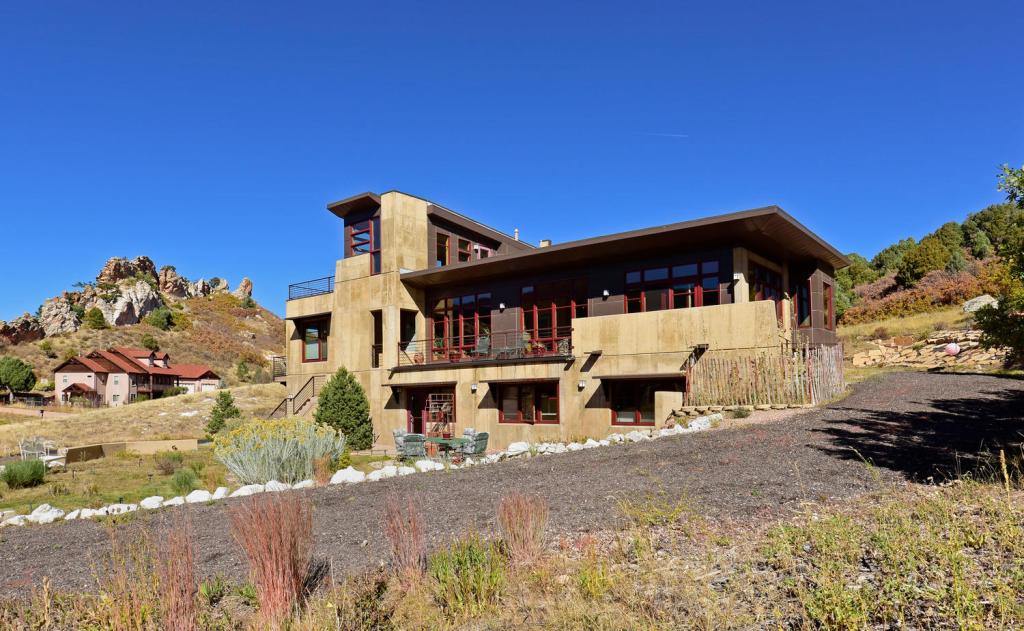
Reader Lynn Greene invited me to visit her home in Perry Park (see picture below), southwest of Castle Rock, which was built with Thermomass® walls and concrete floors developed by Composite Technologies Corporation of Boone, Iowa.

Lynn’s tenant told me that the energy costs peak out at about $70 per month to heat the house with radiant floor heating built into the concrete floors. That heat is provided by a high efficiency boiler using natural gas. Large south-facing windows provide a lot of free winter time heating. (Notice the large overhangs shading the south-facing windows in summer but not in the winter.)

The Thermomass walls were poured in place, less expensive and more attractive than walls built of uninsulated concrete block. It also allowed electrical and other conduits to be built into the walls instead of surface mounted afterward.

Another “sandwich” approach is sold by a company called RSG 3-D, but they create panels which are assembled onsite instead of being poured in place. Also, their polystyrene interiors (which are wider) have steel connectors instead of the plastic connectors used in the Thermomass walls. That reduces the insulating quality of the wall, since metal is a conductor.

Another reader reminded me that the making of concrete is a major source of carbon dioxide, a greenhouse gas. According to Wikipedia, “The cement industry is one of the two largest producers of carbon dioxide (CO2), creating up to 8% of worldwide man-made emissions of this gas, of which 50% is from the chemical process and 40% from burning fuel.”

Click here to read an article from The Guardian about the development of “green concrete” in Australia that sounds very promising. As you may know, “concrete is made from approximately 10% Portland cement, 3% supplementary cementitious inclusion (for example fly ash), 80% aggregates (such as gravel and sand), and 7% water.” Then it is reinforced with steel, which has its own huge carbon footprint.  By replacing the steel with recycled plastic, that impact is mitigated, and, according to article from The Guardian, the Australian company Wagners has created earth friendly concrete using blast furnace slag – an industrial waste from steel production – along with fly ash, a waste from coal power generation, as a replacement for Portland cement.

To make a concrete home truly resistant to wildfire, it is necessary to make the windows and doors and other openings fire resistant too. There is glass (with frames) rated for 20 to 180 minutes of fire resistance. See www.fireglass.com.

Lastly, one must deal with roofing. Another reader made me aware of the synthetic roofing by CeDUR which was installed on her Wheat Ridge home and which is also on Woody’s Wood-Fired Pizza:

It looks just like a wood shake roof and is installed the same way in individual shakes, but it has the highest rating of fire resistance (Class A), earning homeowners a substantial discount on their homeowners insurance. Learn more at www.cedur.com/fire-safety.

There are vents of all kinds not only on your roof but on soffits, foundations, eaves and gables, and they need to be protected from flying embers. Vulcan Vent sells vents for all those openings, “built to create a barrier against wind-blown embers and flames in the presence of intense heat.” Learn more about them at www.VulcanVents.com.

Homes Built of Concrete Garner Increased Interest in Wake of the Marshall Fire  

Last week’s column focused on ways that homes can be made more fire-resistant, but there’s only so much you can do to protect wood frame homes from wildfires that are driven by hurricane force winds. Looking at neighborhoods where every home was reduced to its concrete foundation, it’s not hard to question that common method of construction.

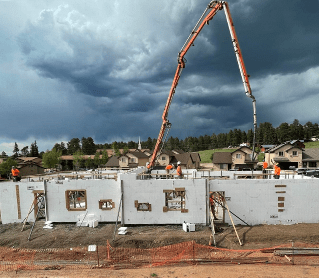
Reader Peter Deem made me aware of the use of insulated concrete forms (ICFs) to construct the entire “envelope” of a house and pointed me to Don Clem of the National Ready Mixed Concrete Association, which has a local office in Denver. That organization, along with its Colorado affiliate and several concrete companies, sponsored an 18-townhome project in Woodland Park for Habitat for Humanity of Teller County last summer. Here’s a picture of those townhomes under construction:

Photo by Sara Vestal, Teller County HFH

I was first introduced to the use of ICFs when I participated in the 1994 Jimmy Carter Work Project on the Cheyenne River Sioux Indian Reservation in Eagle Butte SD. The 28 homes in that project were conventional wood frame (“stick-built”) homes, but the concrete foundations were poured into ICFs. An ICF replaces more common wood forms which have to be removed from the foundation after it cures. The ICF provides insulation in the form of two inches of expanded polystyrene (EPS) both inside and outside the foundation. After seeing it there, I was surprised not to see ICFs in widespread use for foundations by production builders over the past 27 years.

The ICFs being promoted now are for above-ground use for exterior walls, and there are even ICFs for pouring concrete flat roofs. (More commonly, there are concrete tile sloped roofs, including one on the house Rita and I once owned on Parfet Estates Drive in Golden.)

While concrete is a non-combustible material, the EPS insulating layers will melt with direct flame, but it does not act as a fuel source, will not promote flame spread, and will not release harmful gases. In addition, the ICF would be protected on the outside of a home by siding — for example, a fiber cement siding like Hardieboard, which is not combustible, and the flames would probably only be present briefly during a passing wildfire. The interior would be covered by drywall, as with a stick-built house.

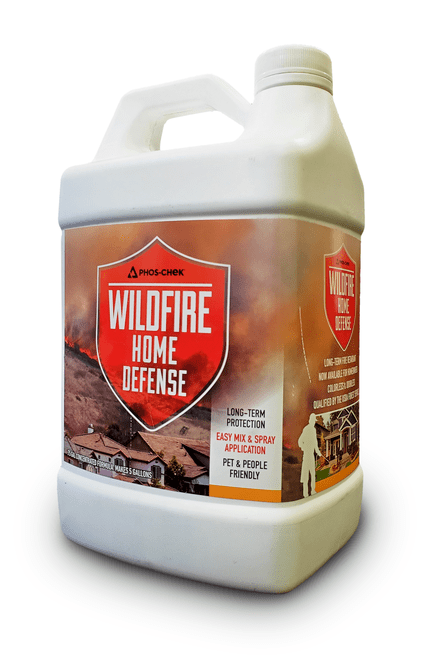
Speaking of that, there is still the question of combustible vegetation such as juniper bushes that are close to your house. Another reader made me aware of Phos-Chek, the same fire retardant that you see used by aerial tankers to attack wildfires. While that chemical is red, it’s available in a colorless concentrate that you mix with water and apply using an ordinary sprayer to the vegetation around your home.  A single bottle of Phos-Chek sufficient to make 5 gallons costs $59.99.  You will need 5 to 20 gallons depending on the amount of vegetation you want to cover. Click here to view a KNBC news segment about a Malibu homeowner who saved her home from the Woolsey fire in November 2018 thanks to an application of Phos-Chek to the grounds around her house three months earlier.

In last week’s column I also mentioned that the soffit vents typical of homes with unconditioned attics can allow embers to enter the attic, igniting an interior fire, but I neglected to mention that there are ways to fireproof soffit vents to keep that from happening.

Another way that concrete homes are being built is using 3D printing pioneered by Icon, an Austin TX-based company which is currently building a 100-home Texas subdivision in partnership with Lennar using that process. Icon built its first 3D-printed home in 2018 as a proof of concept, following which they built a community of 3D-printed homes in Tabasco, Mexico. Here’s a picture of a Habitat for Humanity 3D-printed home in Virginia:

Just as desktop 3D printers work by applying multiple layers of material following a computerized template, Icon’s huge 3D printers apply multiple layers of concrete. See www.IconBuild.com for more information about this company, which, by the way, has NASA contracts to build 3D-printed structures on the moon and on Mars. Their primary mission, however, is “to re-imagine the approach to homebuilding and construction to make affordable, dignified housing available to everyone throughout the world.”

Their home page goes on to say, “the audacious mission of Icon is to revolutionize homebuilding, and our team’s expertise and determination have already made this dream a reality. Our team has a passion for design, engineering, and elegant software. We have decades of experience in sustainable technology and construction innovation.”

Building with concrete is both less labor intensive, less expensive and more sustainable than building with lumber. It’s significant that one of America’s biggest builders, Lennar, is working with Icon to build those 100 concrete homes in Texas. That project should provide facts and figures about the practicality and economy of building with concrete that could be a powerful influence on the rest of the home-building industry.

We Want to Help Fire Victims Who Want to Relocate, Not Rebuild

If someone you know lost their home in last week’s fires and decides to relocate rather than rebuild, have them call us. Golden Real Estate will rebate 75% of our earned commission to any buyer who lost their home and all their furnishings in the fire, so they can use that money to buy new furnishings. Email Jim@GoldenRealEstate.com for more information.

You can donate, too, at www.CommFound.org.

Last Week’s Fire Disaster Is a Wakeup Call for Building More Fire-Resistant Homes  

My column on Nov. 29, 2018, followed the wildfire that took out the entire town of Paradise, California.

Last week we experienced a similar tragedy in our northern suburbs of Superior and Louisville. The difference was that this fire was driven by hurricane force winds that are all too common along the foothills.

Those winds weren’t limited to that area, and it was clear to Rita and me that a spark on Lookout Mountain (to which our home backs) might well have led to a similar catastrophe for the city of Golden. There’s no way to stop a fire driven by such winds.

You probably noticed, as I did, that the fire spared some houses while completely consuming adjoining houses, so perhaps it’s possible to increase the chances of being one of those skipped houses in a future wind-driven wildfire. Was it just luck, or did those homes have any features that may have helped spare them?

Today I’ll describe some features that might increase the chances of a home being skipped.

In high wind or low, it’s important to recognize that fires spread from home to home primarily by wind-blown embers. You’ve probably heard of insurance companies requiring homes in the “wildland urban interface” to create a “defensible space” around them by removing trees and other combustibles within, say, 20 to 30 feet of the home.

Useful as that might be, it’s more important that burning embers from further away not land on combustible material such as dead leaves, shrubbery, a wood deck, or a shingle roof.

There’s a useful website on this topic, www.DisasterSafety.org/wildfire. One of the links on that website that you’ll find useful is “What to do if a wildfire is approaching your home.”

California is, understandably, a leader in researching and rating building materials based on their fire resistance. Cal-Fire’s 48-page handbook dated Dec. 14, 2021, lists construction materials in 7 categories: decking; exterior windows; exterior wall siding and sheathing; exterior doors; under-eave protection; vents; and non-wood roof covering/assemblies.

If I were to invest in making my own home more fire resistant (which I am seriously considering in the wake of last week’s fires), here are some of the things I would investigate;

Metal roofing: I like the look of what is called “stone-coated steel” roofing. It looks from a distance like wood shake roofing. There’s an HOA in south Jeffco which requires wood shake roofing, but it will allow this kind of metal roofing. (It does not allow the more commonly used composition shingle roofing.)

Roof sprinklers: I have often thought it would make sense to install sprinkler heads at strategic locations on my roof to wet the roof if a fire is approaching. I’m going to ask a plumber about this concept. Sprinklers that douse the exterior walls might also be a good idea. I found on Amazon a kit of 2 roof sprinklers with gutter, wall or fence mounting and 50 feet of hose for $179.95, but I   like the idea of permanent sprinkler heads with through-the-roof plumbing, which I think my HOA would find less objectionable.

Motorized rolling metal shutters: I have seen these installed on a few Jeffco homes. They’re marketed for privacy and security, but they completely cover the windows when lowered and would surely help protect against fire. Some such systems allow the shutters to be operated via an app on your smartphone. One vendor is www.SomfySystems.com. Think of this as another reason for having a home battery backup system (which we have ordered) in case of power failure.

Non-combustible siding: The most common siding being installed by local builders is “HardieBoard” from James Hardie. Although it can be mistaken for wood siding, it is actually a non-combustible fiber cement product. It’s only 1/4 inch thick, however, so it only provides short-term protection and does not qualify as fire resistant, so it matters what is underneath it. (Refer to that Cal-Fire handbook of siding products.)

Special attention should be paid to the underside of roof overhangs, balconies and decks, where flames can be trapped. Roof soffits in most homes have vents which combine with vents on the roof to circulate outside air through the attic.  Unfortunately, this design can also allow the introduction of wind-blown embers into the attic. One way to eliminate these vents is to do what Meritage Homes did in building Arvada’s Richards Farm subdivision. The insulation of those homes is closed-cell foam sprayed onto the underside of the roofs, rather than the more typical blown-in cellulose or fiberglass batts resting on the floor of the attic, as is found in most homes. The attic in such homes becomes conditioned (i.e., heated) space, eliminating the need for soffit and roof vents. Meritage probably didn’t consider that making the homes more energy efficient in this way had the added benefit of making them more resistant to ember intrusion in a wildfire.

In past columns, I have promoted the all-electric home for sustainability and health reasons, but last week’s fires have provided another reason for doing away with natural gas. A large number of homes that were not destroyed are nevertheless enduring days and possibly weeks without natural gas for heating during some bitterly cold days. If any of those homeowners had switched to heat pumps for space heating and for hot water (as I have recommended), they would not be affected by the long delay involved in restoring gas service to their neighborhood. That might be an additional inducement to make the switch away from natural gas.

Homeowners in that area are being urged to boil water, so they might consider buying a countertop induction burner, which can boil water in one or two minutes, versus 10 or more minutes on a conventional range. I found 110V models online for $49-79.

It is not uncommon for homes to have “safe rooms” to which homeowners can retreat in case of a home invasion. If such a room were constructed in a basement with cinderblock walls, a metal door, and a concrete-and-metal ceiling, it might double as a survival room in the event of a wildfire when evacuation is a risky alternative. Given the increase in tornadoes due to climate change, it could also serve as a tornado shelter.

Although I have not researched it, I would guess that taking some of these precautions — especially metal roofing and the rolling metal shutters — might help to reduce your insurance premiums, as well as to possibly save your life and property in case of wildfire. 

The Year in Review: 2021 Saw Unprecedented Real Estate Changes  

I don’t think anyone in real estate foresaw the amazing year which is now coming to an end, any more than they foresaw the pandemic’s arrival in March 2020 and its effect on that year’s real estate market.

Even though the pandemic spanned both years, the two years display notably different patterns when it comes to home sales.

Below are four charts derived from REcolorado statistics, the first three of which span the time from Jan 1, 2020 through Dec. 27, 2021, when I researched this article. Final figures for December 2021 are not yet in but shouldn’t greatly affect that month’s stats. Because REcolorado is a statewide MLS, I limited the analysis to listings within 20 miles of downtown Denver, which includes the metro area except for the city of Boulder.

The most spectacular effect of the pandemic is shown in the top left chart, as homes started going under contract in a week or less (median), down from 26 median days in MLS in January 2020. Despite that, you can see that the active inventory of listings shot up from about 5,000 before the pandemic to a high of nearly 8,000 in May 2020. Inventory only started dropping at the end of that first summer, but  it’s apparent that the decline in active listings was not for lack of new listings but rather because most listings which came on the MLS went under contract within a week, causing the number of unsold listings to decrease.

The third chart has what looks to be an uninteresting top line, but that’s only because of the compressed scale. It actually reveals a dramatic change which only occurred in the second year of the pandemic. The ratio of closed price to listing price was only 99.3% in January 2020, but it rose to 100% in February and stayed there through January 2021. It surged to almost 105% in June 2021 and was still at 100.6% in November.

What has happened in the luxury market is even more pronounced. The fourth chart, going back six years, shows how the number of closings over $1 million has surged from well below 100 in early 2016 to a high of 547 in June 2021, with the two pandemic years showing the most outstanding growth. On the same chart you can see that the change in price per finished square foot was up and down showing a gradual increase month-to-month from 2016 to 2019, but then took on a sharper and steadier increase during the pandemic.

There does seem to be a cause-and-effect relationship between the pandemic and the real estate market. In the beginning, we could conclude that the lockdown was causing people to seek bigger homes to accommodate working from home (and schooling at home). Also, it seems that some couples broke up under the strain of being together 24/7, further increasing the demand side of the real estate market.

Although the government is reluctant to reimpose a lockdown for pretty obvious reasons, the pandemic is still a factor and can be expected to drive further real estate activity for months to come, even as interest rates rise gradually.

(Actually, rising interest rates can stimulate buying activity, because once buyers see rates rising and realize they’ll continue to rise, they want to buy before rates rise much further.)

Meet Anapaula Schock, Golden Real Estate’s Newest Broker Associate  

    Anapaula Schock first came to our attention through her renovation firm, Carlani, which several of our broker associates and I have utilized. I hired her company, for example, to repaint our former office on South Golden Road and to do some demolition in our new storefront location.

    All that time, I knew that she was herself an experienced bilingual Realtor with 12 years’ experience. I was pleased that after she got to know Golden Real Estate and our values, she asked if she could join our team. Passionate about helping clients to meet their real estate goals, she particularly resonates with our commitment to “hometown service delivered with integrity.” She looks forward in particular to bringing those values to Spanish-speaking buyers and sellers. Call her at 303-917-1749 or email her at ap@livincolorado.com.