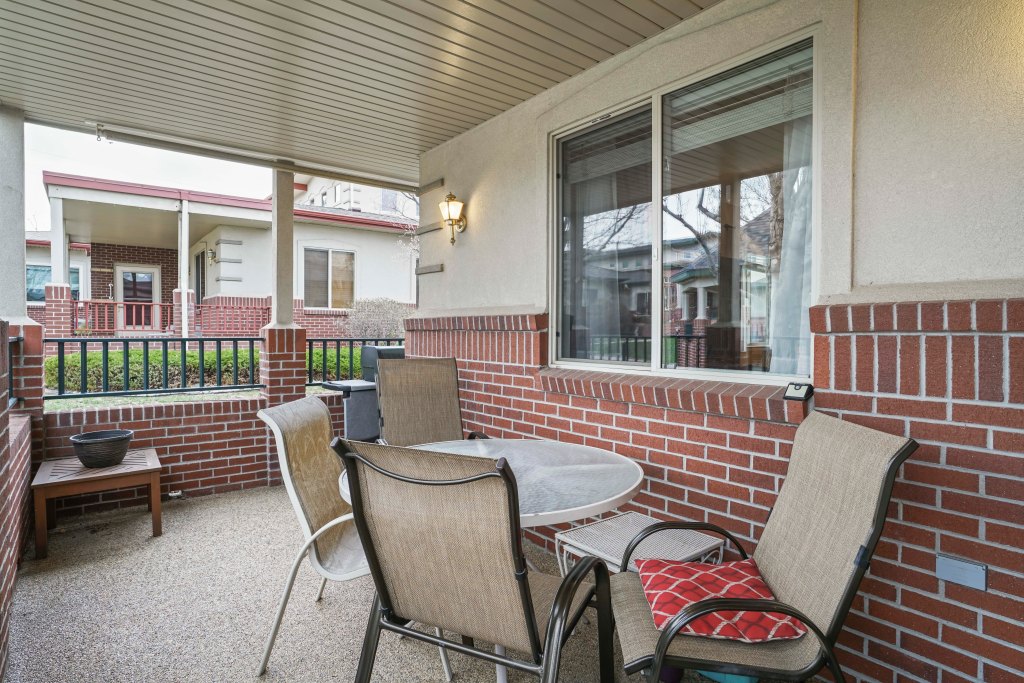
Just Listed: A 2-Bedroom Townhome in a 55+ Senior Community in Golden

Maintenance-free patio homes and 55+ communities are rare. This townhome at 1140 Ulysses Street is in one of only two such subdivisions within the City of Golden. There are only 24 townhomes in this self-managed HOA, with low monthly dues and Golden’s low all-inclusive property taxes. The units are all story-and-a-half, with a  main-floor master suite plus a guest bedroom with ensuite bathroom and loft upstairs. There’s no basement. There’s a 2-car attached garage with 8+ guest parking spaces adjacent to this end unit. There’s a large covered porch, visible in this picture, and the community’s gazebo used for weekly happy hours during the summer is steps from this home’s porch. The finishes in this unit, as in all the units, are high end, with hardwood floors. It’s a community of happy and friendly neighbors, evident in the fact that there have only been four sales since 2016. NOTE: Agent showings are limited to this Thursday, April 27th, 1-6 pm and during the open house this Saturday, April 29th, from 11am to 1pm. Meanwhile, you can view a narrated video tour of this listing at www.GoldenTownhome.info.

What Are Some Affordable Ways to Make Your Home More Attractive to Buyers?

This week’s column is inspired by an email I received from Brock Pardo of PunchListUSA. His company is in the business of helping sellers fix problems identified in buyers’ inspection objections. Toward that end, he also offers free pre-listing consultations and quotes. (I offer free consultations too, but I’m not a contractor, so I can’t give quotes, just refer you to my vendors for implementing suggested repairs or improvements.)

Being in that business, Brock’s email contained a “top ten” list of issues which could be addressed affordably prior to putting a home on the market, resulting perhaps in selling that home for more money.

Usually, when I get an unsolicited email with a top ten list, I find that it’s not the top ten items I would have selected, but this time I found that I agreed with all of them, so I’m going to publish his list, but with my own elaborations.

1) Fresh coat of paint. Brock cited a report that interior painting returns a 107% return-on-investment, and exterior painting a 50% ROI, but I’d add that it depends on condition. If your home has a faded pastel exterior color popular in the 1990s with or without peeling paint, I’d say that a fresh paint job in a more up-to-date color would make a huge difference in first impressions and the number of showings that are set and offers that you receive.

2) Landscaping improvements. These can be quite affordable and, again, make a huge difference in the first impression that your home makes. A couple months’ service by Lawn Doctor can make a big difference in your lawn’s appeal, as can a load of fresh cedar chips for your non-grassy areas.

3) Upgrading lighting fixtures. Those “brass and glass” chandeliers and sconces are so 1990s, and are inexpensive enough to replace with, for example, brushed nickel fixtures. And even if you don’t replace any fixtures, replace all your incandescent or CFL light bulbs with affordable LED bulbs. The best deal on those, I’ve found, are 8-packs of 60-watt equivalents for $2.75 (34¢ each) from Batteries+Bulbs. (Don’t put your CFLs in the trash. Take them to Home Depot for recycling, because they contain mercury.)

4) Minor kitchen updates. You don’t have to replace your Formica countertop unless it’s damaged or a really bad color, but replacing the faucet on your kitchen sink is an affordable upgrade. Also, I like to see knobs and pulls on kitchen cabinets, and you can get affordable ones, as Rita did, at Hobby Lobby, of all places. Maybe paint or repaint your kitchen cabinets — white is a good choice. Beyond this, I’m happy to bring my stager and consult with you on further upgrades, because kitchens can make a huge difference, and certain improvements are worth considering.

5) Bathroom upgrades. Replacing those 1990s plastic Delta faucets is a no-brainer! And you can find some affordable replacement vanities at home improvement stores.

6) Replace or clean wall-to-wall carpeting. Unless your carpet is shag or damaged, cleaning it professionally is sufficient and affordable. My preferred carpet cleaner is Bruce Ruser of New Look Dry Carpet & Upholstery Cleaning, 303-697-1584, who uses an environmentally friendly system that utilizes plant-based ingredients. The website www.hostdry.com explains his process.  We use Bruce ourselves.

7) Replace older appliances. These can be affordable. Look for Energy Star ratings, too. I had a 1990s listing with its original white kitchen appliances. It just sat on the market until the seller replaced them with new appliances.

8) Install new door and window hardware. Brock quotes a 2021 Zillow report claiming that updated hardware has up to an 80% ROI, but I’d like to see your current hardware before suggesting this update.

9) Declutter and organize. This is more about staging than repair of something. We provide a free staging consultation for all listings, and our report always recommends decluttering, thinning and organizing.

10) Deep clean your home. Again, this is a staging matter. And it’s a no-brainer! We can refer you.

That concludes my version of Brock Pardo’s “top ten” list. I’d add the following two items:

11) Wash your windows. You’ll need to remove screens when you wash your windows, so don’t reinstall them. Label and store them in your basement or garage. Removing window screens has a effect similar to washing your windows, greatly improving visibility. If any of the screens are damaged (including sun damage), most Ace Hardware stores can rescreen them affordably.

12) Update your moldings. At a recent open house, a would-be buyer objected to the older stained wood moldings on the walls. She said they should be white, and I realized that she’s right. You could paint them white (priming first with Kilz), or replace them all with plain white moldings from a home improvement store.

Do you have your own suggestions of additional items? Let me know, and maybe I’ll feature them in a future column or on our blog.

A Good Loan Officer Can Help You Navigate Buying Before You Sell

Many people are ready for a move. They have substantial equity in their home that will fund the down payment on their new home, but because the inventory of homes for sale is so low, they don’t want to sell before they identify their new home.

While obtaining a bridge loan or a home equity line of credit to access equity are options, few buyers can qualify for them and doing so impacts their buying power for their new home. FNMA requires that lenders count a borrower’s current mortgage, the new HELOC payment AND the mortgage payment on the new house in the debt-to-income ratio that is used to qualify for the new loan. This means that unless they list and sell their current residence before finding a new one, their only option is to write an offer to purchase that is contingent upon the sale of their current home and unfortunately, contingent offers do not have much traction in our current market.

Enter the “Buy Before You Sell” program. Several lenders offer such a program. Jaxzann Riggs, owner of The Mortgage Network, explained the fundamentals to share with you.

Step one is for the “Buyout” company to determine the current value of your existing home. Step two is for you to contract with the “Buyout” company for the guaranteed sale of your current residence.

The Buyout company will then provide an interest free, no payment loan on your available equity to use as your down payment. Your realtor will then be able to write a noncontingent offer with your full available down payment on the new home, which will be your most competitive option. Because you have a guaranteed purchase for your current residence, lenders aren’t required to include the expense of your “departing” residence in your qualifying ratios.

The stipulations for the “buyout” are that once you close on your new home, you will have 10 days to list your current home and you must be under contract within 90 days. The Colorado Association of Realtors shows that year to date, the average home was on the market 62 days, which should be reassuring to those who are concerned about the 90-day time limit.

The cost for this program is 2.4% of the selling price of your existing home, paid to the buyout company when your home sells.

While this cost is not insignificant, consider what it is worth to you to eliminate the stress of selling first, and then having a time constraint attached to finding a home that you love. Also, there can be added costs of a rental property and moving twice if you do not happen to find your new home quickly.

Another cost that is important to consider is that if you don’t get any offers by the 90-day mark, the buyout company will execute its right to your home at a price that’s set at the beginning of the process. This amount will not be market value, but if they then sell your house for more, you will get the additional equity after their 2.4% fee has been collected. It is important to talk to your Realtor about the realistic value of your home, and strategies to ensure a sale within the 90-day period.

Jaxzann reports that while not suitable for everyone, using a “Buy Before You Sell” option can be a way for buyers to maximize their buying power, to take their time looking for a home that they love, and to write their strongest possible offer.

If you feel stuck in your homeownership journey, call Jaxzann at 303-990-2992 for more info.

Why Wouldn’t a Listing Agent Want to Maximize the Exposure of His Listings?

Although the average real estate agent barely makes a living and either has a second income source or a high-earning spouse, about 10% of agents earn a lot of money — and want to earn even more.

Myself, I make a very good living, as evidenced by the fact that I’m writing this week’s column while Rita and I are on vacation in Prague, capital of the Czech Republic. (I’ll be home by the time this column appears in print.)

But my business model does not involve doing every single thing I can to maximize my personal income. I get more satisfaction from trying to maximize my service to others, including my clients and the unknown readers of this blog. Since long before I became a Realtor, I lived by a motto that has mistakenly been attributed to Confucius. “Concentrate on giving, and the getting will take care of itself.”

My Denver Post column — what newspapers call an “advertorial” — is evidence of that strategy. As a former newspaper journalist trained on the metro desk of The Washington Post in 1968, I decided at the very beginning of my real estate career in 2003 that I’d spend my marketing dollars on buying newspaper space to publish a helpful real estate column.

It has paid off quite well. Unlike every real estate agent I know, I have never made a cold call or prospected in any way to get buyers and sellers to hire me. (This month, I just realized, is the 20th anniversary of getting my real estate license and starting as a broker associate at the Union Blvd. office of Coldwell Banker Residential Brokerage, now called Coldwell Banker Realty for some reason I have yet to learn.)

That column, which also appears in three Jefferson County weekly newspapers, is my sole outreach to potential clients, and every week I get one or more calls from someone who says, in effect, “I’ve been reading your column for many years, knowing the day would come when I’d call you to sell my home. Today’s that day!”

The above is a long-winded way of saying that I’m happy to abide by the Realtor Code of Ethics (and state law) which says I should put clients’ interest ahead of my own. This brings me back to the question posed in this article’s headline.

Last week, members of REcolorado, Denver’s MLS, received an email detailing how easy our MLS has made it to withhold a listing from all syndication, including Zillow, Redfin, and even REcolorado’s own consumer-facing website, www.REcolorado.com.

That email cast its guidance in the context of a seller requesting such limited exposure, but why would any seller give his/her listing agent informed consent to limit the exposure of their home’s listing to only their listing agent’s own website or circle of prospects? I suspect the only reason a listing agent would convince his or her client to approve such a strategy would be to maximize the chance that the agent wouldn’t have to compensate a buyer’s agent, thereby doubling his own commission earnings. That is not what anyone would call putting their clients’ interests ahead of their own.

Some Thoughts on War and Peace as I Vacation in Eastern Europe

As I write this on Monday evening, Rita and I are midway through our cruise of the Danube River from the Black Sea to Vienna. On Saturday we had a home visit at a village in Croatia. Our host family’s home was largely destroyed during the Serbo-Croatian war of the early 1990s, but they rebuilt it with help from the government. During that conflict they had to evacuate to another country. I remember those years well and can’t imagine what our life would have been like if it had included such fear, dislocation and destruction.

We already feel blessed to live in the Denver area, spared from the tornados, hurricanes, floods, mudslides, earthquakes (and more) afflicting fellow Americans, but being bombed and having to rebuild entire cities — that’s another matter entirely. Our guide told us that 91% of the buildings in the city where our ship docked were destroyed during World War II. Many buildings still show damage from that war.

And we can’t forget that a few hundred miles to the east of where we are, whole cities, including homes, hospitals and schools continue to be destroyed by Russian artillery.

Yes, we lucked out being born in America and choosing to relocate to Colorado. But we can’t forget the suffering of those — in America and elsewhere — who have suffered and continue to suffer.

As baby boomers, Rita and I are only a few years shy of being old enough to have lived through World War II. We didn’t witness it in real time, and we were raised to believe that such killing and devastation  was only something that occurred before our time. But we have seen too much conventional warfare elsewhere and should realize that America is indeed exceptional for having been spared the experience of warfare at home since our Civil War.

Last week we spent a day in Belgrade, the capital of Serbia and the former capital of Yugoslavia. Located strategically at the confluence of two rivers, it has been fought over through the centuries so often that it has been destroyed and rebuilt 40 times, according to guide books. Al-though it holds the prize in that regard, other European cities were destroyed by war multiple times. Can you imagine your city and your life including such a history?

If you, like me, had thought that the cycle of wartime destruction and rebuilding had been broken, you and I need only look at what Vladimir Putin is doing right now in Ukraine, leveling multiple cities and towns, committing verifiable war crimes by targeting apartment buildings, hospitals, churches and schools.

But shouldn’t war itself be considered a war crime?  We’d like to believe that Putin is the last world leader to justify in his own mind the bombing and destruction of another nation’s cities.

The creation of the European Union and the expansion of NATO gives us hope that European countries, at least, will not go to war with each other ever again.

Meanwhile, with the increased political division in our own country and the use of “civil war” language on the far right, should we worry that those millions of assault weapons in Americans’ personal arsenals might someday be used against fellow citizens perceived as enemies? Even posing that question would have been unthinkable a decade ago, but now it’s a valid and recurring topic of serious discussion. 

I wish more Americans would come to Eastern Europe, or at least Western Europe, to meet people who have in their lifetime experienced warfare at home. We have seen similar devastation from tornados in America, but imagine if those same scenes of devastation had been created by us Americans in a prolonged war against each other?

Please, let that not be our future!

Preparing for the Biennial Property Tax Process

Nobody likes taxes, but our Colorado property tax system is, in my opinion, among the fairest in the nation, so as we brace ourselves for the “Notice of Valuation” we’ll receive from our county assessor next month, I thought it useful to describe how it works and why I believe it to be relatively fair.

A 2022 post on the website Investopedia.com ranked Colorado as having the 5th “best” (i.e., lowest) property tax in the nation, behind Hawaii, Alabama, Louisiana and Wyoming. It calculated that the state’s “effective property tax rate” was 0.51% of a home’s valuation. Hawaii was lowest at 0.31% and New Jersey was highest at 2.31%.

However, that statewide average does not include the impact of metropolitan tax districts, which can nearly double the tax rate on a given home.  (This is a huge scandal which is only recently beginning to get the attention of legislators, who could, if they wanted, rein in metro district abuses.)

Putting aside that scandal for a moment, let me describe how property taxes are calculated in Colorado, as mandated by Colorado’s constitution.

The essence of the system is to have the county assessor determine the fair market value — that is, what every property could have sold for based on what comparable homes sold for — on June 30th of every even numbered year. That means that the valuation you receive in the mail next month will be what the county assessor, guided by mass appraisal software, estimates your home might have sold for on June 30, 2022.

That’s an unfortunate date this time around, because June 2022 may well have marked the peak of the Covid-19 era run-up of home prices in Colorado and nationwide.

An important note: Although the valuation date is June 30th of last year, it applies to what your house looked like on January 1st of this tax year. That made a big difference for victims of the Marshall Fire, because their home was worth next to nothing on Jan. 1, 2022, so the tax bill they received this year which covered 2022 should have been based solely on land value, not a repeat of their 2021 tax bill. If the fire had not destroyed their home on Dec. 30, 2021, the valuation of it from June 30, 2020, would have applied to property taxes for both 2021 and 2022.

Getting back to the process, once the valuation on your home is finalized following any appeal you might make, your tax for this year and next will be determined by applying your home’s mill levy to the assessed valuation, which is now 6.765% of your home’s full valuation.

I’ll use an example a home with a full valuation of $1,000,000. First of all, that figure is reduced by $15,000 under a law passed last year, so the assessment rate is applied to $985,000. Applying the above assessment rate, it would have an assessed value of $66,635, so if your mill levy is 100, then your tax bill would be $6,663.50. (It’s called a mill levy from the Latin word for thousand, so the levy is applied to every thousand dollars of assessed value. Thus, 100 x 66.635 = $6,663.50.

Keep in mind when you appeal your valuation that every $10,000 in reduced full valuation is worth only $676.50 in reduced assessed valuation. At a mill levy of 100, a full value reduction of that amount reduces your tax bill by only $67.65. That may not be worth arguing for, but a reduction in full valuation of $100,000 would be worth $676.50. And if you’re in a metropolitan tax district with a high mill levy, it’s worth even more.

Expect more on this topic from me in the coming weeks.

YouTube Playlist Features Over 40 ‘Top Green Products’ from the International Builders Show

I would have loved to attend the 2023 International Builders Show in Las Vegas to check out the vendors of green products, but I have a job here that already keeps me pretty busy.  So I was delighted to receive a link to a YouTube playlist of over 40 videos featuring many of the same products that would have interested me.

In those videos Rate It Green host Matt Hoots of Sawhorse Inc. shares his picks for some of the best green building products from IBS. You’ll certainly make some new discoveries, as I did, and appreciate Matt’s insights. Many of these products I already knew about and some of them I have mentioned in this column (such as the Rheem heat pump water heater, which I bought for my home), but I didn’t make videos of them. He did. Thank you, Matt!

The videos are a great service, with the shortest ones being under two minutes and only one of them being over 10 minutes. Each of them is a short visit to a different IBS 2023 booth, interviewing the attendant about their product. It would have taken me a few days to do the same thing, with most of my time spent walking up and down the aisles looking for products that interested me and blowing off those which didn’t.

The nice thing about a YouTube playlist is that all the videos are listed next to the one you’re viewing, so you can skip to the ones that interest you the most or skip to the next video as soon as you’ve seen enough of the one you’re watching.

Click here for the link for the YouTube playlist.

Here are the video titles that stood out for me:

> 3D Printed Homes: Is This the Future of Housing?

> Modern Heat Pump Designed to Work in Hot and Cold Climates

> Rheem Heat Pump Water Heater to Replace Gas

> This Toilet Could Have Saved Me $1,000 in Water Bills

> Revolutionizing Construction With Plaex Building Systems

> Gas Appliance Manufacturer Now Going Green With Induction Cooktops and Cookware

> What Is the Difference Between Induction and Electric Cooktops?

> Customized Switches and Sensors to Help with Indoor Air Quality

> Cold Weather Heat Pump Advice

> Hubers Zip Wall System: Air and Water Sealing Sheathing

> Toto’s Washlet and Wall Hung Toilet Systems — Saving Water & Toilet Paper

> Ventilation: Air Filtration and Humidity Management

> Panasonic Energy Recovery  Ventilators (ERVs) Explained

> Neolith Sintered Stone: Sustainable Countertops, Shower Systems and Rainscreens

> AZEK Decks: Recycled Content, Eco-Friendly, Durable Decking

> A Smarter Way to Add Solar to Your Roof: Solar Shingles

I suggest you take notes as you watch these videos and create a menu of possible upgrades you could make to your home. Then review that menu and decide what to implement first.

I should add that watching the playlist is “sustainable” in itself—you didn’t add to your carbon footprint by traveling to Las Vegas, and you didn’t come home with a bag full of handouts that will only go into the recycling bin!

Heads Up for Homeowners: Property Valuations by Your County Assessor Are Coming in Early May

Colorado’s constitution dictates that in May of every odd-numbered year, each county assessor must provide every property owner with a “Notice of Value” of their real estate as of June 30th of the previous year.

Your property taxes for 2023 (due next spring) and for 2024 will be based on that valuation, so you may want to appeal that valuation by the June deadline. As I have done in this column every other year for the past two decades, I will publish a guide for how to determine whether you have a case for reducing your valuation and the most successful way to submit it. 

Check www.JimSmithColumns.com for what I wrote in May 2021 and May 2019 to see that process, which may require some updating when I publish it next month.

Sellers Are Helping Buyers to Buy Down High Interest Rate Mortgages

With interest rates staying between 6 and 7 percent, it has become a common practice for buyers to demand and sellers to grant a concession by which the seller pays a fee to the buyer’s lender to get a lower interest rate for the first year or two, after which the buyer can hopefully refinance at a lower rate.

To see how pervasive this trend has become, I compared the statistics on Denver metro area closings over the past 90 days versus before interest rates began rising last year.

During the 90 days prior to this Monday, there were 4,512 closings of residential listings on REcolorado.com in which it was reported that the seller had provided a concession related to buyer’s closing costs. During the first 90 days of 2022, that number was only 2,675.

2 Denver Entities Cited for Housing Affordability Work

Ivory Innovations has released the names of 25 finalists for the Ivory Prize for Housing Affordability, and two of them are in Denver. The finalists are selected by an advisory board which is composed of the top minds in housing across the U.S. In addition to awarding financial support, Ivory Innovations connects all of its finalists with leading practitioners, capital partners, student interns, and pro bono consulting or capacity-building services. The two Denver finalists are:

Madelon (MadelonGroup.com) simplifies infill housing development by streamlining and productizing the entire process. They seamlessly integrate each component, including pre-designed housing products that are compatible with industrialized housing manufacturers, into their online REDtech platform. This allows small local developers, non-profit institutions, and even community trusts to get into the driver’s seat and finally leverage new construction technology to identify and build more affordable housing supply at scale.  

Launched by Gary Community Ventures in partnership with Denver’s Black community, The Dearfield Fund for Black Wealth (DearfieldFund.com) provides up to $40,000 in down-payment assistance to first-time African American homebuyers to help build generational wealth. The fund aims to close the racial wealth gap and accelerate Black homeownership by generating an average of $100K in net worth for 500-600 Black families, leading to $50-$75M in wealth creation for the Black community. The fund seeks to create a model that other cities could replicate in their own housing markets.