
We have two tools for making you a market expert in your neighborhood. First we can send you a Neighborhood Market Analysis. Second, we can set you up to receive an MLS Email Alert when a home in your neighborhood is coming soon, active, goes under contract, or closes. Send your request to Jim@GoldenRealEstate.com.
Author: Jim Smith, Broker
Jim Smith is best known for his weekly "Real Estate Today" column published on the Real Estate page of The Denver every Saturday and in 24 metro area weekly newspapers the following Wednesday or Thursday. Individual articles are also published at http://RealEstateToday.substack.com. Over a decade of the columns are archived at www.JimSmithColumns.com.
Littleton Ranch With Hi-Tech Features Just Listed by Chuck Brown

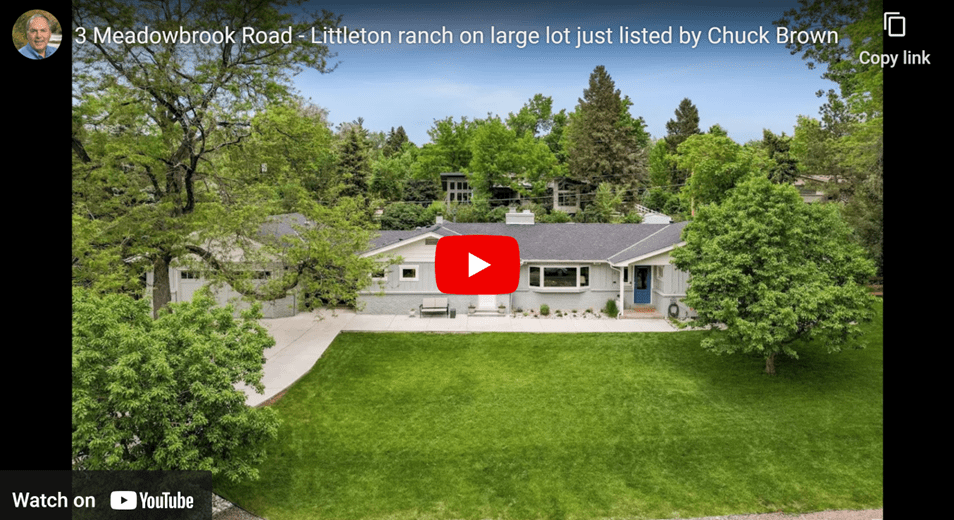
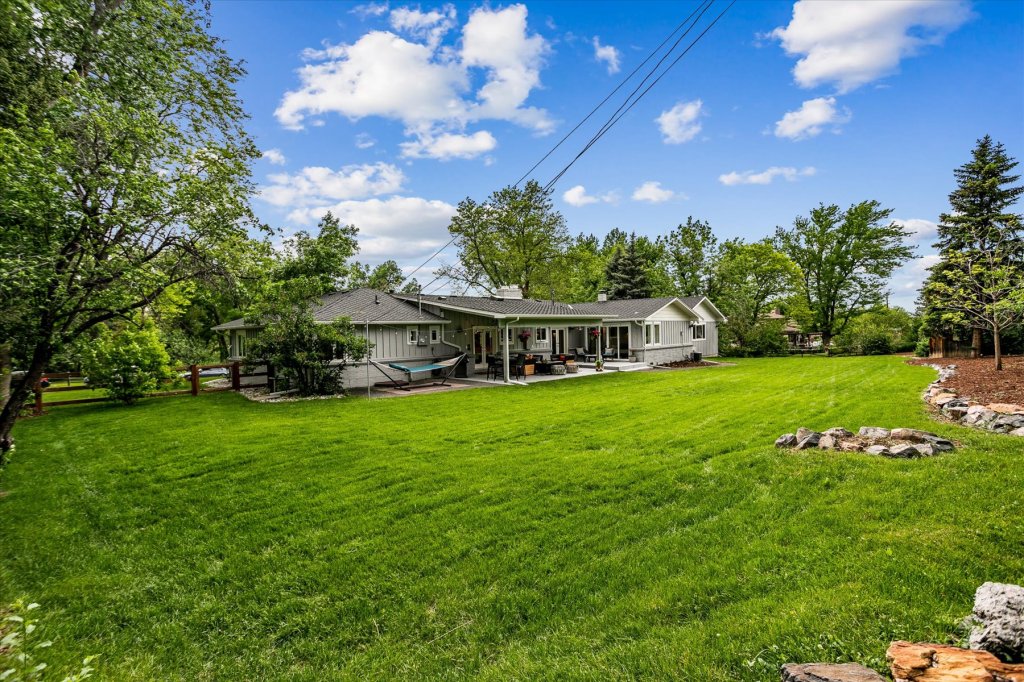
Remodeled in 2016 and again in 2020, this home at 3 Meadowbrook Road is located on a 0.61-acre lot in the quiet Ridge View neighborhood at the end of a cul-de-sac and just steps from Lee Gulch Trail with access to the High Line Canal trail. Chuck Brown just listed it for $1,589,000. This expansive light-filled home has five bedrooms and four baths, an open floor plan and a chef’s kitchen. The stainless steel 6-burner Thermador range with double oven and the Thermador refrigerator complement the dramatic 12’x4’ island, making food prep and hosting a breeze. The tranquil primary suite features an extraordinary newly remodeled bathroom which includes radiant floor heating, marble vanities and floors, custom wood cabinetry, and many other features too numerous to mention. Additional amenities include a professional grade wired and wireless internet, Sonos system throughout, and home theater. The backyard features expansive park-like grounds with a covered patio perfect for entertaining. The newly remodeled garage accommodates two cars, and has a lighted workbench, cabinets, wall storage, EV charger, epoxy flooring and ceiling-mounted storage racks. View the narrated video tour below, then visit www.LittletonHome.info, where there are lots of magazine-quality photos and a second video tour of the home technology features of this home. Then come to the open house on Saturday, June 10th, from 11am to 2pm.





Innovative Startup to Make ‘Carbon Negative’ Building Materials From Grass

One of the most common lumber products used by home builders is OSB, which stands for Oriented Strand Board. It is not to be confused with particle board, which is basically sawdust and resin. With its limited structural strength, particle board is used primarily in furniture, cabinetry and countertops, typically under Formica.
OSB is a structural replacement for plywood, and is used extensively by builders for roof, wall and floor sheathing. It is also used in manufactured floor joists and is the skin material for structural insulated panels (SIPs).
Www.Naturallywood.com explains that OSB “is made from wood strands 8 to 15 centimeters long. It uses the whole tree and makes use of crooked, knotty and deformed trees that would otherwise go unused.” Although that’s an economical use of waste timber, OSB is not as sustainable as the product invented by Plantd, an Oxford, NC, startup which won the “Most Innovative Startup” award from the National Association of Home Builders at this year’s International Builders Show (IBS) in Las Vegas.

What the company invented was an OSB substitute made from a proprietary grass that grows to 20 feet tall in a single season, drawing CO2 out of the atmosphere far quicker than trees do. The company claims that 14,000 acres of grass plantations can produce as much material as 400,000 acres of managed timber lands. These qualities make Plantd’s grass a superior crop for addressing climate change, which was the original objective of the company’s founders. “At Plantd,” says the company’s press release, “we are leading a shift to materials made from renewable grass and building the factory of the future to ensure atmospheric carbon captured in the field is locked away inside the walls and floors of new homes.” Here’s a great 10-minute video: https://youtu.be/tzuuEFemVDY
With $10 million in venture capital, the company will manufacture its “carbon negative building materials” in a former cigarette factory. Moreover, the farmers who previously grew tobacco will now be growing the grass needed by the factory, helping the local economy recover from the closing of the cigarette factory.
The company has been getting lots of national press, which you can read at www.PlantdMaterials.com.
Plantd is now constructing the first of its automated, modular, all-electric production lines at its new facility, with a target to open within the next 12 months, according to the May 3rd press release.
Here’s an excerpt from the website’s home page: “Throughout history, civilizations have advanced at the speed of material innovation. Timber, steel, and concrete enabled remarkable progress, but today they are the problem, not the solution. Continuing to build with these materials accelerates climate change and promises to impede progress by threatening our future on this planet. We see a world built from grass. A world where buildings no longer cause climate change but are central to the solution. Where they are stronger, more durable, and more affordable.”

Plantd’s founders, left to right: Josh Dorfman, CEO; Nathan Silvernail, COO; and Huade Tan, CTO. The latter two were formerly engineers at SpaceX.
The website claims that their product will be stronger, lighter, more moisture resistant, carbon negative, and will cost the same as regular OSB.
Plantd’s panels have just two ingredients: the perennial grass plus a small amount of resin (with the formaldehyde reacted out before reaches Plantd’s factory). This creates a low-VOC product with fewer chemical additives compared to other products, according to Plantd.
What Listing Agents Don’t Understand About Legal Descriptions
Every piece of real estate has both a mailing address and a legal description. The latter needs to be cited in MLS listings and on the deeds recorded with each County Clerk & Recorder.
Most listing agents copy the full legal description which they find on Realist, the property records section of the MLS. However, in the case of property located in a subdivision, that information contains way more than the legal description. Here is an example of a Golden home’s legal description as shown on Realist:
SECTION 28 TOWNSHIP 03 RANGE 70 QTR SW SUBDIVISION CD 108795 SUBDIVISION NAME CANYON POINT VILLAS FLG NO 2 BLOCK LOT 0001 SIZE: 1379 TRACT VALUE: .032
Because this property is in a subdivision which is itself recorded with the County, the true legal description is simply the name of the subdivision plus the block and lot number. In the above example, there is no block number, so the legal description is simply the following:
CANYON POINT VILLAS FLG NO 2, LOT 1. That’s all that would appear on the deed recorded by the Jefferson County Clerk & Recorder.
International Rescue Committee (IRC) Honors Judy Denison of Golden

Judy Denison, 86, was honored this Wednesday by the International Rescue Committee for her indefatigable work obtaining free furniture and housewares for virtually every refugee resettled in Colorado by the IRC since 2020.
From her arrival in Golden 35 years ago, Judy volunteered in countless ways to serve Golden and ultimately to serve refugees, reaching out to involve the rest of us in every possible way.
Her first civic involvement took the form of co-founding Save the Mesas (from being developed by Nike) and joining the fight against ramming a beltway through Golden. She created the “Golden Newsletter” to keep over 1,000 email subscribers informed of that and other campaign/issues as well as the activities of virtually every Golden organization.
Judy’s first local refugee effort was the creation of the Golden Relief Group, which helped seven families who survived Hurricane Katrina.
For the IRC, she used her 2-car garage to store furniture donations for refugees from Afghanistan and a dozen other countries. Golden Real Estate was proud to make our moving truck available for transferring those items to IRC’s warehouse until Judy’s greatest collaboration, which is with CK & Done, an estate sale company. That company donates the unsold furniture and furnishings from estate sales and delivers them to IRC’s warehouse.
The IRC was not the first organization to recognize Judy for her voluntarism and civic mindedness. In 2012 the Golden Landmarks Association honored her as a “living landmark.”
Space does not allow for a sufficient listing of Judy’s contributions to Golden and our planet, but these links for both those honors provide a lot more details:
https://www.rescue.org/announcement/spotlight-judy-denison-0
http://goldenlandmarks.com/wp-content/uploads/2018/10/2012-Judy-Denison-1.pdf
Judy’s prep school, Northfield Mt. Herman, did a podcast interview with her. Here’s the link for that:
Governor Polis Signs into Law Massive Tax Credits for EVs and Home Electrification
A package of new climate-related legislation signed this year by Governor Polis is designed to make it more attractive for Colorado households to ditch fossil fuels.
Many of the discounts are designed to be combined with other incentives, but not all the savings will be available right away.
Here’s a guide to what’s coming and when:
Electric Vehicles: Right now, Colorado has 80,000 registered plug-in hybrids and battery EVs, a long way from the state’s goal of 940,000 EVs on the road by 2030. The new incentives are intended to speed up their adoption through a $5,000 tax credit on the purchase of a battery-electric or plug-in hybrid vehicle with a suggested purchase price of less than $80,000. For cars priced under $35,000, buyers can get an additional $2,500 credit. Any Colorado resident qualifies, beginning on July 1, 2023. After Jan. 1, 2025, the base rebate decreases until it’s phased out in 2029.
E-bikes: Denver proved the power of e-bike rebates last year. The state is now hoping for similar success. The Colorado Energy Office plans to launch an e-bike rebate program for low- to moderate-income residents this summer but hasn’t detailed the size of the discounts.
The plan for all Coloradans regardless of income is clearer. Under legislation signed into law this year, the state will offer a $450 discount on e-bikes starting on April 1, 2024 and continuing through 2032. The discount will be applied at the point of sale.
Electric lawn equipment: Because gas-powered lawnmowers and other lawn equipment is a major source of ozone pollution, the state will institute a 30 percent discount on electric lawnmowers, leaf blowers, trimmers and snowblowers, applied at time of purchase, starting Jan. 1, 2024 and continuing through December 2026.
Heat pumps: Heat pumps for household space heating and water heating, powered by electricity, are seen as key to reducing pollution from natural gas. Colorado currently has a rebate worth 10 percent of the cost of installing heat pump equipment. It was scheduled to expire at the end of this year, but recent legislation extended it through 2024. The same bill also includes new incentives depending on the technology.
For air-source heat pumps, a resident is eligible for a one-time $1,500 tax credit from 2024 through 2026. After that, it drops to $1,000 until 2029, then to $500 through the end of 2032.
For ground-source heat pumps, residents are eligible for a $3,000 tax credit from 2024 until 2026. After that, it drops to $2,000 until 2029, then again to $1,000 through the end of 2032.
For heat pump water heaters, residents can apply for a $500 tax credit from 2024 until 2026. After that, it drops $250 until 2032.
You can expect vendors of such equipment to be well versed on all these discounts and rebates.
Nine Signs Your Home May Have a Water Issue
Water damage can lead to serious structural issues and health concerns if not addressed promptly. Here are nine signs that could indicate you have a water problem.
Unexpected Increases in Water Bills: If you notice a sudden spike in your water bill without a corresponding increase in usage, it could signify a hidden leak or other water-related problem in your home.
Wet Spots on Floors, Walls, or Ceilings: Look for persistent damp spots on your floors, walls, or ceilings. This could be an indication of a hidden water leak or poor drainage.
Sudden Appearance of Mold or Mildew: Excessive moisture in your home can lead to mold or mildew growth. Not only does this signify a severe water issue, but it can also negatively impact your health, causing allergies and respiratory problems. Keep in mind that mold requires a steady source of water for it to grow.
Sagging in Walls or Ceilings: Water accumulation can lead to structural damage over time. If your walls or ceilings start sagging or warping, it’s a clear sign of prolonged water exposure.
Persistent Musty Smell: A recurring, unpleasant odor in your home may indicate the presence of hidden mold or mildew, suggesting a water issue. If the musty smell persists despite cleaning, investigate further.
Cracking or Buckling in Floors: Water damage can cause wooden floors to buckle or tiles to crack. If you notice these changes and can’t attribute them to normal wear and tear, it might signal a water problem.
Stained or Discolored Areas: Unusual stains or discolorations on your home’s surfaces can indicate water damage, especially if they are yellow or brown. This could be due to roof or plumbing leaks.
Changes in Lawn or Garden: A leaking water line can lead to unusual changes in your yard. Look for patches of particularly lush vegetation or sinking areas in your yard due to the excess water.
Decreased Water Pressure: A drop in water pressure could indicate a significant leak in your home’s plumbing system.
Water issues in your home should never be ignored. If you notice any of these signs, addressing them immediately is essential to prevent further damage. Remember, the quicker you act, the better.
—Courtesy PunchListUSA.com
Build Your Dream Home Creekside in Cedaredge CO
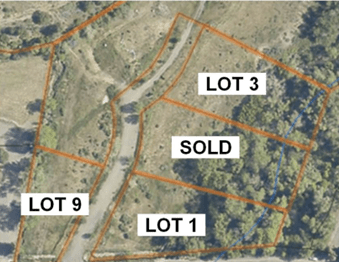
Our good friend and former broker associate Kim Taylor, who now lives in Cedaredge on the Western Slope, has listed these parcels in the Will-o-Way subdivision along Surface Creek. All four lots have infrastructure in place and range in size from 0.438 to 0.716 acres. Lots 1-3 have between 118’ and 200’ of creek frontage (but are not in a flood zone). The subdivision is within Cedaredge town limits, adjacent to a golf course and a walking path into town, and are near the scenic byway over the Grand Mesa. Envision your energy efficient home on any one of these lots. Conceptual architectural drawings are available. Lots priced individually from $80,000 to $112,000. For more info, call 303-304-6678, or visit www.WOWsubdivision.com.
New Disclosure Targets Financial Crimes and Fraud in Real Estate Transactions
We just learned about a new mandatory disclosure that affects some residential real estate transactions in the state of Colorado. It goes into effect tomorrow, May 24, 2023. The purpose of the new disclosure is to help combat the scams and fraud that are increasing in our industry.
The Federal Financial Crimes Enforcement Network (FinCEN) has issued a Geographic Targeting Order (GTO), requiring all underwriters and licensed title agents to report additional information about buyers before closing qualifying transactions.
Impacted transactions include residential transactions that are purchased with cash or financed by “hard money” loans from private investors, or if the buyer is a business entity. Only purchases over $300,000 are affected.
The rule applies to purchases within all the Denver metro counties plus Clear Creek, Elbert, El Paso, Fremont, Mesa, Pitkin, Pueblo and Summit counties.
For transactions that fall under these criteria, the buyer will need to provide specific details about the real estate transaction, the source of their purchase funds, and information about individuals with a 25% or more beneficial interest in the buying entity. This includes contact information, Social Security numbers, and copies of ID cards.
Title companies handling such transactions will reach out to agents and their buyers directly and ask for this information on a new form which will need to be returned to the title company prior to closing.
Yes, I Know It’s Confusing, But There Are Some Changes in Loan Rates

Social media has been abuzz lately with rumors about a new “tax” that is targeting high-credit score borrowers. Before you decide to stop paying your bills on time, I asked Jaxzann Riggs, owner of The Mortgage Network to explain as best she can what these changes are about.
She reminded me that we wrote about the shifts that had already begun in home loan pricing several months ago, when FHFA, the federal agency that supervises Fannie Mae (FNMA) and Freddie Mac (FHLMC), announced that changes were on the horizon.
FNMA and FHLMC are charged with providing liquidity, stability, and affordability to mortgage markets. Affordability is the key word here, especially for those borrowers within “underserved communities.” To support this priority, FNMA and FHLMC began changing Loan Level Price Adjustments, also referred to as LLPAs. These are adjustments made to the interest rates offered to borrowers based upon such criteria as credit score, loan-to-value (LTV) ratio, occupancy, property type, and debt-to-income (DTI) ratios.
In recent months, FHFA has announced many targeted changes to FNMA and FHLMC pricing. One example would be that first-time homebuyers who are at or below 100% of area median income (AMI) in most of the United States and below 120% of AMI in high-cost areas such as Denver may be offered rates that are lower than in the past. These changes signal a significant shift in lending philosophy with emphasis placed on those who may be “underserved.”
As an example, at the height of the COVID crisis, the cost of mortgages for second homes and investment properties was identical to that for primary residences. Currently the rate differential between an owner occupied home and an investment property or second home is over a full percentage point, making real estate investing much more expensive than during COVID.

The current change to LLPAs will, in some cases, reduce costs for those with lower credit scores and raise costs for those with higher credit scores, but, as shown in the graphic above from The Mortgage News Daily, the rumors are conflating the changes for the actual cost. Let’s take a minute to look at that graphic.
The chart shows the changes to the previous LLPAs. The green represents the falling costs; the red represents rising costs. As you can see, there is clearly no scenario where someone with lower credit will have a lower interest rate after adjustments are made.
While the change in LLPAs does result in a tweak of an existing fee structure in favor of those with lower credit scores, you can also see that there are instances where costs have lowered (green) for those with a high credit score. A low credit score borrower isn’t paying less than a high credit score buyer, but the gap between what they pay is simply smaller than it was previously.
According to the Federal Housing Finance Agency, while some fees are being eliminated for lower-income buyers and lower credit score buyers, and fees are being increased for some buyers with higher credit scores, the two are not cause-and effect.
“Higher-credit-score borrowers are not being penalized or charged more so that lower-credit-score borrowers can pay less,” they said in a statement. “Some updated fees are higher, and some are lower, in differing amounts. They do not represent pure decreases for high-risk borrowers or pure increases for low-risk borrowers.”
I know that these topics can be confusing, and rumors can be overwhelming to debunk. If you are shopping for a home loan, Jaxzann would be happy to provide an interest rate quote for you. You can reach her anytime on her cell phone at 303-990-2992. Tell her you saw this column..

