Real Estate Bidding Wars Are Not Abating

This is my monthly update on the real estate bidding wars. This week I chose to analyze the closings that occurred last Thursday, June 10th, to see how the bidding wars have evolved over the past four weeks. The source for this monthly analysis is REcolorado.com, the Denver MLS.

As I did in previous months, I limited my analysis to sales within a 15-mile radius of downtown Denver. I limited my search to homes, condos and townhouses that were on the MLS at least one day and not more than 6 days before going under contract. Those are the homes with bidding wars. I divided the results into homes which sold up to $500,000 and those that sold for more.

As you can see in this chart, the bidding wars only took off in earnest during February 2021, and they have kept accelerating month by month, enough that it raised the average ratio of closing price to listing price over all sales, not just the homes which sold in six days or less.

On June 10th there were 40 closings up to $500,000, compared to 44 closings on May 13th. The median home sold for 6.2% over its asking price, compared to 8.7% on May 13th. The highest ratio this time was 19.6% for a condo in Golden compared to 15.7% on May 13th for a home in southwest Denver. Only one listing sold for the asking price, and only two sold for less than listing price.

There were 37 homes that closed on June 10th for more than $500,000, compared to 56 homes on May 13th. The median home in that group sold for 7.7% over its listing price, compared to 8.1% on May 13th. Only three sold for the listing price, and none sold for less than the listing price. The highest overbid in this group was 20.9% for a one-story home in Lakewood on June 10 compared to 29.4% on May 13.

To have a statistically significant number of closings over $1 million, I analyzed the 82 such closings over a longer period — June 1-13. The median closing for those high-end homes was 6.1% over listing price, compared to 6.0% in May. Four homes sold for the listing price and 9 homes sold for less than the listing price. The highest overbid was for a 1979 ranch-style home in Jeffco’s Sixth Avenue West subdivision, which was listed at $1,080,000 and sold in 6 days for $1,575,000, 45.8% over listing price.  

I’ll repeat this analysis on July 15.

How High Are Bidding Wars Pushing Up Home Prices?

We’ve all heard some crazy examples of bidding wars in which homes have sold for way over their listing prices, so I took a snapshot of just one day’s closings, limited to a 15-mile radius of downtown Denver. That takes in an area from Broomfield to Highlands Ranch and from Golden to Aurora. It does not include the City of Boulder.

The day I chose was last Friday. The source was REcolorado.com.

I limited my search to homes, condos and townhouses that were on the MLS at least one day and no more than 6 days before going under contract. Those are the listings that experienced bidding wars. I divided the results into homes which sold up to $500,000 and those that sold for more than that.

On April 16th there were 48 closings up to $500,000. The median home sold for 4.7% over its asking price. It was a tri-level home in Aurora listed at $420,000 which sold in 3 days for $440,000. Only 3 homes sold for the listing price and 2 sold for less. The highest ratio was 25.8% for a home in Aurora that sold in 1 day.

There were 68 homes that closed on April 16th for more than $500,000. The median home in that group sold for 8.3% over its listing price.  It was a 1950 ranch in Denver’s North Hilltop neighborhood listed for $600,000 that sold in 3 days for $650,000. The highest overbid in this group was 18.8% for a 2-story home in Westminster listed for $425,000 that sold in 5 days for $505,000. Only 5 sold for the listing price and 4 sold for less.

To get a statistically meaningful number of closings over $1 million, I looked at 68 such closings from April 1-16. The median ratio was 4.3% over listing price. The highest was for a 1954 bungalow in Denver which was listed at $965,000 and sold for $1,205,000, 24.9% over listing.

Note: These statistics reflect the bidding wars that were taking place during late March, when most of these listings went under contract. Today’s bidding wars appear to be even more intense. Stay tuned!

Report Names 7 Cities Most at Risk of a Housing Crash. Denver Isn’t One of Them

With the crazy seller’s market we’re experiencing now, it’s common for people to ask whether we’re in a “bubble” which could burst at any time.

Well, last Wednesday UBS Group released its annual Real Estate Bubble Index, and while it listed three U.S. cities (San Francisco, Los Angeles and New York) as “overvalued,” none of the seven cities listed as “bubble risks” were in the U.S.

Those seven cities with the highest “bubble risk” included Toronto (#3) and Hong Kong (#4), but the rest were all in Europe — Munich (#1), Frankfurt (#2), Paris (#5), Amsterdam (#6), and Zurich (#7).

Boston squeaked into the “Fair Valued” category, and Chicago narrowly made it into the “Undervalued” category.

I was surprised at this analysis until I read the UBS report myself instead of just the coverage of it on a real estate news service to which I subscribe.

The answer as to why more American cities weren’t on the list turns out to be very simple — UBS Group only studies “25 major cities around the world,” and the U.S. cities I mentioned above are the only U.S. cities analyzed each year in the report!  Twelve of the 25 cities studied for this report are in Europe, with the rest divided between North America, the Middle East and Asia/Australia.  It should be noted that the UBS Group office which creates the report is based in Switzerland, so it’s rather Euro-centric.

Click here to view the full UBS Group Global Real Estate Bubble Index.

Despite the limited number of U.S. cities included in the UBS report, there are some useful observations about our market, such as this one:

“Overall, the drop of mortgage rates to historically low levels supports house prices in the U.S. But price changes in the analyzed cities trail the nationwide average. Inner-city demand growth has slowed down as citizens move out to the suburbs as a result of affordability issues and the impacts of COVID-19. Continued migration to lower-cost and more tax-, business-, and regulatory-friendly states has accelerated this trend.”

Claudio Saputelli, Head of Real Estate at UBS Global Wealth Management’s Chief Investment Office, added the following: “The rise of the home office calls into question the need to live close to city centers. Pressure on household incomes cause many people to move to more affordable suburban areas. Moreover, already debt-ridden or economically weaker cities will have to respond to this economic crisis with tax increases or public spending cuts, neither of which bode well for property prices. Taken together, these factors amplify some longer-term uncertainties surrounding urban housing demand.”

Doing my own statistical analysis on REcolorado, Denver’s MLS, I see the trend described above.  While the number of active (i.e., not yet sold) listings and days on market are at nearly   all-time lows in Jefferson County, they are near all-time highs in the Lodo/Downtown Denver market. This is not a good time to sell a condo in any city center (except small cities like Golden), but it is certainly a good time to sell a single-family home (or a condo) in Jefferson County, as I have reported in previous columns.

The last time Realtor Magazine even dealt with the question of a real estate bubble was in November 2018.  The consensus of real estate economists is that our country is not in a real estate bubble, but it’s hard not to worry about it as one looks at the recently increased rate of appreciation in home prices.

With no end in sight to the low mortgage interest rates and with the rich getting richer under the Trump tax cuts, it’s understandable that the real estate market is performing as it is, but such appreciation cannot be sustained long-term.

Only time will tell, and our crystal balls will at least clear up a little after the current election season ends. A Biden victory is sure to bring rollbacks of the Trump tax cuts which benefited the rich (defined as those having taxable incomes over $400,000 per year) and the super rich, which will reduce some of the upward pressure on home prices, but those rollbacks are critical to address the widening wealth gap in America and the exploding national deficit — something that used to be an important issue among Republicans!

Experts Are Predicting a Surge in Foreclosures, But I See the Situation Differently

With the continued high unemployment rate and the expiration of Pandemic Unemployment Assistance (PUA), many homeowners are hurting, so it makes sense that we may have a foreclosure crisis in our future.

CoreLogic reported recently that back in June (when the Feds were still sending $600/week in PUA to Americans) the share of mortgages with payments 90 to 119 days late had already risen to 2.3%, “the highest level in 21 years.” A rate that high could result in a foreclosure crisis, the report said. Not only could millions of families potentially lose their home, but that would also create downward pressure on home prices.

But I see the situation differently, and after consulting with Jaxzann Riggs of The Mortgage Network, here’s why I don’t expect that flood of foreclosures.

First of all, foreclosure should only happen when a seller owes more on their home than it is worth. That’s because sellers lose all their accumulated equity in a foreclosure, and most people have accumulated a lot of equity thanks for the sellers’ market we have been experiencing.

Secondly, federally mandated forbearance is in effect, which is unlike the forbearance which delinquent borrowers may have enjoyed in the past. Under the current plan, lenders add extra payments at the end of the loan instead of requiring any kind of catch-up payments. This mandate could be extended, too.

The only people likely to face foreclosure will be those who recently took out 100% VA loans or 96.5% FHA loans or conventional loans with only 3% down payment, and for whom there is hardly any equity to lose in a foreclosure action.

Being on forbearance doesn’t affect one’s credit rating even though you are not making payments (again, part of the federal mandate), but once you resume payments, you need to make a minimum of three on-time payments to qualify for a Fannie Mae or Freddie Mac loan, which will restrict your ability to sell your home and purchase a replacement home. Some lenders require six months post-forbearance loan payments.

That, too, will slow down any surge in what are known as “distressed listings.”

Despite Global Pandemic, Our Real Estate Market Was the Hottest Ever for August

Much to the consternation of observers, the real estate market in metro Denver was hotter this August than it was in any previous August, according to the Market Trends Committee of the Denver Metro Association of Realtors (DMAR). At this rate, 2020’s statistics at year end will likely exceed 2019’s statistics.

The report covers an expanded metro area, including 11 counties instead of the 7 urban and suburban counties that you and I think of as “metro Denver.” The non-urban counties included in the report are Clear Creek, Gilpin, Elbert and Park.

Detached single-family homes sold like crazy in August—up over 6% from August 2019, despite 50% fewer active listings at month’s end. The average sold price was up 13.8% from last year, and average days on market was down 23%.

Attached homes sold on a par with last year, although their inventory was also down — 19% fewer listings at month’s end. They did sell quicker, though, with days on market down by over 27%.

Unlike DMAR, I like to define the metro Denver market as within a 25-mile radius of the state capitol, as shown here, instead of by county. Using that method, the number of detached homes sold this August was up 13.7% from August 2019, and the sold price per finished square foot (my preferred metric) was up 7.0%. Average days on market dropped by 31%, but median days on market plunged 57% from 14 days in August 2019 to 6 days this year.

Even more interesting to me is that median days on market was in double digits until March 2020 — the first month of Covid-19 lockdown — when it dropped by 40% to 6 days, and remained in the 5- to 7-day range through August. It could be said that “Stay at Home” and “Safer at Home” really meant “Buy a Home” in the real estate business!

Average sold price within that  25-mile radius rose by 13.4% to $597,290, while median sold price rose by 11.6% to $505,000. The gap between average and median is attributable to a large number of million and multi-million dollar closings. I wish others would stop focusing on average stats for that reason.

The number of active listings (what we call “inventory”) plummeted from 6,483 in August 2019 to 3,444 in August 2020, a 47% decline.

Another measure of market strength is how many listings expire without selling. That number was 777 in August 2019, but it fell by 37% to 493 this year.

The average ratio of sold price to listing price was 100% both last August and this August — suggesting that roughly half the listings sold above full price. With half the homes selling in 6 days or less, it’s to be expected that there were multiple offers and possibly a bidding war on many listings.

This week my downtown Golden fixer-upper closed at $665,000, which was $40,000 over listing price. My Lakewood listing from last week is already under contract at $55,000 over full price. Clearly, the seller’s market is still hot despite the pandemic.

If you have considered selling your home, there couldn’t be a better time than now to put your home on the market. And you couldn’t do better than call one of us listed below to talk about it. Your home would, of course, be featured in my weekly Denver Post column and on this blog.

If you let us represent you in the purchase of your replacement home, the listing commission could be as low as 3.6% and qualify you for totally free moving!

Jim Smith— 303-525-1851

Jim Swanson — 303-929-2727

Carrie Lovingier — 303-907-1278

Chuck Brown — 303-885-7855

David Dlugasch — 303-908-4835

Carol Milan — 720-982-4941

Realtor.com Weighs in on the Real Estate Market’s Surprising Rebound

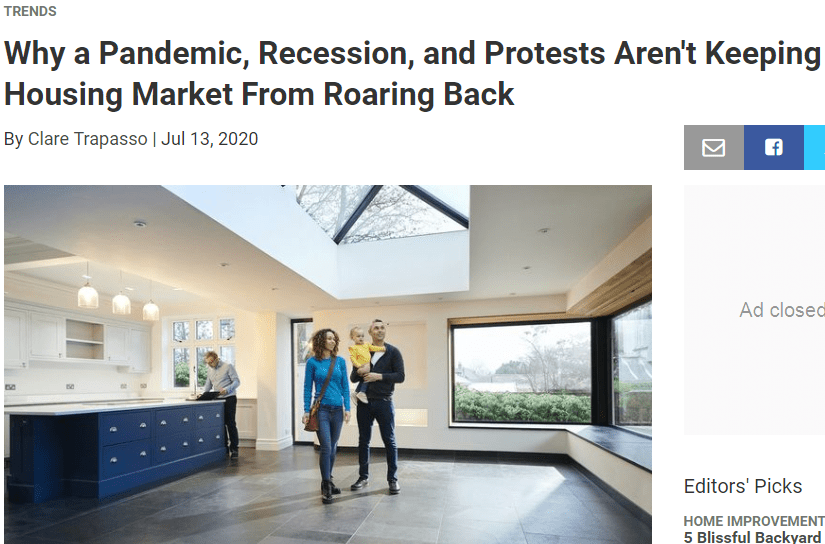
The fact that we’re still in a seller’s market puzzles many real estate professionals, but there are reasonable explanations, which Realtor.com did a good job of describing in a July 13th article by Clare Trapasso.

The headwinds in this market are strong and numerous. We have a lingering and maybe worsening pandemic, staggering unemployment numbers, and a contentious presidential campaign, made even more contentious because of our national reckoning about systemic racism. How does one account for such a strong real estate market, and when will that market soften?

First let’s look at our local numbers. In my July 9th column, I showed statistically how the market had surged in June.  As I write this on Monday evening, there are 4,903 active listings within 20 miles of the State Capitol, but there are 7,720 listings under contract, 3,905 of which (or 50.6%) went under contract in 7 days or less.  A total of 5,219 listings closed in the last 30 days, 2,679 of which (or 51.3%) went under contract in 7 days or less and 1,895 of which (or 36.3%) sold for above full price, likely with competing offers.

So, yes, we are still in a seller’s market — but how can that be, given all that’s going on?

To quote the realtor.com article, “The housing market is back — and then some.”

Nationally, according to realtor.com, median home prices rose 6.2% year-over-year for the week ending June 27th.  According to REcolorado, the median sold price for listings within 20 miles of the State Capitol that same week was $440,000, with 49.9% of them selling in 7 days or less, compared to $418,000 for the same 7-day period a year ago, when 44.5% sold in 7 days or less. That’s a 5% increase in median price year-over-year.

To quote the realtor.com article, “Homes are selling faster than they did in 2019, when no one had heard of Covid-19. And bidding wars are back as first-time and trade-up buyers who have lost out on other homes slug it out.”

The contrast between this market and the market during the “Great Recession” of 2008 couldn’t be sharper. Back then, there was a glut of housing and few buyers. Today, the situation is reversed, with fewer listings and a glut of buyers. Because the 2008 crisis was caused by the subprime mortgage scandal, the glut of housing was made worse by a flood of foreclosures.

Quoting further from the realtor.com article, “To be sure, there are plenty of danger signs ahead in this economy, including continuing historic levels of unemployment and rising coronavirus infection rates in many parts of the country. But, for now, real estate is bouncing back much quicker than other bellwether industries. The reason: After months on hold, Americans are beginning to feel more confident about the idea of buying or selling a home.”

The article quoted a Fannie Mae survey of 1,000 participants, showing that 61% said it was a good time to buy and 41% said it was a good time to sell. And that survey was taken before mortgage rates dropped to under 3%, which happened just last week.  As a result, we can expect the real estate market to be even more supercharged in the coming weeks. Already, mortgage applications for home purchases had risen 33.2% year over year in the week ending July 3rd, according to the Mortgage Bankers Association.

Lower interest rates mean lower mortgage payments by hundreds of dollars, which instantly increases the affordability of homes, and buyers understandably believe they are smart to buy now before the rates rise again, as they surely will.

The low interest rates also make the decision to buy more compelling for renters burdened by the still high cost of renting in the Denver market.  This is particularly compelling for white-collar workers who were not furloughed or laid off during the pandemic and may have money in the bank for a down payment.

Another factor which I mentioned in my earlier column is the number of workers who started telecommuting because of the pandemic and whose employers said they could keep telecommuting even after it’s safe to return to the office. These people are in a buying mood as they look to move further from the congestion of downtown apartments or condos where going outside involves a greater risk of Covid-19 infection.  They also saved a lot of money (as Rita and I did) by eating more home cooked meals because restaurants were closed. And Netflix costs a lot less than going out to the movies or the theatre, to say nothing about the savings on popcorn made at home or purchased at the supermarket!

Yet another factor is the increase in divorces and separations resulting from forced home confinement. I was amused to note the increase in TV commercials by divorce attorneys during April and May.

What Will Be the Short- and Long-Term Effects of Covid-19 on Real Estate?

As I write this column on Tuesday, April 28th, the infection rate of Covid-19 seems to be leveling off, and the rule against in-person showings has been relaxed, although open houses are still banned.

The inability during much of April to show listings not only made it harder to sell homes, it also resulted in a reduction of roughly 50% in the number of homes being listed. Despite that, homes that were listed continued to go under contract quickly, thanks in part to good pictures and virtual tours.

It may be that the smart thing to do in April was to list your home. It was a matter of supply and demand — many fewer listings meant less competition for the homes that were listed, while buyers were apparently still willing to “pull the trigger.”  The key was to have good pictures and a narrated video tour because of the limit on showings.

I predict that there will be a bigger than usual surge of new listings in May and June, now that the no-showings rule has been relaxed. Although Denver and five other metro counties have extended their stay-at-home orders through May 8th, it was the Division of Real Estate and the state Attorney General’s office that were setting the rules about showings and open houses, and they don’t enforce local ordinances, so it’s expected that in-person showings will be happening throughout the metro area starting this week. Don’t, however. expect real estate offices to be open for walk-ins during this period.

So, what about the market going forward? The fact that mortgage rates are staying low, heading inexorably in the direction of 3% for a 30-year fixed loan, means that buyers are going to be supercharged as they go house hunting under fewer restrictions. There is pent-up demand, and there is also pent-up supply.

Nevertheless, we can’t ignore the near-depression economic conditions we face nationally in May. There will be many buyers not going back to work and unable to qualify for a home loan. However, the estimated 70% of Americans who were able to keep working from home or who had “essential” jobs, such as construction and health care, have been making good money — many earning overtime and/or hazard pay — and may want to reward themselves with a new home once things calm down.

So, while we real estate professionals have remained fairly busy during April,  I expect we’ll be even busier in May and throughout  the summer — especially as rules are relaxed. There will, however, be some subtle and not-so-subtle changes to the way we practice.

Most real estate agents were already accustomed to working from home, only going to their offices for floor duty, to handle paperwork, or to meet with buyers and sellers. Contract software has been online for a decade or more. We are used to emailing documents and having clients sign contracts electronically instead of on paper, which has served us well during the stay-at-home period. That will continue unchanged.

Showing appointments for nearly all MLS listings are handled by one company, ShowingTime, and increasingly the showings are being set online instead of speaking with an operator.

Where we will see the most changes will be with those activities that still require personal contact. Fist bumps and elbow bumps will probably replace handshakes long-term. We’re becoming hardwired as germophobes, I suspect.

Offices will be much cleaner. We’ll disinfect hard surfaces and wash hands more often. We’ll go back to having open houses eventually, but there may be fewer lookie-loos.

It will be a while before buyers want to ride in our cars, preferring to follow us to showings in their own cars.  I will continue to carry disposable gloves and Clorox wipes in my car, to use when showing homes.

More agents will learn to do their own narrated video walk-throughs of their listings, as Golden Real Estate agents have been doing for 13 years. And more buyers will look for those video tours and be more selective about the homes they choose to see.

In conclusion, real estate has shown great resilience during the pandemic thanks to how online the industry has already become, and I believe it will emerge from the current situation stronger than ever.

Why Real Estate Won’t Crash Like It Did Before

Many buyers and sellers of real estate are wondering whether we’ll see the kind of crash in real estate values that we saw in the Great Recession of 2008 onward. Experts agree that we will not.

In an April 22nd post, realtor.com explained that circumstances this time are quite different from then. Reasons cited by realtor.com’s economist, Danielle Hale, include the following:

First, the 2008 crash was created by a rash of bad mortgages — a situation that was remedied because of that crash. Second, there was an oversupply of houses for sale, whereas today there is an undersupply.

According to the realtor.com post, “There are simply too many would-be buyers out there: millennials eager to put down roots and start families, folks who lost their homes during the last recession and want to buy another property, and boomers looking to downsize.”

Lawrence Yun, chief economist at the National Association of Realtors, predicts that home sales will pick up again quickly and that prices will not fall.  He sees the luxury market taking the biggest hit, largely because the buyers of those homes may have lots of financial liquidity, but it is in stocks which they don’t want to sell while prices are low.

Also, widespread mortgage forbearance will prevent the surge in foreclosures we saw before.

Homes Are Still Selling

Each week I have been checking the MLS to see how many homes are being listed and how many are going under contract as the Covid-19 stay-at-home order remains in place.

For the weeks of March 22nd and March 29th, the market showed surprising resilience, with statistics comparable to prior years.  Now let’s look at the statistics for last week.

During the 7-day period from Sunday April 5th to Saturday April 11th, a total of 819 homes were entered on Denver’s MLS, REcolorado, within 25 miles of downtown Denver. Of those, 22 had already been sold privately, so there were only 797 new active listings. Of those, 133 were already under contract by Saturday.  A total of 25 were immediately withdrawn or expired, many of them likely because of the no-showings rule, which was issued that Monday.

This is a huge drop from the same 7-day period in 2019, when there were 1,631 new active listings, 227 of which had gone under contract by the end of the same 7-day period. 

In 2018, the numbers were similar, with 1,588 new active listings, 579 of which went under contract within the same 7-day period.

In 2017, the numbers were also similar, with 1,633 new active listings, 663 of which were under contract by the end of the same 7-day period. 

The numbers were equally impressive in 2016.

Bottom line? We are finally seeing about a 50% decline in new listings, but many of them are still selling quickly. Sellers who do list their homes may benefit from the lack of competition.

The Rule Against Showings and Open Houses Shouldn’t Hamper Home-Buying…

…that is, if the listing agent does what Golden Real Estate has done for over 13 years — create a narrated walk-through video of each listing.

Our narrated video tours are just like a showing. They are live action videos which start in front of the house (just like a real showing) and then go through the house and into the back yard, pointing out features as we go. 

Check out the video tours for any of our current listings at www.GRElistings.com to see what I mean. They really are like an in-person showing with the listing agent. For example, the video camera points down to the floor and up to the ceiling as I describe the hardwood floor or the sun tunnels which bring natural light into the home’s interior.

But, you say, you’re not going to buy a home that you can’t see in person.  Right? You don’t have to, because the rules allow for inspection once the buyer has signed a purchase contract. Your visit (presumably with an agent)  the very next day constitutes an inspection. That can be before you even have to deliver your earnest money check, since you may not even be under contract yet. The guidance from the Division of Real Estate says, “home inspections and final walkthroughs after a buyer has signed a purchase contract (emphasis added)… is also considered to be an essential part of the real estate transaction.” The buyer is not under contract simply by signing a contract that has not also been signed or countered by the seller.

That “guidance” from the Division of Real Estate was issued on April 9th and has not been updated as of April 18th, which is when I am updating this blog post.

Scott Peterson’s April 15, 2020 “Legal Bite”

However, Scott Peterson, general counsel for the Colorado Association of Realtors, maintains in a video recorded from quarantine on April 15th that the governor’s executive order prohibits any “marketing” that involves entry into a property – no photos, no video, nothing at all – without a contract in place. If that’s true, however, why isn’t it reflected in the April 9th guidance and why hasn’t that guidance been updated?

I tried Googling the governor’s executive orders and looked at his web page on www.colorado.gov/governor and saw only two executive orders on other matters and no link for all his executive orders. So, for now, I lack evidence of Scott Peterson’s claim and am relying on the April 9th guidance, which I keep checking for updates.

Therefore, a visit to the home by a buyer immediately after signing an offer to purchase the home does, in my opinion as a broker, comply with guidance currently in effect from the Division of Real Estate. Then, if the buyer is able to get under contract with the seller, he or she can schedule a second inspection by a professional inspector.

So, here’s a possible scenario: You look at the video tour of the patio home or the ranch-style luxury which you found at www.GRElistings.com. I guarantee you’ll have a pretty good sense of the home from viewing that video. You’ll experience the flow from kitchen to dining room, to family room, to back yard, etc., because you are being walked through the home. It is not a slideshow of different rooms, giving no indication of flow from one room to the next.

Let’s say you call me or your agent to submit a contract and let’s say that it is accepted by the seller. You’re under contract!  The typical contract has a 7- to 10-day inspection period. You schedule your personal inspection with your agent (or me, if you don’t have one) the next day, before delivering your earnest money check, which is typically due in 3 days.  You can terminate immediately if you have buyer’s remorse, and go back to looking at other houses.

If you don’t terminate, you still have a week to hire a professional inspector and submit a detailed inspection objection.

What if you’re a buyer, and there’s no such video for a house that interests you, but you don’t want to sign a purchase contract? I believe you’ve got three choices here.  One, your agent (me, for example) could ask the listing agent to create and provide a narrated walk-through video. Second, I could preview the home for you since the guidance make no mention of banning previews, and shoot my own rough-cut video tour of the home, post it as an “unlisted” video on YouTube and send you the link. Or, third and perhaps best, we could use Facetime, Zoom, or another app to have you see what I’m seeing as I walk you through the house. (NOTE: Scott Peterson believes that previews and videos shot by anyone other than the seller are not allowed. I just don’t have any documentation supporting that position.)

Therefore, while it may be inconvenient not to have an in-person showing of a listed home, there are work-arounds that can make it possible to get under contract and confirm your interest in the property before you are fully committed to it or put down any earnest money.

Finally, I’d like to note that many listings are empty and vacant.  I see no reason why in-person showings of those listings should not be allowed. I know that builders are letting buyers view their empty homes. Again, Scott Peterson maintains that empty homes cannot be visited either. Show us the actual orders from the Governor or guidance from the Division of Real Estate, Scott!