We just learned about a new mandatory disclosure that affects some residential real estate transactions in the state of Colorado. It goes into effect tomorrow, May 24, 2023. The purpose of the new disclosure is to help combat the scams and fraud that are increasing in our industry.
The Federal Financial Crimes Enforcement Network (FinCEN) has issued a Geographic Targeting Order (GTO), requiring all underwriters and licensed title agents to report additional information about buyers before closing qualifying transactions.
Impacted transactions include residential transactions that are purchased with cash or financed by “hard money” loans from private investors, or if the buyer is a business entity. Only purchases over $300,000 are affected.
The rule applies to purchases within all the Denver metro counties plus Clear Creek, Elbert, El Paso, Fremont, Mesa, Pitkin, Pueblo and Summit counties.
For transactions that fall under these criteria, the buyer will need to provide specific details about the real estate transaction, the source of their purchase funds, and information about individuals with a 25% or more beneficial interest in the buying entity. This includes contact information, Social Security numbers, and copies of ID cards.
Title companies handling such transactions will reach out to agents and their buyers directly and ask for this information on a new form which will need to be returned to the title company prior to closing.
Social media has been abuzz lately with rumors about a new “tax” that is targeting high-credit score borrowers. Before you decide to stop paying your bills on time, I asked Jaxzann Riggs, owner of The Mortgage Network to explain as best she can what these changes are about.
She reminded me that we wrote about the shifts that had already begun in home loan pricing several months ago, when FHFA, the federal agency that supervises Fannie Mae (FNMA) and Freddie Mac (FHLMC), announced that changes were on the horizon.
FNMA and FHLMC are charged with providing liquidity, stability, and affordabilityto mortgage markets. Affordability is the key word here, especially for those borrowers within “underserved communities.” To support this priority, FNMA and FHLMC began changing Loan Level Price Adjustments, also referred to as LLPAs. These are adjustments made to the interest rates offered to borrowers based upon such criteria as credit score, loan-to-value (LTV) ratio, occupancy, property type, and debt-to-income (DTI) ratios.
In recent months, FHFA has announced many targeted changes to FNMA and FHLMC pricing. One example would be that first-time homebuyers who are at or below 100% of area median income (AMI) in most of the United States and below 120% of AMI in high-cost areas such as Denver may be offered rates that are lower than in the past. These changes signal a significant shift in lending philosophy with emphasis placed on those who may be “underserved.”
As an example, at the height of the COVID crisis, the cost of mortgages for second homes and investment properties was identical to that for primary residences. Currently the rate differential between an owner occupied home and an investment property or second home is over a full percentage point, making real estate investing much more expensive than during COVID.
The current change to LLPAs will, in some cases, reduce costs for those with lower credit scores and raise costs for those with higher credit scores, but, as shown in the graphic above from The Mortgage News Daily, the rumors are conflating thechangesfor the actual cost. Let’s take a minute to look at that graphic.
The chart shows the changes to the previous LLPAs. The green represents the falling costs; the red represents rising costs. As you can see, there is clearlyno scenario where someone with lower credit will have a lower interest rate after adjustments are made.
While the change in LLPAs does result in a tweak of an existing fee structure in favor of those with lower credit scores, you can also see that there are instances where costs have lowered (green) for those with a high credit score. A low credit score borrower isn’t paying less than a high credit score buyer, but the gap between what they pay is simply smaller than it was previously.
According to the Federal Housing Finance Agency, while some fees are being eliminated for lower-income buyers and lower credit score buyers, and fees are being increased for some buyers with higher credit scores, the two are not cause-and effect.
“Higher-credit-score borrowers are not being penalized or charged more so that lower-credit-score borrowers can pay less,” they said in a statement. “Some updated fees are higher, and some are lower, in differing amounts. They do not represent pure decreases for high-risk borrowers or pure increases for low-risk borrowers.”
I know that these topics can be confusing, and rumors can be overwhelming to debunk. If you are shopping for a home loan, Jaxzann would be happy to provide an interest rate quote for you. You can reach her anytime on her cell phone at 303-990-2992. Tell her you saw this column..
As regular readers know, I’ve written several columns on technological developments in home construction and especially in the field of manufactured and modular home construction.
This week I was made aware of Liv-Connected, a 2018 startup which really got going during the pandemic when one of their partners, who was in the live event business building compact and readily deployed stage sets found himself with no work and turned his attention to compact and readily deployable modular housing.
At first, the company worked to improve upon the typical FEMA trailer being deployed to disaster areas, but then to the housing industry itself, beset as it was with labor shortages, supply-chain problems, and a soaring demand for second or remote homes.
Manufacturing home components in a warehouse has inherent efficiencies, but the cost of delivery of the finished home and/or its components to the build site needs to be factored in. For homes to be installed on a foundation, transportation costs for most manufacturers are inflated by the need to use wide-load trucks and pilot cars and to pay the associated permit fees. Liv-Connected’s concept eliminates that need by breaking down the segments of the house and roof into components (see diagram below) that can be delivered on one standard semi trailer (also below) and linked together in one day at the build site.
The bathroom and kitchen modules are fully equipped at the factory with fixtures and appliances and can be mixed and matched to create the desired end result. Also, the modular design allows the addition of more bedrooms at a later date, as illustrated on the company’s website, www.liv-connected.com.
Part of Liv-Connected’s business is building tiny homes or Accessory Dwelling Units (ADUs) under the brand Via, for which delivery costs are less because the homes are on a trailer chassis. The buyer could take delivery of them at the company’s Pennsylvania factory. Here’s a screenshot from their website:
Click here to read the June 2022 article on Forbes.com about the modular home industry, comparing and contrasting Liv-Connect’s business strategy with that of other off-site housing manufacturers. Here’s a link for an informative 9-minute video by Kerry Tarnow, an independent YouTuber.
Off-site construction has multiple advantages, including all-weather and year-round construction, much reduced waste, and much improved insulation. There’s also less loss due to vandalism or theft from the build site.
On-site work is limited to building the foundation with its entry points for water, sewer and other utilities, pre-matched to the underside of the Liv-Connect modules. Those connections, when done right, consume only about four hours of the one-day installation process. The driver of the truck is a Liv-Connect employee who is part of the installation crew.
The prices for Via homes start under $100,000. The prices for the modular homes, under the brand Connexus, start at $150,000.
The brokers at Golden Real Estate are ready to provide you with the qualified sales that you can use in your appeal, including their time adjusted sale prices. Call 303-302-3636 and enter the 3-digit code for the broker you want to help you. Or email your request to jim@goldenrealestate.com.
I’m so offended by the texts and emails I receive which are clearly from scammers. I don’t want you to be a victim, so let me describe some of them.
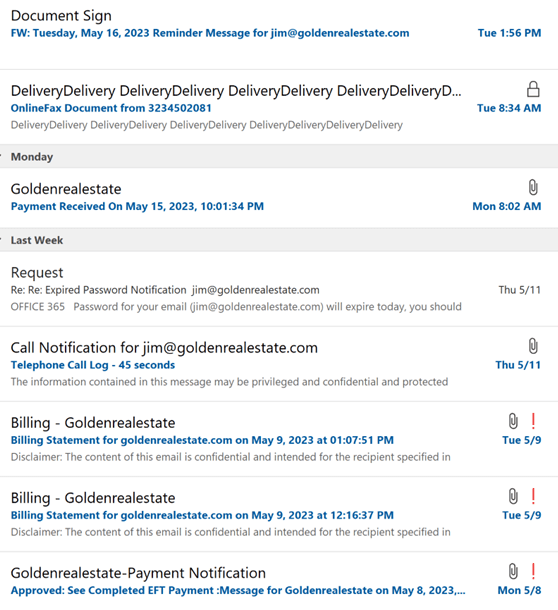
At least once or twice a day I get an email labeled “payment notification,” “deposit notification,” “ACH transfer completed,” or something similar with no message, only an attachment. But the attachment is not a PDF or document, it’s a file with the suffix “.htm” or “.html,” signifying that it’s a website. I could be pretty sure that by clicking on that link I would have my computer or iPhone infected with some kind of coding which would open me up to identity theft or worse. Don’t click on any link that’s a website! Another frequent email scam pretends to be from Microsoft stating that my password is about to expire. If I click on the link it will, of course, ask for my password! Here’s a screenshot from my Scam folder where I have been archiving the scam emails I receive:
Text messages are an increasing source of dubious and unsavory contacts. Many of them simply try to start a conversation with a greeting (a particularly clever such text message is shown at right), but the phone number is from a strange area code. Delete those! If it’s a real person, they will call you if you’ve ignored the text.
HomeVestors of America is a franchisor of its “ugly homes” concept and now has over 1,100 franchisees, including here in the Denver area. The chief benefit of being a franchisee is the company’s national advertising which you have surely seen on billboards and in other media.
HomeVestors also trains its franchisees on lead generation, which was the subject of a May 11th article by ProPublica, co-published with the Dallas Morning News and Shelterforce.
To quote from the article, “HomeVestors, the self-proclaimed “largest homebuyer in the United States,” goes to great lengths to distinguish itself from the hedge funds and YouTube gurus that have taken over large swaths of the real estate investment market. The company says it helps homeowners out of jams — ugly houses and ugly situations — improving lives and communities by taking on properties no one else would buy. Part of that mission is a promise not to take advantage of anyone who doesn’t understand the true value of their home, even as franchisees pursue rock-bottom prices.”
Pro-Publica’s investigation, which included “interviews with 48 former franchisees and dozens of homeowners who have sold to its franchises” found that franchise owners “used deception and targeted the elderly, infirm and those so close to poverty that they feared homelessness” if they sold.
One former franchise owner said they were trained to lie.
We in the real estate industry are familiar with various tried-and-true prospects for listing a home, including couples that have recently divorced, or where an elderly husband or wife has just died, but HomeVestors apparently “goes the extra mile” in that regard.
A former employee of an ad agency hired by HomeVestors is cited as saying that the ad agency’s owner bragged about being able to target homeowners who had recently broken a hip, saying that the injury “is effectively a 60-day countdown to death — and, possibly, a deal.”
Click here for the full ProPublica article. And here are some follow-up articles:
Help ProPublica Investigate “We Buy Houses” Practices If you’ve had experience with a company or buyer promising fast cash for homes, our reporting team wants to hear about it. By Byard Duncan, Anjeanette Damon and Sarah Smith
The article acknowledges that there are many legitimate fees — including title insurance, which is absolutely necessary to protect both the buyer and seller of a home. In Colorado, unlike some states, it’s common for title insurance (the second largest expense after agent commissions) to be deducted from the seller’s proceeds rather than added to the buyer’s costs.
Other necessary expenses paid at closing and notlevied by the buyer’s or seller’s brokerage include, for the seller, the fee to record the release of lien for any paid-off mortgage, HOA transfer fees, escrow for the final water bill, half the settlement fee to the title company (typically $300-400), and property taxes for the current year pro-rated to the date of closing.
For the buyer, fees are levied for the buyer’s half of the settlement fee mentioned above, and for recording documents with the county clerk. If the buyer financed the purchase with a loan, there are fees levied by the lender, such as processing & document preparation fees, origination fee (“points”), pre-paid interest from the date of closing through the end of that month, and appraisal (if not paid earlier). In addition, the buyer will be debited at closing for their homeowner’s insurance policy plus 3 months’ escrow of same, and 3 months’ escrow of property taxes.
All of the above are not junk fees, but necessary fees to close on the sale or purchase of a home. It should be noted that the contract to buy and sell could include provisions moving some of these fees to one side or the other of the transaction. For example, the buyer might offer, in order to win a bidding war, to pay the HOA transfer fees, the full settlement fee, and/or the cost of title insurance. Once I saw a buyer offer to pay the property taxes for the full first year of ownership instead of the seller crediting the buyer with his/her pro-rated share.
So, if all those are necessary fees, what are those “junk fees” complained about in the BusinessLeader.com article? It’s a single fee which some agents began charging their clients years ago. It’s shown on the settlement statement as an “administrative fee.”
Basically, it’s a transaction fee which larger brokerages in particular began charging their agents to bolster their profits. It could be a flat fee like $300 or it could be a small percentage of the sale price. This fee is deducted from the agent’s share of the commission, but agents are allowed to pass that fee on to their clients, which many have chosen to do. That’s what the article was complaining about, not multiple “junk fees.”
Of course, buyers and sellers, upon signing a listing or buyer agency agreement with their agents, could negotiate not to pay this fee, just as they could negotiate a lower listing commission. But, as you can imagine, this fee slips through without most clients noticing or objecting to it. Myself, I never propose charging my clients for this fee. Call my broker associates or me if you don’t want to pay any junk fees for buying or selling a home. You can reach any of them on their cell phones by calling 303-302-3636.
The single-family home that David Dlugasch listed this week, a half-duplex, will not be found by buyers searching the MLS for single-family homes, thanks to a big change made in January 2020, when our MLS began conforming to a standardized set of property descriptors which all MLSs were expected to adopt.
Under the new system, a duplex must be listed under the “Multi-Family” Sub-Property type, with “Duplex” under Property Structure. This replaced the earlier system, which had “Single-Family Attached” as well as “Single-Family Detached” as property types.
You can search by address and find the listing, but most people searching for homes are unlikely to include “multi-family” in their search criteria, even though they would lovethis single-family homeif they saw it.
The Department of Energy (DOE) has announced 6 finalists in its Equitable and Affordable Solutions to Electrification (EAS-E) Prize.
Although administered by the National Renewable Energy Laboratory (NREL) here in Jefferson County, none of the finalists were from Colorado. Two were from California, and one each from New York, Oregon, Ohio and Nevada.
Two of the finalists focused on solutions which eliminated the need to upgrade a home’s electrical panel. The New York finalist’s plan focused on allowing the occupant to remain in the home during the conversion process. The Ohio finalist focused on cold-weather conversions.
Cities, towns and counties typically base their building codes on the International Residential Code (IRC), which is collaborating with the Tiny Home Industry Association (THIA) to standardize the codes related to tiny homes used for permanent occupancy, whether on a foundation or on wheels.
Tiny homes are increasingly being adopted as an affordable means of housing the homeless, but have also grown in popularity among those who choose to “live lightly.” I have toured tiny homes in more than one “green homes tour” in Boulder and elsewhere.
The standards are included in the IRC as Appendix AQ. ICC/THIA Standard 1215 will complement existing tiny house resources developed by the Code Council, including the “International Tiny House Provisions,” “Model Legislation on Tiny Houses,” and a “Guide on Navigating Certification and Regulation of Tiny Houses.” All of these are available on the Code Council’s dedicated off-site construction webpage.
“This new standard will codify existing requirements for the design, construction, inspection, and certification of tiny houses into a single standard while also helping to address identified gaps in available requirements,” said Ryan Colker, Code Council vice president of innovation.
“This joint effort with the Code Council will go a long way in helping to clear the confusion within the regulatory and tiny home builder community,” said Brad Wiseman, CEO and Board Chairman of THIA.






 Jim Smith's Blog