
The Washington Post’s “Climate Coach” recently wrote his column about Connecticut’s program which, like War Bonds (which raised billions of dollars to fight World War II), aims to create a pool of millions of dollars to finance small solar energy systems. Here’s a link to that column. It links to another such program, “Raise Green.”
Tag: Jim Smith
Colorado Now Regulates the Installation of Radon Measuring Devices
By now, most home sellers and buyers should be aware that radon, a naturally occurring carcinogenic gas, is prevalent in Colorado. Every buyer’s agent should be advising their client to hire an inspector who, in addition to inspecting the home for hidden defects, can perform a radon test.
Radon, at any level, can cause lung cancer, and the EPA has established an “action level” of 4 picocuries per liter (4 pCi/l) above which mitigation is recommended. According to www.cdc.gov, the EPA estimates that radon gas is responsible for 21,000 lung cancer deaths per year, about one-sixth of the annual lung cancer deaths (cancer.org). However, if the radon level is above 4.0 pCi/l using any testing device other than a CRM (Continuous Radon Monitor), such as charcoal or E-perms, a second test is required immediately after, and those results are averaged with the first set of results to determine if mitigation is recommended.
Radon is an odorless, colorless and tasteless gas which is a decay product from Uranium U235. It further decays into polonium, which is what’s harmful to your health. The final decay product is lead.
Home inspectors are still not licensed or regulated in Colorado (something I have argued for), but as of July 1, 2022, only a licensed radon professional can install an approved radon testing device as part of a home inspection, and must follow explicit and detailed instructions for doing so.
Fortunately, my go-to home inspector, Jim Camp of Metropolitan Home Inspections, obtained his radon license and gave us a PowerPoint presentation on the subject at a recent office meeting. Here’s a link to his presentation.
Prior to licensing, any inspector could install the 48-hour testing equipment in a home and leave behind a flyer requesting “closed house conditions.” The device makes hourly measurements, so any violation of those rules would be obvious from looking at hourly variations in the measurements. Only the CRM has hourly results of the concentration levels along with temperature, barometric pressure and relative humidity reading.
But now there are several specific procedures that must be followed, including getting signed approval from the client to conduct the test, and providing advance notice of the test to the owner or occupant. The latter form states that closed house conditions must be initiated at least 12 hours prior to testing, not just throughout the 48-hour testing period.
Another rule is that if the basement footprint exceeds 2,000 square feet, two radon measuring devices must be installed. There are detailed instructions about where a testing device can and cannot be positioned.
Any air exchange systems, such as whole house fans, moisture mitigation systems for homes with structural wood or concrete floors, window air conditioners and box fans must be turned off. In addition, the garage overhead door must remain closed along with the windows and exterior doors including the passage door to an attached garage. An existing radon mitigation system can remain on during the test.
Environmental Film Festival Expanded My ‘Woke’ Credentials, But That’s a Good Thing – Better Than ‘Unconscious’
I’m writing this column in the immediate aftermath of attending the Colorado Environmental Film Festival. I was only able to watch 20 or so of the 90-plus films featured during the sixteen 2-hour sessions, but I plan to watch others this week. (You can access all the films at www.CEFF.net for $75, which gives you seven days to view any collection you log into by Sunday, March 5.)
My favorite films were: The Sacrifice Zone; Wings over Water; Heart of Maui; Somehow Hopeful; Earth Girl; The Witness Is a Whale; and A Rally for Rangers.
Many of these films raised my consciousness regarding different issues facing humanity and America, which got me thinking about the term “Woke,” which is applied negatively against those of us with similar awareness of certain issues. In the parlance of the MAGA folks, I’m part of the “Woke mob.”
Obviously, the term is adapted from “awake” or “awakened.” One thing for which we can thank the previous administration is that the division it spawned awakened people like me to portions of our history (and our present) of which we may have been less aware. I’m thinking of books like The 1619 Project and Caste, which taught me things I did not know about our nation’s sad legacy of enslavement and racism, which are at the heart of America’s “great experiment.” For example, I didn’t realize that the 13th amendment abolished slavery, “except as a punishment for crime whereof the party shall have been duly convicted,” an exception that was exploited throughout the former confederate states by convicting Blacks of petty or false crimes and imprisoning them so that the prisons could lease them to plantation owners to continue their enslavement.
Yes, I’m awake to many aspects of our history to which the MAGA mob is (and would like to remain) unconscious. I’m awake to the environmental injustice suffered by the minority communities close to the Suncor plant in north Denver, which was the topic of a CEFF film. I’m awake to the broken promise of “40 Acres and a Mule” which underlies the calls for reparations to descendants of the enslaved.
I prefer “woke” to “unconscious.”
National Association of Home Builders Reports on What Buyers Want in a New Home

In a February 14 release, the National Association of Home Builders (NAHB) reported that the experience of Covid-19 and mortgage interest rate fluctuations has resulted in homebuyers sacrificing features for affordability. Buyers have also changed the features which they prioritize.
The NAHB reported that the size of new homes increased in 2021 as a reflection of the pandemic’s increase in work-at-home and remote schooling space requirements, but that house sizes fell slightly in 2022, as did the demand for three or more full bathrooms and 3-car or larger garages.
The organization predicts that home sizes will increase this year because of a predominance of wealthy buyers less affected than other buyers by the increase in mortgage rates, but that will change in 2024, if mortgage rates moderate and more buyers reenter the market.
“Home buyers are looking more and more to their homes to provide a sense of well-being,” observed Donald Ruthroff, AIA, founding principal at Design Story Spaces LLC. “They want their homes to support their day- to-day health — physically, emotionally, and mentally,” as quoted in the NAHB release.
Below is a chart showing the results of an October 2020 survey of 1,240 respondents by John Burns Real Estate Consulting, LLC. The answers were in response to the question, “Which of the following would you require of a home for you to consider it a healthy home.”
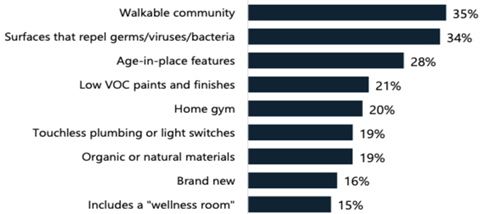
Given that the survey was done only six months into the pandemic, it’s not surprising how many responses related to a healthy environment and lifestyle. The survey was done long before the recent brouhaha over the health effects of natural gas cooking and heating, or I would expect “all-electric home” or “no natural gas” to have been among the choices offered to respondents.
The survey results were included in a research report from the New Home Trends Institute.
The release also described a trend toward “biophilic design,” a term that I had not seen previously. Basically, it refers to a preference for natural materials and environment. Lots of natural light and real wood finishes would contribute to such a feeling. It has been demonstrated that exposure to nature and natural home design reduces stress.
In November, 2022, the University of Maine unveiled its 600-sq.-ft. “Bio3D” home made using forest-derived cellulose nano fiber (CNF) technology to 3D print the floor, walls and roof. These modules were then assembled at a site on the UMaine campus. It is a “biophilic” alternative to the concrete 3D-printed homes which I featured in my Nov. 5, 2020, and Dec. 15, 2022, columns, available online at www.JimSmithColumns.com.
The site ConstructUtopia.com, in a January 2021 article clearly influenced by the pandemic, listed “4 healthy home features that home buyers care about”:
1) Good indoor air quality. This is especially needed in a well-insulated/air tight home, where a suitable appliance would be a Conditioned Energy Recovery Ventilator (CERV), which I wrote about in my Feb. 9, 2023, column.
2) Quiet, soothing bedrooms. The report suggested “thoughtful lighting, better soundproofing” and a nearby “snore room” for the offending or the suffering partner.
3) Easy-to-clean surfaces.
4) Outdoor recreation areas. Over three-quarters of survey respondents said they were focusing more on their physical health, and nearly as many (69%) said they’re focusing on their mental health. Exercise addresses both needs.
A September 2022 article on the same website featured a Mississippi company called Modern Mill which uses discarded rice husks to create a wood-alternative building material called “Acre” because one pallet of the product reportedly saves one acre of rainforest. Rice is a major agricultural product in the South, and rice husks would otherwise go to a landfill. Here are a few pictures of the Acre product from https://modern-mill.com/decking/ used as decking and siding, which, like real wood, can be stained:


NAHB reports a big jump this year in the demand for exterior amenities such as patios, decks and porches. Outdoor kitchens weren’t mentioned but could have been, from my own observation.
Home offices also appeared on the list of most wanted features for the first time this year, again a result of the pandemic.
Donald Ruthroff (mentioned above) noted that by making homes smaller, more money can be spent on details and finishes such as a luxurious bathroom, laundry rooms, walk-in pantries and hardwood flooring.
Boxabl, the Las Vegas Manufacturer of ADUs, Has Ramped Up Production
Manufactured housing started before most of us were born, if you include mobile homes. Modular housing, in which components of a building are put together in a factory and then assembled onsite, is also a part of early housing history. I remember attending Expo 67 in Montreal, where one of the exhibits (but not an attraction to be toured) was “Habitat 67,” a funny looking 148-unit apartment complex adjacent to the 1967 World’s Fair site in which concrete apartment modules were held together by cables.
Then, in 1997, I purchased a home in Golden’s Mesa Meadows subdivision which I learned later from a neighbor was built in a Ft. Morgan factory and assembled in one day on the foundation in Golden. Knowing that, I noticed the tell-tale beam in the ceiling which was where the two halves of the one-story home were attached to each other. Here’s the MLS picture of that home (798 Cressman Ct.) which sold last June for over $1 million.
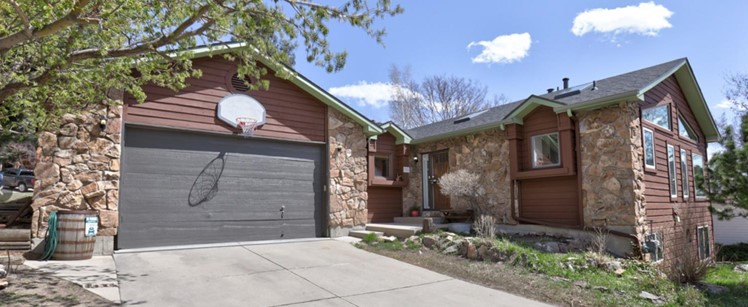
It was explained to me that manufactured homes are often of higher quality and better insulated, because they are done on a factory floor where there is better supervision, resulting, for example, in better insulation. The exterior walls were all made from 2×6 lumber instead of 2×4 lumber to better withstand the stresses of being loaded, unloaded and moved on the building site. Indeed, my Mesa Meadows house was a good one, although I expect the current owners (the third since I sold it) don’t even know that it was not stick-built on site over several months, like its neighboring homes.
Next came the “tiny home” movement in which complete homes were often built on a factory floor, wheeled on a trailer to someone’s lot, and then put onto a foundation. Some tiny homes were put into service as temporary homes for our unhoused population, formerly referred to as “homeless,” on vacant land or in church parking lots — a good idea, but without a conventional connection to a sewer line. Here are three tiny homes displayed for sale on https://www.tumbleweedhouses.com/:

About that time the ADU movement took off, with many if not most cities and counties changing their single-family zoning laws to allow the creation of “accessory dwelling units.” These could be walk-out basements converted to an apartment, but often they were apartments created above detached garages or stand-alone buildings in backyards. The typical ADU ordinance requires three things: 1) the ADU cannot exceed a certain size, 2) it has to have its own off-street parking space, and 3) the property owner has to live in either the main house or the ADU and not rent out both units. Some jurisdictions are considering loosening these rules. Here’s the City of Golden’s web page about their ADU rules: https://www.cityofgolden.net/city-services/accessory-dwelling-units/
Several local businesses were created to cater to this new construction opportunity, including Verdant Living, 303-717-1962, owned by John Phillips. His “backyard bungalows” are manufactured in Nebraska and meet local code requirements. You can visit www.VerdantLiving.us for more information.
A company called Villa started building ADUs in a factory southeast of Los Angeles, after California legalized ADUs in 2020. This company delivers and installs its units across the state, with prices starting at $105,000 plus as much as $200,000 for delivery, infrastructure costs, foundation, and installation. Here’s Villa’s website: https://villahomes.com/units/

There’s a Las Vegas startup called Boxabl, whose competitive advantage is that its ADUs fit on a standard flatbed trailer and then unfold into the simple unit shown here or to larger homes, such as the 3-bedroom, 2½-bath, 2-story home (assembled from three units) shown below.
It’s a father-son company which has not yet gone public. It was clearly inspired by the factory concept of Tesla, not surprising since the son drives a Tesla. Notice the Tesla wall charger and the Tesla battery unit above it on the exterior of the 2-story building below. That picture is from the International Builders Show last month in Las Vegas. It drew a lot of attention, and the company now has a waiting list over 100,000, even though it can’t deliver more units until regulators approve its construction.

The company did deliver 156 of its 400-square-foot “casitas” to the Federal government for use in Guantanamo Bay, which helped it build its factory and develop its technology. The company received that multi-million-dollar contract based on its proposal, even though the government knew they hadn’t built anything yet.
After completing that contract, Boxabl got a contract from an Arizona company to build workforce housing. Currently the firm is only building and, presumably, stockpiling its 400-square-foot casitas as it perfects its current factory and equips a second factory next door.
Learn more at www.Boxabl.com.
‘Everything You Need to Know About the Wild World of Heat Pumps’
That’s the title of an article in a February 14th post from MIT — https://www.technologyreview.com/2023/02/14/1068582/
I have written about and provided my own explanations regarding how heat pumps differ from forced air furnaces and traditional A/C systems, but the article cited above goes the extra mile.
If you’ve spent a night in a hotel or motel, you have probably slept in a room that was heated or cooled by a heat pump, because invariably that’s what those units are which you saw and controlled under each window.
In my other post today, heat pumps provide the heating and cooling for every Boxabl home. They are also what heats and cools many electric vehicles, since they require less battery power than conventional electric car heaters.
I was surprised to hear that heat pumps were invented in the 1850s but only started being used to heat and cool homes in the 1960s. It took the global climate crisis and the need to reduce our dependence on fossil fuels to make them the hottest trend in new homes.
Speaking of new homes, however, I lamented as recently as last fall that I haven’t found a single new Denver area home builder which has abandoned gas-based home heating or even offers an upgrade to heat pumps. If you know of one, please tell me, because I’d be happy to promote that home builder in a future column.
The MIT article provides some useful information, including about the rebates being offered for heat pump installations. It also debunks the myth promoted by fossil fuel interests that heat pumps don’t work in colder climates. They are actually in use from Alaska to Maine, where, for example, my sister in Kingfield, Maine, installed a heat pump in her home to save on her fuel oil bill. Her fuel oil vendor told her that the adoption of heat pumps by her neighbors has noticeably reduced his sale of fuel oil in that rural community near the Canadian border.
According to the article, 60% of the homes in Norway are heated by heat pumps, as are 40% of the homes in Finland and Sweden (where another of my sisters lives).
“Wherever you look,” the MIT article concludes, “the era of the heat pump has officially begun.”
The Colorado Environmental Film Festival Is Back Live Next Weekend – Don’t Miss it!
Golden Real Estate has proudly co-sponsored this unique film festival for at least a decade. For the first time since 2020, the festival is back live at the American Mountaineering Center (AMC) in downtown Golden Feb. 23-26, but most of the films can also be viewed online starting the following week.
During the pandemic, the festival (“CEFF”) was only virtual, and I loved it because I was able to see far more films than I could have seen in person.
Meanwhile, if you go online to https://ceff2023.eventive.org/films, you get to read descriptions and view trailers for all 97 films in the festival. Below is a screenshot from that website, showing just three of those films’ thumbnails.

I was particularly drawn to “The Power of Activism,” and look forward to seeing the full 53-minute Australian film about six young women activists out to save the planet. “Purple Haze” is about the purple martin, described as “America’s favorite backyard bird.”
An in-person “all access” pass costs $90 and can be purchased at the same website. The virtual pass costs $75.
As before, the films are organized into 28 “collections” such as the “Activism Collection” (my favorite), each of which can be purchased for $12 if you don’t want to buy the all-access or virtual pass. All the information is on that website. Click on the “Menu” link at the top left of the website to see the various pages with all the information you need to attend the festival.
As in past festivals, there is a free (but ticket required) “Community Opening Night” on the 23rd which includes announcement of the winning films in various categories. It starts at 6 pm in the AMC auditorium and is followed at 7:15 by the screening of seven of the award-winning films, ranging from a one-minute PSA to a couple 23-minute films. I never miss this event, which is held in the AMC’s Foss auditorium.
Although CEFF is an international film festival, several of the “collections” feature films made by Colorado filmmakers. There are also 16 accessible collections which are either captioned, subtitled or have no dialog. One collection is of the “Top 10 Best Kids’ Short Films.”
Other collections which caught my attention include: Art in Nature; Climate Chaos; Feathered Friends & More; Innovation & Inspiration; Off the Beaten Path; People to Know; Special Places; Unique Solutions; and two Wildlife Collections.
If you are reading this column in time, there’s a free Festival Preview at the University of Denver’s Sturm Hall on Thursday, Feb. 16th, 6:30 to 8:30 pm.
The Foss auditorium is the main venue for the festival at the American Mountaineering Center, but a second screen is created in the AMC’s event center to accommodate all the screenings, which begin at 10 a.m. from Friday through Sunday. The virtual access ticket (which I’m going to get) allows you seven days to watch any or all of the films on demand.
The festival features young filmmakers from around the nation including Hawaiian youth-made films like “Sunscreen Standoff,” and local Colorado young filmmakers like Taylor Saulsbury, who gives voice to her generation’s climate anxieties, creating portraits of resistance and resilience in “Right Here. Right Now.”

Join one of the free virtual “Green Bag Lunch & Learn Series” to hear from local experts as they dig deeper into current event environmental issues, including a closer look at the impact of Climate Chaos on young people’s mental health (Wednesday, March 1st at noon).
By attending the festival in person, you also get to participate in Filmmaker Q&A Sessions after many of the films to chat live with the filmmakers in attendance or watch one of the many recorded sessions to hear the secrets and intriguing behind-the-scenes stories of the films featured in the festival.
It Pays to Be Aware of Recent FHFA Changes to Lending Rates and Rules

We are barely six weeks into 2023 and already, we are feeling the effects of “pent up demand” for housing. Denver’s real estate market is rebounding and the advantages that buyers had in the last few months are declining as the “Spring Selling Season” unfolds. Consumer confidence, unemployment numbers and inflation have been in the news recently, and while those factors certainly impact the cost of residential home loans, there are other upcoming changes in the industry that aren’t as well known. I asked Jaxzann Riggs, owner of The Mortgage Network, to elaborate.
The Federal Housing Finance Agency (FHFA) has announced changes that will affect the cost of home ownership for many borrowers starting in March.
Established in 2008, FHFA was created to restore confidence in the mortgage market and to provide supervision and regulation over Fannie Mae, Freddie Mac, and the Federal Home Loan Banks. FHFA has made it their mission to prevent a repeat of the housing collapse and promote stability so that Americans can buy homes with confidence, especially those within underserved communities.
FHFA has announced targeted changes to Fannie Mae (FNMA) and Freddie Mac (FHLMC) pricing by eliminating added interest rate adjustments called Loan Level Price Adjustments (LLPAs) for certain borrowers and affordable mortgage products. There are requirements to qualify, but one example would be first-time homebuyers who are at or below 100 percent of the area median income (AMI) in most of the United States and below 120 percent of the AMI in high-cost areas such as Denver.
Traditionally, LLPAs have been added to interest rates to account for higher risks such as lower credit scores, low down payments, and property types, such as condominiums. Eliminating these LLPAs can lower the offered interest rate by up to 1.75%, which makes a substantial difference in a monthly mortgage payment. These changes will help to make home ownership easier for underserved and first-time buyers.
To support FHFA’s priorities, lenders will offer new mortgage programs that allow individuals to make down payments of only 3% and, in an effort to help first-time and lower-income buyers enter the housing market, a portion of the 3% down payment can actually be borrowed.
While Fannie Mae, Freddie Mac, and FHA are reducing the interest rates being offered to first-time and lower-income buyers, they are increasing the interest rates being charged to other home buyers. We have already seen a dramatic increase in the cost of loans for individuals purchasing a second home or investment property, and additional increases are expected in the next couple of months. These changes signal a significant shift in lending philosophy. At the height of the COVID crisis, the cost of mortgages for second homes and investment properties was identical to that for primary residences.
Currently the price differential between an owner-occupied home and an investment property is over a full percentage point, making real estate investing much more expensive than in recent years.
While credit scores have influenced the cost of money for over a decade, Fannie Mae and Freddie Mac will now increase interest rates for those with mid-level FICO scores. In the past, the percentage of income (debt to income ratio or DTI) that a borrower used for housing had no impact on the cost of the loan. Soon a borrower’s DTI ratio will be factored into the cost of loan — the higher the DTI, the higher the rate.
You may have questions about the changes. Do you qualify? What is the best loan option for your personal circumstances? Reach out to Jaxzann Riggs of The Mortgage Network, 303-990-2992, for answers.
Have You Wondered About 72Sold? It’s Not Licensed as a Real Estate Brokerage in Colorado
Perhaps, like me, you have wondered about 72Sold, which runs commercials every night on local TV stations, giving the impression that it is a Colorado real estate brokerage, and directing you to www.72Sold.com, which gives the same impression.
In researching this company, the first thing I did was to look on REcolorado.com, the Denver MLS, to see how many listings they have sold. The answer was none, because 72Sold is not a member of the MLS and is not even licensed in Colorado to sell real estate.
So what’s the story? First I asked Marcia Waters, director of the Colorado Division of Real Estate, who confirmed that 72Sold is not licensed in Colorado, and said the division has not received any complaints about them — which makes sense, since one can only file a complaint against a licensed brokerage.
My suspicions about 72Sold were raised further as I scanned the company’s website, which contains numerous testimonials and the following graphic, which has no identification of, or links to, the “five independent studies” cited in it:

To learn more, I posed as a potential seller and requested a valuation on 72Sold’s website, which uses such terminology as “a better way to sell your home.” That sure sounds like a brokerage, doesn’t it?
Registering my name and a home address on their website resulted in a call from a woman who said she was from 72Sold but who, under questioning, said she was actually with Your Castle Realty, a non-Realtor brokerage. So as not to blow my cover, I used the excuse that I only wanted to work with a Realtor, and she offered to have an agent from Keller Williams call me.
Susan Thayer, co-owner with her husband of Keller Williams Action Realty in Castle Rock, was the agent who called me next. I revealed to her that I was actually a Realtor myself writing this real estate column. I explained that posing as a seller on 72Sold’s website was the only way I could find out what was really behind all those TV commercials.
Susan was quite open and helpful and sent me links with background information, including an Inman News article about 72Sold’s partnership with Keller Williams and its many franchises.
Like 72Sold’s website, the Inman story conflated the roles of a lead generating company and a real estate brokerage, reporting, for example, that 72Sold had grown from 10 agents to 426 agents (as of August 2022), when in fact they only have licensed agents in Arizona, where they are a licensed brokerage. Everywhere else, as I understand it, they have what should be called “referral partners” instead of agents.
What 72Sold does is invest 80% of its referral fee income (according to the Inman story) into more TV advertising in those markets where it has referral partners, and some of that expense is apparently shared by those referral partners, although I didn’t garner any specific numbers.
What 72Sold offers through its referral partners is a strategy of combining a 7-day coming soon period with a Friday-to-Sunday active period during which buyers’ agents may show the home for 15 minutes on Saturday, according to the Inman article. The idea is to create a buyer frenzy and “fear of loss.” With the slowing of the market, that strategy has softened. It sounds great to sellers, however, making the leads generated well worth 72Sold’s referral fee.
Click on the thumbnail below to watch a video from 72Sold’s home page. Judge for yourself whether they are posing as a brokerage in Colorado, where you just watched their TV ad.

PS: It is a violation of the Realtor Code of Ethics for a member to misrepresent himself or his level of success, but neither Greg Hague nor his Arizona brokerage is a member of the National Association of Realtors, and therefore neither is bound to the Code of Ethics.
Understanding Indoor Air Quality and How It’s Managed in Super-Insulated Homes
As we all work to make our homes more airtight, we also have to be conscious of our families’ need for fresh air — oxygen above all! If our homes were completely airtight, we not only would risk suffocation, we would also be more susceptible to the toxic gases and fumes emitted by our paint, our carpeting, our gas appliances, and more.
The outgassing from our carpet and other building materials are known as “volatile organic compounds” or VOCs.
An appliance which you’ll be hearing more about as homes become better insulated and therefore more airtight is displayed schematically in the third column. It’s called an Energy Recovery Ventilator (ERV) or a Heat Recovery Ventilator (HRV).
Before I explain this appliance’s operation, let me tell you what it replaces: the exhaust fans in your bathrooms and above your kitchen stove. Those exhaust fans simply pump air out of your house, which causes fresh air to be sucked into your house via the gaps around your doors and windows and multiple other gaps you are not aware of.
That air which enters your home is not preconditioned in any way. It is whatever the temperature is outdoors, and in midwinter it could make your furnace work harder heating the cold air which naturally enters your home, whether or not those exhaust fans are operating.

Thus, the primary job of the ERV or HRV is to use the heat from the air being exhausted from your home to preheat the air that is entering your home without having those two sources of air mix with each other. This is done through a heat exchanger. In the above diagram, the heat exchanger is in the middle of the device. The unit runs at low speed, taking the stale air from your bathrooms and kitchen (typically), through a metallic heat exchanger which then adds that heat to the air which is passing through the adjoining passageway from the outdoors into your living spaces. That fresh air replenishes the oxygen in your home. The picture below is of a typical HRV installation. Both images are sourced from homes.winnipegfreepress.com.

What I have described above is the function of the HRV, which only handles the transfer of heat from one air source to the other. The ERV also performs the transfer of humidity. Thus, if the cold air outside your house is very dry (typical of Denver’s climate), the ERV will transfer some of the moisture from the indoor air to the incoming air.
Neither the ERV nor the HRV measure or react to the presence of toxic gases in your home. That’s the added value of a third device, the CERV or Conditioning Energy Recovery Ventilator. If you’re concerned about indoor air quality, this is the device you’ll want to consider installing in your home.
Whereas the ERV and HRV may operate on an as-needed basis, the CERV is intended to run 24/7, constantly monitoring the level of CO2 and VOCs in your indoor air as it is drawn through the unit. If the levels of these or other pollutants are high, the unit’s fan will run faster. A recent update of the unit has the addition of a virus-killing UV light.
Also, a CERV contains a heat pump, so it can actually perform the function of a furnace, preheating the air which is drawn from outdoors (or recirculated within the house), not merely transferring the room temperature heat from the exhausted air to the incoming air.
I have written in the past about the Geos Community in Arvada. None of the homes in that community use natural gas. Instead, the townhomes are heated and cooled by a combination of a heat pump/mini-split system and a CERV which provides additional heating or cooling. The detached homes at Geos also have CERVs to complement the ground source heat pumps which provide the primary year-round heating and cooling of the homes.
Learn more about CERVs at www.BuildEquinox.com. The local vendor is Todd Collins of AE Building Systems, 720-287-4290.
 Jim Smith's Blog