No Firm Experimented More With Co-op Commissions Than Trelora  

Trelora began as an outspoken anti-Realtor brokerage that also was against paying buyer’s agents a co-op commission. (The name “Trelora” was derived from a scrambling of the word “Realtor.”)  However, Trelora has made an about-face in the last couple of years and is now both a Realtor brokerage and a brokerage that offers 2.5% to 2.8% co-op commissions on its listings.

When it started as a non-Realtor brokerage in 2010, its first 96 listings all advertised a co-op commission of $2.80, an apparent play on the common co-op of 2.80%. Perhaps they wanted buyer agents to misread the co-op on the MLS and only realize later that they had worked for free. 

By April 2013, Trelora had adopted the practice of recommending to sellers a flat co-op of $3,000, although it wasn’t universal because many buyers felt their listings might not get shown if they were too miserly in their compensation offer.  I myself was paid 3% on a listing during this time because the seller told me that he wanted buyer agents to show and sell it knowing they’d earn a commission equivalent to a million-dollar listing. 

Also, during this time, one of my broker associates spoke to a Trelora agent who encouraged him to put into the listing contract that the buyer would pay 2.8% instead of $3,000, and that indeed worked for him, although I’ve been advised since then that inserting an additional provision related to broker compensation was inappropriate.

In mid-2019, Trelora created a separate Realtor firm that operated side-by-side with their original non-Realtor firm for about two years. That non-Realtor firm appears now to have been phased out. Meanwhile, the Realtor firm has listed over 500 homes and has closed 450 of them. Of its first 50 listings, 33 offered 2.8% co-ops, three offered 3% co-ops, and seven offered 2.5% co-ops. Only three of the 50 offered less than 2%. 

The 50 most recent closings reflected the same shift I reported on last week: Only 13 offered 2.8%, 34 offered 2.5%, and none offered less than 2%.

My fellow Realtors will be less surprised by the change in co-op compensation than by Trelora becoming a Realtor brokerage, given its original animus toward Realtors.

56% of Americans Say They’d Live in a Tiny Home  

Treehugger.com is an interesting website which was brought to my attention because of a Dec. 28 posting entitled, 2021 in Review: The Year in Tiny Living.” 

The article contains 10 stories about tiny homes that make great reading and may inspire you to consider building your own tiny home. The headline above was item #1.  Here’s an excerpt from it:

“…Oft-cited factors behind the appeal of tiny houses include efficiency, eco-friendliness, the minimalist lifestyle, the ability to downsize, with the top motive being affordability, as 65 percent of respondents indicate. Of those surveyed, 61 percent say they would spend $40,000 or less on a tiny home, compared to 16 percent who would spend more than $70,000. Seventy-nine percent say they would be able to outright buy or finance a tiny home, rather than a traditional starter home.”

Here are the titles of the other nine articles. Click on them to read the full article:

Young Biologist Builds Her Own Tiny House for $30,000

This Steel-Clad Tubular Cabin in the Woods Is Built Like a Ship

Couple’s Extra Wide Tiny Home Features Mudroom & Ergonomic Kitchen

> Family’s Fabulous Bus Conversion Has Play Loft and Roof Deck

Adaptable Furniture & Mirrored Walls Enlarge a Compact Apartment

This Ambulance Conversion Is a 4×4 Overland Rig With Shower, Toilet and Hot Tub

Young Couple Builds Sprinter Van Home for $8,000

> A Shipping Container Home That Makes Sense.

Small Parisian Apartment Revamped With Clever Space-Saving Staircase:

The Hidden (But Very High) Cost of Waiting to Buy Your Home  

It seems almost impossible to open a newspaper or listen to a news broadcast without being reminded that mortgage loan rates are on the rise. I asked Jaxzann Riggs, owner of The Mortgage Network, for her thoughts on how rising rates will affect our market. Here is what she told me.

Borrowers are being impacted on two levels right now. In the Denver metro area, the median price for a single-family home has increased by 19.3% in the past 12 months, according to the Denver Post. That means a home that you could have bought for $502,775 in January 2021, would cost $599,900 now.

Let’s assume that you agreed to purchase that home in January 2021 for $502,775. At that time, interest rates were hovering around 2.75%. If you made a 20% down payment, your expected monthly principal and interest payment would be approximately $1,642. If, on the other hand, you waited until January 2022 to buy that same home, your purchase price would be $599,810 and your interest rate would have risen to 4.087% and you would be paying $2,315 per month in principal and interest. That’s an increase of $673 per month.

Underwriters qualify borrowers for a maximum monthly payment based upon their income and other monthly liabilities. Underwriters refer to this as the borrower’s “debt to income” ratio, or DTI ratio, a term that you may have heard before. The maximum allowable monthly payment is then translated to a loan amount based upon current interest rates.

Rising rates make the maximum loan amount that a borrower can afford a moving target. By most accounts, The Federal Reserve is likely to increase the federal funds discount rates 3 to 5 times this year, with an increase certain to occur on March 16th. There is no direct correlation between the fed funds discount rate and long-term mortgage rates, but the trend for both is up. Jaxzann believes that the March 16th increase has already been factored into the cost of 30-year mortgage money by Fannie Mae and Freddie Mac, but expects rates as high as 4.75% by the year’s end. The mortgage market is resilient, changing daily, and we are beginning to see a variety of loan products (for example, adjustable-rate mortgages and interest-only loans) being offered by conventional lenders that will offset some of the damage done by increasing rates.

 While prospective purchasers can’t control real estate prices or mortgage rates, they do have some small measure of control when it comes to the price they pay for a loan while they are actively shopping for a home. Many of our lending partners have begun to offer a feature that allows the borrower to obtain a preliminary loan approval (without finding a property) and to “lock in” an interest rate, while shopping for a new home. Some lenders will lock in an interest rate for up to 120 days while their clients shop, but the most common term is 90 days. The lender charges a small premium to hold the consumers’ rate for a set timeframe and typically will also offer the borrower the ability to “roll down” the rate if interest rates drop by a preset amount during the lock period. Borrowers wishing to execute the roll down feature will pay a small fee, but it ensures that they will still be able to qualify for a specific loan amount, when they finally go under contract.

What does this mean for future homeowners? The cost of waiting is just too high. Don’t allow rising home prices and mortgage rates to price you out of the market. If you are currently house hunting and would like to learn more about locking in an interest rate, call Jaxzann at (303) 990-2992.

There’s a Persistent Myth That the “Standard” Real Estate Commission Is 6 Percent  

I barely remember the one time that I charged 6% to list a home, but I think it was over a decade ago and it was for a condo priced under $100,000.

Agents who have been in this business longer than I have may recall when the Denver Board of Realtors dictated a 7% listing commission with 2.8% of that going to the cooperating (i.e., buyer’s) agent as a “co-op” commission..  If the listing agent sold the listing himself, he would keep the entire 7%.

Times have certainly changed. The Sherman Anti-Trust Act of  1890 wasn’t deemed to apply to the setting of real estate commissions until the 1980 Supreme Court decision in McLain v. Real Estate Board of New Orleans, Inc. It took until then for the Court to rule that the brokering of real estate transactions involved enough elements of interstate commerce for the local practice of real estate to be reason-ably subject to that federal law.

As a result of that decision, the Denver Board of Realtors abandoned the dictating of commissions. Commission rates have been declining ever since, although listing commissions still average in the mid-5% range, largely because few brokerages or their agents have been willing to offer less that 2.8%   co-op commissions lest their listings not get shown and sold by other agents. But even that is changing now. With real estate prices skyrocketing, there is increasing free market pressure to reduce both the listing commission and the portion of that commission offered to cooperating brokers.

In real estate school it was drummed into us that there is no such thing as a “standard” commission, that listing commissions are negotiable. We were also told that we should never discuss with fellow agents what we charge. Even to suggest that there is a standard commission or discuss commissions with others would be a violation of anti-trust laws.

Years ago, I experimented with offering 2.5% co-op commissions on my listings and I found that they got fewer showings and no offers, so I went back to offering 2.8%.  Nowadays, however, because of higher home prices, lower co-op commissions are less of an impediment. I am back to offering a 2.5% co-op commission on higher-priced listings so I can charge a lower listing commission, and they’re still selling immediately.

I did some research to quantify the effect of the lower co-op commissions and found that 30% of the homes which sold in one day were offering between 2% and 2.6% co-op commission, with a 2.5% co-op being the most common. The homes that took 10 to 12 days to sell had twice as many showing lower co-ops, so lower co-op offers appear to have slowed sales, but the homes still sold relatively quickly.

It seems only right to me that higher priced homes should carry lower listing commissions and lower co-op offers, so I did some research on that, too. The MLS does not reveal listing commissions, but I was able to research co-op commissions which, to a certain extent, should reflect the listing commission, since agents are reluctant to give away more than half their listing commission to buyers’ agents.

What I found surprised me. Of homes that closed in the last 30 days, I found that 46% of the closings under $450,000 offered less than 2.8% co-ops. Only 26% of home which sold between $1 million and $1.3 million offered less than 2.8% co-op.  And most shocking of all, only 16% of the homes that sold for $3.4 million or more offered less than 2.8% co-op.

There’s currently a listing in the foothills above Golden for $25.7 million that is offering 2.8% co-op commission. The lucky broker who sells that listing will earn a commission of $770,000 for writing that contract. And, of course, the listing agent is getting about that much for putting it in the MLS. That seems excessive to me.

That brings up the topic of whether real estate agents generally are over compensated — a belief that generates considerable antagonism toward my colleagues and myself.

Here, too, the myth of the 6% commission is at play. Since the commission is typically lower than 6% and is split between the agents on each side of the transaction, a broker typically earns between 2.5% and 2.8% on each closing, not 6%. In most brokerages, the agent only gets a percentage of that commission and what’s earned is pre-expense income — referred to as Gross Commission Income or GCI.

The National Association of Realtors has reported that its members had a median GCI of $43,330 in 2020. Deduct expenses such as MLS fees, E&O insurance, cell phone and car expenses, computers and their software, plus licensing fees, and we are not a highly compensated industry on average. Keep in mind that only half of licensed brokers are Realtors, because NAR dues cost about $500 per year.   Licensees who won’t pay the dues to be Realtors likely earn even less.

The 80/20 rule applies in real estate as it does everywhere. Twenty percent of agents do 80% of the business and earn 80% of the commissions. Golden Real Estate’s brokers are all in that 20%. We attribute our success to the fact that we give back, spending far more money, for example, on publishing this educational column than we do on all other expenses related to the real estate business.

I believe we earn our commissions and offer a great “value proposition.”  See our list of services below.  I hope you agree.

Why Aren’t More Homes Going on the MLS Amid This Record Shortage of Listings?  

This January, only 3,237 non-builder homes were entered for sale on the Denver MLS within 25 miles of downtown Denver, the lowest number of new resale listings in that area for any January in at least 10 years. That’s a big drop from January of 2020 (pre-pandemic), which saw 4,171 new listings of non-builder homes for sale.

I find these statistics surprising, given what an ideal time it is to sell one’s home. We’ve had a seller’s market throughout the pandemic, but this month it became a sellers market on steroids, partly because of the Marshall Fire, which destroyed over 1,000 homes, putting even more pressure on the limited supply of homes for rent and for sale.

Of January’s 3,237 new listings, 2,611 went under contract before month’s end, and the median time on market before they went under contract was a mere 4 days. Only 214 (8.2%) of them were active more than a week before going under contract.

Of those listings which went under contract before the month’s end, 284 of them closed in January, 227 selling for more than the listing price, with the median listing selling for 5.2% over listing.  More than 1 in 9 sold for at least 15% over the listing price. Obviously, most of the homes that went under contract were the subject of bidding wars, and the thing to remember about a bidding war is that there are losers — many losers who are still in the market, possibly interested in your home. Except for the small number who get totally discouraged and quit looking, they are still on the lookout for a home to buy.

Any new listing, if priced appropriately, should sell quickly and, frankly, for more than it will appraise for — but appraising is not generally a problem because, as we all know, a home is worth what a willing buyer will pay. We’re not seeing problems with homes appraising, especially when the listing agent can show the appraiser multiple arm’s length offers for close to the same price.

Even so, it is common practice now for winning bidders to waive appraisal objection, meaning they agree to bring additional cash to the closing if their lender won’t lend them the contracted amount because of a low appraisal.

Buyers are incentivized to purchase now more than they were last year (or even last month), because it’s quite clear that mortgage interest rates, which have hovered around 3% for a year or longer, have started rising. By the end of 2022, we may see interest rates for mortgages in the 4% range. On a $500,000 loan, a 1% higher interest rate equates to an additional $417 per month on your mortgage payment. That’s a strong incentive to buy now.

With the ranks of buyers swelling because of these and other factors, why aren’t homeowners putting their homes on the market?

The number one reason I encounter is that would-be sellers dread being a buyer in this market. Being a buyer is very frustrating, and although sellers know they will be able to sell quickly, they worry about being able to buy a replacement home. They understandably don’t want to end up homeless.

This problem is mitigated when a seller can make an offer that is not contingent on the sale of their current home, something that might be more possible than you think.

For example, if you have a lot of equity in your current home — say, for example, you owe $50,000 on your existing home, but it’s worth $700,000 — you can probably get a credit union to give you a Home Equity Line of Credit (HELOC) for 80% of your equity minus what you owe. In the above example, that would be about $500,000. 

The nice thing about a HELOC vs. a regular mortgage is that you don’t pay any interest until you draw on that line of credit, such as at the closing on the home you’re buying. Then you put your current home on the market, sell it quickly, and pay off the HELOC at closing, having paid as little as one month’s interest on that $500,000 loan.

I like credit unions because they are non-profit member organizations, and the closing costs are typically less than with other lenders. If the line of credit is small enough — say, 50% of your equity — credit unions have been known to waive a full appraisal, saving you several hundred dollars.

If you have a lot of money tied up in stocks that you don’t want to sell, you can borrow against them, then pay off the borrowed amount when you sell your current home.

If you have a large balance in an IRA, you can withdraw money from it and not pay any penalty for early withdrawal if you re-deposit the withdrawn amount within 60 days, which is possible since you’ll be selling your current home within that time period.

Another highly effective approach is to sell your home requiring a 60-day closing and a 60-day free rent-back, which gives you 120 days after going under contract to find and close on a replacement home as a cash buyer (if you’ll be netting enough from the sale).  You could also make the penalty for overstaying the free rent-back period be a reasonable rental amount such as $100 to $150 per day.  The seller still has the ability to evict you but may be open to this arrangement as long as you’re making a good faith effort to buy and move.

Sometimes a would-be seller tells me that they don’t want to buy while prices are so high. I point out that if you are selling and buying in the same market, it doesn’t matter what prices are, because you benefit in the same way on the sale of your current home.  The same applies in a depressed market.  Don’t want to sell because you won’t get what you’d like for your current home? If you’re buying in the same market, you won’t pay as much for your replacement home.

My broker associates and I are happy to arrange an in-person or phone conversation with you about selling your current home and/or buying a replacement home. Our phone numbers are below.

Jim Smith, Broker/Owner, 303-525-1851

Broker Associates:

Jim Swanson, 303-929-2727

Chuck Brown, 303-885-7855

David Dlugasch, 303-908-4835

Ty Scrable, 720-281-6783

Anapaula Schock, 303-917-1749

Houston Builder Specializes in Net Zero Homes Built of Concrete

A reader who has been following my columns about fire resistant home construction, including concrete, sent me information about a Houston TX builder, Everlasting Homes Building Group LLC, which uses RSG 3-D structural concrete insulated panels to build homes which are not only fire resistant but also meet “extraordinary levels of excellence in energy and performance.”

At the top of its excellent home page, EverlastingHomesGroup.com, is the following statement: “Our vision is to design and build the most comfortable, healthy, resilient & sustainable living spaces dedicated to creating the best net zero energy homes and communities for our future.” They promise to build homes “resistant to hurricanes, tornados & floods, extreme cold / hot weather, earthquakes & fires, wood-destroying insects, and allergens, pollens, molds & dust.”

The Buying of Homes Has Become More & More Frantic Since the Marshall Fire  

I had a busy weekend this last Saturday and Sunday. With two new listings, I held each open for two hours. I couldn’t even count the number of visitors at the single family home listing that I held open on Saturday. Listed at $495,000, over 120 agent showings had been scheduled during the five days that it was active, and I received 25 contracts for it by the Sunday afternoon deadline. It went under contract for $630,000 on Sunday evening.

Surprised by this level of interest, I did some research Monday to quantify the increased buyer activity. Here’s what I found.

During the first 23 days of January, 403 Jefferson County listings went under contract.  Of those, 295, or 73.2%, had been active a week or less at the time they went under contract..

But not only were new listings selling this month. Twenty-four, or 6%, of the listings that went under contract in the first 23 days of January had been languishing on the market for 3 months or longer. Three listings had been on the MLS for over half a year.

My very busy open house on Saturday, Jan. 22nd in Arvada

Of the 403 contracts written so far in January, 36 (8.9%) were for homes listed for $1 million or more. The most expensive home on that list, a 1930 ranch-style home in Genesee Ridge that had been on the MLS for 275 days, went under contract last Monday. This didn’t happen because of a recent price reduction. It had been listed at $5.9 million since last July 15th. It was originally listed at $6.6 million on April 1, 2021.

So, how does January’s activity compare with December’s?  In December, a total of 554 Jeffco homes went under contract, most of which have now closed. Of those, 336, or 60.6%, had been active a week or less, versus 73.2% of the January contracts Twenty-five of them, or 4.5%, had been active for three months or longer, versus 6% in January..

Forty-four Jeffco homes (7.9%) sold for $1 million or more in December, compared to 8.9% in January.

So, yes, statistics do reflect a more frantic sales pace in January.

Taking a longer perspective, let’s look at the 4th quarter of 2021 vs. the 4th quarter of 2020.

In the latest quarter, 56% of the homes went under contract in 7 days or less, versus 60.2% in Q4 of 2020. A smaller percentage of homes that had been on the MLS three months or longer sold in the 4th quarter of each year — 3.9% in 2020, down to 3.0% in 2021.

Having established the statistical basis for my observation that home buying has become more frantic this month, let’s look at possible reasons.

At least one of the 25 contracts I received last weekend for my Arvada listing was from a family which lost their home in the Marshall fire.  They are currently living in an Airbnb.  Others may have been from victims of that fire, but they didn’t say so in their offer.

Another buyer was an investor who told me that they were rushing to buy a home because they felt prices were rising at an increasing rate. This buyer thought that despite the bidding wars, they could get a better deal now than if they waited another year to add to their portfolio.

Rising interest rates and the expectation of further increases later on probably are playing a role. People want to buy before rates increase further. You may have read that a high percentage of buyers are cash buyers, but this has not been my experience, and only three or four of the 25 contracts I received for my listing.

How to Alert Residents About Approaching Wildfires  

Clearly many lives were saved in the Marshall Fire because it started in the morning and residents were awake and alert to the danger. Imagine if the fire had begun at 2 a.m.  How many more people might have died in their homes?

A reader suggested that community-based sirens could help to save lives, and that does sound like a good idea.

NextDoor is a great resource for alerting residents about all kinds of dangers, but it would not wake anyone up. Something like the Amber alert which makes a deafening alarm on cell phones could be effective. (I leave my cell phone on at night but it is purposely out of earshot for phone calls and text messages. I would, however, hear the loud alarm used for Amber alerts.)

The Amber alert should not itself be utilized for such a warning, because it can be silenced.  If there were a separate alert for fire danger, it’s unlikely that people would silence that alert or turn off their cell phones at night.

There are, I’ve found, many seniors who have held off buying cell phones, but the existence of such an alert might inspire them to purchase one. In addition to the low-cost providers, there is a program called Lifeline that provides free cell phones to households that are on various programs such as SNAP, SSI, Medicaid, etc. Learn more at www.AssuranceWireless.com. If you are currently paying for a landline telephone, you could get rid of it and port your phone number to the free cell phone that you get with this program. The cellphone can also provide you with free internet service via a “hotspot,” allowing you to save money on broadband, too.

Styrofoam Recycling

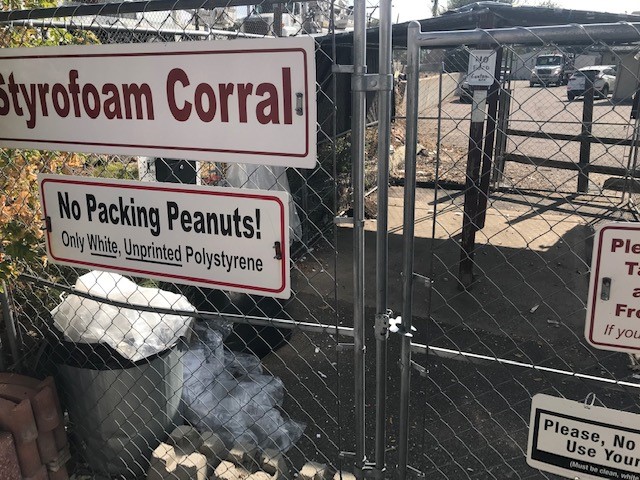
Since our real estate office moved from 17695 S. Golden Road to 1214 Washington Avenue in downtown Golden, people have been asking if our Styrofoam Corral has moved.

The answer is “no,” we still maintain the Styrofoam Corral behind our old office (which we still own) and still take two truckloads of Styrofoam to the Centennial Containers in Denver every month, keeping over 200 cubic yards of the material out of landfills every year!

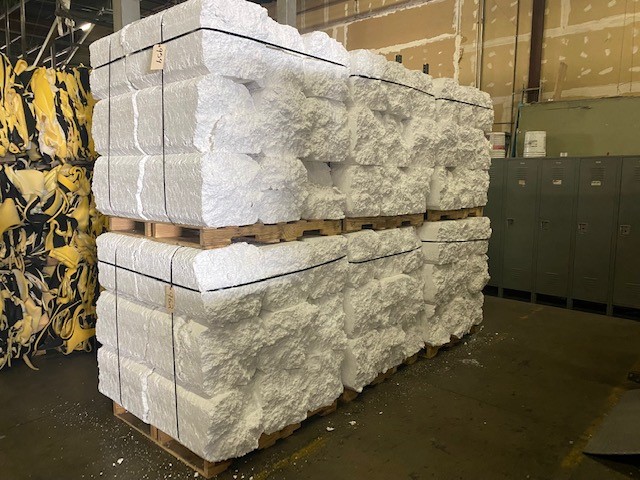
One truckload of Styrofoam from Golden Real Estate ends up being just one bar of “densified” polystyrene on these half-ton skids which are then delivered to a company which makes new products from it.

Here Are More Examples of Concrete Construction and Fire Resistant Roofing  

My previous two columns about reducing your home’s vulnerability to wildfires generated a lot of reader response, providing even more to write about on this important subject.

Fire resistance is personal for Rita and me, since we live in a wood frame home backing to open space which would be ready fuel for a wildfire.

I’ve been told that following an 1863 fire, Denver passed an ordinance requiring masonry construction. Somewhere along the line, that requirement was dropped. I wouldn’t be surprised to see building codes changed once again restricting wood construction.

While there’s a trend toward requiring  fire suppression systems inside homes, they are designed to suppress fires which originate inside a home.  If a fire originates externally, such systems may be of limited effectiveness in saving a structure.

Last week I wrote about ICFs — insulated concrete forms. Concrete is poured into a form which has insulating EPS (expanded polystyrene) on each side. This produces a concrete wall which has insulation pre-installed on each side of it.

A couple readers made me aware of the opposite approach, a concrete wall in which the “sandwich” has concrete on the outside and the expanded polystyrene on the inside.

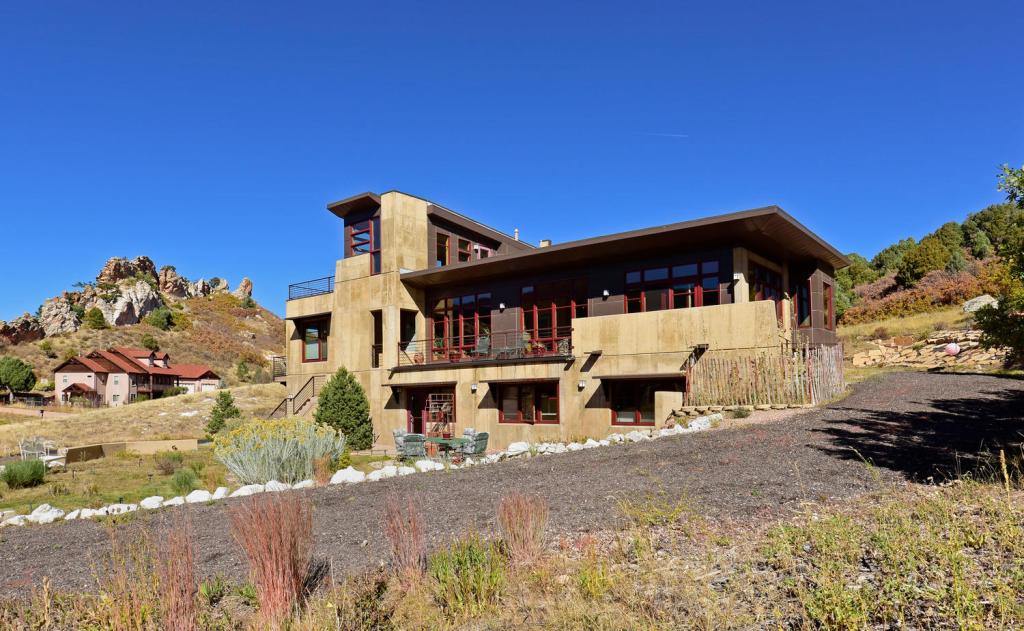
Reader Lynn Greene invited me to visit her home in Perry Park (see picture below), southwest of Castle Rock, which was built with Thermomass® walls and concrete floors developed by Composite Technologies Corporation of Boone, Iowa.

Lynn’s tenant told me that the energy costs peak out at about $70 per month to heat the house with radiant floor heating built into the concrete floors. That heat is provided by a high efficiency boiler using natural gas. Large south-facing windows provide a lot of free winter time heating. (Notice the large overhangs shading the south-facing windows in summer but not in the winter.)

The Thermomass walls were poured in place, less expensive and more attractive than walls built of uninsulated concrete block. It also allowed electrical and other conduits to be built into the walls instead of surface mounted afterward.

Another “sandwich” approach is sold by a company called RSG 3-D, but they create panels which are assembled onsite instead of being poured in place. Also, their polystyrene interiors (which are wider) have steel connectors instead of the plastic connectors used in the Thermomass walls. That reduces the insulating quality of the wall, since metal is a conductor.

Another reader reminded me that the making of concrete is a major source of carbon dioxide, a greenhouse gas. According to Wikipedia, “The cement industry is one of the two largest producers of carbon dioxide (CO2), creating up to 8% of worldwide man-made emissions of this gas, of which 50% is from the chemical process and 40% from burning fuel.”

Click here to read an article from The Guardian about the development of “green concrete” in Australia that sounds very promising. As you may know, “concrete is made from approximately 10% Portland cement, 3% supplementary cementitious inclusion (for example fly ash), 80% aggregates (such as gravel and sand), and 7% water.” Then it is reinforced with steel, which has its own huge carbon footprint.  By replacing the steel with recycled plastic, that impact is mitigated, and, according to article from The Guardian, the Australian company Wagners has created earth friendly concrete using blast furnace slag – an industrial waste from steel production – along with fly ash, a waste from coal power generation, as a replacement for Portland cement.

To make a concrete home truly resistant to wildfire, it is necessary to make the windows and doors and other openings fire resistant too. There is glass (with frames) rated for 20 to 180 minutes of fire resistance. See www.fireglass.com.

Lastly, one must deal with roofing. Another reader made me aware of the synthetic roofing by CeDUR which was installed on her Wheat Ridge home and which is also on Woody’s Wood-Fired Pizza:

It looks just like a wood shake roof and is installed the same way in individual shakes, but it has the highest rating of fire resistance (Class A), earning homeowners a substantial discount on their homeowners insurance. Learn more at www.cedur.com/fire-safety.

There are vents of all kinds not only on your roof but on soffits, foundations, eaves and gables, and they need to be protected from flying embers. Vulcan Vent sells vents for all those openings, “built to create a barrier against wind-blown embers and flames in the presence of intense heat.” Learn more about them at www.VulcanVents.com.