A Subdivision in Pueblo Sets the Standard for All-Electric Home Construction

One of my favorite newsletter subscriptions is to “Big Pivots,” written and edited by Allen Best. The focus is on sustainability, especially as it relates to real estate and home construction. This week’s newsletter featured an article which I am reprinting with permission because it would be hard to improve upon it.

By ALLEN BEST

It took Rod Stambaugh a couple of years before his vision of high-performance housing on the northeastern edge of Pueblo had anything to show. Now he and his two partners have begun getting results. In recent weeks they’ve sold three homes for an average price of $780,000.

“It’s been a long road, but it’s getting easier,” says Stambaugh.

The company, Pure Zero Construction,  has 14 of the single-family houses under construction with work underway on the first of 51 townhomes.

None of the homes will have natural gas or propane. The company has rights to build as many as 500 additional homes in North Vista Highlands.

“We will compete all day on the merits and benefits of high-performance, all-electric homes as compared to stick-built housing that uses natural gas,” says Stambaugh. “We will win that battle every time.”

The townhomes will have 2,200 square feet and come in at around $600,000, he says. The company expects buyers to come from Denver and the northern Front Range.

Pueblo has a well-deserved reputation for lower real estate prices, but it does have pricier homes, too. Pure Zero is staking its reputation on both environmental performance, which translates into cost savings over time, and on health benefits.

Accumulating evidence points to harmful impacts of indoor air quality from natural gas combustion, whether for space and water heating or for cooking.

Gene Meyers, long-time “green” builder in the Denver metro area, has said that if for no other reason than health considerations, it’s time to get rid of natural gas in homes.

Having no natural gas comports with Colorado’s goals for greenhouse gas reduction goals. Several laws passed in 2021 provide direction for the decarbonizing of buildings through various new metrics, including building codes that make natural gas less desirable. So far, however, Colorado has not imposed bans on natural gas. The lone exception is Crested Butte, and the restriction there applies to relatively few units.

Stambaugh got into the building technologies world about eight years ago when he began building 189-sq.-ft. “tiny” homes after returning to Colorado from California. That business is called Sprout Tiny Homes. He sold some of the tiny homes to the Aspen Skiing Co. for use in Basalt. He is now at work on a third generation of workforce housing for Aspen.

Then, in 2020, he purchased land in Pueblo’s North Vista Highlands subdivision. He had thought that there would be no natural gas available in that subdivision. That turned out not to be true, but it’s true for the housing he and his two partners are building — and he has no plans to change.

“We will not deviate from our mission,” says Stambaugh. “We are going to build high-performance homes where you can see, feel and breathe the difference. That is our mission.”

One measure of a building’s performance is a metric called HERS, short for Home Energy Rating System. The lower the HERS score, the more energy efficient the home. Existing homes may have HERS ratings of 130. New homes built to code have HERS scores of 100 – al-though some production builders are shooting for lower scores. KB Home has said it plans to achieve HERS scores of 45 nationally by 2025.

How do Pure Zero’s homes rate? “We’re in the low 40s and we actually had a -9 score after adding solar,” says Stambaugh.

High-performance building has several components. One is building tightly to avoid loss of heat in the winter and cool air in the summer. Unlike houses built from 2x4s and 2x6s, the Pure Zero houses were built with structural insulated panels, or SIPs. They provide superior insulation and, says Stambaugh, provide corners that are always on the mark. They used to cost more than wood, but no longer.

Eliminating natural gas is another fundamental of the houses. Instead, electrically powered Mitsubishi air-source heat pumps extract the heat from outside air efficiently down to 0ºF (and with less efficiency below zero). They do the reverse during hot weather, eliminating the need for a separate air conditioning unit.

Stambaugh swears by Mitsubishi’s heat pumps. They cost $1,500 more than other air-source heat pumps, but their superior performance at lower temperatures will result in less need for backup heating. Those lower costs will recoup the original investment in five years.

[Golden Real Estate installed Mitsubishi heat pumps in its South Golden office and downtown storefront, and they work great.]

Instead of natural gas ranges, the houses in Pueblo have induction ranges. Bathrooms are tiled from top to bottom. Temperatures throughout the 3,900-square-foot houses (with fully finished basements) are consistent. They’re so structurally tight that they are quiet even within a construction zone.

There used to be a higher cost premium for the materials. That has somewhat gone away.

But building high-performance homes requires rethinking, including finding subcontractors willing to learn new techniques. Stambaugh says his team had difficulty at first finding craftsmen willing to learn how to install the new technology. Some refused. Now, as the housing construction industry has slowed, some of those workers have returned, looking for jobs.

You can subscribe to the Big Pivots newsletter (and find lots of other interesting articles) at www.BigPivots.com. You will learn a lot, as I have, from Allen’s articles.

What Is a Heat Pump, and How Does It Work?

I came across a website that gives a great description of heat pumps, how they work, and why they are more efficient. Here’s the link for it.

Most Americans are accustomed to heating systems that generate heat using fossil fuels, wood, or electricity. But heat pumps don’t create heat, they move heat. Here’s how the process is explained on that website:

Heat pumps function similarly to refrigerators or air conditioners, which take warm air from one space and send it to another. In the winter, a heat pump transfers heat from the outdoors inside and, in the summer, it reverses this process.

There are two main types of heat pumps, and both can function as space heaters or coolers and as water heaters.

A ground-source (or “geothermal”) heat pump sends a mixture of water, antifreeze, and/or a refrigerant through a network of pipes buried below the frost line. As the liquid passes through the pipes, it absorbs the earth’s approximately 55-degree heat. The liquid is then drawn up into a compressor, which heats it further, creating a vapor. The heat pump then distributes the warm air through ducts or tubes throughout your home. In the summer, the heat pump reverses the process, taking warmth out of the house and transferring it to the earth.

An air-source heat pump extracts heat from the air rather than from the ground. It functions the same way, but because air temperature, unlike earth temperature, can get very cold, it has more work to do bringing up the temperature. As with a ground-source heat pump, a reversing valve inside the heat pump allows the same unit to function as an air conditioner in the summer. At right is an air source heat pump that was retrofitted into a ducted forced air heating/cooling system of one of my current listings in Golden.

Looking for a vendor who specializes in heat pumps? I recommend Sensible Heating & Cooling, 720-876-7166, or Helio Home, Inc., 720-460-1260.

NAR’s Annual Survey of Buyers and Sellers Shows Big Deviations From Past Years

 Every year the National Association of Realtors (NAR) surveys buyers and sellers of primary residences on a variety of topics. Usually, the changes from one year to the next are fairly minor, but the most recent survey (covering the period from July 2021 through June 2022) produced some big statistical deviations from prior years. Here are some of the findings that stood out to me.

1)   The percentage of first-time buyers dropped to a record low of just 27%, beating the previous record low of 30% in 1987 — 35 years ago! In the 2020-2021 survey it was 34%. The average age of first-time buyers jumped from 33 to 36. The average age of repeat buyers also rose — from 56 to 59.

2)   88% of all buyers were White, the highest percentage since the 1990s. Meanwhile, the percentage of buyers who were Black and Asian/Pacific Islander both dropped by half, from 6% to 3%. The percentage of buyers who were Hispanic/Latino rose slightly from 7% to 8%.

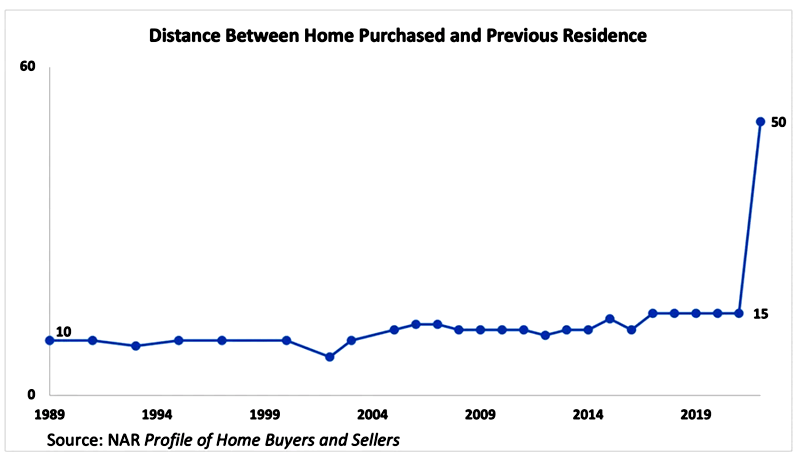
3)  Buyers moved an average of 50 miles from where they lived before, up from 15 miles the prior year, which was as high as it had been since at least the 1980s. (See chart below.) So, where did they move? Suburbs took a big hit, plunging from 51% to 39%, while rural and small town destinations jumped by half — 12% to 19% for rural areas and 20% to 29% for small towns. The NAR survey attributes that change to the pandemic’s effect of encouraging work from home. “Zoom towns were boom towns.”

4)   While only 3% of first-time buyers paid cash for their homes, 27% of repeat buyers paid cash, up from 17% the prior year. The survey attributes this to the surge in equity which homeowners had experienced in recent years, especially during the pandemic, providing them with lots of cash to spend on their replacement homes.

5)  How long buyers expect to remain in the home they just purchased had held steady since 2009 at 15 years for repeat buyers and 10 years for first-time buyers. The NAR survey showed a huge jump in that expectation for first-time homebuyers — from 10 years to 18 years. The expectation of repeat buyers remained unchanged at 15 years.

6)   The percentage of first-time buyers who had been renters plunged from 73% to 64%, while the number who moved from living with family or friends jumped from 21% to 27%. (See chart below.)

Click here to view the full summary of NAR’s 2022 survey of buyers and sellers.

Thanksgiving 2022 – In Spite of Everything, Much to Be Thankful for

First of all let me thank The Denver Post for making it possible for me to reach its many readers for well over a decade in this YourHub ad. I estimate that we get 90% of our real estate business from people who read this column and are inspired to contact us when they have a real estate need. Although we pay for this ad and for its placement on page 3 — the best ad location in any newspaper — they don’t need to sell it to us, and I thank them for letting me advertise here.

The feedback I get from many readers is that this is the first place they turn to when they receive this newspaper. What a great compliment that is, so my second “thanksgiving” is to you, my readers for following this column each week and thinking to call us when you have a real estate need. You can count on me to continue writing this column week after week and year after year so long as The Denver Post keeps it affordable!

By the way, should you move or stop subscribing to this newspaper, remember that I send it by email to over 1,400 subscribers (free, of course), and I would be happy to add you to that list.

Next, I am thankful to Golden Real Estate’s broker associates who continue to excel in serving our clients year-round. They share their commission earnings with the brokerage, of course, but are compensated for that    in various ways, including having their listings featured in this ad and being themselves promoted at the bottom of each week’s ad. They are all excellent Realtors who share our company’s values, an example of which is that the majority of them drive Tesla cars! I am blessed that they choose to be associated with Golden Real Estate and am happy to share with them many of the leads which come to me from readers of this column.

(By the way, we welcome applications from other licensed agents, as long as they share our values and are Realtor members.)

One of the unexpected secrets to Golden Real Estate’s success has been my personal outspokenness politically, which has meant disparaging former President Trump and his MAGA allies in my Talking Turkey column. There was initially some concern that we would lose business, but the opposite has been true. Readers who have appreciated my political stand have chosen Golden Real Estate as their brokerage because of my writings. The gained business has far outweighed the lost business, which I hope inspires other Realtors and brokerages to be less shy about sharing their patriotic beliefs, whether left or right. As citizens, let’s put country before self, however that looks.

In that regard, I am especially thankful for the results of the midterm elections.  And I’m guessing that next year I’ll be thankful that Donald Trump has entered the 2024 presidential race. May he do even more damage to the MAGA cause that he has already done!  More importantly, however, may his candidacy contribute to the revival of the mainstream Republican Party,  re-earning its designation as the “Grand Old Party.” That was the party of my father, and I miss it!

As always, I continue to be thankful for the contribution made by the National Association of Realtors (NAR) to protecting and promoting home ownership and the real estate industry. Only half of licensed real estate agents pay dues to NAR through their local Realtor association, but NAR continues to serve the entire industry as well as the general public by lobbying against negative legislation and government regulation on both the national and state level. Thank you, NAR!

I am grateful, too, to the Golden Chamber of Commerce and all metro area chambers of commerce for all they do to serve the business community, and I’m proud that Golden Real Estate pays dues to our own Chamber, regardless of the direct benefit we may gain from membership. It’s our way of giving back to the community by providing sustenance to an organization that serves the community.

We are also grateful to have made the move to downtown Golden, now occupying a storefront next to Ace Hi Tavern. Come by and say hello, perhaps during December 2nd’s candlelight walk!

I also thank Wendy Renee of Fairway Independent Mortgage Corporation for choosing to office inside Golden Real Estate’s storefront. She adds important expertise to our office and helps us to serve the many walk-ins we are welcoming in our new location.

Last but not least, Rita and I are thankful for our relationship with each other and our extended family. Happy Thanksgiving to all!

Would you help us stock the shelves of Golden Rotary’s ‘Miracle Shop’?

The Miracle Shop, housed at Calvary Church in downtown Golden, is a pop-up holiday toy store where financially struggling parents, grandparents, and guardians in the Golden area can shop for the perfect gifts for the children they love.  The store is not a handout. Instead, customers choose what to pay for the toys they have selected…..no questions asked. Sometimes payment is pocket change and sometimes $20 or $30.   The goal is to provide an opportunity for caregivers to feel empowered by their ability to take care of themselves. They tell us they are excited about the opportunity to choose gifts for their children and that paying something feels better than receiving a handout.

Toy Donations will be accepted at Golden Real Estate‘s office, 1214 Washington Ave., Golden, from Nov 25 to Dec 9. The Miracle Shop will be open on December 14th-16th.

In addition, toys may be purchased on our Amazon Wish List and delivered directly to Santa’s Workshop…. go to TheMiracleShop.org   Cash donations can be made on the website, too, are tax-deductible, and always appreciated.

We sincerely hope you will support The Miracle Shop. The difference you will make is real.

Redfin Shuts Down Its iBuyer Unit. Will Opendoor and Offerpad Survive This Down Market?

The big news in real estate last week was the announcement by Redfin that it was shutting down its fix-and-flip unit called Redfin Now and has terminated 13% of its employees.

The end of the seller’s market has left iBuyer outfits like Redfin’s with homes they paid too much for and can only sell for a loss. A good example of that is Opendoor’s listing at 2090 Braun Drive in Applewood, which I mentioned in my column on August 11, 2022, under the headline, “Looking for Good Deal? Opendoor Is Slashing Prices to Clear Its Inventory.” As the MLS chart below shows, Opendoor purchased that home on Sept. 3, 2021, for $638,300, tried to flip it 4 months later for $652,000, and had already reduced its price to $620,000 by August. That home is still sitting on the market in November, now priced at $562,000 — $76,300 less than Opendoor paid for it over a year ago.

Opendoor currently has 165 unsold listings on REcolorado, the Denver MLS, and the median days on the MLS without selling is 115 — nearly 4 months. Once a home has been active without selling for about a month, Opendoor starts reducing the price, and pretty soon, their profit margin has disappeared.

In the last 30 days, Opendoor has closed on 68 listings, and the median days on the MLS for them was 90.  That median listing that was unsold for 3 months was purchased by Opendoor for $692,700, listed at $760,000 and sold for $650,000, representing an even bigger loss when you factor in the co-op commission paid to the buyer’s agent, renovation costs, and staff costs, not to mention the carrying cost of their investment in the property, property taxes, and more.

The company reported a $928 million loss for the third quarter ($573 million of which was from revaluing its unsold inventory), laid off 550 workers, and saw its stock price fall to just above $1. If it falls below $1 for a month, it will be delisted from NASDAQ.

How much longer can Opendoor and Offerpad, its one remaining competitor, (whose stock price is already under $1), sustain such losses? We’ll see, won’t we?

We Just Took Delivery of the F-150 Lightning Electric Pickup

Regular readers know me as a committed Tesla fan, currently owning both a 2015 Model S and a 2017 Model X. But I was drawn to make a reservation for the F-150 Lightning as soon as it was announced, and last week a real estate client and I took delivery as co-buyers of a carbonite gray Lightning Lariat model.

My reservation number was still several months out, but the sales manager was able to secure this vehicle from an inventory vehicle shipped to him by Ford.  We didn’t get to choose any finishes, including color or an extended range battery, but we liked it enough that we bought it.

Initially, the Lightning was promoted with a base price under $40,000, which understandably attracted hundreds of thousands of reservations. But that was a mirage, much like the $35,000 base price for the Tesla Model 3 when it was introduced.

Today, the base price for the Lightning is $51,974, and our Lariat model came with a $74,474 price tag, plus a $5,000 dealer mark-up, which we had to accept. The base model doesn’t have two driver assistance features I’m used to on my Teslas and which I can’t live without adaptive cruise control and lane-keeping.

So, how do I like our Lightning Lariat? After putting a couple hundred miles on it, I can say that I love it. What surprised me most of all was that the ride at highway speed and on rough pavement was better and quieter than in either of my Teslas.

I love that the Lightning offers a “one-pedal” driving mode, in which you not only have strong regenerative braking, but it brings you to a complete stop, greatly reducing the need to use the brake pedal.

I appreciate the great Apple Play integration for my iPhone. Tesla’s iPhone integration is terrible – unimproved despite my complaints since my first Tesla purchase in 2014.

At first, I didn’t like the lane-keeping feature because, unlike with Tesla, you can’t change lane by using the turn signal. But I came to love it because it’s always on, such that when I do change lanes, it locks onto the new lane without asking.

Although I would have little use for it, I like that the Lightning has numerous USB and 120V outlets in the front trunk, the cargo bed and inside the cab, plus a 240V outlet in the cargo bed. One feature I’d make great use of is the large work surface that is created when you retract the shift lever and unfold the console cushion. (Photos from Ford.com)

My client loves the Lightning, too, so I am letting him buy me out and take sole ownership.

Good Mortgage Lending News for First-Time Homebuyers

There is great news this month for first-time homebuyers. The Federal Housing Finance Agency (FHFA) has made changes that will benefit up to 20% of people looking to buy.

The most significant could result in as much as a 0.5% reduction of the interest rate. When you apply for a mortgage, your rate is based upon various risk factors. If you have a low credit score, a small down payment, or are buying an investment property, your loan is at a higher risk of default than someone who has excellent credit, large down payment, or is going to live in the home. These risk factors are added into your interest rate as “Loan Level Price Adjustments,” or LLPAs.

First time home buyer programs such as “HomeReady” and “Home Possible” have always had reduced LLPAs, but this month FHFA announced that they are removing all such pricing adjustments from their most popular first-time homebuyer programs.

FHFA has also increased the income limits associated with the programs and is allowing lenders to offer up to $2,500 in grant funds to qualifying borrowers. If you have questions about a first-time homebuyer mortgage, reach out to Jaxzann Riggs of The Mortgage Network at (303) 990-2992 for answers.

A Reader Asks: Could a Reverse Mortgage Be Funded by Heirs at Less Cost?

Recently, I heard from a reader about reverse mortgages. The reader astutely observed that the costs associated with a reverse mortgage (or HECM) could be eliminated by putting a family-funded mortgage into place. This would require an attorney to draft the legal documents that would spell out and secure each family member’s future interest in the property, but those fees would likely be lower than the costs associated with a HECM.

I asked Jaxzann Riggs, owner of The Mortgage Network to weigh in on the topic. “Absolutely,” she told me, “a family-funded reverse is preferable to a traditional reverse if the homeowner has a family that is able and willing to be the lender.”

Reverse mortgage closing costs are very straightforward. A borrower should expect to pay, on average, a 1% origination fee and a 2% initial mortgage insurance premium, plus closing costs and third-party fees such as appraisal, title, settlement and recording fees.

Jaxzann told me there is a difference, however, between closing costs and the actual expense of a reverse mortgage. The expense is far more difficult to calculate because it would require concrete information about the future value of the home, the duration of the occupancy (how long will the owner live in the home), and how much the homeowner will draw now and in the future from the home’s equity. A homeowner who decides to sell the home within a few years after creating a reverse mortgage would find it to be VERY expensive.

If a borrower rolls $10,000 of closing costs into the loan balance and then sells the home after one year, the cost of selling (without calculating and adding the interest and mortgage insurance accruals) would be the full $10,000. If, on the other hand, the homeowner lives in the home for 20 years, the initial cost spread out over the life of the loan would be approximately $500 per year. The future appreciation or depreciation of the home is critically important when attempting to calculate HECM expenses because, unlike a family-funded reverse, FHA HECMs are non-recourse loans meaning that if the home is worth less than the dollars owed at the time of sale, the borrower or heirs are not responsible for the deficiency. If the home does not appreciate much (or depreciates), a HECM can be very inexpensive.

Here’s How Denver’s Real Estate Market Has Performed Since the Start of the Pandemic and the Recent Surge in Interest Rates

The charts below will not surprise any of us who have been witnessing the Denver real estate market over the past 2½ years. They do, however, document the death rattle of the seller’s market, which was killed by the Federal Reserve’s Open Market Committee, whose dramatic increases in the Federal Funds Rate were reflected in the amazingly quick increases in mortgage interest rates.

NOTE: The MLS charts above were created on REcolorado.com, limiting data to listings within an 18-mile radius of downtown Denver. That covers the entire Denver Metro area roughly within the C470/E470 beltway, but does not reach to the City of Boulder.

Back in January, when the 30-year fixed mortgage rate was just above 3%, it was hard to imagine that before year’s end the rate would be over 7%. The rates started rising in January, but they didn’t break above 4% until about the time that the FOMC started its aggressive rate increases.

(As a layman, I’ve never quite understood how inflating the cost of money is the best strategy for reducing inflation of everything else. And haven’t we noticed that that strategy hasn’t really worked yet? Some food for thought….)

Looking now at the three MLS charts, you can see that the number of sold listings exceeded the number of active listings throughout most the pandemic but sharply diverged starting around the time the FOMC rate increases began in mid-April.

The number of new listings saw no dramatic changes over previous years, but the number of listings that expired without selling was 3.24 times as high in October as it was in April of this year. Many of those new listings have sat on the MLS, as shown in the median days in MLS, which quadrupled from 4 to 16 days from April to October.

What may surprise observers is that the median sold price fell as little as it did from April to October. It is still higher than it was in January of this year when that 30-year fixed interest rate was about 3%.

What lies ahead? Homes are still selling, and buyers still need to buy, leading me to believe that we’ll see a “normal” market soon. Stay tuned!