Homeownership Surged During the Pandemic, According to a Realtor.com Report

On July 28th, Realtor.com published an article by Clare Trapasso (link) with surprising statistics about a surge in homeownership during the 2nd quarter of this year.

According to her article, which was based on a U.S. Census Bureau report (link), the homeownership rate surged to 67.9%, the highest it has been since the Great Recession of 2008. (See chart below.) That rate was 3.8 percentage points higher than the same quarter of 2019 and  2.6 percentage points over the first quarter of this year. Covid-19 arose during the last month of the first quarter, but it dominated the entire second quarter.
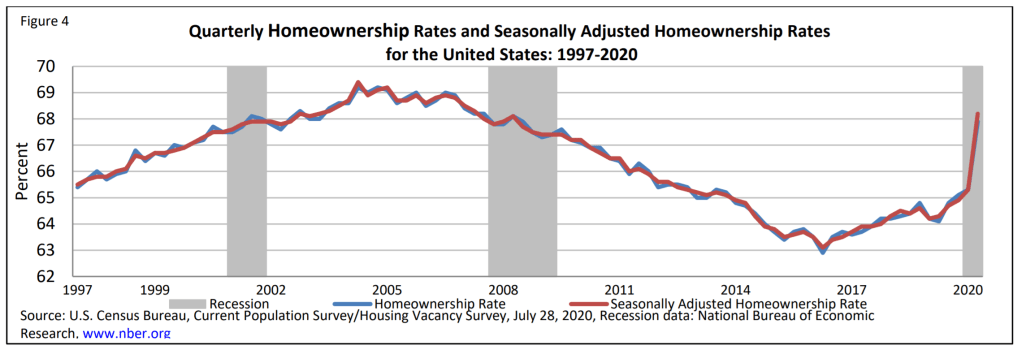
Gray areas = Recessions / Blue line = Homeownership rate / Red line = Seasonally Adjusted Rate

The homeownership rate in this century peaked at 69.2% during the second and fourth quarters of 2004.

As you’d expect, the homeownership rate varies among different age groups, currently 40.6% for adults under 35 and 80.4% of persons 65 and older. The rate has been rising in each age group. In 2015 (2nd quarter) it was 38.4% for the under-35 age group, and it was 78.5% for the 65-and-over group. The greatest increase was in the 35-44 age group, which increased from 58.0% to 64.3% during the same 5-year period.

Homeownership surged in every race and ethnic group in the second quarter from last year to this year. For Non-Hispanic Whites, the rate increased from 73.1% to 76.0%. For Blacks it surged from 40.6% to 47.0%, and for Hispanics of any race, it surged from 46.6% to 51.4%.

The Census report came with a caveat that its data collection methodology was impacted by the   Covid-19 pandemic, shifting from a mix of in-person and phone interviews to entirely phone interviews, which resulted in a reduced response rate, declining from 70% in April to only 65% in June, compared to an average response rate of 82.7% during the second quarter of 2019.

Realtor.com’s chief economist, Danielle Hale, believes the increase in homeownership was distorted by the change in methodology. “It’s likely the homeownership rate rose, but I don’t think it’s likely that it rose that much,” she said.

According to the article on realtor.com, “After a pause during stay-at-home orders, the housing market has rebounded — and then some. The lack of homes on the market hasn’t discouraged the hordes of buyers from descending en masse, seeking to escape small, city apartments and cramped starter homes while taking advantage of record-low mortgage interest rates. (Rates dipped just below 3% for the first time ever earlier this month.)”

As an example, Rita and I just locked in an interest rate of 2.5% for refinancing our home’s mortgage with Jaxzann Riggs of The Mortgage Network. A buyer I’m working with was quoted a 2.25% rate.

“People still want to own homes, and with mortgage rates low, a lot of people are taking advantage of that even though there are lots of scary things going on in the economy,” says realtor.com’s Hale.

The article continues, “This has led median home prices to shoot up 9.1% year over year in the week ending July 18. That’s despite a recession and the most widespread unemployment since the Great Depression. Meanwhile, the number of homes for sale is down 33% compared with the previous year, when the nation was already experiencing a housing shortage.”


How Should a Listing Agent Manage a Bidding War?

In today’s seller’s market, it is common for a new listing to attract multiple offers. There are three ways for a listing agent to deal with competing offers. Above all, it is important that the method chosen is in the seller’s interest, since that’s the listing agent’s legal obligation.

The first approach, of course, is to do nothing — not advise buyers that you have multiple offers and simply accept the best one. This approach, however, assures that the seller won’t get the most money he or she could get for their home.

The more common approach is to inform buyer agents that there are multiple offers and instruct them to submit their “highest and best” offer by a particular deadline. Sometimes the listing agent will add that the seller “reserves the right to sell the home prior to that deadline.”

When I’m functioning as the buyer’s agent, I dislike that approach. Why? Because it could inspire my client, shooting in the dark, to offer more than he needs to in order to win the bidding war, but, worse, we could learn later that my buyer could have won the bidding war if he or she had only offered a little bit more.

HighGate Investment Properties

The third approach is our approach at Golden Real Estate — to function like an auctioneer. If you’ve been to an auction, you know how it works. Everyone knows what the highest bid is, and no one is blindsided. As I explain to buyers and agents, “The only way you will lose out is if you drop out.”  They universally appreciate this approach.

Using this approach, I got my 6th Avenue West listing featured in last week’s column under contract for $41,000 over the listing price. It’s unlikely that asking for “highest and best” would have produced an offer for that amount. The winning bidder’s agent had submitted a full-price offer initially, but, being updated on competing offers, she won the bidding war with her third submission. The other agents had the opportunity to win the bidding war, but they chose when to drop out. The result was that the winner was happy, the seller was very happy, and no one was angry or blindsided in the process. Disappointed, yet, but not angry.

In a bidding war on my other new listing, the price was bid up by about $16,000. In that case, the seller chose not to take the highest bidder (but not by much) because that buyer was an investor, and she preferred an owner occupant. That reflects an important point when handling multiple offers: The seller is always in charge.

A High-Performance Car Can Kill You. A High Performance Home Can Save Your Life.

I have the best assignment on the steering committee of the Metro Denver Green Homes Tour — shooting video tours of the homes we choose to feature. Because of Covid, I’m taking that assignment more seriously than ever, because we may not have an in-person tour this year. (The tour is on October 3rd.)

I post these tours (along with the video tours of our listings) on my YouTube channel. Go there to check out some of the more recent tours.

Those videos, however, are limited in what they can convey in 7 to 10 minutes, so I must leave out a lot of what I learn during the lengthy orientation I get from each homeowner prior to shooting the video.

A good example was my tour last Saturday of Jen Grauer and Josh Renkin’s house in Denver. They scraped a house and built from scratch the best example of a “high performance home” I have come across yet — and I’ve seen a lot of high performance homes.

My 7½-minute tour of the house that Jen completed three years ago could not include a lot of what makes it such a good example of sustainability, so I’ll add to it here.

To be “net zero energy,” a solar-powered home like Jen’s has to be super insulated and super efficient in its use of energy. When a home is that tight, indoor air quality has to be addressed to make the home safe. That job is performed by an Energy Recovery Ventilator (ERV).

The ERV’s job is to bring in fresh air from the outside and to expel bad air while maintaining a healthy indoor humidity level. In the typical home, exhaust fans in bathrooms, kitchens and laundry rooms exhaust air to the outside, thereby drawing fresh air into the house only through whatever leaks exist around doors, windows and other penetrations of the home’s “envelope.” An ERV has one dedicated duct to exhaust air and another to bring in fresh, filtered air. This air is circulated through the house via multiple exhaust and fresh air vents around the home. In addition to maintaining indoor air quality, the ERV transfers some of the temperature (and humidity) of the outgoing air to the incoming air when there is a differential between the two.

Let’s say your home is 70 degrees inside, but it’s 100 degrees outside. The temperature of that incoming air can be reduced to, say, 75 degrees by passing it through a heat exchanger where it doesn’t mix with the outgoing air but acquires some of its temperature. Similarly if the outdoor air is below freezing, the ERV might raise that incoming air to, say, 50 degrees. (I could be way off on these numbers. I’m just trying to convey the concept.)

A conditioning ERV (or CERV) monitors the level of carbon dioxide and volatile organic compounds (VOCs) in the outgoing air. You can set a level that is acceptable (say, 900 ppm maximum) and the CERV will increase the flow of air when those levels are exceeded to bring them back to the acceptable range. Whereas an ERV runs 24/7, the CERV only needs to turn on to bring the levels of CO2, VOCs and humidity down to set acceptable levels. A CERV also has an internal heat pump to add heat or cooling. (See my videos of John Avenson’s and Jim Horan’s homes.)

In Jen’s case, in addition to an ERV, she made sure that the home was built with low-VOC products. For example, instead of using high-VOC particle board, her cabinets are made with zero-formaldehyde birch plywood and her island is solid maple and waterproofed with a zero-VOC oil. Her home has no wall-to-wall carpeting, which typically has VOCs in it. (These items are mentioned in the video of Jen’s house.)

Radon is another pollutant which seeps into every home through their concrete foundation walls and slab-on-dirt. To further improve air quality, Jen installed a radon mitigation system.

In summary, a high performance home can not only save you money in the long run (it costs more to build but nearly eliminates monthly utility bills), it can also create a home than extends your life through improved indoor air quality.

Many Home Sellers Aren’t Familiar With the Capital Gains Tax Exemption

I’m not an accountant or tax advisor, but periodically I need to explain to clients the exemption on capital gains tax enjoyed by homeowners. (You’ll want to verify what I write with your accountant or tax advisor.)

Prior to 1997, the seller of one’s primary residence was required to buy another home that was at least as costly as their previous home in order to avoid paying capital gains tax on the sale.  Since passage of the Taxpayer Relief Act of 1997, however, that is no longer the case, although there are several important rules.

First of all, the home you sell must have been your primary residence for two of the five years preceding the date of sale, and you can only do this once every two years. 

Rita and I once sold a home after owning and living in it for just 18 months, but there was no gain on the sale, so it didn’t matter that we didn’t qualify for the exemption.

Occupancy does not have to be continuous. You only have to have lived in the house for a total of 24 months prior to the date of sale. If you want to enjoy the exemption on a home that you previously lived in, then rented for less than five years, you may need to move into it until the total occupancy meets the 2-year requirement, if you want to enjoy the exemption.

If you’re single, you are exempt from tax on the first $250,000 of gain. For a married couple, the exemption is doubled. (For LGBT couples who own a home together, being able to marry legally brought with it this significant financial advantage.) The gain is calculated by deducting from the sale price your “basis” in the home.  That basis is the sum of the price you paid for the home, the cost of improvements or additions made to it, and the costs and fees associated with purchasing and selling it. Those fees include real estate commissions, title insurance, recording fees, legal expenses, etc.

For example, let’s say you bought a home 30 years ago for $100,000 and you sell it for $700,000 this year. You are married, so you qualify for the $500,000 exemption. If you can document $50,000 in improvements (not repairs), and your cost of selling was, say, 6%, including commissions, title insurance and fees, your basis is increased by $92,000, raising it to $192,000. Thus, your gain was $508,000, but only $8,000 of it is taxable. You will owe 15% federal plus 4.5% Colorado capital gains tax on that $8,000. That amounts to $1,560 tax that would be due the following April 15. That still leaves a lot of tax-free profit from the sale!

Now and then, I meet a couple, like I did last week, who are selling a home they purchased over 30 years ago, and are pushing up against a capital gains tax liability, especially if the homeowner is not married. (If the homeowner is widowed, he or she has two years to sell before the exemption drops to $250,000.) If you are in that situation or approaching it, you could benefit from selling your home and buying another one.

It’s a mistake to put your heirs on the title of your home so they inherit it. That’s because in addition to inheriting your home, they also inherit your basis, which could cost them dearly when they end up selling it.  It’s better to put them on a “beneficiary deed” or let them inherit it through your will. In either scenario, the basis of the home is stepped up to its market value at the time of your death.  The beneficiary deed is a particularly attractive option because the cost of creating and recording it is minimal, and it can be revoked at any time.

One of my clients is a home builder. He builds homes one at a time over a 2-year period, moving into and living in each of them for two years while building the next house. That way he is able to apply the full $500,000 marital exemption to the sale of each house, whereas he’d owe regular income tax on his profit for each home if he sold it upon completion.

You can claim the exemption on the sale of a second home, but you need to have lived in it as your primary residence for two of five years preceding the date of sale, and, as mentioned above, you have to wait two years before taking that exemption on your other home.

If you have additional questions about qualifying for this tax exemption, don’t ask me. As I said, I’m not an accountant or tax advisor.  However, I can refer you to our accountant (who does our taxes) if you don’t have one. I can also refer you to a real estate lawyer for a beneficiary deed.

New Brokerage Offers to Help You Buy Before You Sell

Perhaps you’ve wondered about those TV commercials by a new brokerage called Orchard offering to help you buy your replacement home without selling your current home first. Golden Real Estate has been successful at that, too, although not using the same business model. (See my previous columns on April 25, 2019 and May 11, 2017 and Sept. 17, 2015 and Mar. 12, 2015.)

The company, which came to Denver in January and has closed 14 purchases and 17 sales so far, was formerly called Perch. If you scroll to the bottom at Orchard.com, there’s a link to their reviews, which I suggest clicking on. The 7 negative reviews give an insight that the positive reviews don’t provide.

Basically, the company, based in New York, is “vertically integrated,” meaning that they have their own mortgage company, title company, etc. They are backed by a venture capital firm which provides the working capital to purchase your home if they don’t sell it first.

They operate like the iBuyers I wrote about in two previous columns (Jan. 2, 2020 and August 22, 2019 ). They make a market-based offer to purchase your home, then reduce that offer based on inspection, and they charge a 6% fee (in lieu of a commission).

Also, you pay rent for your new home, which you don’t actually buy until after your home closes. If it doesn’t close in 90 days, Orchard will buy it at their low-ball price. Note: Their agents work on salary, not commission, which is unattractive to the really successful agents.

Sound advice from a virologist about the Coronavirus

This was sent to me by a school classmate. I Googled this doctor’s name and he speaks with authority. I haven’t seen this information or advice in the media!

Notes on Coronavirus for guidance:  Good luck to all of us! James Robb, MD FCAP   

1. If you have a runny nose and sputum, you have a common cold
2. Coronavirus pneumonia is a dry cough with no runny nose.
3. This new virus is not heat-resistant and will be killed by a temperature of just 26/27 degrees. It hates the Sun.
4. If someone sneezes with it, it takes about 10 feet before it drops to the ground and is no longer airborne.
5. If it drops on a metal surface it will live for at least 12 hours – so if you come into contact with any metal surface – wash your hands as soon as you can with a bacterial soap.
6. On fabric it can survive for 6-12 hours. normal laundry detergent will kill it.
7. Drinking warm water is effective for all viruses. Try not to drink liquids with ice.
8. Wash your hands frequently as the virus can only live on your hands for 5-10 minutes, but – a lot can happen during that time – you can rub your eyes, pick your nose unwittingly and so on.
9. You should also gargle as a prevention. A simple solution of salt in warm water will suffice.
10. Can’t emphasize enough – drink plenty of water!


THE SYMPTOMS
1. It will first infect the throat, so you’ll have a sore throat lasting 3/4 days
2. The virus then blends into a nasal fluid that enters the trachea and then the lungs, causing pneumonia. This takes about 5/6 days further.
3. With the pneumonia comes high fever and difficulty in breathing.
4. The nasal congestion is not like the normal kind. You feel like you’re drowning. It’s imperative you then seek immediate attention.

BIO:  As some of you may recall, when I was a professor of pathology at the University of California San Diego, I was one of the first molecular virologists in the world to work on coronaviruses (the 1970s). I was the first to demonstrate the number of genes the virus contained. Since then, I have kept up with the coronavirus field and its multiple clinical transfers into the human population (e.g., SARS, MERS), from different animal sources
The current projections for its expansion in the US are only probable, due to continued insufficient worldwide data, but it is most likely to be widespread in the US by mid to late March and April.


Here is what I have done and the precautions that I take and will take. 

These are the same precautions I currently use during our influenza seasons, except for the mask and gloves.


1) NO HANDSHAKING! Use a fist bump, slight bow, elbow bump, etc.
2) Use ONLY your knuckle to touch light switches. elevator buttons, etc.. Lift the gasoline dispenser with a paper towel or use a disposable glove.
3) Open doors with your closed fist or hip – do not grasp the handle with your hand, unless there is no other way to open the door. Especially important on bathroom and post office/commercial doors.
4) Use disinfectant wipes at the stores when they are available, including wiping the handle and child seat in grocery carts.
5) Wash your hands with soap for 10-20 seconds and/or use a greater than 60% alcohol-based hand sanitizer whenever you return home from ANY activity that involves locations where other people have been.
6) Keep a bottle of sanitizer available at each of your home’s entrances. AND in your car for use after getting gas or touching other contaminated objects when you can’t immediately wash your hands.
7) If possible, cough or sneeze into a disposable tissue and discard. Use your elbow only if you have to. The clothing on your elbow will contain infectious virus that can be passed on for up to a week or more!

What I have stocked in preparation for the pandemic spread to the US:

1) Latex or nitrile latex disposable gloves for use when going shopping, using the gasoline pump, and all other outside activity when you come in contact with contaminated areas.
Note: This virus is spread in large droplets by coughing and sneezing. This means that the air will not infect you! BUT all the surfaces where these droplets land are infectious for about a week on average – everything that is associated with infected people will be contaminated and potentially infectious. The virus is on surfaces and you will not be infected unless your unprotected face is directly coughed or sneezed upon.
This virus only has cell receptors for lung cells (it only infects your lungs) The only way for the virus to infect you is through your nose or mouth via your hands or an infected cough or sneeze onto or into your nose or mouth.
2) Stock up now with disposable surgical masks and use them to prevent you from touching your nose and/or mouth (We touch our nose/mouth 90X/day without knowing it!). This is the only way this virus can infect you – it is lung-specific. The mask will not prevent the virus in a direct sneeze from getting into your nose or mouth – it is only to keep you from touching your nose or mouth.
3) Stock up now with hand sanitizers and latex/nitrile gloves (get the appropriate sizes for your family). The hand sanitizers must be alcohol-based and greater than 60% alcohol to be effective.
4) Stock up now with zinc lozenges. These lozenges have been proven to be effective in blocking coronavirus (and most other viruses) from multiplying in your throat and nasopharynx. Use as directed several times each day when you begin to feel ANY “cold-like” symptoms beginning. It is best to lie down and let the lozenge dissolve in the back of your throat and nasopharynx. Cold-Eeze lozenges is one brand available, but there are other brands available.

I, as many others do, hope that this pandemic will be reasonably contained, BUT I personally do not think it will be. Humans have never seen this snake-associated virus before and have no internal defense against it.


Tremendous worldwide efforts are being made to understand the molecular and clinical virology of this virus. Unbelievable molecular knowledge about the genomics, structure, and virulence of this virus has already been achieved. BUT, there will be NO drugs or vaccines available this year to protect us or limit the infection within us. Only symptomatic support is available.

I hope these personal thoughts will be helpful during this potentially catastrophic pandemic. You are welcome to share.

Good luck to all of us! James Robb, MD FCAP  

Celebrating Martin Luther King Jr. With His Words

We’re all familiar with Martin Luther King Jr.’s “I Have a Dream” speech on the steps of the Lincoln Memorial, but this Monday, CBS This Morning (my favorite morning TV habit) featured the audio of Martin Luther King Jr.’s “American Dream” speech given on Feb. 5, 1964, at Drew University, interleaving the recording of his words with two of his children and one grandchild reading his words. It was very inspiring.

You can watch that well-produced segment online at: https://www.cbsnews.com/video/mlk-jr-s-children-grandchild-read-his-american-dream-speech/

You can read the full 6,700-word speech at: https://depts.drew.edu/lib/archives/online_exhibits/King/speech/TheAmericanDream.pdf

The Future of Heating is Heat Pumps, Not Gas Forced Air

Here in Colorado, as in much of the country, the typical home heating system is gas forced air. A gas flame heats up a plenum across which a fan blows air through ductwork into the various rooms of a house.  For cooling, the same ductwork and fan are used, but instead of the flame heating that plenum, the air passes over a set of coils beyond the plenum with super-chilled fluid created by an outdoor compressor.

Gas forced air, however, is relatively inefficient and is only common in the United States because of our exceptionally low cost of natural gas and other fossil fuels.

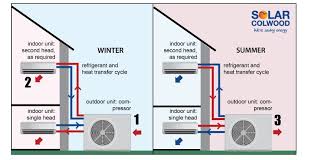
Elsewhere in the world, heating is done using heat pumps. What is a heat pump? Your central air unit is a heat pump, but it operates in only one direction—extracting heat from indoor air and dissipating it outdoors. A heat pump heating system simply reverses that process, creating heat by extracting heat from outdoor air and dissipating it in your home, either through your existing ductwork or through wall-mounted “mini-split” units. Unlike gas, a heat pump moves heat instead of creating it.

How a heat pump works to heat and cool a home using wall-mounted mini-split units heated and cooled by an exterior compressor.

Rita and I replaced our gas furnace in 2012 with a hybrid system by Carrier. It heats our home using the heat pump unless the outdoor temperature falls below freezing, at which point a gas burner kicks in. With our solar panels providing the electricity for the heat pump, our highest mid-winter Xcel bill is under $50. Meanwhile, at Golden Real Estate’s office, as described in my Jan. 4, 2018, newspaper column, we got rid of our furnace and ductwork and installed a ductless mini-split system (like in the above diagram), also powered by solar panels. As a result, our Xcel bill is under $11/month year-round.

We Provide Free Moving Boxes

Buyers and sellers appreciate the free moving boxes which we provide with our free moving trucks. We have a shed behind our office which is used solely to store lightly used moving boxes.

But that shed is getting empty again. If you have used moving boxes that you’re willing to part with, we will pick them up. In return, we promise to give you free boxes when the need arises!  Call 303-525-1851 to arrange pickup (or bring them to us).  Thanks!

Remodeling Your Home to Help It Sell May Not Be the Moneywise Approach

Before putting your home on the market, it’s natural to ask for advice on what should be fixed or upgraded before doing so. Here’s how we re-spond when asked.

First, you need to know that every study we’ve seen shows that sellers almost never recoup 100% of the cost of remodeling, so you should only do so for your own enjoyment, years before you plan to sell. Don’t make updates expecting to get a higher price for your home..

Rita and I, or example, recently spent $40,000 to update our kitchen, and we love it! (It was done by Bonnie Kitchen Design in Golden, and we strongly recommend her!)  But that doesn’t mean our home increased its value and selling price by $40,000 or more. We made that improvement for our own enjoyment, just as we did when we spent $20,000 on our master bathroom several years ago.  Yes, it will increase the attractiveness of our home when we eventually sell it, but that will only be after years of happy enjoyment of those two improvements.

We’ll probably make additional improvements in coming years, but it will never be to dress up the home for sale. On top of not recovering the full expenditure upon sale, it’s a huge disruption of one’s life to engage in major renovations.

The most recent study I’ve read about cost vs. ROI (return on investment) was made by Remodeling magazine, as reported by RISmedia.

According to that report the 5 projects with the highest ROI in the mid-range cost category are:

Manufactured Stone Veneer (94.9%)

Minor Kitchen Remodel (80.5%)

Deck Addition (Wood) (75.6%)

Siding Replacement (75.6%)

Entry Door Replacement (Steel) (74.9%)

The 5 projects with the highest ROI in the upscale cost category are:

Garage Door Replacement (97.5%)

Window Replacement (Vinyl) (73.4%)

Grand Entrance (Fiberglass) (71.9%)

Window Replacement (Wood) (70.8%)

Bathroom Remodel (60.2%)

Lastly, here are the 5 projects with the lowest ROI in the mid-range cost category:

Backyard Patio (55.2%)

Master Suite Addition (59.4%)

Bathroom Addition (60.6%)

Roofing Replacement (Metal) (60.9%)

Major Kitchen Remodel (62.1%)

Master Suite Addition (50.4%)

Bathroom Addition (58.1%)

Major Kitchen Remodel (59.7%)

Bathroom Remodel (60.2%)

Window Replacement (Wood) (70.8%)

So, clearly you should only remodel when it’s intended to be enjoyed by you for years to come. If you know you’ll be selling this year, we advise our clients as follows.

First, only make improvements that eliminate a defect or an issue which will turn off prospective buyers.  I call these “eyesores,” things that stand out like a sore thumb, and not things that are simply “dated” or out of tyle.

Here are some examples:

Do refinish hardwood floors that are seriously and obviously in need of refinishing.

Do replace carpeting that is seriously old, such as 1970’s shag carpeting, or carpeting that is seriously worn or stained. (Again, think “eyesore.”)

Do replace damaged countertops.

Do repair damaged walls and replace damaged doors that can’t be repaired.

Do replace those 1990’s glass-and-brass lighting fixtures. (They’re so unappealing that Habitat’s thrift store won’t accept them as donations!)

Do replace burned out light bulbs.

Do repaint (inside and out) where there is peeling or discolored paint.

Do replace rotted timbers on your deck, then power wash and re-stain or repaint as necessary.

Do improve curb appeal (always the first impression), including weeding and pruning and freshening the front door. (It’s true that red doors sell homes…)

Do have someone with “fresh eyes” walk through your house and identify other turn-offs. (Our stager performs that function.)

Do not replace undamaged countertops or bathroom fixtures just because they are “dated” — even those pastel colored bathtubs and sinks. (I tell buyers “You can’t buy these anymore!”)  The exception would be the toilets. A white chair height low-flow toilet can be replaced for a couple hundred dollars and installed by our handyman for $50 (but he only works for our clients).

Beyond the above advice, I tell my sellers to be strategic about major issues which they know need to be done. If these are likely to become inspection issues, don’t fix them prior to listing your home if they’re not the kind of eyesore which would deter a buyer from making an offer.

For example, I have a listing, currently under contract, which had damage to the concrete driveway. The seller was thinking he should repair it before putting the home on the market. We knew it would be an inspection issue, but by leaving it undone we could use it as a bargaining chip. Sure enough, we got under contract (well above listing price because of competing buyers), and the inspection demands included repairing the driveway. Because it was such a big expense, the buyer didn’t ask for a bunch of other repairs.  If the seller had fixed the concrete prior to listing the home, you can sure the buyer would have asked for those other repairs, but instead they were delighted that the seller agreed to pay for the concrete repair.

I have used the same strategy to save other sellers money on inspection items. For example, one seller knew that radon needed to be mitigated, but we knew that this issue (which we properly disclosed) would not deter buyers from competing for the home. Yes, it became an inspection demand, and the buyer was delighted that the seller agreed to mitigate it.

Your situation will be different, of course, and we are happy to meet with you in your home and discuss what’s needed and strategic to fix before listing. We consider such advice part of the free staging consultation we provide sellers.