Getting Personal: Reflections on My Two Decades as a Colorado Realtor

I’m writing this from a hotel room in Athens, following an 11-day cruise of the Aegean Sea, so real estate isn’t top of mind for me right now. I needed something that would be easy to write, and it occurred to me to share my path from newly licensed agent over 20 years ago to where I am today. Maybe it will interest a few readers.

I was originally licensed as a Colorado real estate agent in April 2002, so I’m well into my third decade as a real estate broker.

Real estate is a tough field to break into. Back in 2002, new brokers received a one-year initial license. More than half of new licensees would not renew their license at the end of their first year because they had completed few or no transactions, burned through savings, and thought it futile to continue.

As I recall it, my gross commission income that first year was about $7,000. In my second year, it was about $75,000, and in my third year it was $150,000. These are gross figures, because back then we were all “independent contractors” and we had to cover all the costs of being in business — computers, software, MLS dues, Realtor dues, E&O insurance, cell phones, car expenses, and self-employment tax. And most of those expenses came upfront, so waiting six months or longer for a first commission check was hard for anyone who wasn’t prepared to go thousands of dollars in the hole before earning a reliable income.

Fortunately, I did have the financial reserves to outlast that “newbie drought,” and I did go at least $30,000 negative before going positive, ultimately becoming quite successful.

When a real estate license is first issued, you have to hang your license with a brokerage. You may be an independent contractor, but you can’t be an independent broker until you have two years’ experience as a broker associate and pass a 24-hour employing broker’s class.

I was drawn into getting a real estate license by attending a career night at Coldwell Banker, so hanging my license with them was an easy decision, and they had a two-week “Fast Start” class for new agents taught by Rich Sands which gave me the tools and understanding I needed to put my financial reserves to work. “You have to spend money to make money,” I reminded myself as I invested heavily in a full-time career as a real estate broker.

I’ll never forget what Rich said in the very first session of that 2-week intensive class. “Congratulations,” he told my classmates and me, “you are now licensed to sell real estate, and there are 20,000 agents out there with more experience than you. How are you going to make yourself stand out from them?”

At the time I was chair of the speakers bureau for Habitat for Humanity of Metro Denver, so my first thought was to stand out by pledging 10% of every earned commission to Habitat.  I recall getting one listing from that offer, but Habitat wouldn’t promote it, so I dropped that pledge after sending several large checks.  (I’m still active with Habitat and still donate, but not a percentage of each closing.)

The other thing I did — a common strategy recommended by Rich Sands — was to specialize in a particular subdivision and “farm” it for listings. The subdivision I chose was the Village at Mountain Ridge, which had just been developed on the west side of Hwy 93 in Golden.

At the time I had a yellow-naped Amazon parrot, Flower, who I referred to as my “unlicensed personal assistant” and even printed up business cards for her with that title. Countless residents or former residents of Mountain Ridge have pictures of Flower on their children’s shoulders and received her business card which Flower “autographed” by puncturing it with her beak. I served free ice cream at the neighborhood picnic (with Flower, of course), and I sponsored a yearly garage sale. I also published a newsletter with useful information including but not limited to the real estate market for the subdivision.

I did all those things Realtors do to get known and trusted by homeowners — plus some things unique to me.  It worked well.

However, you’re looking at my most successful investment. Using my training as a journalist, which included a summer internship at The Washington Post, I chose from the very beginning to write a real estate column. At first it appeared in The Voice of Golden, then the Golden Transcript, and ultimately other Jeffco weekly newspapers and the Jeffco editions of YourHub. It has been so successful in generating business that for several years now I have paid for it to appear in every edition of YourHub.

At first I wrote this column only once a month, but soon I was writing it weekly, spending $30-50,000 per year to have it published in those newspapers. Almost two decades later, I estimate that I get about 90% of my buyers and sellers from long-time (and newer) readers of this “advertorial.” It has also benefited our broker associates (listed below), since I can’t service all the leads that come to me. As a result, the per-agent business done by Golden Real Estate is much higher than that of other brokerages in this market.

Of course, I didn’t know much about real estate when I started writing this column in 2003, but I would research a topic in order to write about it, and I would ask  my managing broker to review and correct what I wrote before sending it to be published. The process taught me a lot about real estate. It’s my personal continuing education program. You’ve probably heard the expression that “you teach what you need to learn.” I needed to learn all aspects of real estate, and writing this column was how I did that.

Most brokers with my number of years in the business have numerous initials after their name representing the certifications they have earned by taking special classes. These include Accredited Buyer Representative (ABR), Graduate Realtor Institute (GRI), Certified Residential Specialist (CRS), GREEN, e-Pro, Seniors Real Estate Specialist (SRES),  and others. I have none of those certifications, but my writings have given me a broad understanding in all those fields.

I’m not downplaying those classes and certifications — they have helped many of my fellow agents gain knowledge in each field, which is why I look for those initials myself when making referrals.  Those initials evidence real knowledge.

I like to tell a story from my childhood which rings true in this context. One of my 9th grade teachers said in an end-of-term report, “Jim shows dangerous signs of becoming a dilettante.”  I asked Dad what a dilettante was. “It’s a person who knows a little about everything but not a lot about one thing,” he said. “Sounds good to me!” I replied.

As I have written in the past, the biggest contributor to an agent’s expertise — in most but not all cases — besides those certifications is the number of transactions he or she has completed, more so than the number of years in the business. We learn from every transaction, and I have been blessed to have completed hundreds of transactions. The average agent completes only two or three transactions per year, and a high percentage of agents go an entire year without a paycheck. That was true in 2002 and it’s still true today.

The New Sellers Property Disclosure Is a Great Improvement

Every few years, the Division of Real Estate releases a revised Sellers Property Disclosure to be used by real estate brokers. A forms committee suggests revisions which then must be approved by the Colorado Real Estate Commission.

I wasn’t a big fan of the version which was released in 2018, but I’m a big fan of the one which is mandatory beginning on January 1, 2023. There are disclosures for each type of property. In this blog post, I’ll only talk about changes to the one for residential listings. Here’s a link to it, which you will need to download to scroll through it.

Some of the changes are subtle — for example, the seller is told to disclosure adverse materials facts instead of defects. That makes sense, since there was no definition of “defect” in the 2018 version.

Other changes are more substantive. For example, instead of just asking if the property is in an HOA, it asks for the name of the association(s) and contact information for each. If the neighborhood has cluster mailboxes, it asks for the location and number of the mailbox.

At the top of the form, it asks when the seller acquired the property, not only the year it was built as in the 2018 form. It also asks the seller to attach any reports, receipts or other documents “you believe necessary for the information you provide to be complete.” There was no such request in the prior version.

The seller is asked whether the home is subject to deed restrictions or affordable housing restrictions, and whether it is in a historic district. This is new.

Another sign of the times is that instead of asking if there is or has been tobacco smoke, it refers only to “smoking” and adds in parentheses “including in garages, unfinished space, or detached buildings.”

Under “Access and Parking,” the form asks if there are any limitations on parking or access due to size, number and type of vehicles. Instead of asking if there are “any access problems,” it asks the broader question of whether there are “access problems, issues or concerns.” Those three words are used elsewhere to expand on the question of “problems.”

In the section on “Use, zoning and legal issues,” instead of asking simply whether any additions or alterations have been made, it specifies whether they were made with a building permit and without a building permit, including “non-aesthetic alterations,” which is undefined. It also asks whether the property has been used for short-term rentals in the past year and whether there are “grandfathered conditions or uses.”

Under “Sewer,” the form asks for the name of the sewer service provider, the date of the last sewer scope, the date of the last septic use permit, inspection, and pumping — all useful information.

In the “Water” section, the form asks for the location of the water shutoff.  If there’s a well, it asks the date of the last inspection and service.  It asks the gallons per minute (GPM) of the well as of a specified date, and it asks the size in gallons of any cistern. Lastly, it asks whether the seller purchased any supplemental water in the last two years — an indication of the well’s adequacy.

The form asks the seller to identify the electricity, cable TV and internet service providers.

The instructor of the class I took regarding these new contracts and disclosures reminded us that the sellers property disclosure is to be accurate as of the date the home goes under contract. Therefore, if the property goes under contract after Dec. 31, 2022, this new form must be completed by the seller, but it does not need to be replaced if the listing is already pending but does not close until 2023.

That led me to adopt a new “best practice” which I’ll share here with my fellow listing agents. Instead of having the seller complete and sign the sellers property disclosure when I list the home, my practice henceforth will be to have the seller complete the document at the time of listing but to review and sign it only after going under contract with a buyer, thereby assuring that it is accurate as of the purchase contract date, as stated on the disclosure.

DMAR’s Metro Area Statistics Cover 11 Counties

What do the rural cities and towns of Kiowa, Agate, Simla, Fairplay, Georgetown, Empire, Black Hawk, Rollinsville, Nederland, Allenspark, Lyons, Longmont, and Bennett have in common?  They’re all included in the Denver metro area statistics compiled monthly by the Denver Metro Association of Realtors for its market trends report. Here is a map of the 11 counties included in that report.

REcolorado, the Denver MLS, allows infinite flexibility in drawing the boundaries when searching for listings or doing statistical analysis, so my preference is always to draw a radius of 20 miles from downtown Denver when compiling metro statistics.

Below is this month’s infographic from DMAR showing the November month-over-month statistics for their 11-county “metro area.”

Under all five elements of the infographic I have inserted the same November statistics for the 20-mile radius of downtown Denver that I prefer to use.

The variations this month are not as great as I have seen in some months.

Lennar Subdivision Near Austin, Texas, Features 3D-Printed Homes

In the Texas Hill Country outside Austin, Lennar has broken ground on a 100-home subdivision in which all the homes will be built using ICON’s 3D printing robots for the exterior and interior walls.

You can find a 1-minute You-Tube video clip demonstrating the process at https://constructutopia.com/3d-printing/lennar-and-icon-begin-100-home-3d-printed-community-texas

The bottom four homes in the aerial rendering above show the various stages of the 3D printing process. After a home’s slab is poured, an overhead gantry goes back and forth pouring 3-inch (I’m guessing) layers of concrete one on top of the other, following a computerized plan for the walls and openings.

Lennar is the first production builder I know of which has adopted ICON’s proprietary 3D printing process to build an entire subdivision. The process eliminates most of the waste and labor associated with building the walls in homes.

The windows and doors are framed conventionally, and wood trusses are added to support the roof.

Developed by Hillwood Communities, the 3- and 4-bedroom homes offer eight different floorplans, with 24 unique elevations ranging from 1,500 to over 2,100 square feet.

The Georgetown, Texas, community, called Wolf Ranch, will “set the standard for the future of homebuilding — technologically advanced, energy efficient and architecturally striking,” according to ICON.

The construction method is not only more sustainable but produces homes that are resistant to fires, floods, termites, and high-wind events.

For the Right Homeowner, an “All-in-One” Loan Can Pay Down Your Mortgage Faster

I was reminded recently about a very non-traditional mortgage loan option that might interest you. The “All in One” has been available for many years but has been widely overlooked in recent years in favor of low fixed-rate loans. I asked Jaxzann Riggs, owner of The Mortgage Network, to explain how the loan works.

The “All in One” (AIO) loan is aptly named because it ties your mortgage loan and checking account together. They become one account. Dollars left in your checking account overnight reduce your mortgage balance for that day (and subsequently the interest due on the loan).

Typically, the money that you have in your checking account does not earn interest. When your money is sitting in your checking account, it’s “working” for your bank, not you. Banks lend out the dollars that you leave in your checking account overnight to other banks, earning interest on those loans. 

The AIO checking account (which is also your mortgage account) can be used just like your current checking account. You deposit your earnings into the AIO account and pay your monthly bills (including the monthly mortgage payment) out of the account.

Since the amount of interest that you pay on your mortgage loan is based upon your loan balance, any extra money that you store in your account lowers both your loan balance and subsequently your interest owed for that month.

Interest on your mortgage is accrued daily, so you will benefit even if money is moving in and out of your account frequently. For example, if you are paid on the first of each month but your bills aren’t due until later in the month, your paycheck would be lowering your loan balance and interest payment just by sitting in your checking account for a few weeks.

Typically, an AIO borrower will store some portion of their emergency funds or savings into their AIO account. All funds in the account can be used whenever needed, but you will be reducing your mortgage balance by that amount if it’s in your AIO account.

Some will ask, why not just make extra payments to a traditional 30-year fixed mortgage? While making extra payments on your mortgage will also have the same effect of paying down your principal balance quicker, you won’t be able to access the dollars that you have prepaid if you need it in the future. To accomplish that, a borrower with a traditional loan must either refinance his or her current loan or obtain a HELOC to access equity. Also, while you will end up paying off your loan earlier, your monthly payments will always stay the same if you are in a fixed rate product.

Because the All-In-One loan is an adjustable-rate mortgage it is possible that you will be paying a higher rate for the AIO than a fixed rate option. The goal of the AIO is to utilize your excess cash to reduce your loan balance faster than a traditional loan. That is where the value lies.

The AIO can be used to refinance your current loan or to buy your next home, but it is not going to be the best option for everyone. The ideal AIO candidate has a history of having money left over each month after paying all bills. The requirements include a high credit score, and a lower debt-to-income (DTI) ratio than most mortgages allow.

If you are interested, Jaxzann, who is a licensed mortgage broker and certified to offer the AIO, will carefully analyze your current income and spending habits and create a personalized scenario for you. You can reach her at (303) 990-2992.

A Subdivision in Pueblo Sets the Standard for All-Electric Home Construction

One of my favorite newsletter subscriptions is to “Big Pivots,” written and edited by Allen Best. The focus is on sustainability, especially as it relates to real estate and home construction. This week’s newsletter featured an article which I am reprinting with permission because it would be hard to improve upon it.

By ALLEN BEST

It took Rod Stambaugh a couple of years before his vision of high-performance housing on the northeastern edge of Pueblo had anything to show. Now he and his two partners have begun getting results. In recent weeks they’ve sold three homes for an average price of $780,000.

“It’s been a long road, but it’s getting easier,” says Stambaugh.

The company, Pure Zero Construction,  has 14 of the single-family houses under construction with work underway on the first of 51 townhomes.

None of the homes will have natural gas or propane. The company has rights to build as many as 500 additional homes in North Vista Highlands.

“We will compete all day on the merits and benefits of high-performance, all-electric homes as compared to stick-built housing that uses natural gas,” says Stambaugh. “We will win that battle every time.”

The townhomes will have 2,200 square feet and come in at around $600,000, he says. The company expects buyers to come from Denver and the northern Front Range.

Pueblo has a well-deserved reputation for lower real estate prices, but it does have pricier homes, too. Pure Zero is staking its reputation on both environmental performance, which translates into cost savings over time, and on health benefits.

Accumulating evidence points to harmful impacts of indoor air quality from natural gas combustion, whether for space and water heating or for cooking.

Gene Meyers, long-time “green” builder in the Denver metro area, has said that if for no other reason than health considerations, it’s time to get rid of natural gas in homes.

Having no natural gas comports with Colorado’s goals for greenhouse gas reduction goals. Several laws passed in 2021 provide direction for the decarbonizing of buildings through various new metrics, including building codes that make natural gas less desirable. So far, however, Colorado has not imposed bans on natural gas. The lone exception is Crested Butte, and the restriction there applies to relatively few units.

Stambaugh got into the building technologies world about eight years ago when he began building 189-sq.-ft. “tiny” homes after returning to Colorado from California. That business is called Sprout Tiny Homes. He sold some of the tiny homes to the Aspen Skiing Co. for use in Basalt. He is now at work on a third generation of workforce housing for Aspen.

Then, in 2020, he purchased land in Pueblo’s North Vista Highlands subdivision. He had thought that there would be no natural gas available in that subdivision. That turned out not to be true, but it’s true for the housing he and his two partners are building — and he has no plans to change.

“We will not deviate from our mission,” says Stambaugh. “We are going to build high-performance homes where you can see, feel and breathe the difference. That is our mission.”

One measure of a building’s performance is a metric called HERS, short for Home Energy Rating System. The lower the HERS score, the more energy efficient the home. Existing homes may have HERS ratings of 130. New homes built to code have HERS scores of 100 – al-though some production builders are shooting for lower scores. KB Home has said it plans to achieve HERS scores of 45 nationally by 2025.

How do Pure Zero’s homes rate? “We’re in the low 40s and we actually had a -9 score after adding solar,” says Stambaugh.

High-performance building has several components. One is building tightly to avoid loss of heat in the winter and cool air in the summer. Unlike houses built from 2x4s and 2x6s, the Pure Zero houses were built with structural insulated panels, or SIPs. They provide superior insulation and, says Stambaugh, provide corners that are always on the mark. They used to cost more than wood, but no longer.

Eliminating natural gas is another fundamental of the houses. Instead, electrically powered Mitsubishi air-source heat pumps extract the heat from outside air efficiently down to 0ºF (and with less efficiency below zero). They do the reverse during hot weather, eliminating the need for a separate air conditioning unit.

Stambaugh swears by Mitsubishi’s heat pumps. They cost $1,500 more than other air-source heat pumps, but their superior performance at lower temperatures will result in less need for backup heating. Those lower costs will recoup the original investment in five years.

[Golden Real Estate installed Mitsubishi heat pumps in its South Golden office and downtown storefront, and they work great.]

Instead of natural gas ranges, the houses in Pueblo have induction ranges. Bathrooms are tiled from top to bottom. Temperatures throughout the 3,900-square-foot houses (with fully finished basements) are consistent. They’re so structurally tight that they are quiet even within a construction zone.

There used to be a higher cost premium for the materials. That has somewhat gone away.

But building high-performance homes requires rethinking, including finding subcontractors willing to learn new techniques. Stambaugh says his team had difficulty at first finding craftsmen willing to learn how to install the new technology. Some refused. Now, as the housing construction industry has slowed, some of those workers have returned, looking for jobs.

You can subscribe to the Big Pivots newsletter (and find lots of other interesting articles) at www.BigPivots.com. You will learn a lot, as I have, from Allen’s articles.

What Is a Heat Pump, and How Does It Work?

I came across a website that gives a great description of heat pumps, how they work, and why they are more efficient. Here’s the link for it.

Most Americans are accustomed to heating systems that generate heat using fossil fuels, wood, or electricity. But heat pumps don’t create heat, they move heat. Here’s how the process is explained on that website:

Heat pumps function similarly to refrigerators or air conditioners, which take warm air from one space and send it to another. In the winter, a heat pump transfers heat from the outdoors inside and, in the summer, it reverses this process.

There are two main types of heat pumps, and both can function as space heaters or coolers and as water heaters.

A ground-source (or “geothermal”) heat pump sends a mixture of water, antifreeze, and/or a refrigerant through a network of pipes buried below the frost line. As the liquid passes through the pipes, it absorbs the earth’s approximately 55-degree heat. The liquid is then drawn up into a compressor, which heats it further, creating a vapor. The heat pump then distributes the warm air through ducts or tubes throughout your home. In the summer, the heat pump reverses the process, taking warmth out of the house and transferring it to the earth.

An air-source heat pump extracts heat from the air rather than from the ground. It functions the same way, but because air temperature, unlike earth temperature, can get very cold, it has more work to do bringing up the temperature. As with a ground-source heat pump, a reversing valve inside the heat pump allows the same unit to function as an air conditioner in the summer. At right is an air source heat pump that was retrofitted into a ducted forced air heating/cooling system of one of my current listings in Golden.

Looking for a vendor who specializes in heat pumps? I recommend Sensible Heating & Cooling, 720-876-7166, or Helio Home, Inc., 720-460-1260.

NAR’s Annual Survey of Buyers and Sellers Shows Big Deviations From Past Years

 Every year the National Association of Realtors (NAR) surveys buyers and sellers of primary residences on a variety of topics. Usually, the changes from one year to the next are fairly minor, but the most recent survey (covering the period from July 2021 through June 2022) produced some big statistical deviations from prior years. Here are some of the findings that stood out to me.

1)   The percentage of first-time buyers dropped to a record low of just 27%, beating the previous record low of 30% in 1987 — 35 years ago! In the 2020-2021 survey it was 34%. The average age of first-time buyers jumped from 33 to 36. The average age of repeat buyers also rose — from 56 to 59.

2)   88% of all buyers were White, the highest percentage since the 1990s. Meanwhile, the percentage of buyers who were Black and Asian/Pacific Islander both dropped by half, from 6% to 3%. The percentage of buyers who were Hispanic/Latino rose slightly from 7% to 8%.

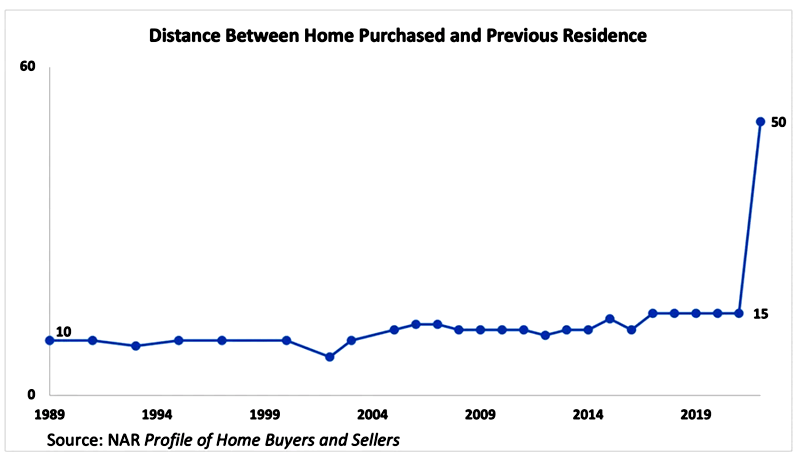
3)  Buyers moved an average of 50 miles from where they lived before, up from 15 miles the prior year, which was as high as it had been since at least the 1980s. (See chart below.) So, where did they move? Suburbs took a big hit, plunging from 51% to 39%, while rural and small town destinations jumped by half — 12% to 19% for rural areas and 20% to 29% for small towns. The NAR survey attributes that change to the pandemic’s effect of encouraging work from home. “Zoom towns were boom towns.”

4)   While only 3% of first-time buyers paid cash for their homes, 27% of repeat buyers paid cash, up from 17% the prior year. The survey attributes this to the surge in equity which homeowners had experienced in recent years, especially during the pandemic, providing them with lots of cash to spend on their replacement homes.

5)  How long buyers expect to remain in the home they just purchased had held steady since 2009 at 15 years for repeat buyers and 10 years for first-time buyers. The NAR survey showed a huge jump in that expectation for first-time homebuyers — from 10 years to 18 years. The expectation of repeat buyers remained unchanged at 15 years.

6)   The percentage of first-time buyers who had been renters plunged from 73% to 64%, while the number who moved from living with family or friends jumped from 21% to 27%. (See chart below.)

Click here to view the full summary of NAR’s 2022 survey of buyers and sellers.

Thanksgiving 2022 – In Spite of Everything, Much to Be Thankful for

First of all let me thank The Denver Post for making it possible for me to reach its many readers for well over a decade in this YourHub ad. I estimate that we get 90% of our real estate business from people who read this column and are inspired to contact us when they have a real estate need. Although we pay for this ad and for its placement on page 3 — the best ad location in any newspaper — they don’t need to sell it to us, and I thank them for letting me advertise here.

The feedback I get from many readers is that this is the first place they turn to when they receive this newspaper. What a great compliment that is, so my second “thanksgiving” is to you, my readers for following this column each week and thinking to call us when you have a real estate need. You can count on me to continue writing this column week after week and year after year so long as The Denver Post keeps it affordable!

By the way, should you move or stop subscribing to this newspaper, remember that I send it by email to over 1,400 subscribers (free, of course), and I would be happy to add you to that list.

Next, I am thankful to Golden Real Estate’s broker associates who continue to excel in serving our clients year-round. They share their commission earnings with the brokerage, of course, but are compensated for that    in various ways, including having their listings featured in this ad and being themselves promoted at the bottom of each week’s ad. They are all excellent Realtors who share our company’s values, an example of which is that the majority of them drive Tesla cars! I am blessed that they choose to be associated with Golden Real Estate and am happy to share with them many of the leads which come to me from readers of this column.

(By the way, we welcome applications from other licensed agents, as long as they share our values and are Realtor members.)

One of the unexpected secrets to Golden Real Estate’s success has been my personal outspokenness politically, which has meant disparaging former President Trump and his MAGA allies in my Talking Turkey column. There was initially some concern that we would lose business, but the opposite has been true. Readers who have appreciated my political stand have chosen Golden Real Estate as their brokerage because of my writings. The gained business has far outweighed the lost business, which I hope inspires other Realtors and brokerages to be less shy about sharing their patriotic beliefs, whether left or right. As citizens, let’s put country before self, however that looks.

In that regard, I am especially thankful for the results of the midterm elections.  And I’m guessing that next year I’ll be thankful that Donald Trump has entered the 2024 presidential race. May he do even more damage to the MAGA cause that he has already done!  More importantly, however, may his candidacy contribute to the revival of the mainstream Republican Party,  re-earning its designation as the “Grand Old Party.” That was the party of my father, and I miss it!

As always, I continue to be thankful for the contribution made by the National Association of Realtors (NAR) to protecting and promoting home ownership and the real estate industry. Only half of licensed real estate agents pay dues to NAR through their local Realtor association, but NAR continues to serve the entire industry as well as the general public by lobbying against negative legislation and government regulation on both the national and state level. Thank you, NAR!

I am grateful, too, to the Golden Chamber of Commerce and all metro area chambers of commerce for all they do to serve the business community, and I’m proud that Golden Real Estate pays dues to our own Chamber, regardless of the direct benefit we may gain from membership. It’s our way of giving back to the community by providing sustenance to an organization that serves the community.

We are also grateful to have made the move to downtown Golden, now occupying a storefront next to Ace Hi Tavern. Come by and say hello, perhaps during December 2nd’s candlelight walk!

I also thank Wendy Renee of Fairway Independent Mortgage Corporation for choosing to office inside Golden Real Estate’s storefront. She adds important expertise to our office and helps us to serve the many walk-ins we are welcoming in our new location.

Last but not least, Rita and I are thankful for our relationship with each other and our extended family. Happy Thanksgiving to all!

Would you help us stock the shelves of Golden Rotary’s ‘Miracle Shop’?

The Miracle Shop, housed at Calvary Church in downtown Golden, is a pop-up holiday toy store where financially struggling parents, grandparents, and guardians in the Golden area can shop for the perfect gifts for the children they love.  The store is not a handout. Instead, customers choose what to pay for the toys they have selected…..no questions asked. Sometimes payment is pocket change and sometimes $20 or $30.   The goal is to provide an opportunity for caregivers to feel empowered by their ability to take care of themselves. They tell us they are excited about the opportunity to choose gifts for their children and that paying something feels better than receiving a handout.

Toy Donations will be accepted at Golden Real Estate‘s office, 1214 Washington Ave., Golden, from Nov 25 to Dec 9. The Miracle Shop will be open on December 14th-16th.

In addition, toys may be purchased on our Amazon Wish List and delivered directly to Santa’s Workshop…. go to TheMiracleShop.org   Cash donations can be made on the website, too, are tax-deductible, and always appreciated.

We sincerely hope you will support The Miracle Shop. The difference you will make is real.