

Here in Colorado, as in much of the country, the typical home heating system is gas forced air. A gas flame heats up a plenum across which a fan blows air through ductwork into the various rooms of a house. For cooling, the same ductwork and fan are used, but instead of the flame heating that plenum, the air passes over a set of coils beyond the plenum with super-chilled fluid created by an outdoor compressor.
Gas forced air, however, is relatively inefficient and is only common in the United States because of our exceptionally low cost of natural gas and other fossil fuels.
Elsewhere in the world, heating is done using heat pumps. What is a heat pump? Your central air unit is a heat pump, but it operates in only one direction—extracting heat from indoor air and dissipating it outdoors. A heat pump heating system simply reverses that process, creating heat by extracting heat from outdoor air and dissipating it in your home, either through your existing ductwork or through wall-mounted “mini-split” units. Unlike gas, a heat pump moves heat instead of creating it.
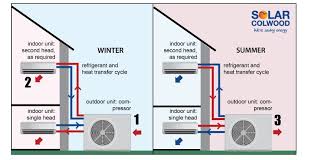
Rita and I replaced our gas furnace in 2012 with a hybrid system by Carrier. It heats our home using the heat pump unless the outdoor temperature falls below freezing, at which point a gas burner kicks in. With our solar panels providing the electricity for the heat pump, our highest mid-winter Xcel bill is under $50. Meanwhile, at Golden Real Estate’s office, as described in my Jan. 4, 2018, newspaper column, we got rid of our furnace and ductwork and installed a ductless mini-split system (like in the above diagram), also powered by solar panels. As a result, our Xcel bill is under $11/month year-round.

 Jim Smith's Blog
Gas forced air, however, is relatively inefficient and is only common in the United States because of our exceptionally low cost of natural gas and other fossil fuels.
LikeLike
Heat pumps are gaining traction as an energy-efficient alternative to gas heating. They reduce carbon emissions and lower energy bills, but are they practical for all climates? Installation costs and cold-weather performance remain concerns.
LikeLike
Thanks, Aldus. It used to be that heat pumps couldn’t extract heat from outside air that was freezing or colder. However, great progress has been made in the past decade or two and now one can purchase a heat pump that can extract heat from outside air that is below zero degrees Fahrenheit. They’re called “cold climate heat pumps” and they are amazing. They are less efficient (i.e., consume more electricity) to extract heat from really cold air, but they do work, eliminating the need for backup from a gas furnace. In the rare instance that one encounters really bitter cold, such as 20 degrees below zero, it makes more sense to have electric space heaters than to have a gas furnace in place for that rare instance and pay the cost of being attached year-round to the gas grid. I replaced a gas furnace with a heat pump and three mini-splits in my stand-alone real estate office in 2017 and went through five winters without ever needing to plug in a space heater and finally got rid of them before selling the building.
LikeLike