Below is the version that was printed in 24 Denver metro weekly newspapers, because it includes more content for each article than does the smaller page size of The Denver Post and the Denver Gazette.
Click on the thumbnail below to view or download a more readable PDF of it. You’ll need 11×17 paper to print it full-size.
The articles in the above ad are also posted individually at http://RealEstateToday.substack.com, where you can subscribe to receive this column each week by email.
As regular readers know, I’ve written several columns on technological developments in home construction and especially in the field of manufactured and modular home construction.
This week I was made aware of Liv-Connected, a 2018 startup which really got going during the pandemic when one of their partners, who was in the live event business building compact and readily deployed stage sets found himself with no work and turned his attention to compact and readily deployable modular housing.
At first, the company worked to improve upon the typical FEMA trailer being deployed to disaster areas, but then to the housing industry itself, beset as it was with labor shortages, supply-chain problems, and a soaring demand for second or remote homes.
Manufacturing home components in a warehouse has inherent efficiencies, but the cost of delivery of the finished home and/or its components to the build site needs to be factored in. For homes to be installed on a foundation, transportation costs for most manufacturers are inflated by the need to use wide-load trucks and pilot cars and to pay the associated permit fees. Liv-Connected’s concept eliminates that need by breaking down the segments of the house and roof into components (see diagram below) that can be delivered on one standard semi trailer (also below) and linked together in one day at the build site.
The bathroom and kitchen modules are fully equipped at the factory with fixtures and appliances and can be mixed and matched to create the desired end result. Also, the modular design allows the addition of more bedrooms at a later date, as illustrated on the company’s website, www.liv-connected.com.
Part of Liv-Connected’s business is building tiny homes or Accessory Dwelling Units (ADUs) under the brand Via, for which delivery costs are less because the homes are on a trailer chassis. The buyer could take delivery of them at the company’s Pennsylvania factory. Here’s a screenshot from their website:
Click here to read the June 2022 article on Forbes.com about the modular home industry, comparing and contrasting Liv-Connect’s business strategy with that of other off-site housing manufacturers. Here’s a link for an informative 9-minute video by Kerry Tarnow, an independent YouTuber.
Off-site construction has multiple advantages, including all-weather and year-round construction, much reduced waste, and much improved insulation. There’s also less loss due to vandalism or theft from the build site.
On-site work is limited to building the foundation with its entry points for water, sewer and other utilities, pre-matched to the underside of the Liv-Connect modules. Those connections, when done right, consume only about four hours of the one-day installation process. The driver of the truck is a Liv-Connect employee who is part of the installation crew.
The prices for Via homes start under $100,000. The prices for the modular homes, under the brand Connexus, start at $150,000.
Manufactured housing started before most of us were born, if you include mobile homes. Modular housing, in which components of a building are put together in a factory and then assembled onsite, is also a part of early housing history. I remember attending Expo 67 in Montreal, where one of the exhibits (but not an attraction to be toured) was “Habitat 67,” a funny looking 148-unit apartment complex adjacent to the 1967 World’s Fair site in which concrete apartment modules were held together by cables.
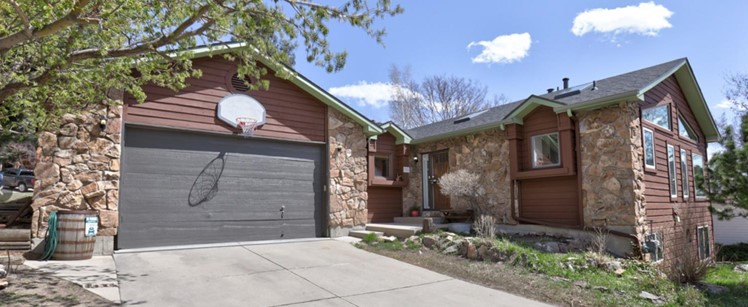
Then, in 1997, I purchased a home in Golden’s Mesa Meadows subdivision which I learned later from a neighbor was built in a Ft. Morgan factory and assembled in one day on the foundation in Golden. Knowing that, I noticed the tell-tale beam in the ceiling which was where the two halves of the one-story home were attached to each other. Here’s the MLS picture of that home (798 Cressman Ct.) which sold last June for over $1 million.
It was explained to me that manufactured homes are often of higher quality and better insulated, because they are done on a factory floor where there is better supervision, resulting, for example, in better insulation. The exterior walls were all made from 2×6 lumber instead of 2×4 lumber to better withstand the stresses of being loaded, unloaded and moved on the building site. Indeed, my Mesa Meadows house was a good one, although I expect the current owners (the third since I sold it) don’t even know that it was not stick-built on site over several months, like its neighboring homes.
Next came the “tiny home” movement in which complete homes were often built on a factory floor, wheeled on a trailer to someone’s lot, and then put onto a foundation. Some tiny homes were put into service as temporary homes for our unhoused population, formerly referred to as “homeless,” on vacant land or in church parking lots — a good idea, but without a conventional connection to a sewer line. Here are three tiny homes displayed for sale on https://www.tumbleweedhouses.com/:
About that time the ADU movement took off, with many if not most cities and counties changing their single-family zoning laws to allow the creation of “accessory dwelling units.” These could be walk-out basements converted to an apartment, but often they were apartments created above detached garages or stand-alone buildings in backyards. The typical ADU ordinance requires three things: 1) the ADU cannot exceed a certain size, 2) it has to have its own off-street parking space, and 3) the property owner has to live in either the main house or the ADU and not rent out both units. Some jurisdictions are considering loosening these rules. Here’s the City of Golden’s web page about their ADU rules: https://www.cityofgolden.net/city-services/accessory-dwelling-units/
Several local businesses were created to cater to this new construction opportunity, including Verdant Living, 303-717-1962, owned by John Phillips. His “backyard bungalows” are manufactured in Nebraska and meet local code requirements. You can visit www.VerdantLiving.us for more information.
A company called Villa started building ADUs in a factory southeast of Los Angeles, after California legalized ADUs in 2020. This company delivers and installs its units across the state, with prices starting at $105,000 plus as much as $200,000 for delivery, infrastructure costs, foundation, and installation. Here’s Villa’s website: https://villahomes.com/units/
There’s a Las Vegas startup called Boxabl, whose competitive advantage is that its ADUs fit on a standard flatbed trailer and then unfold into the simple unit shown here or to larger homes, such as the 3-bedroom, 2½-bath, 2-story home (assembled from three units) shown below.
It’s a father-son company which has not yet gone public. It was clearly inspired by the factory concept of Tesla, not surprising since the son drives a Tesla. Notice the Tesla wall charger and the Tesla battery unit above it on the exterior of the 2-story building below. That picture is from the International Builders Show last month in Las Vegas. It drew a lot of attention, and the company now has a waiting list over 100,000, even though it can’t deliver more units until regulators approve its construction.
The company did deliver 156 of its 400-square-foot “casitas” to the Federal government for use in Guantanamo Bay, which helped it build its factory and develop its technology. The company received that multi-million-dollar contract based on its proposal, even though the government knew they hadn’t built anything yet.
After completing that contract, Boxabl got a contract from an Arizona company to build workforce housing. Currently the firm is only building and, presumably, stockpiling its 400-square-foot casitas as it perfects its current factory and equips a second factory next door.





 Jim Smith's Blog