The Rule Against Showings and Open Houses Shouldn’t Hamper Home-Buying…

…that is, if the listing agent does what Golden Real Estate has done for over 13 years — create a narrated walk-through video of each listing.

Our narrated video tours are just like a showing. They are live action videos which start in front of the house (just like a real showing) and then go through the house and into the back yard, pointing out features as we go. 

Check out the video tours for any of our current listings at www.GRElistings.com to see what I mean. They really are like an in-person showing with the listing agent. For example, the video camera points down to the floor and up to the ceiling as I describe the hardwood floor or the sun tunnels which bring natural light into the home’s interior.

But, you say, you’re not going to buy a home that you can’t see in person.  Right? You don’t have to, because the rules allow for inspection once the buyer has signed a purchase contract. Your visit (presumably with an agent)  the very next day constitutes an inspection. That can be before you even have to deliver your earnest money check, since you may not even be under contract yet. The guidance from the Division of Real Estate says, “home inspections and final walkthroughs after a buyer has signed a purchase contract (emphasis added)… is also considered to be an essential part of the real estate transaction.” The buyer is not under contract simply by signing a contract that has not also been signed or countered by the seller.

That “guidance” from the Division of Real Estate was issued on April 9th and has not been updated as of April 18th, which is when I am updating this blog post.

Scott Peterson’s April 15, 2020 “Legal Bite”

However, Scott Peterson, general counsel for the Colorado Association of Realtors, maintains in a video recorded from quarantine on April 15th that the governor’s executive order prohibits any “marketing” that involves entry into a property – no photos, no video, nothing at all – without a contract in place. If that’s true, however, why isn’t it reflected in the April 9th guidance and why hasn’t that guidance been updated?

I tried Googling the governor’s executive orders and looked at his web page on www.colorado.gov/governor and saw only two executive orders on other matters and no link for all his executive orders. So, for now, I lack evidence of Scott Peterson’s claim and am relying on the April 9th guidance, which I keep checking for updates.

Therefore, a visit to the home by a buyer immediately after signing an offer to purchase the home does, in my opinion as a broker, comply with guidance currently in effect from the Division of Real Estate. Then, if the buyer is able to get under contract with the seller, he or she can schedule a second inspection by a professional inspector.

So, here’s a possible scenario: You look at the video tour of the patio home or the ranch-style luxury which you found at www.GRElistings.com. I guarantee you’ll have a pretty good sense of the home from viewing that video. You’ll experience the flow from kitchen to dining room, to family room, to back yard, etc., because you are being walked through the home. It is not a slideshow of different rooms, giving no indication of flow from one room to the next.

Let’s say you call me or your agent to submit a contract and let’s say that it is accepted by the seller. You’re under contract!  The typical contract has a 7- to 10-day inspection period. You schedule your personal inspection with your agent (or me, if you don’t have one) the next day, before delivering your earnest money check, which is typically due in 3 days.  You can terminate immediately if you have buyer’s remorse, and go back to looking at other houses.

If you don’t terminate, you still have a week to hire a professional inspector and submit a detailed inspection objection.

What if you’re a buyer, and there’s no such video for a house that interests you, but you don’t want to sign a purchase contract? I believe you’ve got three choices here.  One, your agent (me, for example) could ask the listing agent to create and provide a narrated walk-through video. Second, I could preview the home for you since the guidance make no mention of banning previews, and shoot my own rough-cut video tour of the home, post it as an “unlisted” video on YouTube and send you the link. Or, third and perhaps best, we could use Facetime, Zoom, or another app to have you see what I’m seeing as I walk you through the house. (NOTE: Scott Peterson believes that previews and videos shot by anyone other than the seller are not allowed. I just don’t have any documentation supporting that position.)

Therefore, while it may be inconvenient not to have an in-person showing of a listed home, there are work-arounds that can make it possible to get under contract and confirm your interest in the property before you are fully committed to it or put down any earnest money.

Finally, I’d like to note that many listings are empty and vacant.  I see no reason why in-person showings of those listings should not be allowed. I know that builders are letting buyers view their empty homes. Again, Scott Peterson maintains that empty homes cannot be visited either. Show us the actual orders from the Governor or guidance from the Division of Real Estate, Scott!
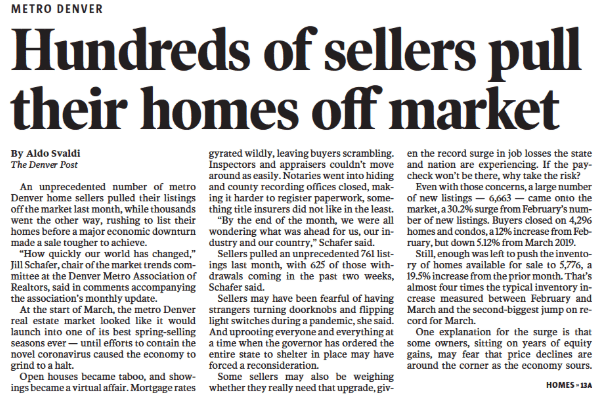
Newspaper Headline Gave a Distorted Picture of Real Estate Market Under Covid-19

“Hundreds of sellers pull their homes off market,” read the lead headline on the Business page of last Friday’s Denver Post, but the first sentence of the article noted that “thousands [of sellers] went the other way, rushing to list their homes before a major downturn made a sale tougher to achieve.”

The reporter was referring to March statistics quoted by the chair of the market trends committee of the Denver Metro Association of Realtors.

Let’s look at the actual numbers. Yes, 184 listings that were entered during the month of March were “expired” on the MLS by month’s end. Another 443 listings were “withdrawn,” which means the listing agreement is still in effect, but it is not displayed on the MLS until it is made “active” again.

However, 3,525 listings entered last month are already under contract as I write this on April 5th, and another 467 listings have already closed.  Of the ones that closed, 179 were sold before being entered on the MLS, and of the 308 that were exposed to MLS users as active and had already closed by this past weekend, only 13 took longer than a week to go under contract.

 As I write this on April 5th, there are still 4,289 listings that were entered on the MLS during March and are still active.

So, yes, 184 sellers decided not to sell during March, but 8,122 sellers made their homes active on REcolorado during March and did not withdraw or expire them. Another 443 sellers kept their listing agreement active but without exposure on the MLS.  Presumably their listing agents can still sell those listings privately, perhaps keeping their entire commission instead of having to share it with a buyer’s agent.

So the headline was sort of accurate.

By the way, unless the practice has changed since I was a reporter at the Washington Post and then a headline writer at the New York Post, reporters have no say in the headlines that appear above their articles. Instead, a headline writer on the “copy desk” reads the article briefly and writes a headline that fits the assigned character count. As a result, sometimes the headline doesn’t truly reflect the gist of the article, and that may be the case with last Friday’s article.

From the New York Post, I went on to publish several community newspapers in New York City and instructed my reporters to write their own headlines, not knowing what the character count had to be, so the editor had the reporter’s headline as a guide as he rewrote it to fit. 

Getting back to real estate — sorry, I had to vent! — here are the numbers from March 2019:

A total of 7,968 listings were entered as “active” during March 2019, which is fewer than this year, even if you include the 70 listings that were withdrawn by month’s end.  So, not only was the headline misleading, but this March showed increased activity over March 2019.

The fact that 70 listings were expired prematurely in a “normal” month suggests that not all 184 expired listings this year should be attributed to Covid-19.

The market was “hotter” last year, in that over 400 of that month’s listings went under contract in less than 7 days compared to just under 300 this March.

I invite any and all reporters writing about real estate statistics to let me fact check their conclusions prior to publication. And suggest your own headlines!

Can you tell that I enjoy statistical analysis?

Real Estate Coach Thinks That I Should Charge Much More Than I Do. What Do You Think?

Business coaches exist in every industry, and I’ve dabbled in hiring a coach over the years.

When I first entered the business, I had a mustache, and Mike Ferry, the best known of all real estate coaches, said to shave it off because “people don’t trust agents with facial hair.” A week later I asked a seller why he listed with someone else, and he said, “Well, I didn’t trust you.”  Off it came!

Recently I was offered a free one-hour coaching session with a lesser-known coach, and I accepted the offer.

During the session, he thought I was giving my services away too cheap. He said I should charge 7% and not reduce my commission when I don’t have to share it with a buyer’s agent. (I charge 5.6% and reduce it to 4.6% if I double-end a transaction.)

He didn’t like that I further reduce my commission when I earn a commission on the purchase of a seller’s replacement home and that I provide totally free moving in that situation, too.

“You’re worth more than that,” he said.  I didn’t hire him as my coach.

The Real Estate Market Is Still Active, Meeting the Needs of Both Buyers and Sellers

The Denver real estate market, based on my own analysis of REcolorado listings, showed continued strength last week, despite the imposition of a statewide stay-at-home order by Gov. Jared Polis that Tuesday.

To my surprise, despite the growing COVID-19 threat with all its expected economic impacts, a total of 1,799 listings went “active” on REcolorado last week — that is, between Sunday the 22nd and Saturday the 28th.

Although 53 of those new listings were taken off the market the same week — likely because of the stay-at-home order — and 24 of them were entered as “sold” without ever being active, that left 1,722 new listings on the market, and 387 or 22.5% of them were under contract by week’s end. That does not sound to me like a real estate market that is stalling because of the COVID-19 virus. 

It makes me wonder about those 53 listings that were pulled off the MLS because of the stay-at-home order. How many of them would have been under contract by now had the sellers and their listing agents not been overly cautious?

The homes that went under contract within their first week on the MLS ranged from a 2-bedroom, 1-bath condo for $100,000 in the Windsor Gardens senior community south of Lowry to a 4-bedroom, 4-bath home for $1.3 million in the foothills northwest of Boulder. The median price of those homes was $425,000.

To see how last week compared to “normal,” I researched the listings that were first entered on REcolorado during the same seven days in 2019.

Surprisingly, slightly fewer homes were entered on Denver’s MLS during the same 7 days a year ago — 1,727.  Of those, only 12 were taken off the MLS that same week. Another 73 were entered as “sold” that week. Of the remaining 1,642 listings, 670 or 40.8% went under contract within a week. That’s much higher than the 22.5% this year, but consistent with the slowing of the market which we saw before the advent of the virus. Those 670 listings which went under contract within 7 days last year ranged from a $95,000 condo in Aurora to a $1.5 million dollar 6-bedroom home in South Boulder. The median listing price was $395,000.

As you might guess, I was concerned about whether the new Lakewood ranch listed by me last Wednesday would get any showings, since showings didn’t begin until Friday, three days after Gov. Polis instituted the stay-at-home order. I needn’t have worried. We had five showings by Sunday, with one agent calling to ask if we had any offers yet because his buyer was interested in submitting an offer.

Also on Sunday, a buyer I hadn’t heard from in months called about seeing a new listing.  I set a showing for that afternoon, and the buyer is considering making an offer.

All in all, then, this market continues to surprise me. While it is slower in terms of activity, there are still many serious buyers willing and able to make offers on new listings.  Those buyers who are unable or afraid to make an offer, whether for economic or health reasons, are not calling us. Agents might appreciate the fact that only serious and qualified buyers are going to call about seeing homes for sale.

Meanwhile, sellers who want to sell should recognize that there are serious and qualified buyers out there and consider putting their home on the market. Just make sure you use an agent like us at Golden Real Estate who does narrated video tours of listings.

How Golden Real Estate Is Coping With COVID-19 Guidelines

We and our partners in real estate continue to work while adapting to the COVID-19 guidelines for physical distancing, minimized travel, and more. Inspectors are still inspecting, but they don’t want buyers or agents in the house with them. Title companies are still doing their title searches and conducting closings, albeit with attention to sanitizing rooms and some physical distancing. Mortgage companies are still doing their jobs, as are the appraisers they hire.

Meanwhile, real estate brokers like us are still showing homes, writing contracts, negotiating inspection issues just as we always have — that is, by phone and email — and going to closings, although even that could be more virtual, now that Gov. Polis has issued an executive order saying that Notaries can work virtually.

What’s different is the cancelation of all kinds of meetings, open houses, and in-person continuing education classes (which are still available online). 

That keeps us all at home, which is where most brokers work anyway, but with fewer reasons to leave.  I’m walking the dog more than ever.  My Apple watch tells me that I completed all three activity rings last week.  Woohoo!

Bottom line: I’m sort of liking this, although I do look forward to getting back to normal.

The Narrated Video Tours of Our Listings Allow You to Visit Them From Home

For over decade, Golden Real Estate has created narrated video tours of its listings. You can find examples at www.GREListings.com. If all brokerages did this, it would greatly reduce the need for open houses and in-person showings.

Here’s the video tour from this week’s featured listing in Lakewood:

What Does ‘Open and Transparent’ Look Like in Real Estate?

For some reason I’ve never understood, most listing agents believe that they should not be open and transparent with buyers’ agents regarding the disclosure of offers in hand when there’s a bidding war for their listing.

At Golden Real Estate, we believe in being open and transparent. Here’s what that looks like.

Rule number one is to always tell the truth. We never mislead a colleague about offers in hand. If we don’t have competing offers, we’ll never represent that we do. This is a matter of ethics. The Realtor Code of Ethics, to which every Realtor swears allegiance, requires no misrepresentation about anything, whether it’s how successful we are or whether we have competing offers.

Agents from other brokerages, however, typically won’t disclose the price or nature of the offers they have for their listings. At Golden Real Estate, we not only disclose the price and terms of offers received, but we will let each agent know if their offer is surpassed by a better offer. We don’t want any buyer or their agent to have the experience of being blindsided.

This is good for both buyer and seller, and buyers’ agents invariably thank me when I explain this policy. After all, how would you as a buyer like to learn later that if you had only offered $2,000 more (which you were willing to do), you would have won that bidding war?

Similarly, how would you as a seller, like to learn that you could have gotten $2,000 more for your house?

Although this process essentially operates like an auction, where everyone in the room knows what they’re bidding against and chooses on their own when to drop out of the bidding, it doesn’t mean that we let the bidding go on forever.

After the buyers have raised their bids twice, it’s time to ask for a final bid, without offering to return if it’s not the winning bid. While this is our policy, the seller, of course, is the final authority on how long to continue the back and forth. By that time, however, they tend to be quite happy with the highest bid and agree to cut it off. To do otherwise risks antagonizing the buyers and their agents.

It’s important to us as professionals that we leave each party in a bidding war happy that we were transparent enough that they felt they had a fair chance to win a coveted listing.

This approach takes more work on our part than doing what other agents typically do when multiple offer situations arise, which is to inform agents that they have multiple offers and ask buyers’ agents to submit their “highest and best.” Then the seller accepts the best offer and other buyers are upset and angry that they weren’t allowed to raise their offer.

We feel, however, that our approach is not only fairer to buyers’ agents but also produces the best price for our sellers.  We wish that other listing agents would adopt this practice.

Transparency, however, does not extend to disclosing the price at which a home is under contract prior to closing. The reason for that is that if the contract falls, we don’t want the next buyer to know what the seller was willing to accept. That’s because we have an ethical and legal obligation to work in our seller’s best interest.

The only time I would disclose the price at which one of my listings is under contract is when an appraiser needing comps calls me. If we are cleared to close — past inspection, appraisal and other contingencies — I’m willing to help that appraiser know the price so he can do his or her job in appraising a comparable listing for a different seller.

Thanks to this practice, Golden Real Estate has a better-than-average track record when it comes to closing price vs. listing price. In some cases this has resulted in our sellers netting their full listing price even after subtracting commissions and the other costs of selling.

Call me or one of our broker associates at 303-302-3636 if you like how we operate and would like a no-obligation market analysis of your home.

Renters Aren’t Taking Advantage of Rent-With-Right-to-Purchase Program

Renters face many problems that they wouldn’t face as owners.  Not only do they face uncontrolled rent increases, they don’t even know that their lease will be renewed. There’s always the risk that their landlord might sell the home and the new owner will want it for themselves or another tenant.

Both problems are made worse if the tenant has no lease at all or has transitioned to a month-to-month lease — quite common after the initial lease term expires. 

And the selection of new places to rent is small. If a tenant has to find a new place to live, he or she will be hard pressed to find a home they like — even more so if they have a pet.

Wouldn’t it be great if a renter didn’t face those problems of uncontrolled rent increases and having to move?  For a couple years now, Golden Real Estate has worked with a buyer who gives tenants a 5-year rent schedule and can’t be kicked out as their lease is renewed each year through that 5-year period. I’d like to see more renters take advantage of it, even if they aren’t buyers.

Our buyer is Home Partners of America. They not only address those challenges, they expand the number of homes from which to choose.  (And having a pet is not a problem.) That’s because Home Partners will buy any townhome or home on the MLS for which the renter has been pre-qualified as the tenant. Get your invitation to apply from Golden Real Estate, and once accepted as a tenant, you log in to HomePartners.com, which has every home on the MLS which you are qualified to rent.  Instead of just displaying the sales price of the home, it displays your personal rental price. 

Your contract with Home Partners, which is now your landlord, includes the rental amount for years 2 through 5, but you’re under no obligation to renew. Your contract also includes a purchase price for each year in case you like the home and decide to purchase it at any time during the 5-year period.

Call any Golden Real Estate agent at 303-302-3636 if you or someone you know is interested.

Do You Think a Big Down Payment Is Needed to Buy a Home? Think CHFA.

One of the most enduring misconceptions among home buyers is that a large down payment — typically 20% — is required in order to buy a home.  Nothing could be further from the truth.

FHA loans only require a 3.5% down payment, although they come with a mortgage insurance requirement which lasts for the life of the loan. Because of that, you’ll need to refinance with a conventional loan once you exceed 20% equity in your new home.

Conventional (non-FHA) loans don’t necessarily require a 20% down payment either. To compete with FHA loans, there are lenders who require as little as 3% down payment, often without mortgage insurance. If they do require mortgage insurance, it can be eliminated once your equity rises to 22%, although that requires a new appraisal, which can cost $400 or more.

Best of all, however, the Colorado Housing & Finance Authority (CHFA, pronounced “Chaffa) can get you into a home with as little as $1,000 out of pocket cost. CHFA loans have income limits, but they are reasonable, up to $120,100 in the metro area. Their website is super helpful and easy to navigate at www.chfainfo.com.

At that website you’ll learn the complete process involved in getting approved for a CHFA loan. One of the first steps is to take a free buyer education class that covers every aspect of the home buying process as well as ownership responsibilities after closing.

CHFA loans are only obtained through mortgage lenders, not from CHFA directly, and Golden Real Estate can connect you with a CHFA-approved lender. 

If you’re a veteran with an honorable discharge, you are eligible for 100% financing, but there’s a funding fee.  That fee, however, is waived if you have a service related disability. Even if it isn’t waived, the fee can be included in the mortgage so that you can literally close on a VA loan with zero money out of pocket. Earnest money submitted is refunded to you at closing! We can also connect you with a VA-approved lender.

Big Entities Target Mobile Home Parks, the Last Bastion of Affordable Housing

I just finished watching John Oliver’s riff on mobile homes. If you’re not familiar with his HBO show “Last Week Tonight” or don’t get HBO, the good news is that his single topic take-outs* are archived on YouTube, where you’ll be glued to your computer screen for an unending series of  take-outs that only starts with his take-out on mobile homes.

Here’s what I learned from watching John Oliver’s piece and was able to confirm by talking to others. Sometimes I wish I could be a full-time journalist again so I could really do investigative reporting, but I’m a Realtor now and have to depend on others like John Oliver and David Migoya of the Denver Post doing the heavy lifting. So, instead, Google is my friend. And there’s so much to learn just by Googling.

The big trend in mobile homes is the influx of big corporations like Warren Buffett’s Clayton Homes in the mobile home park business. Historically, such parks were “mom and pop” operations, but it was inevitable that mom and pop got old and, even if their children had an interest in taking over the family business, it was more profitable to sell the park to a developer or to a company like Clayton Homes.

What makes a mobile home park a great investment is that, while people own their mobile or “manufactured” home, they rent or lease the land on which it sits. The land owner can raise the rental fee without limit because, while the home can technically be moved, it would cost thousands of dollars to do so, and there’s little choice of where to move it. You can’t just buy a lot somewhere and put your mobile home on it. I checked with Jefferson County, and you can only install a mobile home on land zoned for mobile home parks. That rule feeds right into the greed motivating those corporations which, like Clayton Homes, are buying up every mobile home park they can.

Another thing about mobile homes is that, while they can be really nice when they’re brand new, they do not appreciate in value like regular homes. Rather, they decline in value like a car or like the “personal property” they are. Also, since they’re not “real property,” you can’t get a mortgage on them for 4% over 30 years, you get a chattel loan at 15% and for a shorter term.

Thus, if a mobile home owner can’t afford an increase in land rental for their home, their only choice often is to simply abandon the home that they paid thousands of dollars to buy. Since it becomes abandoned property, the mobile park owner can then assume ownership of it, or scrape it depending only on what makes financial sense. And down the road (so to speak), they can kick out the remaining occupants and sell the entire mobile park to a developer.

This is a heartless process, but it’s how our free enterprise system works. So, what can be done about it?

On January 21st Golden United sponsored a public meeting on the subject of manufactured housing which I attended, along with several city councilors and civic minded people. Sadly, only a handful of the attendees were residents of a mobile home park.

The main presentation was by an organization which organizes residents of mobile homes parks to form an owner’s association which might then outbid other buyers of the park when the current owner attempts to sell it. This organization, called Resident Owned Communities (ROC), was featured briefly in John Oliver’s piece.. (Fast forward to 13:10.)

What local governments could do to address the problem, Oliver said, was to legislate a “right of first refusal” by which an owner’s association or other non-profit entity serving the interests of mobile home park owners, would be able to match any bona fide offer by a for-profit buyer, and purchase the mobile home park. I’m not aware of any such legislation or other public policy aimed at protecting manufactured house, which is, after all, the last bastion of affordable housing in most cities.

Mobile home parks have few friends among owners of conventional real estate, but however you might feel about them, I hope you feel they are worth preserving.

————-

*“Take-out” is a journalistic term for an in-depth look at a single topic. During my 1968 internship at the Washington Post, I was tasked with writing a 3-part series on the solid waste industry in the District of Columbia. I enjoyed telling people that I did a “take-out on trash.”