As the Housing Crisis Deepens, Zoning Laws Are in the Crosshairs

In December 2018, Minneapolis made news when it abolished single-family zoning. That began a nationwide conversation about the use of zoning laws to restrict growth and density at a time when housing affordability was worsening and homelessness was increasing.

One of our broker associates, Chuck Brown, attended the National Association of Realtors convention last November in San Francisco. I had attended the same convention there several years ago. I hadn’t noticed many homeless people on the streets back then, but Chuck reported that it was way out of control now, with the streets overcrowded with homeless people.

You, like me, have probably followed the coverage of homelessness in Denver, with that city passing an urban camping ban, which was ruled unconstitutional by a lower court but is still being enforced pending an appeal by the city. It could go all the way to the Supreme Court.

The conversation over zoning created by Minneapolis 13 months ago is growing louder. That’s because the history of zoning is one of intentional discrimination. In researching this topic, I read a Fast Company posting on the history of zoning in San Francisco.. After the 1906 earthquake, the Chinese population there was targeted by zoning changes designed to promote and protect white enclaves. This was long before there were federal laws making discrimination based on race or national origin illegal.

That Fast Company article included the following detail regarding the role of the mortgage industry: “In 1934, as part of President Roosevelt’s New Deal, the Federal Housing Administration (FHA) was established to insure private mortgages. The FHA’s underwriting handbook included guidelines that pushed cities to create racially segregated neighborhoods and encouraged banks to avoid areas with ‘inharmonious racial groups,’ essentially meaning any neighborhood that wasn’t exclusively white.”

Another New Deal program to help homeowners threatened with foreclosure to refinance their home with low-interest long-term mortgages, provided lenders with “safety maps” which used red shading for risky areas which were under “threat of infiltration of foreign-born, negro, or lower grade population.”  This is the origin of the term “redlining,” and the practice wasn’t outlawed until the Fair Housing Act of 1968.

Last week I attended a meeting of the Group Living Advisory Committee in Denver’s municipal building, where they are discussing a zoning amendment which would dramatically increase the number of unrelated persons who can live in a single family home. You can expect this proposal to arise in suburban jurisdictions, too, even if they don’t follow Minneapolis in getting rid of single-family zoning altogether.

I’ll be reporting again as this conversation evolves. Don’t shoot me. I’m just the messenger.

Buyer Beware: You May Be on Candid Camera When Looking at a Home

The use of internet-connected cameras such as the Ring doorbell is becoming more and more common. Rita and I have both a Ring doorbell and four other cameras protecting the entrances to our home plus the garage, and the Golden Real Estate office has a total of 10 cameras covering the interior, exterior and our parking lot. Such systems are increasingly affordable and easy to set up, since they require no wiring and can be monitored on any smartphone. Their video (with sound) is motion-activated and uploaded to “the cloud” so that you can go back in time to see past activity. You can also be alerted real-time on your smartphone when motion is detected by any of the cameras.

With the widespread adoption of such internet-connected home cameras, it is becoming more and more possible for sellers to eavesdrop on buyers who tour their home. You can understand the value to a seller of hearing what you say as you look around. Imagine, for example, if you were caught on video saying to your agent, “I love this house! I’ll pay whatever I have to for it!”  You wouldn’t want the seller to hear that, would you?

There are, of course, legal implications to such surveillance. On the one hand, sellers have the right to install such equipment for home security, but buyers and their agents also have a “reasonable expectation of privacy” while touring your home when you’re not there.

While Colorado law allows you to record your conversations with another person secretly, that is only because you are a party to the conversation. Taping a conversation to which you are not a party is a serious matter for which you could be subject to both civil and criminal liability.

Every year, licensed real estate brokers are required to take a 4-hour real estate update class as one element of their continuing education requirement. This year’s class, which all Golden Real Estate agents take in January instead of later in the year, devotes 10 to 15 minutes to this topic of audio and video surveillance by sellers. 

In that update class, we were instructed to advise our buyer clients that they might be under surveillance while touring a home and should be careful what they say. We were also instructed to have a conversation with sellers about this topic, advising them of the legal dangers of recording buyers. It was suggested that, if our sellers do have such equipment, we urge them to post a notice next to the doorbell or prominently inside the house to the effect that “audio and video surveillance is in use” in the house. We should also put that information in the MLS listing, to protect ourselves as listing agents.

It is understandable for sellers to be concerned about strangers being escorted through their home by brokers who they do not know. When this issue is raised by a seller during a listing presentation, I let them know that no buyer will be touring their home without a licensed broker, and that all licensed brokers undergo a criminal background check and are fingerprinted in order to be licensed. Brokers would be risking their license and their livelihood to allow themselves or their buyers to commit a crime in your home. Moreover, the showing service is diligent about not providing the lockbox combination to anyone who is not a licensed broker. Your broker can also install an electronic lockbox which provides even greater accountability as to when each broker enters and leaves your home.

I have been a practicing real estate broker in Colorado for nearly two decades now, showing hundreds of listings per year to prospective buyers and holding scores of open houses for my listings.  I have yet to be made aware of any loss sustained by a seller or any misdeeds by my buyers.

Our low crime rate here in Colorado is reflected in our lowest-in-the-nation premiums for errors and omissions insurance.  In Colorado the cost of such insurance is $200-400 per year, depending on the coverage limits. In some states, like California, I’ve heard that brokers can pay that much per month for E&O coverage. 

Is Your Gas Furnace or Gas Water Heater About to Fail? Consider a Heat Pump

A reader called me last week because her gas furnace had quit working and, knowing my expertise regarding sustainability, she wanted my advice on replacing it.

I told her that this was an opportunity to do something other than buy a new gas furnace.  I told her about my Carrier “Hybrid Heat” furnace which uses an air-source heat pump for heating as well as cooling and only burns gas when the outdoor temperature dips well below freezing. With her solar panels, it’s possible she won’t even pay for the electricity consumed by the heat pump, and her gas consumption will plummet.

That hybrid system would use her home’s existing ductwork, but, since she has a one-story home, I suggested she consider a ductless mini-split heat pump system like the one we have at our office. I gave her the name of the vendor who installed both my home and office systems who could advise her which system was best for her.

I also suggested that she look into replacing her gas water heater with a heat-pump model when it fails.  My gas water heater is over 15 years old, so I’m thinking of replacing it before it fails. Home Depot sells a Rheem 50-gallon heat pump water heater (model #XE50T10HD50U1) for $1,299. Best off all, Xcel Energy gives its customers a $500 rebate for purchasing it.  I have enough solar panels to handle the extra electrical demand and eliminate much of my current gas usage, which is mostly for water heating, since I have that Carrier hybrid furnace. Our only other gas usage is for cooking and grilling.

In Colorado, Real Estate Brokers Are Granted the Limited Practice of Law

Colorado is a great state to buy and sell real estate — and to be a real estate broker. In other states, as many as four lawyers must be retained in the typical real estate transaction — one by each party to the contract, and one by the broker for each side. This can make the cost of buying and selling real estate in such states unduly expensive.

Although I have only been a licensed real estate broker in Colorado, I have bought and sold real estate in New York, Virginia and Hawaii.  Colorado is definitely the best.

In Colorado, the only costs of selling real estate are the 1) title insurance, 2) real estate commissions, and 3) the fee charged by the title company for closing the transaction, although there may be additional costs charged by your HOA or its management company, when applicable. There are no state transfer fees or taxes. Since the above fees are typically paid by the seller, a buyer who does not require a mortgage to purchase real estate pays only his share of the title company’s closing fee ($100 to $400 typically), plus the cost of recording the transaction with the county, which is 1/10th of 1% of the sales price. Buyers who take out a mortgage loan to finance their purchase are the only ones with significant additional costs when purchasing real estate in Colorado.

In 1957, the Colorado Bar Association sued to require lawyers’ involvement in real estate transactions, but the Colorado Supreme Court ruled in the Conway Bogue decision that real estate licensees could provide the limited legal service of interpreting and completing state-approved forms for buyers and sellers.

Among the arguments in support of that decision, the court cited the lack or shortage of lawyers in many Colorado counties and the fact that real estate licensees had been performing that function for 50 or more years with no evidence that the public — or lawyers — had been harmed.

The court did require that this service only be performed by licensees who were retained to represent one or both parties in the transaction and that no separate fee be charged for completing the forms beyond the compensation already being earned by the licensee for the transaction.

Sixty-three years later, the Conway Bogue decision is still the law in Colorado, allowing the limited practice of law by real estate brokers, and we can all be glad for it. Imagine if you had to pay $100 or more per hour to a lawyer to counsel you through every step of a real estate sale or purchase!

As I said, we licensees only have the ability to interpret and complete state-approved forms, such as listing agreements, buyer agency agreements, purchase contracts, counterproposals, amendments, disclosures, inspection objections, post-closing occupancy agreements, and the numerous other forms approved by the Colorado Real Estate Commission.

Any seller is allowed to replace those state-approved forms with ones created by an attorney, and home builders routinely use their own contracts. While we can and do represent buyers of new homes, we may not counsel our buyers regarding those documents, since that would constitute practicing law without a license. Instead, we must recommend that buyers hire a real estate lawyer to review them,  Of course, we only recommend legal advice (just as we recommend getting tax advice), but the buyer is free to ignore that recommendation, which many of them do, opting instead to study the documents by themselves and ask questions of the builder’s sales personnel.

Do You Really Need a Buyer’s Agent?

Like most real estate professionals, my broker associates and I make a living representing both sellers and buyers of real estate.  Occasionally I encounter a buyer who doesn’t want to have an agent of his own, preferring to deal directly with the listing agent.

The most common reason given is that the buyer thinks he can negotiate a better deal by saving the seller the 2.8% commission typically paid to a buyer’s agent.  In fact, doing so usually saves the seller nothing since the buyer’s agent is paid by the listing agent, not by the seller. Al-though our policy at Golden Real Estate is to reduce the listing commission if we don’t have to share it with the buyer’s agent, that’s not the practice among the majority of listing brokerages.

Also, there’s the issue of representation. If you deal directly with the listing agent, the best you can expect is that the agent will be a neutral party, but in most cases that agent will continue to work in the seller’s best interest and treat you as a “customer.”  As a buyer, you should really want someone on your side, negotiating in your best interest, not just regarding the contract price but later when it comes to inspection and other issues.  In the case of buying from a builder, such representation is even more important.

Real Estate Agents Have a Responsibility to Report Wrongdoing

As with many professions, we real estate professionals are largely, though not completely, self-policing. Indeed, in a recent continuing education class, we were taught that we have an “affirmative responsibility” to report wrongdoing by our colleagues, whether the offense is illegal, contrary to real estate commission or MLS rules, or, in the case of Realtors, is unethical.

(Many real estate agents belong to brokerages where membership in the Realtor association is not required, and only Realtors are bound by the Realtor Code of Ethics and can be disciplined for violating it. Ask if your broker is a Realtor.)

Of course, the public can also file complaints against licensees. You can do it online here or you can mail a complaint to the Division at 1560 Broadway, Suite 925, Denver CO 80202. You can ask to remain anonymous, but an investigator will call to interview you.

Unless a broker is independent, you can also complain to his brokerage. Ask to speak with the managing broker. If he’s a Realtor, you can file an ethics complaint with his Realtor association. Here’s a link for doing so online.

I have filed complaints about illegal behavior with the Division. I have also sent numerous emails to our MLS about violations of MLS rules and regulations — including last week when a listing agent listed himself instead of one of our broker associates as the selling agent for his listing. (Email compliance@REcolorado.com.) I have also filed ethics complaints against a fellow Realtor through my Realtor association.

By accepting that “affirmative responsibility” to report wrongdoing of any kind by fellow licensees and fellow Realtors, we protect and advance the reputation of our industry and of the Realtor brand. As managing broker at Golden Real Estate, I promote this responsibility, as I did at our weekly office meeting earlier this month.

Although some people like to demean real estate licensees and even Realtors, I have found that the vast majority of us are true professionals who put our clients’ interests above our own, as required by both law and ethics, and I am proud to be a member of this profession.

January Is National Radon Action Month. Here’s What You Need to Know:

Here in Colorado, about half our homes have elevated levels of radon, a naturally occurring gas created by the decay of radioactive radium in our soils. It is the leading cause of lung cancer in non-smokers. Here’s a link for an excellent YouTube video explaining radon and how it’s mitigated.

Most real estate professionals, including the agents at Golden Real Estate, are well aware of this issue and will always advise the buyers we represent to have the home they are buying tested for the level of radon gas as part of the home inspection process.

Notice that I didn’t say to test for the presence of radon gas, but rather the level of radon gas.  That’s because radon gas is present even in “fresh” air. But it can concentrate when it seeps into your basement, crawl space and even your above-grade living areas.

Since a high level of this gas is considered a “health and safety” issue, a seller is essentially obligated to accept responsibility for having the radon level mitigated or to compensate the buyer for doing it after closing. 

At Golden Real Estate, we have a hand-held device smaller than a TV remote which we can lend to sellers prior to listing their home so they’ll know in advance what level of radon a buyer’s inspector is likely to discover. Ace Hardware has this same device for sale for $199.

There are less expensive mail-in radon tests that you can purchase at Home Depot or Lowe’s, but they’re also free at multiple locations — including from our office at 17695 S. Golden Road in Golden. These DIY kits should not be considered adequate for use in a real estate transaction.

During the home sale, it’s best to have a certified radon measurement contactor do the official test. You can find a list at www.ColoradoRadon.info. The test utilizes an electronic device which samples the air every hour over a 48-hour period. It can detect whether the device has been disturbed and whether there have been changes in atmospheric conditions which might suggest that windows or doors have been opened to allow fresh air into the house. Inspectors charge between $100 and $150 for this test, but it’s well worth the expense, especially if the results of the test show that the level of radon gas exceeds the EPA action level of of 4 picocuries per liter of air. If the test shows a level greater than that, the buyer can demand that the seller have radon mitigated. That typically costs about $1,000, so the testing is well worth the additional inspection cost.

Below is a diagram showing how radon is mitigated use sub-slab depressurization:

(from Wikipedia)

Learn the True Cost of Selling Your Home off-MLS to an iBuyer Like Zillow

Perhaps you’ve heard the pitch from an iBuyer firm such as Open Door, Zillow Offers, or another firm with the word “Offers” in their name.

These companies are promoting the convenience of selling your home quickly for cash, without putting it on the market or having buyers traipse through your home, or worrying that their financing might fall through.

But what is the cost of that convenience?

My column on Aug. 22nd reported on the “true cost of selling to an iBuyer,” but you can’t know that cost personally until it’s your home. So let’s talk about your home!

The next time you get a solicitation to buy your home direct for cash without putting it on the market, go ahead and ask them for a quote.  Then call us and we’ll analyze the offer for free, with no obligation whatsoever.

Here’s what you need to know about the offer you’ll receive.

1)   They will tell you that you won’t pay a commission, but the contract will deduct a “service fee” which, in the case of the Open Door contract I wrote about in August, is 7%.

2)    There will be an inspection contingency. They’ll tell you that you don’t have to make any repairs, but the company will do an “assess-ment” and come up with a dollar figure they will deduct from the purchase price to cover “necessary” repairs. It could amount to tens of thousands of dollars–$38,563 in the case of the Open Door contract I reviewed in August.

3)   The good news is that you as seller are given the right to terminate the contract at any time prior to closing — at least according to that Open Door contract I reviewed.

Most of all, you need to know that these iBuyer firms are only buying your home because they expect to make a profit when they resell it. They will entice you with an offer that is reasonable, but in the following weeks that offer will be eroded by other provisions such as I’ve mentioned above.

Perhaps the convenience of selling a home for cash to someone who will resell it at a higher price makes sense for some sellers. My point is that you should know how much that convenience is going to cost you.

An “iBuyer” is nothing more or less than an investor who makes money by buying low and selling high, with or without making any improvements. For years I’ve been advising homeowners who receive unsolicited offers for their home to treat such an offer as the “opening bid,” and to talk to me or another Realtor about seeing how much more they can get for their home once it is exposed to the full market. That is only accomplished by putting a home on the MLS.

It’s all about maximizing exposure. The more potential buyers who learn about your home, the more offers you are likely to receive. I’m saddened to see how many homes are sold with zero days on the MLS.  Those homes were sold without entering them on the MLS, and the listing agent only puts the home on the MLS after closing as a courtesy to other agents (for market analysis purposes) and/or to receive credit for the sale in terms of personal sales volume.

Consistently over the past three years, between 60 and 160 homes per month in Denver & Jeffco have been entered on the MLS only after they sold. The majority of them sold at or below the listing price, because the home was not exposed to additional buyers, and a high percentage of them were “double-ended” by the listing agent, meaning that the agent doubled his commission by not giving other agents with willing buyers the opportunity to earn their half of the listing commission. 

Our policy at Golden Real Estate is to avoid selling a home before it has been on the MLS at least 3 or 4 days, during which all potential buyers have had a chance to see the home and consider making an offer. This is consistent with our responsibility under state law to put our sellers’ interest ahead of our own.

This policy is an expression of the value statement that appears on our yard signs — “Hometown service delivered with integrity.”

In my Aug. 22 column, I quoted a report on iBuyer transactions by Collateral Analytics. The final paragraph in their report is worth quoting again:

In all, the typical cost to a seller appears to be in the range of 13% to 15% depending on the iBuyer vendor. For some sellers, needing to move or requiring quick extraction of equity, this is certainly worthwhile, but what percentage of the market will want this service remains to be seen.”

Call me or any of our broker associates at 303-302-3636 before accepting an off-market offer for your home. And remember: even if you are already under contract with an iBuyer, you may have the right to terminate the sales contract.

Denver Post Series Uncovers the Corruption of Tax Districts Created by Developers

Four years ago, on Dec. 17, 2015, I devoted this weekly column to explaining why property tax rates vary so much around the metro area, mostly due to the creation by developers of “metropolitan  tax districts” to reimburse themselves for the cost of building the infrastructure for their subdivisions. A follow-up column on July 21, 2016, went into greater detail, giving examples of such tax districts created for Stapleton and Green Valley Ranch in Denver and Solterra and Candelas in Jefferson County. For example, in Candelas, adjacent to Rocky Flats, homeowners are paying a 70-mill tax levy on top of Arvada’s mill levy until the tax district infrastructure bonds are paid off. For a home valued at $500,000, that would be an additional property tax burden of nearly $3,000 per year, which would only increase based on rising property values for 30 years following construction. Below is an excerpt from that column, which quoted mill levies in effect that year:

You can read both columns at JimSmithColumns.com, where all my prior columns are archived – or simply click on the links provided above.

It was clear to me back then that homeowners would not recognize the special tax burden they would be facing as they purchased homes, since disclosure of that tax burden is buried in the flurry of documents buyers have to sign at closing.

Now, with more and more owners of homes in such subdivisions realizing what they got themselves into and how unfair it is, it was inevitable that some investigative reporter would dig into this topic in a way that I could not as a full-time Realtor. 

Earlier this month, investigative reporter David Migoya’s multi-part series on this important topic was published in the Denver Post following eight months of research. Perhaps you read that series.

Migoya provides an excellent summary of what these districts are: “Metro districts are taxing authorities created by subdivision developers, with the consent of the local government, for the sole purpose of selling government-like bonds to finance their projects. Repayment of the bonds is tied to future property taxes assessed to the homes that will eventually be built.”

Among the things I learned from Migoya’s multi-part series that I did not know or realize when I wrote about metropolitan tax districts in 2015 and 2016 was that this device of creating special tax districts for infrastructure investments began to be utilized because 1992’s Taxpayer Bill of Rights (TABOR) made it harder for cities or the county to invest in the infrastructure of new subdivisions, even though these subdivisions would ultimately pay for themselves through new property taxes. (I’m not fully convinced of that argument, since many newer subdivisions, including mine, were built without such tax districts.)

Migoya’s series went further to describe the scheming which kept property owners from being able to control the tax districts once the subdivisions were fully built out.

If you are in one of those newer subdivisions, you probably are subject to such a mill levy. If you didn’t read the series when it was published in the main section of this newspaper, I suggest you Google “Denver Post metropolitan tax districts” and read the full series. It should make your blood boil.

One could apply “scandalous” to how these tax districts were created and are run to profit developers at the expense of unwitting future homeowners, but the fact is that what the developers have done is legal, manipulating laws passed by the General Assembly and signed into law by previous Governors.

As Migoya explained so well in his opening installment on Dec. 5th, “Colorado law permits developers to elect themselves to serve on a district’s board of directors, then use that position to approve tens of millions of dollars in public financing for their businesses, and leverage the property taxes on homes they haven’t yet built. No regulations stop these developer-controlled boards from approving arrangements that are financially advantageous to their business, allowing them to finance overly ambitious plans without fear of liability, knowing future homeowners ultimately shoulder the burden.”

Surely the upcoming legislative session will feature hearings and legislation to address the worst abuses of this tax district tool, but the damage may be irreversible in the state’s 1,800 such existing tax districts, since they were created pursuant to existing laws.

Depending on how aware buyers and their agents become of these oversized tax burdens, the resale value of homes in those subdivisions should reflect the fact that they have a far greater tax burden than comparable homes in areas without such a developer-created tax district.  You can count on Golden Real Estate’s brokers being knowledgeable in this area.

The Value of Local Journalism

I have been concerned that the reduction in the reporting staff at the Denver Post would make investigate series like the one above a thing of the past. The “Afghanistan Papers” series by the Washington Post is another example. Subscribers make the investment in such journalism possible, so thank you for subscribing to the Denver Post.

By the way, please note that our “Real Estate Today” column in the Denver Post also needs your support. It is our primary marketing tool. You can assure this column’s continuation by coming to us with your real estate needs and recommending us to others. Thank you!

The Future of Heating is Heat Pumps, Not Gas Forced Air

Here in Colorado, as in much of the country, the typical home heating system is gas forced air. A gas flame heats up a plenum across which a fan blows air through ductwork into the various rooms of a house.  For cooling, the same ductwork and fan are used, but instead of the flame heating that plenum, the air passes over a set of coils beyond the plenum with super-chilled fluid created by an outdoor compressor.

Gas forced air, however, is relatively inefficient and is only common in the United States because of our exceptionally low cost of natural gas and other fossil fuels.

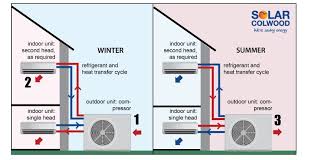
Elsewhere in the world, heating is done using heat pumps. What is a heat pump? Your central air unit is a heat pump, but it operates in only one direction—extracting heat from indoor air and dissipating it outdoors. A heat pump heating system simply reverses that process, creating heat by extracting heat from outdoor air and dissipating it in your home, either through your existing ductwork or through wall-mounted “mini-split” units. Unlike gas, a heat pump moves heat instead of creating it.

How a heat pump works to heat and cool a home using wall-mounted mini-split units heated and cooled by an exterior compressor.

Rita and I replaced our gas furnace in 2012 with a hybrid system by Carrier. It heats our home using the heat pump unless the outdoor temperature falls below freezing, at which point a gas burner kicks in. With our solar panels providing the electricity for the heat pump, our highest mid-winter Xcel bill is under $50. Meanwhile, at Golden Real Estate’s office, as described in my Jan. 4, 2018, newspaper column, we got rid of our furnace and ductwork and installed a ductless mini-split system (like in the above diagram), also powered by solar panels. As a result, our Xcel bill is under $11/month year-round.