Looking Back at a Busy Year: Here Are Some Popular Columns From 2018

`Tis the season when it’s popular to reflect on the year that is drawing to a close, so here’s a collection of my favorite columns from 2018. If any of them strike your fancy, you can find links for each of them online at www.JimSmithColumns.com.

Jan. 4, 2018 — Golden Real Estate: ‘Promoting and Modeling Environmental Responsibility’ This column describes how we completed the transition from mere energy efficiency to a “net zero energy” office. 

Jan. 25, 2018 — Life Transitions Are at the Heart of Most Clients’ Real Estate Needs. Divorce, marriage, relocation, medical crises and becoming “empty nesters” are a few examples.

Feb. 1, 2018 — Here Are Some Obstacles (Real or Imagined) Faced by First-Time Home Buyers.  Down payment, credit issues, student loan debt, and unwarranted risk aversion are some of the obstacles covered. 

Feb. 22, 2018 — Owned Your Home for a Long Time? Here Are Some Ideas on Limiting Capital Gains Liability. Although not a CPA myself, I offer some advice such as “Don’t put your heirs on the title of your house — let them inherit it.” 

Mar. 8, 2018 — How Can Sellers Prepare for the Buyer’s Inspection? Here’s Some Practical Advice. The information in this column can help to save you money when the buyer asks for repairs. 

Mar. 15, 2018 — Buyers and Sellers Ask: Why Did the Appraisal Come in at Exactly the Contract Price?  This is a common question, and I help answer it this week. 

Mar. 22, 2018 — Off-Market Real Estate Sales Hurt Sellers by Shutting Out Buyers Who Might Pay More.  When someone offers to buy your house, treat it as an opening bid. You don’t want to sell your home to less than it’s worth, do you? 

Mar. 29, 2018 — How Can Buyers Win a Bidding War?  Here’s What Our Agents Do. It’s easy for agents to ask buyers to submit their “highest and best,” but an auction approach often nets you more money for your home. 

April 5, 2018 — What If Sellers and Their Agents Don’t Disclose Known Defects in Their Listings?  The new version of the Sellers Property Disclosure is a disservice to both buyers and sellers. I explain why. 

April 26, 2018 — Just in Time: A Breakthrough in ‘Rent-to-Own’ for Those Who Can’t Buy Now.  Golden Real Estate has an investor who will buy a home that is being offered for sale, then rent it you.  And you receive an 5-year option to buy!

May 3, 2018 — As Warm Weather Arrives, What Are the Different Ways to Cool a Home?  Alternatives to conventional air conditioning includes whole house fans, evaporative coolers and heat pumps.  

May 24, 2018 — What Is Title Insurance, and Why Do Buyer and Sellers Need It, Anyway?  This is typically your second biggest expense when selling a home. I explain its purpose. 

June 14, 2018 — Here’s Why You Shouldn’t Sell Your House Without Putting It on the Market.  To get the highest price, you need to expose your home to the broadest range of buyers possible, something that happens only if it appears on the MLS. 

June 21, 2018 — I Love to Write About Real Estate, But This Week It’s Personal.  This well-received column was about Donald Trump.  I just couldn’t stay silent any longer, and I was flooded with thank-yous for writing it. 

July 26, 2018 — The Home Buying Process: How It Works in the Internet Age. The role of the real estate agent has changed now that most buyers do their own online searching before calling their agent. 

Aug. 16, 2018 — Should the MLS Include a Condition Rating for Each Listing? Here’s How It Might Work. In this column, I explain how this could be done and how it would better serve buyers.  

Aug. 30, 2018 — What You Need to Know About Agents Who Claim to Have a Buyer for Your Home. They could be lying to get you to list with them.  

Sept. 13, 2018 — Don’t Make the Same Mistakes Made by Others When Trying to Sell Their Homes  Perhaps you’ll recognize some of these common mistakes.

Nov. 8, 2018 — Senior Homeowners Are at Risk of Being Conned/Scammed Out of Their Homes. This is a must-read! Too many seniors are falling victim to scammers.

Statistics Seem Not to Reflect a Coming Slowdown in the Real Estate Market

By JIM SMITH, Realtor

Because of recent national and regional reports that the real estate market is changing from a seller’s market to a balanced, or even a buyer’s market, I have drilled down into the statistics for real estate activity in Denver and Jefferson County, looking for evidence of that shift. After all, as in politics, all real estate is local, and even reports about Metro Denver’s real estate market don’t necessarily reflect what is happening in each of the metro area’s six counties.

So, are the Denver and Jeffco real estate markets changing from a seller’s market to a balanced or buyer’s market?  The answer appears to be “yes,” as I’ll show below, although the data in the 25-month charts above provide no indication of a coming slowdown. While 25 months might seem like an odd timeframe for a chart, I used it so you could compare this November (on the outer right) with November 2016 (on the outer left) as well as all the months in between.

Two measures of a market’s health are the trends in median sold price and the median days on market. The charts show continued year-over-year increases in the median sold price in both Denver and Jefferson County and only seasonal changes in the days on market. When median days on market are this low — ranging from 5 to 16 days in both Denver and Jefferson County over the past two years — you know it’s a seller’s market.

However, the listings that are currently active or under contract and those which have sold thus far in December suggest that, from a purely mathematical standpoint, 2019 statistics will document a shift in Denver’s and Jeffco’s real estate market.

As I write this on Tuesday, December 11th, there are 1,832 active Denver listings on REcolorado. The median days on market of those listings is 54, more than triple the median days on market for last month’s sales. There are 1,230 Denver listings that are under contract, and their median days on market is 24.  Of the 200 Denver listings which closed between December 1st and 11th, the median days on market was only 20.  Clearly, as those currently active and under contract listings change their status to “sold,” the median days on market will rise significantly by month’s end and into 2019.

The figures for Jefferson County mirror those of Denver. Median days on market for active listings is 42, median days on market for under contract listings is 25, and median days on market for listings sold December 1st to 11th is 19. As with Denver, it’s safe to say that Jeffco’s market has already begun to slow, and statistics will reflect that in coming months. 

If you’re thinking of selling your home, don’t let yourself be blindsided by this evolving market. You can still sell a home quickly in a slowing market, but only if you price it correctly. As I have written before, you can’t underprice a home, because competing offers will drive the price upward. And by pricing your home correctly, you’ll benefit from those competing listings that were not priced appropriately. Call me or another Golden Real Estate agent at 303-302-3636 if you’d like advice on pricing your home to sell.

Should You List Your Home During the Holidays? The Answer May Surprise You

The national real estate media and blogs have finally caught onto something I’ve been saying for several years — that winter, even during the holidays, is a great time to put your home on the market.   The lead article this week on RSImedia’s “Housecall” blog, for example, promotes listing homes during the upcoming holidays, writing as follows:

“With the colder temperatures and many people heading on vacation, it may seem like an inopportune moment to list your house, but that couldn’t be further from the truth.  Although it’s true that there are fewer buyers looking for a home at this time of year, the pros far outweigh the cons. There are fewer, yet far more serious buyers searching for homes in your market, and there is less competition with fewer homes on the market, and transactions proceed more quickly….”

The blog post gives three reasons why the holidays are a good time to list a home. First, sellers needn’t worry as much about staging the home. “Homebuyers who shop during the off-season are typically very serious about getting into a house. They’re unlikely to waste their time viewing homes that don’t already suit their criteria, and will be able to look past your child’s messy playroom.”

Second, the article states that transactions move more quickly, since inspectors, lenders, appraisers and title companies have less of a backlog.  (Personally, I don’t see this being so significant.)

Third, the article points out what I think is most important — there are fewer homes competing for attention against your home.   Sellers should particularly appreciate the fact that buyers who want to see listings at this time of year are probably serious about buying. “Lookie loos” are most often fair weather visitors. So, fewer people are likely to want to see your home during the holidays, but those who do are typically of the highly qualified and highly motivated variety.

What the RSImedia blog post fails to address is what changed to make the holiday season a good time to list a home, because that wasn’t true years ago.  I believe it is because of how the internet has changed the relationship between buyers and their real estate agents.

In the past, agents would do the looking, contacting their client when they identified a home they think their buyer would like. With today’s MLS systems, agents can enter their buyers’ search criteria into the MLS, which triggers an email alert whenever the system identifies a listing matching those criteria.

Thus, while agents might lose focus from time-to-time, the MLS computer never stops watching and alerting. The minute a suitable listing is entered in the MLS, buyers are alerted.  Some of these folks are sufficiently motivated that if the listing “checks enough of their boxes,” they’ll call their agents to request an immediate showing — even on Christmas eve.

Buyers can set up similar alerts themselves on consumer-facing real estate websites such as Zillow, but they can’t use nearly as many search criteria as their agent can.  For example, I don’t know of a single consumer-facing website that allows a user to search for main-floor master suites, fenced yards, homes with mountain views, or homes with full-but-unfinished basements.  The MLS system on the other hand, allows its member agents to search for all of these criteria – and more.  If it’s a field on the MLS, it can be a search criterion for us agents.

If you aren’t able to search for exactly what you want on those consumer-facing websites, ask us or your agent of choice to set up the search for you.  It doesn’t cost the agent or you anything to create these alerts. 

In previous years I’ve published statistics showing how well listings sell in the winter.  You can find those columns at www.JimSmithColumns.com.

Readers Offer Suggestions on Making Homes More Resistant to Wildfires

I was pleased to get several responses to last week’s column on protecting homes from wildfires.

One reader suggested that building a house out of concrete might help.  While this is a good idea, remember that such a house would still have a roof and openings for windows and doors that would need to be made as fire-resistant as possible.

Another reader suggested installing outdoor smoke detectors, something that hit close to home with a friend of mine. She said that a firefighter once rang her doorbell to warn her of an approaching wildfire. The moment she opened the door she smelled the smoke, but she hadn’t smelled it when she was indoors. For that matter, why not cell-connect detectors in the forests?

That prompted me to wonder why building codes don’t require smoke detectors in attached garages, but only require that the walls, door and ceiling be fire-rated to extend the time it takes for a garage fire to penetrate the living quarters.

Lastly, one reader pointed out that in a firestorm no measures are likely to prevent a home from being consumed.  So true.

Keep the suggestions coming.  You can comment on this post or comment on the original post from last week. 

California’s Wildfires Are a Wakeup Call for Building More Fire-Resistant Homes

Real_Estate_Today_bylineWhether or not you live in the foothills or adjacent to drought-parched open space, you were likely stunned, as I was, by the scene of an entire city being consumed by fire so quickly that people burned to death in their homes or in their cars trying to escape.  Perhaps you worry that what we witnessed in California could happen here.  Given our dry climate, our topography, and our strong winds, the question isn’t whether such an event could happen here but rather what we can do to mitigate the risks to life and property should we find our home in the path of a fast-moving wildfire.

If you’ve been in Colorado for awhile, you may remember the Waldo Canyon fire of June 2012.  That wildfire destroyed 346 homes in the Mountain Shadows subdivision of Colorado Springs and killed two people.  As shown in the picture below, that fire did not burn every home, however. The homes that burned were ignited by wind-blown embers.

Canyon Fire 2 AerialsThat subdivision, like the city of Paradise, California, is in what’s known as the Wildland Urban Interface, but the kind of winds we experienced as recently as last weekend can cause embers from a single house fire to spread quickly to other homes in urban areas, too.  If embers start flying, you’ll want to make sure that your home is not ignited by them.

Traditionally, fire control has focused on fires that begin inside your home. For example, building codes have long required the use of self-closing solid doors and ⅝-inch fireboard between your garage and the living quarters and attic of your home, and new multi-family buildings are typically required to have fire-suppression (sprinkler) systems. In some jurisdictions, single-family homes also must have such systems, which can quickly flood the interior of your home with fire-dousing water, but I have yet to find a house with exterior and roof-mounted sprinkler heads.

stone-coated metal roofingThe next time you have to replace your roof, consider what one of my clients in Golden did — install a stone-coated metal roof instead of yet another composition shingle roof. It will help to protect your home from fire, not just hail.  At right is a picture of a stone-coated metal roof.

In South Carolina, the Insurance Institute for Business & Home Safety built a massive wind tunnel, originally to test different construction materials and designs under hurricane conditions. More recently it has been adapted to measure the effect of wind-blown embers (see image below) on various building materials. See website at www.DisasterSafety.org/wildfire/.

Wind_tunnel_pictureFrom that website and other research I’ve done, here are some thoughts about making homes more resilient in the face of wildfire.

Although fire-resistant roofing and siding materials should be used whenever possible, it’s not enough to consider just the material itself.  For example, a tile roof won’t burn but is not impervious to embers, which can be blown into the gaps between the tiles.

house_with_rolling_shuttersIntense heat can cause windows to shatter, so consider using tempered glass all around, not just where required by code. Better yet, consider installing electric rolling metal shutters, which descend to completely cover exterior windows and doorways. One vendor’s website is www.SomfySystems.com. Although marketed for other reasons, such as security and privacy, they could also protect windows from being blown out by an approaching wildfire. They can also be monitored and operated using a smartphone app.  I have seen such shutters installed on a few Colorado homes, including on the Golden home shown here, which we listed in 2009.  The metal shutters roll down from that box above each window.
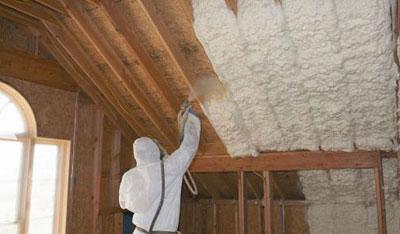
Special attention should be paid to the underside of roof overhangs, balconies and decks, where flames can be trapped. Roof soffits in most homes have vents which combine with vents on the roof to circulate outside air through the attic.  Unfortunately, this design can also allow the introduction of wind-blown embers into the attic. One way to eliminate these vents is to do what Meritage Homes did in building Arvada’s Richards Farm subdivision. The insulation of those homes is closed-cell foam applied to the underside of the roofs, rather than the more typical blown-in cellulose or fiberglass batts resting on the floor of the attic, as is found in most homes – perhaps your own.  Meritage probably didn’t consider that making the homes more energy efficient in this way had the added benefit of making them more resistant to wildfire.  Below is a picture of this kind of insulation being installed in an attic. Conditioned attic

If your home has those attic vents, screens should be installed on them to minimize the intrusion of wind-blown embers, in the same way that chimneys have screens to prevent the escape of such embers. Other openings such as plumbing vents, dryer exhaust vents, etc., can be similarly made more fire-resistant.

Owners of foothills properties are well aware of the “defensible space” requirements of local jurisdictions which involve the removal of trees and clearing other combustibles from around a home.  For example, firewood should never be stored against the side of a home. Insurance companies often make such mitigation a condition for insuring a home.

It is not uncommon for homes to have “safe rooms” to which homeowners can flee in case of a home invasion. I have seen really good examples of safe rooms in a couple of homes. The existence of such a room can be concealed through, for example, a door built into a floor-to-ceiling book shelf. If such a room were constructed in a basement with cinderblock walls, a metal door, and a concrete-and-metal ceiling, it might double as a survival room in the event a wildfire like the one in Paradise, which made evacuation a risky alternative. Meanwhile, such a room would make a great wine cellar!

Although I haven’t researched it, I would guess that taking some of these precautions — especially metal roofing and the rolling metal shutters — might help to reduce your insurance premiums, as well as to possibly save your life and property in case of wildfire.

Because many of the measures described above require electricity, and electrical service can be interrupted during a fire, you might consider installing a power back-up system such as the Tesla Powerwall or a conventional gas generator. While you’re at it, installing solar panels would help not only to shield an otherwise combustible roof, but could also power your home if electrical service remains out after the fire has passed.


At Thanksgiving, I Like to Reflect on the Many People for Whom I’m Grateful

By JIM SMITH, Realtor ®

Thanksgiving is my favorite holiday, because it gives me an opportunity to dwell on all that I have to appreciate in my life — both professionally and personally.

First and foremost, I’m grateful for the nine broker associates who found themselves drawn to work at Golden Real Estate. They are pictured with me below outside our South Golden Road office. Let me introduce them, from left to right.

GRE_AgentsI have known Jim Swanson since we both worked at Coldwell Banker in 2002.  Jim, a lifelong resident of South Golden, followed me to RE/MAX Alliance where we both worked before I bought a former restaurant building on South Golden Road and created Golden Real Estate. I value his familiarity with and love of Golden. He’s also an excellent Realtor! You can reach him at 303-929-2727 or you can contact him by email at BrokerSwanson@aol.com. Thanks, Jim, for being with me as we grew our brokerage!

Chuck Brown, second from left, owned his own Metro Brokers office before giving it up to join Golden Real Estate several years ago, attracted by our commitment to sustainability. (He has a Tesla Model 3 on order.) He lives and sells in Paradise Hills on Lookout Mountain, but he’s also our Denver expert, having listed and sold many homes there over the years. You can reach Chuck at 303-885-7855 or you can email him at Chuck@GoldenRealEstate.com.

Norm Kowitz came to us from RE/MAX Alliance. He lives in North Golden and is currently enrolled in Leadership Golden to deepen his knowledge of this city that he and I call home. His service on the board of directors of the Christian Action Guild testifies to his commitment to serving others.  Deeply proud of his service as a U.S. Marine Infantryman, Norm also takes pride in the fine people his four children have become and, of course, in his five grandchildren. Also, he helps me by copyediting my columns. He’s a great Realtor, too! You can call Norm at 303-229-3891, or email  him at Norm@GoldenRealEstate.com.

Next to Norm is Carol Milan, who has lived in Golden for 30 years (since college) and has been a strong community volunteer over that entire time. A mother of three teenagers, she is married to Kevin Milan, the chief of South Metro Fire District. I’m impressed at her commitment to Golden and how many people she knows! Prior to becoming a Realtor, she was a Registered Nurse at Colorado Orthopedic Hospital, where she attended to my wife, Rita, during her knee replacement!  You can call or text Carol at 720-982-4941, or email Carol@GoldenRealEstate.com.

Standing between Carol and me is Kristi Brunel, who is also on the board of the Christian Action Guild and, like me, is a graduate of Leadership Golden. It was Kristi who recruited Norm and Carol to join Golden Real Estate. The Brunel family is well known for its long-time residency here and for its contribution of Golden’s civic life. I value Kristi for her knowledge of investment properties, because she and her husband Kenny have long owned and managed several rentals in Jefferson County. You can reach Kristi at 303-525-2520 or email her at Kristi@GoldenRealEstate.com.

On the other side of me is one of our newer agents, Debbi Hysmith, a real dynamo of a Realtor who lives in Westminster. She came to us from another small brokerage, attracted by our commitment to sustainability. (She drives a Chevy Volt, which she charges for free in our parking lot!)  She is also a home staging expert and even has her own inventory of furnishings that she uses to stage her listings. You can call or text Debbi anytime at 720-936-2443 or email her at Debbi@GoldenRealEstate.com.

Next to Debbi is David Dlugasch, a certified home stager. David had his own brokerage in Crested Butte, but relocated to Arvada 5 years ago and was drawn to join Golden Real Estate after reading my columns online. He specializes in Arvada real estate. He’s my deputy managing broker. You can reach him at 303-908-4835 or David@GoldenRealEstate.com. David recently took delivery of a Tesla Model 3, which he, too, charges in our parking lot.

Next to David is Carrie Lovingier, who has been with Golden Real Estate for a decade. Carrie lives in south Evergreen (behind Evergreen High School), so I look to her when it comes to listing or showing Evergreen listings. She is a great Realtor!  Reach her at 303-907-1278 or Carrie@GoldenRealEstate.com.

    Last but not least is Andrew Lesko, who lives in Golden (across the street from me).  Andrew specializes in townhomes, condos and duplex properties. If you are considering buying or selling these types of properties, a great place to start would be his websites GoldenTownhomes.com and DuplexAlerts.com. Andrew can always be reached at 720-710-1000, or you can email Andrew@GoldenRealEstate.com.

Next I’d like to salute and thank our many clients, most of whom came to us from reading this column, so I am really grateful for my readers!  Remember, I love to hear from you, so do call or write me!  And please know how grateful all of us are for all of you

I’m also thankful for my colleagues from other brokerages and especially those in leadership positions at the Denver Metro Association of Realtors (DMAR) and fellow members of the MLS’s Rules and Regulations Committee on which I’ve been privileged to serve for many years. I’m equally grateful for the staff who manage both DMAR and REcolorado (our Denver MLS). Ann Turner continues to provide excellent leadership at DMAR, and Kirby Slunaker has done the same for REcolorado.

Last but not least, I so love and appreciate my wife of 15 years, Rita Smith. She is my rock and is a great sounding board for everything I do and write. Thank you, Rita. I love you!  I also thank Rita’s son, Bob Guinn, a wine executive in California, for welcoming me into his family.  Rita and I cherish every opportunity to be with him, his wife Maria, and his amazing teenage daughters, Lauren and Melissa.


Yes, the Russians Wanted Trump Over Hillary, But Their Real Goal Is to Divide Americans

By JIM SMITH

Prompted by last week’s election results and the firing of Attorney General Jeff Sessions, I’m taking a break once again from writing about real estate to write about politics. But my intention is to be more educational than partisan. Once again, as in my June 26th column, I am speaking only for myself and not for Golden Real Estate or its wonderful — and largely apolitical — broker associates.

As a professional journalist myself (trained at the Washington Post during the turbulent summer of 1968) and educated about the Soviet Union in boarding school as a student of the Russian language, I know something about what led up to the 2016 election that I don’t feel has been adequately conveyed by the media.

In addition to learning the Russian language from my prep school teacher, a Dutchman, I also learned about how the Soviets used information to control their own population, and how they used it to influence people of other nations. My education even included subscribing to the Soviet newspaper Izvestia, which probably put me on a CIA watch list back in the 1960s.  I also traveled to the Soviet Union in 1978 as a tourist and again in the 1980s three times as part of “citizen diplomacy” groups sponsored by the Center for Soviet-American Dialogue in Bellingham, Washington. After the fall of the Soviet Union, I made one additional visit to Russia, this time as a tourist, to Vladivostok, the Pacific naval port which is also the terminus of the famed Trans-Siberian Railroad.

From these and other experiences, I learned about the KGB, in which Vladimir Putin served with distinction, leading to his selection to succeed Boris Yeltsin as President of Russia. I’m speaking up now, because, unless you watched the excellent 2-part series “Putin’s Revenge” on the PBS program Frontline (Google it), you may not fully comprehend how the Russians impacted the 2016 election or recognize the activities they continue to engage in today.

I never worried that Russians colluded with the Trump campaign or tried to hack actual voting, because I knew that their tactic is to manipulate minds. It was the Russians who invented the terms “disinformation” and “kompromat” (compromising material).  I learned those terms in Russian class in the 1960s.

The widespread adoption of social media, such as Facebook, supercharged the Russians’ ability to influence “low information voters” — voters who aren’t well enough informed to detect fake stories intended to influence their beliefs and voting behavior.

The Frontline program showed how Russia’s Internet Research Agency has used social media to fire up both sides of any issue which has the potential of creating social and political division in America. They would seize on issues and events that were already dividing America, such as the white nationalist rally in Charlottesville, and create social media posts both promoting and attacking what was happening.

Think about any event that happened in the past several years — such as the killings of blacks by white police officers, but also anything that would stir up the far right and/or liberals — and you can be sure that some of the social media postings appealing to each extreme were created by Russians working in the St. Petersburg, Russia, office of the Internet Research Agency.  Such postings then triggered other events — think mass casualty events — which in turn were exploited using additional postings. It’s a never-ending vicious circle. The Frontline program gave examples.

America is not the only target of Russia’s meddling with public perceptions and opinions. Russians are even more keen on breaking up the European Union and NATO.  Without a doubt, they did the same kind of meddling in European countries to stir up, for example, division over the influx of Syrian refugees.

The Brexit vote in England was probably influenced by a Russian disinformation campaign in that country.  And that makes sense, because what would Russia like more, given Putin’s commitment to making Russia great again, than to see the European Union weakened? Russia’s Internet Research Agency is probably at work stirring up nationalist feelings in every European country. Promotion of nationalism in America also serves Russia’s interest because it serves to weaken NATO and draw us out of other international agreements such as the Trans-Pacific Partnership.

The bottom line, as I see it so clearly, is that President Trump has served as a useful tool — without actual “collusion” — for the aggrandizement of the new Russia under Vladimir Putin. And everything that Trump does to further divide Americans against each other, whether promoted or not by the Internet Research Agency, serves to weaken the United States’ position in the world, which, almost by definition, strengthens Russia’s position in the world.

In one of my “citizen diplomat” trips to the Soviet Union, I was struck by the fact that attractive young women were inexplicably introduced into some of the social events for our largely male delegation. When I heard about the “dossier” with compromising videos of Donald Trump the businessman with prostitutes — for whom I’d wager he did not pay — I suspected immediately that it was true. This and other “kompromat” could serve to keep our President from doing anything adverse to the Russian government.

It doesn’t matter whether the campaign to weaken the First Amendment by creating mistrust of mainstream media with the “fake news” label is inspired or promoted by the Russians. Trump is doing a good enough job at that, and it does indeed weaken our society and ultimately our standing in the world, which must warm the hearts of our adversaries. The trade war with our allies and other countries — except Russia, it should be noted — can’t hurt in that respect, either.

Ultimately, I have great faith in America, and I am heartened that one house of Congress will soon be under Democratic control, providing a check on the Republican Senate and the Trump administration. A crucial role of Congress is to provide oversight of every department and agency and to hold the administration accountable — something that the Republican Congress has declined to do lest it impact their individual political futures. Impeachment of President Trump is not necessary, however deserved it might be on constitutional grounds. It is sufficient just to have one house of Congress holding the rest of our government accountable for its actions.

Changing topics, it is common knowledge that more than 80% of the tax breaks in the Trump tax bill went to the very rich, with some relief to the middle class thrown in to garner popular support. Overlooked, however, is the impact on the non-profit sector. I’m concerned that Americans will donate less money to worthy charities as we approach the holiday season because of the doubling of the standard deduction. That one provision takes away the tax advantage of supporting charitable causes for a large number of taxpayers, but it is not being discussed.

I’m not letting it affect my own giving, but I worry that it could affect others’ giving, and I’m looking forward to some entity doing a statistical analysis of the tax bill’s effect on charitable giving this year and next.


Why Use Facebook Messenger?

Perhaps I’m showing my age, but I just don’t understand why some people choose to communicate by Facebook Messenger instead of email. I get emails that so-and-so has sent me a message on Facebook, and I have to login to read it.

Wouldn’t it make more sense — and be more considerate — to send the message in an email?  Someone please explain this to me!

While on the topic of email, I find Windows’ default typeface (10-pt. Calibri) hard-to-read. I have changed that default to readable 12-pt. Georgia.

If you use Outlook, you can change your email defaults at File>Options>Mail>Stationery and Fonts.


Senior Homeowners Are at Risk of Being Conned/Scammed Out of Their Home

Real_Estate_Today_bylineAlthough I’ve written on this topic before, it certainly bears repeating. If you are a senior citizen living in a home you own — perhaps free and clear — know that you are the target of some less-than-honest speculators.

I was reminded of this risk when a friend who does home health care for seniors visited me last week. She recounted how one of her clients keeps getting phone calls and letters from people offering to buy her home “as is, for cash, with no real estate commissions to pay.” My friend fears that this elderly widow may be taken in by an offer to sell her house for less than it’s really worth.

This fear is understandable because, to a trusting and unwary senior, the pitch can be appealing.  Unfortunately, it’s almost certain that any such offer is based on an expectation of buying at a bargain price and selling for much more. Such people only want to buy your home because they can flip it quickly for its real value. They count on you not knowing your home’s true value.

Many senior citizens who receive such solicitations don’t have the internet access or computer skills to perform even a rudimentary value check on their home. The speculators behind such solicitations know this. 

Let’s say you purchased your home decades ago for $30,000 or less. An offer of 10 times that amount might be very appealing.  But what if your home is actually worth far more than that?  Imagine if you sold your home to someone for $300,000 only to discover later that he sold it quickly for $400,000 or more without making a single improvement?   Would you feel short-changed?  You probably would – and rightfully so.

You’ve probably read stories or seen television coverage of young women who marry, or at least befriend, very elderly men, investing a decade or less of their young lives in order to inherit a lifetime’s accumulation of wealth upon their “loved one’s” death. Even some paid caregivers, who have ostensibly dedicated their lives to caring for the elderly, have been known to put forth a loving and compassionate front, only to manipulate their charge in such a way as to gain access to his lifetime accumulation of wealth.   

A few years ago, I was asked by a surviving sibling to sell her deceased brother’s home, only to discover that her brother, who suffered from dementia, had been convinced by his caregiver to add her to the title of not only his home, but also his car and his bank accounts. Sadly, the sister had no legal recourse – although she fought mightily – and was ultimately forced to take the home off the market, whereupon the erstwhile caregiver promptly listed and sold the home, pocketing the proceeds. She had already drained the bank accounts.

If you are a senior, it’s important that you have a clear understanding of this issue. Get your relatives and heirs involved before you respond to any solicitation you receive. If you don’t have relatives or heirs, try reaching out to  Colorado Housing Connect at 844-926-6632 or Mpowered at 303-233-2773. If their counselors can’t provide the advice or help you need in this regard, feel free to call me, because I will be continuing to research this topic after the deadline for submitting this column to YourHub.

If the solicitation involves real estate, reach out to me or to a real estate professional you believe you can trust. If I’m not the best Realtor to help you, I’ll refer you to one who is.  A good real estate professional can determine pretty quickly whether the offer is in line with the market or if someone is trying to con you into selling your home for less than its real-world value.  At a minimum, if you decide to participate in a private, off-market sale of your home, let me or that other trusted Realtor provide you with honest, professional representation.

An example of that occurred just last week, when a reader asked me to assist him in selling his home for $275,000. I advised him, after performing a quick value check, that he could easily get $350,000 for his home. He told me that he and his wife were okay with getting less than full value because they were happy to help a friend. I sensed that this couple was of sound mind and not being scammed, so I agreed to handle the sale as a transaction broker for a nominal fee.

I’m glad this couple called me and that I was able to serve them.  Their situation, along with the caregiver scenario above, was the inspiration for this week’s column.  I fear that far too many of our elderly neighbors are being conned or cheated out of a significant portion of the value of their homes, and I want to do my part to minimize the damage inflicted upon them.

As an aside, if you are a senior considering the option of selling your home and moving into a senior community, the choices can be as confusing as they are plentiful. Any Realtor can help you sell your home, but when it comes to choosing the best senior community, we like to refer seniors to a woman who has made it her career to learn about all such communities in the metro area and can help you select the best one for you.

Call me at 303-525-1851 to arrange a meeting that includes you, that woman, and myself or one of our two broker associates who earned the Senior Real Estate Specialist (SRES) designation through extensive training in the real estate needs and concerns of seniors.


Are You Ready to Take Full Advantage of the Winter Home-Selling Season?

[This column appeared only in the Denver edition of YourHub.]

Real_Estate_Today_bylineAs the weather turns colder, the real estate market can actually get hotter for sellers. However, since few sellers are aware of this dynamic, let me explain.

The internet has changed the way home buyers shop, making the residential real estate market far less seasonal than it used to be. In the past, buyers would tell an agent what they’re looking for and wait to see what the agent turned up.  Those days are behind us.  Buyers now have a variety of tools by which they can perform a home search online, contacting their agent as they identify properties they’d like to see. Consumer-facing real estate websites also offer email alerts based on geography, price and other criteria.

A hybrid option, made possible by MLS improvements over the years, is for the buyer’s agent to set up an email alert within the MLS. This option has the advantage of the search being far more specific, since agents can search every MLS field, not just location, price range, bed/baths and a few other fields.  Buyers can choose to receive their MLS alerts monthly, daily or even as soon as a new listing is entered on the MLS by the listing agent.  When a buyer receives an alert on a home that checks enough of their boxes, he or she can call their agent and request a showing.

While a buyer might do less active searching on the internet as winter sets in, the MLS alerts keep coming on their own.  This allows a buyer to respond quickly should the “perfect” home hit the market.  (If you haven’t asked your agent to set up such an MLS alert, ask him – or me. It’s a free service to us and you and takes little time to set up.)

Experience has shown me that, if a buyer were to get an MLS alert the day before Christmas with a new listing that sounds perfect, he or she would pick up the phone to wish his agent “Merry Christmas… and by the way, did you see that new listing?  When can I see it?”

What this means for sellers is that you shouldn’t withhold your home from the market just because winter’s approaching. Don’t think that spring and summer are the “selling season.”  Homes sell year round more than in earlier times, and, because many sellers aren’t aware of that and wait for spring, the opportunity for your home to get more attention increases. Put your home on the market in the depths of winter and if you’ve priced it right (not too high), you’ll be amazed at how many showings you will have and how quickly it will sell. Why? Because there’s little else out there!

My own research shows that homes take longer to sell in December and January than in June and July — almost double — but median days on market have stayed under 20 through every winter since 2014. That’s still a very good environment for selling a house, and the showings you get in  mid-winter are higher quality. People who are house hunting in the winter are, for the most part, serious buyers and not “lookie-loos.”

Yes, families with young children might prefer to move during summer vacation, but they are not the majority of home buyers anymore. Consider these other buyers: baby boomers looking to downsize, millennials looking to start a family, and employees facing mid-winter job relocations.

Seniors facing a knee or hip replacement six months from now want to sell their 2-story home and buy a   ranch-style home with no stairs without waiting for spring. Ditto for women who are three months pregnant. They want to move now into a home with more bedrooms, not wait until they’re eight months pregnant or until after the baby is born.

Yes, the market is slowing, but we’ll continue to see quick sales with multiple offers on homes that are priced properly this winter, just as we did last winter. If you fail to price your home right, you’ll think I misled you, as your home sits on the market for weeks or months with few showings and no offers. I’ve written columns on how to price a home properly in the past. Find them at www.JimSmithColumns.com, or call for a free consultation with me or one of our nine excellent agents.

It’s all about supply and demand. There are just as many buyers in the winter, but there are far fewer listings to choose from, which makes it a great time to put your home on the market. Some of those buyers tried all summer to buy a home and lost out to other bidders. They are not going to stop looking just because the days are getting colder and shorter.