The Buying of Homes Has Become More & More Frantic Since the Marshall Fire  

I had a busy weekend this last Saturday and Sunday. With two new listings, I held each open for two hours. I couldn’t even count the number of visitors at the single family home listing that I held open on Saturday. Listed at $495,000, over 120 agent showings had been scheduled during the five days that it was active, and I received 25 contracts for it by the Sunday afternoon deadline. It went under contract for $630,000 on Sunday evening.

Surprised by this level of interest, I did some research Monday to quantify the increased buyer activity. Here’s what I found.

During the first 23 days of January, 403 Jefferson County listings went under contract.  Of those, 295, or 73.2%, had been active a week or less at the time they went under contract..

But not only were new listings selling this month. Twenty-four, or 6%, of the listings that went under contract in the first 23 days of January had been languishing on the market for 3 months or longer. Three listings had been on the MLS for over half a year.

My very busy open house on Saturday, Jan. 22nd in Arvada

Of the 403 contracts written so far in January, 36 (8.9%) were for homes listed for $1 million or more. The most expensive home on that list, a 1930 ranch-style home in Genesee Ridge that had been on the MLS for 275 days, went under contract last Monday. This didn’t happen because of a recent price reduction. It had been listed at $5.9 million since last July 15th. It was originally listed at $6.6 million on April 1, 2021.

So, how does January’s activity compare with December’s?  In December, a total of 554 Jeffco homes went under contract, most of which have now closed. Of those, 336, or 60.6%, had been active a week or less, versus 73.2% of the January contracts Twenty-five of them, or 4.5%, had been active for three months or longer, versus 6% in January..

Forty-four Jeffco homes (7.9%) sold for $1 million or more in December, compared to 8.9% in January.

So, yes, statistics do reflect a more frantic sales pace in January.

Taking a longer perspective, let’s look at the 4th quarter of 2021 vs. the 4th quarter of 2020.

In the latest quarter, 56% of the homes went under contract in 7 days or less, versus 60.2% in Q4 of 2020. A smaller percentage of homes that had been on the MLS three months or longer sold in the 4th quarter of each year — 3.9% in 2020, down to 3.0% in 2021.

Having established the statistical basis for my observation that home buying has become more frantic this month, let’s look at possible reasons.

At least one of the 25 contracts I received last weekend for my Arvada listing was from a family which lost their home in the Marshall fire.  They are currently living in an Airbnb.  Others may have been from victims of that fire, but they didn’t say so in their offer.

Another buyer was an investor who told me that they were rushing to buy a home because they felt prices were rising at an increasing rate. This buyer thought that despite the bidding wars, they could get a better deal now than if they waited another year to add to their portfolio.

Rising interest rates and the expectation of further increases later on probably are playing a role. People want to buy before rates increase further. You may have read that a high percentage of buyers are cash buyers, but this has not been my experience, and only three or four of the 25 contracts I received for my listing.

How to Alert Residents About Approaching Wildfires  

Clearly many lives were saved in the Marshall Fire because it started in the morning and residents were awake and alert to the danger. Imagine if the fire had begun at 2 a.m.  How many more people might have died in their homes?

A reader suggested that community-based sirens could help to save lives, and that does sound like a good idea.

NextDoor is a great resource for alerting residents about all kinds of dangers, but it would not wake anyone up. Something like the Amber alert which makes a deafening alarm on cell phones could be effective. (I leave my cell phone on at night but it is purposely out of earshot for phone calls and text messages. I would, however, hear the loud alarm used for Amber alerts.)

The Amber alert should not itself be utilized for such a warning, because it can be silenced.  If there were a separate alert for fire danger, it’s unlikely that people would silence that alert or turn off their cell phones at night.

There are, I’ve found, many seniors who have held off buying cell phones, but the existence of such an alert might inspire them to purchase one. In addition to the low-cost providers, there is a program called Lifeline that provides free cell phones to households that are on various programs such as SNAP, SSI, Medicaid, etc. Learn more at www.AssuranceWireless.com. If you are currently paying for a landline telephone, you could get rid of it and port your phone number to the free cell phone that you get with this program. The cellphone can also provide you with free internet service via a “hotspot,” allowing you to save money on broadband, too.

U.S. Cement Industry Sets Goal for Carbon Neutrality  

In last week’s column about shifting from combustible wood-frame home construction to fire-resistant concrete home construction, I reported that an Australian company has developed a “green” concrete which reduces the large carbon footprint of traditional concrete made from Portland cement. Concrete manufacture and deployment reportedly is responsible for 8% of global CO2 emissions.

A reader shared with me information about the Portland Cement Association’s release of its “Roadmap to Carbon Neutrality” in October 2021, suggesting that the industry is aware of its carbon footprint and wants to reduce it.

Here’s an excerpt from a press release published online:

“The PCA roadmap involves the entire value chain, starting at the cement plant and extending through the entire life cycle of the built environment to incorporate the circular economy. It recognizes five main areas of opportunity: clinker, cement, concrete, construction and carbonation (using concrete as a carbon sink). Each phase of the value chain is integral to reaching the goal and can unlock unique and specific pathways to carbon neutrality, including actions such as reducing CO2 from the manufacturing process, decreasing combustion emissions by changing fuel sources, and shifting toward increased use of renewable electricity.

“The association is committed to gathering a coalition of industry experts, researchers, policymakers and companies along the value chain to make the roadmap a reality. ‘PCA is actively engaging with organizations beyond the industry to bring the right people to the table to accelerate and advance solutions to reach carbon neutrality,’ said Massimo Toso, PCA climate and sustainability council co-chair, and president and CEO of Buzzi Unicem USA.

Styrofoam Recycling

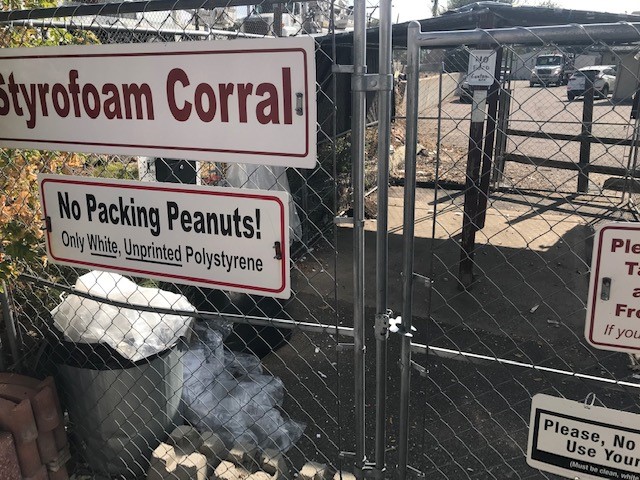
Since our real estate office moved from 17695 S. Golden Road to 1214 Washington Avenue in downtown Golden, people have been asking if our Styrofoam Corral has moved.

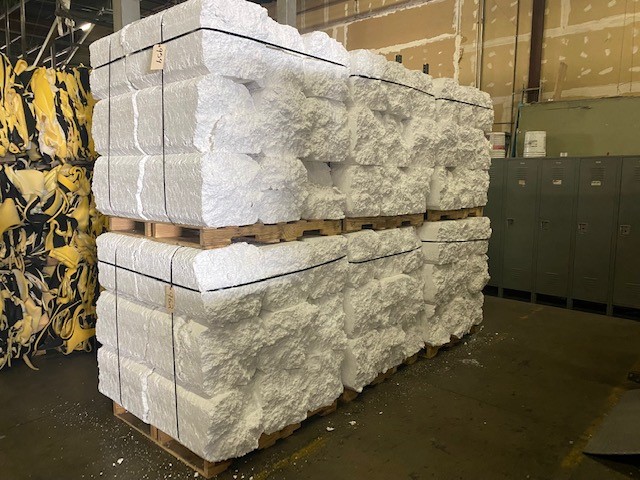
The answer is “no,” we still maintain the Styrofoam Corral behind our old office (which we still own) and still take two truckloads of Styrofoam to the Centennial Containers in Denver every month, keeping over 200 cubic yards of the material out of landfills every year!

One truckload of Styrofoam from Golden Real Estate ends up being just one bar of “densified” polystyrene on these half-ton skids which are then delivered to a company which makes new products from it.

Here Are More Examples of Concrete Construction and Fire Resistant Roofing  

My previous two columns about reducing your home’s vulnerability to wildfires generated a lot of reader response, providing even more to write about on this important subject.

Fire resistance is personal for Rita and me, since we live in a wood frame home backing to open space which would be ready fuel for a wildfire.

I’ve been told that following an 1863 fire, Denver passed an ordinance requiring masonry construction. Somewhere along the line, that requirement was dropped. I wouldn’t be surprised to see building codes changed once again restricting wood construction.

While there’s a trend toward requiring  fire suppression systems inside homes, they are designed to suppress fires which originate inside a home.  If a fire originates externally, such systems may be of limited effectiveness in saving a structure.

Last week I wrote about ICFs — insulated concrete forms. Concrete is poured into a form which has insulating EPS (expanded polystyrene) on each side. This produces a concrete wall which has insulation pre-installed on each side of it.

A couple readers made me aware of the opposite approach, a concrete wall in which the “sandwich” has concrete on the outside and the expanded polystyrene on the inside.

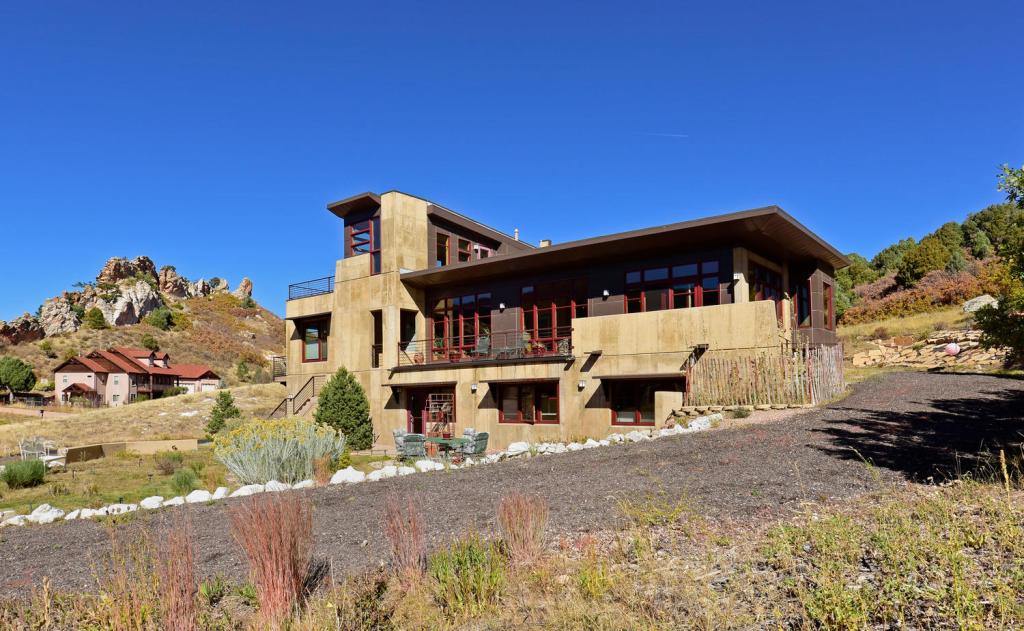
Reader Lynn Greene invited me to visit her home in Perry Park (see picture below), southwest of Castle Rock, which was built with Thermomass® walls and concrete floors developed by Composite Technologies Corporation of Boone, Iowa.

Lynn’s tenant told me that the energy costs peak out at about $70 per month to heat the house with radiant floor heating built into the concrete floors. That heat is provided by a high efficiency boiler using natural gas. Large south-facing windows provide a lot of free winter time heating. (Notice the large overhangs shading the south-facing windows in summer but not in the winter.)

The Thermomass walls were poured in place, less expensive and more attractive than walls built of uninsulated concrete block. It also allowed electrical and other conduits to be built into the walls instead of surface mounted afterward.

Another “sandwich” approach is sold by a company called RSG 3-D, but they create panels which are assembled onsite instead of being poured in place. Also, their polystyrene interiors (which are wider) have steel connectors instead of the plastic connectors used in the Thermomass walls. That reduces the insulating quality of the wall, since metal is a conductor.

Another reader reminded me that the making of concrete is a major source of carbon dioxide, a greenhouse gas. According to Wikipedia, “The cement industry is one of the two largest producers of carbon dioxide (CO2), creating up to 8% of worldwide man-made emissions of this gas, of which 50% is from the chemical process and 40% from burning fuel.”

Click here to read an article from The Guardian about the development of “green concrete” in Australia that sounds very promising. As you may know, “concrete is made from approximately 10% Portland cement, 3% supplementary cementitious inclusion (for example fly ash), 80% aggregates (such as gravel and sand), and 7% water.” Then it is reinforced with steel, which has its own huge carbon footprint.  By replacing the steel with recycled plastic, that impact is mitigated, and, according to article from The Guardian, the Australian company Wagners has created earth friendly concrete using blast furnace slag – an industrial waste from steel production – along with fly ash, a waste from coal power generation, as a replacement for Portland cement.

To make a concrete home truly resistant to wildfire, it is necessary to make the windows and doors and other openings fire resistant too. There is glass (with frames) rated for 20 to 180 minutes of fire resistance. See www.fireglass.com.

Lastly, one must deal with roofing. Another reader made me aware of the synthetic roofing by CeDUR which was installed on her Wheat Ridge home and which is also on Woody’s Wood-Fired Pizza:

It looks just like a wood shake roof and is installed the same way in individual shakes, but it has the highest rating of fire resistance (Class A), earning homeowners a substantial discount on their homeowners insurance. Learn more at www.cedur.com/fire-safety.

There are vents of all kinds not only on your roof but on soffits, foundations, eaves and gables, and they need to be protected from flying embers. Vulcan Vent sells vents for all those openings, “built to create a barrier against wind-blown embers and flames in the presence of intense heat.” Learn more about them at www.VulcanVents.com.

Do You Have an Adjustable Rate Mortgage? Here Are Some Important Changes

I recently received a call from a reader asking what is likely to happen with his adjustable rate mortgage (ARM) that is tied to the LIBOR Index. LIBOR may be just another acronym that you’ve skipped over in the sea of real estate acronyms, but if you have an ARM read on, because the “index” (LIBOR) that is used to set your interest rate is being phased out after 2021. I asked Jaxzann Riggs, owner of The Mortgage Network what borrowers should expect.

LIBOR, or the London Interbank Offered Rate, was a benchmark interest rate index used for decades by lenders all around the world, as a predictor of future loan costs. To break it down, LIBOR was calculated based on estimates of the average interest rate a group of leading global banks would charge each other for short-term loans. Lenders then used that information (referred to as the “index”) to calculate the rate you would pay for your mortgage as the interest rate on your ARM was “adjusted.”

During higher-priced housing markets, many homeowners chose an adjustable rate mortgage because they preferred the lower monthly payments that an ARM offered. Most ARMs created in the past 20 years were tied to the LIBOR benchmark, which is why this index has played an important role in how much interest you pay on your mortgage if you have an ARM.

The LIBOR index, as I said, is being phased out. Introduced in 1986 by the British Bankers’ Association, the LIBOR index quickly became the default standard interest rate used by both local and international lenders. Despite wide acceptance, LIBOR was based on self-reporting and good faith estimations, which made it very susceptible to manipulation and fraud. Scheming and collusion within the LIBOR index were brought to light in 2012, causing distrust, tighter regulations, and the beginnings of a plan to create a new system. 

Introducing… SOFR, the Secured Overnight Financing Rate (pronounced “so-far”).

Effective January 3, 2022, the mortgage industry began to adopt SOFR. SOFR is a benchmark rate that uses the rates banks are charged for their overnight transactions. This system helps deter manipulation and subjectivity, as it is based on transactions secured by U.S. Treasuries.

What does this mean for you?

Absolutely nothing if you have a fixed-rate mortgage. However, if you have an adjustable rate mortgage, you might see changes in your upcoming bills. ARMs typically adjust annually and as LIBOR-based ARMs hit reset, the new SOFR index is likely to be used to calculate your new rate. When SOFR ARMs reset, they will be adjusted every six months, the reason being that the 1-year LIBOR looks forward, while SOFR looks backward. LIBOR reflects where interest rates are expected to go in the next 12 months, while SOFR reflects an average of short-term rates during a recent 30-day period. 

Jaxzann told me that LIBOR and SOFR rates should be close to each other. “It won’t be identical but within the margin of a homeowner’s perspective, it should be a minimally different.” 

I agree that the switch from LIBOR to SOFR is going to have a relatively limited effect on most borrowers, but as with all things, knowl-edge is power and consumers who have an ARM should contact their loan servicers to discuss the changes that they can expect.

So, take a deep breath and remember, you are not alone in this! Reach out to Jaxzann Riggs  at 303-990-2992 to discuss the implications that SOFR will have on your existing ARM or the future benefits that you might enjoy by having an ARM.

Homes Built of Concrete Garner Increased Interest in Wake of the Marshall Fire  

Last week’s column focused on ways that homes can be made more fire-resistant, but there’s only so much you can do to protect wood frame homes from wildfires that are driven by hurricane force winds. Looking at neighborhoods where every home was reduced to its concrete foundation, it’s not hard to question that common method of construction.

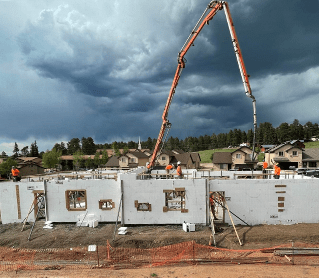
Reader Peter Deem made me aware of the use of insulated concrete forms (ICFs) to construct the entire “envelope” of a house and pointed me to Don Clem of the National Ready Mixed Concrete Association, which has a local office in Denver. That organization, along with its Colorado affiliate and several concrete companies, sponsored an 18-townhome project in Woodland Park for Habitat for Humanity of Teller County last summer. Here’s a picture of those townhomes under construction:

Photo by Sara Vestal, Teller County HFH

I was first introduced to the use of ICFs when I participated in the 1994 Jimmy Carter Work Project on the Cheyenne River Sioux Indian Reservation in Eagle Butte SD. The 28 homes in that project were conventional wood frame (“stick-built”) homes, but the concrete foundations were poured into ICFs. An ICF replaces more common wood forms which have to be removed from the foundation after it cures. The ICF provides insulation in the form of two inches of expanded polystyrene (EPS) both inside and outside the foundation. After seeing it there, I was surprised not to see ICFs in widespread use for foundations by production builders over the past 27 years.

The ICFs being promoted now are for above-ground use for exterior walls, and there are even ICFs for pouring concrete flat roofs. (More commonly, there are concrete tile sloped roofs, including one on the house Rita and I once owned on Parfet Estates Drive in Golden.)

While concrete is a non-combustible material, the EPS insulating layers will melt with direct flame, but it does not act as a fuel source, will not promote flame spread, and will not release harmful gases. In addition, the ICF would be protected on the outside of a home by siding — for example, a fiber cement siding like Hardieboard, which is not combustible, and the flames would probably only be present briefly during a passing wildfire. The interior would be covered by drywall, as with a stick-built house.

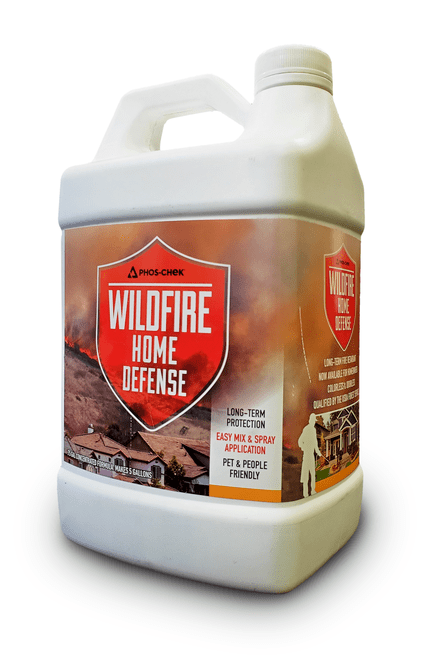
Speaking of that, there is still the question of combustible vegetation such as juniper bushes that are close to your house. Another reader made me aware of Phos-Chek, the same fire retardant that you see used by aerial tankers to attack wildfires. While that chemical is red, it’s available in a colorless concentrate that you mix with water and apply using an ordinary sprayer to the vegetation around your home.  A single bottle of Phos-Chek sufficient to make 5 gallons costs $59.99.  You will need 5 to 20 gallons depending on the amount of vegetation you want to cover. Click here to view a KNBC news segment about a Malibu homeowner who saved her home from the Woolsey fire in November 2018 thanks to an application of Phos-Chek to the grounds around her house three months earlier.

In last week’s column I also mentioned that the soffit vents typical of homes with unconditioned attics can allow embers to enter the attic, igniting an interior fire, but I neglected to mention that there are ways to fireproof soffit vents to keep that from happening.

Another way that concrete homes are being built is using 3D printing pioneered by Icon, an Austin TX-based company which is currently building a 100-home Texas subdivision in partnership with Lennar using that process. Icon built its first 3D-printed home in 2018 as a proof of concept, following which they built a community of 3D-printed homes in Tabasco, Mexico. Here’s a picture of a Habitat for Humanity 3D-printed home in Virginia:

Just as desktop 3D printers work by applying multiple layers of material following a computerized template, Icon’s huge 3D printers apply multiple layers of concrete. See www.IconBuild.com for more information about this company, which, by the way, has NASA contracts to build 3D-printed structures on the moon and on Mars. Their primary mission, however, is “to re-imagine the approach to homebuilding and construction to make affordable, dignified housing available to everyone throughout the world.”

Their home page goes on to say, “the audacious mission of Icon is to revolutionize homebuilding, and our team’s expertise and determination have already made this dream a reality. Our team has a passion for design, engineering, and elegant software. We have decades of experience in sustainable technology and construction innovation.”

Building with concrete is both less labor intensive, less expensive and more sustainable than building with lumber. It’s significant that one of America’s biggest builders, Lennar, is working with Icon to build those 100 concrete homes in Texas. That project should provide facts and figures about the practicality and economy of building with concrete that could be a powerful influence on the rest of the home-building industry.

Politicians Could Learn From the National Football League  

One of the remarkable parts of watching NFL games on television is at the end when the coaches and players who just “fought like hell” against each other converge on the playing field to shake each other’s hands and even hug each other, exchanging congratulations and best wishes to the players who just beat them.

And one of my favorite penalties is for taunting. Wouldn’t it be nice if there were a penalty for taunting off the field, including in politics? Nowadays we not only see politicians taunting, insulting and ridiculing each other, but even refusing to concede that they were defeated.

Wikipedia defines taunting as “a battle cry, sarcastic remark, gesture, or insult intended to demoralize the recipient, or to anger them and encourage reactionary behaviors without thinking. Taunting can exist as a form of social competition to gain control of the target’s cultural capital.” Sounds like today’s political discourse, doesn’t it?

In football, a coach can challenge a referee’s call, but the final call after review is accepted without question (except by fans), and the players proceed undaunted, accepting every call and moving quickly to avoid a delay-of-game penalty.

We Want to Help Fire Victims Who Want to Relocate, Not Rebuild

If someone you know lost their home in last week’s fires and decides to relocate rather than rebuild, have them call us. Golden Real Estate will rebate 75% of our earned commission to any buyer who lost their home and all their furnishings in the fire, so they can use that money to buy new furnishings. Email Jim@GoldenRealEstate.com for more information.

You can donate, too, at www.CommFound.org.