Security Devices Could Allow Sellers to Eavesdrop on Buyers During Showings

The increasing prevalence of smart speakers like the Amazon Echo and security cameras inside and outside of homes, has introduced the possibility that sellers could be watching buyers and their agents and listening to what they say during showings.

The Colorado Real Estate Commission considers the privacy implications serious enough that this year’s annual update class for real estate brokers includes a section on legal jeopardy and practical advice.

Imagine, for example, that a buyer is overheard by a seller telling his/her broker, “I must have this home. I’ll pay whatever I have to!” The seller would immediately have an unfair negotiating advantage over the buyer.

The next time you are being shown a home, consider the very real possibility that the seller is parked nearby, watching and listening on his smartphone as you walk through the home, monitoring everything you and your agent say.

Although Colorado is a “one-party consent state,” meaning that only one party to a conversation needs to know it is being recorded, the implications of such technology are serious.

Given that people have rapidly embraced the use of internet-connected video and audio devices, enabling homeowners to monitor the goings-on in their homes, buyers and their agents would be well advised to minimize talk about the property and their level of interest during showings. Don’t count on being able to spot the devices. 

Also, to avoid possible breach-of-privacy litigation, sellers should consider disabling such devices when putting their homes on the market or, at a minimum, placing a notice on the front door advising visitors of the presence of monitoring devices that might be active.

Rita and I have a Ring video doorbell on our house, and we love it. It rings on Rita’s cell phone, enabling her to see and speak with the visitor. Chances are, the person at the front door would think we are home, even if we are not, which is advantageous from a security standpoint. This feature accounts for the rapid adoption of Ring and other brands of internet-connected video doorbells and security cameras.  Not everyone is a fan of these devices, as some believe that if your doorbell faces the street you could be violating the privacy of someone walking or driving beyond your front property line. (That was a point made during the annual update class which our agents took last month.)

In the update class our agents were advised both to warn buyers that sellers could be watching and listening, and to ask sellers during listing appointments whether they have video and audio recording devices in their home and, if so, to advise them of the implications of their use.

What are the legal arguments? A buyer’s lawyer would argue that a buyer, alone in an unoccupied house with his broker, has a “reasonable expectation of privacy.”  A seller, on the other hand, can claim a legitimate interest in monitoring – and even recording — the activities and conversations of strangers in his home, as the possibility exists that someone could be casing the home for a subsequent burglary.

It’s likely that these arguments will play out in front of judges in the not-too-distant future, at which point we’ll have case law to guide us. Until then, both buyers and sellers should understand that the issue of privacy is real and that the use of eavesdropping equipment could put sellers in legal jeopardy.

Some Home-Selling Advice Is No Longer Valid; Let’s Review the Literature…

On January 30th, Realtor.com published an article with the catchy headline, “That’s So 2018!  The Most Outdated Home Selling Advice You Should Now Ignore.”  I found it interesting to compare the author’s conclusions with my own opinions, many of which I have shared here before. Here is the author’s list of outdated home-selling advice that should be ignored, along with my response to what she wrote:

1) Wait for spring to sell your house.  I have written numerous times that winter can be the best time to sell a home, and it’s nice to see how other real estate writers have reached the same conclusion, albeit only recently. The writer for realtor.com made the same arguments I’ve been making for years — that there are fewer competing listings at this time of year, yet there are still many active buyers.

2) Price your home high and leave room to negotiate.  This, for sure, is not your best strategy in a seller’s market and even less so in a balanced market like we’re beginning to see in many areas. One agent she quoted in her article said it well: “If you’re not priced at the market, or at least very close, you’re not going to get that many people in the door to begin with. Price your property to sell.”

3) Sell your home as is.  The writer said this may have been true in the now-fading seller’s market, but argues that today’s millennial buyers in particular want a home that doesn’t need any work done on it.  I addressed the topic of what you should and should not do in last week’s column. Read it at www.JimSmithColumns.com or at www.GoldenREblog.com.

4) Amateur photos of your home are fine. The writer states that your smartphone pictures may have been all you needed during the seller’s market, but that you now need to invest in professional pictures. When it comes to high quality images, Golden Real Estate agents used magazine-quality HDR photos on all listings throughout the seller’s market, so this comment doesn’t apply to us.  However, the writer also promoted 3D tours of the home such as those using Matterport equipment, but I’m not a fan.  At Golden Real Estate, we believe it’s much more useful to produce a narrated video tour of a property. We’ve been doing narrated video tours for a decade or more and continue to be surprised how few other brokers have adopted the practice. And the Osmo camera we recently purchased makes those videos even more professional-looking. It’s equivalent to using a movie-quality Steadicam!

5) Holding an open house is a must. The writer says open houses only serve the broker and not the seller, but I disagree. You’ll notice that almost every listing we feature in this weekly ad mentions an open house. Since we price our listings to sell, these open houses serve to magnify buyer interest in our listings. (Indeed, the listing I closed last Friday was to a buyer who came to our open house.)  Open houses also fit into our strategy of not selling listings in less than 4 days. Our time-tested process is to put a listing on the MLS on Wednesday, advertise it on Thursday (with an open house), and to advise agents and buyers who submit early offers that the seller will wait until after the open house to choose the buyer.  Using this strategy, prospective buyers typically bid up the price, which is an obvious benefit to our sellers.  An example is last week’s sale of our Wheat Ridge listing for $561,000, which sold on that 4-day schedule for $36,000 over its listing price.  

Holding open houses also fits into our belief that you never know what will sell a house, so you should try everything.

You Can ‘Sell High/Buy Low’ and Stay in Colorado

We Coloradans love where we live, and few of us would ever leave it for another place. Our climate appears to be responding less quickly than elsewhere to global climate change, which is, like it or not, yet another reason people are drawn here from other states.  This steady influx of new residents inevitably has the effect of raising local real estate prices.

But there are other beautiful places in Colorado which remain affordable and which are drawing metro area residents. Last fall, a client sold their Arvada home for $385,000 and bought a bigger home on two acres in Cedaredge for only $230,500. A colleague of mine bought a 6-acre parcel with a home and two outbuildings in that same town for $270,000.  If you don’t have to be in the metro area and like living in a quiet (and beautiful) rural community on the western slope, Cedaredge sounds like a great alternative.

I have a client who sold their Lakewood home for almost $600,000 and are currently renting. They’re looking at lower-priced homes around the state and are ready to pounce when the right one pops up. Now that our MLS (REcolorado) serves much of Colorado (including Cedaredge), I set up a search for this client based on price per square foot under $200, and they are considering quite a few properties outside our metro area.

As more and more out-of-staters find the Denver metro area to be a desirable (and more climate-friendly) alternative to their current home, more and more current residents are looking to leave for greener and more affordable locales. This is a trend that is likely to increase over the coming months and years.

For years I have explained to metro area homeowners that they shouldn’t be afraid of high prices if they are buying and selling in the same market. If prices are high, they’ll probably sell high and buy high. If they’re low, they’ll sell low and buy low. (That was my experience in 2012 when I sold a home for less than I had paid for it but also bought my current home for a fraction of what it is worth now). Ideally of course, you’d like to sell in a high market and buy in a low one, something that is certainly possible for those who are willing to relocate. It’s nice to know you can find that lower market within Colorado.

Statistics Seem Not to Reflect a Coming Slowdown in the Real Estate Market

By JIM SMITH, Realtor

Because of recent national and regional reports that the real estate market is changing from a seller’s market to a balanced, or even a buyer’s market, I have drilled down into the statistics for real estate activity in Denver and Jefferson County, looking for evidence of that shift. After all, as in politics, all real estate is local, and even reports about Metro Denver’s real estate market don’t necessarily reflect what is happening in each of the metro area’s six counties.

So, are the Denver and Jeffco real estate markets changing from a seller’s market to a balanced or buyer’s market?  The answer appears to be “yes,” as I’ll show below, although the data in the 25-month charts above provide no indication of a coming slowdown. While 25 months might seem like an odd timeframe for a chart, I used it so you could compare this November (on the outer right) with November 2016 (on the outer left) as well as all the months in between.

Two measures of a market’s health are the trends in median sold price and the median days on market. The charts show continued year-over-year increases in the median sold price in both Denver and Jefferson County and only seasonal changes in the days on market. When median days on market are this low — ranging from 5 to 16 days in both Denver and Jefferson County over the past two years — you know it’s a seller’s market.

However, the listings that are currently active or under contract and those which have sold thus far in December suggest that, from a purely mathematical standpoint, 2019 statistics will document a shift in Denver’s and Jeffco’s real estate market.

As I write this on Tuesday, December 11th, there are 1,832 active Denver listings on REcolorado. The median days on market of those listings is 54, more than triple the median days on market for last month’s sales. There are 1,230 Denver listings that are under contract, and their median days on market is 24.  Of the 200 Denver listings which closed between December 1st and 11th, the median days on market was only 20.  Clearly, as those currently active and under contract listings change their status to “sold,” the median days on market will rise significantly by month’s end and into 2019.

The figures for Jefferson County mirror those of Denver. Median days on market for active listings is 42, median days on market for under contract listings is 25, and median days on market for listings sold December 1st to 11th is 19. As with Denver, it’s safe to say that Jeffco’s market has already begun to slow, and statistics will reflect that in coming months. 

If you’re thinking of selling your home, don’t let yourself be blindsided by this evolving market. You can still sell a home quickly in a slowing market, but only if you price it correctly. As I have written before, you can’t underprice a home, because competing offers will drive the price upward. And by pricing your home correctly, you’ll benefit from those competing listings that were not priced appropriately. Call me or another Golden Real Estate agent at 303-302-3636 if you’d like advice on pricing your home to sell.

What Are the Implications When a Buyer Waives Appraisal in a Bidding War?

Real_Estate_Today_bylineWhen a home is priced at or below its likely selling price based on recent sales of comparable homes, there’s a good chance in this seller’s market that multiple offers could bid it up, possibly above the value an appraiser might give it. So what happens then?

Fortunately, I can report that the homes I have sold above the value suggested by comparable sales have not, as a rule, had trouble appraising for the contract price. Showing the appraiser the multiple offers that were received can demonstrate real-world market value. Without seeing those competing offers, the appraiser might determine that the buyer paid more than they should have. The presence of multiple, nearly equal offers gives appraisers an important tool for justifying value in our rising market.

Whenever a purchase is financed by a lender, there will be an appraisal. Lenders require them to make sure they’re not lending based on an overstated valuation. That doesn’t mean that the buyer can’t waive appraisal objection and bring additional funds to cover the discrepancy between appraised value and contract price. The contract may or may not specify a limit to the size of discrepancy the buyer will cover. Regardless, it is important for the seller’s agent to ascertain that the buyer is able to bring that additional cash to the closing table.

If the buyer is borrowing 95% or more of the purchase price, one might ask whether bringing several thousand extra dollars to the closing table is possible. This is where it is advisable for the listing agent to interview the buyer’s lender — something we do regardless of the size of the down payment. Typically, a buyer who is putting down 20% or more of the purchase price is more likely to have available cash to cover an appraisal discrepancy.

With Golden Real Estate’s auction approach, which maximizes the purchase price for our sellers, it is not unusual for the final price to be well above what comparable sales might support.  And because one can never be certain that the appraiser will be impressed enough by the existence of those other competing offers to justify the contract price, it’s a good idea to ask that buyers cover some or all of any appraisal discrepancy and that they provide evidence of their ability to bring extra funds to closing for that purpose.

Few buyers start out offering to waive appraisal, but once the bidding enters a range that is considerably above an appraisal based solely on recent sales of comparable homes, the listing agent can and should encourage waiving of the appraisal objection by the highest bidders.

One should remember, however, that an offer to waive appraisal objection is not iron clad when a lender is involved, because the buyer can still terminate based on loan objection if the appraisal ordered by the lender comes in too low for the buyer’s comfort. I’ve witnessed the scenario where a buyer who has agreed to waive appraisal objection still threatens to terminate because of the low appraisal, at which point the seller offers to lower the price to keep the contract from falling (assuming he doesn’t have a backup contract).

This is not unlike when a buyer agrees to purchase a home “as is” and use the inspection deadline only to terminate, not to demand any repairs. That can be a hollow promise.  If, for example, the buyer decides to terminate because the furnace needs to be replaced, the seller is likely to say, “Wait! I’ll replace the furnace!” Why?  Because the seller now knows the furnace needs to be replaced and would have to disclose that fact to the next buyer. Indeed, when I’m representing a buyer in what appears to be a bidding war, I will suggest making our offer “as is” while advising the buyer that it doesn’t mean we can’t get serious items repaired. The only time this doesn’t work is when the seller has received a backup contract that’s more attractive than ours. I point out to my buyer that the seller might be happy to have him or her terminate so that back-up offer can become the primary contract.

These two areas — appraisal and inspection — require deft skill in order to navigate the negotiation process effectively — a good reason to employ an experienced listing agent like one of us at Golden Real Estate instead of trying the for-sale-by-owner (FSBO) approach. A good listing broker can definitely justify his or her commission both in getting a higher selling price and saving money through effective negotiation.


Great Golden Listing Coming Soon from Debbi Hysmith

Better_front_pictureEnjoy incredible mountain views from this special home at 17425 Rimrock Drive!  Take advantage of the opportunity to own this 4-bedroom, 3-bathroom custom home.  It backs to South Table Mountain open space, with unbeatable views of the foothills!  It features an extra-tall garage — tall enough for your large truck —- with a mud room and laundry room on the main level. Look for more information in next week’s column. We have created a website for this home at www.SouthGoldenHome.com, where you can see more pictures and take a narrated video tour. That website will also have information about an open house the weekend of July 14-15. Or call your agent or Debbi Hysmith at 720-936-2443 to arrange a showing.


Hardwood Floors Are Popular, But Some Condo Owners Are Having Second Thoughts

A client of mine fell in love with a condo, in part because of its hardwood flooring.  But within weeks of moving in, he’s now thinking of selling.  Why? Because the hardwood flooring in the unit above him appears overly effective at transmitting the sound of both human and canine footfalls.  Apparently the neighbor below him has noticed the same thing and has complained about the sound my client makes when he and his dog move about on their hardwood floors.

This raises an interesting question: Is there a reasonable way to construct a building’s floors so as to mitigate the transmission of sound from hardwood flooring?


Just in Time: A Breakthrough in ‘Rent-to-Own’ for Those Who Can’t Buy Now

Real_Estate_Today_byline      It’s not uncommon for us to get a phone call or drop-in from someone who would like to buy but who might not be in a position do so at this time. They are looking for a rental, and for that we refer them to trusted companies that specialize in rentals. Sometimes the caller or visitor will inquire about rent-to-own, but we explain that it is nearly impossible to find a seller in this market who would consider rent-to-own when they can sell now for top dollar.

I’m happy to announce a breakthrough. Last week our office was presented with a new business model that could fill this gap in the real estate market. The way it works is this: we submit the prospect’s name to a company which, upon approving the person as a tenant, agrees to purchase a house, which that pre-approved tenant can rent.

Once approved, the prospect goes on the company’s website which contains all the MLS listings (sub-ject to company approval) that qualify for this program. The homes can range in price from $100,000 to $550,000. Only townhomes and single family homes qualify for this program — condos do not.

If you’ve looked online for rentals, you are familiar with the limited inventory of rental homes.

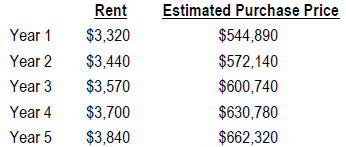
The fact that the sellers and listing agents of the qualified MLS listings are offering their homes for sale, not for rent, doesn’t matter. If a prospective tenant finds a for-sale home they’d like to rent, our partner company can offer a lease for that home which states what the rent will be for the next five years, and which also provides a pre-determined purchase price for that home over the same 5-year period.

Let’s say you find a $500,000 home you’d like to rent.  If you click on that listing, you’ll find the following grid of rental and purchase prices:

Rent_to_own_grid As you might expect, these figures are subject to adjustment, since (1) the listed price may not be the final sale price, (2) the home may need renovation work, and (3) there may be other costs associated with purchasing and owning the property. These and other conditions are spelled out in the lease agreement that is signed by the prospective tenant.

At that point, we represent the rent-to-own company in negotiating a purchase of the identified property. To the seller and to us as a buyer’s agent, it’s an ordinary transaction by an investor.   In this case, however, the investor has already identified a qualified tenant for the property.

Although the landlord is bound by the specified rents and purchase prices for five years, the tenant is only locked into a one-year renewable lease and can choose to purchase the home at any time.  They can also choose to not renew the lease and simply walk away.

This flexibility will be particularly attractive, I expect, to people relocating to our area who may be able to buy immediately, but don’t want to lock themselves into purchasing the first home they find. They can rent a home they think they might want to buy, then buy another house after the first 1-year lease period is up.  They can also opt to exercise their option to buy the house for a pre-determined price — an increase over what their landlord paid for it.

Home_Partners_screen_shot  At right is how an MLS listing appears when displayed on the company’s website, showing the listing price on the right and the estimated initial rent on the left.

Although the prospective tenant is not our client — the landlord is — we set up showings for that tenant just like we would for any buyer. When the tenant identifies the home they’re interested in, we tell the company and together we go about buying the property so that tenant can rent it.

If you or someone you know can’t (or doesn’t want to) buy at this time, have them call any Golden Real Estate agent at 303-302-3636 or send an email to info@GoldenRealEstate.com.


What Is an ‘Escalation Clause’ and How Should Sellers Respond to One?

In our competitive seller’s market where a listing might attract five, ten or more competing offers, submitted contracts often include something called an “escalation clause.”

An escalation clause is an additional provision worded something like this: “In the event Seller receives a competing contract with a purchase price, net of concessions, in excess of the Purchase Price in this Contract, Buyer agrees to increase the Purchase Price of this Contract to $1,000 in excess of the purchase price of said competing contract, up to a maximum of $______.” I have seen contracts offering as much as $5,000 over a competing contract.

Two things you need to know about this strategy. Most importantly, the seller is completely free to ignore the escalation clause and does not even have to accept the best offer. Secondly, when it’s you submitting the contract with an escalation clause, I recommend not inserting a maximum price. That makes it more likely you’ll receive a call from the seller’s agent telling you what that higher offer is.