Redfin Survey Suggests Colorado Will See Influx of Buyers Due to Climate Fears

A recent survey of 2,000 U.S. residents by Redfin found that three-quarters of Americans are hesitant to buy homes in areas with a high climate risk. Those risks include more severe hurricanes & tornadoes, flooding, higher temperatures, wildfires, and rising sea levels.

It’s not hard to see why Colorado would be a favored destination for “climate refugees.” I have sold several homes to Californians recently, including just this month to my stepson, who currently lives in Sherman Oaks. 

We Realtors are seeing more and more of our listings going to out-of-state buyers, subjecting local buyers to increased competition in bidding wars.

If you’ve been paying attention to national weather reports, you can understand this trend. In California, the last two fire seasons have been terrifying. Last week’s earthquake in Los Angeles could have added to the situation.

In the Midwest, we have seen tornado after tornado destroying entire neighborhoods. And rising water temperatures in the Atlantic Ocean and the Gulf of Mexico are promising increasingly severe hurricanes and flooding.

The Redfin survey broke down by age the reluctance of home buyers to purchase a home in such areas. What it found was that buyers between 35 and 44 years old have the highest reluctance, with buyers between 25 and 34 years old having the second highest reluctance to buy in such areas.
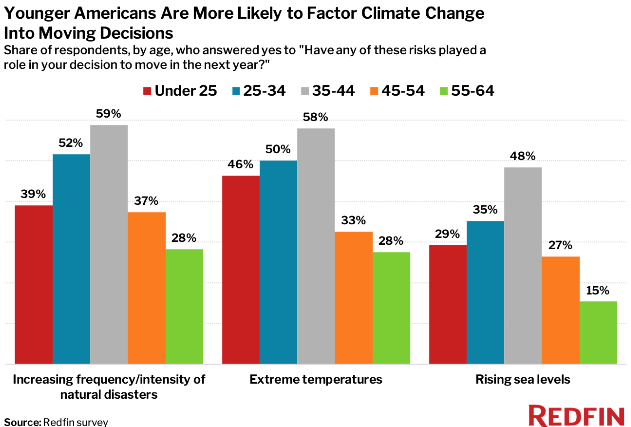
Fifty-nine percent of persons between 35 and 44 years old said that the increasing intensity and frequency of natural disasters played a role in their decision about where to move.  Fifty-eight percent said that extreme temperatures played a role, and 48% said that rising sea levels played a role in their decision.

For people 25 to 34 years old, the percentages were 52%, 50% and 35% respectively.

The lowest percentage of reluctance was among the oldest buyers surveyed, those between 55 and 64 years old. (For some unexplained reason, Redfin didn’t survey people 65 and older.) Only 28% of that age group said that natural disasters and rising temperatures were a factor in their decision to buy, and only 15% cited rising sea levels as a factor.

Among my own clients, I have been surprised at how many sellers — all of them seniors — have relocated to Texas and Florida. For some it was to be close to family. For others it was because of lower home prices. They benefited from our runaway seller’s market, buying equivalent homes for much less money in those states.
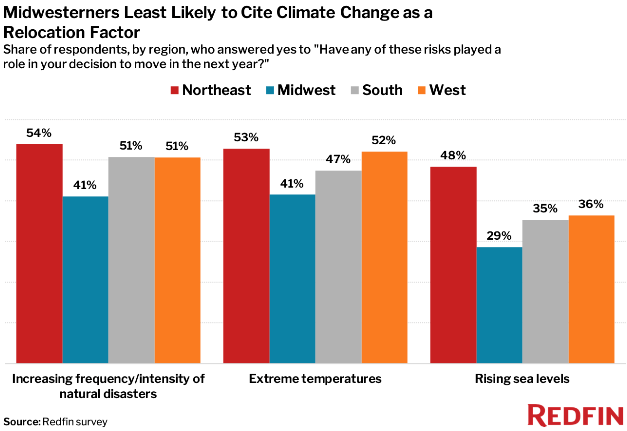
“Climate change is making certain parts of the country less desirable to live in,” says Redfin’s chief economist. “As Americans leave places that are frequently on fire or at risk of going underwater, the destinations that don’t face those risks will become increasingly competitive and expensive.”

Perhaps the Denver Post should bring back the phrase, “Climate Capital of the World,” below its front-page logo.


All-Electric Homes (and Buildings) Are Central to Mitigating Climate Change

As much as we Americans love our gas fireplaces, gas ranges and gas grills, we need to recognize that the move to an all-electric home, with the electricity being generated using minimal fossil fuels, is central to the goal of mitigating the effects of climate change.

And it can be a good future, especially if you’re able to generate all the electricity that your home and cars use.

That’s the future Rita and I have created for ourselves. We have 10 kW of solar panels on our Golden home, enough to heat and cool our home and charge our two electric cars. Our forced air furnace only burns gas when the outside temp dips below freezing. Otherwise, a heat pump provides all the heat we need. And recently we replaced our gas water heater with a hybrid water heater that heats all the water we need using its built-in heat pump. It has a standard electric heater coil in case we need faster recovery.  (We never have needed faster recovery.)

Yes, we still have a gas cooktop and gas fireplace, and our BBQ grill is plumbed with gas. I can picture us moving to an induction electric cooktop, electric fireplace and electric grill, but for now we comfort ourselves with the knowledge that we have drastically reduced our carbon footprint and our monthly energy bills with the use of heat pumps for heating, cooling and water heating, as well as by driving EVs.

A December article on axios.com reported that some progressive jurisdictions are now banning gas hookups in new residential and commercial construction. According the article, 40 California municipalities, starting with Berkeley in 2019, have banned the installation of natural gas service in new construction.

The most common argument against this anti-natural gas trend relates to the cost of electric heating vs. gas heating, but the people who make that argument are probably thinking of conventional resistance heating, such as baseboard electric heating.

Resistance heating is similar to your kitchen toaster, sending electricity to a coil causing it to generate heat.  There is a more efficient way to heat, however, which is to use a heat pump. A heat pump moves heat instead of generating heat, and the cost is as little at one quarter that of resistance heating for the same BTU (heat) output. Here’s a article comparing the two kinds of electric heating.

Moreover, a heat pump can provide both heating and cooling, merely by reversing the direction in which it moves heat, replacing both the gas furnace and electric air conditioning unit which most of us have in our homes.

Another argument against increased electrification is that electricity is itself created by the burning of coal and natural gas. The current fuel mix of Xcel Energy in Colorado is 36% natural gas, 32.5% coal, and the rest renewable energy (mostly wind). The company’s goal is 55% renewable by 2026 and 100% “carbon-free” by 2050, so it makes sense to start now replacing gas appliances with high efficiency electric ones such as heat pumps.

Keep in mind, too, that we can generate our own electricity at home and on our office buildings, taking advantage of “net metering,” paying only to be connected to the electric grid. With net metering, Xcel’s grid functions like a battery, taking excess electricity from our solar installations during the day and delivering it back to us when the sun goes away — or when our solar panels are covered with snow!

This Climate Change Movie Is a Must-See

Of all the movies I watched during last month’s Colorado Environmental Film Festival, “Kiss the Ground” was by far the most impactful. It won the festival’s top  award, and deservedly so.

You will learn so much, as I did, from this 84-minute documentary about agriculture, farming, carbon sequestration and climate change. Schools can stream a 45-minute version of it free, including if you are doing home schooling. Visit www.KissTheGroundMovie.com to stream it. The rest of us can rent it for a dollar, or find the full-length documentary on Netflix.

The central thesis of the movie is that the mass tillage and spraying of farmlands under industrial farming is destroying the soil’s natural ability to sequester carbon. By the end of the movie you’ll be convinced that “regenerative farming” is the solution of our CO2 crisis.

The narrator of the movie is Woody Harrelson, who starts out by saying that he had given up on saving the planet from the effects of climate change, until he realized that the solution is “as old as dirt.”

A key character in the documentary is Ray Archuleta, a conservation agronomist with the USDA’s Natural Resources Conservation Service (NRCS), formerly the Soil Conservation Service created by FDR to deal with the causes of the “Dust Bowl” of the 1930s, when excessive tillage of farmland had caused massive erosion and dust storms.

The goal of NRCS agents like Archuleta is to reduce tillage and the use of chemicals that damage the soil. Achieving that counter-revolution would allow the soil to absorb and sequester enough carbon to solve the climate crisis, the film asserts. It’s a powerful argument.

I challenge you to watch the first 10 minutes of this film, and you will want to watch the remaining 74 minutes. You’ll get a huge education about the importance of soil health to the future of our planet. There’s a trailer on the website.

Plant-Based Meat Has Won Us Over

First, Rita and I tried the “Impossible Whopper” at Burger King, and we liked it — can’t tell it from the regular Whopper. Then Rita found the package shown here at Costco — eight 1/4-lb. patties for $14.99. She cooked them in a pan and seasoned them as she would regular burgers, topped with pepperjack cheese and sautéed mushrooms, and served the patties on a bed of romaine lettuce and sliced tomatoes with a balsamic vinaigrette dressing. On another occasion she substituted Roast Pineapple & Haberno Sauce for the dressing, and it was even more delicious.  Try it! You’ll thank me for telling you about them!

Committed as Rita and I are to mitigating climate change, we recognize the desirability of reducing our consumption of beef, and this product makes that really easy and enjoyable.

Were Last Week’s “Climate Strikes” Enough of a Wake-up Call on Climate Change?

We can thank Al Gore for educating us about global warming, but I wish a non-politician such as Carl Sagan had performed that service. I can’t think to any other scientific research which became partisan in a similar way.

Remember CFCs and the ozone hole? It wasn’t a partisan issue. The issue was addressed quickly in a bi-partisan manner.

It was meteorologists, not politicians, that taught us about El Nino and La Nina—the cyclical events in which changes in ocean temperature create weather patterns affecting our entire continent. No one has said El Nino is not real.  It is accepted science — like climate change.

It’s only because Al Gore introduced us to the “inconvenient truth” about climate change that his teachings were disputed and rejected as left-wing propaganda by those on the right. How sad, how unfortunate, and how deadly the consequences.

Last Friday I attended the “Climate Strike” event on the Colorado School of Mines campus and watched news coverage of bigger events around the world.  I’m 72 now, and, yes, the climate will worsen before I die. But those under 40 and certainly those under 20 are seeing the early effects of global warming and worry that their world will be unlivable by the time they’re my age.  For them, it’s a huge crisis.

Back in June, I attended my 50th reunion at M.I.T, during which there was a Technology Day symposium on climate change. One of the speakers, Prof. Noelle Selin, told us that the global concentration of carbon dioxide was 325 parts per million when we graduated in 1969, but now it was 410 ppm. She made us think about those who graduated in 2019 (who she dubbed “the Class of 410 ppm”) and speculated on the class that would be graduating at their 50th reunion. “Will it be the Class of 600 ppm or the Class of 700 ppm?” she asked. And what will life be like for them at their 50th reunion?

It was a sobering presentation. And you can be sure that it was even more sobering for the Class of 2019 and for M.I.T. students who have yet to graduate.  To view her 19-minute presentation, click here.

The impact on real estate — and national security — is apparent when you consider all the “climate refugees” who are likely to migrate from heavily impacted areas such as the Bahamas, Florida, Houston — and Syria, where drought, as much as civil war, contributed to the exodus of Syrians to Europe. Indeed, over a decade ago the U.S. Defense Department labeled climate change a threat to national security. You can understand why.  I do.

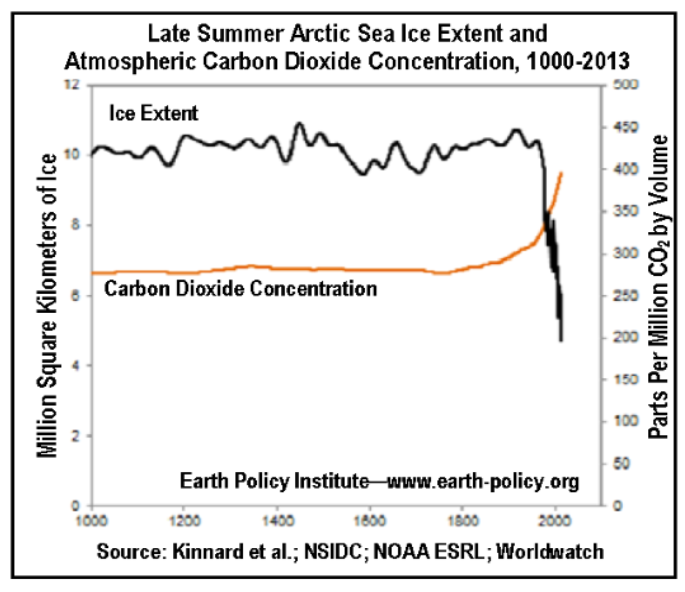
The headline of my column on Jan. 14, 2014 was, “We May Have Already Passed the Tipping Point on Climate Change.” That statement was based on the already dramatic reduction in summer sea ice in the Arctic Ocean, as documented by the Earth Policy Institute at Rutgers. I published their chart showing a correlation between the increase in atmospheric CO2 from 300 to 400 ppm since the Industrial Revolution, and the 50% loss of summer sea ice in the Arctic between the late 20th Century and 2013. 

The reason loss of sea ice creates a tipping point for our climate is that sea ice, being white, reflects sunlight, whereas open ocean, being dark, absorbs sunlight, causing more ice to melt and to melt faster. A warmer Arctic region in turn upsets weather patterns worldwide.

Almost six years have passed since I wrote that column, and now the Arctic Ocean is open and navigable for part of the summer. We have learned the term “polar vortex” and experienced the effects of wilder than normal fluctuations of the jet stream. Warmer oceans in the tropics have caused stronger, slower hurricanes, causing 100-year floods to become frequent, as we have already seen in Houston. These effects were already happening back in 2012 with superstorm Sandy in New York and New Jersey and even here in Colorado with the heavy rains and flooding of Sept. 2013.

Unfortunately, we have a president who will never admit he was wrong, so he will never admit that climate change is real, that it is exacerbated by CO2 emissions, and that the only hope, if there is any this late in the game, of reducing the impacts of climate change is to drastically reduce the output of greenhouse gases like CO2 and methane. Instead, inaction on climate change, and worse, may be this president’s #1 legacy.  How sad.

All-Electric Homes Are Practical Now, and Can Help Mitigate Climate Change

The typical American home is powered electrically but heated by natural gas, propane or other fossil fuels. You and I can generate our own electricity with solar panels, but there’s no way for us to generate natural gas or other fossil fuel energy, so the transition to a “net zero energy” lifestyle necessitates turning away from fossil fuels and going all-electric.

Fortunately, technology has advanced — just in the last decade — to the point where going all-electric is totally practical, affordable, and a way you and I can mitigate climate change

At Golden Real Estate, our office was heated with natural gas until November 2017, when we installed a heat pump “mini-split” system and had our natural gas meter removed. With 20 kilowatts of solar photovoltaic panels, we were able to eliminate our natural gas bill but not increase our electric bill. We continue to pay just $11 per month to be connected to the electric grid (which functions as our “battery” thanks to net metering), but we are generating all the electricity needed to power, heat and cool our office building. We even have enough electricity from the solar panels to power our four electric cars without buying any net electricity from Xcel Energy. We hope other businesses will follow our lead.

Making the switch to all-electric at home is still in our future, because — like you, I suspect — we prefer gas cooking, gas grilling, and having a gas fireplace.

If, however, we can get beyond those preferences, it is possible now to heat our home and domestic hot water using heat pump appliances, and to cook our food with electric or induction cooktops and ovens.  Electric grilling is also available, although not as attractive from a taste standpoint to most of us.

All-electric homes was the subject of a talk by architect Peter Ewers at last week’s meeting of the Colorado Renewable Energy Society’s Jeffco chapter.  You can view an archived video of Peter’s talk at www.cres-energy.org/video.

Once we have removed gas service from our homes (and gas cars from our garages), we will have also eliminated the risks of explosion and carbon monoxide poisoning, too.  Wouldn’t that be great?

Free eBook on Solar Power with ‘The Property Brothers’

KNOWLEDGE IS POWER is the name of the free eBook, which you can download below.

The simple, undeniable fact is this: The sun can provide more energy in an hour than all of humanity uses in a year. We’re talking about an inexhaustible supply of clean, safe, reliable power that people and countries across the planet can access to power their lives and economies.

Even still, fossil fuel utilities continue to make billions of dollars from dirty energy monopolies – while the rest of us pay the consequences.

But we can flip the script by taking bold action.

That’s why Climate Reality has teamed up with HGTV’s Property Brothers co-host and solar energy advocate Jonathan Scott for Knowledge is Power, a new e-book about the incredible benefits of solar energy and the deceptive tactics fossil fuel utilities are using to protect their bottom lines at the expense of every person on the planet.

The benefits of solar don’t end with lower power bills. Cutting carbon pollution? Check. Empowering communities? Check. Providing energy independence? Check. Creating good jobs? Check and check.

Learn more about this incredible resource – and how together we can take control of our energy future – by getting your free download of Knowledge is Power today

Thoughts From Attending My 50th Class Reunion at MIT

Forgive me for straying from my usual topic of real estate — I took some time off with Rita to attend my 50th reunion at the Massachusetts Institute of Technology last week, and I was super-inspired by the experience of returning to the Institute for what was more than just a party. It was an immersion  into the continuing impact that MIT is having on the world of science and technology.

Reunions at MIT are probably unlike those at any other college or university. Yes, there is partying, but roughly half the events were educational in nature, updating alums on current research regarding important topics of the day. This year the dominant topic was climate change — something I wrote about, quite coincidentally, in last week’s column.

Not only was climate change the subject of Michael Bloomberg’s commencement address (there’s a video link for it at http://news.mit.edu), but the 3-hour Technology Day symposium the following morning was all about climate change. The 1,200-seat auditorium was filled to capacity with alumni eager to be updated on MIT research about this important topic, and they were fully engaged to the very end.

Technology Day at MIT – click here for archived 3-hour video.

When I attended MIT 50 years ago, undergraduate men vastly outnumbered the undergraduate women, who barely filled the one dormitory provided for them.  Over the past 20 years, women have risen to comprise 46% of the undergraduate student body and 35% of the graduate student body, spanning every academic discipline. This gender equity was evident in Saturday’s symposium, too. Four of the six presenters, including the moderator, were women.

In his commencement address, the former NYC mayor observed that the technology for successfully addressing climate change is largely in place (except for bringing it to scale), and challenged graduates to go out into the world not just to expand upon it, but to build the political will to deploy it. I was reminded of that statement the following day while attending a Class of ’69 discussion about anti-Vietnam war activism at MIT during our time on campus. During the Q&A, a fellow ’69 alum said he had interviewed several undergraduates about political activism, which is not currently evident on campus. The impression he got is that the students are all “heads down,” concentrating on solving the world’s problems — such as climate change — undistracted by the politics that excite and divide those of us beyond the walls of academia.  Reflecting on that analysis, as someone who was very active politically as a 1960s undergrad and is still active now, I suspect it’s because nowadays, unlike in the 1960s, the Institute and its students are on the same page about such issues, sharing the same commitment to addressing commonly accepted world problems.

(In the unlikely event that President Trump were to stage a campaign rally in the Boston area, I get the impression there would be a sudden upwelling of activism at all local universities, including MIT, but the MIT activists would be focusing their vitrol on the President’s denial of climate change.)

Climate change, of course, is only one of the “world’s great challenges” which MIT is committed in its mission statement to addressing through academic research. We learned in Saturday’s symposium about ground breaking research on mass storage battery systems and alternatives to blast furnaces for creating steel. Those inventions likewise contribute in a big way to sustaining the livability of our planet.

A deceased member of the class of ’69, Bob Swanson, who cofounded Genentech, is generally credited with creating the biotech industry. Scores of biotech businesses now populate the high rises on Kendall Square, adjacent to the MIT campus. A tribute to his accomplishments during one of the luncheons was most inspiring.

It was hard not to come away from the reunion weekend without a deep appreciation of what MIT and its graduates can and are accomplishing in addressing the planet’s most important challenges.  I consider myself very fortunate to be among those who were given the privilege of being immersed in that environment for four or more years, however long ago.

A videographer asked members of my class what their biggest learning was from MIT.  My answer to that question referenced the chemical process of osmosis, a secondary definition of which, according to Google is, “the process of gradual or unconscious assimilation of ideas, knowledge, etc.” Just being in that environment amidst the faculty, administration and fellow students was its own education through osmosis. This may be hard to understand if you weren’t there, but my classmates would probably all nod in agreement.

I return from my reunion, renewed in my appreciation of science and technology and of all that my alma mater contributes to their positive application to society.

PS: I was honored when MIT chose to feature me in a pre-reunion “Slice of MIT” blog post, focusing on what I have done to transition Golden Real Estate’s office to “net zero energy.” Here’s a link to that blog post.

Climate Change, Our Planet’s Most Pressing Issue

Colorado has been blessed with probably the least impact of climate change, but eventually it will catch up with us.  Meanwhile, we watch, stunned, not only by the tornadoes, hurricanes, wildfires and flooding in other sections of the country, but also by the failure of the major networks to mention climate change as the culprit and to point out that it will only get worse over time.

Over 5 years ago, in 2014, the headline on my column was “We May Have Already Passed the Tipping Point on Climate Change.”  Here is what I wrote back then:

Each January, political leaders shower us with speeches on the State of the Union, the State, the City and other jurisdictions.  No one presents a State of the Planet speech, but if someone did, I suspect climate change would be topic #1 — and for good reason.

My friend and mentor, Steve Stevens, sent me a chart (below) showing the decline in late summer Arctic sea ice. It’s a wake-up call regarding climate change.

I don’t have a degree in science, but I do understand science enough to know this chart’s significance.

If you studied any science — or own an automobile — you know that white surfaces reflect solar heat, whereas dark surfaces (open ocean, for example) absorb it. The loss of sea ice does not just indicate global warming, it accelerates it, which makes one worry whether it’s already too late to reverse the effects of human-caused global warming.

Climate change deniers may celebrate the fact that the Arctic Ocean is becoming increasingly navigable in the summer, but they need to connect the dots between global warming and the whipsawing we now see in our day-to-day weather. 

I’d be curious to see the statistics on how many times the network news programs featured severe weather reports in 2013 versus previous years.  I can’t remember an evening in which weather wasn’t a major or lead story.

Our earth’s climate has been de-stabilized. Had you heard of the polar vortex before this year?  I hadn’t.  The uninformed will say that our cold weather proves that the earth is not warming, but how naïve is that?  It’s global warming that is causing extremes, both of temperature and precipitation — which is caused by warming. I don’t hear them questioning El Nino, in which natural changes in ocean temperature affect climate.

Is there time to reverse this situation?  Maybe not. But we certainly don’t have time to debate its existence with climate change deniers.

[End of my 2014 column]

Night after night, we see news reports of unprecedented severe weather around the country, but rarely is the connection to climate change mentioned. Our president’s failure to address climate change may be part of his legacy.